VIBRATION SENSOR
oleh :
Wachid Much Yasin 13/345370/TK/40350
Harid Luthfi P 13/345293/TK/40281
Triyatna M Safei 12/330497/TK/39611
Ahmad Rifki A 12/333660/TK/40004
WHAT IS VIBRATION SENSOR?
Vibration sensor is a device that serves to detect the
presence of vibration then it will be converted into electrical
signals, the electric signals are processed in the measuring
instrument then we can read the information in the
measuring instrument.
The selection of vibration sensors for vibration signal
monitoring purposes is based on the following considerations:
Vibration signal type
Measurement frequency range
The size and weight of the vibration object.
Sensitivity of the sensor
TYPES
Generally there are two types of vibration sensor :
Contact Vibration Sensors
The following sensors require mounting the transducer to
the vibrating test piece. This has the advantage of moving
with the test article to measure absolute motion.
Non-Contact Vibration Sensors
For non-contact sensors, probes and machines or
media are not in direct contact.
TYPES
Contact Vibration Sensors
Acceleration Sensor
• Piezoelectric Accelerometer
• Piezoresistive Accelerometer
• Capacitive MEMS
Strain Gauges
Velocity Sensor
Non-Contact Vibration Sensors
Microphones or Acoustic
Pressure Sensors
Laser Displacement Sensor
Eddy Current and Capacitive
Displacement Sensors
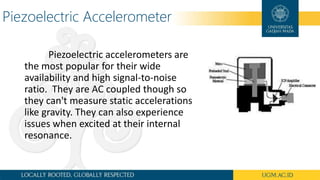
Piezoelectric Accelerometer
Piezoelectric accelerometers are
the most popular for their wide
availability and high signal-to-noise
ratio. They are AC coupled though so
they can't measure static accelerations
like gravity. They can also experience
issues when excited at their internal
resonance.
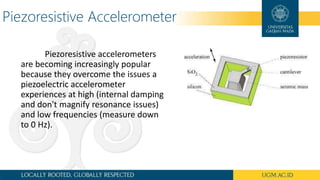
Piezoresistive Accelerometer
Piezoresistive accelerometers
are becoming increasingly popular
because they overcome the issues a
piezoelectric accelerometer
experiences at high (internal damping
and don't magnify resonance issues)
and low frequencies (measure down
to 0 Hz).
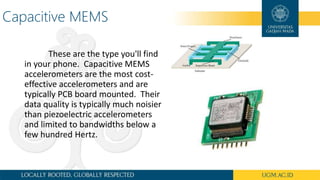
Capacitive MEMS
These are the type you'll find
in your phone. Capacitive MEMS
accelerometers are the most cost-
effective accelerometers and are
typically PCB board mounted. Their
data quality is typically much noisier
than piezoelectric accelerometers
and limited to bandwidths below a
few hundred Hertz.
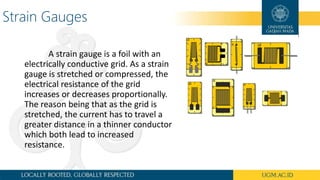
Strain Gauges
A strain gauge is a foil with an
electrically conductive grid. As a strain
gauge is stretched or compressed, the
electrical resistance of the grid
increases or decreases proportionally.
The reason being that as the grid is
stretched, the current has to travel a
greater distance in a thinner conductor
which both lead to increased
resistance.
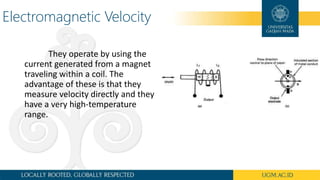
Electromagnetic Velocity
They operate by using the
current generated from a magnet
traveling within a coil. The
advantage of these is that they
measure velocity directly and they
have a very high-temperature
range.
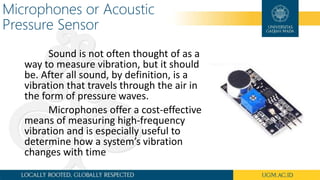
Microphones or Acoustic
Pressure Sensor
Sound is not often thought of as a
way to measure vibration, but it should
be. After all sound, by definition, is a
vibration that travels through the air in
the form of pressure waves.
Microphones offer a cost-effective
means of measuring high-frequency
vibration and is especially useful to
determine how a system’s vibration
changes with time
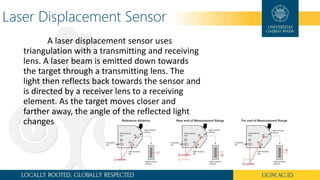
Laser Displacement Sensor
A laser displacement sensor uses
triangulation with a transmitting and receiving
lens. A laser beam is emitted down towards
the target through a transmitting lens. The
light then reflects back towards the sensor and
is directed by a receiver lens to a receiving
element. As the target moves closer and
farther away, the angle of the reflected light
changes
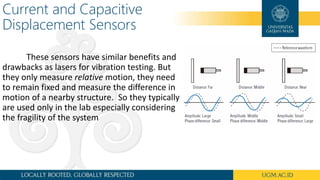
Current and Capacitive
Displacement Sensors
These sensors have similar benefits and
drawbacks as lasers for vibration testing. But
they only measure relative motion, they need
to remain fixed and measure the difference in
motion of a nearby structure. So they typically
are used only in the lab especially considering
the fragility of the system
Vibration Sensing Systems
All the previous vibration sensor options discussed
require the user to handle wiring, provide power, signal
conditioning, and electronics to acquire the data. The next
two options do all that for you in one, self-contained system.
These make it much easier to do vibration testing for
the general purpose user, but they often come in handy for
advanced vibration measurement and analysis experts for
initial testing.
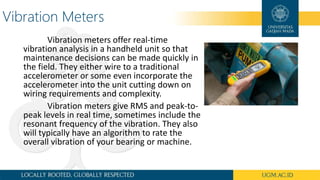
Vibration Meters
Vibration meters offer real-time
vibration analysis in a handheld unit so that
maintenance decisions can be made quickly in
the field. They either wire to a traditional
accelerometer or some even incorporate the
accelerometer into the unit cutting down on
wiring requirements and complexity.
Vibration meters give RMS and peak-to-
peak levels in real time, sometimes include the
resonant frequency of the vibration. They also
will typically have an algorithm to rate the
overall vibration of your bearing or machine.
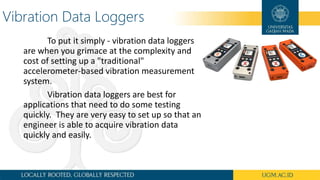
Vibration Data Loggers
To put it simply - vibration data loggers
are when you grimace at the complexity and
cost of setting up a "traditional"
accelerometer-based vibration measurement
system.
Vibration data loggers are best for
applications that need to do some testing
quickly. They are very easy to set up so that an
engineer is able to acquire vibration data
quickly and easily.
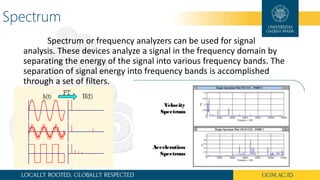
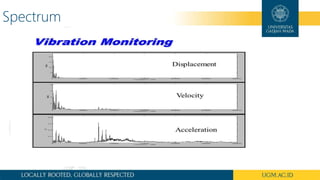
Spectrum
Spectrum or frequency analyzers can be used for signal
analysis. These devices analyze a signal in the frequency domain by
separating the energy of the signal into various frequency bands. The
separation of signal energy into frequency bands is accomplished
through a set of filters.
Spectrum
References
1. Rao, Singiresu S., Mechanical Vibrations-5th Ed, Pearson Educations, 2004.
2. https://blog.mide.com/vibration-sensor-types-and-where-to-buy-them accessed on December 3rd
2017.
3. http://instrumentationtools.com/types-of-sensors-used-in-vibration-measurement/#.WiSnxlWWbIX
accessed on December 3rd 2017.
4. http://awan05.blogspot.co.id/2009/12/analisa-vibrasi.html accessed on December 3th 2017.
5. http://slideplayer.com/slide/5678352/18/images/13/Vibration+Monitoring+Displacement+Velocity+
Acceleration.jpg accessed on December 3th 2017.

Vibration sensor

  • 1.
    VIBRATION SENSOR oleh : WachidMuch Yasin 13/345370/TK/40350 Harid Luthfi P 13/345293/TK/40281 Triyatna M Safei 12/330497/TK/39611 Ahmad Rifki A 12/333660/TK/40004
  • 2.
    WHAT IS VIBRATIONSENSOR? Vibration sensor is a device that serves to detect the presence of vibration then it will be converted into electrical signals, the electric signals are processed in the measuring instrument then we can read the information in the measuring instrument. The selection of vibration sensors for vibration signal monitoring purposes is based on the following considerations: Vibration signal type Measurement frequency range The size and weight of the vibration object. Sensitivity of the sensor
  • 3.
    TYPES Generally there aretwo types of vibration sensor : Contact Vibration Sensors The following sensors require mounting the transducer to the vibrating test piece. This has the advantage of moving with the test article to measure absolute motion. Non-Contact Vibration Sensors For non-contact sensors, probes and machines or media are not in direct contact.
  • 4.
    TYPES Contact Vibration Sensors AccelerationSensor • Piezoelectric Accelerometer • Piezoresistive Accelerometer • Capacitive MEMS Strain Gauges Velocity Sensor Non-Contact Vibration Sensors Microphones or Acoustic Pressure Sensors Laser Displacement Sensor Eddy Current and Capacitive Displacement Sensors
  • 5.
    Piezoelectric Accelerometer Piezoelectric accelerometersare the most popular for their wide availability and high signal-to-noise ratio. They are AC coupled though so they can't measure static accelerations like gravity. They can also experience issues when excited at their internal resonance.
  • 6.
    Piezoresistive Accelerometer Piezoresistive accelerometers arebecoming increasingly popular because they overcome the issues a piezoelectric accelerometer experiences at high (internal damping and don't magnify resonance issues) and low frequencies (measure down to 0 Hz).
  • 7.
    Capacitive MEMS These arethe type you'll find in your phone. Capacitive MEMS accelerometers are the most cost- effective accelerometers and are typically PCB board mounted. Their data quality is typically much noisier than piezoelectric accelerometers and limited to bandwidths below a few hundred Hertz.
  • 8.
    Strain Gauges A straingauge is a foil with an electrically conductive grid. As a strain gauge is stretched or compressed, the electrical resistance of the grid increases or decreases proportionally. The reason being that as the grid is stretched, the current has to travel a greater distance in a thinner conductor which both lead to increased resistance.
  • 9.
    Electromagnetic Velocity They operateby using the current generated from a magnet traveling within a coil. The advantage of these is that they measure velocity directly and they have a very high-temperature range.
  • 10.
    Microphones or Acoustic PressureSensor Sound is not often thought of as a way to measure vibration, but it should be. After all sound, by definition, is a vibration that travels through the air in the form of pressure waves. Microphones offer a cost-effective means of measuring high-frequency vibration and is especially useful to determine how a system’s vibration changes with time
  • 11.
    Laser Displacement Sensor Alaser displacement sensor uses triangulation with a transmitting and receiving lens. A laser beam is emitted down towards the target through a transmitting lens. The light then reflects back towards the sensor and is directed by a receiver lens to a receiving element. As the target moves closer and farther away, the angle of the reflected light changes
  • 12.
    Current and Capacitive DisplacementSensors These sensors have similar benefits and drawbacks as lasers for vibration testing. But they only measure relative motion, they need to remain fixed and measure the difference in motion of a nearby structure. So they typically are used only in the lab especially considering the fragility of the system
  • 13.
    Vibration Sensing Systems Allthe previous vibration sensor options discussed require the user to handle wiring, provide power, signal conditioning, and electronics to acquire the data. The next two options do all that for you in one, self-contained system. These make it much easier to do vibration testing for the general purpose user, but they often come in handy for advanced vibration measurement and analysis experts for initial testing.
  • 14.
    Vibration Meters Vibration metersoffer real-time vibration analysis in a handheld unit so that maintenance decisions can be made quickly in the field. They either wire to a traditional accelerometer or some even incorporate the accelerometer into the unit cutting down on wiring requirements and complexity. Vibration meters give RMS and peak-to- peak levels in real time, sometimes include the resonant frequency of the vibration. They also will typically have an algorithm to rate the overall vibration of your bearing or machine.
  • 15.
    Vibration Data Loggers Toput it simply - vibration data loggers are when you grimace at the complexity and cost of setting up a "traditional" accelerometer-based vibration measurement system. Vibration data loggers are best for applications that need to do some testing quickly. They are very easy to set up so that an engineer is able to acquire vibration data quickly and easily.
  • 16.
    Spectrum Spectrum or frequencyanalyzers can be used for signal analysis. These devices analyze a signal in the frequency domain by separating the energy of the signal into various frequency bands. The separation of signal energy into frequency bands is accomplished through a set of filters.
  • 17.
  • 18.
    References 1. Rao, SingiresuS., Mechanical Vibrations-5th Ed, Pearson Educations, 2004. 2. https://blog.mide.com/vibration-sensor-types-and-where-to-buy-them accessed on December 3rd 2017. 3. http://instrumentationtools.com/types-of-sensors-used-in-vibration-measurement/#.WiSnxlWWbIX accessed on December 3rd 2017. 4. http://awan05.blogspot.co.id/2009/12/analisa-vibrasi.html accessed on December 3th 2017. 5. http://slideplayer.com/slide/5678352/18/images/13/Vibration+Monitoring+Displacement+Velocity+ Acceleration.jpg accessed on December 3th 2017.