Emerson
Process Management
Vibration Analysis for Machinery Health Diagnosis
Transducer Mounting (Accelerometers)
Stud mounting is preferred but common only with inaccessible situations and online
systems
More care is necessary when mounting higher frequency range accelerometers
Adhesive mounting is second in performance to stud mounting
Magnetic mounting is most commonly used for route-based monitoring
Hand-held probes yield poorest performance and are not recommended but are
sometimes necessary because of access restrictions or safety concerns
RESONANCE
Every machine will vibrate when excited by a forcing function. Each machine has one or more natural or resonant frequencies. When any forcing function is near the
natural frequency, the resulting vibration will be significantly amplified and could cause premature failure.
A critical speed is when the rotating element is turning at a speed which excites resonance in the machine
Many times a forcing function (such as from a rotating shaft) excites a resonant frequency in another part of the same or nearby machine.
This resonant frequency may be identified by an impact test, typically when the machine is off; the machine structure may be “rung” like a bell.
Changing a structure’s stiffness, mass, damping, operating speed and/or reduction of the forcing function will effect the resonance issue and may help solve the
problem.
Resonance is becoming more of a problem in industry because:
• New equipment is often built lighter
• More variable speed machinery is being used in industry
• Machines are now often run at higher speeds without properly considering natural or resonant frequency of equipment
IMBALANCE & MISALIGNMENT ANTIFRICTION BEARING FAULTS
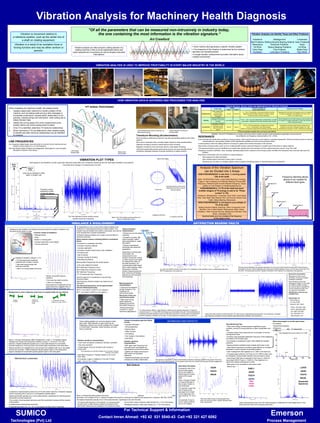
"Of all the parameters that can be measured non-intrusively in industry today,
the one containing the most information is the vibration signature.“
Art Crawford
 Each machine fault generates a specific vibration pattern
 The frequency of the vibration is determined by the machine
geometry and operating speed
 A single vibration measurement provides information about
multiple components
Vibration analysis can often pinpoint a failing element of a
rotating machine in time to avoid catastrophic failure and
costly replacement of machinery as well as lengthy production
interruptions.
VIBRATION ANALYSIS IS USED TO IMPROVE PROFITABILITY IN EVERY MAJOR INDUSTRY IN THE WORLD
Typical displacement probe mounting on a
large sleeve bearing
Typical magnetic mounting of
accelerometer
HOW VIBRATION DATA IS GATHERED AND PROCESSED FOR ANALYSIS
LINE FREQUENCIES
Line frequency related peaks commonly exist on every AC driven machine and are
present to some extent at 2 x of line frequency.
See chart Electric Motor Problems and Diagnostics Techniques for more complete
discussion of electric motor issues.
When evaluating any machine’s health, the analyst should:
1. Visually inspect each machine for overall condition of the
machine, such as leaking seals and any other damaged or
incomplete components, cracked welds, deterioration in the
grouting, missing clamps and hold-downs while visiting site to
collect vibration data
2. Identify the turning speed (TS) at the measurement point
location before any critical measurement is taken
3. Once TS is identified, determine TS harmonic relationships
4. When harmonics of TS are determined, other vibration peaks
of interest and other harmonic relationships may be identified
for analysis
An imperfection in one or more of the contact surfaces of an
antifriction or rolling element bearing is called a defect. The
problem may be invisible even under a microscope, and may be
more complex than a simple imperfection.
Antifriction bearing problems are a major source of failure in
industrial machinery
Some common causes of bearing defects or premature
failure:
• Excessive or inadequate lubrication
• Improper mounting methods
• Improper application
• Excessive vibration before and/or after installation
• Excessive load
• Age of bearing
• Improper storage & handling
• Manufacturing defects
Bearing ID Interpretation
Bearings are built to world
standards, ensuring consistent
availability worldwide.
Note: Because most motor
bearings are listed on motor tags
as AFBMA or ABMA numbers,
you may be able to calculate the
common bearing number from
the equipment nameplate.
Identification resources are
available from:
Interchange, Inc.
Interchange Inc.
P.O. Box 47596
Plymouth, MN 55447
Phone: (763) 694-7596
Phone: (800) 669-6208
Fax: (800) 729-0395
Fax: (763) 694-7117
Interchangeinc.com
High 2 x TS peak characterizes offset misalignment; a high 1 x TS signifies angular
misalignment, though both frequently combine to cause 1 x TS and 2 x TS in the
spectrum. Highest amplitudes typically occur in the radial direction for horizontally
mounted equipment; overhung rotors may exhibit higher amplitudes in the axial plane.
Velocity waveform for misalignment is very periodic and repetitive with one or two peaks
(events) per revolution. Offset amplitudes typically appear higher in the radial plane;
angular misalignment amplitudes typically appear higher in the axial plane.
Imbalance is the condition of a rotating component where the center of rotation is not
the same as the center of mass
Angular
Problem
Imbalance vibration is always 1 x TS
• Turning speed peak amplitude
increases with increase in speed
• Little axial energy except with
overhung machines
• Little or no turning speed harmonics
Mechanical Looseness
Centers of
rotation are
offset
Outer Race
Inner Race
Center
of
Rotation
Center
of
Gravity
Amount of
Eccentricity
Center
of
Rotation
Center
of
Gravity
Amount of
Eccentricity
Common causes of imbalance:
• Material buildup
• Wear
• Broken or missing parts
• Improper assembly or poor design
• Thermal distortions
•Simple, sinusoidal, periodic
waveform
• One event per shaft revolution
• Little or no impacting
Note-presence of significant turning
speed harmonics suggests other or
additional defects (looseness, etc.)
Looseness is characterized by harmonics of TS with raised noise floor. Waveform displays
random impacting which may be in a nonrepetitive irregular pattern.
Highest amplitudes typically occur in the radial direction, specifically the vertical plane for
horizontally mounted equipment.
•The number of turning speed harmonics and their amplitudes increase with the severity
of the problem
•Unstable phase characterizes looseness
•Fractional harmonics (1/4, 1/3, 1/2, ¾) may appear develops due to looseness
FFT SIGNAL PROCESSING
RESULTING
SPECTRUM
CAPTURED
WAVEFORM
Vibration is a result of an excitation force or
forcing function and may be either random or
periodic.
Vibration is movement relative to
a reference position, such as the center line of
a shaft on rotating equipment. Imbalance Misalignment Looseness
Belt Problems Rolling Element Bearing Defects Gear Problems
Resonance Electrical Problems Rubs
Oil Whirl Sleeve Bearing Problems Oil Whip
Vane Pass Flow Prolems Blade Pass
Cavitation Lubrication Problems Pipe Strain
Vibration Analysis can Identify These and Other Problems
Imbalance
Misalignment
Looseness
Bearing Band 2
Bearing Band 1
Frequency Banding allows
alarms to be created for
different fault types
V
E
L
O
C
I
T
Y
Analysis of the Vibration Spectrum
can be Divided into 3 Areas:
SUB-SYNCHRONOUS is less than 1 x turning speed
(TS) of the shaft:
Belts, Oil Whirl/Whip, Rubs, Loose Roller Bearing in Housing,
Cage or Train Frequency of Antifriction Bearing, Primary Belt
Frequency, Defective tooth-to-tooth Repeat Frequency, Surge,
Ignition or Fuel Problem on Reciprocating Source
SYNCHRONOUS is 1 X TS of the shaft and exact
multible integers of TS (energy is said to be "Phase
Locked" to TS):
Imbalance, Misalighment, Looseness, Bent Shaft, Vane/ Blade
Pass, Gear Mesh, Belt Sheave Pitch Line Runout, Broken Gear
Tooth, Sleeve Bearing, Resonance
NON-SYNCHRONOUS is not equal to any multiple of
TS of the shaft
Rolling Element Defects, Electrical, Other Component in the
Machine, One or More System Resonances, Belts, Noise,
Cavitation, Other Unusual Sources, Background Vibration, Pipe
Strain, Lubrication Fault
Electrical faults occur as a multiple of the frequency
of the supply current.
SEISMIC VELOCITY PROBES are no longer commonly used in industry except in high-temperature applications and are best for
low-amplitude, low-frequency measurements (1Hz - 2 KHz)
Metric English
Displacement
Non-contact eddy
current probe
(requires signal
converter)
μ Pk-Pk mils Pk-Pk
0 - 1 kHz. Permanently or semi-permanently mounted.
Measures shaft vibration relative to machine casing.
Commonly used on turbo-machinery.
Displacement enhances low frequency and is a measure
of motion expressed in thousandths of an inch (1mil =
0.001”) or in metric units
Velocity
Spring-loaded mass,
sensitive to heat and
humidity
(no power required)
mm/s (RMS) in/s (Peak)
10 Hz - 1 kHz. Accuracy dependent on temperature, humidity
and position. Displays low and high frequency data equally
Velocity displays low and high frequency data equally and
is a measure of speed expressed in inches per second or
metric units per second
Acceleration
Piezoelectric crystal,
extremely robust
(requires external
power)
Peak g's Peak g's
0.5 Hz - 60 kHz depending on design and mounting.
10 Hz - 3 kHz typical. Very robust design.
Ideal for monitoring rolling element bearings and gear boxes.
Acceleration enhances high frequency data and is a
measure of the rate of change of speed (1g = 386
inches/second squared or metric units/second squared)
Units* Frequency Range and
Typical Applications
Display Units for Plotting
Typical Sensors, Sensor Units and Applications for Vibration Analysis
*These are typically accepted units, but may be user-defined
Probe Type
A combination of these
problems is most common
Misalignment is when rotational center lines of coupled shafts are not collinear
For rolling element defects, cage frequency sidebands are typically displayed in a spectrum
centered around 1 or 2 times BSF fault frequency as illustrated in the plot. These sidebands are
caused by the defect passing in and out of the load zone at the TS of the cage. The associated
waveform displays modulation at the cage TS which appears as sidebands in the spectrum.
These plots demonstrate an advancing fault. The trend shows a deteriorating bearing defect. As it advances, increased
high frequency broadband energy indicates rapid deterioration exhibited in the waveforms.
An outer race defect normally shows little or no modulation in the waveform, thus no sidebanding about the
BPFO frequencies in the spectrum.
Gear Ratio Calculation
Knowing the ratio of the
input to output gears
can be very helpful in
determining the turning
speed of the output
shaft.
Ratio = Number of teeth
on output shaft gear to
the number of teeth on
input shaft gear
For example, a gear box
with 72 teeth on the
input gear and 24 teeth
on the output gear, the
ratio would be 72 / 24 or
3:1
For example, if input is
10 Hz, output would be
30 Hz (TS X Ratio).
Gear Misalignment shows clearly at 2 x GMF
Gearbox spectrum
characteristics:
•GMF (gear mesh frequency) will
commonly exist, and appears as
high-frequency synchronous peaks
• Defects can display harmonics of
GMF and/or turning speed
sidebands
• Sideband amplitudes will normally
increase as condition deteriorates
Gearbox waveform characteristics:
• Gear mesh will appear (impacting* indicates a problem)
• Very busy waveform
• Pulses appear once per revolution with cracked or
broken tooth
*Since gearboxes are naturally energetic due to the gears meshing,
trending is very helpful.
Gear Mesh Frequency = Rotation Speed (in Hz) X # of
Gear Teeth
For example, a gear is rotating at 10 Hz with 72 teeth:
GMF = 10 Hz X 72 = 720Hz
Other technologies to monitor gear boxes:
•Oil analysis
•Infrared thermography
•Ultrasonics
•Endoscopy
Gear Monitoring Tips:
• Gear mesh energy normally appears regardless of gear
condition; amount of energy depends on gear configuration and
load.
• Increase of gear mesh harmonics are an indication of normal
homogeneous wear
• Eccentric wear generates sidebands; frequency of the sidebands
are related to the problem gear.
• An increase in amplitudes of gear mesh sidebands indicates
problems.
• Spacing between sideband peaks indicate which gear is bad
• Gear natural resonance is excited by gear defects; an increase in
amplitude is a good indicator of potential problems
• Gear misalignment often appears as 2 x GMF in the spectrum.
• To analyze gear problems, set Fmax at 3.5 X GMF to allow room
for sidebands. Accelerometer selection and mounting is critical.
• Use at least 1600 lines of resolution if the Fmax is < 2000 Hz;
use at least 3200 if Fmax is > 2,000 Hz. (The objective is to
resolve the slowest shaft speed in mesh).
• Mark gears to be reinstalled to allow same mesh
• Best to replace gears in sets
Causes of premature gear box failure
include:
• Improper lubrication
• Wrong application
• Bearing failure
• Water intrusion
• Overheating
• Poor design or manufacture
• Seal failure
Gears demonstrating wear over time. Note changes in amplitude from early stage wear to more
advanced tooth wear and increasing side bands
The spectrum (expressed in orders) demonstrates extensive impacting at gear turning speed. Recurring
periods of high spiking appear in the waveform each time the cracked tooth passes through engagement.
GEARBOXES AND DEFECTS
WDT - GBOX
GBOX -P6 Measurement Pt6
Routine Spectrum
16-Oct-02 16:04:23
RMS = .2125
LOAD = 100.0
RPM = 1319. (21.98 Hz
0 500 1000 1500 2000 2500
0
0.06
0.12
0.18
0.24
0.30
Frequency in Hz
RMS
Acceleration
in
G-s
Freq:
Ordr:
Spec:
681.25
31.00
.02673
1 X GM
2 X GM
WDT - GBOX
GBOX -P6 Measurement Pt6
Routine Spectrum
16-Oct-02 16:04:23
RMS = .2125
LOAD = 100.0
RPM = 1319. (21.98 Hz
0 500 1000 1500 2000 2500
0
0.06
0.12
0.18
0.24
0.30
Frequency in Hz
RMS
Acceleration
in
G-s
Freq:
Ordr:
Spec:
681.25
31.00
.02673
1 X GM
2 X GM
Trend plot clearly shows increasing gear tooth
wear over several months, despite readings taken
under varying load
GEAR
TOOTH
WEAR
EARLY
GEAR
TOOTH
WEAR
(Use
same
scale)
LATER
GEAR
TOOTH
WEAR
(Expanded
Spectrum)
VIBRATION PLOT TYPES
Metric
Units
English
Units
Units may be displayed in either
Metric or English units
Frequency may be
expressed in either:
•Cycles Per Minute
•Hertz
•Orders
1 X Filtered Orbit Plot
Unfiltered Orbit Plot
Circle Plot
Both Spectrum and Waveform provide useful data. Machinery faults often occur at specific frequencies and are most easily identified in the spectrum.
Trend plots show changes in a measurement over time.
Basic Trend Plot displays growing defect and
result of maintenance action
The Time Waveform shows random events,
periodic events and impacting
Cascade spectrum plot shows
resonance over time, such as
during a startup
Other Plot Types
Bearing defect frequencies will usually appear
in this order (highest to lowest):
BPFI (Ball Pass Frequency Inner)
BPFO (Ball Pass Frequency Outer)
BSF (Ball Spin Frequency)
FTF (Fundamental Train Frequency)
View the spectrum in acceleration to see the high
frequency peaks
High-frequency vibration analysis can detect lack of
lubrication
The following frequencies can be approximated
with the following formulae:
BPFO = # of rollers X shaft TS x 0.4 (approx.)
BPFI - # of rollers X shaft TS x 0.6 (approx.)
Running speed sidebands are typically displayed in an inner race defect spectrum about BPFI frequencies as
illustrated in the plot. These sidebands are caused by the defect passing in and out of the load zone at the TS of
the shaft. The associated waveform displays modulation which appears as sidebands in the spectrum.
Bearing spectrum
characteristics:
• Commonly first appears
as high frequency / low
amplitude non-
synchronous peaks
Harmonics of the non-
synchronous peaks
• Often show turning
speed sidebands
appearing around the
race defect frequency
• Broad band energy
“mounds” or “grass”
(advanced degradation)
•An eccentric sheave produces radial vibration at 1 x TS of the sheave
•Misaligned sheaves create axial vibration at 1 x TS of the sheave
Worn or mismatched belts produce sub-synchronous and sometimes non-synchronous peaks and harmonics. The 2 x belt frequency typically
dominates, and multiples of the 2 x appear throughout the spectrum, because the defective belt passes over 2 sheaves. ASK BILL DAVIS
The highest amplitudes typically occur in the radial direction, specifically in line with the belts.
•To resolve belt frequency in the spectra, it is necessary that
the time block of data includes at least 6 revolutions of the
belt (further references are available in Art Crawford’s books)
Belt Defects
Gears rotating together at a common tangent create
gear mesh. Data collection on gear boxes can be
challenging. Defects may include misalignment, chipped
or broken teeth, looseness, stress fractures, and worn
gears or bearings.
Typical waveform
characteristics:
• Periodic but non-sinusoidal
impacting
• Excessive “g swing” with
sharp impacting “spikes”
often resembling an “angel
fish pattern”
• Periodic characteristic
diminishes with advanced
degradation
Depending on bearing type
and location, the
measurement in one
direction (horizontal, vertical
or axial) may be more useful
for analysis than either of
the other directions. For
most standard radial loaded
ball or roller bearings, radial
(horizontal or vertical)
location measurements are
best. Axial may be best for
tapered cup and cone and
thrust bearings.
SUMICO
Technologies (Pvt) Ltd
For Technical Support & Information
Contact Imran Ahmad: +92 42 531 5540-43 Cell:+92 321 427 6092

vibration-diagonistic-chart.pdf

  • 1.
    Emerson Process Management Vibration Analysisfor Machinery Health Diagnosis Transducer Mounting (Accelerometers) Stud mounting is preferred but common only with inaccessible situations and online systems More care is necessary when mounting higher frequency range accelerometers Adhesive mounting is second in performance to stud mounting Magnetic mounting is most commonly used for route-based monitoring Hand-held probes yield poorest performance and are not recommended but are sometimes necessary because of access restrictions or safety concerns RESONANCE Every machine will vibrate when excited by a forcing function. Each machine has one or more natural or resonant frequencies. When any forcing function is near the natural frequency, the resulting vibration will be significantly amplified and could cause premature failure. A critical speed is when the rotating element is turning at a speed which excites resonance in the machine Many times a forcing function (such as from a rotating shaft) excites a resonant frequency in another part of the same or nearby machine. This resonant frequency may be identified by an impact test, typically when the machine is off; the machine structure may be “rung” like a bell. Changing a structure’s stiffness, mass, damping, operating speed and/or reduction of the forcing function will effect the resonance issue and may help solve the problem. Resonance is becoming more of a problem in industry because: • New equipment is often built lighter • More variable speed machinery is being used in industry • Machines are now often run at higher speeds without properly considering natural or resonant frequency of equipment IMBALANCE & MISALIGNMENT ANTIFRICTION BEARING FAULTS "Of all the parameters that can be measured non-intrusively in industry today, the one containing the most information is the vibration signature.“ Art Crawford  Each machine fault generates a specific vibration pattern  The frequency of the vibration is determined by the machine geometry and operating speed  A single vibration measurement provides information about multiple components Vibration analysis can often pinpoint a failing element of a rotating machine in time to avoid catastrophic failure and costly replacement of machinery as well as lengthy production interruptions. VIBRATION ANALYSIS IS USED TO IMPROVE PROFITABILITY IN EVERY MAJOR INDUSTRY IN THE WORLD Typical displacement probe mounting on a large sleeve bearing Typical magnetic mounting of accelerometer HOW VIBRATION DATA IS GATHERED AND PROCESSED FOR ANALYSIS LINE FREQUENCIES Line frequency related peaks commonly exist on every AC driven machine and are present to some extent at 2 x of line frequency. See chart Electric Motor Problems and Diagnostics Techniques for more complete discussion of electric motor issues. When evaluating any machine’s health, the analyst should: 1. Visually inspect each machine for overall condition of the machine, such as leaking seals and any other damaged or incomplete components, cracked welds, deterioration in the grouting, missing clamps and hold-downs while visiting site to collect vibration data 2. Identify the turning speed (TS) at the measurement point location before any critical measurement is taken 3. Once TS is identified, determine TS harmonic relationships 4. When harmonics of TS are determined, other vibration peaks of interest and other harmonic relationships may be identified for analysis An imperfection in one or more of the contact surfaces of an antifriction or rolling element bearing is called a defect. The problem may be invisible even under a microscope, and may be more complex than a simple imperfection. Antifriction bearing problems are a major source of failure in industrial machinery Some common causes of bearing defects or premature failure: • Excessive or inadequate lubrication • Improper mounting methods • Improper application • Excessive vibration before and/or after installation • Excessive load • Age of bearing • Improper storage & handling • Manufacturing defects Bearing ID Interpretation Bearings are built to world standards, ensuring consistent availability worldwide. Note: Because most motor bearings are listed on motor tags as AFBMA or ABMA numbers, you may be able to calculate the common bearing number from the equipment nameplate. Identification resources are available from: Interchange, Inc. Interchange Inc. P.O. Box 47596 Plymouth, MN 55447 Phone: (763) 694-7596 Phone: (800) 669-6208 Fax: (800) 729-0395 Fax: (763) 694-7117 Interchangeinc.com High 2 x TS peak characterizes offset misalignment; a high 1 x TS signifies angular misalignment, though both frequently combine to cause 1 x TS and 2 x TS in the spectrum. Highest amplitudes typically occur in the radial direction for horizontally mounted equipment; overhung rotors may exhibit higher amplitudes in the axial plane. Velocity waveform for misalignment is very periodic and repetitive with one or two peaks (events) per revolution. Offset amplitudes typically appear higher in the radial plane; angular misalignment amplitudes typically appear higher in the axial plane. Imbalance is the condition of a rotating component where the center of rotation is not the same as the center of mass Angular Problem Imbalance vibration is always 1 x TS • Turning speed peak amplitude increases with increase in speed • Little axial energy except with overhung machines • Little or no turning speed harmonics Mechanical Looseness Centers of rotation are offset Outer Race Inner Race Center of Rotation Center of Gravity Amount of Eccentricity Center of Rotation Center of Gravity Amount of Eccentricity Common causes of imbalance: • Material buildup • Wear • Broken or missing parts • Improper assembly or poor design • Thermal distortions •Simple, sinusoidal, periodic waveform • One event per shaft revolution • Little or no impacting Note-presence of significant turning speed harmonics suggests other or additional defects (looseness, etc.) Looseness is characterized by harmonics of TS with raised noise floor. Waveform displays random impacting which may be in a nonrepetitive irregular pattern. Highest amplitudes typically occur in the radial direction, specifically the vertical plane for horizontally mounted equipment. •The number of turning speed harmonics and their amplitudes increase with the severity of the problem •Unstable phase characterizes looseness •Fractional harmonics (1/4, 1/3, 1/2, ¾) may appear develops due to looseness FFT SIGNAL PROCESSING RESULTING SPECTRUM CAPTURED WAVEFORM Vibration is a result of an excitation force or forcing function and may be either random or periodic. Vibration is movement relative to a reference position, such as the center line of a shaft on rotating equipment. Imbalance Misalignment Looseness Belt Problems Rolling Element Bearing Defects Gear Problems Resonance Electrical Problems Rubs Oil Whirl Sleeve Bearing Problems Oil Whip Vane Pass Flow Prolems Blade Pass Cavitation Lubrication Problems Pipe Strain Vibration Analysis can Identify These and Other Problems Imbalance Misalignment Looseness Bearing Band 2 Bearing Band 1 Frequency Banding allows alarms to be created for different fault types V E L O C I T Y Analysis of the Vibration Spectrum can be Divided into 3 Areas: SUB-SYNCHRONOUS is less than 1 x turning speed (TS) of the shaft: Belts, Oil Whirl/Whip, Rubs, Loose Roller Bearing in Housing, Cage or Train Frequency of Antifriction Bearing, Primary Belt Frequency, Defective tooth-to-tooth Repeat Frequency, Surge, Ignition or Fuel Problem on Reciprocating Source SYNCHRONOUS is 1 X TS of the shaft and exact multible integers of TS (energy is said to be "Phase Locked" to TS): Imbalance, Misalighment, Looseness, Bent Shaft, Vane/ Blade Pass, Gear Mesh, Belt Sheave Pitch Line Runout, Broken Gear Tooth, Sleeve Bearing, Resonance NON-SYNCHRONOUS is not equal to any multiple of TS of the shaft Rolling Element Defects, Electrical, Other Component in the Machine, One or More System Resonances, Belts, Noise, Cavitation, Other Unusual Sources, Background Vibration, Pipe Strain, Lubrication Fault Electrical faults occur as a multiple of the frequency of the supply current. SEISMIC VELOCITY PROBES are no longer commonly used in industry except in high-temperature applications and are best for low-amplitude, low-frequency measurements (1Hz - 2 KHz) Metric English Displacement Non-contact eddy current probe (requires signal converter) μ Pk-Pk mils Pk-Pk 0 - 1 kHz. Permanently or semi-permanently mounted. Measures shaft vibration relative to machine casing. Commonly used on turbo-machinery. Displacement enhances low frequency and is a measure of motion expressed in thousandths of an inch (1mil = 0.001”) or in metric units Velocity Spring-loaded mass, sensitive to heat and humidity (no power required) mm/s (RMS) in/s (Peak) 10 Hz - 1 kHz. Accuracy dependent on temperature, humidity and position. Displays low and high frequency data equally Velocity displays low and high frequency data equally and is a measure of speed expressed in inches per second or metric units per second Acceleration Piezoelectric crystal, extremely robust (requires external power) Peak g's Peak g's 0.5 Hz - 60 kHz depending on design and mounting. 10 Hz - 3 kHz typical. Very robust design. Ideal for monitoring rolling element bearings and gear boxes. Acceleration enhances high frequency data and is a measure of the rate of change of speed (1g = 386 inches/second squared or metric units/second squared) Units* Frequency Range and Typical Applications Display Units for Plotting Typical Sensors, Sensor Units and Applications for Vibration Analysis *These are typically accepted units, but may be user-defined Probe Type A combination of these problems is most common Misalignment is when rotational center lines of coupled shafts are not collinear For rolling element defects, cage frequency sidebands are typically displayed in a spectrum centered around 1 or 2 times BSF fault frequency as illustrated in the plot. These sidebands are caused by the defect passing in and out of the load zone at the TS of the cage. The associated waveform displays modulation at the cage TS which appears as sidebands in the spectrum. These plots demonstrate an advancing fault. The trend shows a deteriorating bearing defect. As it advances, increased high frequency broadband energy indicates rapid deterioration exhibited in the waveforms. An outer race defect normally shows little or no modulation in the waveform, thus no sidebanding about the BPFO frequencies in the spectrum. Gear Ratio Calculation Knowing the ratio of the input to output gears can be very helpful in determining the turning speed of the output shaft. Ratio = Number of teeth on output shaft gear to the number of teeth on input shaft gear For example, a gear box with 72 teeth on the input gear and 24 teeth on the output gear, the ratio would be 72 / 24 or 3:1 For example, if input is 10 Hz, output would be 30 Hz (TS X Ratio). Gear Misalignment shows clearly at 2 x GMF Gearbox spectrum characteristics: •GMF (gear mesh frequency) will commonly exist, and appears as high-frequency synchronous peaks • Defects can display harmonics of GMF and/or turning speed sidebands • Sideband amplitudes will normally increase as condition deteriorates Gearbox waveform characteristics: • Gear mesh will appear (impacting* indicates a problem) • Very busy waveform • Pulses appear once per revolution with cracked or broken tooth *Since gearboxes are naturally energetic due to the gears meshing, trending is very helpful. Gear Mesh Frequency = Rotation Speed (in Hz) X # of Gear Teeth For example, a gear is rotating at 10 Hz with 72 teeth: GMF = 10 Hz X 72 = 720Hz Other technologies to monitor gear boxes: •Oil analysis •Infrared thermography •Ultrasonics •Endoscopy Gear Monitoring Tips: • Gear mesh energy normally appears regardless of gear condition; amount of energy depends on gear configuration and load. • Increase of gear mesh harmonics are an indication of normal homogeneous wear • Eccentric wear generates sidebands; frequency of the sidebands are related to the problem gear. • An increase in amplitudes of gear mesh sidebands indicates problems. • Spacing between sideband peaks indicate which gear is bad • Gear natural resonance is excited by gear defects; an increase in amplitude is a good indicator of potential problems • Gear misalignment often appears as 2 x GMF in the spectrum. • To analyze gear problems, set Fmax at 3.5 X GMF to allow room for sidebands. Accelerometer selection and mounting is critical. • Use at least 1600 lines of resolution if the Fmax is < 2000 Hz; use at least 3200 if Fmax is > 2,000 Hz. (The objective is to resolve the slowest shaft speed in mesh). • Mark gears to be reinstalled to allow same mesh • Best to replace gears in sets Causes of premature gear box failure include: • Improper lubrication • Wrong application • Bearing failure • Water intrusion • Overheating • Poor design or manufacture • Seal failure Gears demonstrating wear over time. Note changes in amplitude from early stage wear to more advanced tooth wear and increasing side bands The spectrum (expressed in orders) demonstrates extensive impacting at gear turning speed. Recurring periods of high spiking appear in the waveform each time the cracked tooth passes through engagement. GEARBOXES AND DEFECTS WDT - GBOX GBOX -P6 Measurement Pt6 Routine Spectrum 16-Oct-02 16:04:23 RMS = .2125 LOAD = 100.0 RPM = 1319. (21.98 Hz 0 500 1000 1500 2000 2500 0 0.06 0.12 0.18 0.24 0.30 Frequency in Hz RMS Acceleration in G-s Freq: Ordr: Spec: 681.25 31.00 .02673 1 X GM 2 X GM WDT - GBOX GBOX -P6 Measurement Pt6 Routine Spectrum 16-Oct-02 16:04:23 RMS = .2125 LOAD = 100.0 RPM = 1319. (21.98 Hz 0 500 1000 1500 2000 2500 0 0.06 0.12 0.18 0.24 0.30 Frequency in Hz RMS Acceleration in G-s Freq: Ordr: Spec: 681.25 31.00 .02673 1 X GM 2 X GM Trend plot clearly shows increasing gear tooth wear over several months, despite readings taken under varying load GEAR TOOTH WEAR EARLY GEAR TOOTH WEAR (Use same scale) LATER GEAR TOOTH WEAR (Expanded Spectrum) VIBRATION PLOT TYPES Metric Units English Units Units may be displayed in either Metric or English units Frequency may be expressed in either: •Cycles Per Minute •Hertz •Orders 1 X Filtered Orbit Plot Unfiltered Orbit Plot Circle Plot Both Spectrum and Waveform provide useful data. Machinery faults often occur at specific frequencies and are most easily identified in the spectrum. Trend plots show changes in a measurement over time. Basic Trend Plot displays growing defect and result of maintenance action The Time Waveform shows random events, periodic events and impacting Cascade spectrum plot shows resonance over time, such as during a startup Other Plot Types Bearing defect frequencies will usually appear in this order (highest to lowest): BPFI (Ball Pass Frequency Inner) BPFO (Ball Pass Frequency Outer) BSF (Ball Spin Frequency) FTF (Fundamental Train Frequency) View the spectrum in acceleration to see the high frequency peaks High-frequency vibration analysis can detect lack of lubrication The following frequencies can be approximated with the following formulae: BPFO = # of rollers X shaft TS x 0.4 (approx.) BPFI - # of rollers X shaft TS x 0.6 (approx.) Running speed sidebands are typically displayed in an inner race defect spectrum about BPFI frequencies as illustrated in the plot. These sidebands are caused by the defect passing in and out of the load zone at the TS of the shaft. The associated waveform displays modulation which appears as sidebands in the spectrum. Bearing spectrum characteristics: • Commonly first appears as high frequency / low amplitude non- synchronous peaks Harmonics of the non- synchronous peaks • Often show turning speed sidebands appearing around the race defect frequency • Broad band energy “mounds” or “grass” (advanced degradation) •An eccentric sheave produces radial vibration at 1 x TS of the sheave •Misaligned sheaves create axial vibration at 1 x TS of the sheave Worn or mismatched belts produce sub-synchronous and sometimes non-synchronous peaks and harmonics. The 2 x belt frequency typically dominates, and multiples of the 2 x appear throughout the spectrum, because the defective belt passes over 2 sheaves. ASK BILL DAVIS The highest amplitudes typically occur in the radial direction, specifically in line with the belts. •To resolve belt frequency in the spectra, it is necessary that the time block of data includes at least 6 revolutions of the belt (further references are available in Art Crawford’s books) Belt Defects Gears rotating together at a common tangent create gear mesh. Data collection on gear boxes can be challenging. Defects may include misalignment, chipped or broken teeth, looseness, stress fractures, and worn gears or bearings. Typical waveform characteristics: • Periodic but non-sinusoidal impacting • Excessive “g swing” with sharp impacting “spikes” often resembling an “angel fish pattern” • Periodic characteristic diminishes with advanced degradation Depending on bearing type and location, the measurement in one direction (horizontal, vertical or axial) may be more useful for analysis than either of the other directions. For most standard radial loaded ball or roller bearings, radial (horizontal or vertical) location measurements are best. Axial may be best for tapered cup and cone and thrust bearings. SUMICO Technologies (Pvt) Ltd For Technical Support & Information Contact Imran Ahmad: +92 42 531 5540-43 Cell:+92 321 427 6092