
Option Strategies
By
Ashwini Mahale :33 Kalpita Pitale: 46
Derivatives
Derivatives are risk
management
instruments,
which
derive their value from
an underlying asset.
The underlying asset
can be
Bullion,
Index,
Share,
Bonds,
Currency,
Interest, Etc.
Used by

 Banks,
 Securities firm,
 Companies,
 Investors,
 Housewives, ETC.
But why
 To hedge risk
 To gain access to cheaper money
 To make profit
Types of Derivatives
ᵴFuture:
The owner of a future has the obligation to sell or
buy something in the future at a predetermined
price. A future contract has standardized
conditions.

ᵴOptions:
The owner of an option has the option to buy or
sell something at a predetermined price on or
before a predetermined date.
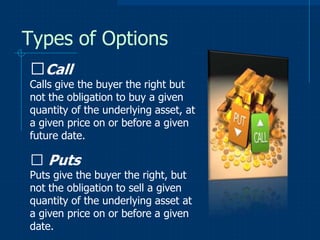
Types of Options
ᵴCall

Calls give the buyer the right but
not the obligation to buy a given
quantity of the underlying asset, at
a given price on or before a given
future date.

ᵴ Puts

Puts give the buyer the right, but
not the obligation to sell a given
quantity of the underlying asset at
a given price on or before a given
date.
Options are Contracts
The option contract specifies:





The
The
The
The

underlying instrument
quantity to be delivered
price at which delivery occurs
date that the contract expires

Three parties to each contract




The Buyer
The Writer (seller)
The Clearinghouse
Core Concepts
Index options: These options have the index as the underlying.
In India, they have a European style settlement. E.g. Nifty options,
Mini Nifty options etc.
Stock options: Stock options are options on individual stocks. A
stock option contract gives the holder the right to buy or sell the
underlying shares at the specified price. They have an American
style settlement.
Buyer of an option: The buyer of an option is the one who by
paying the option premium buys the right but not the obligation to
exercise his option on the seller/writer.
Writer / seller of an option: The writer / seller of a call/put
option is the one who receives the option premium and is thereby
obliged to sell/buy the asset if the buyer exercises on him.
Continued….
Option price/premium: Option price is the price which the option
buyer pays to the option seller. It is also referred to as the option
premium. Premium of an option = Option's intrinsic value + Options
time value
Expiration date: The date specified in the options contract is
known as the expiration date, the exercise date, the strike date or the
maturity.
Strike price: The price specified in the options contract is known as
the strike price or the exercise price.
American options: American options are options that can be
exercised at any time up to the expiration date.
European options: European options are options that can be
exercised only on the expiration date itself.
Continued….
In-the-money option: A call option is in-the-money if the
strike price is less than the market price of the underlying security.
A put option is in-the-money if the strike price is greater than the
market price of the underlying security.
At-the-money option: When the price of the underlying
security is equal to the strike price, an option is at-the-money.
Out-of-the-money option: A call option is out-of-the-money if
the strike price is greater than the market price of the underlying
security. A put option is out-of-the money if the strike price is less
than the market price of the underlying security
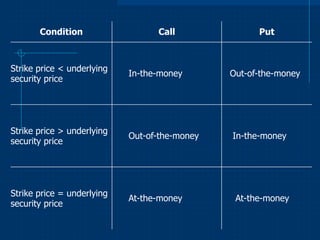
Condition

Call

Strike price < underlying
security price

In-the-money

Strike price > underlying
security price

Out-of-the-money

Strike price = underlying
security price

At-the-money

Put

Out-of-the-money

In-the-money

At-the-money
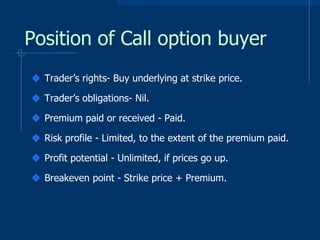
Position of Call option buyer
Trader’s rights- Buy underlying at strike price.
Trader’s obligations- Nil.
Premium paid or received - Paid.
Risk profile - Limited, to the extent of the premium paid.
Profit potential - Unlimited, if prices go up.
Breakeven point - Strike price + Premium.
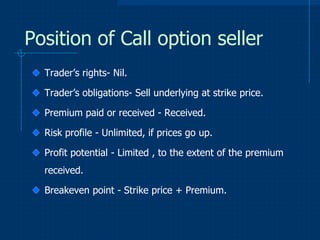
Position of Call option seller
Trader’s rights- Nil.
Trader’s obligations- Sell underlying at strike price.
Premium paid or received - Received.
Risk profile - Unlimited, if prices go up.
Profit potential - Limited , to the extent of the premium
received.
Breakeven point - Strike price + Premium.
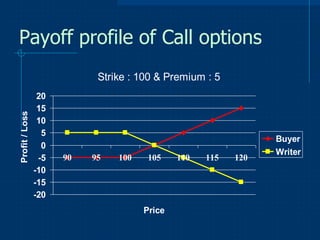
Payoff profile of Call options

Profit / Loss

Strike : 100 & Premium : 5
20
15
10
5
0
-5
-10
-15
-20

90

95

100

105

Price

110

115

120

Buyer
Writer
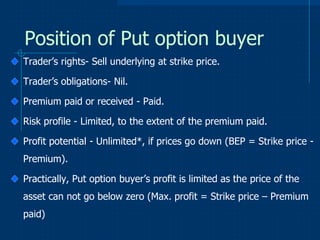
Position of Put option buyer
Trader’s rights- Sell underlying at strike price.
Trader’s obligations- Nil.
Premium paid or received - Paid.

Risk profile - Limited, to the extent of the premium paid.
Profit potential - Unlimited*, if prices go down (BEP = Strike price Premium).

Practically, Put option buyer’s profit is limited as the price of the
asset can not go below zero (Max. profit = Strike price – Premium
paid)
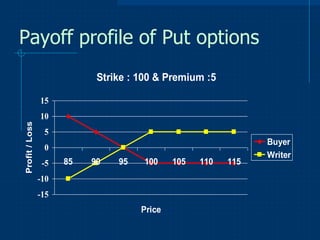
Position of Put option seller
Trader’s rights- Nil.
Trader’s obligations- Buy underlying at strike price.
Premium paid or received - Received.
Risk profile - Unlimited*, if prices go down.
Profit potential - Limited, to the extent of the premium
received (BEP = Strike price - Premium)

Practically, Put option seller’s risk is limited as the price of
the asset can not go below zero (Maximum loss = Strike
price – Premium received)
Payoff profile of Put options
Strike : 100 & Premium :5
15
Profit / Loss

10
5
0
-5

85

90

95

100

-10
-15
Price

105

110

115

Buyer
Writer
Options Strategies
Option strategies
Option Strategies are calculated ways of using options singly or in
combination in order to profit from one or more market movements.
Option Strategies are a direct alternative to traditional buying and
selling of stocks and offers greater profit potential with limited risk.
Option strategies are merely the means through which you transform
your "prediction" of future stock movement into money through option
trading.
Option Strategies give options traders the versatility to profit from
any opinions that they have on an underlying stock and to limit risk
even if that opinion moves against them.
The creative use of Options Strategies makes stock options the most
versatile financial instrument in the world today.
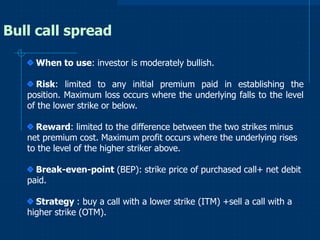
Bull call spread
When to use: investor is moderately bullish.
Risk: limited to any initial premium paid in establishing the
position. Maximum loss occurs where the underlying falls to the level
of the lower strike or below.
Reward: limited to the difference between the two strikes minus
net premium cost. Maximum profit occurs where the underlying rises
to the level of the higher striker above.
Break-even-point (BEP): strike price of purchased call+ net debit
paid.
Strategy : buy a call with a lower strike (ITM) +sell a call with a
higher strike (OTM).
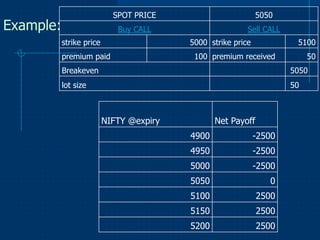
SPOT PRICE
Buy CALL

Example:

5050
Sell CALL

strike price

5000 strike price

premium paid

5100

100 premium received

50

Breakeven

5050

lot size

50

NIFTY @expiry

Net Payoff

4900

-2500

4950

-2500

5000

-2500

5050

0

5100

2500

5150

2500

5200

2500
Net Payoff
3000

2000

1000

Net Payoff

0

4900

4950

5000

5050

5100

5150

5200

-1000

-2000

-3000

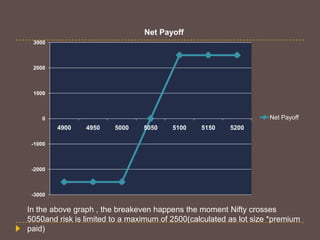
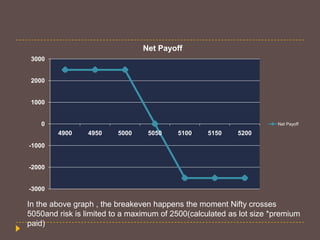
In the above graph , the breakeven happens the moment Nifty crosses
5050and risk is limited to a maximum of 2500(calculated as lot size *premium
paid)
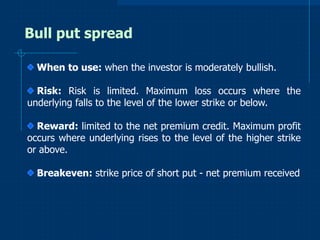
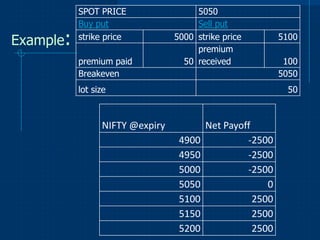
Bull put spread
When to use: when the investor is moderately bullish.
Risk: Risk is limited. Maximum loss occurs where the
underlying falls to the level of the lower strike or below.
Reward: limited to the net premium credit. Maximum profit
occurs where underlying rises to the level of the higher strike
or above.

Breakeven: strike price of short put - net premium received
Example:

SPOT PRICE
Buy put
strike price
premium paid
Breakeven

5050
Sell put
5000 strike price
premium
50 received

lot size

5100
100
5050
50

NIFTY @expiry
4900
4950
5000
5050
5100
5150
5200

Net Payoff
-2500
-2500
-2500
0
2500
2500
2500
Net Payoff
3000

2000

Net Payoff

1000

0

4900

4950

5000

5050

5100

5150

5200

-1000

-2000

-3000

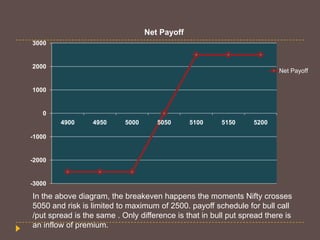
In the above diagram, the breakeven happens the moments Nifty crosses
5050 and risk is limited to maximum of 2500. payoff schedule for bull call
/put spread is the same . Only difference is that in bull put spread there is
an inflow of premium.
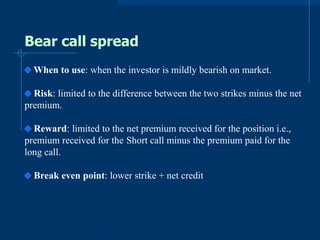
Bear call spread
When to use: when the investor is mildly bearish on market.
Risk: limited to the difference between the two strikes minus the net
premium.

Reward: limited to the net premium received for the position i.e.,
premium received for the Short call minus the premium paid for the
long call.
Break even point: lower strike + net credit
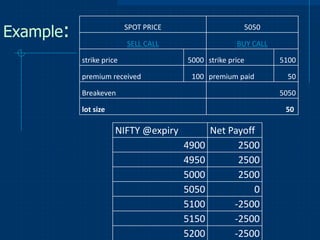
Example:

SPOT PRICE

5050

SELL CALL

BUY CALL

strike price
premium received

5000 strike price
100 premium paid

Breakeven

5100
50
5050

lot size

50

NIFTY @expiry
4900
4950
5000
5050
5100
5150
5200

Net Payoff
2500
2500
2500
0
-2500
-2500
-2500
Net Payoff
3000

2000

1000

0

Net Payoff

4900

4950

5000

5050

5100

5150

5200

-1000

-2000

-3000

In the above graph , the breakeven happens the moment Nifty crosses
5050and risk is limited to a maximum of 2500(calculated as lot size *premium
paid)
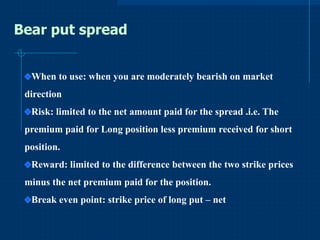
Bear put spread
When to use: when you are moderately bearish on market

direction
Risk: limited to the net amount paid for the spread .i.e. The
premium paid for Long position less premium received for short

position.
Reward: limited to the difference between the two strike prices
minus the net premium paid for the position.

Break even point: strike price of long put – net
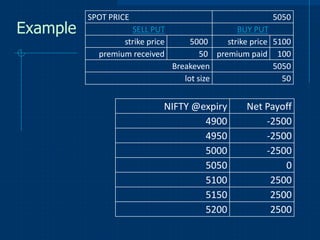
Example

SPOT PRICE

5050

SELL PUT
strike price
premium received

BUY PUT
5000
strike price 5100
50 premium paid 100
Breakeven
5050
lot size
50

NIFTY @expiry
4900
4950
5000
5050
5100
5150
5200

Net Payoff
-2500
-2500
-2500
0
2500
2500
2500
Net Payoff
3000

2000

1000

0

Net Payoff

4900

4950

5000

5050

5100

5150

5200

-1000

-2000

-3000

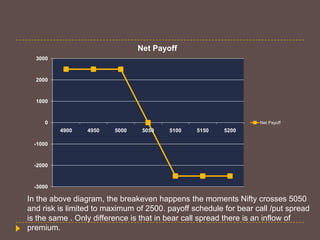
In the above diagram, the breakeven happens the moments Nifty crosses 5050
and risk is limited to maximum of 2500. payoff schedule for bear call /put spread
is the same . Only difference is that in bear call spread there is an inflow of
premium.
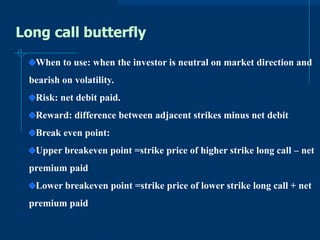
Long call butterfly
When to use: when the investor is neutral on market direction and
bearish on volatility.
Risk: net debit paid.
Reward: difference between adjacent strikes minus net debit

Break even point:
Upper breakeven point =strike price of higher strike long call – net
premium paid

Lower breakeven point =strike price of lower strike long call + net
premium paid
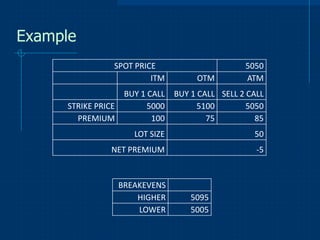
Example
SPOT PRICE
ITM

OTM

5050
ATM

BUY 1 CALL
5000
100

BUY 1 CALL SELL 2 CALL
5100
5050
75
85

LOT SIZE

50

NET PREMIUM

-5

STRIKE PRICE
PREMIUM

BREAKEVENS
HIGHER
LOWER

5095
5005
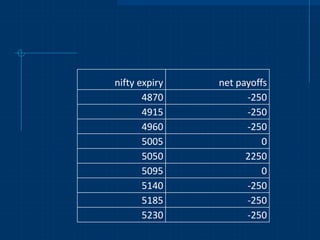
nifty expiry
4870
4915
4960
5005
5050
5095
5140
5185
5230

net payoffs
-250
-250
-250
0
2250
0
-250
-250
-250
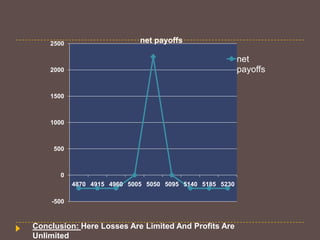
2500

net payoffs

net
payoffs

2000

1500

1000

500

0
4870 4915 4960 5005 5050 5095 5140 5185 5230
-500

Conclusion: Here Losses Are Limited And Profits Are
Unlimited
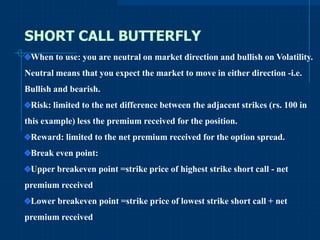
SHORT CALL BUTTERFLY
When to use: you are neutral on market direction and bullish on Volatility.
Neutral means that you expect the market to move in either direction -i.e.
Bullish and bearish.
Risk: limited to the net difference between the adjacent strikes (rs. 100 in
this example) less the premium received for the position.

Reward: limited to the net premium received for the option spread.
Break even point:
Upper breakeven point =strike price of highest strike short call - net
premium received
Lower breakeven point =strike price of lowest strike short call + net
premium received
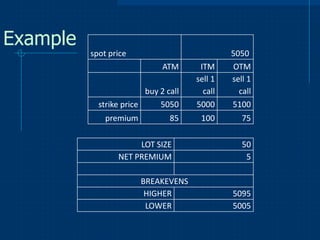
Example
spot price
ATM
buy 2 call
strike price
5050
premium

85

LOT SIZE
NET PREMIUM
BREAKEVENS
HIGHER
LOWER

ITM
sell 1
call
5000

5050
OTM
sell 1
call
5100

100

75
50
5

5095
5005
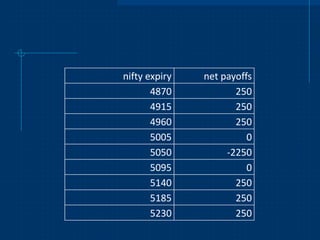
nifty expiry
4870
4915
4960
5005
5050
5095
5140
5185
5230

net payoffs
250
250
250
0
-2250
0
250
250
250
500

0
4870

4915

4960

5005

5050

5095

5140

5185

5230

-500

-1000

-1500

-2000

-2500

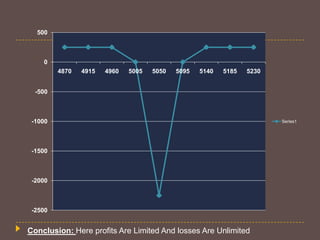
Conclusion: Here profits Are Limited And losses Are Unlimited

Series1
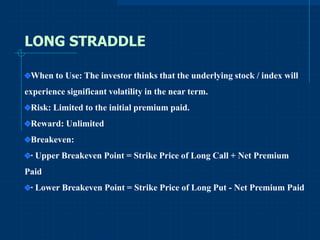
LONG STRADDLE
When to Use: The investor thinks that the underlying stock / index will
experience significant volatility in the near term.
Risk: Limited to the initial premium paid.
Reward: Unlimited
Breakeven:

· Upper Breakeven Point = Strike Price of Long Call + Net Premium
Paid
· Lower Breakeven Point = Strike Price of Long Put - Net Premium Paid
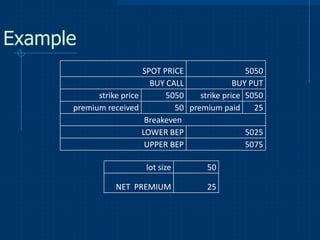
Example
SPOT PRICE
5050
BUY CALL
BUY PUT
strike price
5050
strike price 5050
premium received
50 premium paid
25
Breakeven
LOWER BEP
5025
UPPER BEP
5075
lot size

50

NET PREMIUM

25
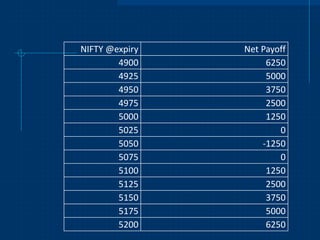
NIFTY @expiry
4900
4925
4950
4975
5000
5025
5050
5075
5100
5125
5150
5175
5200

Net Payoff
6250
5000
3750
2500
1250
0
-1250
0
1250
2500
3750
5000
6250
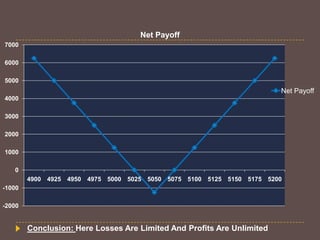
Net Payoff
7000
6000
5000

Net Payoff
4000
3000
2000
1000
0
4900 4925 4950 4975 5000 5025 5050 5075 5100 5125 5150 5175 5200
-1000
-2000

Conclusion: Here Losses Are Limited And Profits Are Unlimited
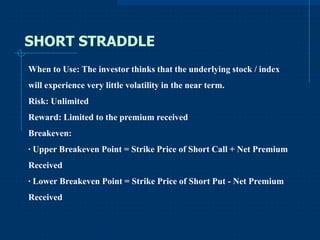
SHORT STRADDLE
When to Use: The investor thinks that the underlying stock / index
will experience very little volatility in the near term.
Risk: Unlimited
Reward: Limited to the premium received
Breakeven:
· Upper Breakeven Point = Strike Price of Short Call + Net Premium
Received
· Lower Breakeven Point = Strike Price of Short Put - Net Premium
Received
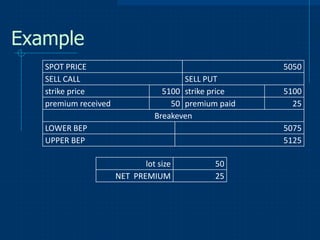
Example
SPOT PRICE
SELL CALL
strike price
premium received

5050
SELL PUT
5100 strike price
50 premium paid
Breakeven

LOWER BEP
UPPER BEP

5100
25
5075
5125

lot size
NET PREMIUM

50
25
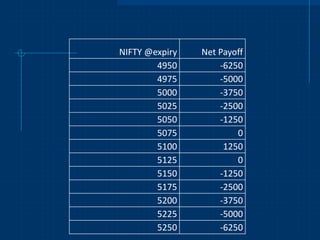
NIFTY @expiry
4950
4975
5000
5025
5050
5075
5100
5125
5150
5175
5200
5225
5250

Net Payoff
-6250
-5000
-3750
-2500
-1250
0
1250
0
-1250
-2500
-3750
-5000
-6250
2000
1000
0
4950 4975 5000 5025 5050 5075 5100 5125 5150 5175 5200 5225 5250
-1000
-2000
Net Payoff

-3000
-4000
-5000
-6000
-7000

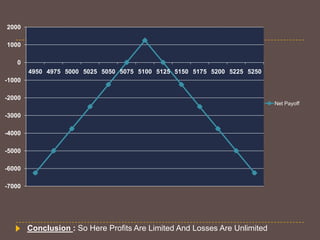
Conclusion : So Here Profits Are Limited And Losses Are Unlimited
Conclusion
Option strategies are the simultaneous, and often
mixed, buying or selling of one or more options that differ in
one or more of the options' variables. This is often done to gain
exposure to a specific type of opportunity or risk while
eliminating other risks as part of a trading strategy. A very
straight forward strategy might simply be the buying or selling
of a single option, however option strategies often refer to a
combination of simultaneous buying and or selling of options.
Thank
You

Option Strategies

  • 1.
  • 2.
    Derivatives Derivatives are risk management instruments, which derivetheir value from an underlying asset. The underlying asset can be Bullion, Index, Share, Bonds, Currency, Interest, Etc.
  • 3.
    Used by  Banks, Securities firm,  Companies,  Investors,  Housewives, ETC.
  • 4.
    But why  Tohedge risk  To gain access to cheaper money  To make profit
  • 5.
    Types of Derivatives ᵴFuture: Theowner of a future has the obligation to sell or buy something in the future at a predetermined price. A future contract has standardized conditions. ᵴOptions: The owner of an option has the option to buy or sell something at a predetermined price on or before a predetermined date.
  • 6.
    Types of Options ᵴCall Callsgive the buyer the right but not the obligation to buy a given quantity of the underlying asset, at a given price on or before a given future date. ᵴ Puts Puts give the buyer the right, but not the obligation to sell a given quantity of the underlying asset at a given price on or before a given date.
  • 7.
    Options are Contracts Theoption contract specifies:     The The The The underlying instrument quantity to be delivered price at which delivery occurs date that the contract expires Three parties to each contract    The Buyer The Writer (seller) The Clearinghouse
  • 8.
    Core Concepts Index options:These options have the index as the underlying. In India, they have a European style settlement. E.g. Nifty options, Mini Nifty options etc. Stock options: Stock options are options on individual stocks. A stock option contract gives the holder the right to buy or sell the underlying shares at the specified price. They have an American style settlement. Buyer of an option: The buyer of an option is the one who by paying the option premium buys the right but not the obligation to exercise his option on the seller/writer. Writer / seller of an option: The writer / seller of a call/put option is the one who receives the option premium and is thereby obliged to sell/buy the asset if the buyer exercises on him.
  • 9.
    Continued…. Option price/premium: Optionprice is the price which the option buyer pays to the option seller. It is also referred to as the option premium. Premium of an option = Option's intrinsic value + Options time value Expiration date: The date specified in the options contract is known as the expiration date, the exercise date, the strike date or the maturity. Strike price: The price specified in the options contract is known as the strike price or the exercise price. American options: American options are options that can be exercised at any time up to the expiration date. European options: European options are options that can be exercised only on the expiration date itself.
  • 10.
    Continued…. In-the-money option: Acall option is in-the-money if the strike price is less than the market price of the underlying security. A put option is in-the-money if the strike price is greater than the market price of the underlying security. At-the-money option: When the price of the underlying security is equal to the strike price, an option is at-the-money. Out-of-the-money option: A call option is out-of-the-money if the strike price is greater than the market price of the underlying security. A put option is out-of-the money if the strike price is less than the market price of the underlying security
  • 11.
    Condition Call Strike price <underlying security price In-the-money Strike price > underlying security price Out-of-the-money Strike price = underlying security price At-the-money Put Out-of-the-money In-the-money At-the-money
  • 12.
    Position of Calloption buyer Trader’s rights- Buy underlying at strike price. Trader’s obligations- Nil. Premium paid or received - Paid. Risk profile - Limited, to the extent of the premium paid. Profit potential - Unlimited, if prices go up. Breakeven point - Strike price + Premium.
  • 13.
    Position of Calloption seller Trader’s rights- Nil. Trader’s obligations- Sell underlying at strike price. Premium paid or received - Received. Risk profile - Unlimited, if prices go up. Profit potential - Limited , to the extent of the premium received. Breakeven point - Strike price + Premium.
  • 14.
    Payoff profile ofCall options Profit / Loss Strike : 100 & Premium : 5 20 15 10 5 0 -5 -10 -15 -20 90 95 100 105 Price 110 115 120 Buyer Writer
  • 15.
    Position of Putoption buyer Trader’s rights- Sell underlying at strike price. Trader’s obligations- Nil. Premium paid or received - Paid. Risk profile - Limited, to the extent of the premium paid. Profit potential - Unlimited*, if prices go down (BEP = Strike price Premium). Practically, Put option buyer’s profit is limited as the price of the asset can not go below zero (Max. profit = Strike price – Premium paid)
  • 16.
    Position of Putoption seller Trader’s rights- Nil. Trader’s obligations- Buy underlying at strike price. Premium paid or received - Received. Risk profile - Unlimited*, if prices go down. Profit potential - Limited, to the extent of the premium received (BEP = Strike price - Premium) Practically, Put option seller’s risk is limited as the price of the asset can not go below zero (Maximum loss = Strike price – Premium received)
  • 17.
    Payoff profile ofPut options Strike : 100 & Premium :5 15 Profit / Loss 10 5 0 -5 85 90 95 100 -10 -15 Price 105 110 115 Buyer Writer
  • 18.
  • 19.
    Option strategies Option Strategiesare calculated ways of using options singly or in combination in order to profit from one or more market movements. Option Strategies are a direct alternative to traditional buying and selling of stocks and offers greater profit potential with limited risk. Option strategies are merely the means through which you transform your "prediction" of future stock movement into money through option trading. Option Strategies give options traders the versatility to profit from any opinions that they have on an underlying stock and to limit risk even if that opinion moves against them. The creative use of Options Strategies makes stock options the most versatile financial instrument in the world today.
  • 20.
    Bull call spread Whento use: investor is moderately bullish. Risk: limited to any initial premium paid in establishing the position. Maximum loss occurs where the underlying falls to the level of the lower strike or below. Reward: limited to the difference between the two strikes minus net premium cost. Maximum profit occurs where the underlying rises to the level of the higher striker above. Break-even-point (BEP): strike price of purchased call+ net debit paid. Strategy : buy a call with a lower strike (ITM) +sell a call with a higher strike (OTM).
  • 21.
    SPOT PRICE Buy CALL Example: 5050 SellCALL strike price 5000 strike price premium paid 5100 100 premium received 50 Breakeven 5050 lot size 50 NIFTY @expiry Net Payoff 4900 -2500 4950 -2500 5000 -2500 5050 0 5100 2500 5150 2500 5200 2500
  • 22.
    Net Payoff 3000 2000 1000 Net Payoff 0 4900 4950 5000 5050 5100 5150 5200 -1000 -2000 -3000 Inthe above graph , the breakeven happens the moment Nifty crosses 5050and risk is limited to a maximum of 2500(calculated as lot size *premium paid)
  • 23.
    Bull put spread Whento use: when the investor is moderately bullish. Risk: Risk is limited. Maximum loss occurs where the underlying falls to the level of the lower strike or below. Reward: limited to the net premium credit. Maximum profit occurs where underlying rises to the level of the higher strike or above. Breakeven: strike price of short put - net premium received
  • 24.
    Example: SPOT PRICE Buy put strikeprice premium paid Breakeven 5050 Sell put 5000 strike price premium 50 received lot size 5100 100 5050 50 NIFTY @expiry 4900 4950 5000 5050 5100 5150 5200 Net Payoff -2500 -2500 -2500 0 2500 2500 2500
  • 25.
    Net Payoff 3000 2000 Net Payoff 1000 0 4900 4950 5000 5050 5100 5150 5200 -1000 -2000 -3000 Inthe above diagram, the breakeven happens the moments Nifty crosses 5050 and risk is limited to maximum of 2500. payoff schedule for bull call /put spread is the same . Only difference is that in bull put spread there is an inflow of premium.
  • 26.
    Bear call spread Whento use: when the investor is mildly bearish on market. Risk: limited to the difference between the two strikes minus the net premium. Reward: limited to the net premium received for the position i.e., premium received for the Short call minus the premium paid for the long call. Break even point: lower strike + net credit
  • 27.
    Example: SPOT PRICE 5050 SELL CALL BUYCALL strike price premium received 5000 strike price 100 premium paid Breakeven 5100 50 5050 lot size 50 NIFTY @expiry 4900 4950 5000 5050 5100 5150 5200 Net Payoff 2500 2500 2500 0 -2500 -2500 -2500
  • 28.
    Net Payoff 3000 2000 1000 0 Net Payoff 4900 4950 5000 5050 5100 5150 5200 -1000 -2000 -3000 Inthe above graph , the breakeven happens the moment Nifty crosses 5050and risk is limited to a maximum of 2500(calculated as lot size *premium paid)
  • 29.
    Bear put spread Whento use: when you are moderately bearish on market direction Risk: limited to the net amount paid for the spread .i.e. The premium paid for Long position less premium received for short position. Reward: limited to the difference between the two strike prices minus the net premium paid for the position. Break even point: strike price of long put – net
  • 30.
    Example SPOT PRICE 5050 SELL PUT strikeprice premium received BUY PUT 5000 strike price 5100 50 premium paid 100 Breakeven 5050 lot size 50 NIFTY @expiry 4900 4950 5000 5050 5100 5150 5200 Net Payoff -2500 -2500 -2500 0 2500 2500 2500
  • 31.
    Net Payoff 3000 2000 1000 0 Net Payoff 4900 4950 5000 5050 5100 5150 5200 -1000 -2000 -3000 Inthe above diagram, the breakeven happens the moments Nifty crosses 5050 and risk is limited to maximum of 2500. payoff schedule for bear call /put spread is the same . Only difference is that in bear call spread there is an inflow of premium.
  • 32.
    Long call butterfly Whento use: when the investor is neutral on market direction and bearish on volatility. Risk: net debit paid. Reward: difference between adjacent strikes minus net debit Break even point: Upper breakeven point =strike price of higher strike long call – net premium paid Lower breakeven point =strike price of lower strike long call + net premium paid
  • 33.
    Example SPOT PRICE ITM OTM 5050 ATM BUY 1CALL 5000 100 BUY 1 CALL SELL 2 CALL 5100 5050 75 85 LOT SIZE 50 NET PREMIUM -5 STRIKE PRICE PREMIUM BREAKEVENS HIGHER LOWER 5095 5005
  • 34.
  • 35.
    2500 net payoffs net payoffs 2000 1500 1000 500 0 4870 49154960 5005 5050 5095 5140 5185 5230 -500 Conclusion: Here Losses Are Limited And Profits Are Unlimited
  • 36.
    SHORT CALL BUTTERFLY Whento use: you are neutral on market direction and bullish on Volatility. Neutral means that you expect the market to move in either direction -i.e. Bullish and bearish. Risk: limited to the net difference between the adjacent strikes (rs. 100 in this example) less the premium received for the position. Reward: limited to the net premium received for the option spread. Break even point: Upper breakeven point =strike price of highest strike short call - net premium received Lower breakeven point =strike price of lowest strike short call + net premium received
  • 37.
    Example spot price ATM buy 2call strike price 5050 premium 85 LOT SIZE NET PREMIUM BREAKEVENS HIGHER LOWER ITM sell 1 call 5000 5050 OTM sell 1 call 5100 100 75 50 5 5095 5005
  • 38.
  • 39.
  • 40.
    LONG STRADDLE When toUse: The investor thinks that the underlying stock / index will experience significant volatility in the near term. Risk: Limited to the initial premium paid. Reward: Unlimited Breakeven: · Upper Breakeven Point = Strike Price of Long Call + Net Premium Paid · Lower Breakeven Point = Strike Price of Long Put - Net Premium Paid
  • 41.
    Example SPOT PRICE 5050 BUY CALL BUYPUT strike price 5050 strike price 5050 premium received 50 premium paid 25 Breakeven LOWER BEP 5025 UPPER BEP 5075 lot size 50 NET PREMIUM 25
  • 42.
  • 43.
    Net Payoff 7000 6000 5000 Net Payoff 4000 3000 2000 1000 0 49004925 4950 4975 5000 5025 5050 5075 5100 5125 5150 5175 5200 -1000 -2000 Conclusion: Here Losses Are Limited And Profits Are Unlimited
  • 44.
    SHORT STRADDLE When toUse: The investor thinks that the underlying stock / index will experience very little volatility in the near term. Risk: Unlimited Reward: Limited to the premium received Breakeven: · Upper Breakeven Point = Strike Price of Short Call + Net Premium Received · Lower Breakeven Point = Strike Price of Short Put - Net Premium Received
  • 45.
    Example SPOT PRICE SELL CALL strikeprice premium received 5050 SELL PUT 5100 strike price 50 premium paid Breakeven LOWER BEP UPPER BEP 5100 25 5075 5125 lot size NET PREMIUM 50 25
  • 46.
  • 47.
    2000 1000 0 4950 4975 50005025 5050 5075 5100 5125 5150 5175 5200 5225 5250 -1000 -2000 Net Payoff -3000 -4000 -5000 -6000 -7000 Conclusion : So Here Profits Are Limited And Losses Are Unlimited
  • 48.
    Conclusion Option strategies arethe simultaneous, and often mixed, buying or selling of one or more options that differ in one or more of the options' variables. This is often done to gain exposure to a specific type of opportunity or risk while eliminating other risks as part of a trading strategy. A very straight forward strategy might simply be the buying or selling of a single option, however option strategies often refer to a combination of simultaneous buying and or selling of options.
  • 49.