Hess Test Indication
&
Interpretation
Siraj Safi
Lecturer in Optometry PICO
Hess Test
• An investigation of binocular vision can be
incorporated into an investigation of the motor
system and an investigation of the sensory system.
• During investigation of the motor system abnormal
position and abnormal movement should be
diagnosed and measured.
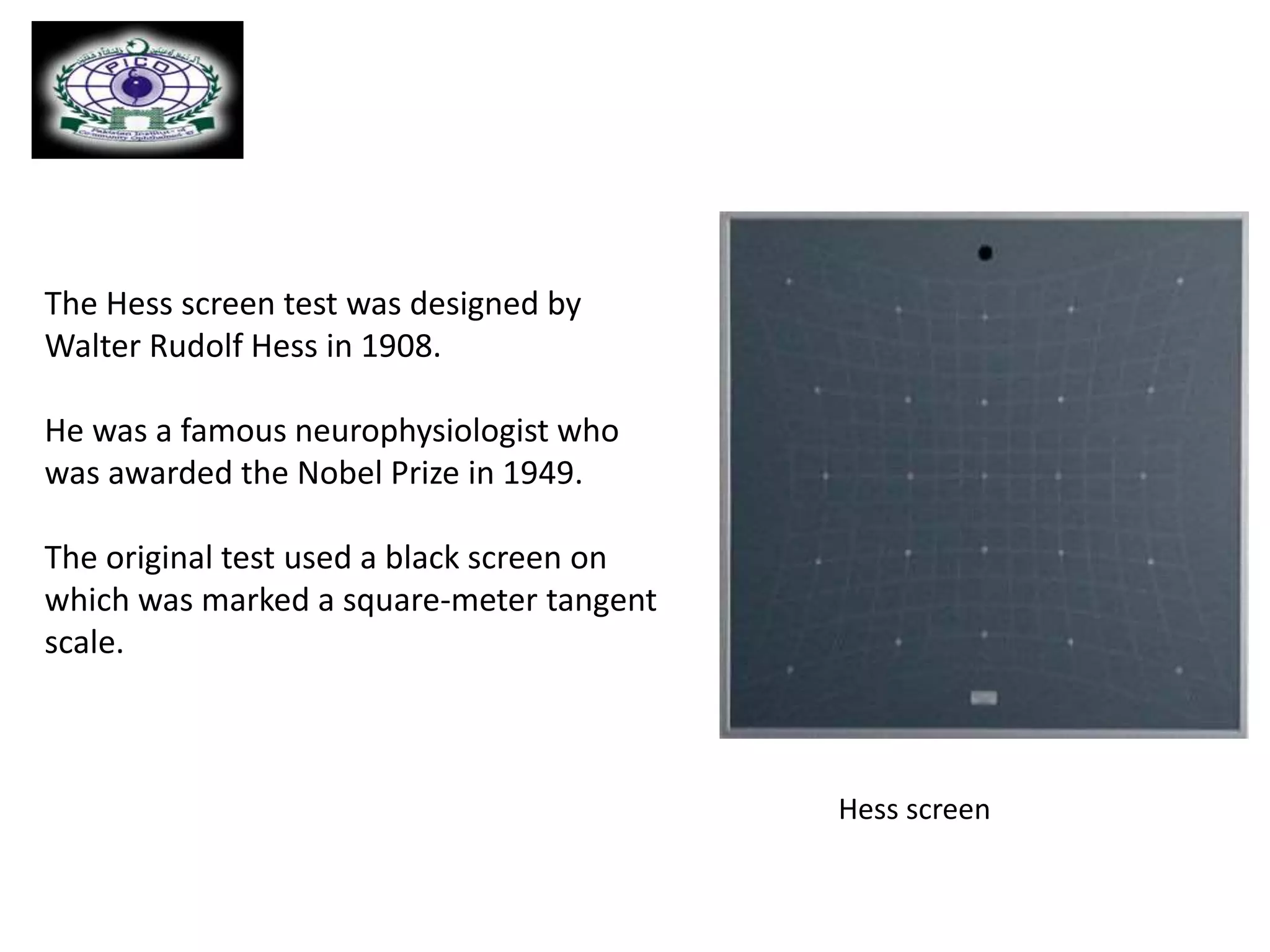
The Hess screen test was designed by
Walter Rudolf Hess in 1908.
He was a famous neurophysiologist who
was awarded the Nobel Prize in 1949.
The original test used a black screen on
which was marked a square-meter tangent
scale.
Hess screen
 The Hess-Screen is a metal plate, 95 cm wide and 95
cm high.
 Includes 24 squares, 12 inner and 12 in outer field.
 The central filed is of 15 degree while outer field
limited to 30 degree.
 Each square on chart indicates 5 degree.
Equipment
General Principle
 Principle is haploscopic.
 Chart is plotted based on the Herring's and
Sherrington’s law of innervations.
 Dissociation of two eyes by means of colors.
Requirements
 Full understanding about what he is supposed to
do, since the test is purely subjective.
 Good vision in both eyes.
 Foveal projection in the presence of normal retinal
correspondence.
Method
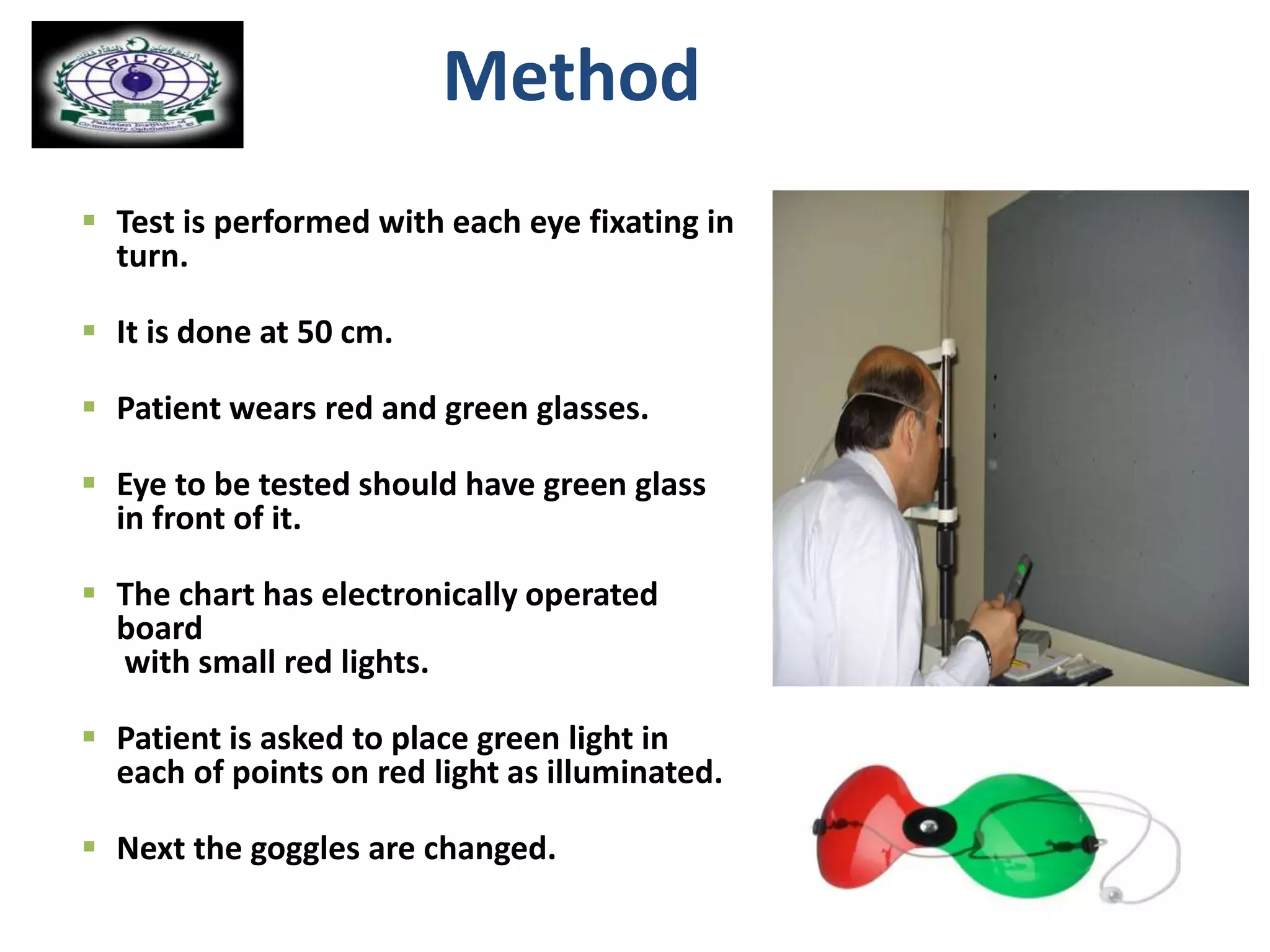
 Test is performed with each eye fixating in
turn.
 It is done at 50 cm.
 Patient wears red and green glasses.
 Eye to be tested should have green glass
in front of it.
 The chart has electronically operated
board
with small red lights.
 Patient is asked to place green light in
each of points on red light as illuminated.
 Next the goggles are changed.
o Compression of space between the two plotted fixation points
indicates underaction of a muscle acting in that direction.
o Expansion indicates overaction.
o Smaller field belongs to eye with paretic muscle.
o Unaffected eye shows larger field expressing the overaction of
the contralateral synergist.
o Fields of similar shape and size seen in comitant deviation,
while dissimilar shape and size indicate incomitance.
Interpretation
 Diagnosis of:
 Under action or Over action of EOM.
 Mechanical or Neurogenic palsy.
 Congenital/Long standing or Acquired pals.
 A or V pattern
 Planning of surgery and post-op effects of surgery
 Monitoring of condition.
Uses of Hess Test
Some Important Questions
 What is the direction of deviation i.e. Eso, Exo,
Hyper, Hypo?
 Look at the position of the central spot as the
patient indicated.
 There may be a combined horizontal and vertical
deviation.
 What is the size of deviation?
 Each square on the Hess chart represent 5 degree
of deviation.
 Look at the position of the central target and
estimate the deviation.
3. Is the deviation concomitant or
Incomitant?
Look at the position of corresponding target in each eye
• Is the deviation same in:
a. Each eye
b. Each direction of gaze
• There may be Incomitance in primary position with each eye,
indicate:
A recent palsy
A long standing palsy controlled by AHP
A mechanical etiology
There may be incomitance in different direction
of gaze
• Horizontally
• Vertically
• Obliquely
Is there a smaller field?
• The eye with the smaller field or range of
motility is usually the affected eye .
• Either due to neurogenic or mechanical
etiology.
Which is the affected muscle or
nerve?
• The position of gaze with the largest under
achieved eye movement is associated with
the affected muscle or the nerve supplied.
Has the muscle sequelae spread to
produce concomitance?
• Look for the four stages in muscle sequelae.
• Muscle sequelae spreads instantly to stage
1&2 but may take several months to spread
to stage 3&4
Is the etiology mechanical or
Neurogenic?
Mechanical aetiology have characteristic
feature:
– Straight lines indicating sudden limitation of movement
e.g. Upgaze in blowout fracture.
– “Laurel and Hardy” field e.g. in Blow out fractures.
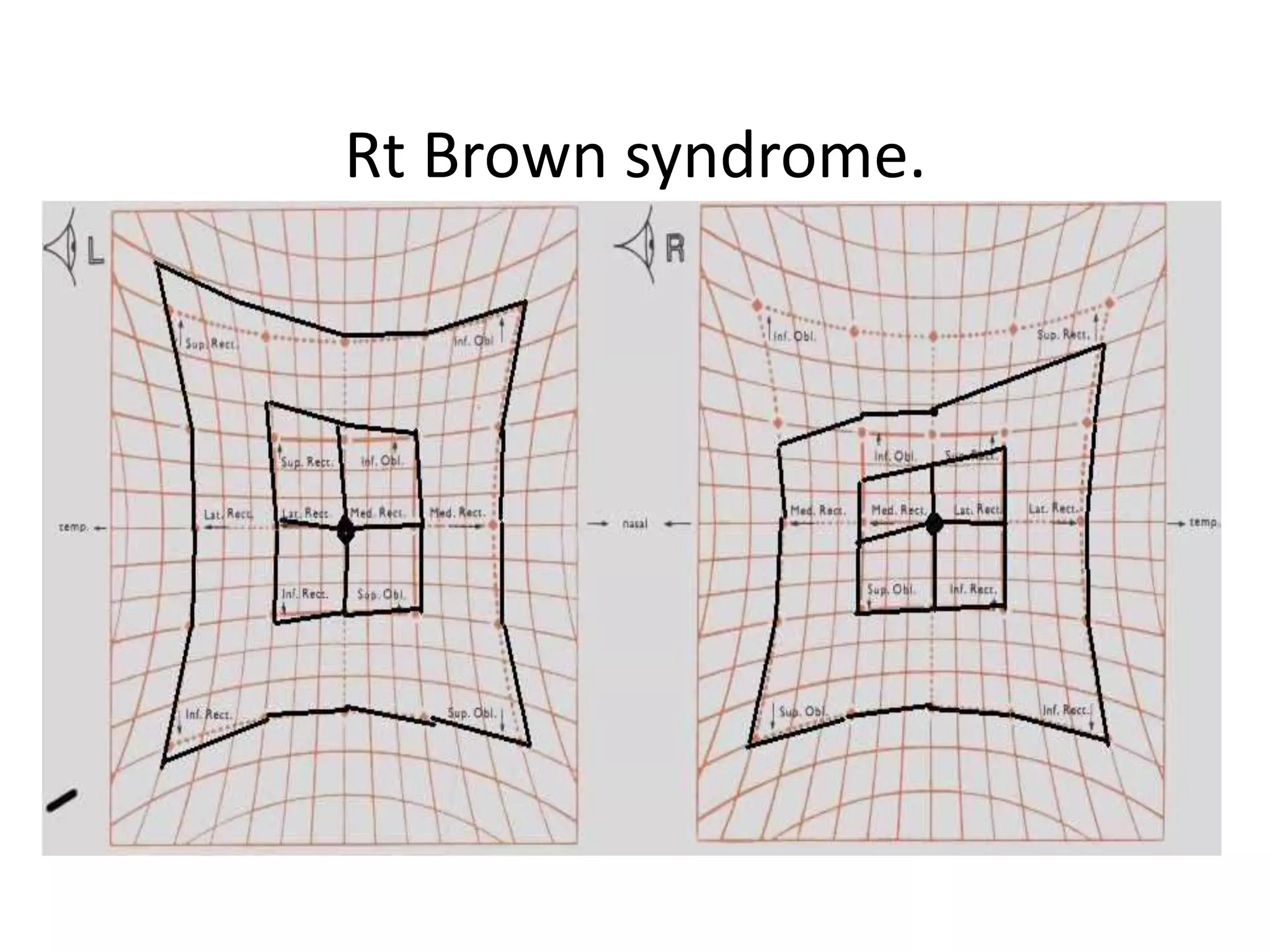
– “Dog --ear” in e.g. Brown syndrome.
Is there an A or V pattern?
• Look at the separation of the inner field in
up and down gaze.
Some plotted Hess charts
Hess chart
Duane's retraction syndrome of type A more
limited abduction than Adduction.
Right 3rd nerve palsy.
Lt orbital fracture.
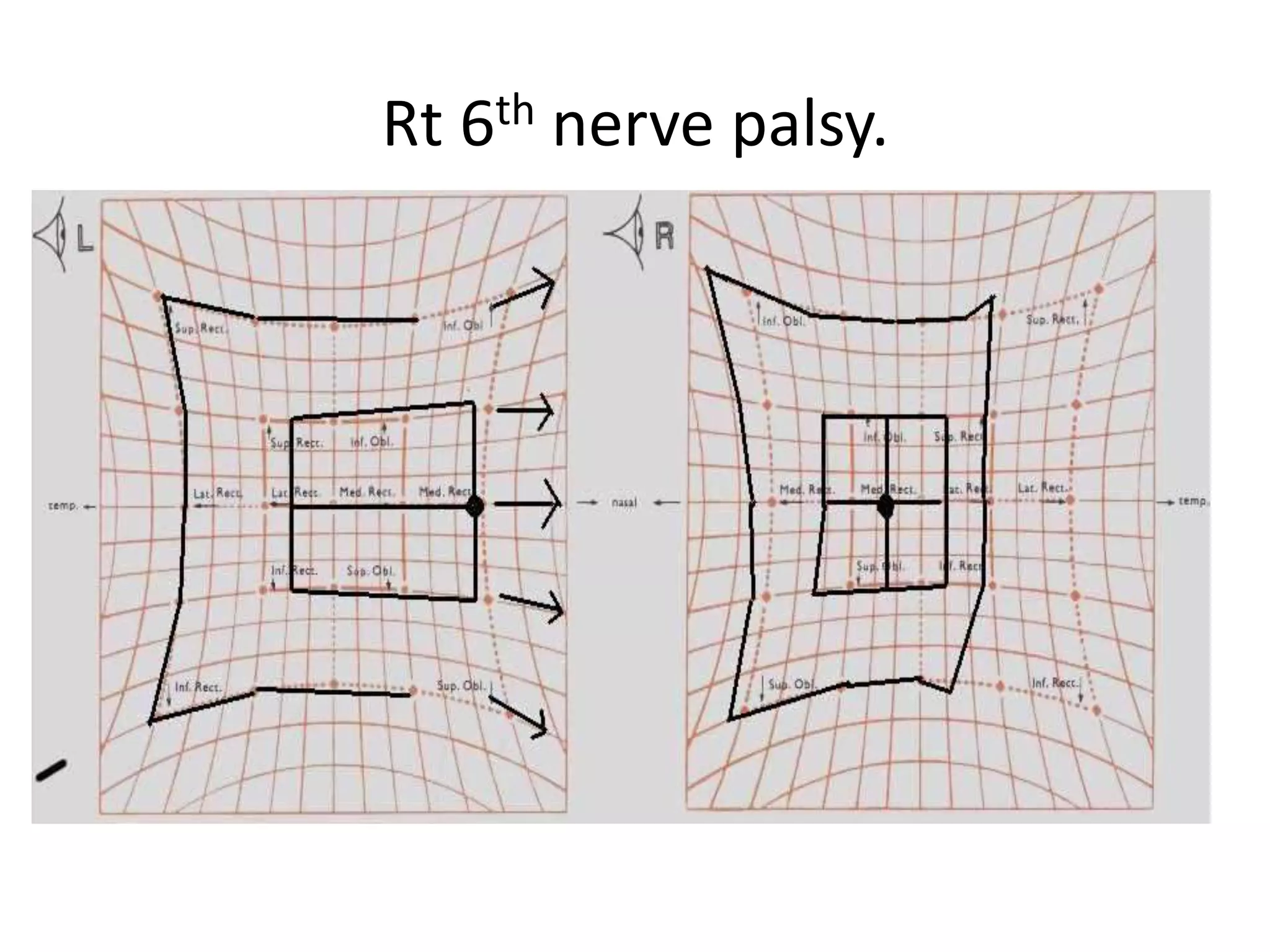
Rt 6th nerve palsy.
Lt SO palsy.
Rt Brown syndrome.
Thankyou

Hess test

  • 1.
    Hess Test Indication & Interpretation SirajSafi Lecturer in Optometry PICO
  • 2.
    Hess Test • Aninvestigation of binocular vision can be incorporated into an investigation of the motor system and an investigation of the sensory system. • During investigation of the motor system abnormal position and abnormal movement should be diagnosed and measured.
  • 3.
    The Hess screentest was designed by Walter Rudolf Hess in 1908. He was a famous neurophysiologist who was awarded the Nobel Prize in 1949. The original test used a black screen on which was marked a square-meter tangent scale. Hess screen
  • 4.
     The Hess-Screenis a metal plate, 95 cm wide and 95 cm high.  Includes 24 squares, 12 inner and 12 in outer field.  The central filed is of 15 degree while outer field limited to 30 degree.  Each square on chart indicates 5 degree.
  • 6.
  • 7.
    General Principle  Principleis haploscopic.  Chart is plotted based on the Herring's and Sherrington’s law of innervations.  Dissociation of two eyes by means of colors.
  • 8.
    Requirements  Full understandingabout what he is supposed to do, since the test is purely subjective.  Good vision in both eyes.  Foveal projection in the presence of normal retinal correspondence.
  • 9.
    Method  Test isperformed with each eye fixating in turn.  It is done at 50 cm.  Patient wears red and green glasses.  Eye to be tested should have green glass in front of it.  The chart has electronically operated board with small red lights.  Patient is asked to place green light in each of points on red light as illuminated.  Next the goggles are changed.
  • 10.
    o Compression ofspace between the two plotted fixation points indicates underaction of a muscle acting in that direction. o Expansion indicates overaction. o Smaller field belongs to eye with paretic muscle. o Unaffected eye shows larger field expressing the overaction of the contralateral synergist. o Fields of similar shape and size seen in comitant deviation, while dissimilar shape and size indicate incomitance. Interpretation
  • 11.
     Diagnosis of: Under action or Over action of EOM.  Mechanical or Neurogenic palsy.  Congenital/Long standing or Acquired pals.  A or V pattern  Planning of surgery and post-op effects of surgery  Monitoring of condition. Uses of Hess Test
  • 12.
    Some Important Questions What is the direction of deviation i.e. Eso, Exo, Hyper, Hypo?  Look at the position of the central spot as the patient indicated.  There may be a combined horizontal and vertical deviation.
  • 13.
     What isthe size of deviation?  Each square on the Hess chart represent 5 degree of deviation.  Look at the position of the central target and estimate the deviation.
  • 14.
    3. Is thedeviation concomitant or Incomitant? Look at the position of corresponding target in each eye • Is the deviation same in: a. Each eye b. Each direction of gaze • There may be Incomitance in primary position with each eye, indicate: A recent palsy A long standing palsy controlled by AHP A mechanical etiology
  • 15.
    There may beincomitance in different direction of gaze • Horizontally • Vertically • Obliquely
  • 16.
    Is there asmaller field? • The eye with the smaller field or range of motility is usually the affected eye . • Either due to neurogenic or mechanical etiology.
  • 17.
    Which is theaffected muscle or nerve? • The position of gaze with the largest under achieved eye movement is associated with the affected muscle or the nerve supplied.
  • 18.
    Has the musclesequelae spread to produce concomitance? • Look for the four stages in muscle sequelae. • Muscle sequelae spreads instantly to stage 1&2 but may take several months to spread to stage 3&4
  • 19.
    Is the etiologymechanical or Neurogenic? Mechanical aetiology have characteristic feature: – Straight lines indicating sudden limitation of movement e.g. Upgaze in blowout fracture. – “Laurel and Hardy” field e.g. in Blow out fractures. – “Dog --ear” in e.g. Brown syndrome.
  • 20.
    Is there anA or V pattern? • Look at the separation of the inner field in up and down gaze.
  • 21.
  • 22.
  • 23.
    Duane's retraction syndromeof type A more limited abduction than Adduction.
  • 24.
  • 25.
  • 26.
  • 27.
  • 28.
  • 29.