Prepared by:
Anis Suzanna Binti Mohamad
Optometrist
Hospital Langkawi
Introduction
Aetiologies
Clinical features
Classifications
Case study
Discussion
Conclusion
References
Binocular
vision

Non
strabismus

Strabismus

Incomitant

Comitant

Neurogenic
palsy

Myogenic palsy

Mechanical
palsy

Duane’s
Syndrome

Vertical
Retraction
Syndrome

Brown’s
Syndrome

Marcus Gunn
Jaw Winking

Orbital Injuries
 aka

Duane’s retraction syndrome or Stilting-Turk
Syndrome
 a congenital eye movement disorder due to
misdirection of the nerve fiber on eye muscle


causing some eye muscle to contract when they
shouldn’t, vice versa

 can

be unilateral or bilateral
 Usually congenital but may be acquired
 Affects females to males in ratio of 3:2
 May be associated with other defects such as
deafness, anisometropia etc.
1.

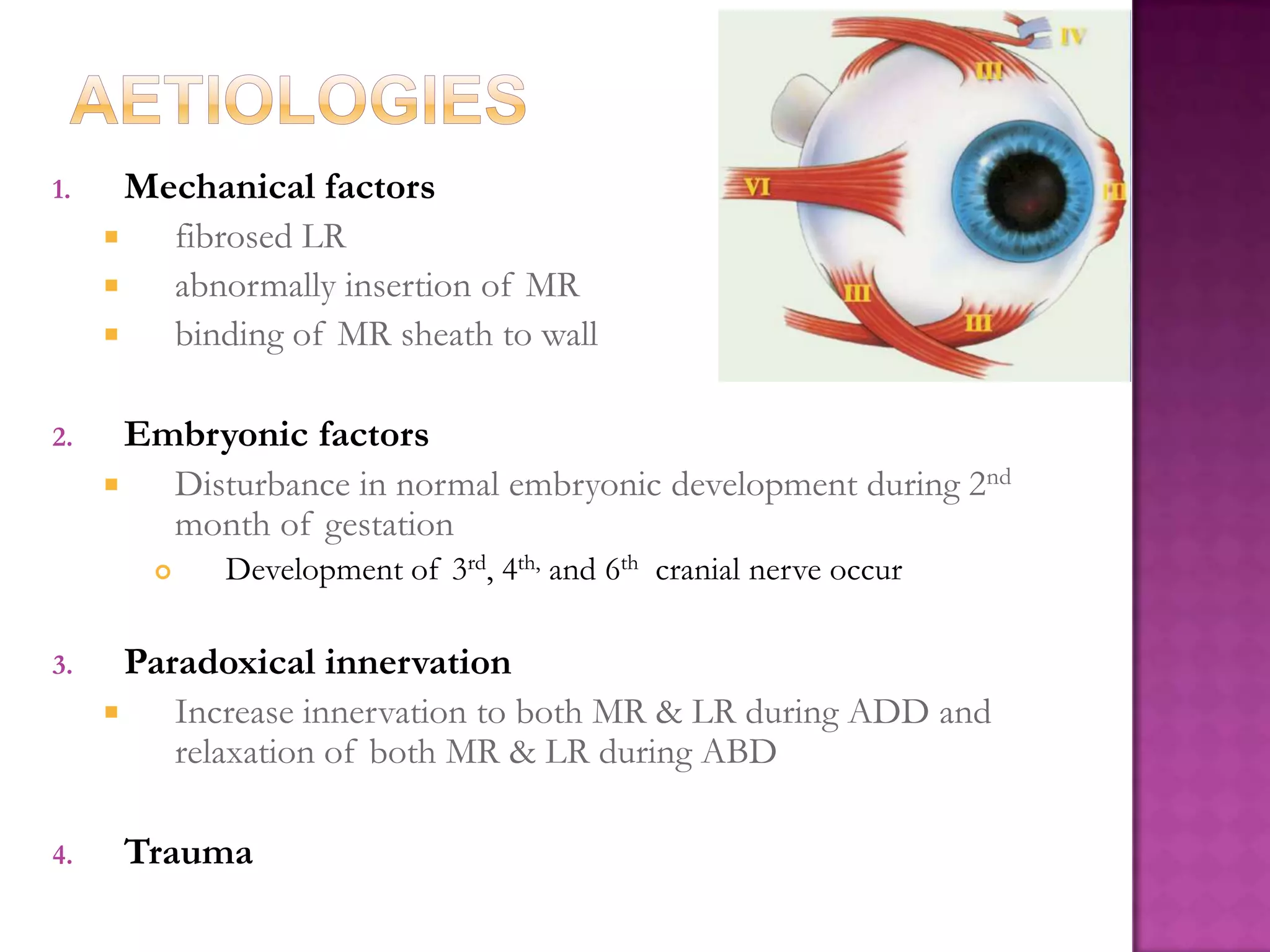
Mechanical factors

fibrosed LR

abnormally insertion of MR

binding of MR sheath to wall

2.

Embryonic factors

Disturbance in normal embryonic development during 2nd
month of gestation


3.

4.

Development of 3rd, 4th, and 6th cranial nerve occur

Paradoxical innervation

Increase innervation to both MR & LR during ADD and
relaxation of both MR & LR during ABD

Trauma
limitation of abduction with or without limitation of
adduction
 attempt adduction: retraction of the globe with narrowing
of fissure
 Protrusion & widening of the palpebral fissure on
abduction
 May or may not have AHP
 Possible defect of convergence
 Strabismus
 May have updrift or downdrift on adduction with A or V
pattern
 Amblyopia if not adopted AHP
 Generally positive forced duction test (done by
ophthalmologist)

 Clinically,

it is often subdivided into 4 types with
associated symptoms:





1. Type 1
2. Type 2
3. Type 3
4. Type 4

 Each

of the group can be further classified into 3
subgroups depends on where the eyes are when on
the primary gaze:




Subgroup A (Effected eye looks esotropia)
Subgroup B (Effected eye looks exotropia)
Subgroup C (Effected eye looks almost orthophoria)
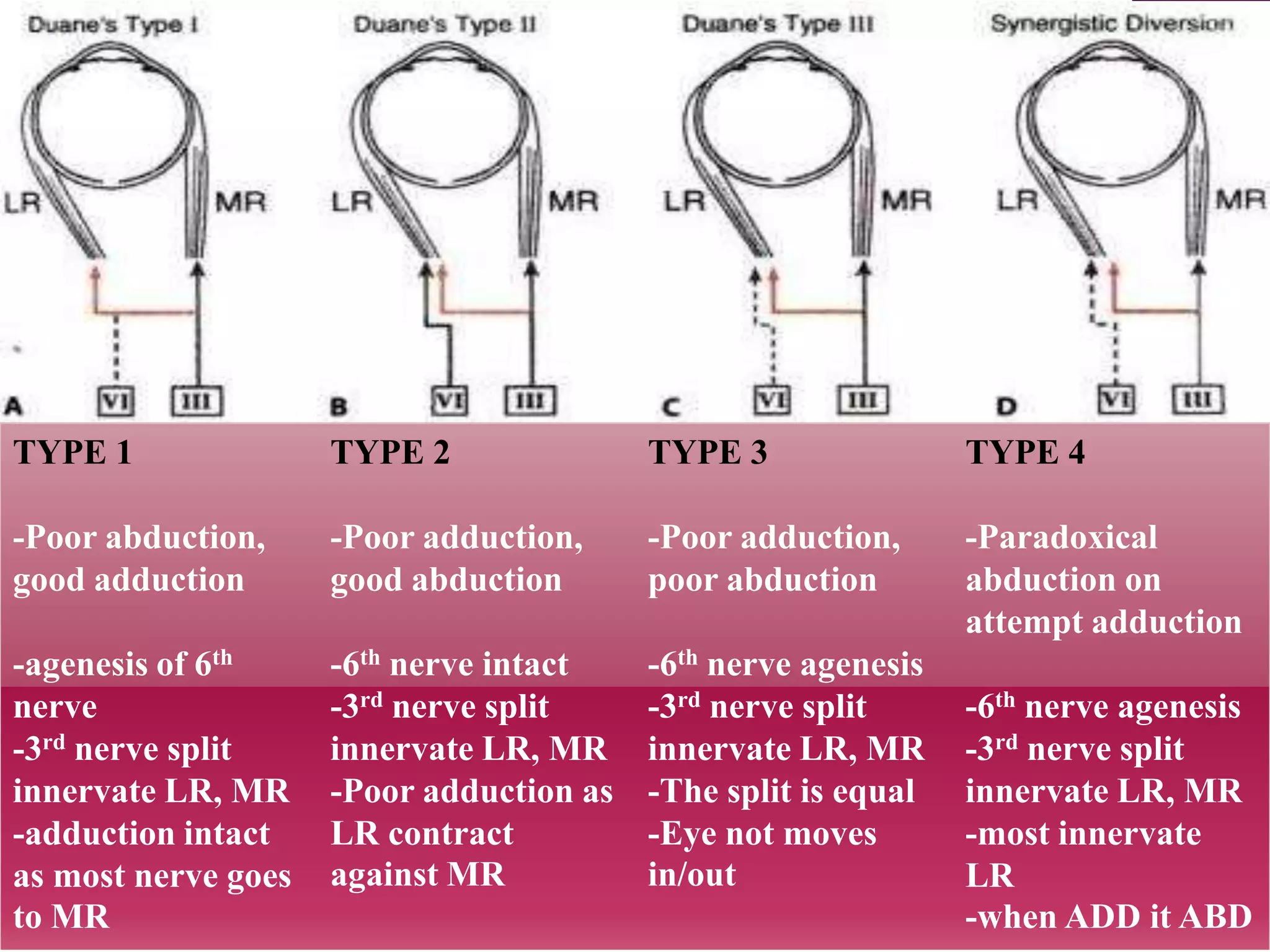
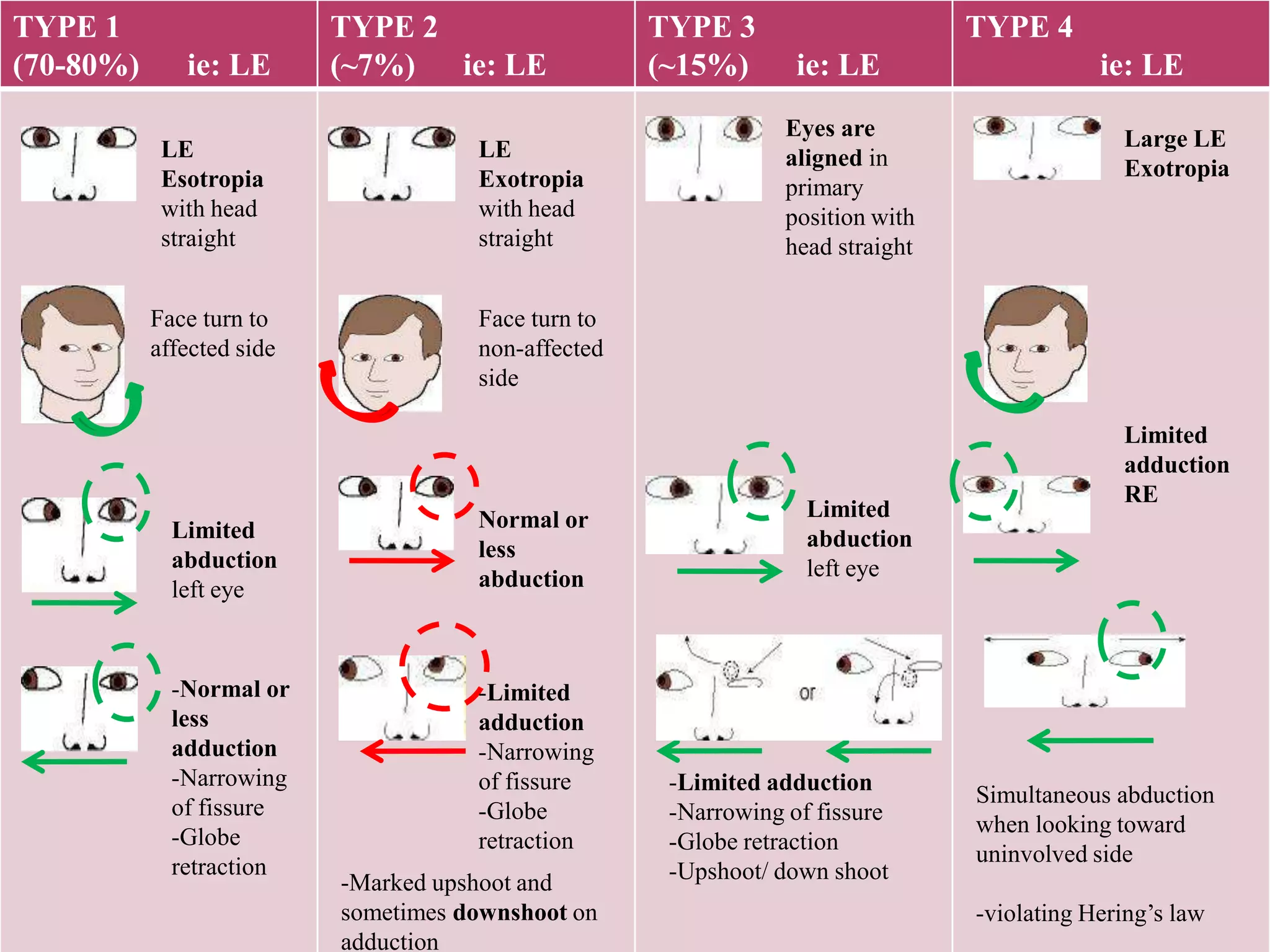
TYPE 1

TYPE 2

TYPE 3

TYPE 4

-Poor abduction,
good adduction

-Poor adduction,
good abduction

-Poor adduction,
poor abduction

-Paradoxical
abduction on
attempt adduction

-agenesis of 6th
nerve
-3rd nerve split
innervate LR, MR
-adduction intact
as most nerve goes
to MR

-6th nerve intact
-3rd nerve split
innervate LR, MR
-Poor adduction as
LR contract
against MR

-6th nerve agenesis
-3rd nerve split
innervate LR, MR
-The split is equal
-Eye not moves
in/out

-6th nerve agenesis
-3rd nerve split
innervate LR, MR
-most innervate
LR
-when ADD it ABD
TYPE 1
(70-80%)

ie: LE
LE
Esotropia
with head
straight
Face turn to
affected side

TYPE 2
(~7%)
ie: LE
LE
Exotropia
with head
straight

TYPE 3
(~15%)

TYPE 4
ie: LE
Eyes are
aligned in
primary
position with
head straight

ie: LE
Large LE
Exotropia

Face turn to
non-affected
side

Limited
abduction
left eye

Normal or
less
abduction

-Normal or
less
adduction
-Narrowing
of fissure
-Globe
retraction

-Limited
adduction
-Narrowing
of fissure
-Globe
retraction
-Marked upshoot and
sometimes downshoot on
adduction

Limited
abduction
left eye

-Limited adduction
-Narrowing of fissure
-Globe retraction
-Upshoot/ down shoot

Limited
adduction
RE

Simultaneous abduction
when looking toward
uninvolved side
-violating Hering’s law
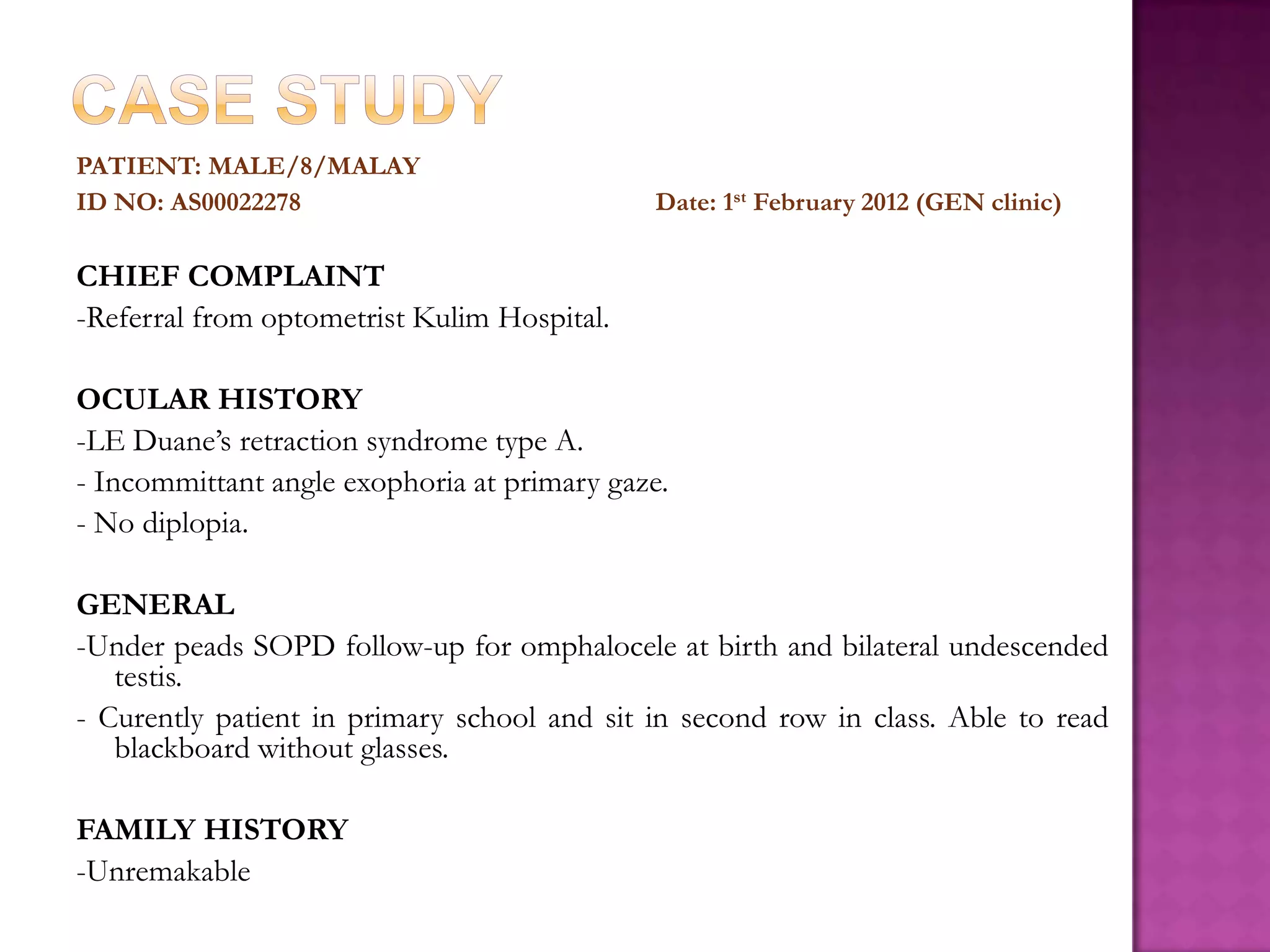
PATIENT: MALE/8/MALAY
ID NO: AS00022278

Date: 1st February 2012 (GEN clinic)

CHIEF COMPLAINT
-Referral from optometrist Kulim Hospital.
OCULAR HISTORY
-LE Duane’s retraction syndrome type A.
- Incommittant angle exophoria at primary gaze.
- No diplopia.
GENERAL
-Under peads SOPD follow-up for omphalocele at birth and bilateral undescended
testis.
- Curently patient in primary school and sit in second row in class. Able to read
blackboard without glasses.
FAMILY HISTORY
-Unremakable
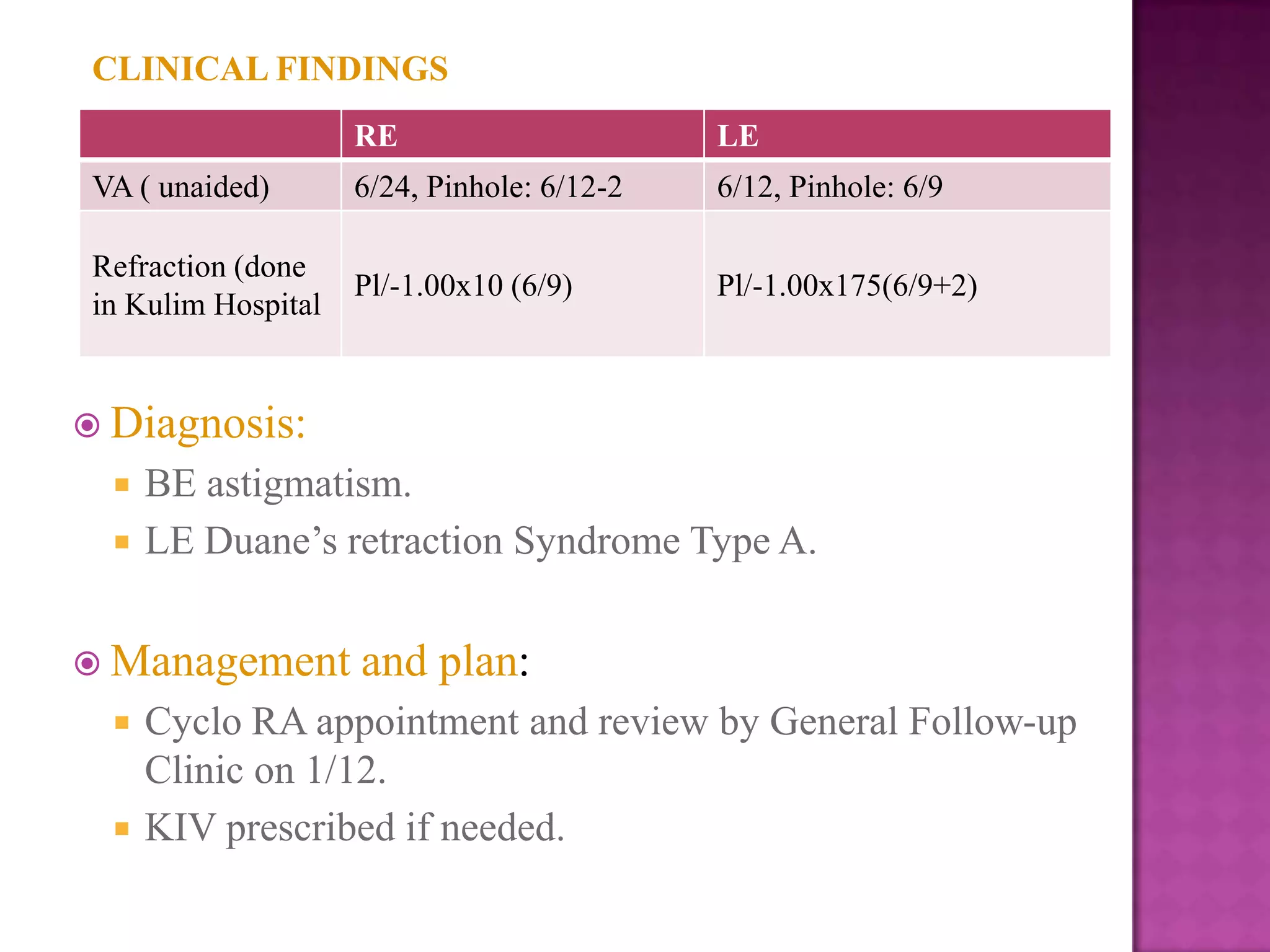
CLINICAL FINDINGS
RE

LE

VA ( unaided)

6/24, Pinhole: 6/12-2

6/12, Pinhole: 6/9

Refraction (done
in Kulim Hospital

Pl/-1.00x10 (6/9)

Pl/-1.00x175(6/9+2)

 Diagnosis:



BE astigmatism.
LE Duane’s retraction Syndrome Type A.

 Management



and plan:

Cyclo RA appointment and review by General Follow-up
Clinic on 1/12.
KIV prescribed if needed.
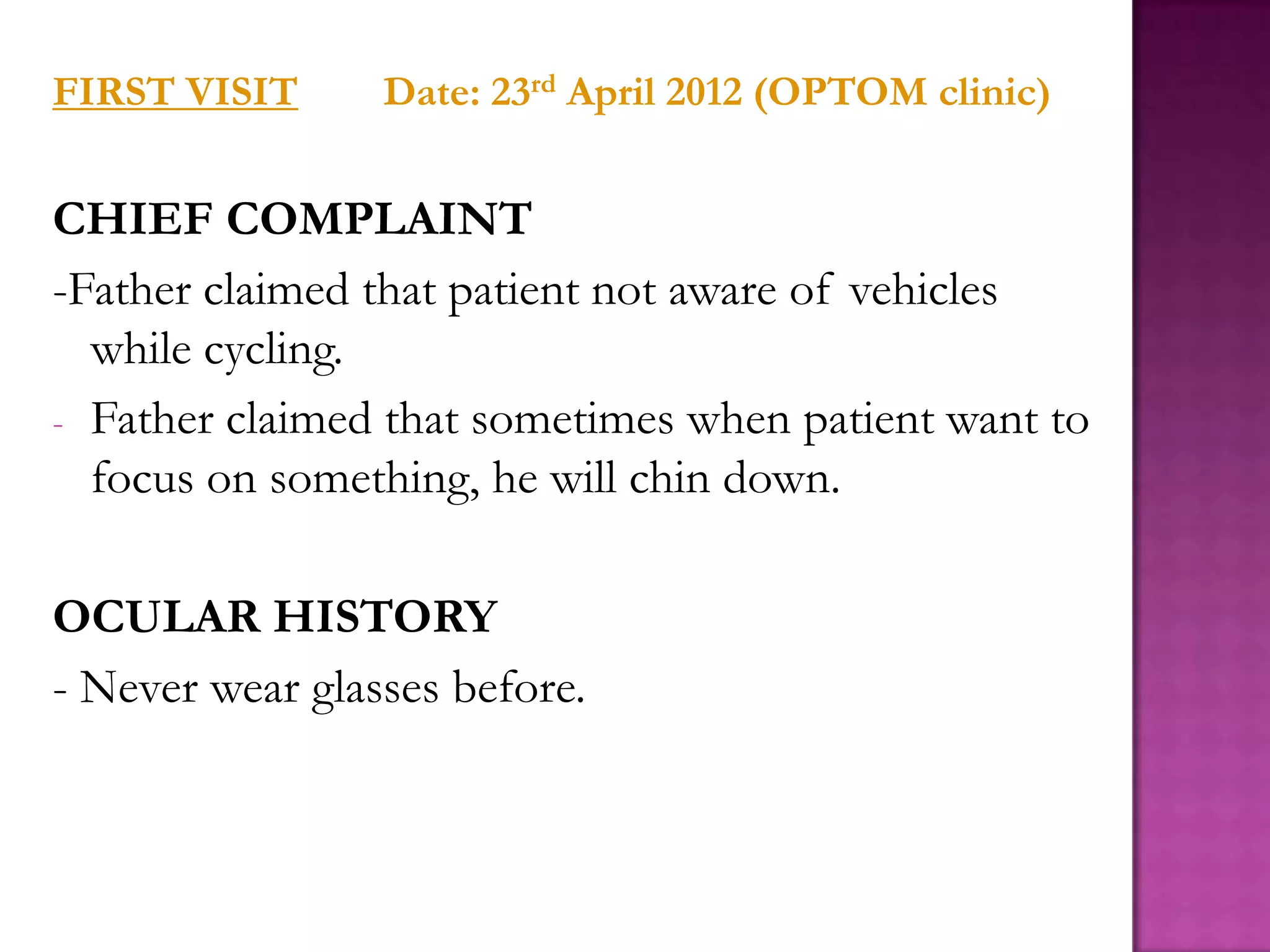
FIRST VISIT

Date: 23rd April 2012 (OPTOM clinic)

CHIEF COMPLAINT
-Father claimed that patient not aware of vehicles
while cycling.
- Father claimed that sometimes when patient want to
focus on something, he will chin down.
OCULAR HISTORY
- Never wear glasses before.
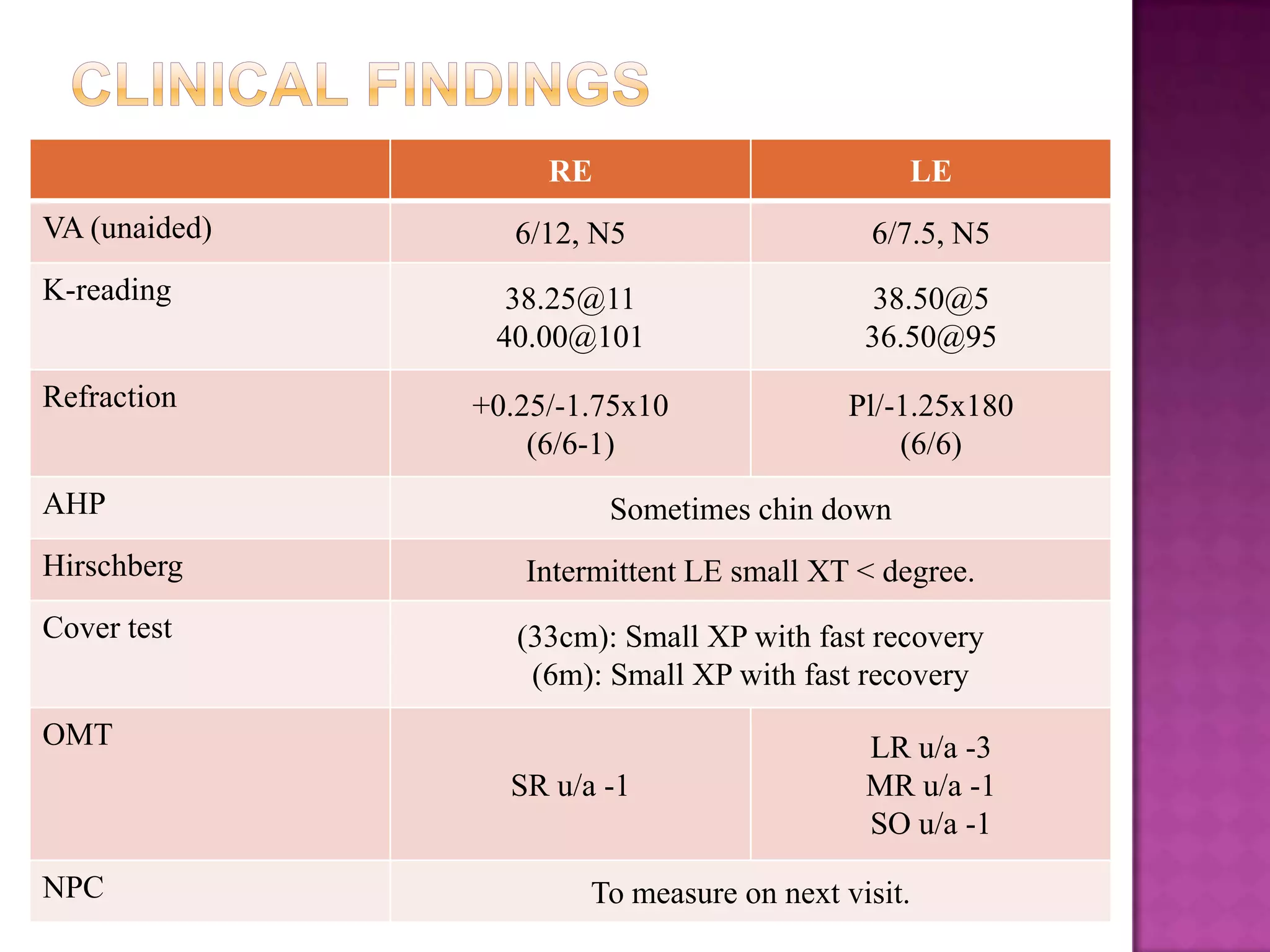
RE

LE

6/12, N5

6/7.5, N5

K-reading

38.25@11
40.00@101

38.50@5
36.50@95

Refraction

+0.25/-1.75x10
(6/6-1)

Pl/-1.25x180
(6/6)

VA (unaided)

AHP

Sometimes chin down

Hirschberg

Intermittent LE small XT < degree.

Cover test

(33cm): Small XP with fast recovery
(6m): Small XP with fast recovery

OMT
SR u/a -1
NPC

LR u/a -3
MR u/a -1
SO u/a -1

To measure on next visit.
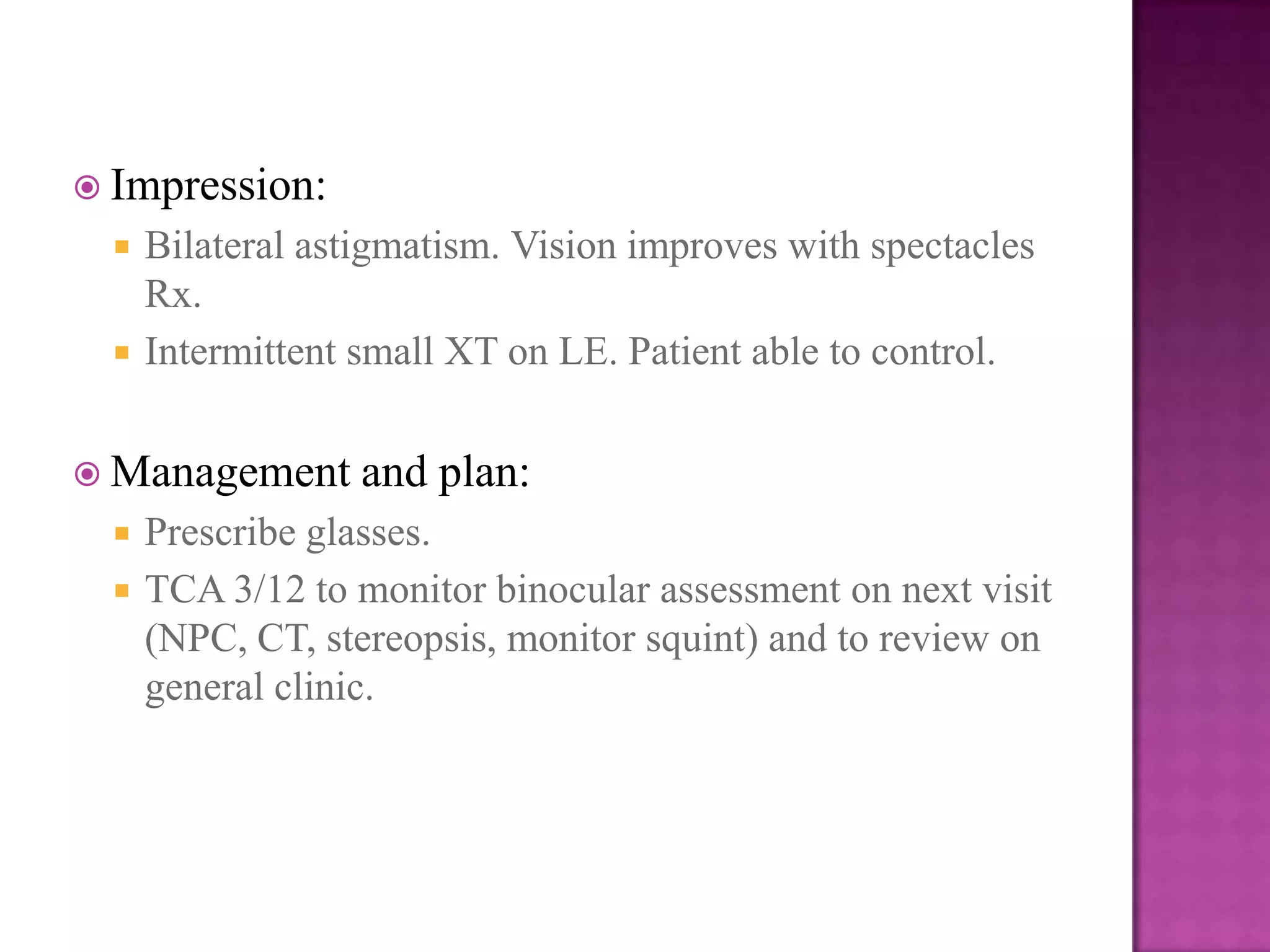
 Impression:



Bilateral astigmatism. Vision improves with spectacles
Rx.
Intermittent small XT on LE. Patient able to control.

 Management



and plan:

Prescribe glasses.
TCA 3/12 to monitor binocular assessment on next visit
(NPC, CT, stereopsis, monitor squint) and to review on
general clinic.
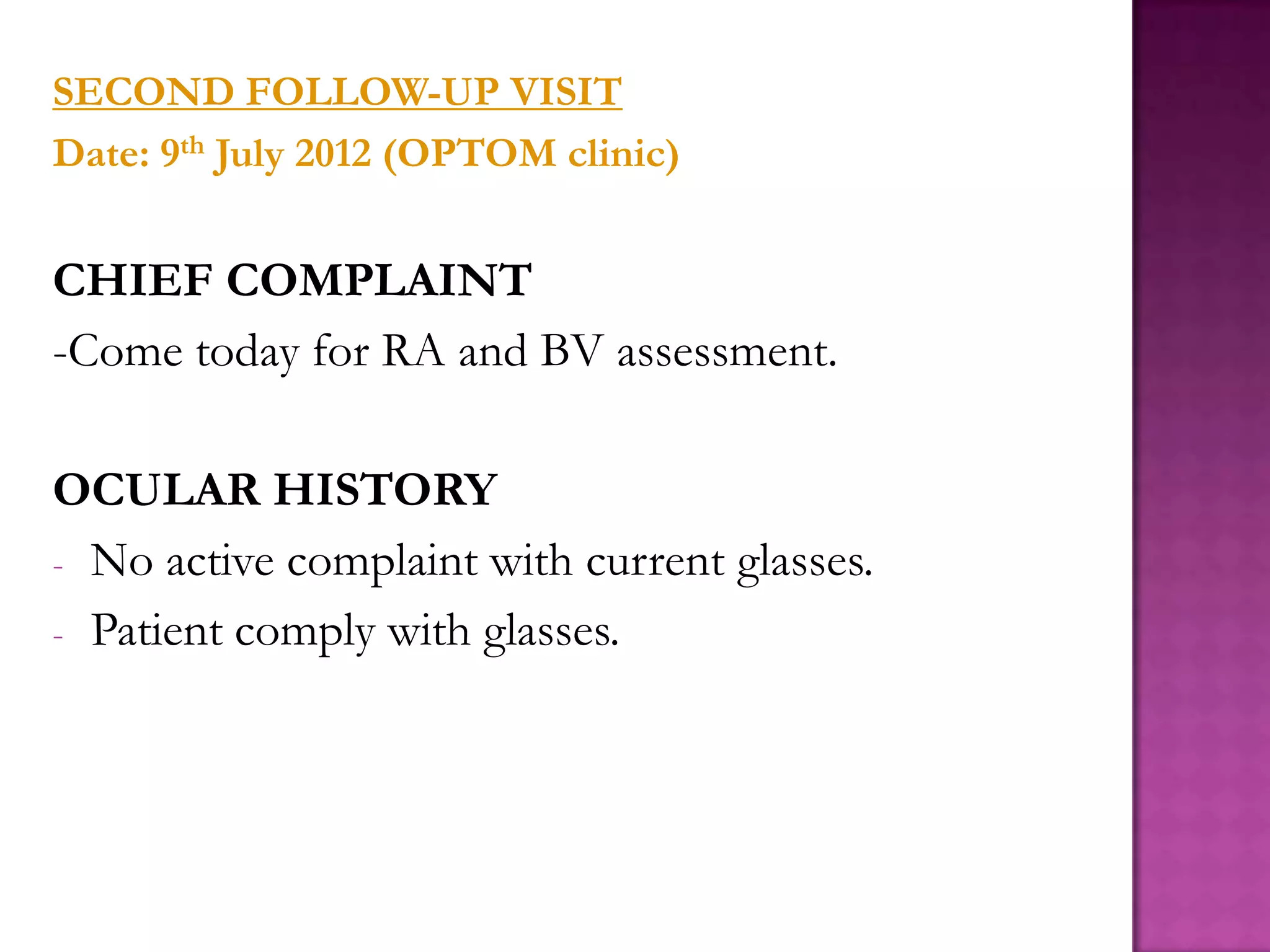
SECOND FOLLOW-UP VISIT
Date: 9th July 2012 (OPTOM clinic)

CHIEF COMPLAINT
-Come today for RA and BV assessment.
OCULAR HISTORY
- No active complaint with current glasses.
- Patient comply with glasses.
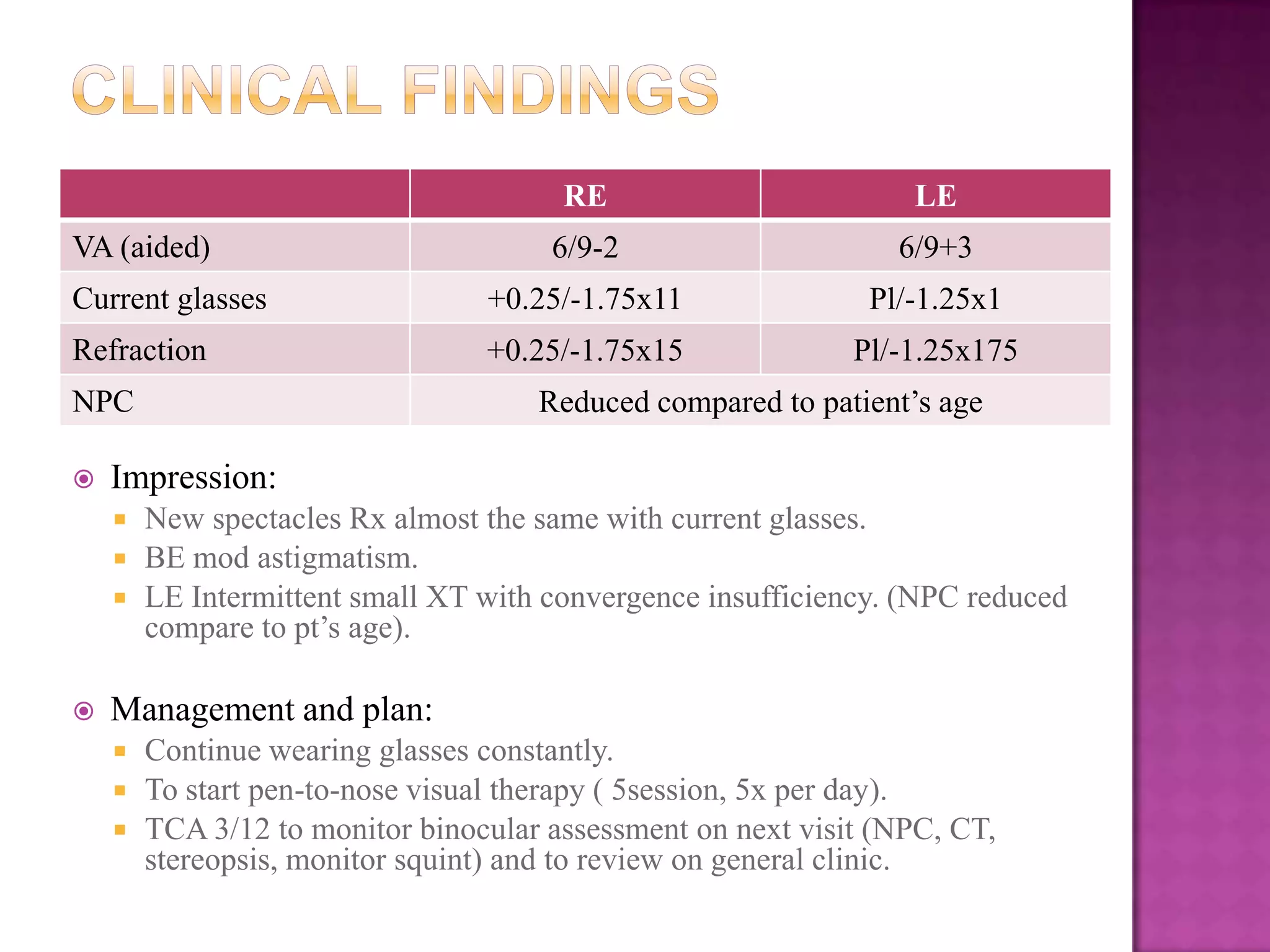
RE

LE

6/9-2

6/9+3

Current glasses

+0.25/-1.75x11

Pl/-1.25x1

Refraction

+0.25/-1.75x15

Pl/-1.25x175

VA (aided)

NPC


Reduced compared to patient’s age

Impression:
New spectacles Rx almost the same with current glasses.
 BE mod astigmatism.
 LE Intermittent small XT with convergence insufficiency. (NPC reduced
compare to pt’s age).




Management and plan:
Continue wearing glasses constantly.
 To start pen-to-nose visual therapy ( 5session, 5x per day).
 TCA 3/12 to monitor binocular assessment on next visit (NPC, CT,
stereopsis, monitor squint) and to review on general clinic.

THIRD FOLLOW-UP VISIT
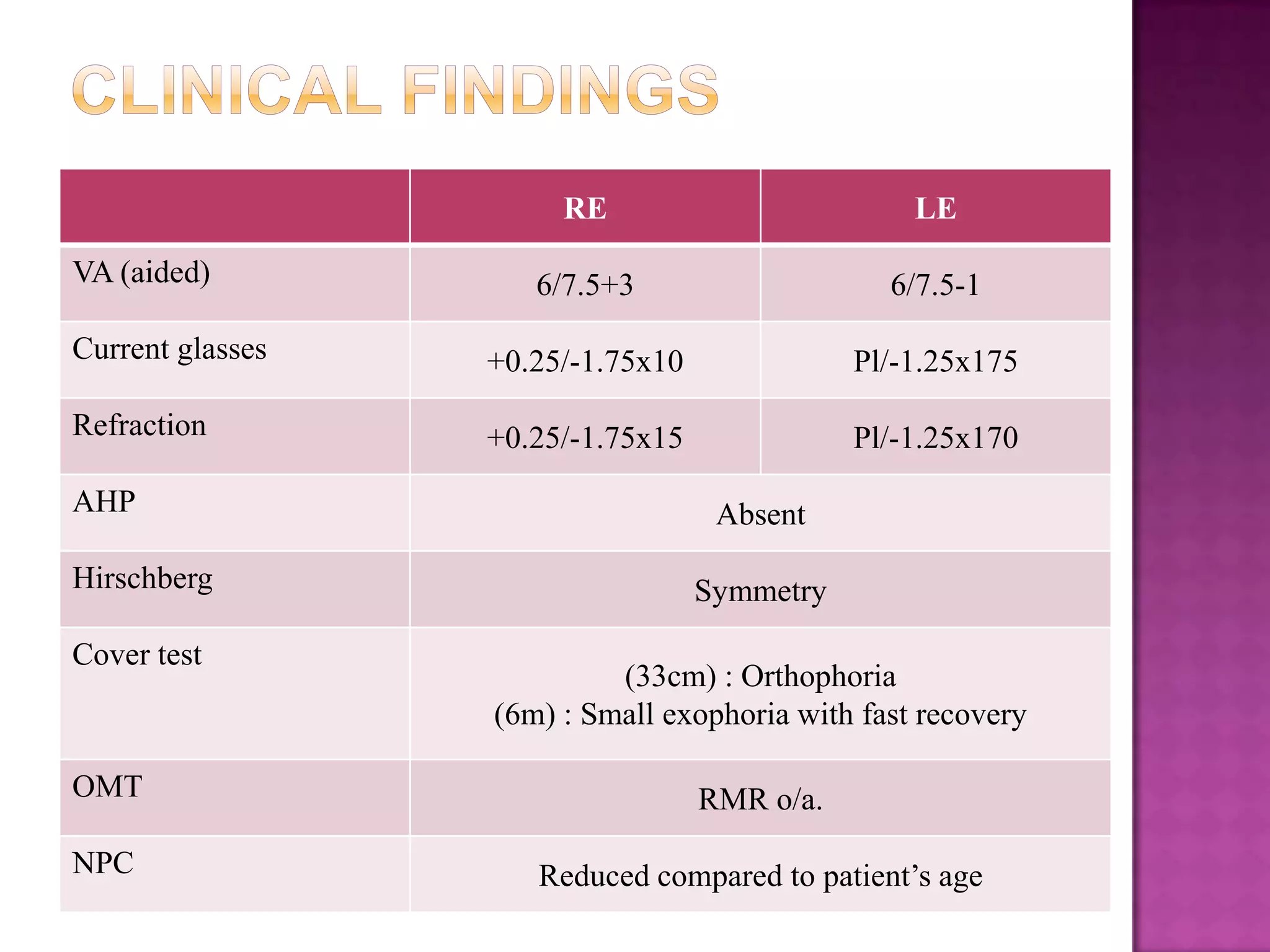
Date: 25th October 2012 (OPTOM clinic)

CHIEF COMPLAINT
-Come today for RA and BV assessment.
OCULAR HISTORY
- No active complaint with current glasses.
RE

LE

6/7.5+3

6/7.5-1

Current glasses

+0.25/-1.75x10

Pl/-1.25x175

Refraction

+0.25/-1.75x15

Pl/-1.25x170

VA (aided)

AHP
Hirschberg
Cover test

Absent

Symmetry
(33cm) : Orthophoria
(6m) : Small exophoria with fast recovery

OMT

RMR o/a.

NPC

Reduced compared to patient’s age
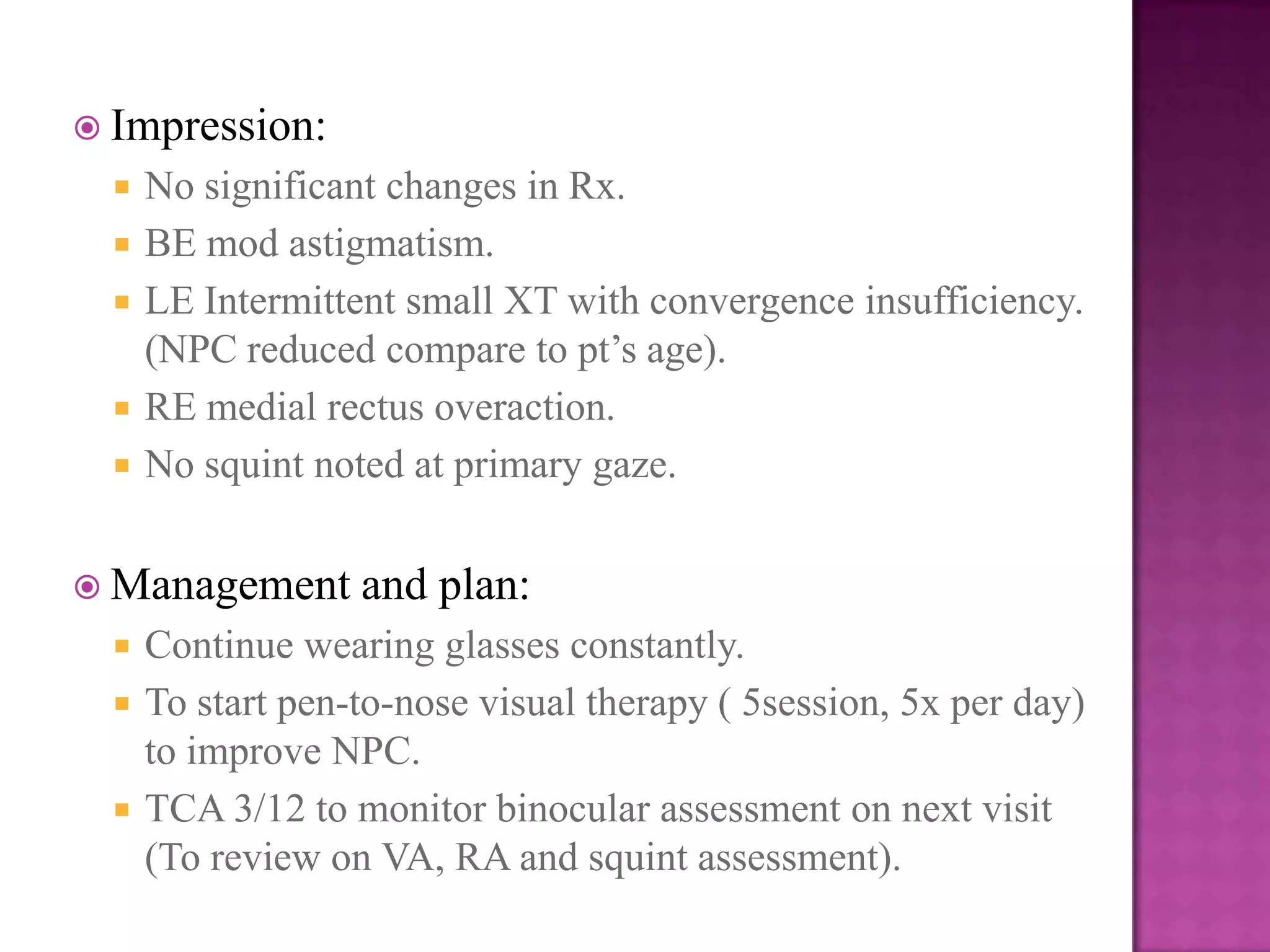
 Impression:






No significant changes in Rx.
BE mod astigmatism.
LE Intermittent small XT with convergence insufficiency.
(NPC reduced compare to pt’s age).
RE medial rectus overaction.
No squint noted at primary gaze.

 Management





and plan:

Continue wearing glasses constantly.
To start pen-to-nose visual therapy ( 5session, 5x per day)
to improve NPC.
TCA 3/12 to monitor binocular assessment on next visit
(To review on VA, RA and squint assessment).
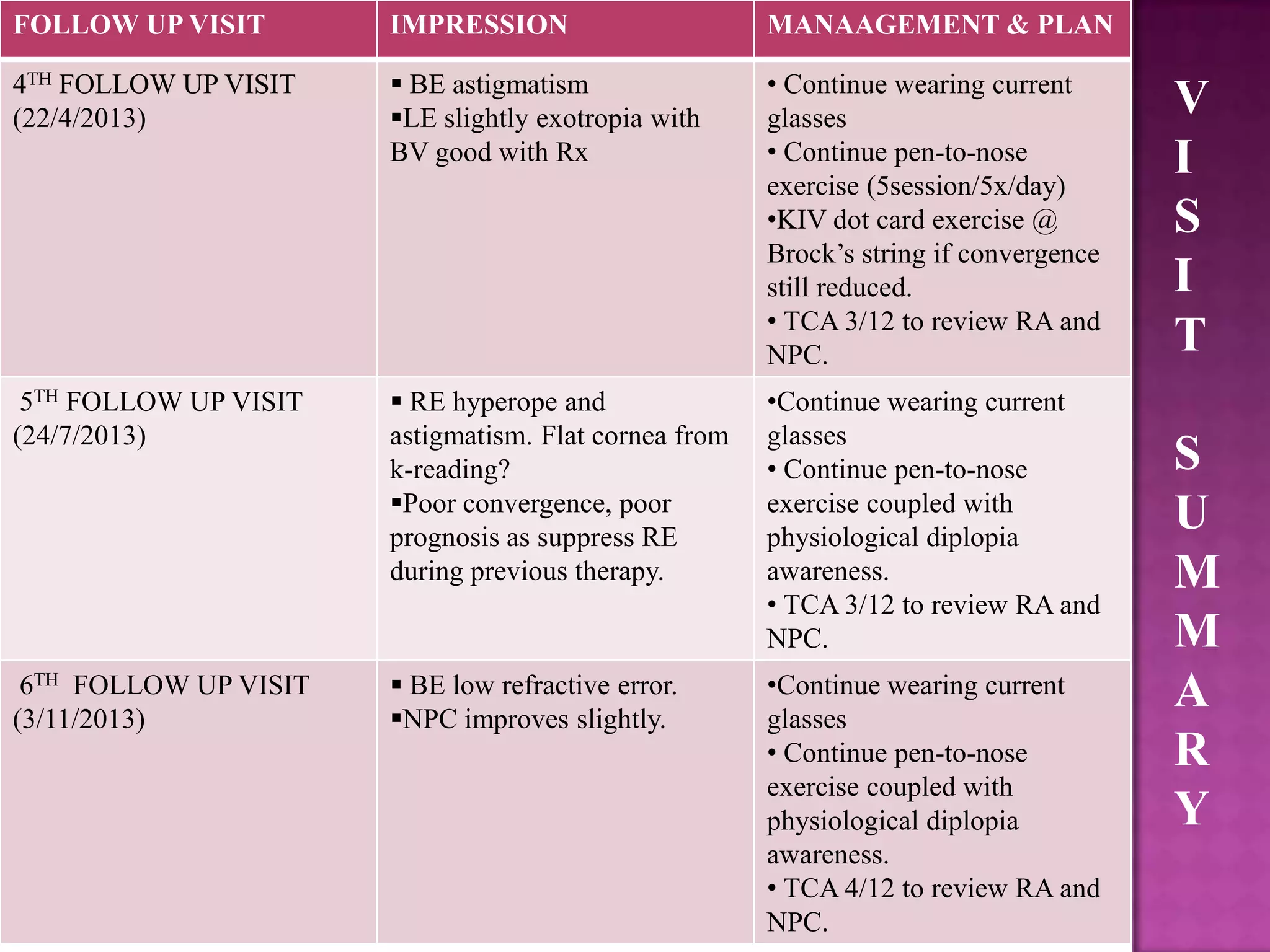
FOLLOW UP VISIT

IMPRESSION

MANAAGEMENT & PLAN

4TH FOLLOW UP VISIT
(22/4/2013)

 BE astigmatism
LE slightly exotropia with
BV good with Rx

• Continue wearing current
glasses
• Continue pen-to-nose
exercise (5session/5x/day)
•KIV dot card exercise @
Brock’s string if convergence
still reduced.
• TCA 3/12 to review RA and
NPC.

5TH FOLLOW UP VISIT
(24/7/2013)

 RE hyperope and
astigmatism. Flat cornea from
k-reading?
Poor convergence, poor
prognosis as suppress RE
during previous therapy.

•Continue wearing current
glasses
• Continue pen-to-nose
exercise coupled with
physiological diplopia
awareness.
• TCA 3/12 to review RA and
NPC.

6TH FOLLOW UP VISIT
(3/11/2013)

 BE low refractive error.
NPC improves slightly.

•Continue wearing current
glasses
• Continue pen-to-nose
exercise coupled with
physiological diplopia
awareness.
• TCA 4/12 to review RA and
NPC.

V
I
S
I
T
S
U
M
M
A
R
Y
 Clinical
1)
2)
3)
4)
5)
6)

investigations:-

Age of presentation
Visual acuity
Abnormal head posture (AHP)
Cover test
Ocular motility
Hess chart
 History





taking

During history taking, we need to ask about the age of
presentation.
Because this syndrome may be occurs during first year
of life, but occasionally later.
Treatment need to give as early as possible for better
prognosis of vision and patient’s condition.
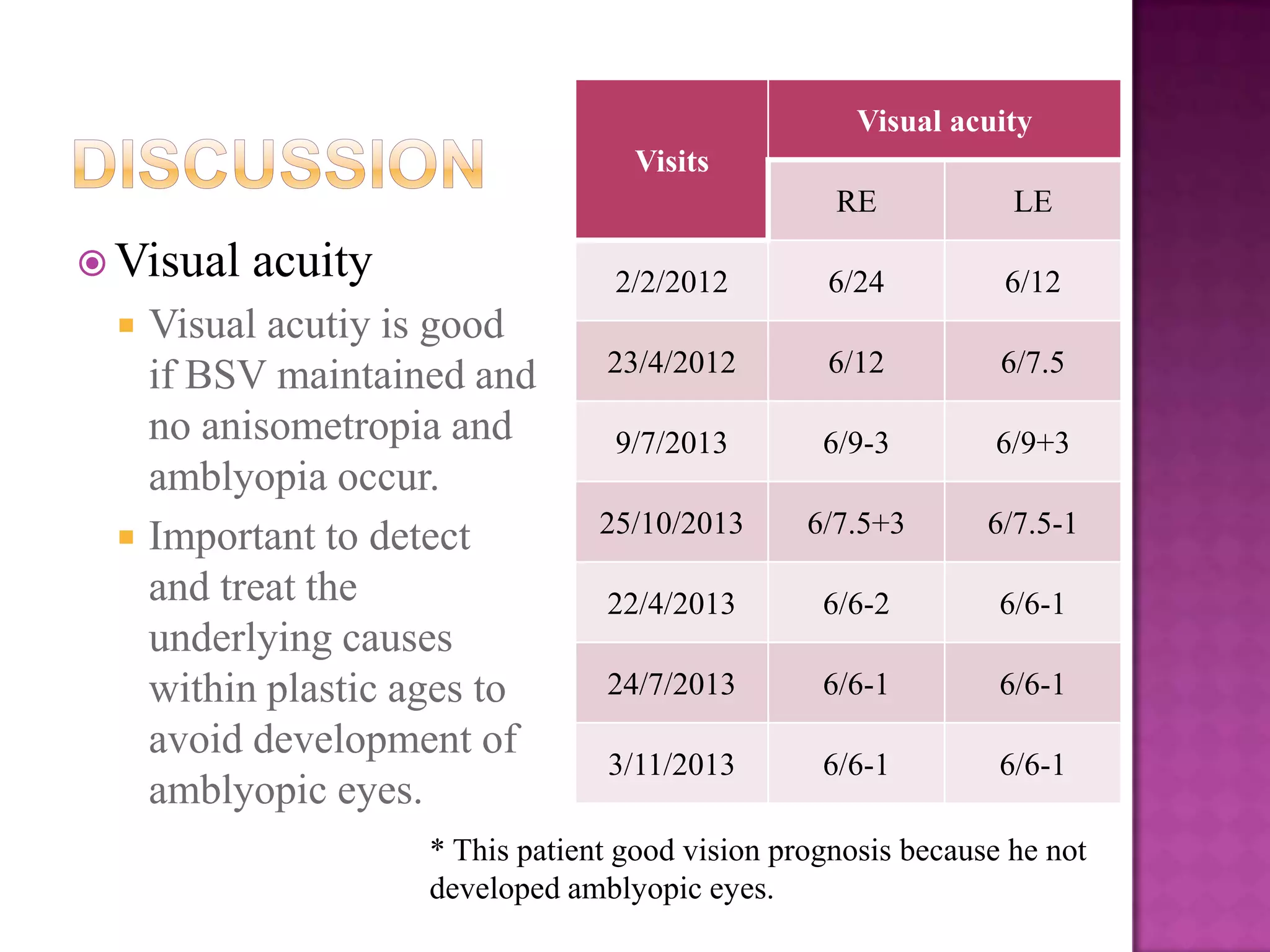
Visual acuity
Visits

RE

 Visual




2/2/2012

acuity

Visual acutiy is good
if BSV maintained and
no anisometropia and
amblyopia occur.
Important to detect
and treat the
underlying causes
within plastic ages to
avoid development of
amblyopic eyes.

LE

6/24

6/12

23/4/2012

6/12

6/7.5

9/7/2013

6/9-3

6/9+3

25/10/2013

6/7.5+3

6/7.5-1

22/4/2013

6/6-2

6/6-1

24/7/2013

6/6-1

6/6-1

3/11/2013

6/6-1

6/6-1

* This patient good vision prognosis because he not
developed amblyopic eyes.
 Abnormal

Head
Posture (AHP)




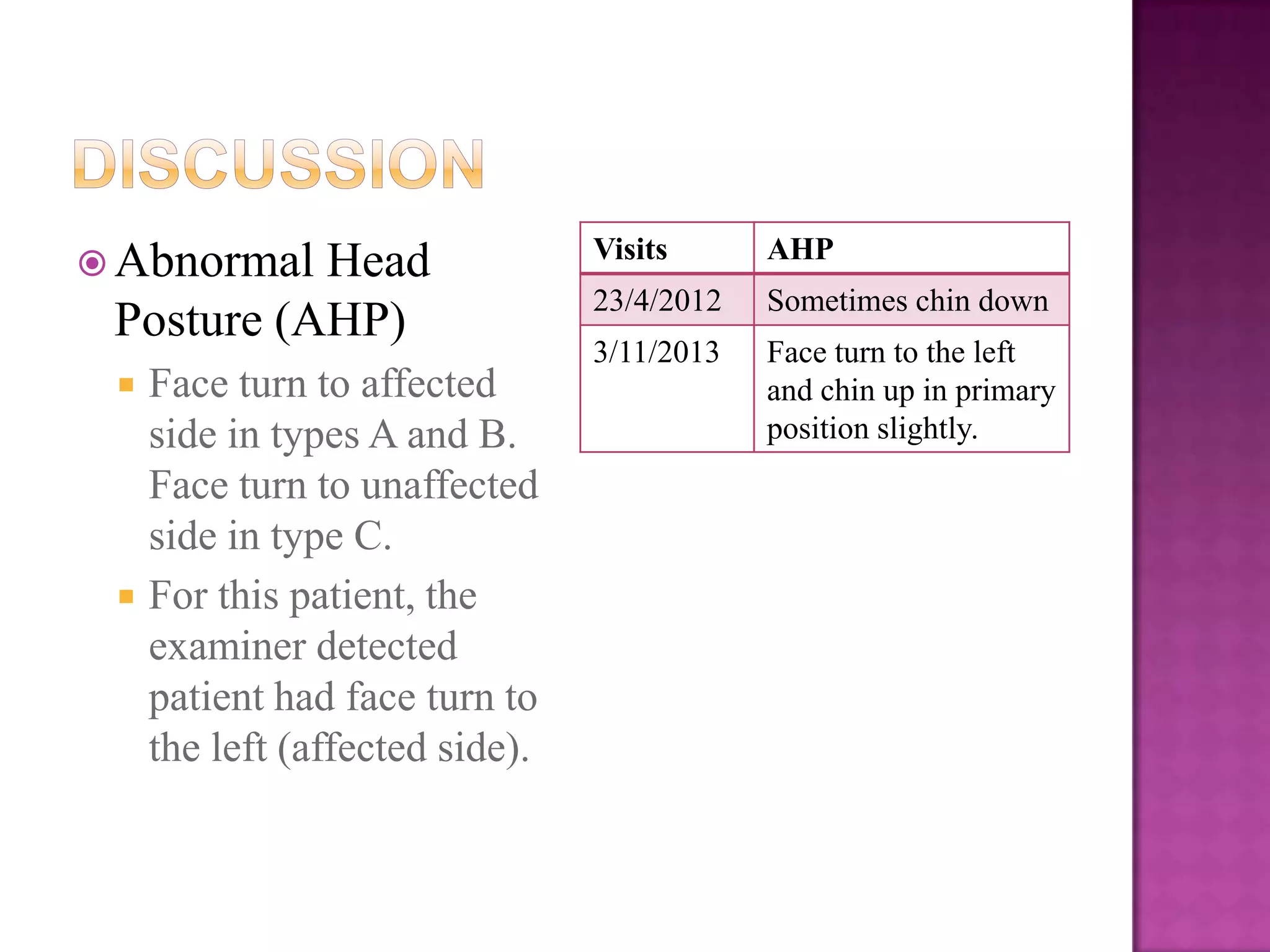
Face turn to affected
side in types A and B.
Face turn to unaffected
side in type C.
For this patient, the
examiner detected
patient had face turn to
the left (affected side).

Visits

AHP

23/4/2012

Sometimes chin down

3/11/2013

Face turn to the left
and chin up in primary
position slightly.
 Cover





test

BSV often maintained with AHP.
Without AHP, types A and B – esotropia. Type C –
exotropia.
In this patient all clinical findings are showed patient
had slightly exo deviation.
Probably had type 3? Confused and indistinct
classification.
 Ocular










motility

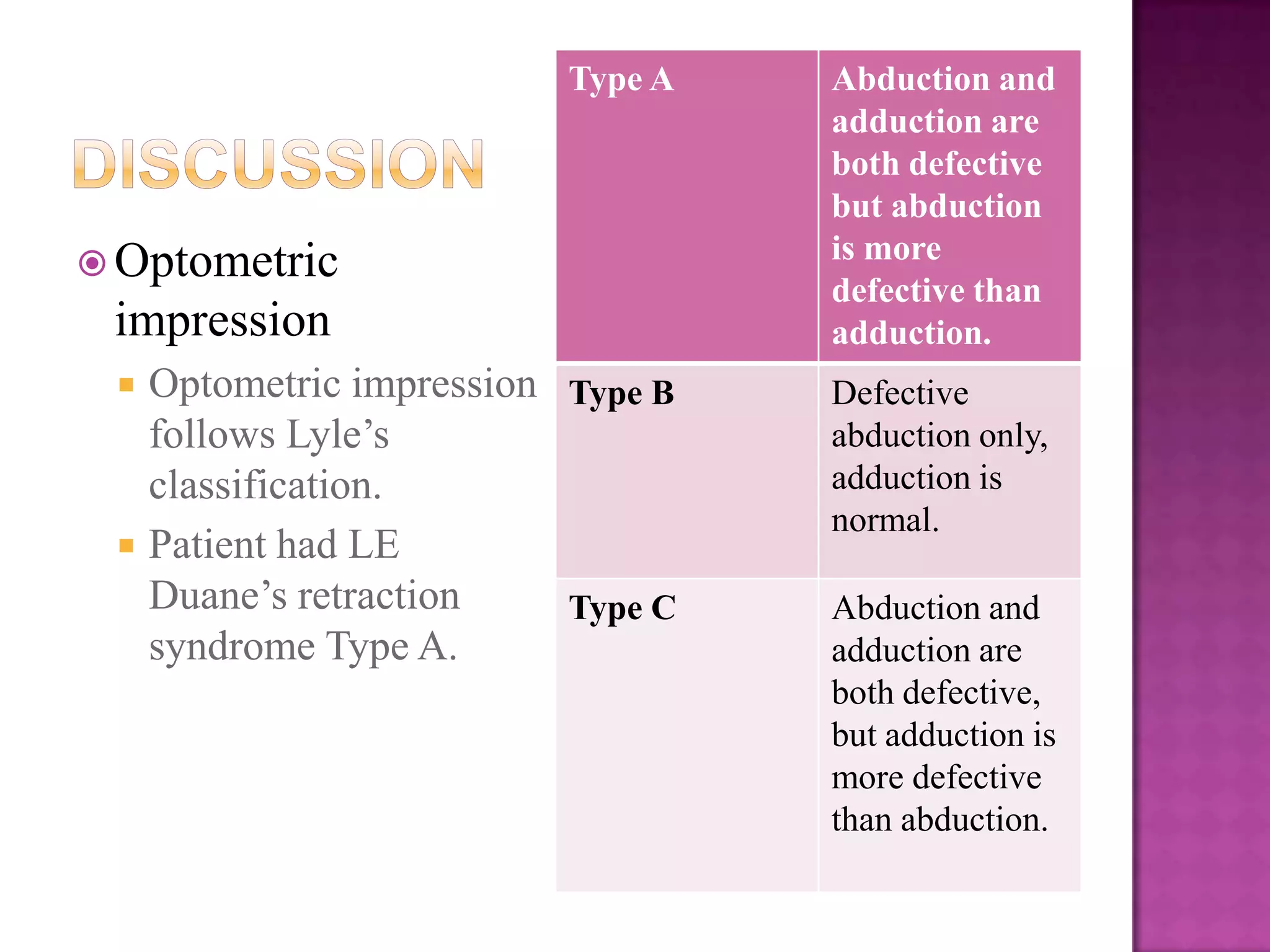
limitation of abduction with or without limitation of
adduction
attempt adduction: retraction of the globe with narrowing of
fissure
Protrusion & widening of the palpebral fissure on abduction
May or may not have AHP
Possible defect of convergence
Strabismus
 May have updrift or downdrift on adduction with A or V
pattern
Amblyopia if not adopted AHP


Hess screen test




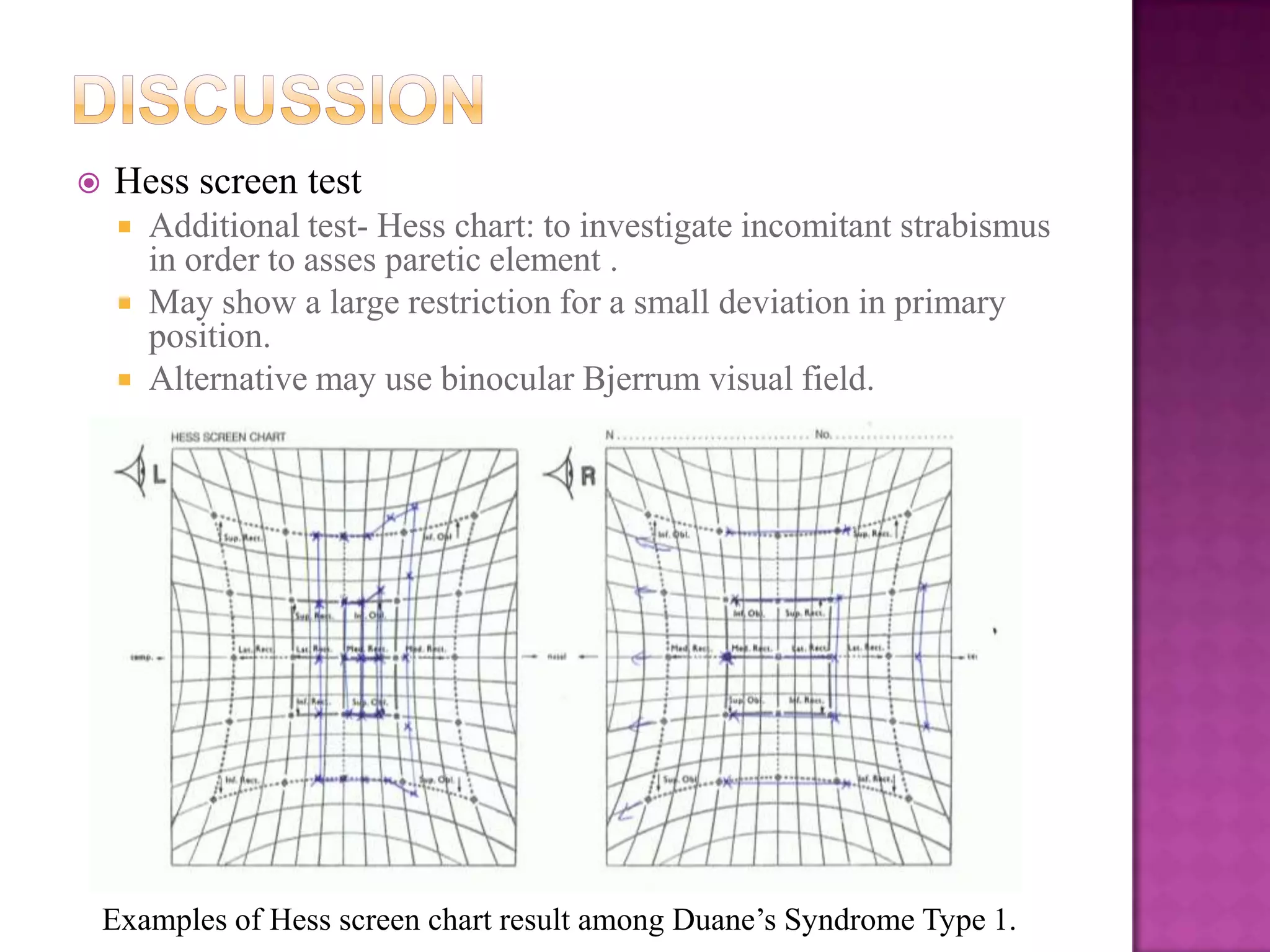
Additional test- Hess chart: to investigate incomitant strabismus
in order to asses paretic element .
May show a large restriction for a small deviation in primary
position.
Alternative may use binocular Bjerrum visual field.

Examples of Hess screen chart result among Duane’s Syndrome Type 1.
Type A

Abduction and
adduction are
both defective
but abduction
is more
defective than
adduction.

Optometric impression Type B
follows Lyle’s
classification.
 Patient had LE
Duane’s retraction
Type C
syndrome Type A.

Defective
abduction only,
adduction is
normal.

 Optometric

impression


Abduction and
adduction are
both defective,
but adduction is
more defective
than abduction.
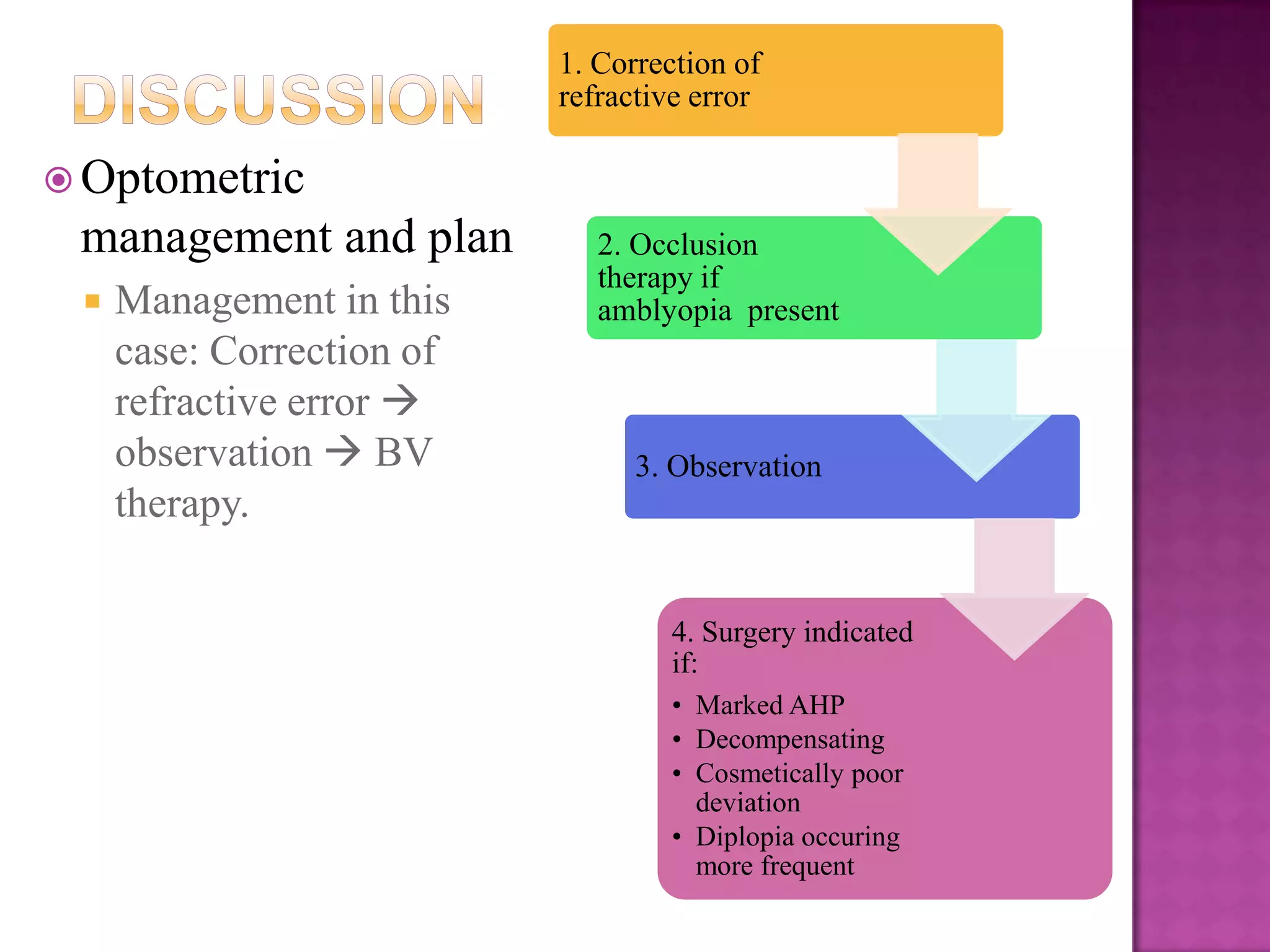
1. Correction of
refractive error

 Optometric

management and plan


Management in this
case: Correction of
refractive error 
observation  BV
therapy.

2. Occlusion
therapy if
amblyopia present

3. Observation

4. Surgery indicated
if:
• Marked AHP
• Decompensating
• Cosmetically poor
deviation
• Diplopia occuring
more frequent
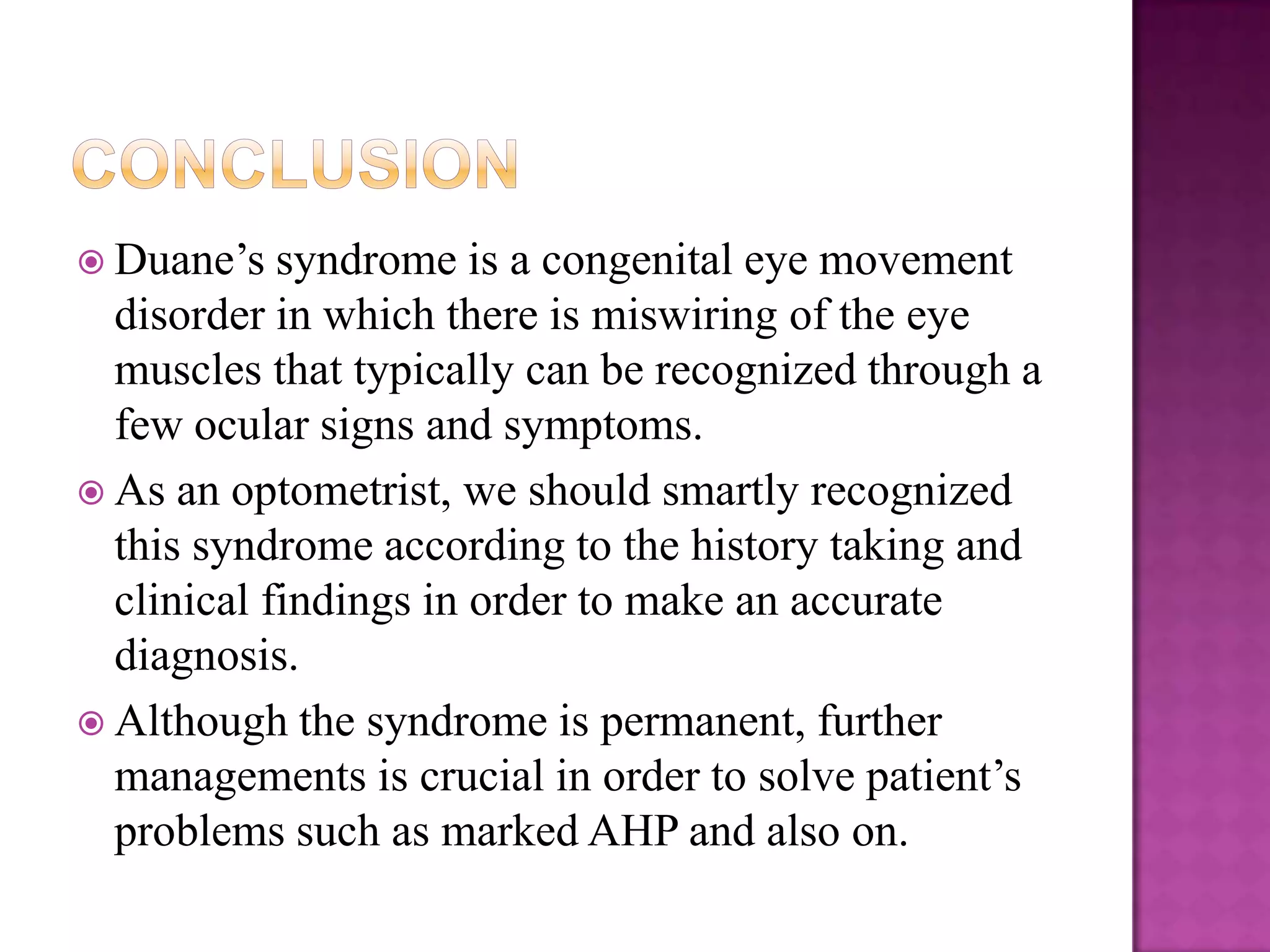
 Duane’s

syndrome is a congenital eye movement
disorder in which there is miswiring of the eye
muscles that typically can be recognized through a
few ocular signs and symptoms.
 As an optometrist, we should smartly recognized
this syndrome according to the history taking and
clinical findings in order to make an accurate
diagnosis.
 Although the syndrome is permanent, further
managements is crucial in order to solve patient’s
problems such as marked AHP and also on.
 Kim

JH, Hwang JM. Presence of the abducens
nerve according to the type of Duane's
retraction syndrome. Ophthalmology. 2005
Jan;112(1):109-13. PubMed PMID: 15629829.
 National Human Genome Research Institute
(http://www.genome.gov/11508984)
 Dr. Norliza Lecture Notes on Nonstrabismic
anomaly.
 Lecture notes Bengkel penglihatan Binokular dan
Terapi Visual Tahap 1/2013.
 E-His systems, Hospital Sultanah Bahiyah, Alor
Setar.
 Special

thanks to all clinician optometrist in
Sultanah Bahiyah Hospital.
 Special thanks to Ms Nur Shafiah ( Supervisor’s
optometrist) for this case.
Case presentation 2 : Duane's Syndrome

Case presentation 2 : Duane's Syndrome

  • 1.
    Prepared by: Anis SuzannaBinti Mohamad Optometrist Hospital Langkawi
  • 2.
  • 3.
  • 4.
     aka Duane’s retractionsyndrome or Stilting-Turk Syndrome  a congenital eye movement disorder due to misdirection of the nerve fiber on eye muscle  causing some eye muscle to contract when they shouldn’t, vice versa  can be unilateral or bilateral  Usually congenital but may be acquired  Affects females to males in ratio of 3:2  May be associated with other defects such as deafness, anisometropia etc.
  • 5.
    1. Mechanical factors  fibrosed LR  abnormallyinsertion of MR  binding of MR sheath to wall 2. Embryonic factors  Disturbance in normal embryonic development during 2nd month of gestation  3. 4. Development of 3rd, 4th, and 6th cranial nerve occur Paradoxical innervation  Increase innervation to both MR & LR during ADD and relaxation of both MR & LR during ABD Trauma
  • 6.
    limitation of abductionwith or without limitation of adduction  attempt adduction: retraction of the globe with narrowing of fissure  Protrusion & widening of the palpebral fissure on abduction  May or may not have AHP  Possible defect of convergence  Strabismus  May have updrift or downdrift on adduction with A or V pattern  Amblyopia if not adopted AHP  Generally positive forced duction test (done by ophthalmologist) 
  • 7.
     Clinically, it isoften subdivided into 4 types with associated symptoms:     1. Type 1 2. Type 2 3. Type 3 4. Type 4  Each of the group can be further classified into 3 subgroups depends on where the eyes are when on the primary gaze:    Subgroup A (Effected eye looks esotropia) Subgroup B (Effected eye looks exotropia) Subgroup C (Effected eye looks almost orthophoria)
  • 8.
    TYPE 1 TYPE 2 TYPE3 TYPE 4 -Poor abduction, good adduction -Poor adduction, good abduction -Poor adduction, poor abduction -Paradoxical abduction on attempt adduction -agenesis of 6th nerve -3rd nerve split innervate LR, MR -adduction intact as most nerve goes to MR -6th nerve intact -3rd nerve split innervate LR, MR -Poor adduction as LR contract against MR -6th nerve agenesis -3rd nerve split innervate LR, MR -The split is equal -Eye not moves in/out -6th nerve agenesis -3rd nerve split innervate LR, MR -most innervate LR -when ADD it ABD
  • 9.
    TYPE 1 (70-80%) ie: LE LE Esotropia withhead straight Face turn to affected side TYPE 2 (~7%) ie: LE LE Exotropia with head straight TYPE 3 (~15%) TYPE 4 ie: LE Eyes are aligned in primary position with head straight ie: LE Large LE Exotropia Face turn to non-affected side Limited abduction left eye Normal or less abduction -Normal or less adduction -Narrowing of fissure -Globe retraction -Limited adduction -Narrowing of fissure -Globe retraction -Marked upshoot and sometimes downshoot on adduction Limited abduction left eye -Limited adduction -Narrowing of fissure -Globe retraction -Upshoot/ down shoot Limited adduction RE Simultaneous abduction when looking toward uninvolved side -violating Hering’s law
  • 10.
    PATIENT: MALE/8/MALAY ID NO:AS00022278 Date: 1st February 2012 (GEN clinic) CHIEF COMPLAINT -Referral from optometrist Kulim Hospital. OCULAR HISTORY -LE Duane’s retraction syndrome type A. - Incommittant angle exophoria at primary gaze. - No diplopia. GENERAL -Under peads SOPD follow-up for omphalocele at birth and bilateral undescended testis. - Curently patient in primary school and sit in second row in class. Able to read blackboard without glasses. FAMILY HISTORY -Unremakable
  • 11.
    CLINICAL FINDINGS RE LE VA (unaided) 6/24, Pinhole: 6/12-2 6/12, Pinhole: 6/9 Refraction (done in Kulim Hospital Pl/-1.00x10 (6/9) Pl/-1.00x175(6/9+2)  Diagnosis:   BE astigmatism. LE Duane’s retraction Syndrome Type A.  Management   and plan: Cyclo RA appointment and review by General Follow-up Clinic on 1/12. KIV prescribed if needed.
  • 12.
    FIRST VISIT Date: 23rdApril 2012 (OPTOM clinic) CHIEF COMPLAINT -Father claimed that patient not aware of vehicles while cycling. - Father claimed that sometimes when patient want to focus on something, he will chin down. OCULAR HISTORY - Never wear glasses before.
  • 13.
    RE LE 6/12, N5 6/7.5, N5 K-reading 38.25@11 40.00@101 38.50@5 36.50@95 Refraction +0.25/-1.75x10 (6/6-1) Pl/-1.25x180 (6/6) VA(unaided) AHP Sometimes chin down Hirschberg Intermittent LE small XT < degree. Cover test (33cm): Small XP with fast recovery (6m): Small XP with fast recovery OMT SR u/a -1 NPC LR u/a -3 MR u/a -1 SO u/a -1 To measure on next visit.
  • 14.
     Impression:   Bilateral astigmatism.Vision improves with spectacles Rx. Intermittent small XT on LE. Patient able to control.  Management   and plan: Prescribe glasses. TCA 3/12 to monitor binocular assessment on next visit (NPC, CT, stereopsis, monitor squint) and to review on general clinic.
  • 15.
    SECOND FOLLOW-UP VISIT Date:9th July 2012 (OPTOM clinic) CHIEF COMPLAINT -Come today for RA and BV assessment. OCULAR HISTORY - No active complaint with current glasses. - Patient comply with glasses.
  • 16.
    RE LE 6/9-2 6/9+3 Current glasses +0.25/-1.75x11 Pl/-1.25x1 Refraction +0.25/-1.75x15 Pl/-1.25x175 VA (aided) NPC  Reducedcompared to patient’s age Impression: New spectacles Rx almost the same with current glasses.  BE mod astigmatism.  LE Intermittent small XT with convergence insufficiency. (NPC reduced compare to pt’s age).   Management and plan: Continue wearing glasses constantly.  To start pen-to-nose visual therapy ( 5session, 5x per day).  TCA 3/12 to monitor binocular assessment on next visit (NPC, CT, stereopsis, monitor squint) and to review on general clinic. 
  • 17.
    THIRD FOLLOW-UP VISIT Date:25th October 2012 (OPTOM clinic) CHIEF COMPLAINT -Come today for RA and BV assessment. OCULAR HISTORY - No active complaint with current glasses.
  • 18.
    RE LE 6/7.5+3 6/7.5-1 Current glasses +0.25/-1.75x10 Pl/-1.25x175 Refraction +0.25/-1.75x15 Pl/-1.25x170 VA (aided) AHP Hirschberg Covertest Absent Symmetry (33cm) : Orthophoria (6m) : Small exophoria with fast recovery OMT RMR o/a. NPC Reduced compared to patient’s age
  • 19.
     Impression:      No significantchanges in Rx. BE mod astigmatism. LE Intermittent small XT with convergence insufficiency. (NPC reduced compare to pt’s age). RE medial rectus overaction. No squint noted at primary gaze.  Management    and plan: Continue wearing glasses constantly. To start pen-to-nose visual therapy ( 5session, 5x per day) to improve NPC. TCA 3/12 to monitor binocular assessment on next visit (To review on VA, RA and squint assessment).
  • 20.
    FOLLOW UP VISIT IMPRESSION MANAAGEMENT& PLAN 4TH FOLLOW UP VISIT (22/4/2013)  BE astigmatism LE slightly exotropia with BV good with Rx • Continue wearing current glasses • Continue pen-to-nose exercise (5session/5x/day) •KIV dot card exercise @ Brock’s string if convergence still reduced. • TCA 3/12 to review RA and NPC. 5TH FOLLOW UP VISIT (24/7/2013)  RE hyperope and astigmatism. Flat cornea from k-reading? Poor convergence, poor prognosis as suppress RE during previous therapy. •Continue wearing current glasses • Continue pen-to-nose exercise coupled with physiological diplopia awareness. • TCA 3/12 to review RA and NPC. 6TH FOLLOW UP VISIT (3/11/2013)  BE low refractive error. NPC improves slightly. •Continue wearing current glasses • Continue pen-to-nose exercise coupled with physiological diplopia awareness. • TCA 4/12 to review RA and NPC. V I S I T S U M M A R Y
  • 21.
     Clinical 1) 2) 3) 4) 5) 6) investigations:- Age ofpresentation Visual acuity Abnormal head posture (AHP) Cover test Ocular motility Hess chart
  • 22.
     History    taking During historytaking, we need to ask about the age of presentation. Because this syndrome may be occurs during first year of life, but occasionally later. Treatment need to give as early as possible for better prognosis of vision and patient’s condition.
  • 23.
    Visual acuity Visits RE  Visual   2/2/2012 acuity Visualacutiy is good if BSV maintained and no anisometropia and amblyopia occur. Important to detect and treat the underlying causes within plastic ages to avoid development of amblyopic eyes. LE 6/24 6/12 23/4/2012 6/12 6/7.5 9/7/2013 6/9-3 6/9+3 25/10/2013 6/7.5+3 6/7.5-1 22/4/2013 6/6-2 6/6-1 24/7/2013 6/6-1 6/6-1 3/11/2013 6/6-1 6/6-1 * This patient good vision prognosis because he not developed amblyopic eyes.
  • 24.
     Abnormal Head Posture (AHP)   Faceturn to affected side in types A and B. Face turn to unaffected side in type C. For this patient, the examiner detected patient had face turn to the left (affected side). Visits AHP 23/4/2012 Sometimes chin down 3/11/2013 Face turn to the left and chin up in primary position slightly.
  • 25.
     Cover     test BSV oftenmaintained with AHP. Without AHP, types A and B – esotropia. Type C – exotropia. In this patient all clinical findings are showed patient had slightly exo deviation. Probably had type 3? Confused and indistinct classification.
  • 26.
     Ocular        motility limitation ofabduction with or without limitation of adduction attempt adduction: retraction of the globe with narrowing of fissure Protrusion & widening of the palpebral fissure on abduction May or may not have AHP Possible defect of convergence Strabismus  May have updrift or downdrift on adduction with A or V pattern Amblyopia if not adopted AHP
  • 27.
     Hess screen test    Additionaltest- Hess chart: to investigate incomitant strabismus in order to asses paretic element . May show a large restriction for a small deviation in primary position. Alternative may use binocular Bjerrum visual field. Examples of Hess screen chart result among Duane’s Syndrome Type 1.
  • 28.
    Type A Abduction and adductionare both defective but abduction is more defective than adduction. Optometric impression Type B follows Lyle’s classification.  Patient had LE Duane’s retraction Type C syndrome Type A. Defective abduction only, adduction is normal.  Optometric impression  Abduction and adduction are both defective, but adduction is more defective than abduction.
  • 29.
    1. Correction of refractiveerror  Optometric management and plan  Management in this case: Correction of refractive error  observation  BV therapy. 2. Occlusion therapy if amblyopia present 3. Observation 4. Surgery indicated if: • Marked AHP • Decompensating • Cosmetically poor deviation • Diplopia occuring more frequent
  • 30.
     Duane’s syndrome isa congenital eye movement disorder in which there is miswiring of the eye muscles that typically can be recognized through a few ocular signs and symptoms.  As an optometrist, we should smartly recognized this syndrome according to the history taking and clinical findings in order to make an accurate diagnosis.  Although the syndrome is permanent, further managements is crucial in order to solve patient’s problems such as marked AHP and also on.
  • 31.
     Kim JH, HwangJM. Presence of the abducens nerve according to the type of Duane's retraction syndrome. Ophthalmology. 2005 Jan;112(1):109-13. PubMed PMID: 15629829.  National Human Genome Research Institute (http://www.genome.gov/11508984)  Dr. Norliza Lecture Notes on Nonstrabismic anomaly.  Lecture notes Bengkel penglihatan Binokular dan Terapi Visual Tahap 1/2013.  E-His systems, Hospital Sultanah Bahiyah, Alor Setar.
  • 32.
     Special thanks toall clinician optometrist in Sultanah Bahiyah Hospital.  Special thanks to Ms Nur Shafiah ( Supervisor’s optometrist) for this case.

Editor's Notes

  • #28 LE has smaller field than RE. Suggest LE affected eye.Sloping sides to field indicates V pattern.Compressed field of LE on nasal part.Underaction of Left MR, IO, SOLarger field of RE Overaction of Right SR, LR, I