EYE Examination
BSCN 4 2021
Assessment of the Eye
• Examination of external eye structures
• Visual acuity of distant and near vision
• Extra Ocular eye movt-cranial nerves
• Visual fields by confrontation
• Six cardinal fields of gaze
• Corneal light reflex
• Cover/uncover test
• Pupils and pupillary response
Requirements
• Pen
• Paper
• Snellens chart
• Pen touch
• Ophthalmoscope
• Colour testing chart
• Tonometry-measure IOP
• Gonioscopy-visualizes the angleof the anterior chamber
• Perimetry testing-evaluates field of vision and scotomas (blind areas in the
visual field)
External Eye Structures
•Inspect the eyelids and eyelashes
•Observe the position and alignment of the
eyeball in the eye socket
•Inspect all other structures
Eye lid symmetry: Patient unable to completely close left
upper eyelid due to peripheral CN 7 dysfunction.
Structures to Inspect
•Position and alignment of eyes
•Eyebrows
•Eyelids
•Lacrimal Apparatus
Inspection
Visual Acuity
• Near Visual acuity
• Distance visual acuity
Near Visual Acuity
•Handheld vision chart
•Normal acuity is 14/14 with or without
corrective lenses
Near Visual Acuity
Hold card approx 14” from pt’s nose  Ask pt to
cover one eye
 Read smallest line  Cover other eye and repeat
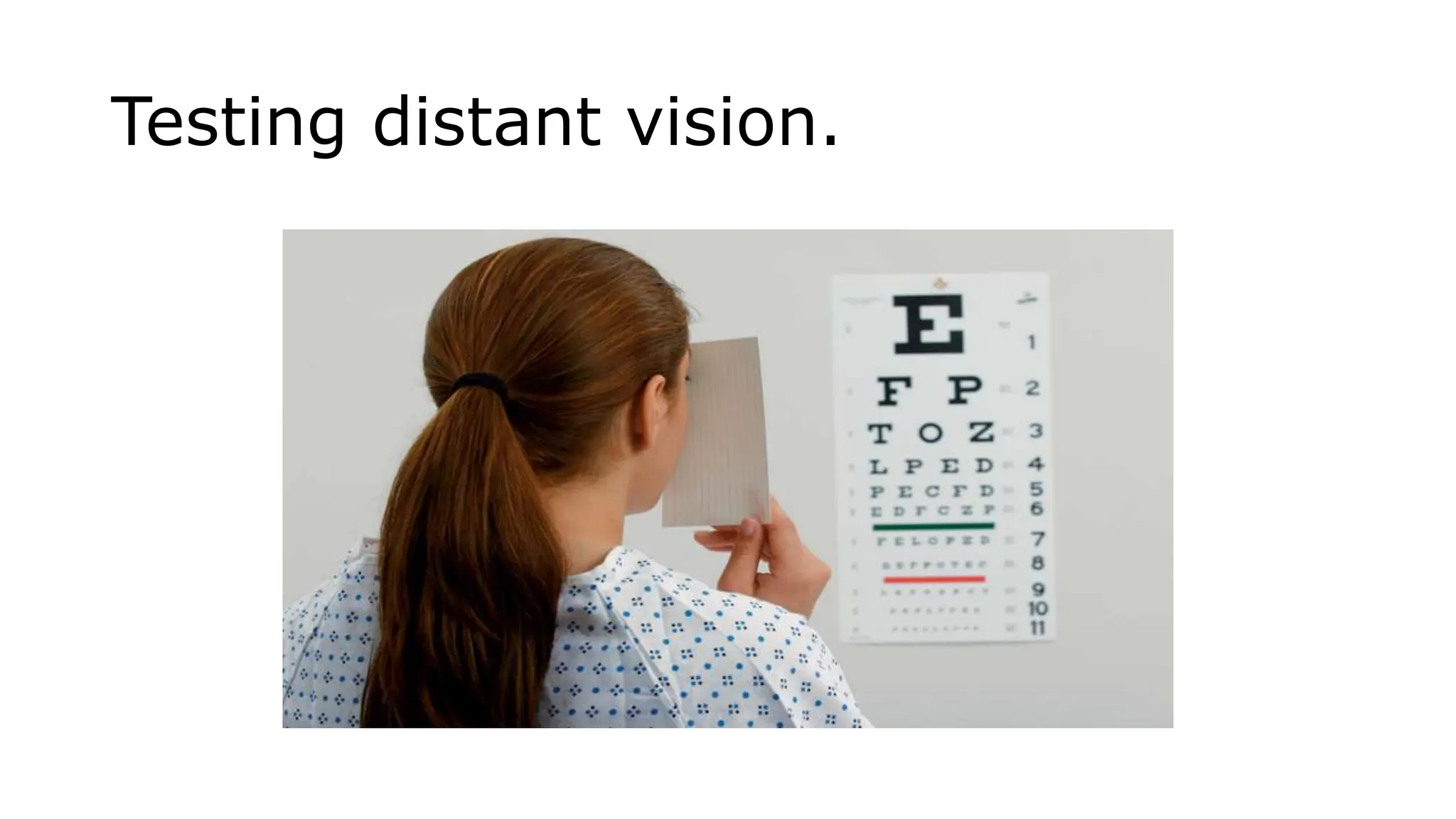
Testing distant vision.
Visual acuity
• Is the resolving power of the eye
• Measures quality and ability of the eye to resolve varying letter sizes
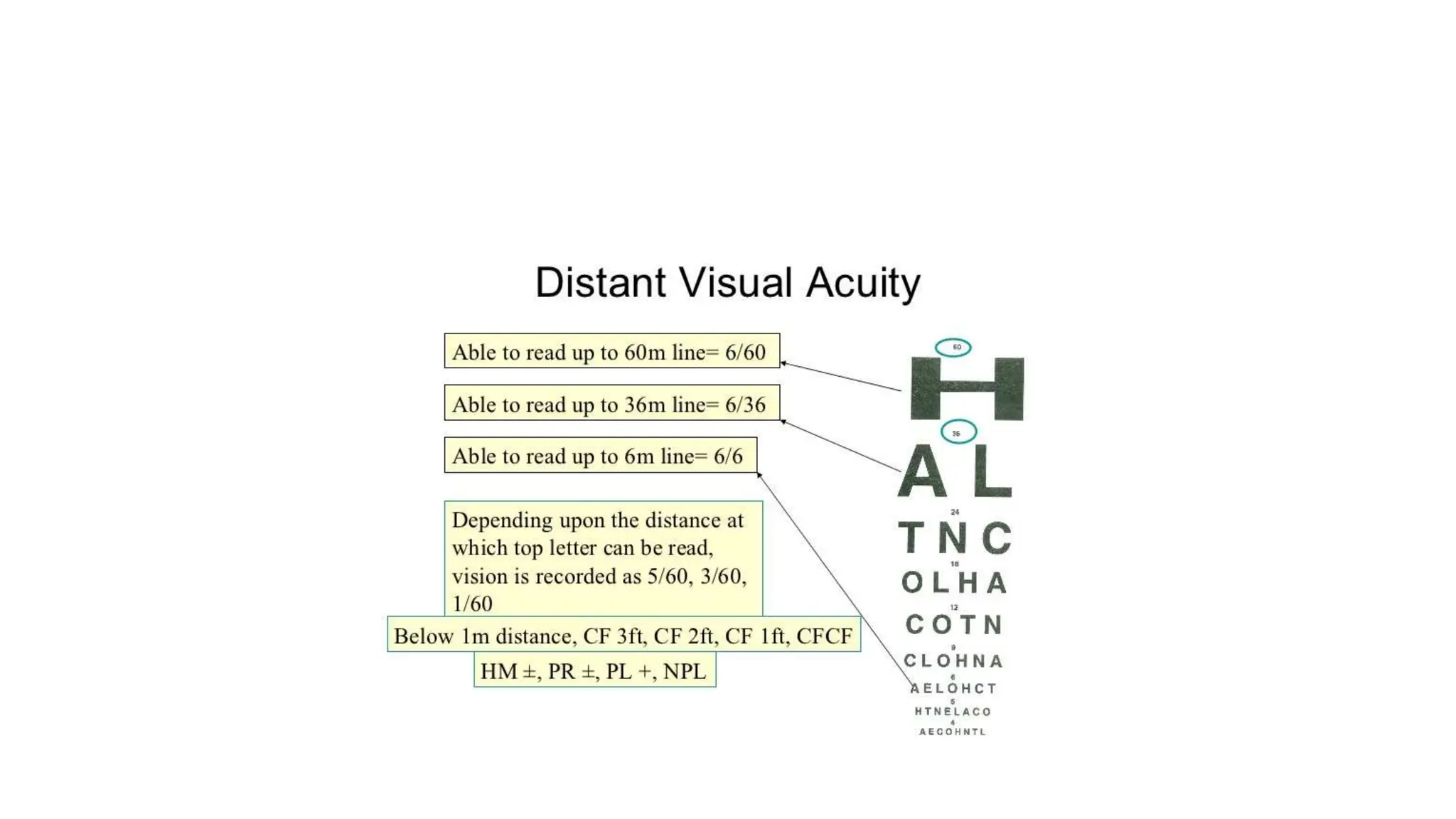
• Measured a 6m (20ft) distance for distant vision
Purpose-Visual acuity
To determine quantify visual acuity
To determine severity of vision imparing disorders
To classify visual impairment, low vision and blindness
Assessment of patient
Assess vision related Hx eg type of vision loss (gradual, sudden, transient) as time of onset, duration, Hx of spectacle wear.
Assess Hx of red eye, pain swelling, diplopia, photophobia, trauma, surgery
Observe abnormality in posture, capacity to comprehend
Required instrument
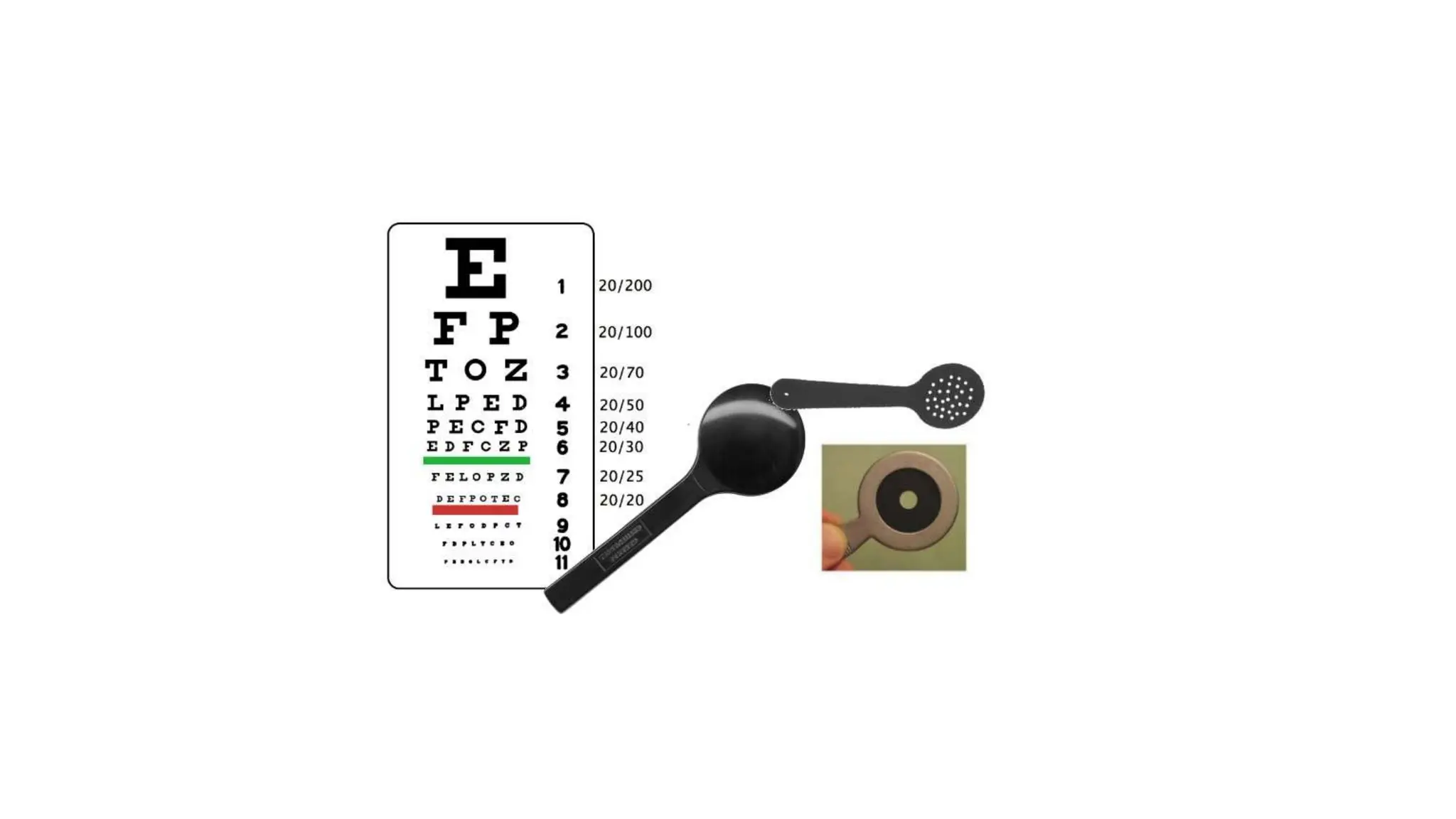
Snellen chart
Occluder
Patient habitual glasses (if present)
Pin hole
Patient preparation
Position patient at 6m from the chart in adequately illuminated room
Explain to patient the nature and importance of the test
Each eye is tested independently (i.e. one is covered while the other is used to read).
Evaluation
• Record the score of Snellen test as visual acuity unaided, with
correction and with pin hole
• Visual acuity of 6/6 is normal, less than 6/6 is clinically abnormal
• Functionally, visual acuity less than 6/12 is considered abnormal
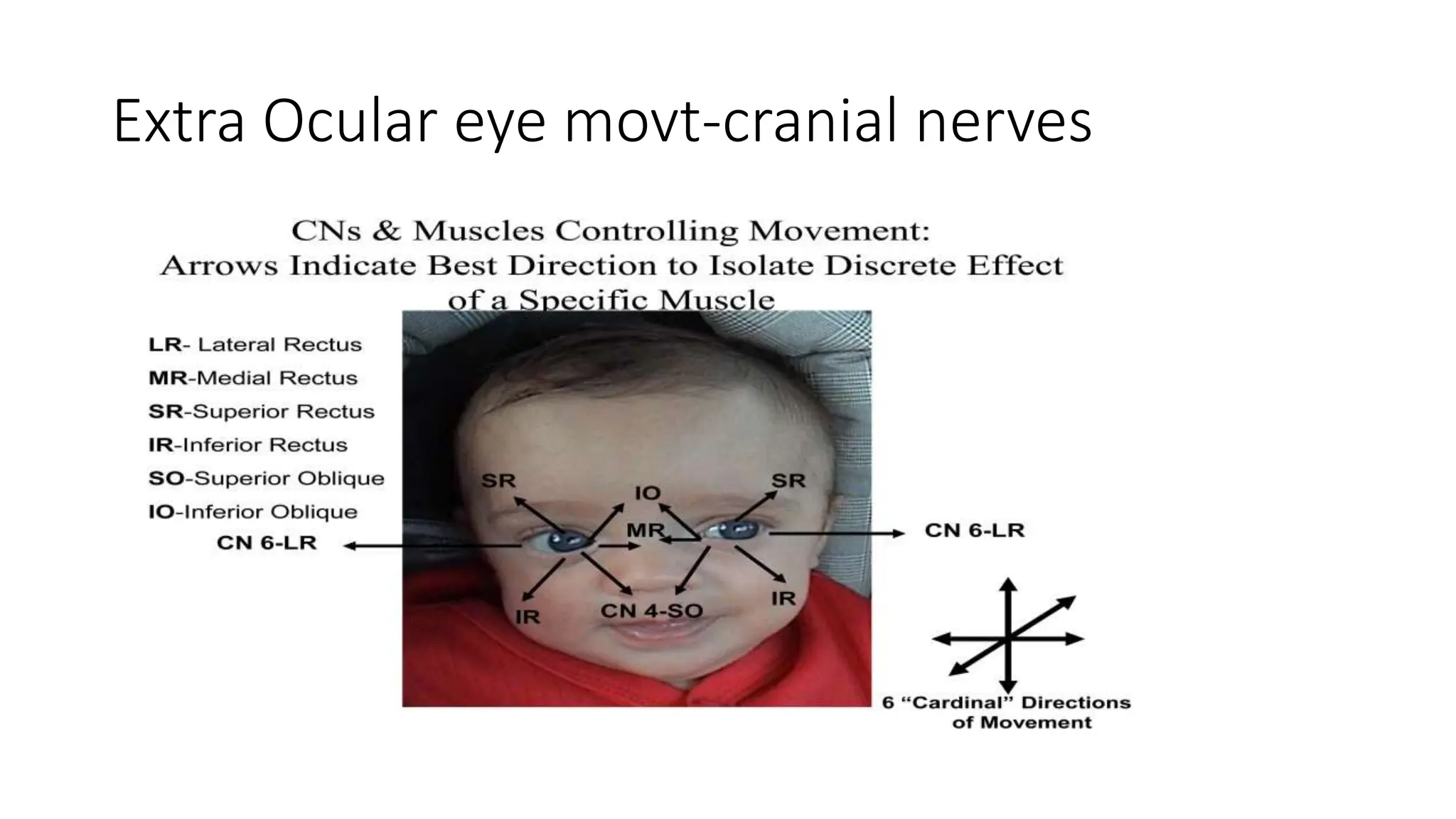
Extra Ocular eye movt-cranial nerves
• The movements should be smooth and coordinated. To assess, proceed as
follows:
• Stand in front of the patient.
• Ask them to follow your finger with their eyes while keeping their head in
one position
• Using your finger, trace an imaginary "H" or rectangular shape in front of
them, making sure that your finger moves far enough out and up/down so
that you're able to see all appropriate eye movements (ie lateral and up,
lateral down, medial down, medial up).
• At the end, bring your finger directly in towards the patient's nose. This will
cause the patient to look cross-eyed and the pupils should constrict, a
response referred to as accommodation.
• Interpretation: The eyes should be able to easily and smoothly follow your
finger.
15. Extraocular Movements
•Ask the pt to hold his/her head still and to follow your finger
with their eyes
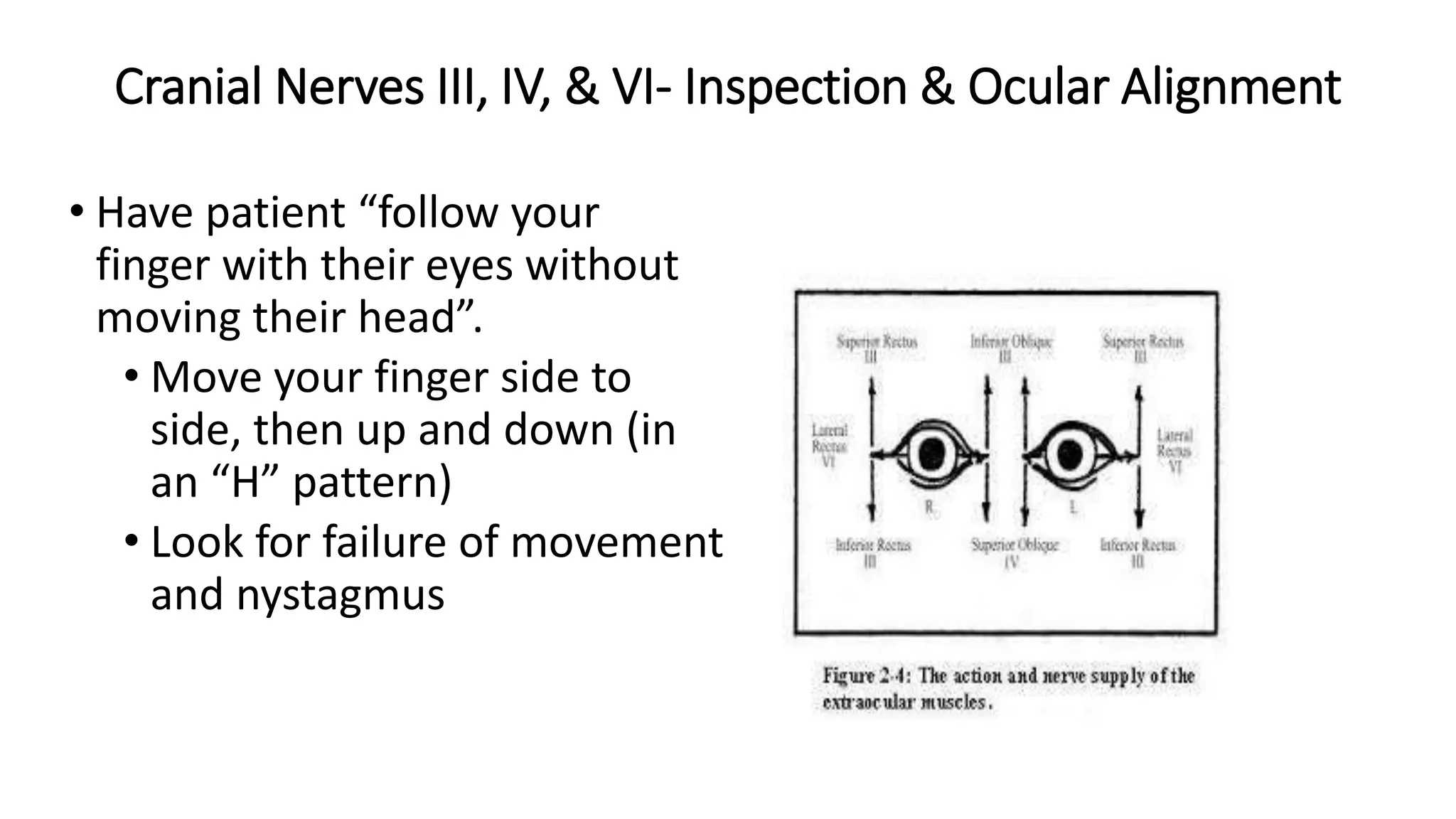
Cranial Nerves III, IV, & VI- Inspection & Ocular Alignment
• Have patient “follow your
finger with their eyes without
moving their head”.
• Move your finger side to
side, then up and down (in
an “H” pattern)
• Look for failure of movement
and nystagmus
Pathology
• Isolated lesions of a cranial nerve or the muscle itself can adversely
affect extraocular movement.
• Patients will report diplopia (double vision) when they look in a
direction that's affected. This is because the brain can't put together
the discordant images in a way that forms a single picture.
• In response, they will either assume a head tilt that attempts to
correct for the abnormal eye positioning or close the abnormal eye.
As an example, the patient shown below has a left cranial nerve 6
lesion, which means that his left lateral rectus no longer functions.
When he looks right, his vision is normal. However, when he looks
left, he experiences double vision as the left eye can't move laterally.
This is referred to as horizontal diplopia.
Left CN 6 Palsy: Patient was asked to look left. Note that left
eye will not abduct.
Visual fields:
• The normal visual field for each eye extends out from the patient in all
directions, with an area of overlap directly in front.
• Field cuts refer to specific regions where the patient has lost their ability
to see.
• This occurs when the transmitted visual impulse is interrupted at some
point in its path from the retina to the visual cortex in the back of the
brain.
• You would, in general, only include a visual field assessment if the
patient complained of loss of sight; in particular "blind spots" or "holes"
in their vision.
• Visual fields can be crudely assessed as follows:
Visual fields assessment
• The examiner should be nose to nose with the patient, separated by
approximately 8 to 12 inches.
• Each eye is checked separately. The examiner closes one eye and the patient closes
the one opposite. The open eyes should then be staring directly at one another.
• The examiner should move their hand out towards the periphery of his/her visual
field on the side where the eyes are open. The finger should be equidistant from
both persons.
• The examiner should then move the wiggling finger in towards them, along an
imaginary line drawn between the two persons.The patient and examiner should
detect the finger at more or less the same time.
• The finger is then moved out to the diagonal corners of the field and moved
inwards from each of these directions. Testing is then done starting at a point in
front of the closed eyes. The wiggling finger is moved towards the open eyes.
• The other eye is then tested.
• Meaningful interpretation is predicated upon the examiner having normal
fields, as they are using themselves for comparison.
• If the examiner cannot seem to move their finger to a point that is outside
the patient's field don't worry, as it simply means that their fields are
normal.
• Interpretation: This test is rather crude, and it is quite possible to have small
visual field defects that would not be apparent on this type of testing. Prior
to interpreting abnormal findings, the examiner must understand the normal
pathways by which visual impulses travel from the eye to the brain.
Assessment of Pupils
• Normal pupils appear symmetric.
• To assess for symmetry, look directly at the patient's eyes and note whether they are in the same relative
position within the eye socket and of equal size and shape.
• Anisocoria means that the pupils are unequal in size.
• When this occurs, the examiner has to determine which is the abnormal eye (i.e. could be either the large
or small pupil).
• Sympathetic nerves traveling to the eye cause dilation of the pupil.
• Processes interfering with sympathetic innervation thus lead to constriction.
• Sympathetics also innervate a small muscle in lid, such that sympathetic lesions also cause an element of
ptosis.
• Interruption along the sympathetic chain is called Horner’s syndrome, a combination of miosis (pupil
appears small), ptosis (droopy eye lid) and anhydrosis (lack of sweating on the affected side – though not
commonly assessed).
• On examination, the affected pupil will appear smaller then it’s counterpart, though it should still constrict
in response to direct and indirect light.
• The subsequent dilation phase (when light removed) will be slower than normal.
Anisocoria where the larger pupil is the abnormal one
• Parasympathetics travel with CN3 and cause pupillary constriction.
• Lesions affecting the parasympathetics result in dilation and may impair
other CN3 functions, including: extra occular movements (all muscles except
lateral rectus and superior oblique) and raising the eyelid (levator palpebrae
muscle).
• A third nerve lesion will often cause the eye to appear “down and out”
(deviated laterally and downward), with impaired movement, dilated and
minimally or non-reactive pupil, and ptosis.
• Depending on the cause, all of these findings may not be present (e.g.
pupillary function can be spared while positioning and movement are
affected).
• Symptoms can include double vision (impaired eye alignment), light
sensitivity (from dilation), blurry vision, and headache depending on the
underlying cause. The unaffected eye should be normal.
Potential causes of a dilated pupil and their associated findings
• Stroke affecting CN3: The onset of symptoms is usually acute and
may include other deficits depending on the location of the stroke.
• Tumor directly affecting CN3: This can be either a metastatic lesion
or a primary CNS tumor compressing CN3.
• Aneurysm (posterior communicating artery most common): As the
aneurysm grows, it compresses CN3. Pupillary dilation is almost
always present.
• Infection, trauma, bleeding, tumor or anything that increases
intracranial pressure can lead to herniation.
• Prior eye surgery, trauma, or injury to pupillary
dilators/constrictors.
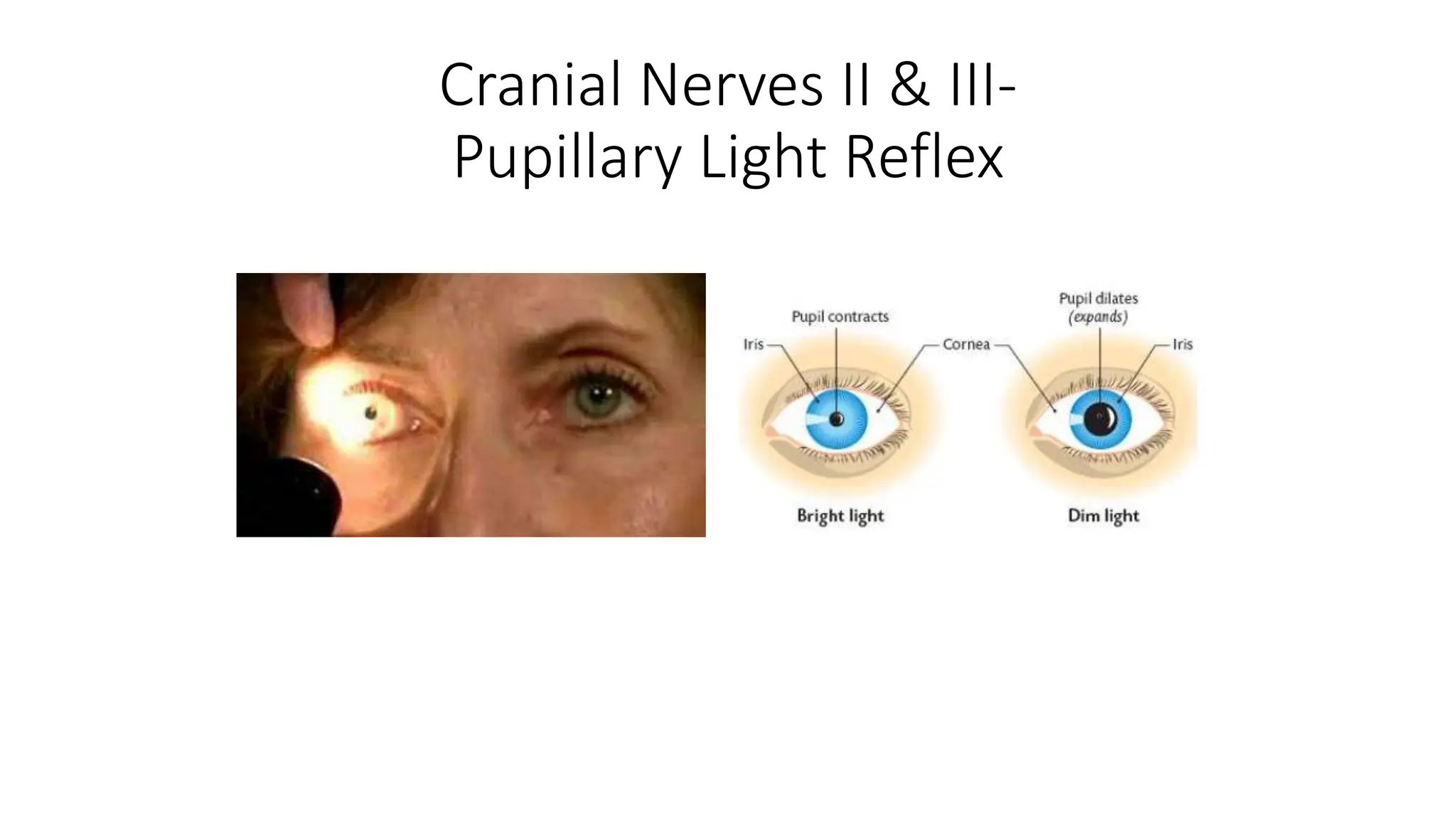
Assessing Pupillary Response to Light:
• The normal pupil constricts when exposed to bright light, known as
the direct response.
• In addition, light presented to the opposite eye also causes
constriction, which is referred to as the consensual response.
• Constriction is due to the fact that stimulation of the afferents (i.e.
sensory nerves, carried with CN 2) in one eye will trigger efferent
(i.e. motor, carried with CN 3) activation and subsequent
constriction of the pupils of both eyes.
To assess pupillary response to light, proceed as follows
• Turn down the light in your exam room, which will make the pupils dilate a bit.
• Observe the pupils. Normally, they should appear equal, round and symmetric in their positioning within the
orbit.
• Instruct the patient to look towards a distant area in the room (e.g. the corner where the wall and ceiling
meet) while keeping both of their eyes open. You may need to gently remind them throughout the exam to
continue looking in that direction as it is very difficult to examine a roving eyeball. Do not ask them to focus
on a specific object as this may lead to pupillary constriction.
• Turn on your ophthalmoscope and adjust the light intensity to mid-range power. The cone of light produced
should be a white, medium sized circle.
• Then assess whether each pupil constricts appropriately in response to direct and indirect stimulation as
follows:
• Shine a light in one eye and note that the pupil constricts (direct response).
• Then, shine a light in the opposite eye while looking at the first eye, noting again whether pupillary
constriction occurs (consensual response).
• If you're having trouble detecting any change, have the patient close their eye for several seconds and place
your hand over their eyebrows to provide additional shade.
• This helps to make it as dark as possible, encouraging greater pupillary dilation and therefore accentuating
any changes.
Cranial Nerves II & III-
Pupillary Light Reflex
Accommodation and convergence
• Shifting gaze from far to near
• Normally, pupils constrict
Assessment of internal eye structure
Include:
• Assessment of middle vitreous, posterior vitreous, fundus (retina and
optic disc
Purpose
• To examine internal eye structure in routine
• To detect any abnormalities eg opacity in vitreous
• To detect any abnormality in retina such as cupping of disc,
hemorrhage, exudates, scars and tear
Assessment of patient
• Assess Hx of decrease in vision, sudden loss of vision, DM, HTN, high
myopia, glaucoma and other systemic codns
• Evaluate presence of cataract, ocular movt and disease of anterior
segments
• Assess best corrected visual acuity
• Assess Hx of trauma or swelling of eye and adnexa
Requirements
• Ophthalmoscope
Vitreous examination
Examination of the retina
Abnormalities of the Fundus
continued on next slide

EYE Examination.pptx- ANATOMY AND PHYSIOLOGY

  • 1.
  • 2.
    Assessment of theEye • Examination of external eye structures • Visual acuity of distant and near vision • Extra Ocular eye movt-cranial nerves • Visual fields by confrontation • Six cardinal fields of gaze • Corneal light reflex • Cover/uncover test • Pupils and pupillary response
  • 3.
    Requirements • Pen • Paper •Snellens chart • Pen touch • Ophthalmoscope • Colour testing chart • Tonometry-measure IOP • Gonioscopy-visualizes the angleof the anterior chamber • Perimetry testing-evaluates field of vision and scotomas (blind areas in the visual field)
  • 4.
    External Eye Structures •Inspectthe eyelids and eyelashes •Observe the position and alignment of the eyeball in the eye socket •Inspect all other structures
  • 5.
    Eye lid symmetry:Patient unable to completely close left upper eyelid due to peripheral CN 7 dysfunction.
  • 6.
    Structures to Inspect •Positionand alignment of eyes •Eyebrows •Eyelids •Lacrimal Apparatus Inspection
  • 7.
    Visual Acuity • NearVisual acuity • Distance visual acuity
  • 8.
    Near Visual Acuity •Handheldvision chart •Normal acuity is 14/14 with or without corrective lenses
  • 9.
    Near Visual Acuity Holdcard approx 14” from pt’s nose  Ask pt to cover one eye  Read smallest line  Cover other eye and repeat
  • 10.
  • 11.
    Visual acuity • Isthe resolving power of the eye • Measures quality and ability of the eye to resolve varying letter sizes • Measured a 6m (20ft) distance for distant vision
  • 12.
    Purpose-Visual acuity To determinequantify visual acuity To determine severity of vision imparing disorders To classify visual impairment, low vision and blindness Assessment of patient Assess vision related Hx eg type of vision loss (gradual, sudden, transient) as time of onset, duration, Hx of spectacle wear. Assess Hx of red eye, pain swelling, diplopia, photophobia, trauma, surgery Observe abnormality in posture, capacity to comprehend
  • 13.
    Required instrument Snellen chart Occluder Patienthabitual glasses (if present) Pin hole Patient preparation Position patient at 6m from the chart in adequately illuminated room Explain to patient the nature and importance of the test Each eye is tested independently (i.e. one is covered while the other is used to read).
  • 16.
    Evaluation • Record thescore of Snellen test as visual acuity unaided, with correction and with pin hole • Visual acuity of 6/6 is normal, less than 6/6 is clinically abnormal • Functionally, visual acuity less than 6/12 is considered abnormal
  • 17.
    Extra Ocular eyemovt-cranial nerves
  • 18.
    Extra Ocular eyemovt-cranial nerves • The movements should be smooth and coordinated. To assess, proceed as follows: • Stand in front of the patient. • Ask them to follow your finger with their eyes while keeping their head in one position • Using your finger, trace an imaginary "H" or rectangular shape in front of them, making sure that your finger moves far enough out and up/down so that you're able to see all appropriate eye movements (ie lateral and up, lateral down, medial down, medial up). • At the end, bring your finger directly in towards the patient's nose. This will cause the patient to look cross-eyed and the pupils should constrict, a response referred to as accommodation. • Interpretation: The eyes should be able to easily and smoothly follow your finger.
  • 19.
    15. Extraocular Movements •Askthe pt to hold his/her head still and to follow your finger with their eyes
  • 20.
    Cranial Nerves III,IV, & VI- Inspection & Ocular Alignment • Have patient “follow your finger with their eyes without moving their head”. • Move your finger side to side, then up and down (in an “H” pattern) • Look for failure of movement and nystagmus
  • 21.
    Pathology • Isolated lesionsof a cranial nerve or the muscle itself can adversely affect extraocular movement. • Patients will report diplopia (double vision) when they look in a direction that's affected. This is because the brain can't put together the discordant images in a way that forms a single picture. • In response, they will either assume a head tilt that attempts to correct for the abnormal eye positioning or close the abnormal eye. As an example, the patient shown below has a left cranial nerve 6 lesion, which means that his left lateral rectus no longer functions. When he looks right, his vision is normal. However, when he looks left, he experiences double vision as the left eye can't move laterally. This is referred to as horizontal diplopia.
  • 22.
    Left CN 6Palsy: Patient was asked to look left. Note that left eye will not abduct.
  • 23.
    Visual fields: • Thenormal visual field for each eye extends out from the patient in all directions, with an area of overlap directly in front. • Field cuts refer to specific regions where the patient has lost their ability to see. • This occurs when the transmitted visual impulse is interrupted at some point in its path from the retina to the visual cortex in the back of the brain. • You would, in general, only include a visual field assessment if the patient complained of loss of sight; in particular "blind spots" or "holes" in their vision. • Visual fields can be crudely assessed as follows:
  • 24.
    Visual fields assessment •The examiner should be nose to nose with the patient, separated by approximately 8 to 12 inches. • Each eye is checked separately. The examiner closes one eye and the patient closes the one opposite. The open eyes should then be staring directly at one another. • The examiner should move their hand out towards the periphery of his/her visual field on the side where the eyes are open. The finger should be equidistant from both persons. • The examiner should then move the wiggling finger in towards them, along an imaginary line drawn between the two persons.The patient and examiner should detect the finger at more or less the same time. • The finger is then moved out to the diagonal corners of the field and moved inwards from each of these directions. Testing is then done starting at a point in front of the closed eyes. The wiggling finger is moved towards the open eyes. • The other eye is then tested.
  • 25.
    • Meaningful interpretationis predicated upon the examiner having normal fields, as they are using themselves for comparison. • If the examiner cannot seem to move their finger to a point that is outside the patient's field don't worry, as it simply means that their fields are normal. • Interpretation: This test is rather crude, and it is quite possible to have small visual field defects that would not be apparent on this type of testing. Prior to interpreting abnormal findings, the examiner must understand the normal pathways by which visual impulses travel from the eye to the brain.
  • 26.
    Assessment of Pupils •Normal pupils appear symmetric. • To assess for symmetry, look directly at the patient's eyes and note whether they are in the same relative position within the eye socket and of equal size and shape. • Anisocoria means that the pupils are unequal in size. • When this occurs, the examiner has to determine which is the abnormal eye (i.e. could be either the large or small pupil). • Sympathetic nerves traveling to the eye cause dilation of the pupil. • Processes interfering with sympathetic innervation thus lead to constriction. • Sympathetics also innervate a small muscle in lid, such that sympathetic lesions also cause an element of ptosis. • Interruption along the sympathetic chain is called Horner’s syndrome, a combination of miosis (pupil appears small), ptosis (droopy eye lid) and anhydrosis (lack of sweating on the affected side – though not commonly assessed). • On examination, the affected pupil will appear smaller then it’s counterpart, though it should still constrict in response to direct and indirect light. • The subsequent dilation phase (when light removed) will be slower than normal.
  • 27.
    Anisocoria where thelarger pupil is the abnormal one • Parasympathetics travel with CN3 and cause pupillary constriction. • Lesions affecting the parasympathetics result in dilation and may impair other CN3 functions, including: extra occular movements (all muscles except lateral rectus and superior oblique) and raising the eyelid (levator palpebrae muscle). • A third nerve lesion will often cause the eye to appear “down and out” (deviated laterally and downward), with impaired movement, dilated and minimally or non-reactive pupil, and ptosis. • Depending on the cause, all of these findings may not be present (e.g. pupillary function can be spared while positioning and movement are affected). • Symptoms can include double vision (impaired eye alignment), light sensitivity (from dilation), blurry vision, and headache depending on the underlying cause. The unaffected eye should be normal.
  • 28.
    Potential causes ofa dilated pupil and their associated findings • Stroke affecting CN3: The onset of symptoms is usually acute and may include other deficits depending on the location of the stroke. • Tumor directly affecting CN3: This can be either a metastatic lesion or a primary CNS tumor compressing CN3. • Aneurysm (posterior communicating artery most common): As the aneurysm grows, it compresses CN3. Pupillary dilation is almost always present. • Infection, trauma, bleeding, tumor or anything that increases intracranial pressure can lead to herniation. • Prior eye surgery, trauma, or injury to pupillary dilators/constrictors.
  • 29.
    Assessing Pupillary Responseto Light: • The normal pupil constricts when exposed to bright light, known as the direct response. • In addition, light presented to the opposite eye also causes constriction, which is referred to as the consensual response. • Constriction is due to the fact that stimulation of the afferents (i.e. sensory nerves, carried with CN 2) in one eye will trigger efferent (i.e. motor, carried with CN 3) activation and subsequent constriction of the pupils of both eyes.
  • 30.
    To assess pupillaryresponse to light, proceed as follows • Turn down the light in your exam room, which will make the pupils dilate a bit. • Observe the pupils. Normally, they should appear equal, round and symmetric in their positioning within the orbit. • Instruct the patient to look towards a distant area in the room (e.g. the corner where the wall and ceiling meet) while keeping both of their eyes open. You may need to gently remind them throughout the exam to continue looking in that direction as it is very difficult to examine a roving eyeball. Do not ask them to focus on a specific object as this may lead to pupillary constriction. • Turn on your ophthalmoscope and adjust the light intensity to mid-range power. The cone of light produced should be a white, medium sized circle. • Then assess whether each pupil constricts appropriately in response to direct and indirect stimulation as follows: • Shine a light in one eye and note that the pupil constricts (direct response). • Then, shine a light in the opposite eye while looking at the first eye, noting again whether pupillary constriction occurs (consensual response). • If you're having trouble detecting any change, have the patient close their eye for several seconds and place your hand over their eyebrows to provide additional shade. • This helps to make it as dark as possible, encouraging greater pupillary dilation and therefore accentuating any changes.
  • 31.
    Cranial Nerves II& III- Pupillary Light Reflex
  • 35.
    Accommodation and convergence •Shifting gaze from far to near • Normally, pupils constrict
  • 36.
    Assessment of internaleye structure Include: • Assessment of middle vitreous, posterior vitreous, fundus (retina and optic disc Purpose • To examine internal eye structure in routine • To detect any abnormalities eg opacity in vitreous • To detect any abnormality in retina such as cupping of disc, hemorrhage, exudates, scars and tear
  • 37.
    Assessment of patient •Assess Hx of decrease in vision, sudden loss of vision, DM, HTN, high myopia, glaucoma and other systemic codns • Evaluate presence of cataract, ocular movt and disease of anterior segments • Assess best corrected visual acuity • Assess Hx of trauma or swelling of eye and adnexa
  • 38.
  • 39.
  • 40.
  • 41.
    Abnormalities of theFundus continued on next slide