1
Copyright Information goes here Company Proprietary and Confidential
Alignement
Tukezban Huseynova, MD
Specialist in Strabismus and Refractive Cornea,
Briz-L Eye Clinic, Baku, Azerbaijan
Tukezban@gmail.com
2
Copyright Information goes here Company Proprietary and Confidential
Primary Position
3
Copyright Information goes here Company Proprietary and Confidential
Classification
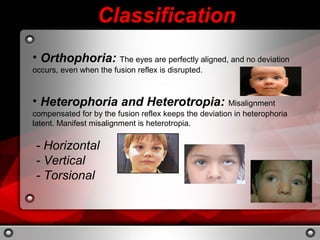
• Orthophoria: The eyes are perfectly aligned, and no deviation
occurs, even when the fusion reflex is disrupted.
• Heterophoria and Heterotropia: Misalignment
compensated for by the fusion reflex keeps the deviation in heterophoria
latent. Manifest misalignment is heterotropia.
- Horizontal
- Vertical
- Torsional
4
Copyright Information goes here Company Proprietary and Confidential
Determination
There are four basic types of alignment tests which
determine the alignement in a whole.
• The various cover tests
• The corneal reflex tests,
• The dissimilar image tests
• The dissimilar target tests.
5
Copyright Information goes here Company Proprietary and Confidential
Determination
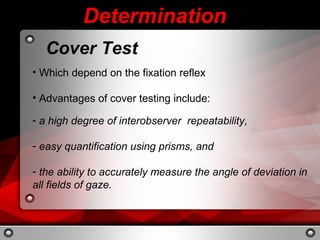
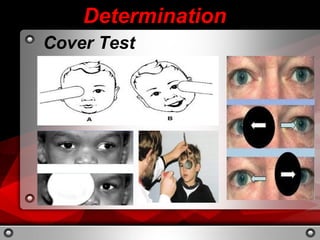
Cover Test
• Which depend on the fixation reflex
• Advantages of cover testing include:
- a high degree of interobserver repeatability,
- easy quantification using prisms, and
- the ability to accurately measure the angle of deviation in
all fields of gaze.
6
Copyright Information goes here Company Proprietary and Confidential
Determination
Cover Test
7
Copyright Information goes here Company Proprietary and Confidential
Determination
Cover Test
• Cover–uncover test
8
Copyright Information goes here Company Proprietary and Confidential
Determination
Cover Test
• Alternate cover test.
9
Copyright Information goes here Company Proprietary and Confidential
Determination
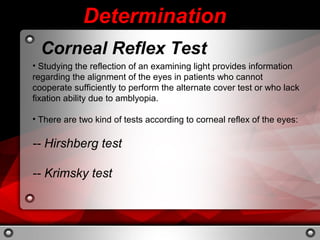
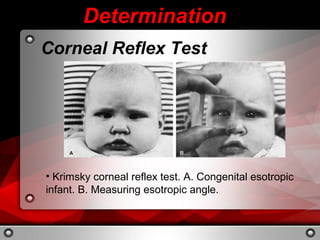
Corneal Reflex Test
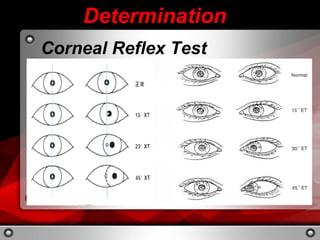
• Studying the reflection of an examining light provides information
regarding the alignment of the eyes in patients who cannot
cooperate sufficiently to perform the alternate cover test or who lack
fixation ability due to amblyopia.
• There are two kind of tests according to corneal reflex of the eyes:
-- Hirshberg test
-- Krimsky test
10
Copyright Information goes here Company Proprietary and Confidential
Determination
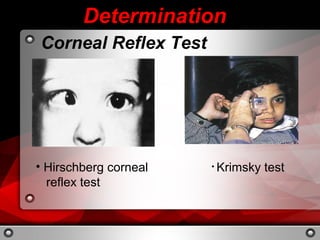
Corneal Reflex Test
• Hirschberg corneal
reflex test
• Krimsky test
11
Copyright Information goes here Company Proprietary and Confidential
Determination
Corneal Reflex Test
12
Copyright Information goes here Company Proprietary and Confidential
Determination
Corneal Reflex Test
• Krimsky corneal reflex test. A. Congenital esotropic
infant. B. Measuring esotropic angle.
13
Copyright Information goes here Company Proprietary and Confidential
Determination
Dissimilar images test
• The same fixation target, which is simultaneously
presented to each eye, is converted into dissimilar
images on the right and the left retina for the
purpose of making fusion difficult or impossible.
14
Copyright Information goes here Company Proprietary and Confidential
Determination
Dissimilar images test
• Maddox Wing
Maddox Wing dissociates the eyes for near fixation (1/3m) and measures
heterophoria. Measurements are made as follows:
-The horizontal deviation is measured by asking the patient to which
number the white arrow points.
-The vertical deviation is measured by asking the patient which number
the the red arrow interests.
-The amount of cyclophoria is determined by asking the patient to move
the red arrow so that it is parallel with the horizontal row of numbers.
15
Copyright Information goes here Company Proprietary and Confidential
Determination
Dissimilar images test
• Maddox Wing
IncycloExcyclo
Left Hypertrophy
XF EF
Right Hypertrophy
16
Copyright Information goes here Company Proprietary and Confidential
Determination
Dissimilar images test
• Maddox rod
Maddox rod consists of a series of fused cylindrical red glass rod which
convert the light into a red streak.
17
Copyright Information goes here Company Proprietary and Confidential
Determination
Dissimilar images test
• Maddox rod
18
Copyright Information goes here Company Proprietary and Confidential
Determination
Dissimilar images test
• Maddox rod
Normal
Xt
Et
19
Copyright Information goes here Company Proprietary and Confidential
Secondary Positions
20
Copyright Information goes here Company Proprietary and Confidential
• The three secondary positions are
near fixation, cardinal positions,
and midline position.
21
Copyright Information goes here Company Proprietary and Confidential
Near fixation
• The purpose of investigating near fixation is
to study the effect that the convergence
associated with accommodation (synkinetic
near reflex) has on the alignment of the eyes.
22
Copyright Information goes here Company Proprietary and Confidential
Near fixation
Determination
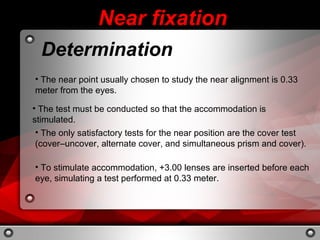
• The near point usually chosen to study the near alignment is 0.33
meter from the eyes.
• The test must be conducted so that the accommodation is
stimulated.
• The only satisfactory tests for the near position are the cover test
(cover–uncover, alternate cover, and simultaneous prism and cover).
• To stimulate accommodation, +3.00 lenses are inserted before each
eye, simulating a test performed at 0.33 meter.
23
Copyright Information goes here Company Proprietary and Confidential
Near fixation
Classification
The classifications of near fixation are as follows.
Normal. The distant (primary position) and near position alignment
are comparable.
Abnormal. The distant and near position alignment are not
comparable:
- Convergence excess: greater esodeviation at near than at distance
- Convergence insufficiency: greater exodeviation at near than at
distance
- Divergence excess: greater exodeviation at distance than at near
- Divergence insufficiency: greater esodeviation at distance than at
near
24
Copyright Information goes here Company Proprietary and Confidential
Cardinal Positions
Classification
Normal. The horizontal and the vertical plane alignment are
orthophoric in all six cardinal positions.
Abnormal. There is a horizontal and/or a vertical plane
misalignment in one or all of the six cardinal positions.
Concomitant. The deviation is identical in all positions.
Horizontal
Esodeviation
Exodeviation
Vertical
Right hyperdeviation
Left hyperdeviation
25
Copyright Information goes here Company Proprietary and Confidential
Cardinal Positions
Classification
Abnormal. There is a horizontal and/or a vertical plane
misalignment in one or all of the six cardinal positions.
Nonconcomitant. The deviation varies in different gaze
positions.
Horizontal
Esodeviation
Exodeviation
Vertical
Right hyperdeviation
Left hyperdeviation
26
Copyright Information goes here Company Proprietary and Confidential
Cardinal Positions
27
Copyright Information goes here Company Proprietary and Confidential
Cardinal Positions
• The purpose of studying these six positions
is to compare the prime mover of the one
eye for each of these positions with the
comparable prime mover of the other eye.
(Only the horizontal and vertical planes are
tested; the torsional plane is disregarded).
28
Copyright Information goes here Company Proprietary and Confidential
Midline Positions
• Both horizontal and
vertical plane deviations
are studied in the up and
down midline positions.
29
Copyright Information goes here Company Proprietary and Confidential
Midline Positions
Classification
The classifications of midline positions are as follows:
Normal. The horizontal and the vertical plane alignment are
orthophoric in both straight upgaze and downgaze.
Abnormal. A horizontal and/or a vertical plane misalignment is
present in the upgaze position and/or the downgaze position.
Horizontal
A pattern
V pattern
30
Copyright Information goes here Company Proprietary and Confidential
Midline Positions
Classification
Abnormal. A horizontal and/or a vertical plane misalignment is
present in the upgaze position and/or the downgaze position.
Vertical
• Double elevator palsy
• Fibrosis of a vertical rectus muscle
• Myopathy due to thyroid disease
• Adherence syndrome
- Following fracture of orbital floor
- Following surgery of extraocular muscles
- Brown syndrome
(All these diseases will be presented in detail in the future presentations)
31
Copyright Information goes here Company Proprietary and Confidential
Thank You

Alignement

  • 1.
    1 Copyright Information goeshere Company Proprietary and Confidential Alignement Tukezban Huseynova, MD Specialist in Strabismus and Refractive Cornea, Briz-L Eye Clinic, Baku, Azerbaijan Tukezban@gmail.com
  • 2.
    2 Copyright Information goeshere Company Proprietary and Confidential Primary Position
  • 3.
    3 Copyright Information goeshere Company Proprietary and Confidential Classification • Orthophoria: The eyes are perfectly aligned, and no deviation occurs, even when the fusion reflex is disrupted. • Heterophoria and Heterotropia: Misalignment compensated for by the fusion reflex keeps the deviation in heterophoria latent. Manifest misalignment is heterotropia. - Horizontal - Vertical - Torsional
  • 4.
    4 Copyright Information goeshere Company Proprietary and Confidential Determination There are four basic types of alignment tests which determine the alignement in a whole. • The various cover tests • The corneal reflex tests, • The dissimilar image tests • The dissimilar target tests.
  • 5.
    5 Copyright Information goeshere Company Proprietary and Confidential Determination Cover Test • Which depend on the fixation reflex • Advantages of cover testing include: - a high degree of interobserver repeatability, - easy quantification using prisms, and - the ability to accurately measure the angle of deviation in all fields of gaze.
  • 6.
    6 Copyright Information goeshere Company Proprietary and Confidential Determination Cover Test
  • 7.
    7 Copyright Information goeshere Company Proprietary and Confidential Determination Cover Test • Cover–uncover test
  • 8.
    8 Copyright Information goeshere Company Proprietary and Confidential Determination Cover Test • Alternate cover test.
  • 9.
    9 Copyright Information goeshere Company Proprietary and Confidential Determination Corneal Reflex Test • Studying the reflection of an examining light provides information regarding the alignment of the eyes in patients who cannot cooperate sufficiently to perform the alternate cover test or who lack fixation ability due to amblyopia. • There are two kind of tests according to corneal reflex of the eyes: -- Hirshberg test -- Krimsky test
  • 10.
    10 Copyright Information goeshere Company Proprietary and Confidential Determination Corneal Reflex Test • Hirschberg corneal reflex test • Krimsky test
  • 11.
    11 Copyright Information goeshere Company Proprietary and Confidential Determination Corneal Reflex Test
  • 12.
    12 Copyright Information goeshere Company Proprietary and Confidential Determination Corneal Reflex Test • Krimsky corneal reflex test. A. Congenital esotropic infant. B. Measuring esotropic angle.
  • 13.
    13 Copyright Information goeshere Company Proprietary and Confidential Determination Dissimilar images test • The same fixation target, which is simultaneously presented to each eye, is converted into dissimilar images on the right and the left retina for the purpose of making fusion difficult or impossible.
  • 14.
    14 Copyright Information goeshere Company Proprietary and Confidential Determination Dissimilar images test • Maddox Wing Maddox Wing dissociates the eyes for near fixation (1/3m) and measures heterophoria. Measurements are made as follows: -The horizontal deviation is measured by asking the patient to which number the white arrow points. -The vertical deviation is measured by asking the patient which number the the red arrow interests. -The amount of cyclophoria is determined by asking the patient to move the red arrow so that it is parallel with the horizontal row of numbers.
  • 15.
    15 Copyright Information goeshere Company Proprietary and Confidential Determination Dissimilar images test • Maddox Wing IncycloExcyclo Left Hypertrophy XF EF Right Hypertrophy
  • 16.
    16 Copyright Information goeshere Company Proprietary and Confidential Determination Dissimilar images test • Maddox rod Maddox rod consists of a series of fused cylindrical red glass rod which convert the light into a red streak.
  • 17.
    17 Copyright Information goeshere Company Proprietary and Confidential Determination Dissimilar images test • Maddox rod
  • 18.
    18 Copyright Information goeshere Company Proprietary and Confidential Determination Dissimilar images test • Maddox rod Normal Xt Et
  • 19.
    19 Copyright Information goeshere Company Proprietary and Confidential Secondary Positions
  • 20.
    20 Copyright Information goeshere Company Proprietary and Confidential • The three secondary positions are near fixation, cardinal positions, and midline position.
  • 21.
    21 Copyright Information goeshere Company Proprietary and Confidential Near fixation • The purpose of investigating near fixation is to study the effect that the convergence associated with accommodation (synkinetic near reflex) has on the alignment of the eyes.
  • 22.
    22 Copyright Information goeshere Company Proprietary and Confidential Near fixation Determination • The near point usually chosen to study the near alignment is 0.33 meter from the eyes. • The test must be conducted so that the accommodation is stimulated. • The only satisfactory tests for the near position are the cover test (cover–uncover, alternate cover, and simultaneous prism and cover). • To stimulate accommodation, +3.00 lenses are inserted before each eye, simulating a test performed at 0.33 meter.
  • 23.
    23 Copyright Information goeshere Company Proprietary and Confidential Near fixation Classification The classifications of near fixation are as follows. Normal. The distant (primary position) and near position alignment are comparable. Abnormal. The distant and near position alignment are not comparable: - Convergence excess: greater esodeviation at near than at distance - Convergence insufficiency: greater exodeviation at near than at distance - Divergence excess: greater exodeviation at distance than at near - Divergence insufficiency: greater esodeviation at distance than at near
  • 24.
    24 Copyright Information goeshere Company Proprietary and Confidential Cardinal Positions Classification Normal. The horizontal and the vertical plane alignment are orthophoric in all six cardinal positions. Abnormal. There is a horizontal and/or a vertical plane misalignment in one or all of the six cardinal positions. Concomitant. The deviation is identical in all positions. Horizontal Esodeviation Exodeviation Vertical Right hyperdeviation Left hyperdeviation
  • 25.
    25 Copyright Information goeshere Company Proprietary and Confidential Cardinal Positions Classification Abnormal. There is a horizontal and/or a vertical plane misalignment in one or all of the six cardinal positions. Nonconcomitant. The deviation varies in different gaze positions. Horizontal Esodeviation Exodeviation Vertical Right hyperdeviation Left hyperdeviation
  • 26.
    26 Copyright Information goeshere Company Proprietary and Confidential Cardinal Positions
  • 27.
    27 Copyright Information goeshere Company Proprietary and Confidential Cardinal Positions • The purpose of studying these six positions is to compare the prime mover of the one eye for each of these positions with the comparable prime mover of the other eye. (Only the horizontal and vertical planes are tested; the torsional plane is disregarded).
  • 28.
    28 Copyright Information goeshere Company Proprietary and Confidential Midline Positions • Both horizontal and vertical plane deviations are studied in the up and down midline positions.
  • 29.
    29 Copyright Information goeshere Company Proprietary and Confidential Midline Positions Classification The classifications of midline positions are as follows: Normal. The horizontal and the vertical plane alignment are orthophoric in both straight upgaze and downgaze. Abnormal. A horizontal and/or a vertical plane misalignment is present in the upgaze position and/or the downgaze position. Horizontal A pattern V pattern
  • 30.
    30 Copyright Information goeshere Company Proprietary and Confidential Midline Positions Classification Abnormal. A horizontal and/or a vertical plane misalignment is present in the upgaze position and/or the downgaze position. Vertical • Double elevator palsy • Fibrosis of a vertical rectus muscle • Myopathy due to thyroid disease • Adherence syndrome - Following fracture of orbital floor - Following surgery of extraocular muscles - Brown syndrome (All these diseases will be presented in detail in the future presentations)
  • 31.
    31 Copyright Information goeshere Company Proprietary and Confidential Thank You