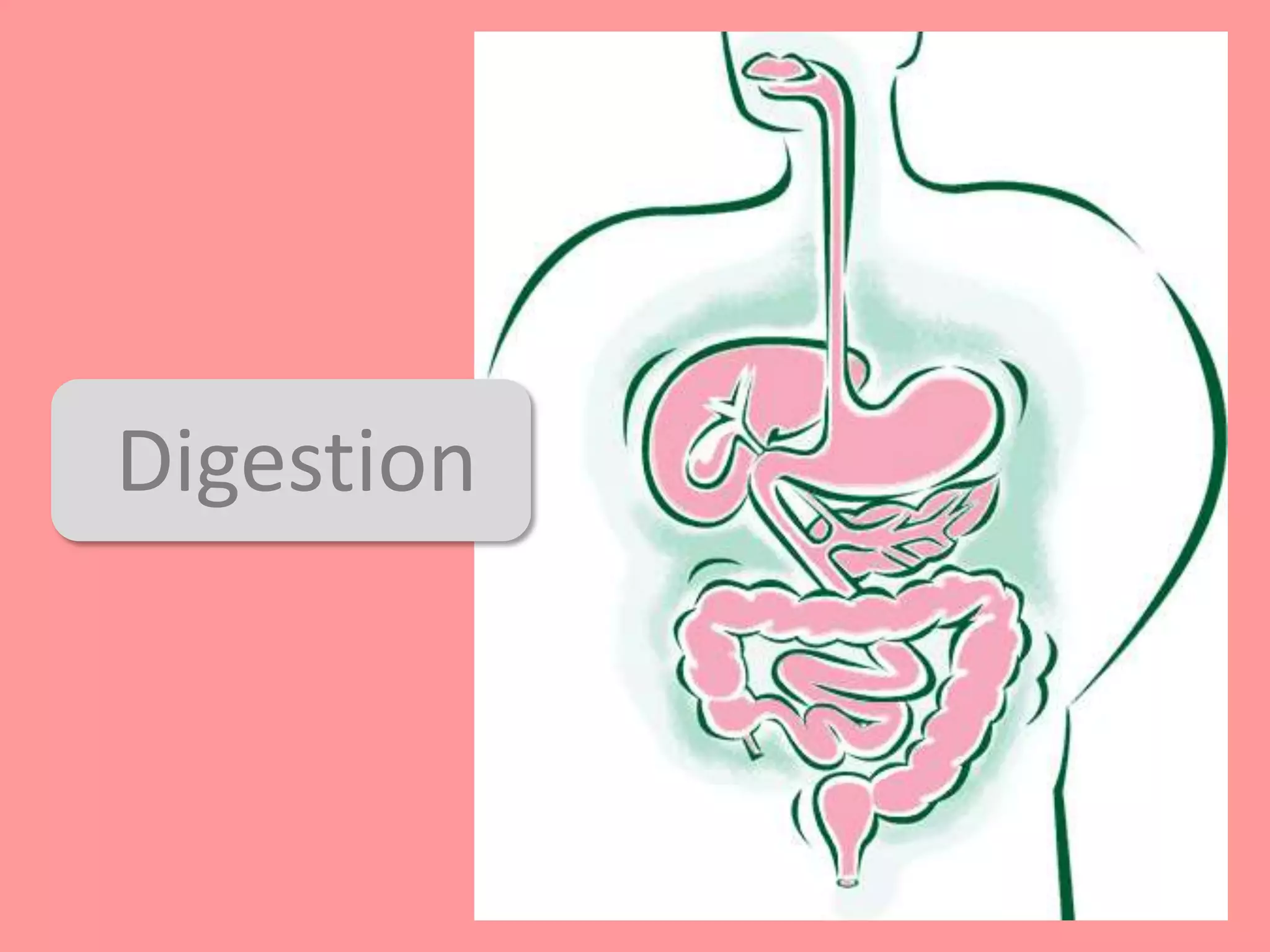
Digestion
Learning Objectives

At the end of this lesson, you should be able to:

• explain what is meant by digestion
• explain why food must be digested
• define enzymes as biological catalysts that speed up the
rate of reactions without being chemically changed at the
end of the reaction
• explain the effects of temperature on enzyme activity
• explain the mode of enzyme action in terms of the lock-
and-key hypothesis
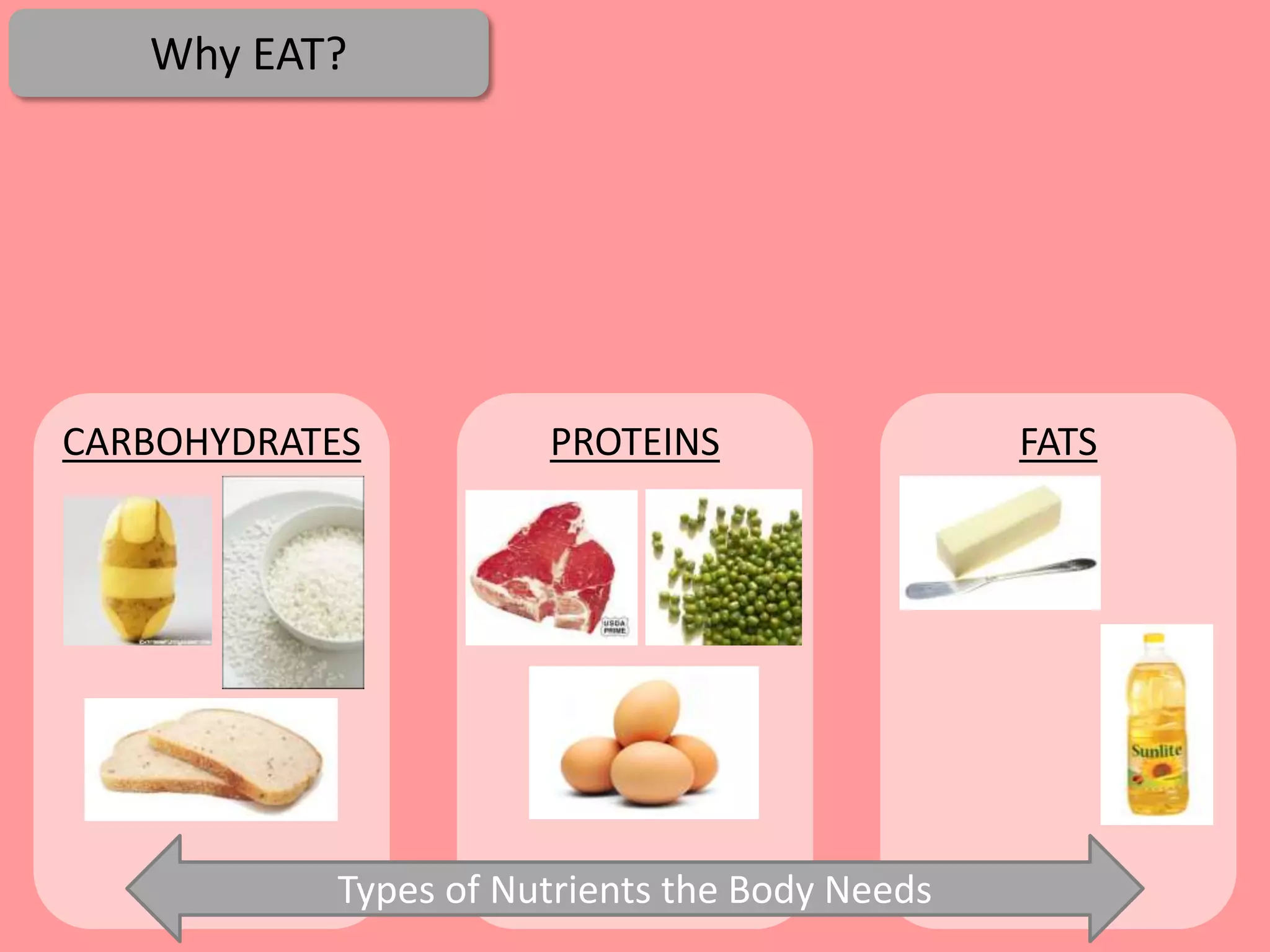
Why EAT?

We need to eat because…

        Our body needs NUTRIENTS

 CARBOHYDRATES            PROTEINS                 FATS


               Types of Nutrients the Body Needs
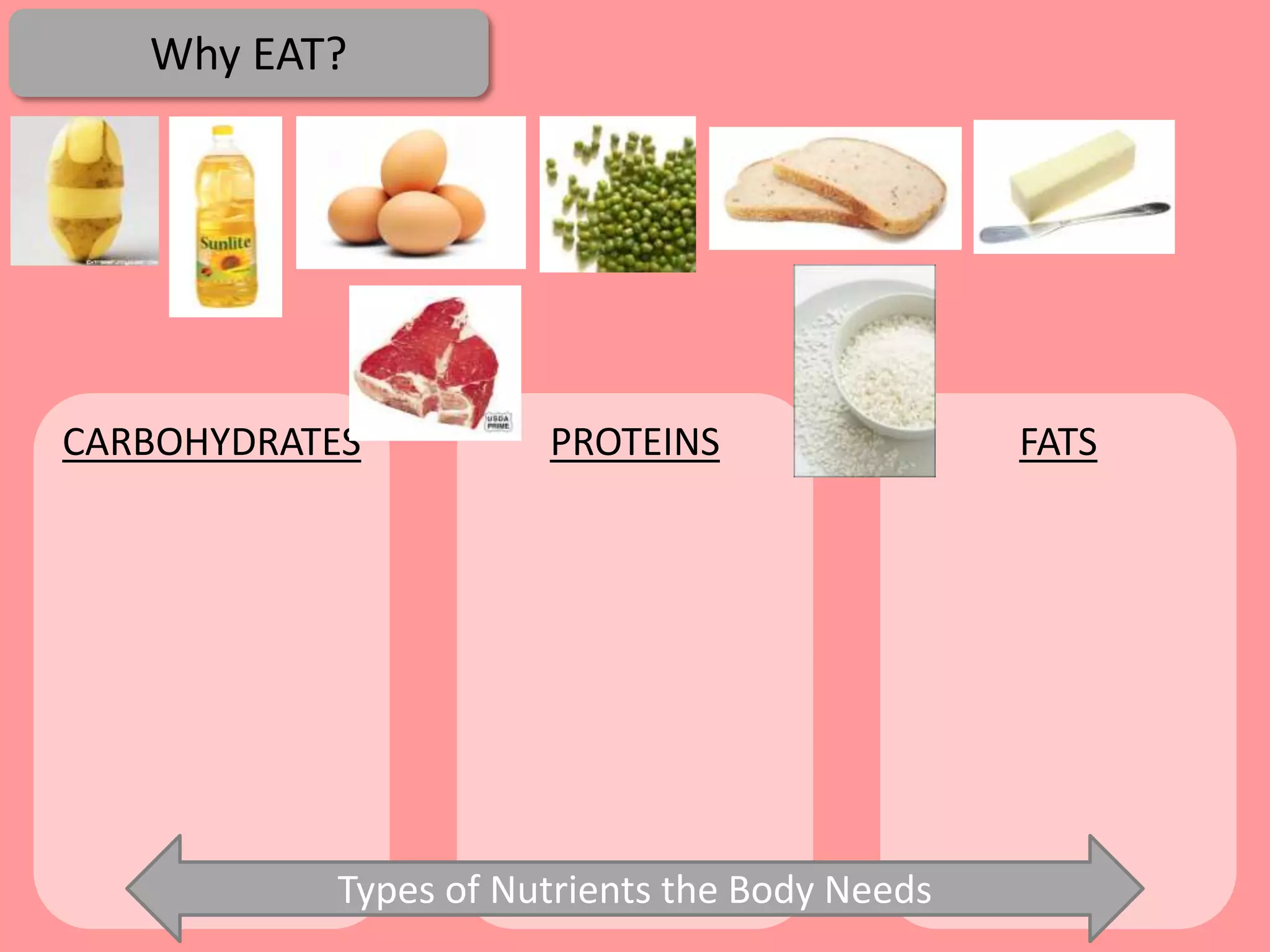
Why EAT?


CARBOHYDRATES         PROTEINS                 FATS


           Types of Nutrients the Body Needs
Why EAT?


CARBOHYDRATES         PROTEINS                 FATS


           Types of Nutrients the Body Needs
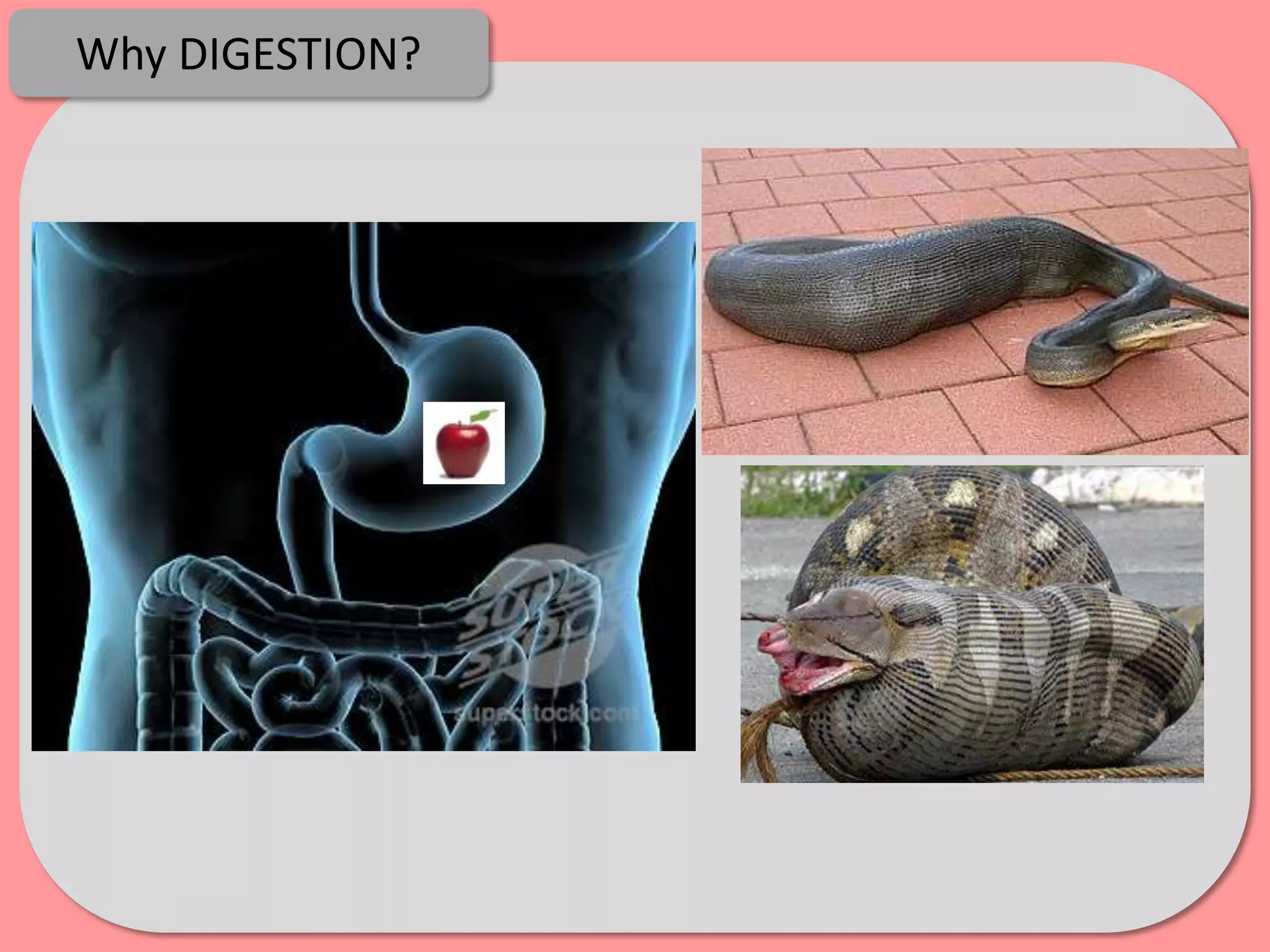
Why DIGESTION?
Why DIGESTION?
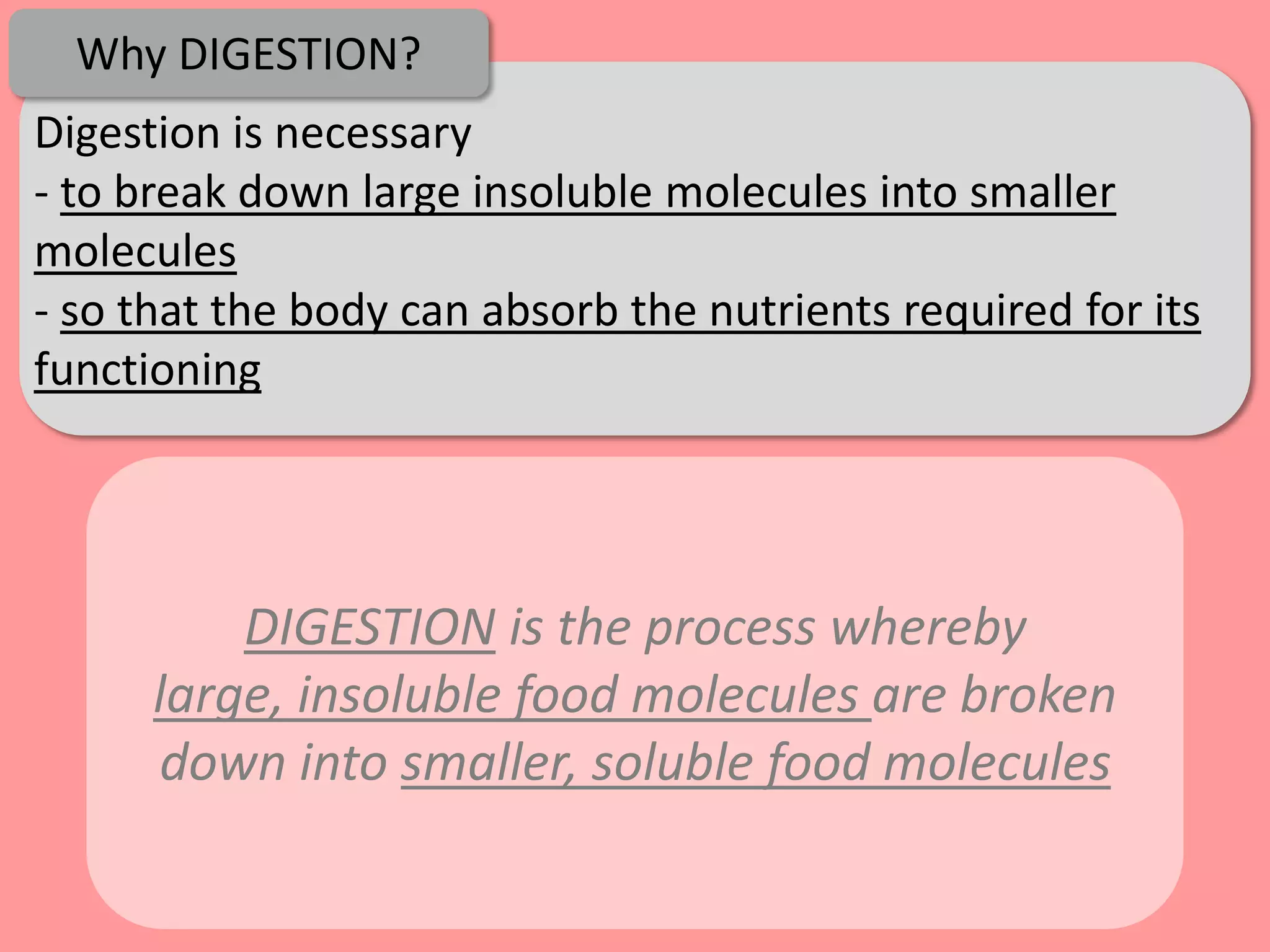
Digestion is necessary
- to break down large insoluble molecules into smaller
molecules
- so that the body can absorb the nutrients required for its
functioning


          DIGESTION is the process whereby
      large, insoluble food molecules are broken
      down into smaller, soluble food molecules
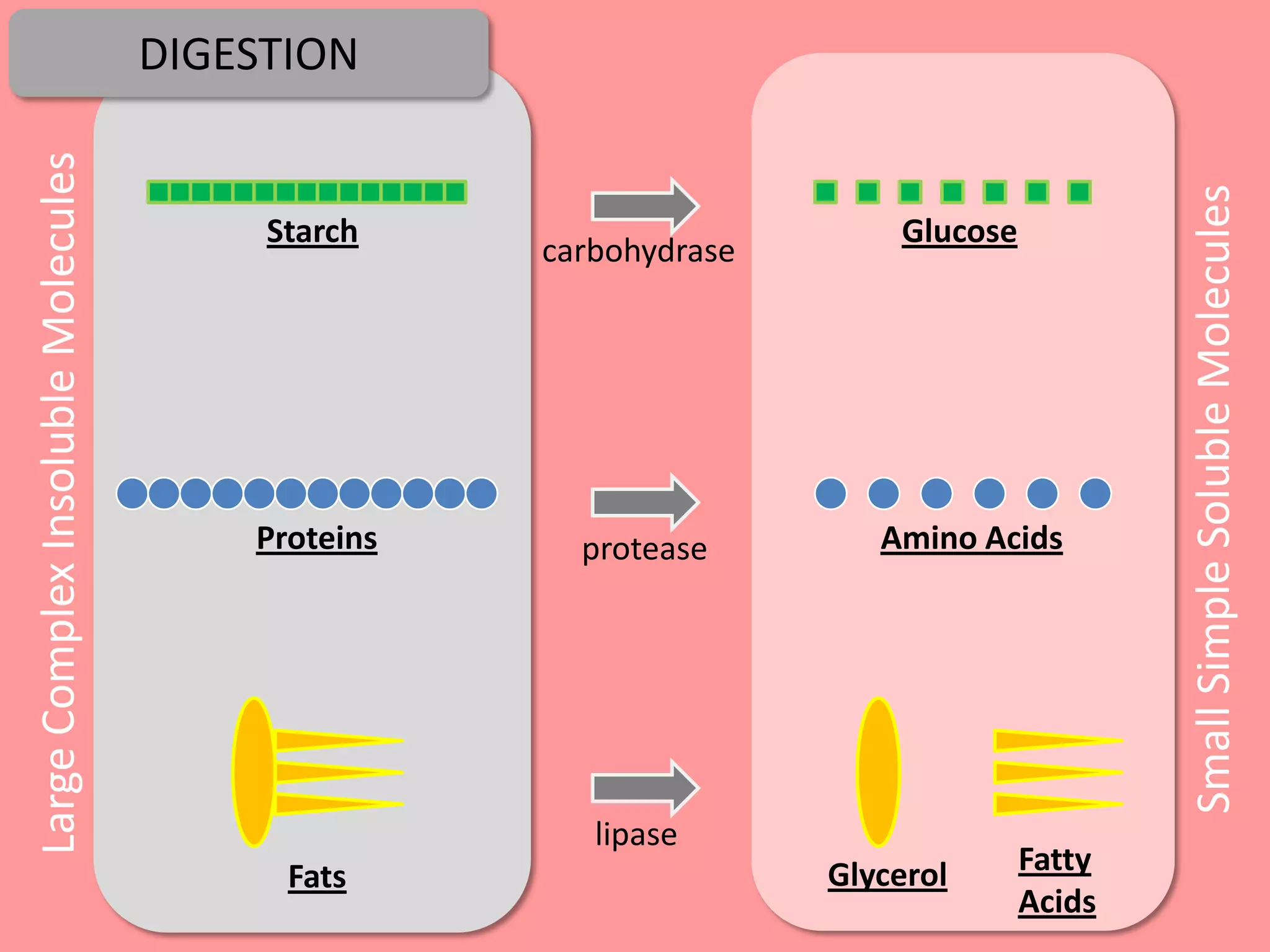
Large Complex Insoluble Molecules   DIGESTION


                                                                                        Small Simple Soluble Molecules
                                         Starch                       Glucose
                                                   carbohydrase


                                        Proteins     protease        Amino Acids


                                                      lipase
                                          Fats                    Glycerol      Fatty
                                                                                Acids
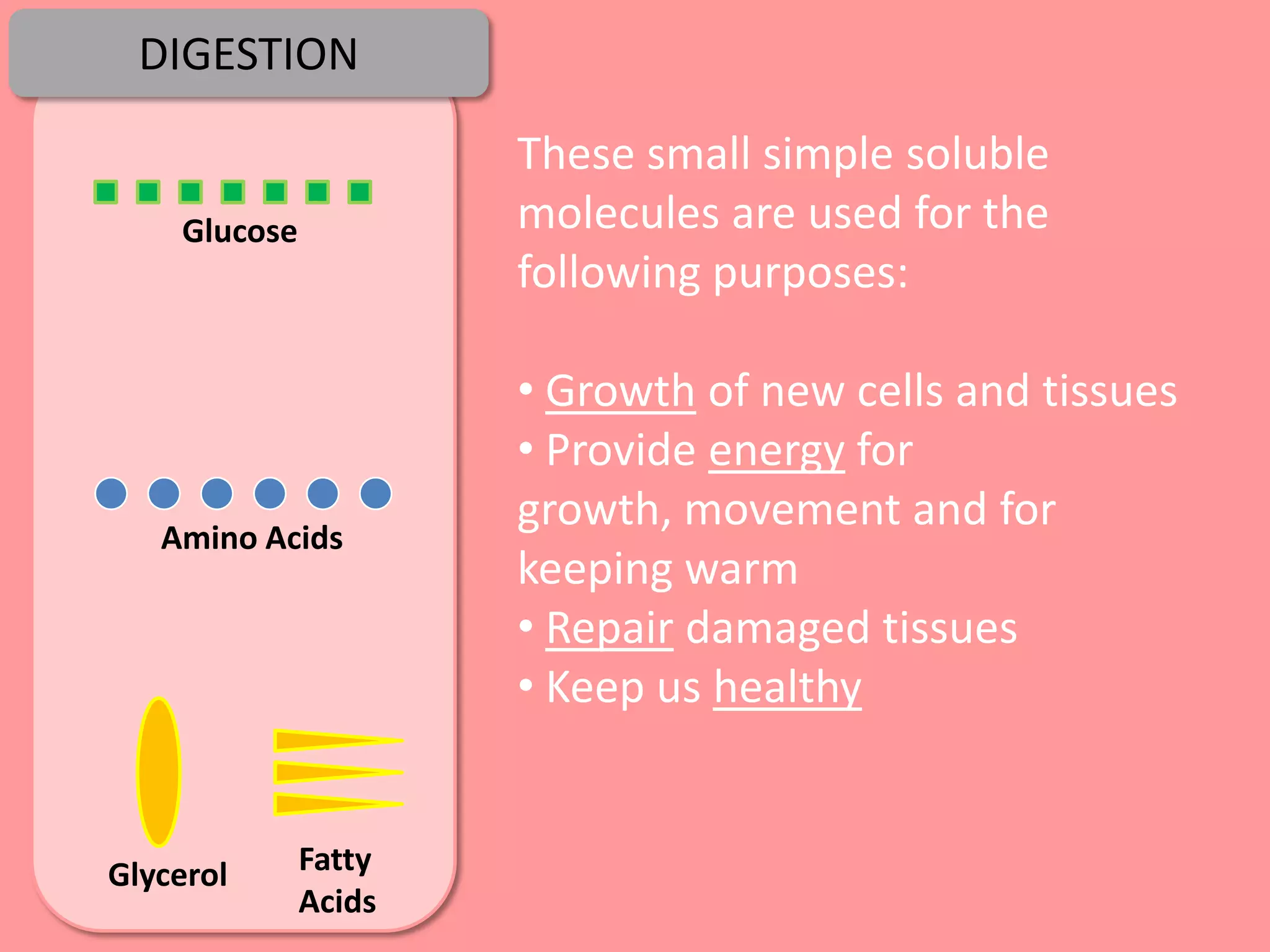
DIGESTION

                      These small simple soluble
    Glucose           molecules are used for the
                      following purposes:

                      • Growth of new cells and tissues
                      • Provide energy for
   Amino Acids
                      growth, movement and for
                      keeping warm
                      • Repair damaged tissues
                      • Keep us healthy


Glycerol      Fatty
              Acids
Food Tests
• To test whether certain nutrients are present
  in a certain food, specific tests can be
  conducted.
• Iodine solution can be used to test if there is
  starch present in food.
• Benedict’s solution can be used to test if there
  is reducing sugar (eg. Glucose) present in
  food.
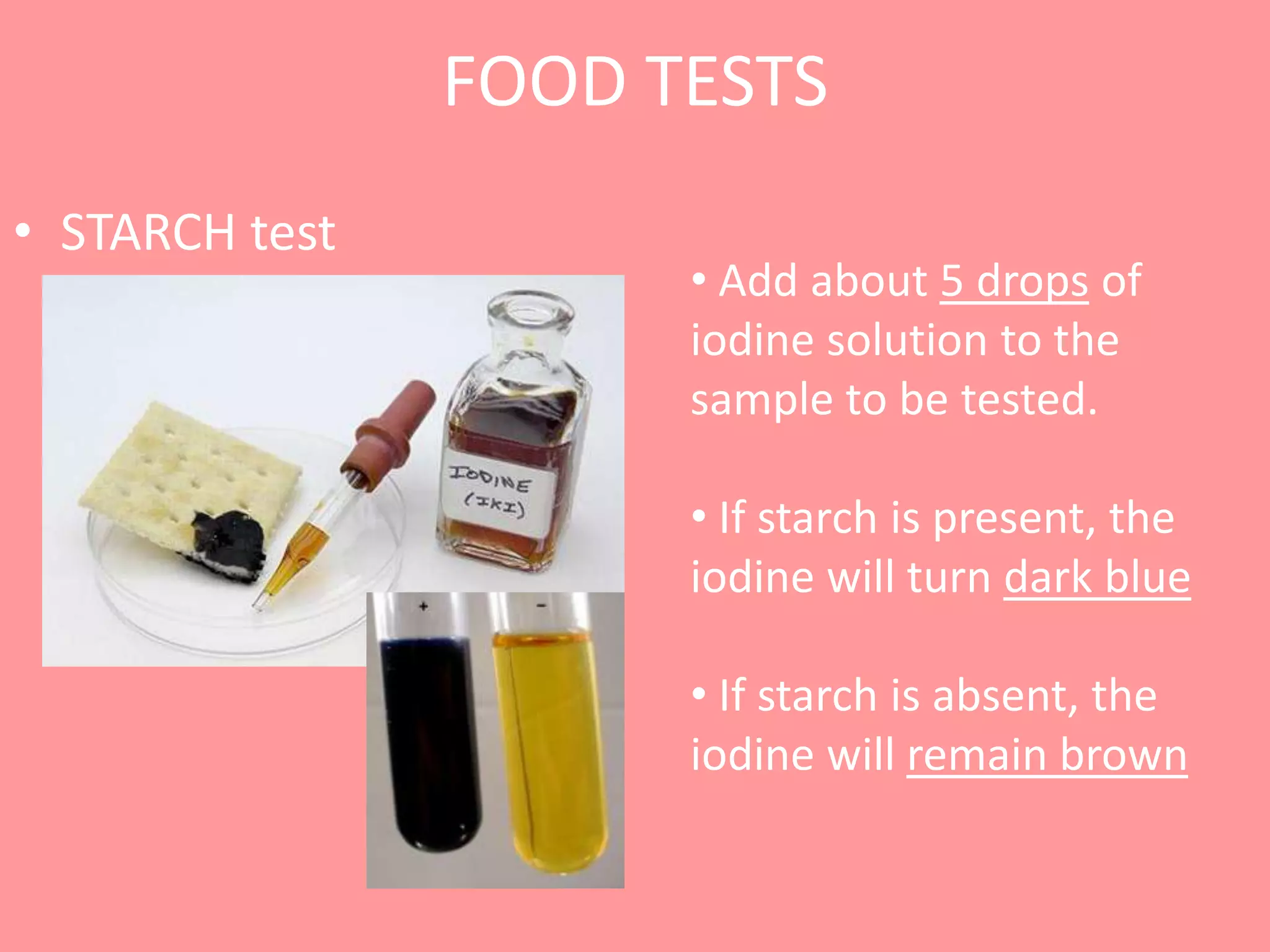
FOOD TESTS
• STARCH test
                      • Add about 5 drops of
                      iodine solution to the
                      sample to be tested.

                      • If starch is present, the
                      iodine will turn dark blue

                      • If starch is absent, the
                      iodine will remain brown
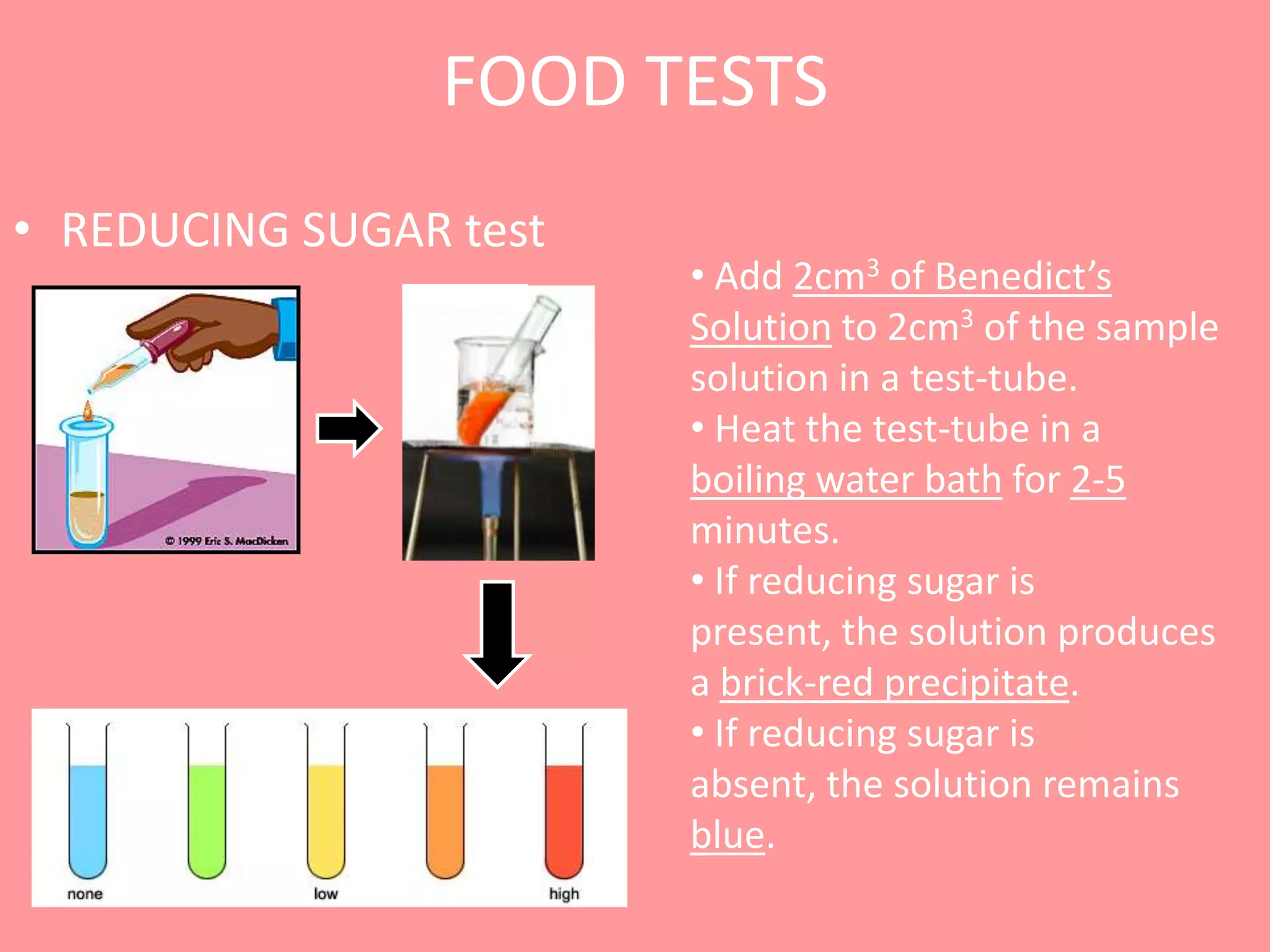
FOOD TESTS
• REDUCING SUGAR test
                        • Add 2cm3 of Benedict’s
                        Solution to 2cm3 of the sample
                        solution in a test-tube.
                        • Heat the test-tube in a
                        boiling water bath for 2-5
                        minutes.
                        • If reducing sugar is
                        present, the solution produces
                        a brick-red precipitate.
                        • If reducing sugar is
                        absent, the solution remains
                        blue.
ENZYMES

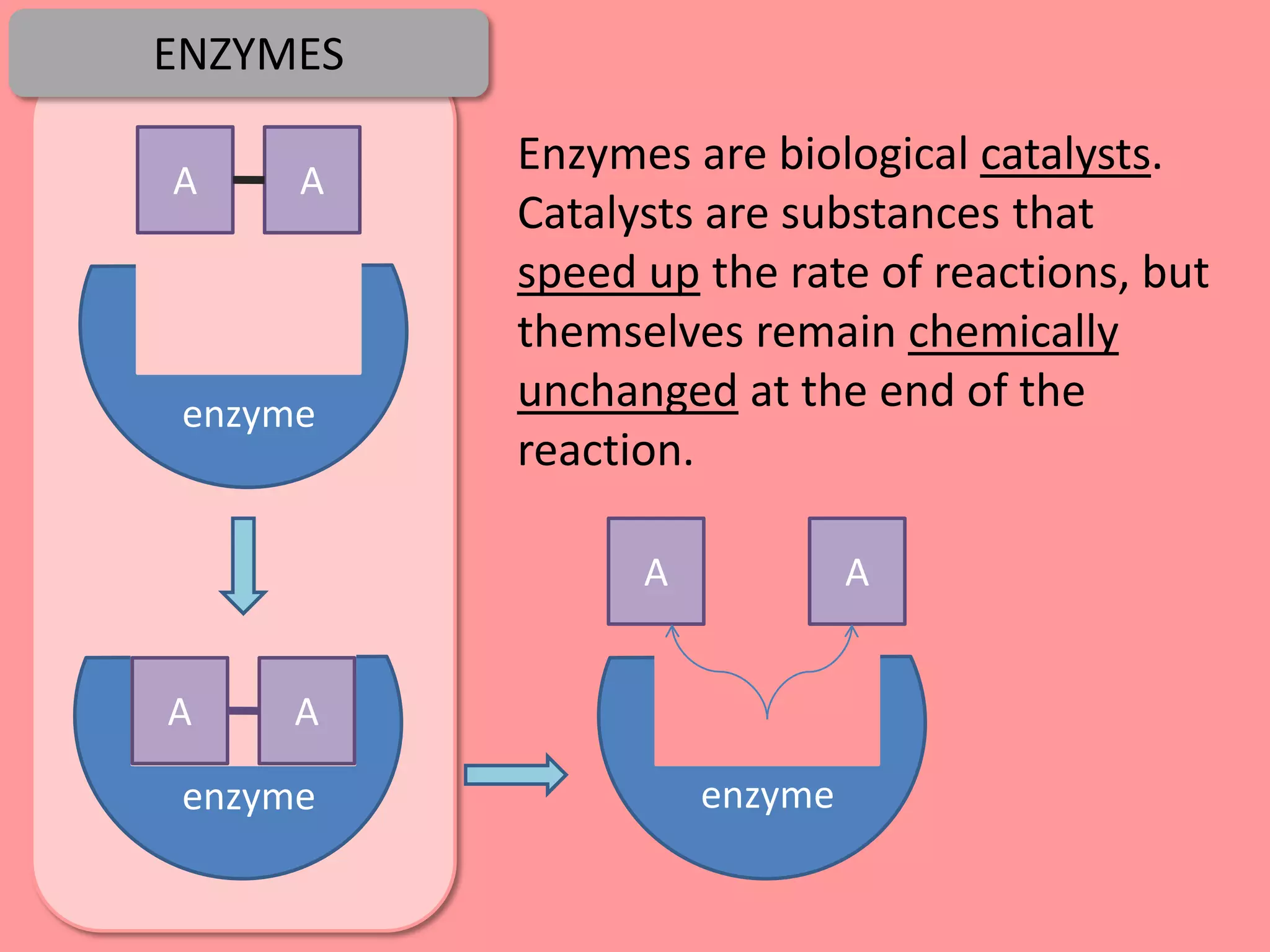
          Enzymes are biological catalysts.
A     A
          Catalysts are substances that
          speed up the rate of reactions, but
          themselves remain chemically
 enzyme   unchanged at the end of the
          reaction.

                A            A


A     A
 enzyme             enzyme
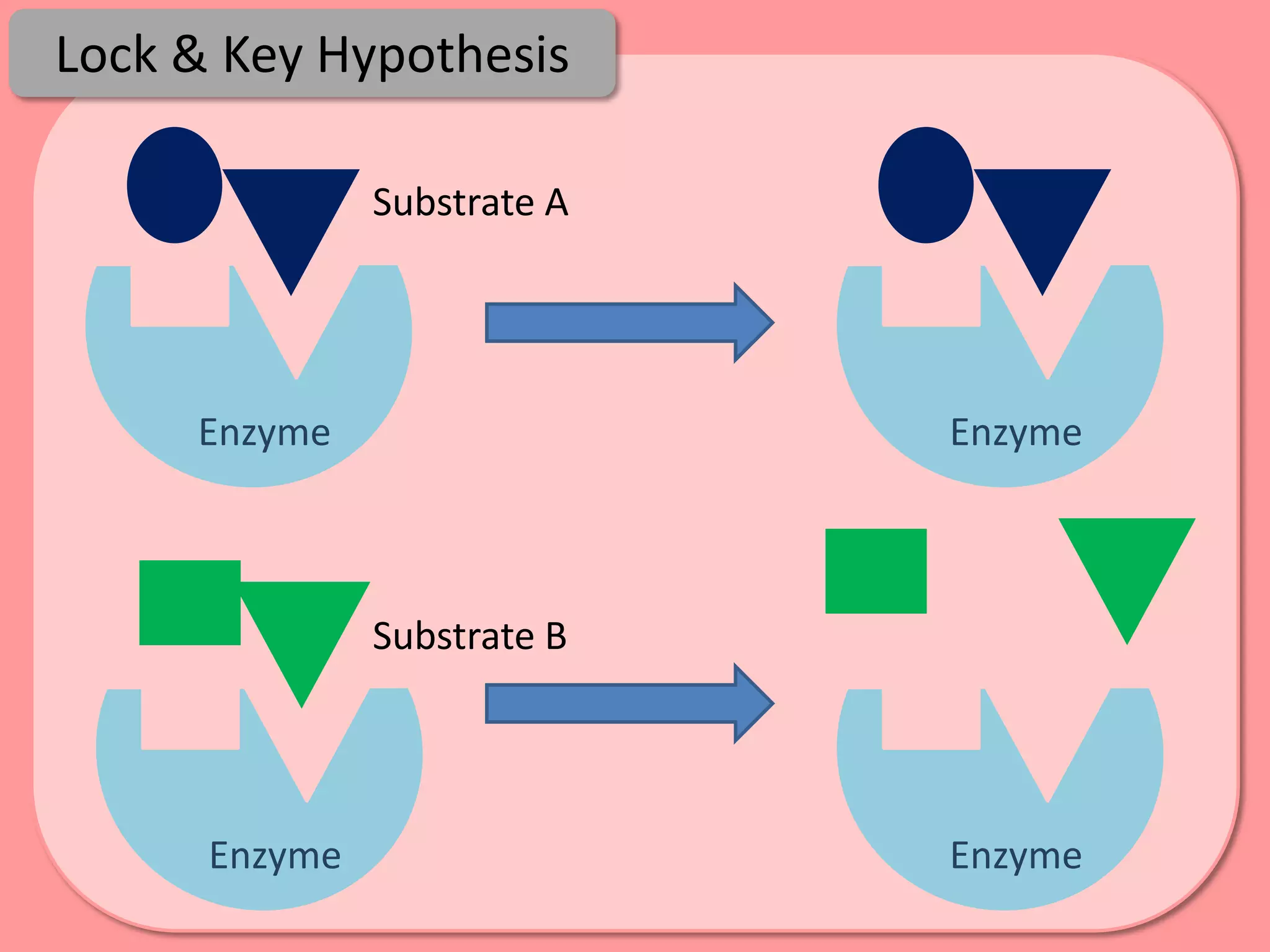
Lock & Key Hypothesis

               Substrate A


     Enzyme                  Enzyme


               Substrate B


      Enzyme                 Enzyme
ENZYMES- Mechanism

    substrate
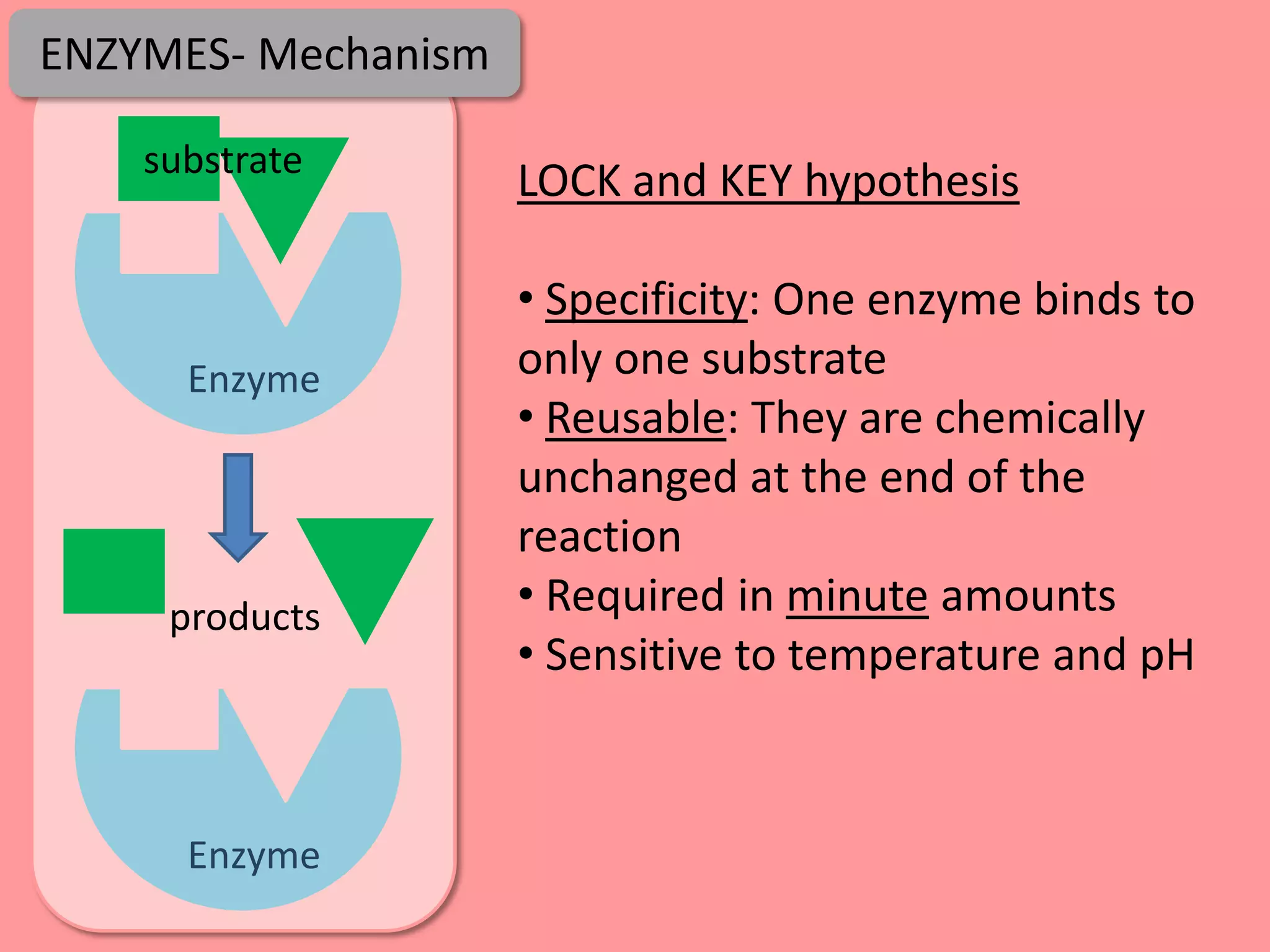
                     LOCK and KEY hypothesis

                     • Specificity: One enzyme binds to
      Enzyme         only one substrate
                     • Reusable: They are chemically
                     unchanged at the end of the
                     reaction
     products        • Required in minute amounts
                     • Sensitive to temperature and pH


      Enzyme
ENZYMES- Mechanism

    substrate


                                Enzyme-substrate
      Enzyme                    complex


                     products


                       Enzyme
ENZYMES- Mechanism

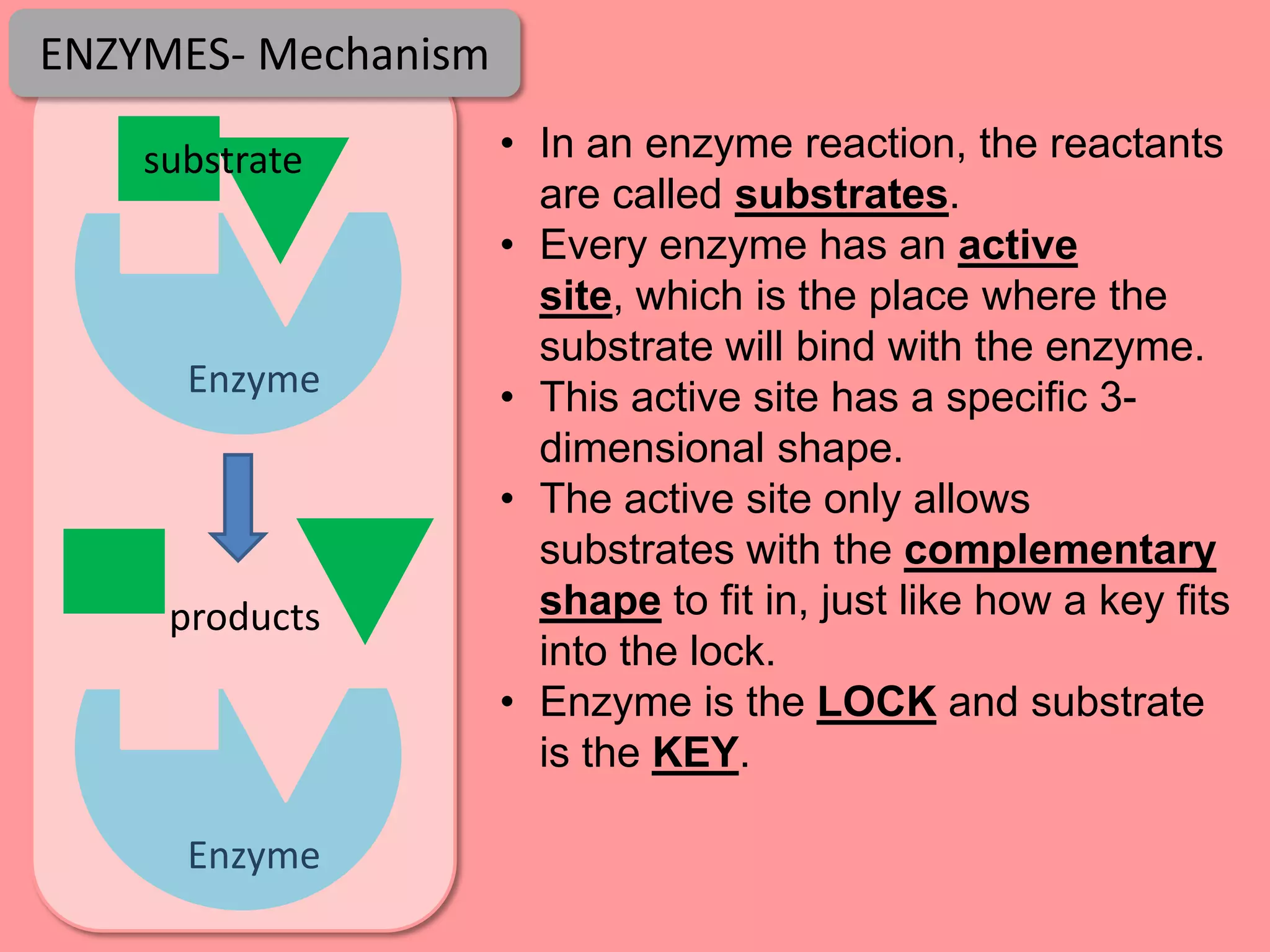
    substrate        • In an enzyme reaction, the reactants
                       are called substrates.
                     • Every enzyme has an active
                       site, which is the place where the
                       substrate will bind with the enzyme.
      Enzyme         • This active site has a specific 3-
                       dimensional shape.
                     • The active site only allows
                       substrates with the complementary
     products          shape to fit in, just like how a key fits
                       into the lock.
                     • Enzyme is the LOCK and substrate
                       is the KEY.

      Enzyme
ENZYMES- Mechanism

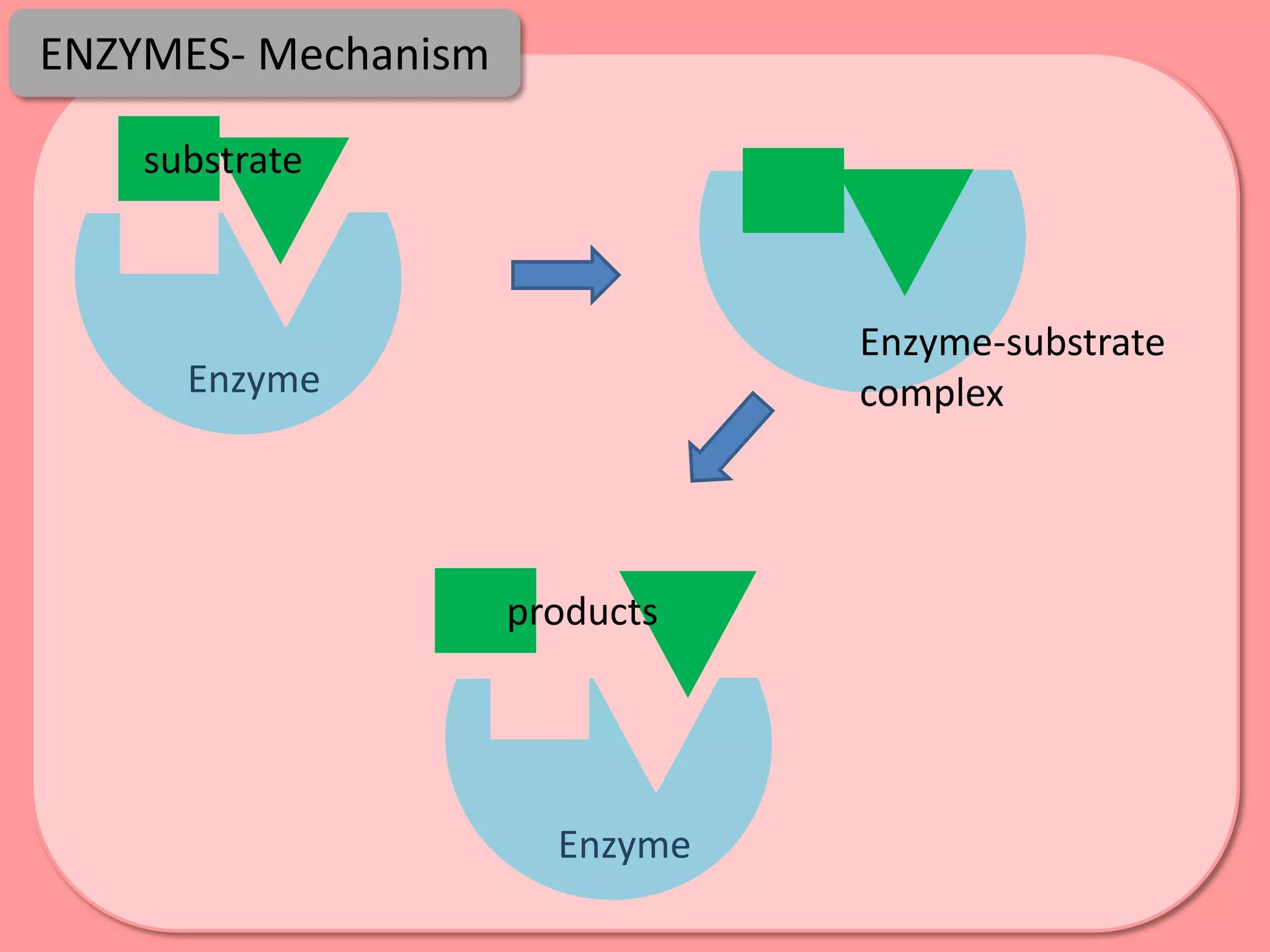
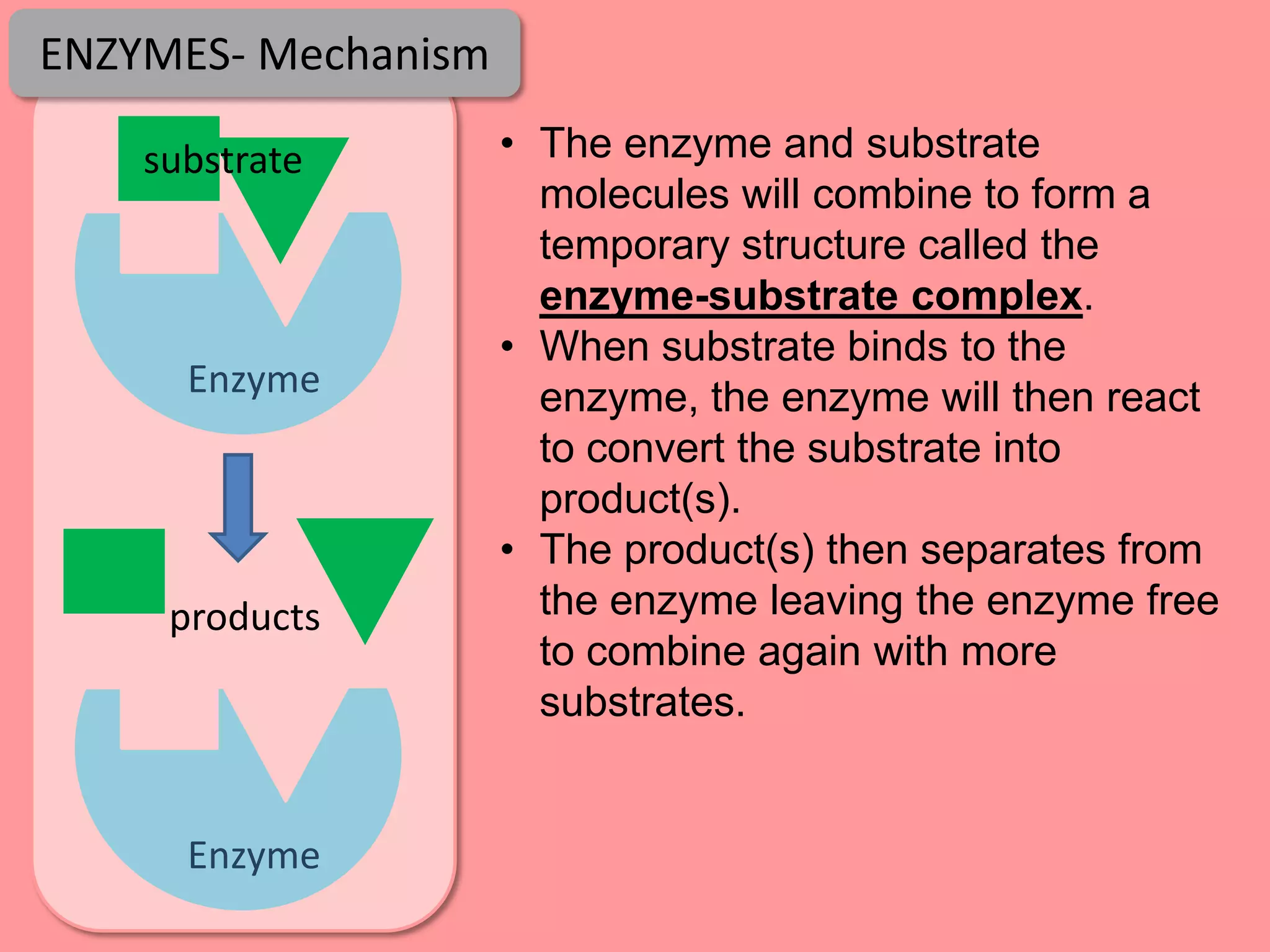
    substrate        • The enzyme and substrate
                       molecules will combine to form a
                       temporary structure called the
                       enzyme-substrate complex.
                     • When substrate binds to the
      Enzyme           enzyme, the enzyme will then react
                       to convert the substrate into
                       product(s).
                     • The product(s) then separates from
     products          the enzyme leaving the enzyme free
                       to combine again with more
                       substrates.


      Enzyme
ENZYMES- Mechanism

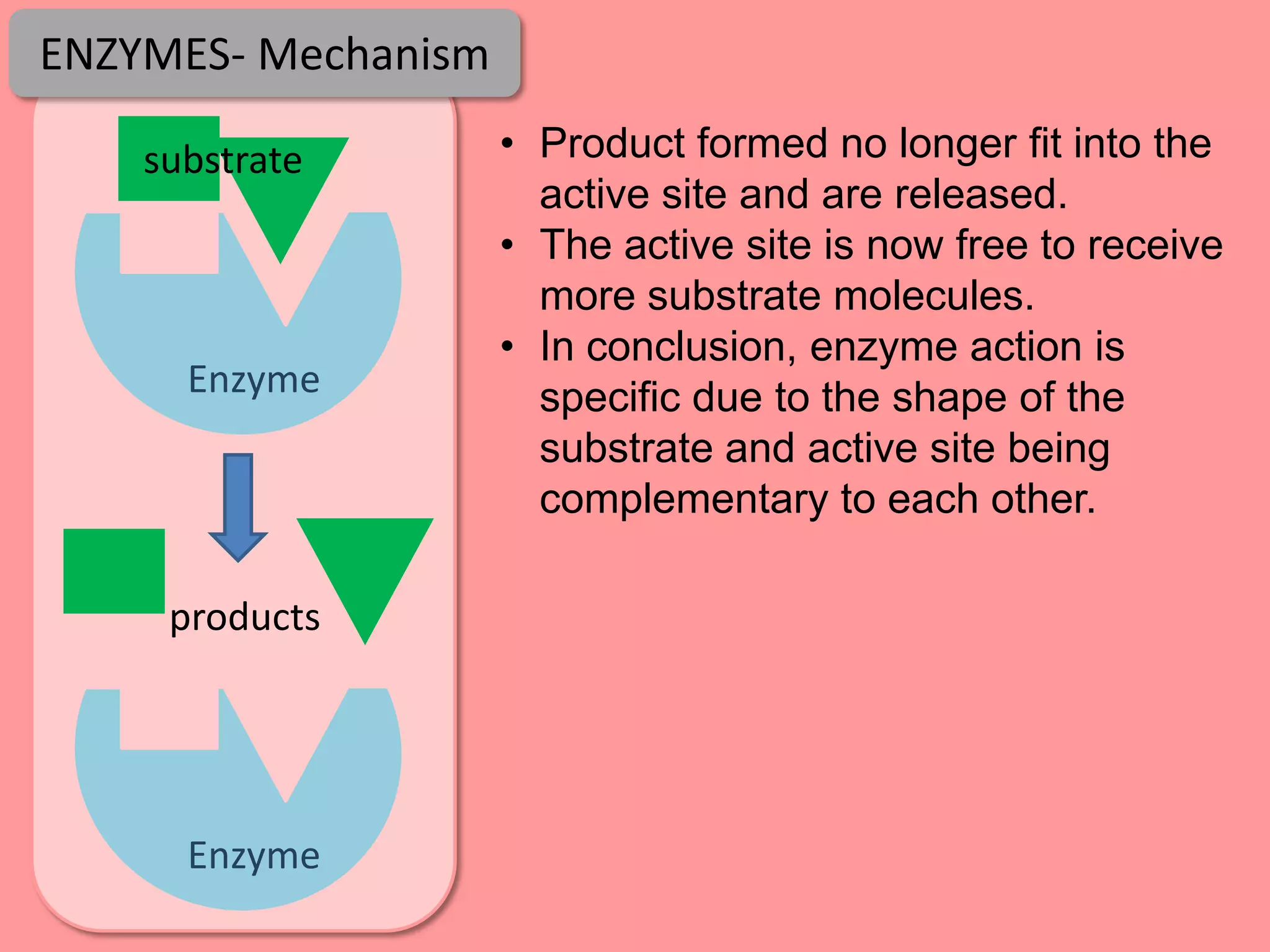
    substrate        • Product formed no longer fit into the
                       active site and are released.
                     • The active site is now free to receive
                       more substrate molecules.
                     • In conclusion, enzyme action is
      Enzyme           specific due to the shape of the
                       substrate and active site being
                       complementary to each other.

     products


      Enzyme
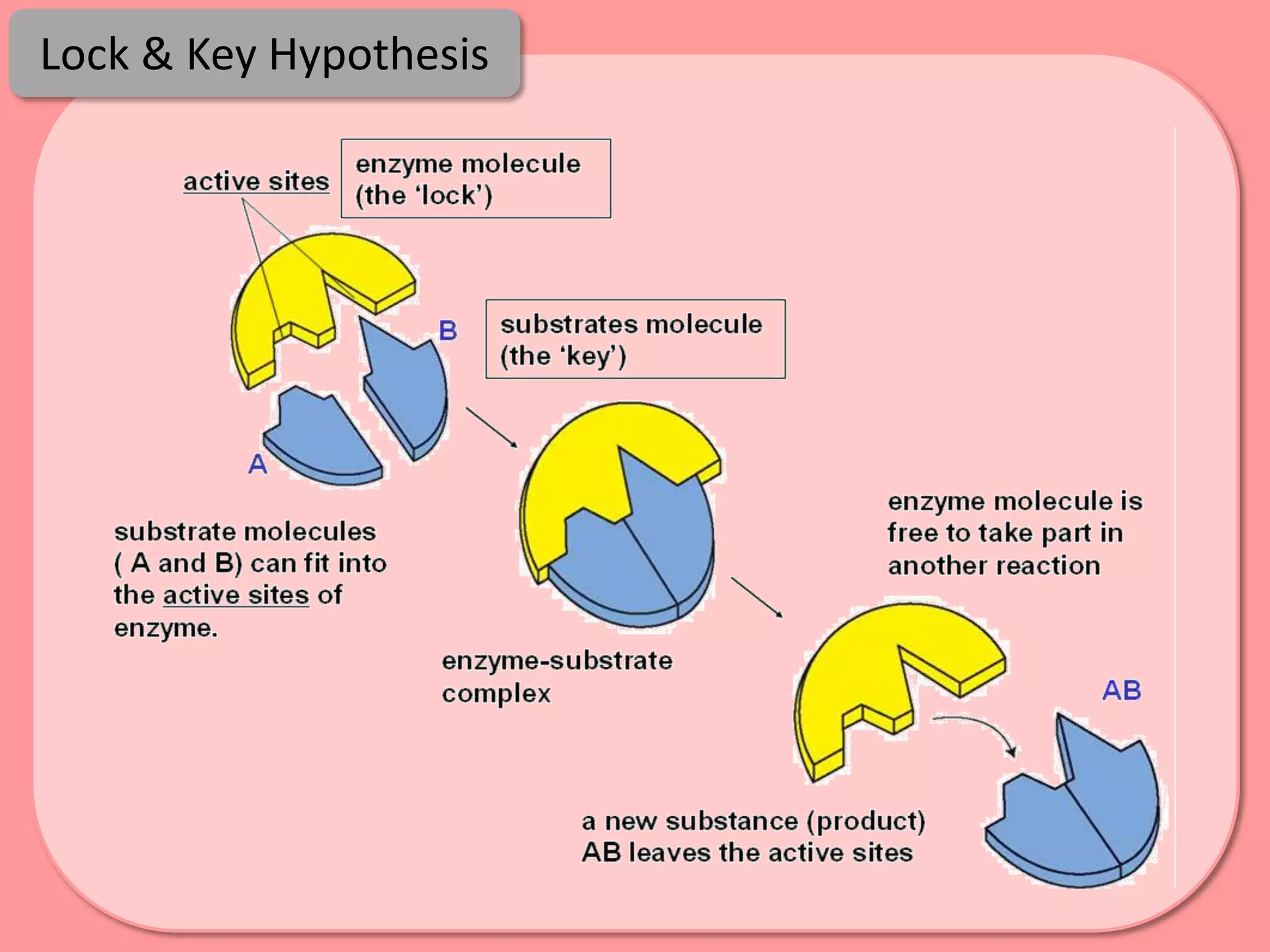
Lock & Key Hypothesis
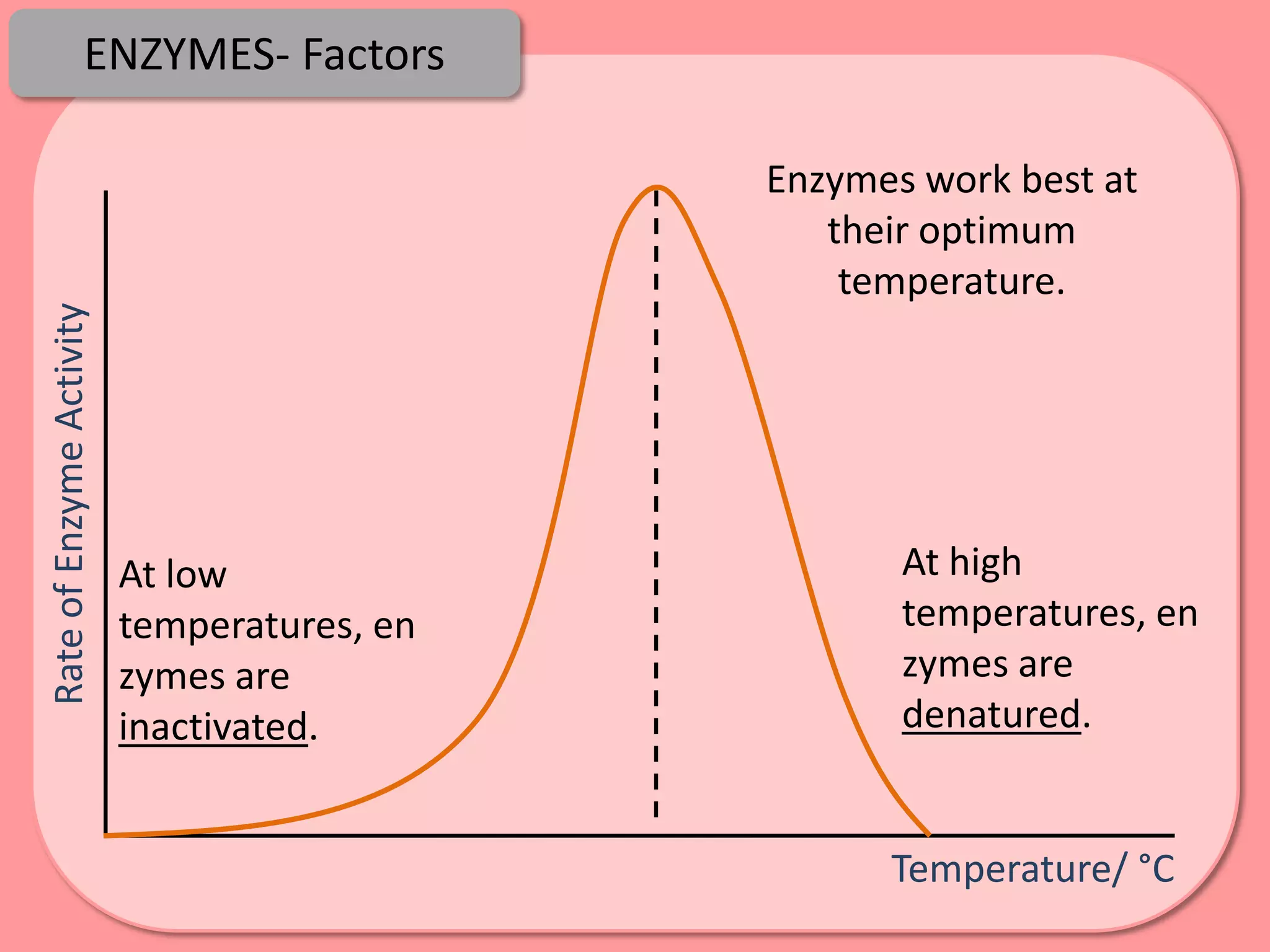
ENZYMES- Factors

                                             Enzymes work best at
                                                their optimum
                                                 temperature.
Rate of Enzyme Activity


                          At low                    At high
                          temperatures, en          temperatures, en
                          zymes are                 zymes are
                          inactivated.              denatured.


                                                   Temperature/ °C
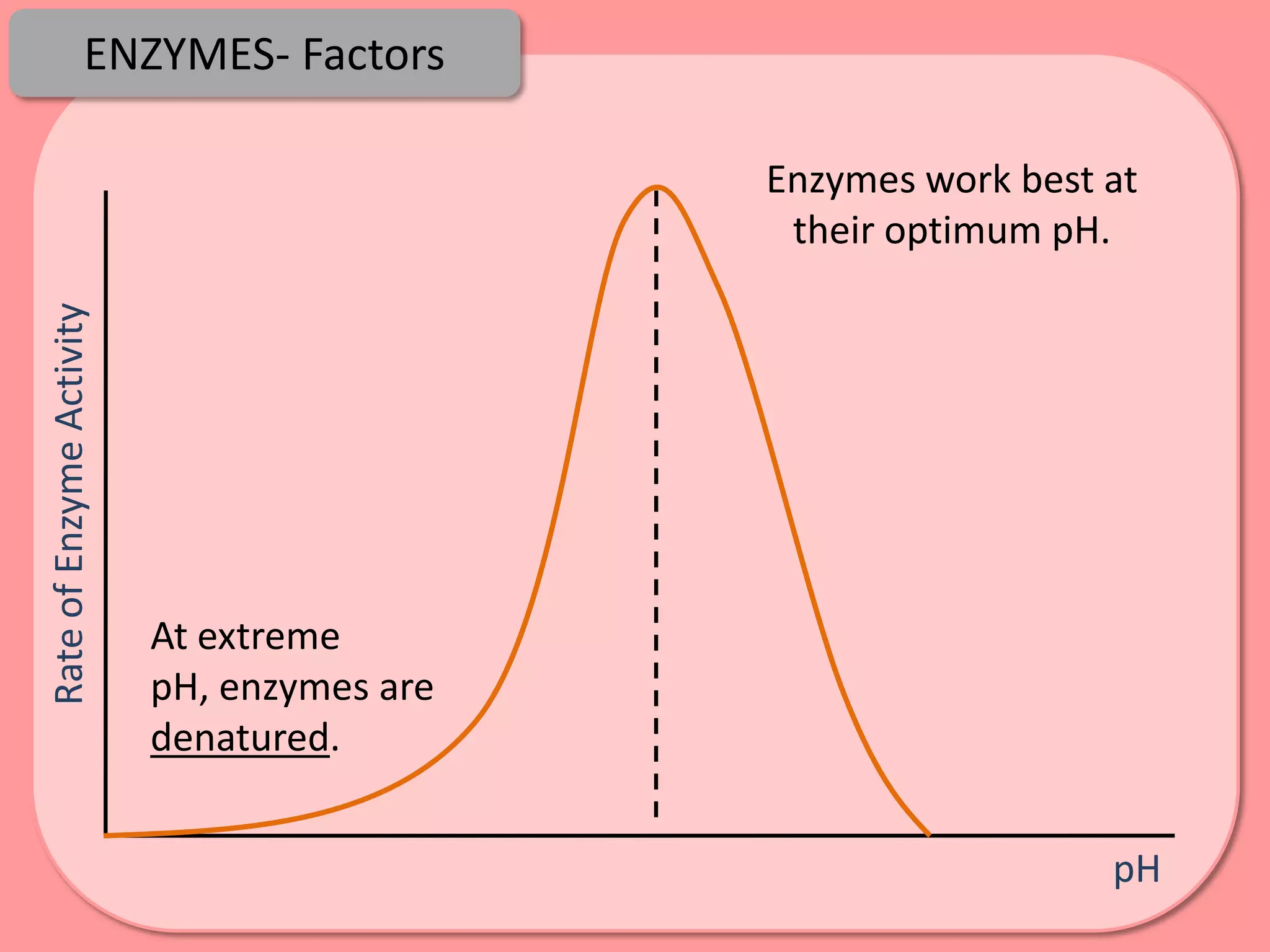
ENZYMES- Factors

                                            Enzymes work best at
                                             their optimum pH.
Rate of Enzyme Activity


                          At extreme
                          pH, enzymes are
                          denatured.


                                                              pH
Learning Objectives

At the end of this lesson, you should be able to:

• explain what is meant by digestion
• explain why food must be digested
• define enzymes as biological catalysts that speed up the
rate of reactions without being chemically changed at the
end of the reaction
• explain the effects of temperature on enzyme activity
• explain the mode of enzyme action in terms of the lock-
and-key hypothesis
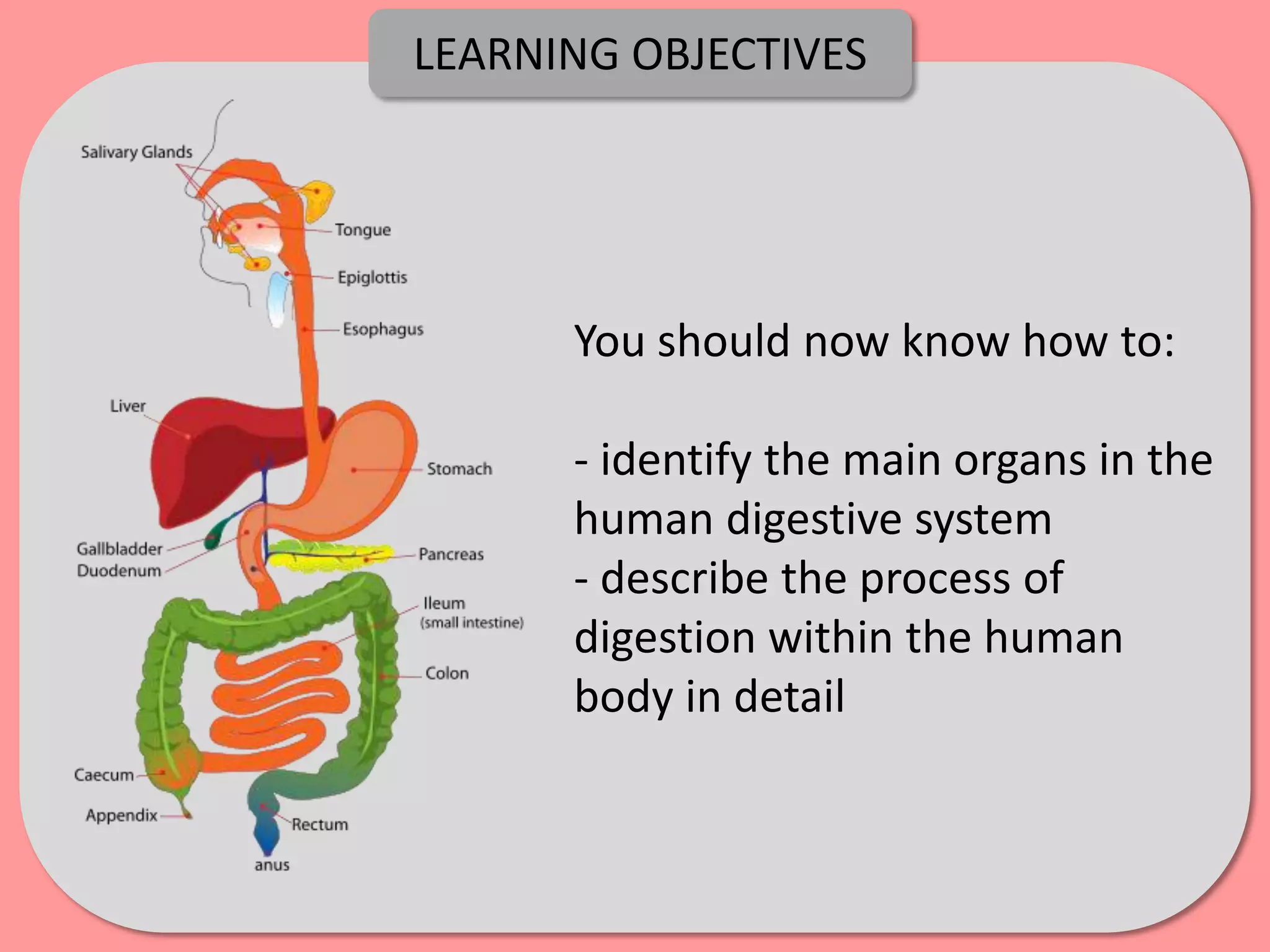
LEARNING OBJECTIVES


      You should now know how to:

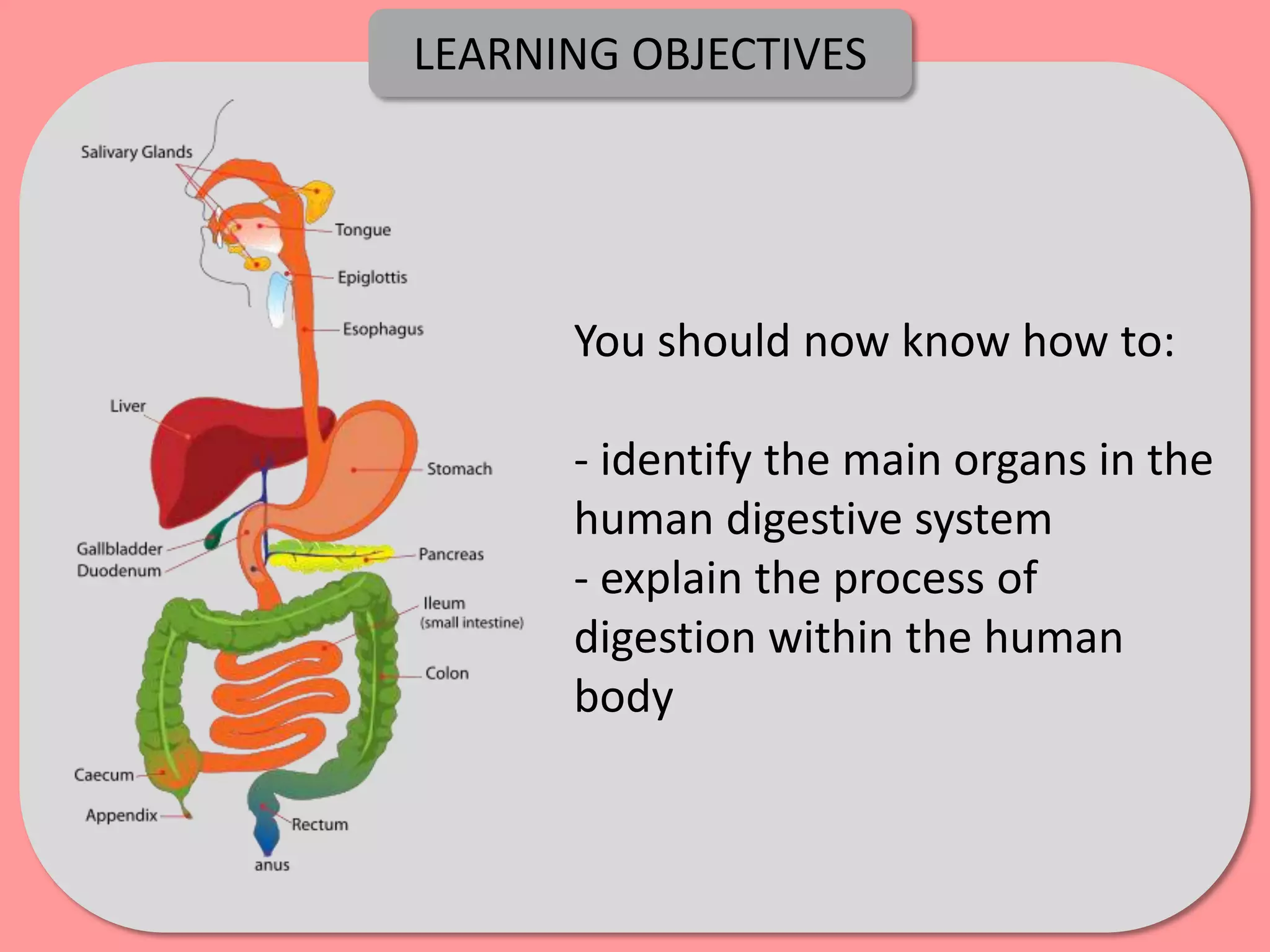
      - identify the main organs in the
      human digestive system
      - describe the process of
      digestion within the human
      body in detail
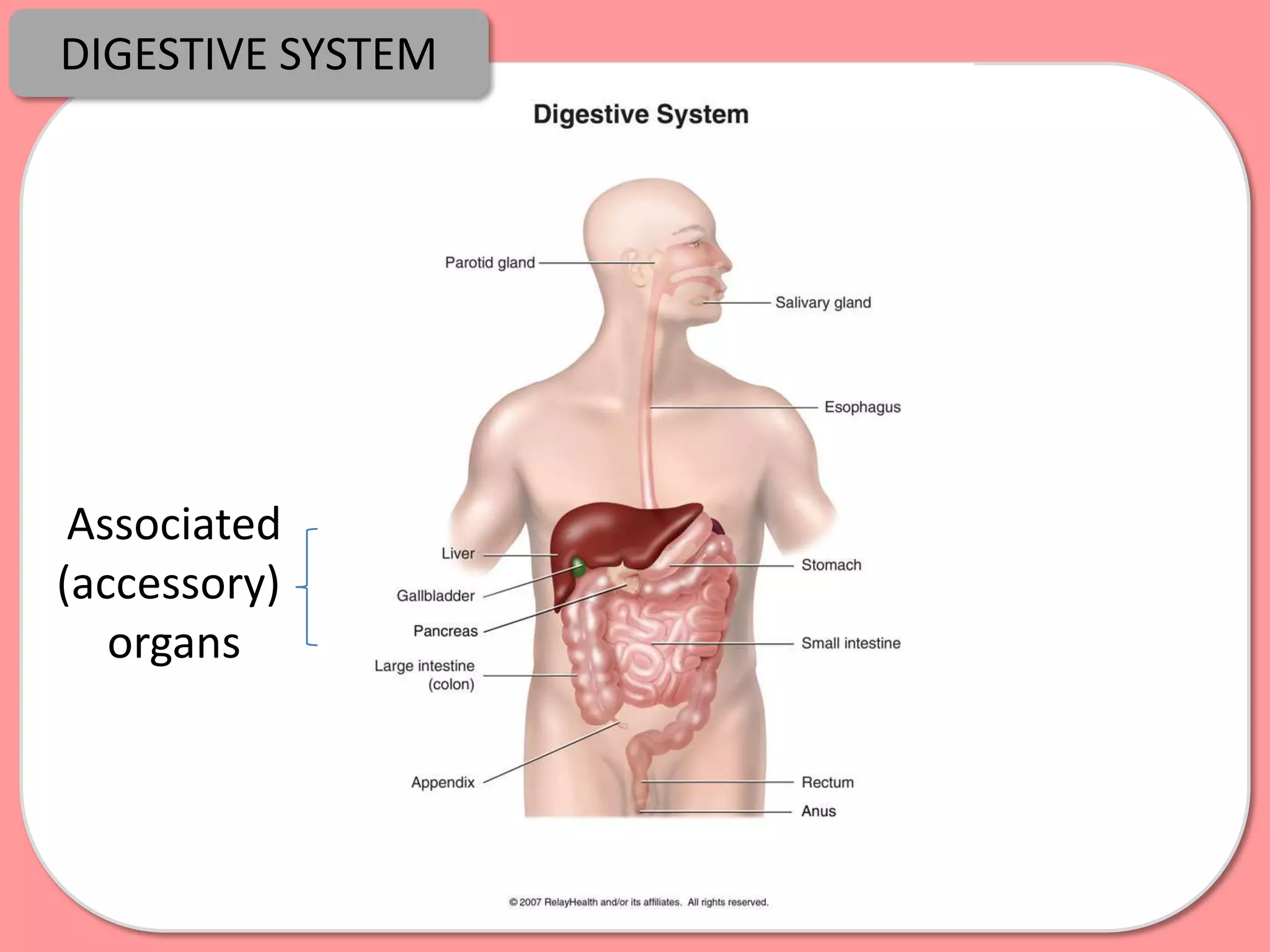
DIGESTIVE SYSTEM


 Associated
(accessory)
   organs
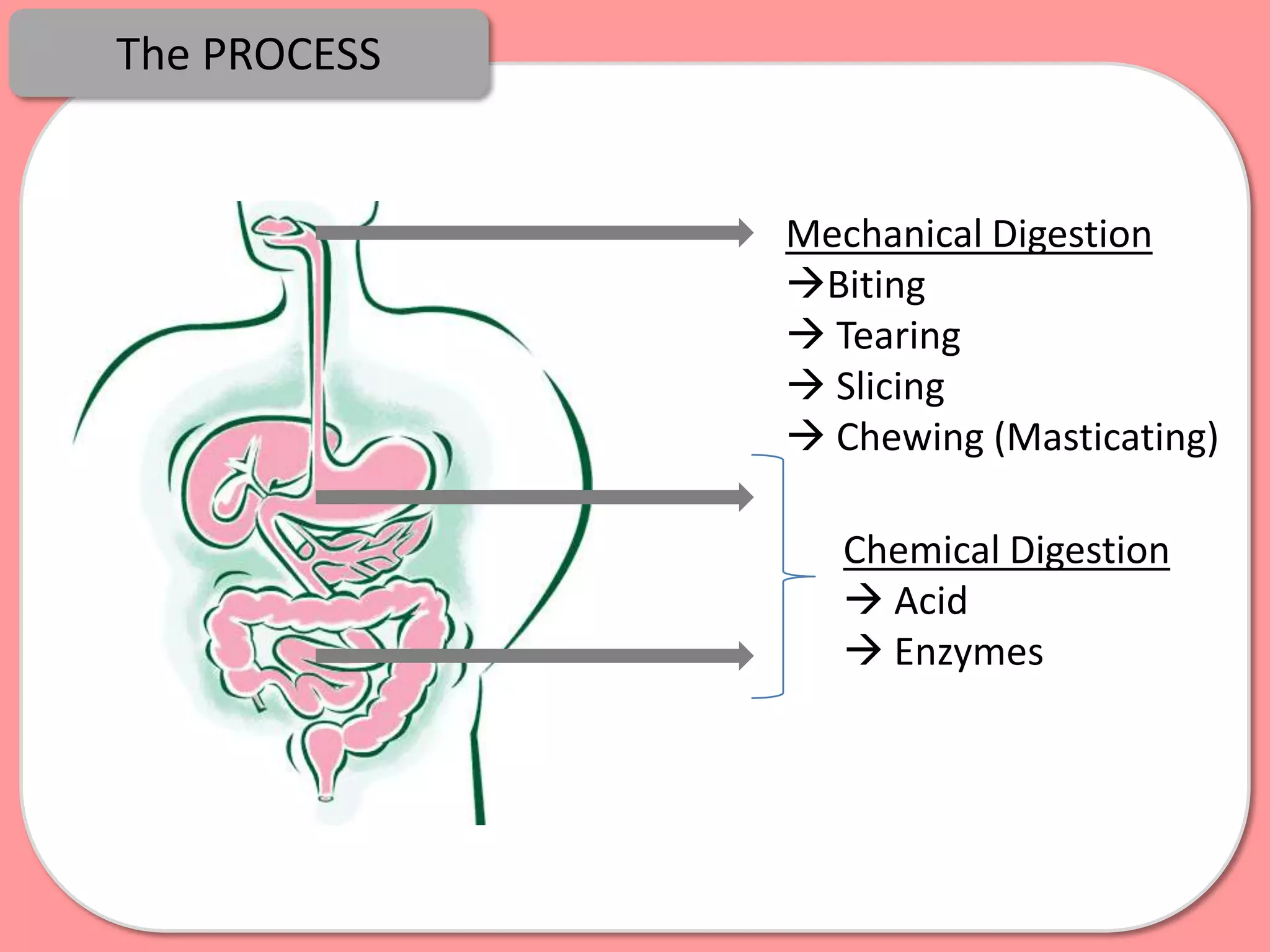
The PROCESS


              Mechanical Digestion
              Biting
               Tearing
               Slicing
               Chewing (Masticating)

                 Chemical Digestion
                  Acid
                  Enzymes
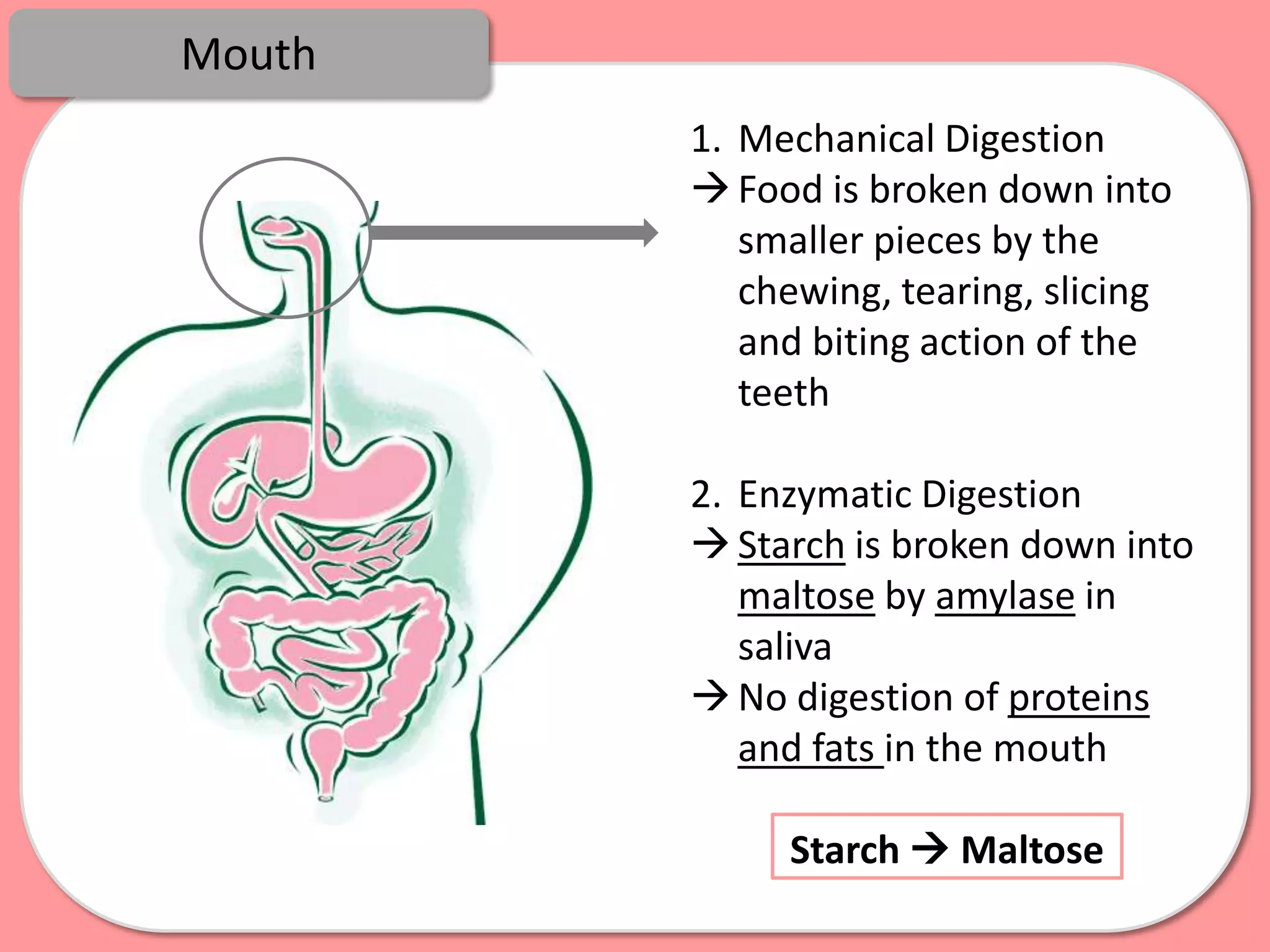
Mouth
        1. Mechanical Digestion
         Food is broken down into
           smaller pieces by the
           chewing, tearing, slicing
           and biting action of the
           teeth

        2. Enzymatic Digestion
         Starch is broken down into
           maltose by amylase in
           saliva
         No digestion of proteins
           and fats in the mouth

             Starch  Maltose
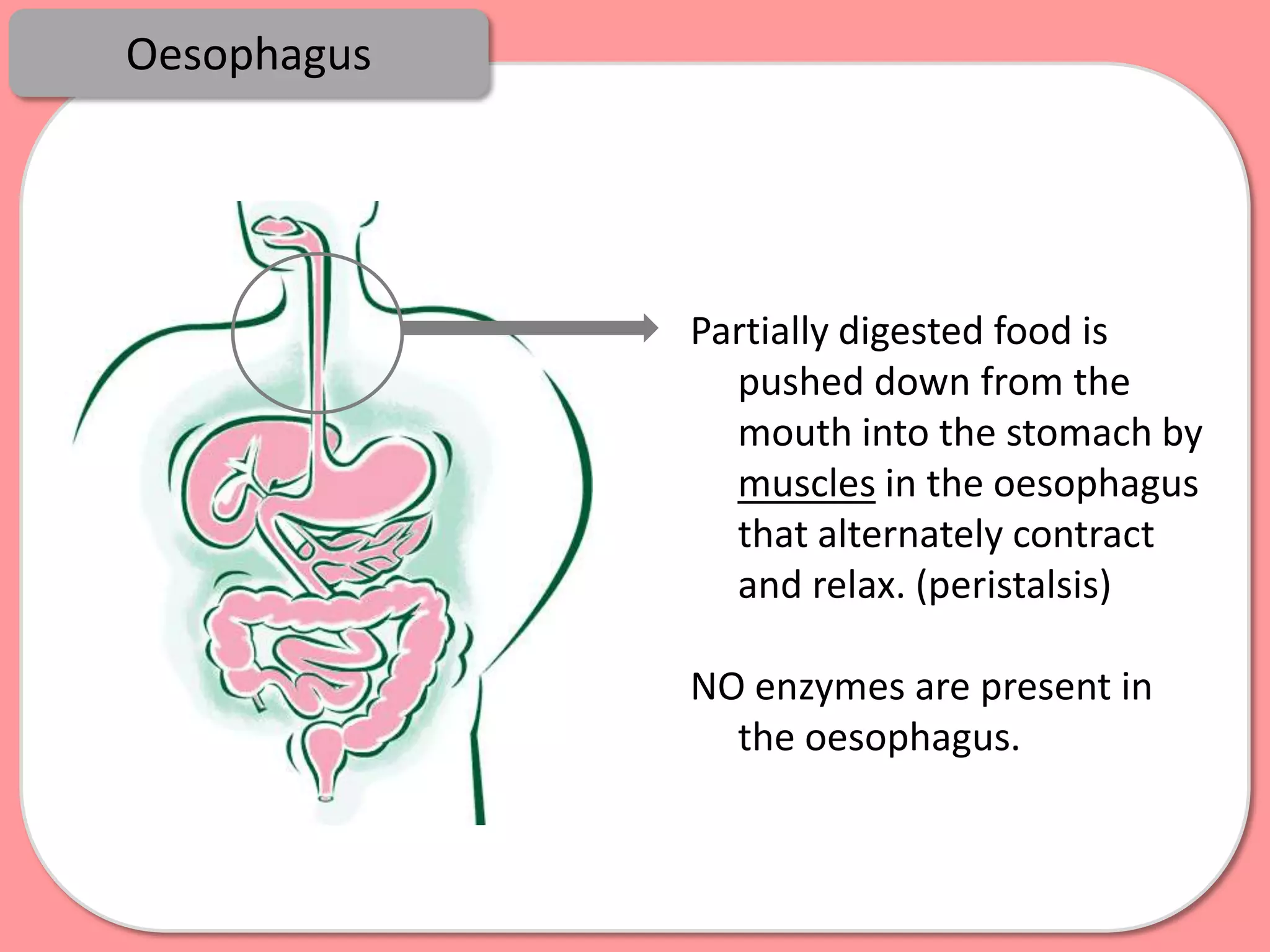
Oesophagus


             Partially digested food is
               pushed down from the
               mouth into the stomach by
               muscles in the oesophagus
               that alternately contract
               and relax. (peristalsis)

             NO enzymes are present in
               the oesophagus.
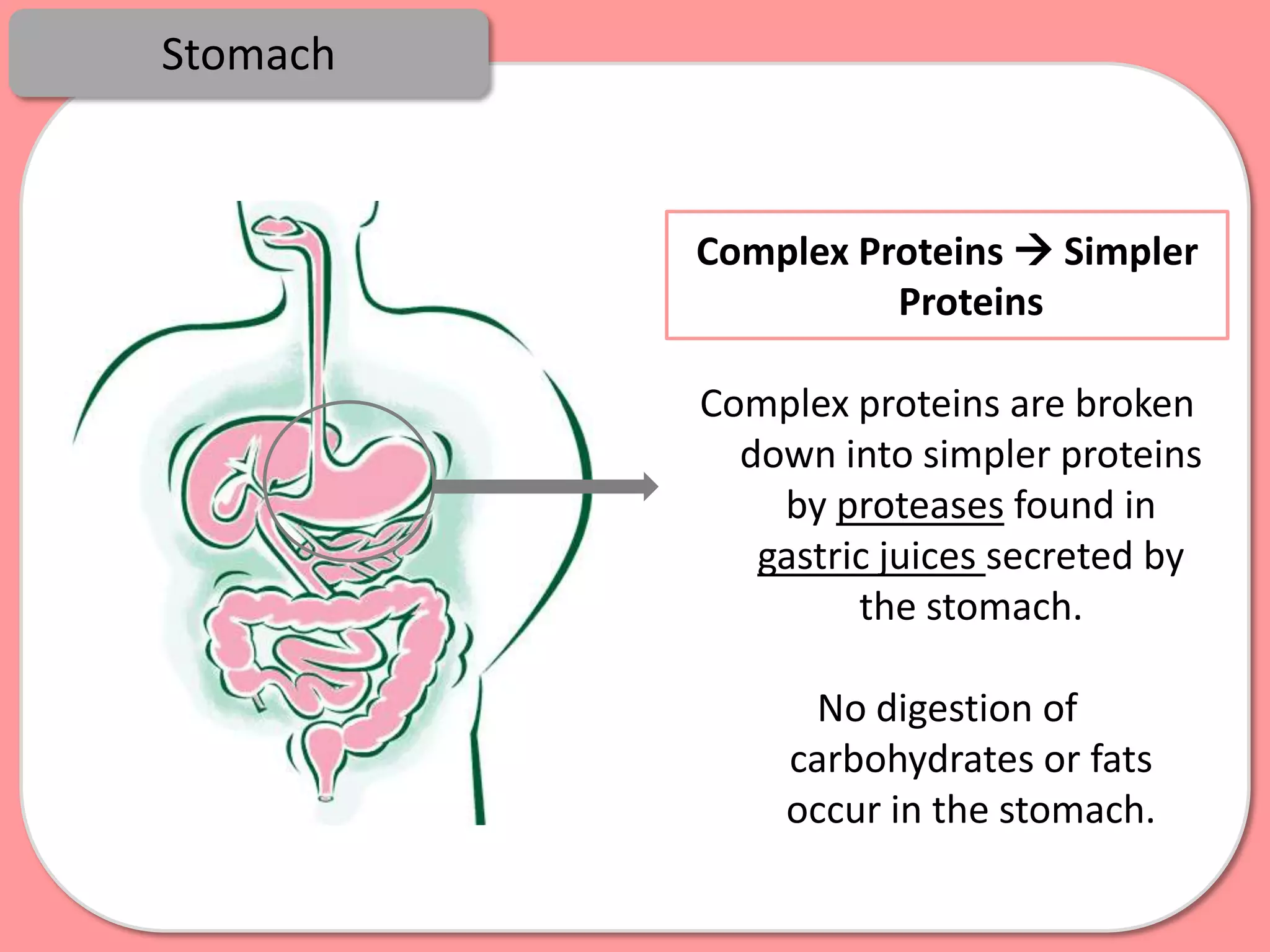
Stomach


          Complex Proteins  Simpler
                    Proteins

          Complex proteins are broken
            down into simpler proteins
              by proteases found in
             gastric juices secreted by
                   the stomach.

               No digestion of
              carbohydrates or fats
              occur in the stomach.
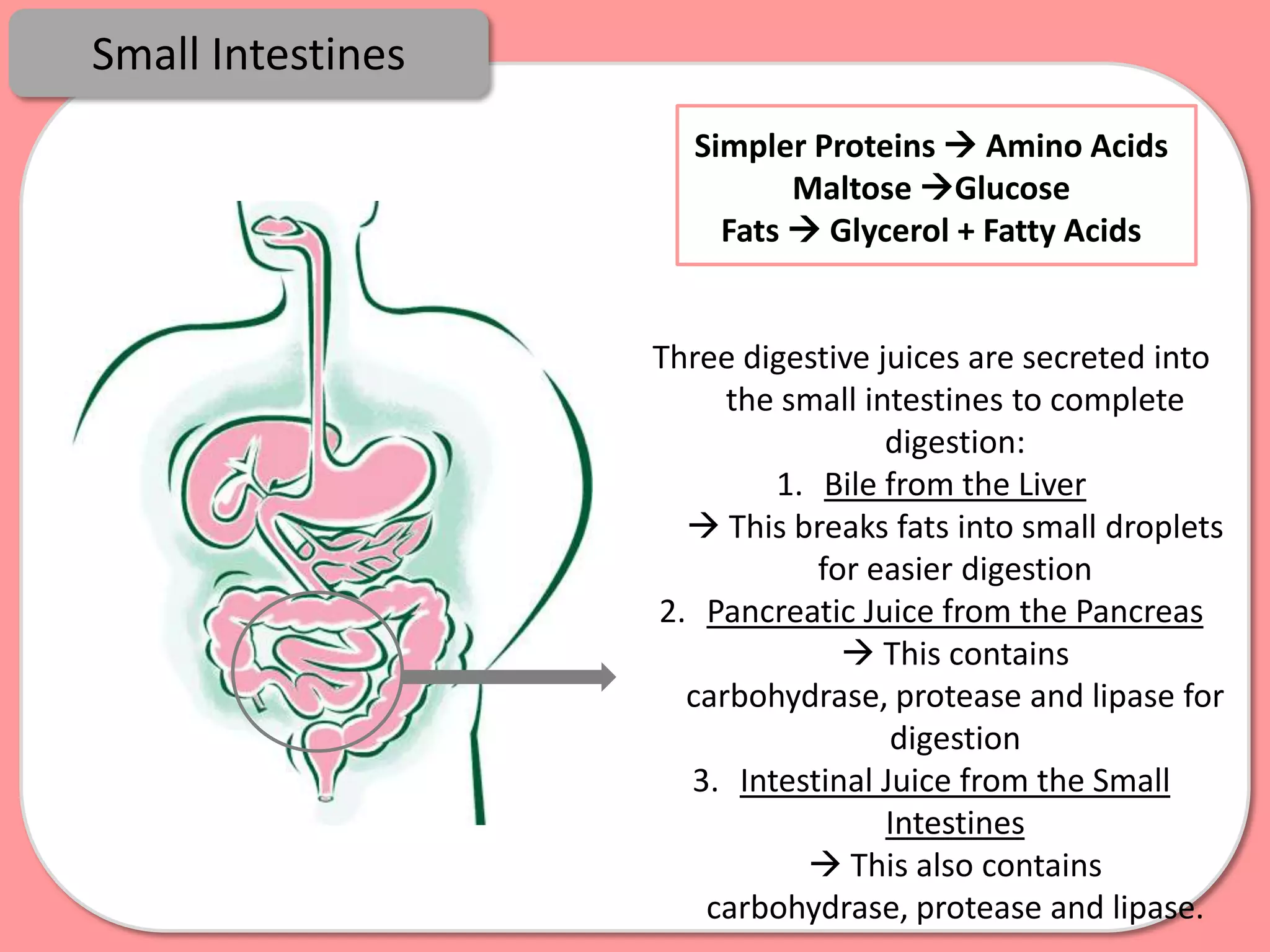
Small Intestines
                     Simpler Proteins  Amino Acids
                            Maltose Glucose
                       Fats  Glycerol + Fatty Acids


                   Three digestive juices are secreted into
                        the small intestines to complete
                                    digestion:
                           1. Bile from the Liver
                      This breaks fats into small droplets
                              for easier digestion
                   2. Pancreatic Juice from the Pancreas
                                 This contains
                     carbohydrase, protease and lipase for
                                    digestion
                     3. Intestinal Juice from the Small
                                    Intestines
                              This also contains
                      carbohydrase, protease and lipase.
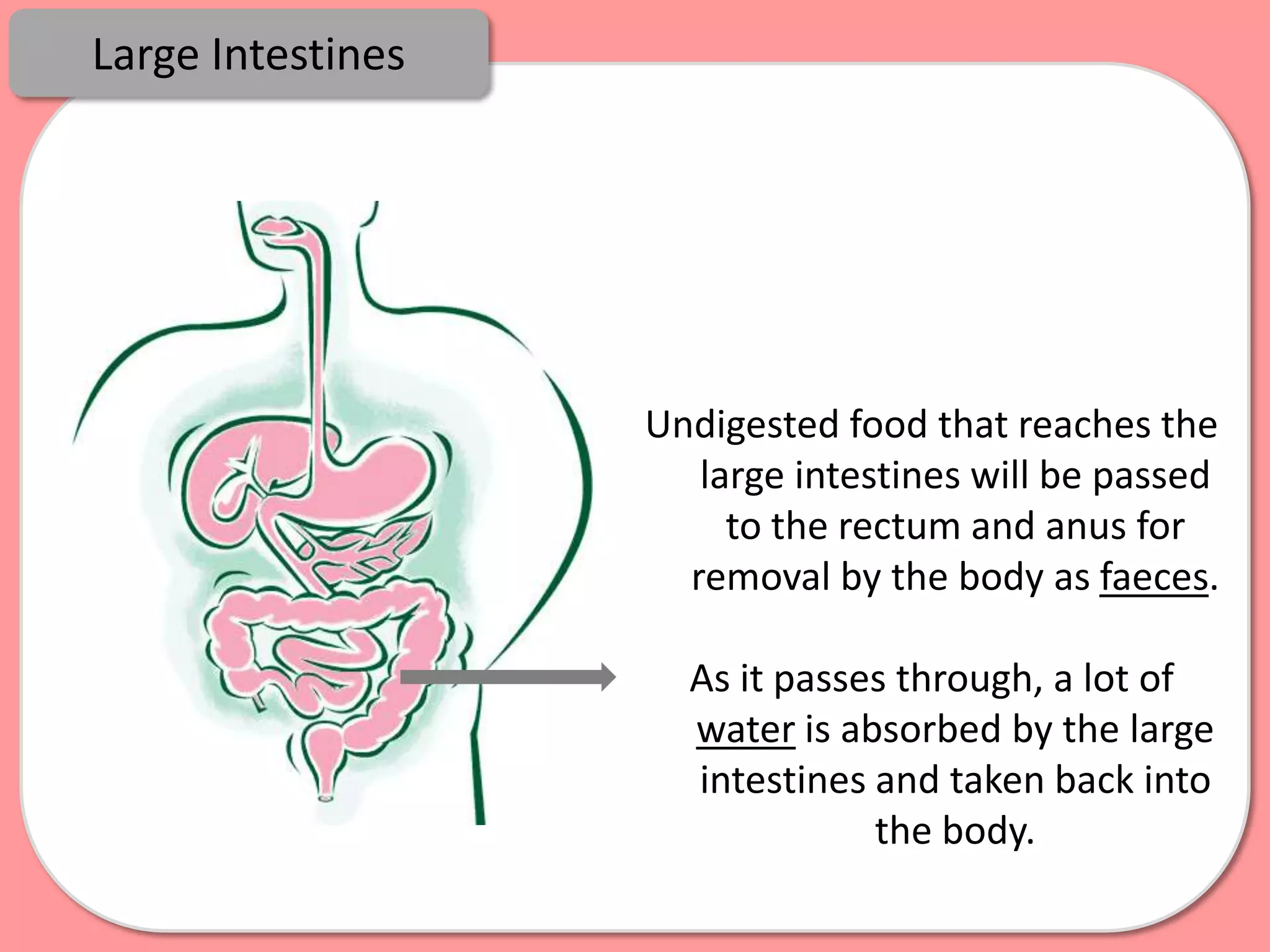
Large Intestines


                   Undigested food that reaches the
                      large intestines will be passed
                        to the rectum and anus for
                     removal by the body as faeces.

                     As it passes through, a lot of
                     water is absorbed by the large
                     intestines and taken back into
                                the body.
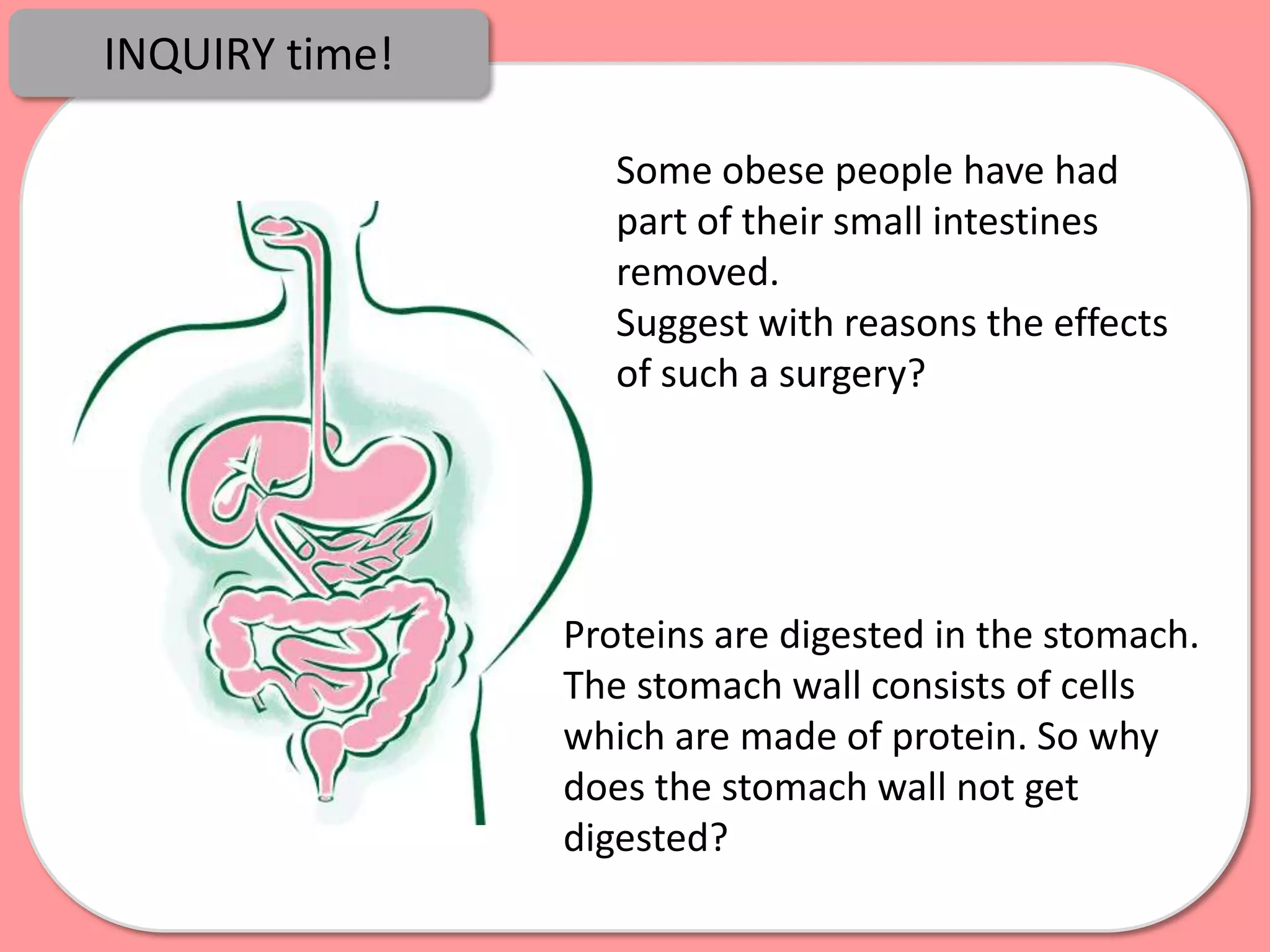
INQUIRY time!

                   Some obese people have had
                   part of their small intestines
                   removed.
                   Suggest with reasons the effects
                   of such a surgery?


                Proteins are digested in the stomach.
                The stomach wall consists of cells
                which are made of protein. So why
                does the stomach wall not get
                digested?
LEARNING OBJECTIVES


      You should now know how to:

      - identify the main organs in the
      human digestive system
      - explain the process of
      digestion within the human
      body
RECALL


You have learnt about

• the meaning of digestion
• why food must be digested
• enzymes as biological catalysts that speed up the rate of
reactions without being chemically changed at the end of
the reaction
• the process of digestion and where specific nutrients
are digested in the body
Learning Objectives

  At the end of this lesson, you should be able to:

  • explain how digested food is absorbed into the
  bloodstream
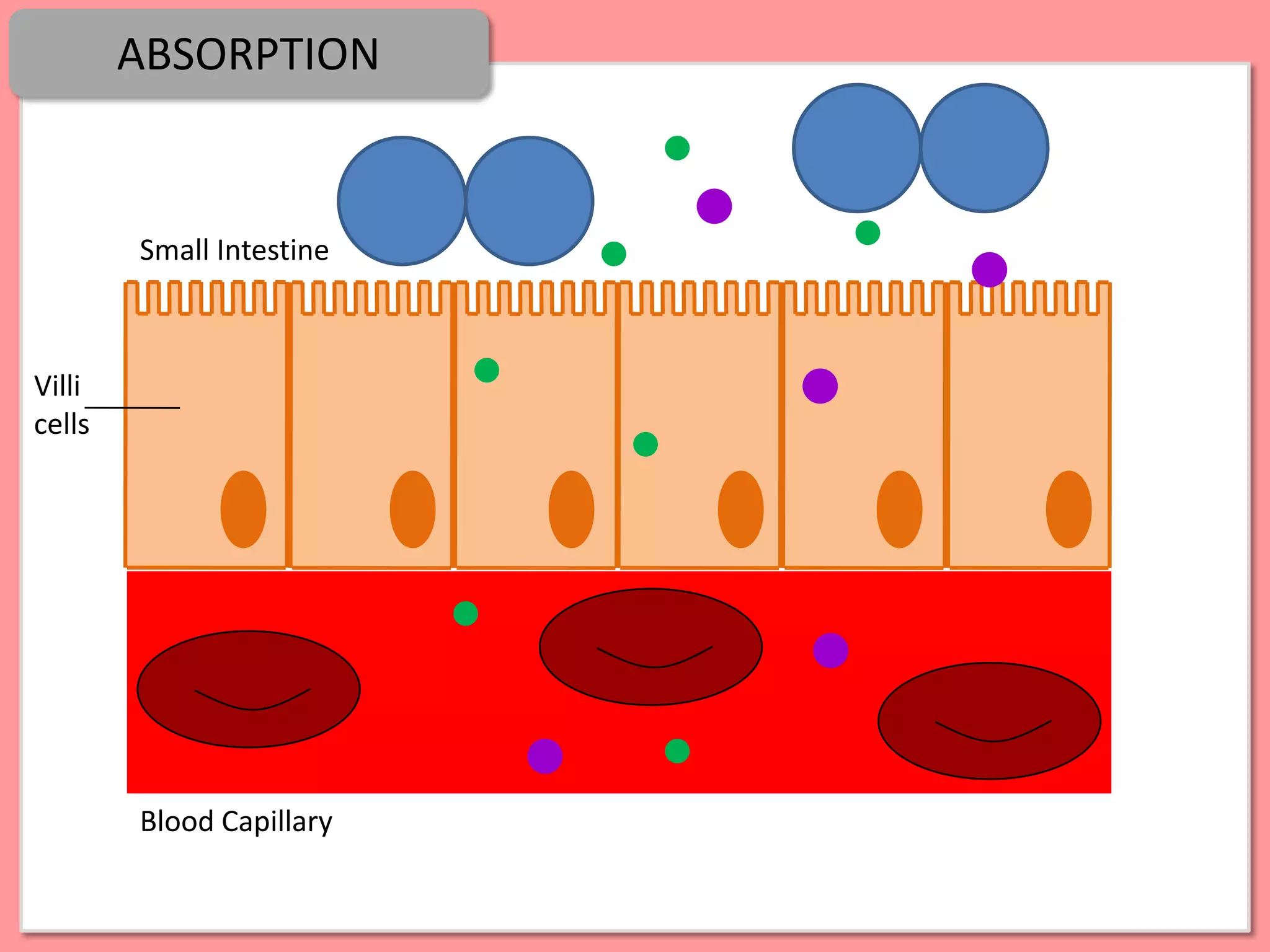
ABSORPTION


        Small Intestine


Villi
cells


        Blood Capillary
ABSORPTION

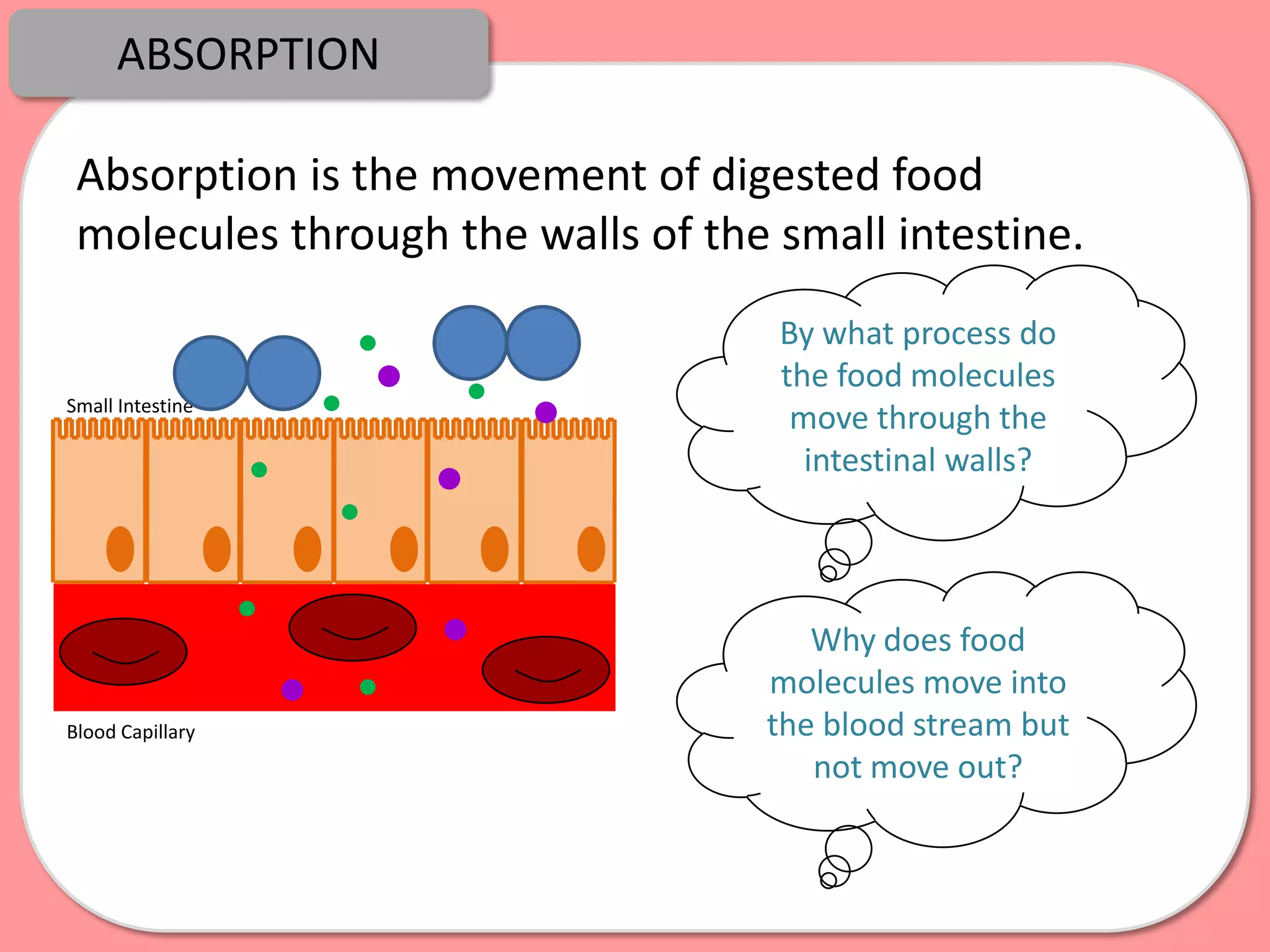
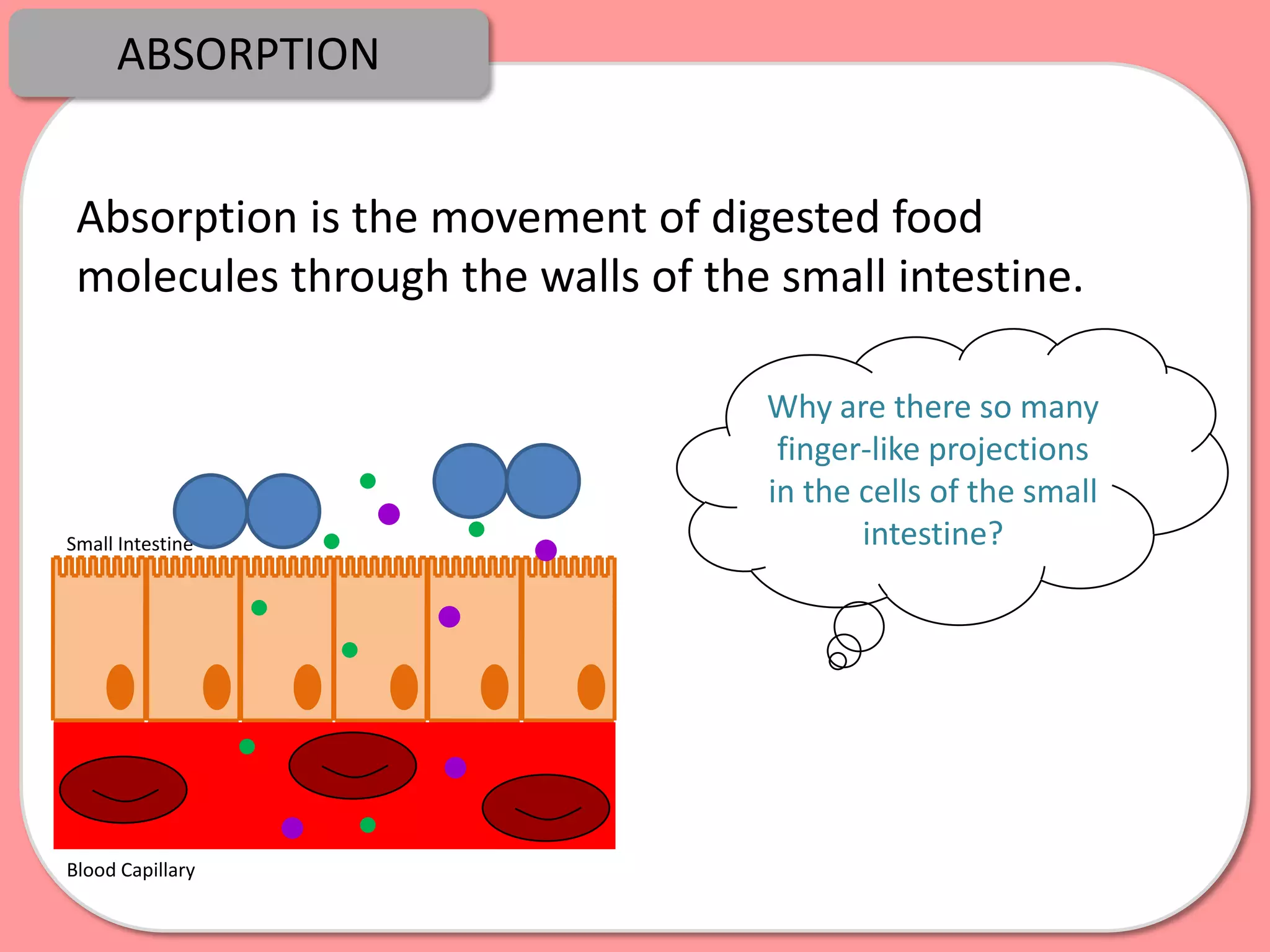
 Absorption is the movement of digested food
 molecules through the walls of the small intestine.
                                    By what process do
                                    the food molecules
Small Intestine
                                     move through the
                                      intestinal walls?


                                      Why does food
                                   molecules move into
Blood Capillary                    the blood stream but
                                      not move out?
ABSORPTION


 Absorption is the movement of digested food
 molecules through the walls of the small intestine.

                                   Why are there so many
                                    finger-like projections
                                   in the cells of the small
Small Intestine                           intestine?


Blood Capillary
ABSORPTION

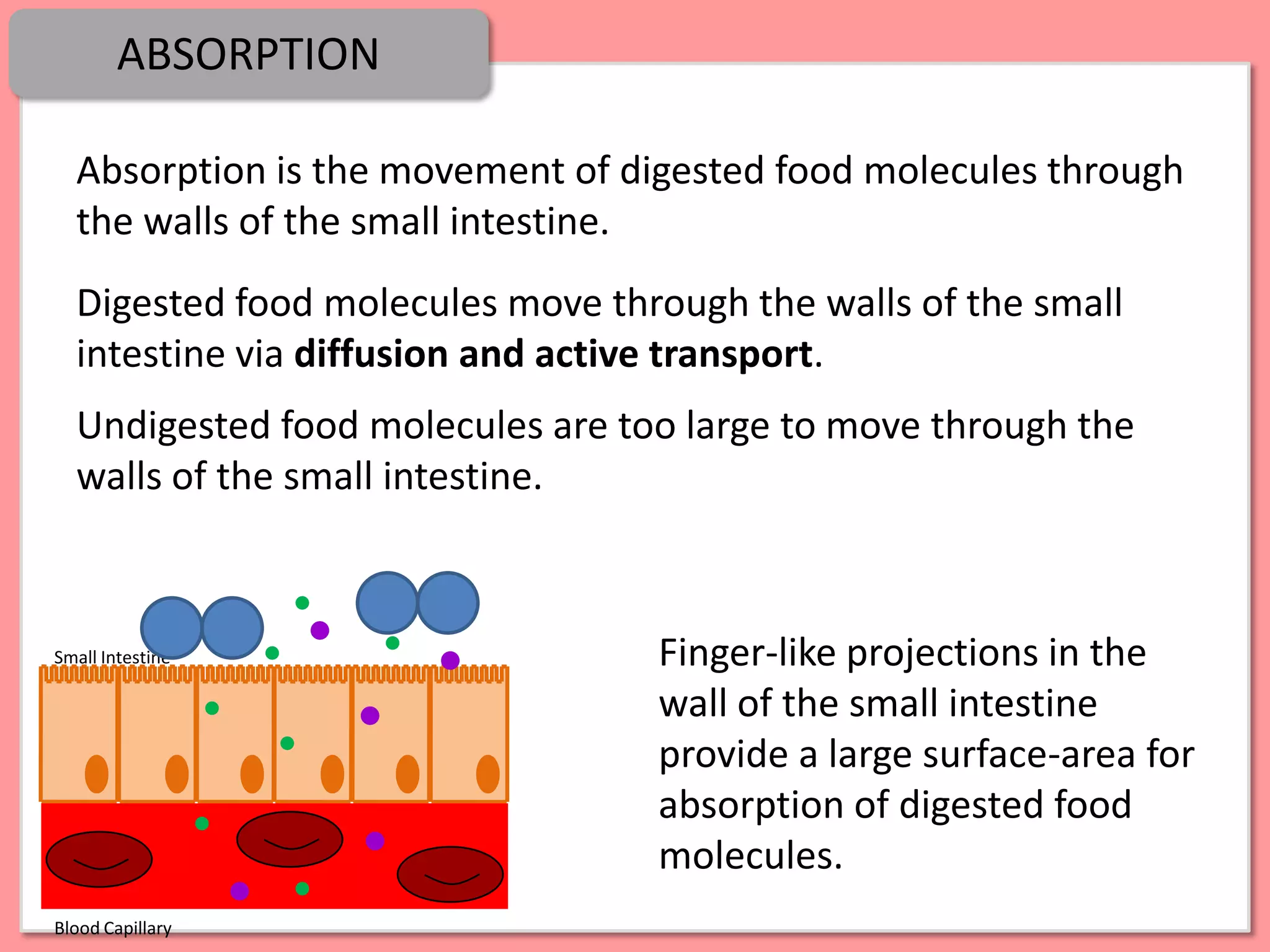
  Absorption is the movement of digested food molecules through
  the walls of the small intestine.
  Digested food molecules move through the walls of the small
  intestine via diffusion and active transport.
  Undigested food molecules are too large to move through the
  walls of the small intestine.


Small Intestine                   Finger-like projections in the
                                  wall of the small intestine
                                  provide a large surface-area for
                                  absorption of digested food
                                  molecules.
Blood Capillary
ABSORPTION
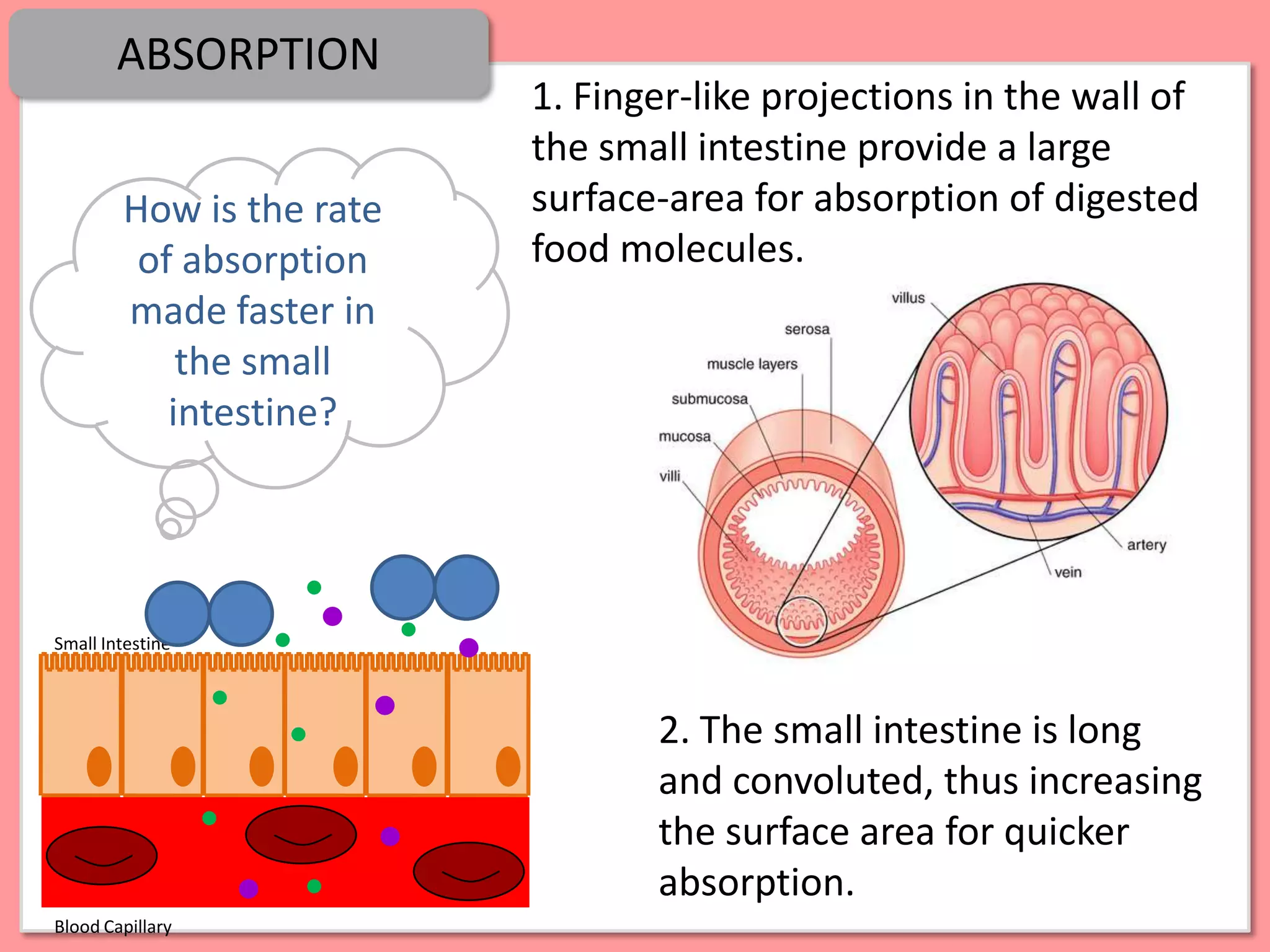
                          1. Finger-like projections in the wall of
                          the small intestine provide a large
        How is the rate   surface-area for absorption of digested
         of absorption    food molecules.
        made faster in
            the small
           intestine?


Small Intestine


                                 2. The small intestine is long
                                 and convoluted, thus increasing
                                 the surface area for quicker
                                 absorption.
Blood Capillary
ABSORPTION
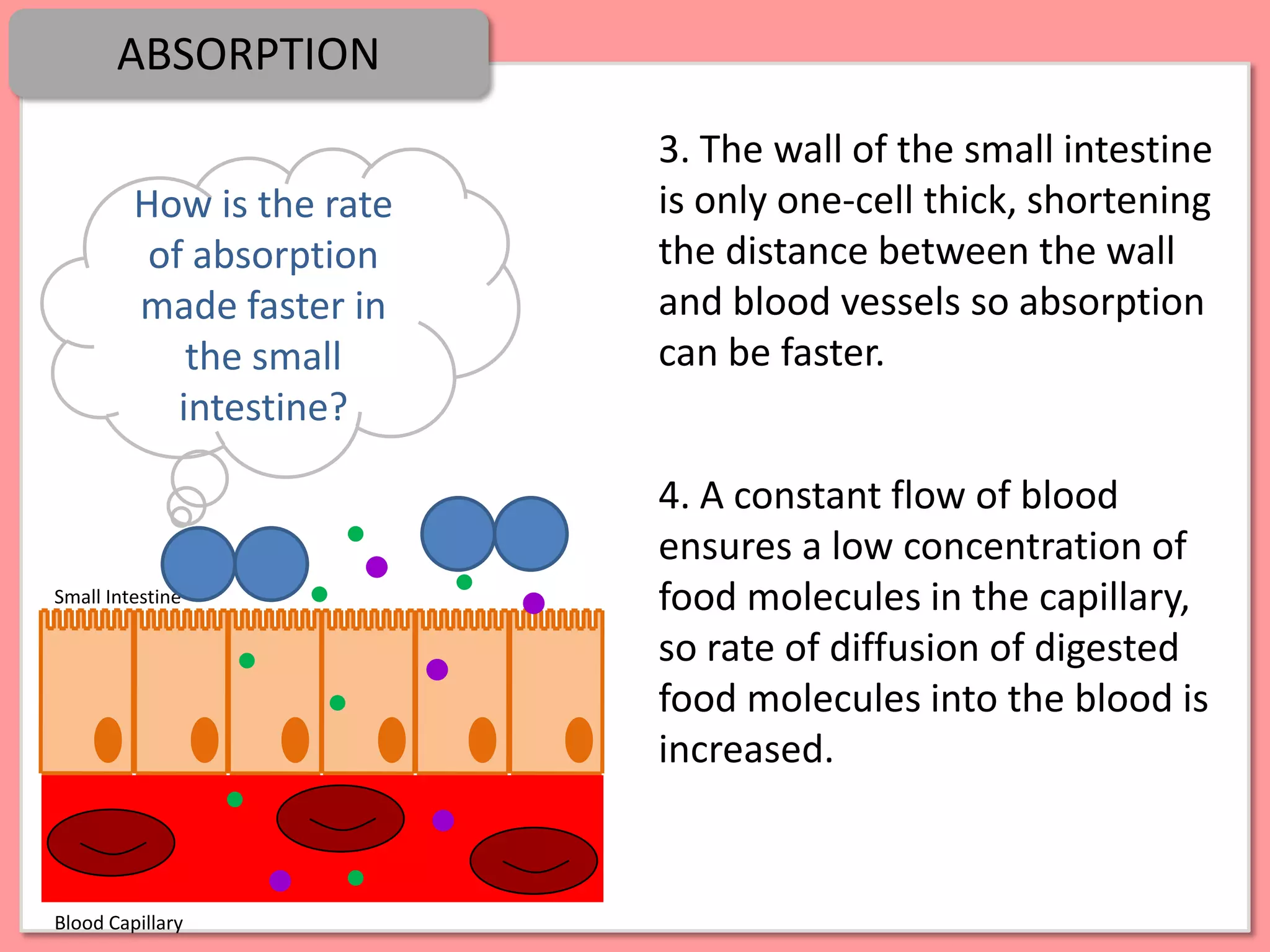
                           3. The wall of the small intestine
         How is the rate   is only one-cell thick, shortening
          of absorption    the distance between the wall
         made faster in    and blood vessels so absorption
             the small     can be faster.
            intestine?

                           4. A constant flow of blood
                           ensures a low concentration of
Small Intestine            food molecules in the capillary,
                           so rate of diffusion of digested
                           food molecules into the blood is
                           increased.


Blood Capillary
Learning Objectives

  At the end of this lesson, you should be able to:

  • explain how digested food is absorbed into the
  bloodstream
RECALL


You have learnt about

• the meaning of digestion
• why food must be digested
• enzymes as biological catalysts that speed up the rate of
reactions without being chemically changed at the end of
the reaction
• the process of digestion and where specific nutrients
are digested in the body
• how absorption occurs efficiently in the body

Digestion, Absorption and Enzymes

  • 1.
  • 2.
    Learning Objectives At theend of this lesson, you should be able to: • explain what is meant by digestion • explain why food must be digested • define enzymes as biological catalysts that speed up the rate of reactions without being chemically changed at the end of the reaction • explain the effects of temperature on enzyme activity • explain the mode of enzyme action in terms of the lock- and-key hypothesis
  • 3.
    Why EAT? We needto eat because… Our body needs NUTRIENTS CARBOHYDRATES PROTEINS FATS Types of Nutrients the Body Needs
  • 4.
    Why EAT? CARBOHYDRATES PROTEINS FATS Types of Nutrients the Body Needs
  • 5.
    Why EAT? CARBOHYDRATES PROTEINS FATS Types of Nutrients the Body Needs
  • 6.
  • 7.
    Why DIGESTION? Digestion isnecessary - to break down large insoluble molecules into smaller molecules - so that the body can absorb the nutrients required for its functioning DIGESTION is the process whereby large, insoluble food molecules are broken down into smaller, soluble food molecules
  • 8.
    Large Complex InsolubleMolecules DIGESTION Small Simple Soluble Molecules Starch Glucose carbohydrase Proteins protease Amino Acids lipase Fats Glycerol Fatty Acids
  • 9.
    DIGESTION These small simple soluble Glucose molecules are used for the following purposes: • Growth of new cells and tissues • Provide energy for Amino Acids growth, movement and for keeping warm • Repair damaged tissues • Keep us healthy Glycerol Fatty Acids
  • 10.
    Food Tests • Totest whether certain nutrients are present in a certain food, specific tests can be conducted. • Iodine solution can be used to test if there is starch present in food. • Benedict’s solution can be used to test if there is reducing sugar (eg. Glucose) present in food.
  • 11.
    FOOD TESTS • STARCHtest • Add about 5 drops of iodine solution to the sample to be tested. • If starch is present, the iodine will turn dark blue • If starch is absent, the iodine will remain brown
  • 12.
    FOOD TESTS • REDUCINGSUGAR test • Add 2cm3 of Benedict’s Solution to 2cm3 of the sample solution in a test-tube. • Heat the test-tube in a boiling water bath for 2-5 minutes. • If reducing sugar is present, the solution produces a brick-red precipitate. • If reducing sugar is absent, the solution remains blue.
  • 13.
    ENZYMES Enzymes are biological catalysts. A A Catalysts are substances that speed up the rate of reactions, but themselves remain chemically enzyme unchanged at the end of the reaction. A A A A enzyme enzyme
  • 14.
    Lock & KeyHypothesis Substrate A Enzyme Enzyme Substrate B Enzyme Enzyme
  • 15.
    ENZYMES- Mechanism substrate LOCK and KEY hypothesis • Specificity: One enzyme binds to Enzyme only one substrate • Reusable: They are chemically unchanged at the end of the reaction products • Required in minute amounts • Sensitive to temperature and pH Enzyme
  • 16.
    ENZYMES- Mechanism substrate Enzyme-substrate Enzyme complex products Enzyme
  • 17.
    ENZYMES- Mechanism substrate • In an enzyme reaction, the reactants are called substrates. • Every enzyme has an active site, which is the place where the substrate will bind with the enzyme. Enzyme • This active site has a specific 3- dimensional shape. • The active site only allows substrates with the complementary products shape to fit in, just like how a key fits into the lock. • Enzyme is the LOCK and substrate is the KEY. Enzyme
  • 18.
    ENZYMES- Mechanism substrate • The enzyme and substrate molecules will combine to form a temporary structure called the enzyme-substrate complex. • When substrate binds to the Enzyme enzyme, the enzyme will then react to convert the substrate into product(s). • The product(s) then separates from products the enzyme leaving the enzyme free to combine again with more substrates. Enzyme
  • 19.
    ENZYMES- Mechanism substrate • Product formed no longer fit into the active site and are released. • The active site is now free to receive more substrate molecules. • In conclusion, enzyme action is Enzyme specific due to the shape of the substrate and active site being complementary to each other. products Enzyme
  • 20.
    Lock & KeyHypothesis
  • 21.
    ENZYMES- Factors Enzymes work best at their optimum temperature. Rate of Enzyme Activity At low At high temperatures, en temperatures, en zymes are zymes are inactivated. denatured. Temperature/ °C
  • 22.
    ENZYMES- Factors Enzymes work best at their optimum pH. Rate of Enzyme Activity At extreme pH, enzymes are denatured. pH
  • 23.
    Learning Objectives At theend of this lesson, you should be able to: • explain what is meant by digestion • explain why food must be digested • define enzymes as biological catalysts that speed up the rate of reactions without being chemically changed at the end of the reaction • explain the effects of temperature on enzyme activity • explain the mode of enzyme action in terms of the lock- and-key hypothesis
  • 24.
    LEARNING OBJECTIVES You should now know how to: - identify the main organs in the human digestive system - describe the process of digestion within the human body in detail
  • 25.
  • 26.
    The PROCESS Mechanical Digestion Biting  Tearing  Slicing  Chewing (Masticating) Chemical Digestion  Acid  Enzymes
  • 27.
    Mouth 1. Mechanical Digestion  Food is broken down into smaller pieces by the chewing, tearing, slicing and biting action of the teeth 2. Enzymatic Digestion  Starch is broken down into maltose by amylase in saliva  No digestion of proteins and fats in the mouth Starch  Maltose
  • 28.
    Oesophagus Partially digested food is pushed down from the mouth into the stomach by muscles in the oesophagus that alternately contract and relax. (peristalsis) NO enzymes are present in the oesophagus.
  • 29.
    Stomach Complex Proteins  Simpler Proteins Complex proteins are broken down into simpler proteins by proteases found in gastric juices secreted by the stomach. No digestion of carbohydrates or fats occur in the stomach.
  • 30.
    Small Intestines Simpler Proteins  Amino Acids Maltose Glucose Fats  Glycerol + Fatty Acids Three digestive juices are secreted into the small intestines to complete digestion: 1. Bile from the Liver  This breaks fats into small droplets for easier digestion 2. Pancreatic Juice from the Pancreas  This contains carbohydrase, protease and lipase for digestion 3. Intestinal Juice from the Small Intestines  This also contains carbohydrase, protease and lipase.
  • 31.
    Large Intestines Undigested food that reaches the large intestines will be passed to the rectum and anus for removal by the body as faeces. As it passes through, a lot of water is absorbed by the large intestines and taken back into the body.
  • 32.
    INQUIRY time! Some obese people have had part of their small intestines removed. Suggest with reasons the effects of such a surgery? Proteins are digested in the stomach. The stomach wall consists of cells which are made of protein. So why does the stomach wall not get digested?
  • 33.
    LEARNING OBJECTIVES You should now know how to: - identify the main organs in the human digestive system - explain the process of digestion within the human body
  • 34.
    RECALL You have learntabout • the meaning of digestion • why food must be digested • enzymes as biological catalysts that speed up the rate of reactions without being chemically changed at the end of the reaction • the process of digestion and where specific nutrients are digested in the body
  • 35.
    Learning Objectives At the end of this lesson, you should be able to: • explain how digested food is absorbed into the bloodstream
  • 36.
    ABSORPTION Small Intestine Villi cells Blood Capillary
  • 37.
    ABSORPTION Absorption isthe movement of digested food molecules through the walls of the small intestine. By what process do the food molecules Small Intestine move through the intestinal walls? Why does food molecules move into Blood Capillary the blood stream but not move out?
  • 38.
    ABSORPTION Absorption isthe movement of digested food molecules through the walls of the small intestine. Why are there so many finger-like projections in the cells of the small Small Intestine intestine? Blood Capillary
  • 39.
    ABSORPTION Absorptionis the movement of digested food molecules through the walls of the small intestine. Digested food molecules move through the walls of the small intestine via diffusion and active transport. Undigested food molecules are too large to move through the walls of the small intestine. Small Intestine Finger-like projections in the wall of the small intestine provide a large surface-area for absorption of digested food molecules. Blood Capillary
  • 40.
    ABSORPTION 1. Finger-like projections in the wall of the small intestine provide a large How is the rate surface-area for absorption of digested of absorption food molecules. made faster in the small intestine? Small Intestine 2. The small intestine is long and convoluted, thus increasing the surface area for quicker absorption. Blood Capillary
  • 41.
    ABSORPTION 3. The wall of the small intestine How is the rate is only one-cell thick, shortening of absorption the distance between the wall made faster in and blood vessels so absorption the small can be faster. intestine? 4. A constant flow of blood ensures a low concentration of Small Intestine food molecules in the capillary, so rate of diffusion of digested food molecules into the blood is increased. Blood Capillary
  • 42.
    Learning Objectives At the end of this lesson, you should be able to: • explain how digested food is absorbed into the bloodstream
  • 43.
    RECALL You have learntabout • the meaning of digestion • why food must be digested • enzymes as biological catalysts that speed up the rate of reactions without being chemically changed at the end of the reaction • the process of digestion and where specific nutrients are digested in the body • how absorption occurs efficiently in the body

Editor's Notes

  • #4 Question to Students: Why do we need to eat?In which types of food can we find the various nutrients?
  • #5 Question to Students: Why do we need to eat?In which types of food can we find the various nutrients?
  • #6 Question to Students: Why do we need to eat?In which types of food can we find the various nutrients?