An Introduction To
Metabolism
Metabolism
• Totality of an organism’s chemical processes.
• It is concerned with managing the material
and energy resources of the cell.
• It is an emergent property that arises from
orderly interactions between molecules.
Catabolic Pathways
• Pathways that break down complex
molecules into smaller ones, releasing
energy.
• Example:
– Cellular Respiration
Anabolic Pathways
• Pathways that consume energy,
building complex molecules from
smaller ones.
• Example:
– Photosynthesis
Catabolic vs. Anabolic
• Think of them as “downhill” and
“uphill” avenues in metabolism.
• Energy released during the downhill
catabolic pathways can be stored and
used to drive the uphill anabolic
pathways.
Energy
• Defined as:
– Capacity to cause change
– Ability to do work.
– The ability to rearrange a collection
of matter.
• Exist in several different forms
Kinetic Energy
• Energy of action or motion.
Thermal Energy
• Random movement of atoms or
molecules
• The transfer of thermal energy from
one object to another is heat.
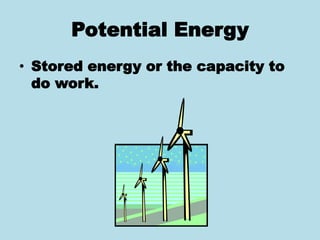
Potential Energy
• Stored energy or the capacity to
do work.
Chemical Energy
• A form of potential energy available for
release during a chemical reaction.
CONVERTING FROM ONE ENERGY
TO ANOTHER
Activation Energy
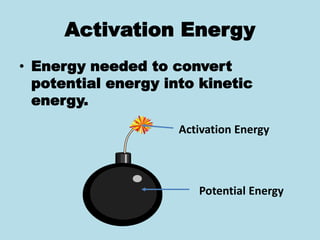
• Energy needed to convert
potential energy into kinetic
energy.
Potential Energy
Activation Energy
Energy Transformation/
Conversions are governed
by the Laws of
Thermodynamics.
1st Law of Thermodynamics
• Energy can be transferred and
transformed, but it cannot be created
or destroyed.
• Also known as the Principle of
Conservation of Energy.
• Energy is converted to forms that are
easy for use.
2nd Law of
Thermodynamics
• Each energy transfer or transformation
increases the entropy of the universe.
• Entropy is the measure of disorder or
randomness.
• As we give off energy, it adds to the
universe, thus, increasing the disorder.
Spontaneous vs.
Nonspontaneous Processes
Spontaneous Process
• Process that leads to
the increase in entropy
• Can proceed without an
input of energy
• “Energetically
Favorable”
• Example – Water
flowing downhill
Nonspontaneous Process
• Process that leads to a
decrease in entropy
• Needs energy to
proceed
• Example - Water
flowing uphill
Free-Energy Change, G
• Gibbs Free Energy of a system, AKA
Free Energy
• The portion of a system's energy that
can perform work.
• G allows us to determine if a process
with spontaneous or nonspontaneous.
Free Energy
• G < 0 = Spontaneous Reaction
– Exergonic Reaction
– Energy Releasing
• G > 0 = Nonspontaneous Reaction
– Endergonic Reaction
– Energy Absorbing
• G = 0 = Equilibrium
ATP
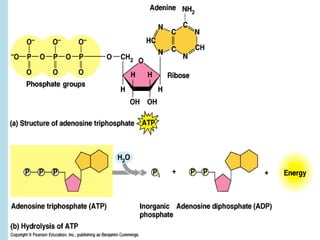
• Adenosine Triphosphate
• Made of:
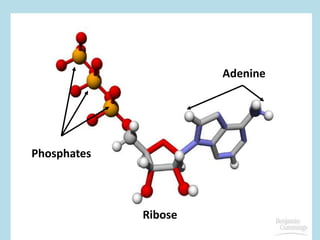
- Adenine (nitrogenous base)
- Ribose (pentose sugar)
- 3 phosphate groups
• The key is the three phosphate
groups.
– Negative charges repel each other and
makes the phosphates unstable.
Adenine
Ribose
Phosphates
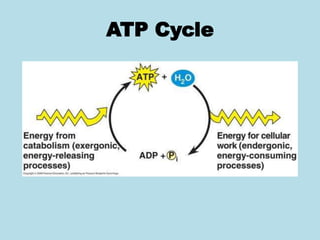
ATP powers cellular work
• It works by coupling exergonic
and endergonic reactions
• It uses exergonic processes to
drive endergonic processes.
Cell work
• Chemical Work
– Pushing of endergonic reactions that
wouldn’t occur spontaneously
• Transport Work
– Pumping of substances across
membranes against the direction of
spontaneous movement
• Mechanical Work
– Movement
ATP Cycle
ATP in Cells
• A cell's ATP content is recycled
every minute.
• Humans use close to their body
weight in ATP daily.
• No ATP production equals quick
death.
ENZYMES
ENZYMES
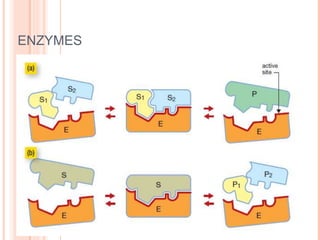
Enzymes are molecules that act as catalysts to
speed up biological reactions.
The compound on which an enzyme acts is the
substrate.
Enzymes can break a single structure into
smaller components or join two or more
substrate molecules together.
Most enzymes are proteins.
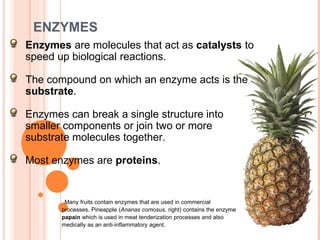
Many fruits contain enzymes that are used in commercial
processes. Pineapple (Ananas comosus, right) contains the enzyme
papain which is used in meat tenderization processes and also
medically as an anti-inflammatory agent.
ENZYMES
ENZYME EXAMPLES
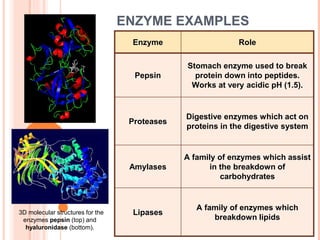
Enzyme Role
Pepsin
Stomach enzyme used to break
protein down into peptides.
Works at very acidic pH (1.5).
Proteases
Digestive enzymes which act on
proteins in the digestive system
Amylases
A family of enzymes which assist
in the breakdown of
carbohydrates
Lipases
A family of enzymes which
breakdown lipids
3D molecular structures for the
enzymes pepsin (top) and
hyaluronidase (bottom).
ENZYME EXAMPLES
 One of the fastest enzymes in the body is catalase.
Catalase breaks down hydrogen peroxide, a waste
product of cell metabolism, into water and oxygen.
Accumulation of hydrogen peroxide is toxic so this
enzyme performs an important job in the body.
ENZYME POWER!
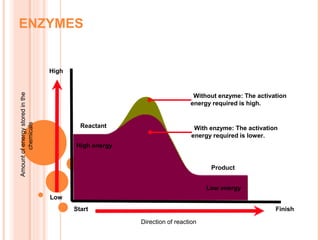
 All reactants need to have a certain energy before
they will react. This is like an energy barrier that it
has to overcome before a reaction will occur. It is
called the activation energy.
 Enzymes are organic catalysts.
 All catalysts lower the energy barrier, allowing the
reactants (substrates) to react faster forming the
products.
 Enzymes do not participate in the reaction.
Reactant
Product
Without enzyme: The activation
energy required is high.
With enzyme: The activation
energy required is lower.
ENZYMES
High
Low
Start Finish
Direction of reaction
Amountofenergystoredinthe
chemicals
Low energy
High energy
ENZYMES
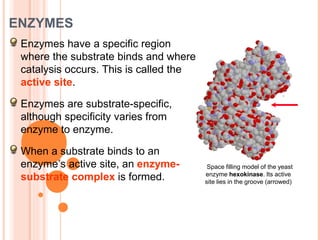
Enzymes have a specific region
where the substrate binds and where
catalysis occurs. This is called the
active site.
Enzymes are substrate-specific,
although specificity varies from
enzyme to enzyme.
When a substrate binds to an
enzyme’s active site, an enzyme-
substrate complex is formed.
Space filling model of the yeast
enzyme hexokinase. Its active
site lies in the groove (arrowed)
ENZYME ACTIVE SITES
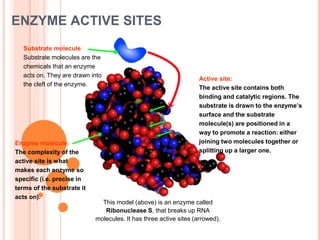
This model (above) is an enzyme called
Ribonuclease S, that breaks up RNA
molecules. It has three active sites (arrowed).
Active site:
The active site contains both
binding and catalytic regions. The
substrate is drawn to the enzyme’s
surface and the substrate
molecule(s) are positioned in a
way to promote a reaction: either
joining two molecules together or
splitting up a larger one.
Enzyme molecule:
The complexity of the
active site is what
makes each enzyme so
specific (i.e. precise in
terms of the substrate it
acts on).
Substrate molecule:
Substrate molecules are the
chemicals that an enzyme
acts on. They are drawn into
the cleft of the enzyme.
LOCK AND KEY MODEL
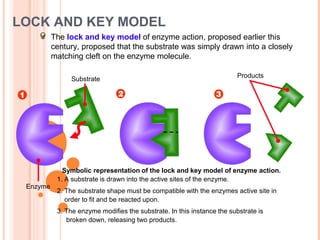
The lock and key model of enzyme action, proposed earlier this
century, proposed that the substrate was simply drawn into a closely
matching cleft on the enzyme molecule.
Substrate
Enzyme
Products
Symbolic representation of the lock and key model of enzyme action.
1. A substrate is drawn into the active sites of the enzyme.
2. The substrate shape must be compatible with the enzymes active site in
order to fit and be reacted upon.
3. The enzyme modifies the substrate. In this instance the substrate is
broken down, releasing two products.
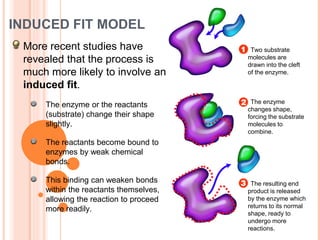
INDUCED FIT MODEL
More recent studies have
revealed that the process is
much more likely to involve an
induced fit.
The enzyme or the reactants
(substrate) change their shape
slightly.
The reactants become bound to
enzymes by weak chemical
bonds.
This binding can weaken bonds
within the reactants themselves,
allowing the reaction to proceed
more readily.
The enzyme
changes shape,
forcing the substrate
molecules to
combine.
Two substrate
molecules are
drawn into the cleft
of the enzyme.
The resulting end
product is released
by the enzyme which
returns to its normal
shape, ready to
undergo more
reactions.
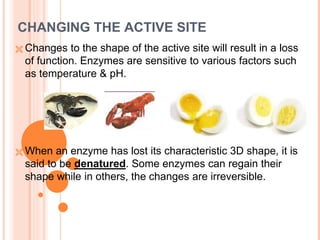
CHANGING THE ACTIVE SITE
 Changes to the shape of the active site will result in a loss
of function. Enzymes are sensitive to various factors such
as temperature & pH.
 When an enzyme has lost its characteristic 3D shape, it is
said to be denatured. Some enzymes can regain their
shape while in others, the changes are irreversible.
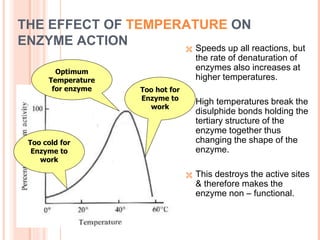
THE EFFECT OF TEMPERATURE ON
ENZYME ACTION  Speeds up all reactions, but
the rate of denaturation of
enzymes also increases at
higher temperatures.
 High temperatures break the
disulphide bonds holding the
tertiary structure of the
enzyme together thus
changing the shape of the
enzyme.
 This destroys the active sites
& therefore makes the
enzyme non – functional.
Too cold for
Enzyme to
work
Too hot for
Enzyme to
work
Optimum
Temperature
for enzyme
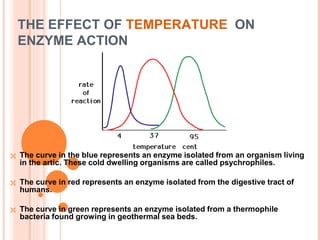
THE EFFECT OF TEMPERATURE ON
ENZYME ACTION
 The curve in the blue represents an enzyme isolated from an organism living
in the artic. These cold dwelling organisms are called psychrophiles.
 The curve in red represents an enzyme isolated from the digestive tract of
humans.
 The curve in green represents an enzyme isolated from a thermophile
bacteria found growing in geothermal sea beds.
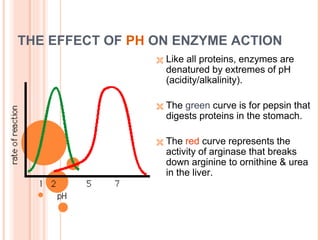
THE EFFECT OF PH ON ENZYME ACTION
 Like all proteins, enzymes are
denatured by extremes of pH
(acidity/alkalinity).
 The green curve is for pepsin that
digests proteins in the stomach.
 The red curve represents the
activity of arginase that breaks
down arginine to ornithine & urea
in the liver.
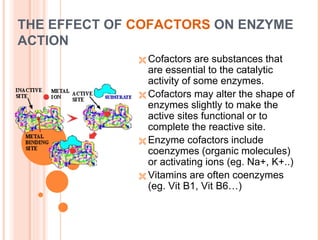
THE EFFECT OF COFACTORS ON ENZYME
ACTION
 Cofactors are substances that
are essential to the catalytic
activity of some enzymes.
 Cofactors may alter the shape of
enzymes slightly to make the
active sites functional or to
complete the reactive site.
 Enzyme cofactors include
coenzymes (organic molecules)
or activating ions (eg. Na+, K+..)
 Vitamins are often coenzymes
(eg. Vit B1, Vit B6…)
THE NATURE OF ENZYME INHIBITORS
Enzyme inhibitors may or may not act reversibly:
Reversible: the inhibitor is temporarily bound to the
enzyme, thereby preventing its function (used as a
mechanism to control enzyme activity).
Irreversible: the inhibitor may bind permanently to
the enzyme causing it to be permanently deactivated.
THE NATURE OF ENZYME INHIBITORS
Reversible Enzymes work in one of two ways:
Competitive inhibitors: the inhibitor competes with
the substrate for the active site, thereby blocking it
and preventing attachment of the substrate.
Non-competitive: the inhibitor binds to the enzyme
(but not at the active site) and alters its shape. It
markedly slows down the reaction rate by making
the enzyme less able to perform its function
(allosteric inhibition).
Process of Cellular
Respiration
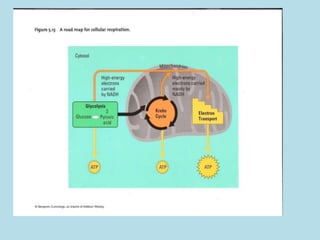
Process of Cellular Respiration
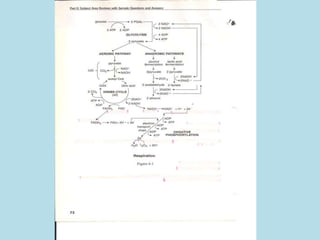
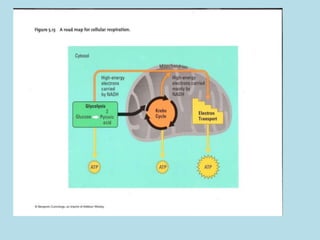
• The process by which food molecules are broken down
to release energy is respiration.
• Respiration that occurs in the presence of oxygen is
called aerobic respiration.
• Respiration that occurs without oxygen is called
anaerobic respiration.
• The energy payoff is much greater when molecules are
broken down aerobically.
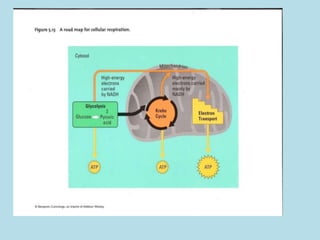
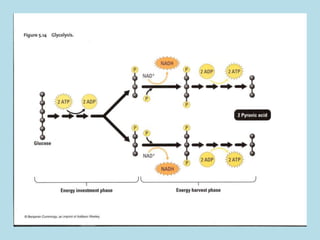
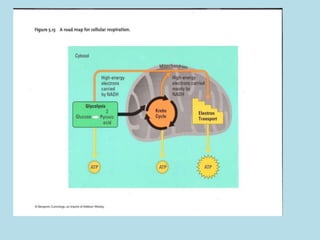
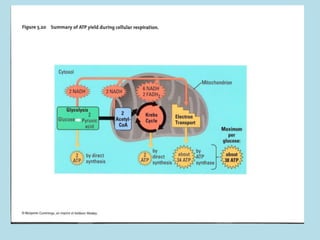
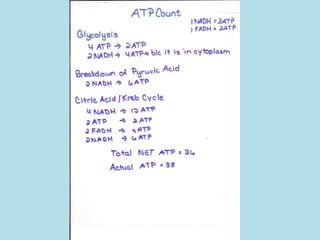
Glycolysis
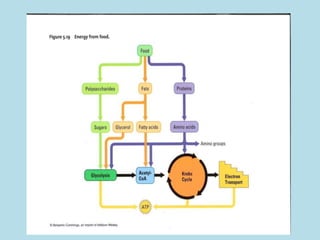
• 1st step of respiration
• Glycolysis is the breakdown of glucose (6-
carbon molecule to pyruvic acid (3-carbon
molecule).
• Glycolysis occurs in the cytoplasm and is
anaerobic.
• Glycolosis produces hydrogen ions and
electrons, which combine with carrier ions
called NAD+ (nicotanamide dinucleotide) to
form NADH.
• End product is 2 ATP’s
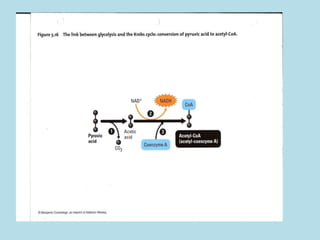
Breakdown of Pyruvic Acid
• The 2nd step that takes place in respiration is the
breakdown of pyruvic acid, and aerobic process.
• Pyruvic acid (3-carbon molecule) is changed to
acetic acid (2-carbon molecule). The carbon
that comes off makes CO2. Acetic acid
combines with a substance called coenzyme A
(CoA), forming acetyl-CoA.
• This process takes place in the mitochondria.
Citric Acid Cycle
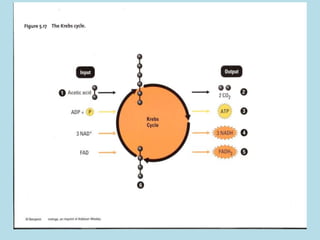
• The 3rd step of aerobic respiration is the citric acid
cycle.
• Acetyl-CoA combines with a 4-carbon molecule to form
a 6-carbon molecule, citric acid. Citric acid is broken
down 1st to a 5-carbon molecule and then to a 4-carbon
molecule, releasing CO2 at each step.
• This cycle of chemical reactions produces more ATP
and releases additional electrons.
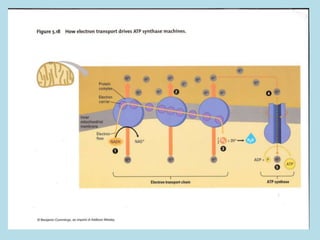
Electron Transport Chain
• The 4th part of aerobic respiration is the
electron transport chain (ETC).
• The ETC is a series of molecules along
which electrons are transferred, releasing
energy.
• Carrier molecules bring the electrons
released during glycolysis and the citric
acid cycle to the ETC.
ETC (con’t)
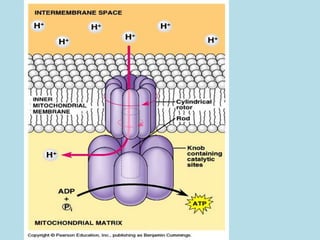
• The molecules of the ETC are located
on the inner membranes of the
mitochondria.
• This is an aerobic process, because
oxygen combines with two hydrogen
ions to produce with water.
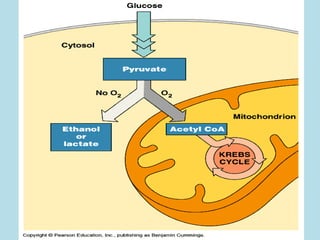
What happens if no oxygen is
present?
If the final electron acceptor, oxygen, is
used up, the chain becomes jammed.
The reactions of the ETC can’t take
place without oxygen.
Anaerobic Respiration
• If oxygen isn’t present, there’s no
electron acceptor to accept the
electrons at the end of the ETC.
• If this occurs, then NADH
accumulates.
• Once all the NAD+ has been
converted to NADH, the Krebs
cycle and glycolysis both stop
(both need NAD+ to accept
electrons).
• Once this happens, no new ATP is
produced, and the cell soon dies. Cells
have derived a method to escape dying
– ANAEROBIC RESPIRATION.
• The main objective of anaerobic
respiration is to replenish NAD+ so that
glycolysis can proceed once again. It
occurs in the cytoplasm right along
with glycolysis.
• There are two forms of anaerobic
respiration:
– Alcoholic fermentation
– Lactic acid fermentation
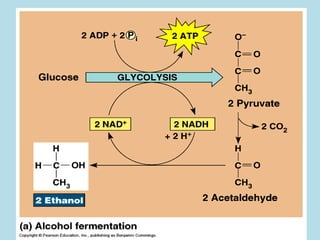
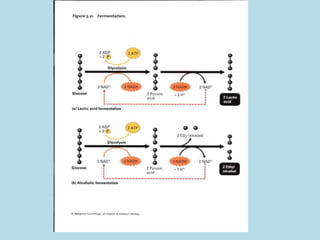
Alcoholic Fermentation
• Alcoholic fermentation occurs in
plants, fungi (yeast), and bacteria.
• There are 2 steps to alcoholic
fermentation:
– The conversion of pyruvic acid to
acetaldehyde
• 1 CO2 and 1 acetaldehyde is produced
– The conversion of acetaldehyde to ethanol
• NADH is used to drive the reaction, releasing
NAD+
• The goal of this reaction is not to
produce ethanol, but it is to free
the NAD+, which allows glycolysis
to continue.
• The reward is 2 ATP from
glycolysis for each 2 converted
pyruvate. This is better than the
alternative, which is 0 ATP.
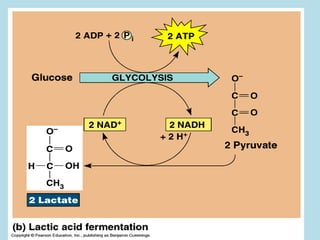
Lactic Acid Fermentation
• Lactic acid can occur in some bacteria
and plants, but it is mostly found in
animals, including humans.
• Anytime your muscle cells require
energy at a faster rate than it can be
supplied by aerobic respiration, they
begin to carry out lactic acid
fermentation.
• There is only one step in lactic acid
fermentation:
• Now, NAD+ can be used for
glycolysis.
• When O2 becomes available again,
lactic acid can be broken down and
its store of energy can be retrieved.
• Because O2 is required to do this,
lactic acid fermentation creates
what is often called an oxygen debt.
Lactic Acid Fermentation
• Uses only Glycolysis.
• An incomplete oxidation - energy
is still left in the products (lactic
acid).
• Does NOT require O2
• Produces ATP when O2 is not
available.
Lactic Acid Fermentation
• Done by human muscle cells
under oxygen debt.
• Lactic Acid is a toxin and causes
soreness and stiffness in muscles.
Fermentation - Summary
• Way of using up NADH so
Glycolysis can still run.
• Provides ATP to a cell even when
O2 is absent.
Aerobic vs Anaerobic
• Aerobic - Rs with O2
• Anaerobic - Rs without O2
• Aerobic - All three Rs steps.
• Anaerobic - Glycolysis only.

Cellular Respiration - AP Biology

  • 1.
  • 2.
    Metabolism • Totality ofan organism’s chemical processes. • It is concerned with managing the material and energy resources of the cell. • It is an emergent property that arises from orderly interactions between molecules.
  • 4.
    Catabolic Pathways • Pathwaysthat break down complex molecules into smaller ones, releasing energy. • Example: – Cellular Respiration
  • 5.
    Anabolic Pathways • Pathwaysthat consume energy, building complex molecules from smaller ones. • Example: – Photosynthesis
  • 6.
    Catabolic vs. Anabolic •Think of them as “downhill” and “uphill” avenues in metabolism. • Energy released during the downhill catabolic pathways can be stored and used to drive the uphill anabolic pathways.
  • 7.
    Energy • Defined as: –Capacity to cause change – Ability to do work. – The ability to rearrange a collection of matter. • Exist in several different forms
  • 8.
    Kinetic Energy • Energyof action or motion.
  • 9.
    Thermal Energy • Randommovement of atoms or molecules • The transfer of thermal energy from one object to another is heat.
  • 10.
    Potential Energy • Storedenergy or the capacity to do work.
  • 11.
    Chemical Energy • Aform of potential energy available for release during a chemical reaction.
  • 12.
    CONVERTING FROM ONEENERGY TO ANOTHER
  • 13.
    Activation Energy • Energyneeded to convert potential energy into kinetic energy. Potential Energy Activation Energy
  • 14.
    Energy Transformation/ Conversions aregoverned by the Laws of Thermodynamics.
  • 15.
    1st Law ofThermodynamics • Energy can be transferred and transformed, but it cannot be created or destroyed. • Also known as the Principle of Conservation of Energy. • Energy is converted to forms that are easy for use.
  • 16.
    2nd Law of Thermodynamics •Each energy transfer or transformation increases the entropy of the universe. • Entropy is the measure of disorder or randomness. • As we give off energy, it adds to the universe, thus, increasing the disorder.
  • 17.
    Spontaneous vs. Nonspontaneous Processes SpontaneousProcess • Process that leads to the increase in entropy • Can proceed without an input of energy • “Energetically Favorable” • Example – Water flowing downhill Nonspontaneous Process • Process that leads to a decrease in entropy • Needs energy to proceed • Example - Water flowing uphill
  • 18.
    Free-Energy Change, G •Gibbs Free Energy of a system, AKA Free Energy • The portion of a system's energy that can perform work. • G allows us to determine if a process with spontaneous or nonspontaneous.
  • 19.
    Free Energy • G< 0 = Spontaneous Reaction – Exergonic Reaction – Energy Releasing • G > 0 = Nonspontaneous Reaction – Endergonic Reaction – Energy Absorbing • G = 0 = Equilibrium
  • 20.
    ATP • Adenosine Triphosphate •Made of: - Adenine (nitrogenous base) - Ribose (pentose sugar) - 3 phosphate groups • The key is the three phosphate groups. – Negative charges repel each other and makes the phosphates unstable.
  • 22.
  • 23.
    ATP powers cellularwork • It works by coupling exergonic and endergonic reactions • It uses exergonic processes to drive endergonic processes.
  • 24.
    Cell work • ChemicalWork – Pushing of endergonic reactions that wouldn’t occur spontaneously • Transport Work – Pumping of substances across membranes against the direction of spontaneous movement • Mechanical Work – Movement
  • 25.
  • 26.
    ATP in Cells •A cell's ATP content is recycled every minute. • Humans use close to their body weight in ATP daily. • No ATP production equals quick death.
  • 27.
  • 28.
    ENZYMES Enzymes are moleculesthat act as catalysts to speed up biological reactions. The compound on which an enzyme acts is the substrate. Enzymes can break a single structure into smaller components or join two or more substrate molecules together. Most enzymes are proteins. Many fruits contain enzymes that are used in commercial processes. Pineapple (Ananas comosus, right) contains the enzyme papain which is used in meat tenderization processes and also medically as an anti-inflammatory agent.
  • 29.
  • 30.
    ENZYME EXAMPLES Enzyme Role Pepsin Stomachenzyme used to break protein down into peptides. Works at very acidic pH (1.5). Proteases Digestive enzymes which act on proteins in the digestive system Amylases A family of enzymes which assist in the breakdown of carbohydrates Lipases A family of enzymes which breakdown lipids 3D molecular structures for the enzymes pepsin (top) and hyaluronidase (bottom).
  • 31.
    ENZYME EXAMPLES  Oneof the fastest enzymes in the body is catalase. Catalase breaks down hydrogen peroxide, a waste product of cell metabolism, into water and oxygen. Accumulation of hydrogen peroxide is toxic so this enzyme performs an important job in the body.
  • 32.
    ENZYME POWER!  Allreactants need to have a certain energy before they will react. This is like an energy barrier that it has to overcome before a reaction will occur. It is called the activation energy.  Enzymes are organic catalysts.  All catalysts lower the energy barrier, allowing the reactants (substrates) to react faster forming the products.  Enzymes do not participate in the reaction.
  • 33.
    Reactant Product Without enzyme: Theactivation energy required is high. With enzyme: The activation energy required is lower. ENZYMES High Low Start Finish Direction of reaction Amountofenergystoredinthe chemicals Low energy High energy
  • 34.
    ENZYMES Enzymes have aspecific region where the substrate binds and where catalysis occurs. This is called the active site. Enzymes are substrate-specific, although specificity varies from enzyme to enzyme. When a substrate binds to an enzyme’s active site, an enzyme- substrate complex is formed. Space filling model of the yeast enzyme hexokinase. Its active site lies in the groove (arrowed)
  • 35.
    ENZYME ACTIVE SITES Thismodel (above) is an enzyme called Ribonuclease S, that breaks up RNA molecules. It has three active sites (arrowed). Active site: The active site contains both binding and catalytic regions. The substrate is drawn to the enzyme’s surface and the substrate molecule(s) are positioned in a way to promote a reaction: either joining two molecules together or splitting up a larger one. Enzyme molecule: The complexity of the active site is what makes each enzyme so specific (i.e. precise in terms of the substrate it acts on). Substrate molecule: Substrate molecules are the chemicals that an enzyme acts on. They are drawn into the cleft of the enzyme.
  • 36.
    LOCK AND KEYMODEL The lock and key model of enzyme action, proposed earlier this century, proposed that the substrate was simply drawn into a closely matching cleft on the enzyme molecule. Substrate Enzyme Products Symbolic representation of the lock and key model of enzyme action. 1. A substrate is drawn into the active sites of the enzyme. 2. The substrate shape must be compatible with the enzymes active site in order to fit and be reacted upon. 3. The enzyme modifies the substrate. In this instance the substrate is broken down, releasing two products.
  • 37.
    INDUCED FIT MODEL Morerecent studies have revealed that the process is much more likely to involve an induced fit. The enzyme or the reactants (substrate) change their shape slightly. The reactants become bound to enzymes by weak chemical bonds. This binding can weaken bonds within the reactants themselves, allowing the reaction to proceed more readily. The enzyme changes shape, forcing the substrate molecules to combine. Two substrate molecules are drawn into the cleft of the enzyme. The resulting end product is released by the enzyme which returns to its normal shape, ready to undergo more reactions.
  • 38.
    CHANGING THE ACTIVESITE  Changes to the shape of the active site will result in a loss of function. Enzymes are sensitive to various factors such as temperature & pH.  When an enzyme has lost its characteristic 3D shape, it is said to be denatured. Some enzymes can regain their shape while in others, the changes are irreversible.
  • 39.
    THE EFFECT OFTEMPERATURE ON ENZYME ACTION  Speeds up all reactions, but the rate of denaturation of enzymes also increases at higher temperatures.  High temperatures break the disulphide bonds holding the tertiary structure of the enzyme together thus changing the shape of the enzyme.  This destroys the active sites & therefore makes the enzyme non – functional. Too cold for Enzyme to work Too hot for Enzyme to work Optimum Temperature for enzyme
  • 40.
    THE EFFECT OFTEMPERATURE ON ENZYME ACTION  The curve in the blue represents an enzyme isolated from an organism living in the artic. These cold dwelling organisms are called psychrophiles.  The curve in red represents an enzyme isolated from the digestive tract of humans.  The curve in green represents an enzyme isolated from a thermophile bacteria found growing in geothermal sea beds.
  • 41.
    THE EFFECT OFPH ON ENZYME ACTION  Like all proteins, enzymes are denatured by extremes of pH (acidity/alkalinity).  The green curve is for pepsin that digests proteins in the stomach.  The red curve represents the activity of arginase that breaks down arginine to ornithine & urea in the liver.
  • 42.
    THE EFFECT OFCOFACTORS ON ENZYME ACTION  Cofactors are substances that are essential to the catalytic activity of some enzymes.  Cofactors may alter the shape of enzymes slightly to make the active sites functional or to complete the reactive site.  Enzyme cofactors include coenzymes (organic molecules) or activating ions (eg. Na+, K+..)  Vitamins are often coenzymes (eg. Vit B1, Vit B6…)
  • 43.
    THE NATURE OFENZYME INHIBITORS Enzyme inhibitors may or may not act reversibly: Reversible: the inhibitor is temporarily bound to the enzyme, thereby preventing its function (used as a mechanism to control enzyme activity). Irreversible: the inhibitor may bind permanently to the enzyme causing it to be permanently deactivated.
  • 44.
    THE NATURE OFENZYME INHIBITORS Reversible Enzymes work in one of two ways: Competitive inhibitors: the inhibitor competes with the substrate for the active site, thereby blocking it and preventing attachment of the substrate. Non-competitive: the inhibitor binds to the enzyme (but not at the active site) and alters its shape. It markedly slows down the reaction rate by making the enzyme less able to perform its function (allosteric inhibition).
  • 45.
  • 46.
    Process of CellularRespiration • The process by which food molecules are broken down to release energy is respiration. • Respiration that occurs in the presence of oxygen is called aerobic respiration. • Respiration that occurs without oxygen is called anaerobic respiration. • The energy payoff is much greater when molecules are broken down aerobically.
  • 50.
    Glycolysis • 1st stepof respiration • Glycolysis is the breakdown of glucose (6- carbon molecule to pyruvic acid (3-carbon molecule). • Glycolysis occurs in the cytoplasm and is anaerobic. • Glycolosis produces hydrogen ions and electrons, which combine with carrier ions called NAD+ (nicotanamide dinucleotide) to form NADH. • End product is 2 ATP’s
  • 53.
    Breakdown of PyruvicAcid • The 2nd step that takes place in respiration is the breakdown of pyruvic acid, and aerobic process. • Pyruvic acid (3-carbon molecule) is changed to acetic acid (2-carbon molecule). The carbon that comes off makes CO2. Acetic acid combines with a substance called coenzyme A (CoA), forming acetyl-CoA. • This process takes place in the mitochondria.
  • 56.
    Citric Acid Cycle •The 3rd step of aerobic respiration is the citric acid cycle. • Acetyl-CoA combines with a 4-carbon molecule to form a 6-carbon molecule, citric acid. Citric acid is broken down 1st to a 5-carbon molecule and then to a 4-carbon molecule, releasing CO2 at each step. • This cycle of chemical reactions produces more ATP and releases additional electrons.
  • 59.
    Electron Transport Chain •The 4th part of aerobic respiration is the electron transport chain (ETC). • The ETC is a series of molecules along which electrons are transferred, releasing energy. • Carrier molecules bring the electrons released during glycolysis and the citric acid cycle to the ETC.
  • 60.
    ETC (con’t) • Themolecules of the ETC are located on the inner membranes of the mitochondria. • This is an aerobic process, because oxygen combines with two hydrogen ions to produce with water.
  • 65.
    What happens ifno oxygen is present? If the final electron acceptor, oxygen, is used up, the chain becomes jammed. The reactions of the ETC can’t take place without oxygen.
  • 66.
  • 67.
    Anaerobic Respiration • Ifoxygen isn’t present, there’s no electron acceptor to accept the electrons at the end of the ETC. • If this occurs, then NADH accumulates. • Once all the NAD+ has been converted to NADH, the Krebs cycle and glycolysis both stop (both need NAD+ to accept electrons).
  • 68.
    • Once thishappens, no new ATP is produced, and the cell soon dies. Cells have derived a method to escape dying – ANAEROBIC RESPIRATION. • The main objective of anaerobic respiration is to replenish NAD+ so that glycolysis can proceed once again. It occurs in the cytoplasm right along with glycolysis.
  • 69.
    • There aretwo forms of anaerobic respiration: – Alcoholic fermentation – Lactic acid fermentation
  • 70.
    Alcoholic Fermentation • Alcoholicfermentation occurs in plants, fungi (yeast), and bacteria. • There are 2 steps to alcoholic fermentation: – The conversion of pyruvic acid to acetaldehyde • 1 CO2 and 1 acetaldehyde is produced – The conversion of acetaldehyde to ethanol • NADH is used to drive the reaction, releasing NAD+
  • 72.
    • The goalof this reaction is not to produce ethanol, but it is to free the NAD+, which allows glycolysis to continue. • The reward is 2 ATP from glycolysis for each 2 converted pyruvate. This is better than the alternative, which is 0 ATP.
  • 73.
    Lactic Acid Fermentation •Lactic acid can occur in some bacteria and plants, but it is mostly found in animals, including humans. • Anytime your muscle cells require energy at a faster rate than it can be supplied by aerobic respiration, they begin to carry out lactic acid fermentation.
  • 74.
    • There isonly one step in lactic acid fermentation: • Now, NAD+ can be used for glycolysis. • When O2 becomes available again, lactic acid can be broken down and its store of energy can be retrieved. • Because O2 is required to do this, lactic acid fermentation creates what is often called an oxygen debt.
  • 76.
    Lactic Acid Fermentation •Uses only Glycolysis. • An incomplete oxidation - energy is still left in the products (lactic acid). • Does NOT require O2 • Produces ATP when O2 is not available.
  • 78.
    Lactic Acid Fermentation •Done by human muscle cells under oxygen debt. • Lactic Acid is a toxin and causes soreness and stiffness in muscles.
  • 79.
    Fermentation - Summary •Way of using up NADH so Glycolysis can still run. • Provides ATP to a cell even when O2 is absent.
  • 81.
    Aerobic vs Anaerobic •Aerobic - Rs with O2 • Anaerobic - Rs without O2 • Aerobic - All three Rs steps. • Anaerobic - Glycolysis only.