Elements,
Compounds
and Mixtures
Learning Objectives
• At the end of the lesson, students should
be able to:
– describe the differences between elements,
compounds and mixtures
Elements
• Pure substance that cannot be split up into two or more
simpler substances.
• Can be represented using chemical symbols (refer to the
Periodic Table)
• Elements can exist as either atoms or molecules.
• Atoms are the smallest particles of an element that have
the chemical properties of that element.
• Molecules are a group of two or more atoms that are
chemically combined.
Properties of Metals and Nonmetals
• Elements can be classified into metals and nonmetals.
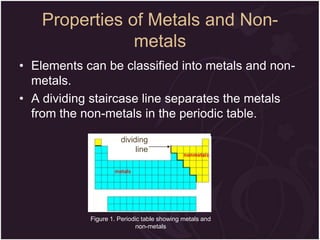
• A dividing staircase line separates the metals
from the non-metals in the periodic table.
dividing
line

Figure 1. Periodic table showing metals and
non-metals
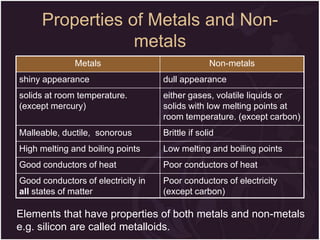
Properties of Metals and Nonmetals
Metals

Non-metals

shiny appearance

dull appearance

solids at room temperature.
(except mercury)

either gases, volatile liquids or
solids with low melting points at
room temperature. (except carbon)

Malleable, ductile, sonorous

Brittle if solid

High melting and boiling points

Low melting and boiling points

Good conductors of heat

Poor conductors of heat

Good conductors of electricity in
all states of matter

Poor conductors of electricity
(except carbon)

Elements that have properties of both metals and non-metals
e.g. silicon are called metalloids.
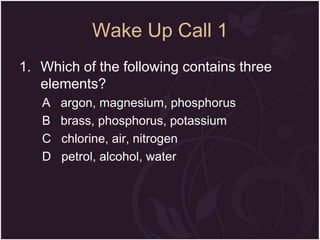
Wake Up Call 1
1. Which of the following contains three
elements?
A
B
C
D

argon, magnesium, phosphorus
brass, phosphorus, potassium
chlorine, air, nitrogen
petrol, alcohol, water
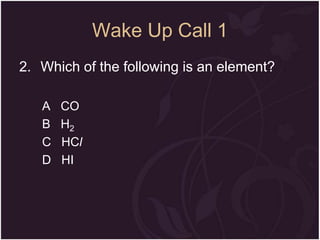
Wake Up Call 1
2. Which of the following is an element?
A
B
C
D

CO
H2
HCl
HI
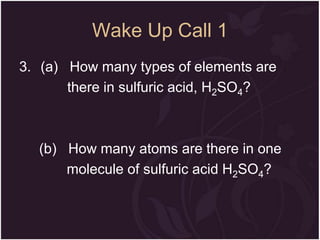
Wake Up Call 1
3. (a) How many types of elements are
there in sulfuric acid, H2SO4?

(b) How many atoms are there in one
molecule of sulfuric acid H2SO4?
Compounds and Mixtures
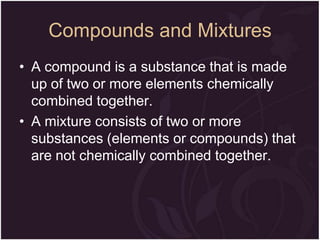
• A compound is a substance that is made
up of two or more elements chemically
combined together.
• A mixture consists of two or more
substances (elements or compounds) that
are not chemically combined together.
Compounds and Mixtures
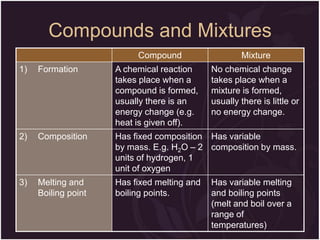
Compound

Mixture

1)

Formation

A chemical reaction
takes place when a
compound is formed,
usually there is an
energy change (e.g.
heat is given off).

No chemical change
takes place when a
mixture is formed,
usually there is little or
no energy change.

2)

Composition

Has fixed composition Has variable
by mass. E.g. H2O – 2 composition by mass.
units of hydrogen, 1
unit of oxygen

3)

Melting and
Boiling point

Has fixed melting and
boiling points.

Has variable melting
and boiling points
(melt and boil over a
range of
temperatures)
Compounds and Mixtures
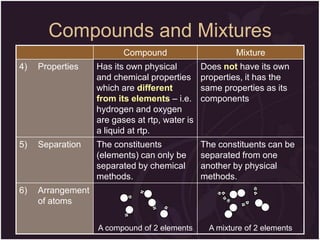
Compound

Mixture

4)

Properties

Has its own physical
and chemical properties
which are different
from its elements – i.e.
hydrogen and oxygen
are gases at rtp, water is
a liquid at rtp.

Does not have its own
properties, it has the
same properties as its
components

5)

Separation

The constituents
(elements) can only be
separated by chemical
methods.

The constituents can be
separated from one
another by physical
methods.

6)

Arrangement
of atoms
A compound of 2 elements

A mixture of 2 elements
Wake Up Call 2
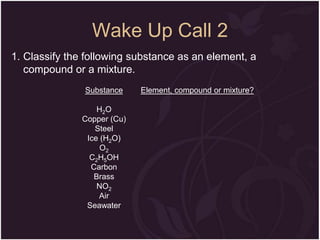
1. Classify the following substance as an element, a
compound or a mixture.
Substance
H2O
Copper (Cu)
Steel
Ice (H2O)
O2
C2H5OH
Carbon
Brass
NO2
Air
Seawater

Element, compound or mixture?
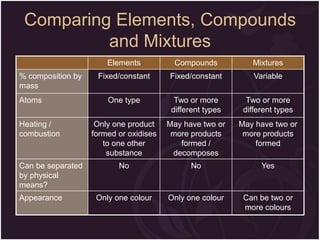
Comparing Elements, Compounds
and Mixtures
Elements
% composition by
mass
Atoms
Heating /
combustion

Can be separated
by physical
means?
Appearance

Compounds

Mixtures

Fixed/constant

Fixed/constant

Variable

One type

Two or more
different types

Two or more
different types

Only one product
formed or oxidises
to one other
substance

May have two or
more products
formed /
decomposes

May have two or
more products
formed

No

No

Yes

Only one colour

Only one colour

Can be two or
more colours
Comparing Elements, Compounds
and Mixtures
Elements
Some parts
dissolve in water
and some parts
do not
Examples

Pure / Impure

Compounds

Mixtures

Not possible

Not possible

Possible

Metals, Na, Ca,
Ar, Ne, H2, Cl2,
O3, P4, S8

HCl, CO2, H2O.
Na2SO4

Crude oil
(petroleum),
alloys (brass,
steel, bronze), air,
solutions,
fractions from
crude oil (diesel,
petrol, bitumen)

Pure

Pure

impure

Elements Compounds and Mixtures

  • 1.
  • 2.
    Learning Objectives • Atthe end of the lesson, students should be able to: – describe the differences between elements, compounds and mixtures
  • 3.
    Elements • Pure substancethat cannot be split up into two or more simpler substances. • Can be represented using chemical symbols (refer to the Periodic Table) • Elements can exist as either atoms or molecules. • Atoms are the smallest particles of an element that have the chemical properties of that element. • Molecules are a group of two or more atoms that are chemically combined.
  • 4.
    Properties of Metalsand Nonmetals • Elements can be classified into metals and nonmetals. • A dividing staircase line separates the metals from the non-metals in the periodic table. dividing line Figure 1. Periodic table showing metals and non-metals
  • 5.
    Properties of Metalsand Nonmetals Metals Non-metals shiny appearance dull appearance solids at room temperature. (except mercury) either gases, volatile liquids or solids with low melting points at room temperature. (except carbon) Malleable, ductile, sonorous Brittle if solid High melting and boiling points Low melting and boiling points Good conductors of heat Poor conductors of heat Good conductors of electricity in all states of matter Poor conductors of electricity (except carbon) Elements that have properties of both metals and non-metals e.g. silicon are called metalloids.
  • 6.
    Wake Up Call1 1. Which of the following contains three elements? A B C D argon, magnesium, phosphorus brass, phosphorus, potassium chlorine, air, nitrogen petrol, alcohol, water
  • 7.
    Wake Up Call1 2. Which of the following is an element? A B C D CO H2 HCl HI
  • 8.
    Wake Up Call1 3. (a) How many types of elements are there in sulfuric acid, H2SO4? (b) How many atoms are there in one molecule of sulfuric acid H2SO4?
  • 9.
    Compounds and Mixtures •A compound is a substance that is made up of two or more elements chemically combined together. • A mixture consists of two or more substances (elements or compounds) that are not chemically combined together.
  • 10.
    Compounds and Mixtures Compound Mixture 1) Formation Achemical reaction takes place when a compound is formed, usually there is an energy change (e.g. heat is given off). No chemical change takes place when a mixture is formed, usually there is little or no energy change. 2) Composition Has fixed composition Has variable by mass. E.g. H2O – 2 composition by mass. units of hydrogen, 1 unit of oxygen 3) Melting and Boiling point Has fixed melting and boiling points. Has variable melting and boiling points (melt and boil over a range of temperatures)
  • 11.
    Compounds and Mixtures Compound Mixture 4) Properties Hasits own physical and chemical properties which are different from its elements – i.e. hydrogen and oxygen are gases at rtp, water is a liquid at rtp. Does not have its own properties, it has the same properties as its components 5) Separation The constituents (elements) can only be separated by chemical methods. The constituents can be separated from one another by physical methods. 6) Arrangement of atoms A compound of 2 elements A mixture of 2 elements
  • 12.
    Wake Up Call2 1. Classify the following substance as an element, a compound or a mixture. Substance H2O Copper (Cu) Steel Ice (H2O) O2 C2H5OH Carbon Brass NO2 Air Seawater Element, compound or mixture?
  • 13.
    Comparing Elements, Compounds andMixtures Elements % composition by mass Atoms Heating / combustion Can be separated by physical means? Appearance Compounds Mixtures Fixed/constant Fixed/constant Variable One type Two or more different types Two or more different types Only one product formed or oxidises to one other substance May have two or more products formed / decomposes May have two or more products formed No No Yes Only one colour Only one colour Can be two or more colours
  • 14.
    Comparing Elements, Compounds andMixtures Elements Some parts dissolve in water and some parts do not Examples Pure / Impure Compounds Mixtures Not possible Not possible Possible Metals, Na, Ca, Ar, Ne, H2, Cl2, O3, P4, S8 HCl, CO2, H2O. Na2SO4 Crude oil (petroleum), alloys (brass, steel, bronze), air, solutions, fractions from crude oil (diesel, petrol, bitumen) Pure Pure impure