BIOENERGETICS- THERMODYNAMIC PRINCIPLES, FREE ENERGY
METABOLISM - GLYCOLYSIS, CITRIC ACID CYCLE, OXIDATIVE
PHOSPHORYLATION
BIOENERGETICS AND METABOLISM
BIOENERGETICS
 Is a quantitative study of the energy
transductions(changes of one form of energy
into another) that occur in living cells and of
the nature and functions of the chemical
processes underlying these transductions.
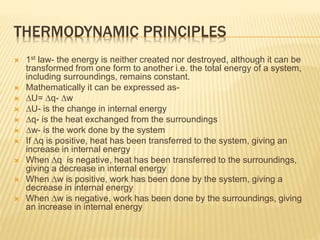
THERMODYNAMIC PRINCIPLES
 1st law- the energy is neither created nor destroyed, although it can be
transformed from one form to another i.e. the total energy of a system,
including surroundings, remains constant.
 Mathematically it can be expressed as-
 ∆U= ∆q- ∆w
 ∆U- is the change in internal energy
 ∆q- is the heat exchanged from the surroundings
 ∆w- is the work done by the system
 If ∆q is positive, heat has been transferred to the system, giving an
increase in internal energy
 When ∆q is negative, heat has been transferred to the surroundings,
giving a decrease in internal energy
 When ∆w is positive, work has been done by the system, giving a
decrease in internal energy
 When ∆w is negative, work has been done by the surroundings, giving
an increase in internal energy
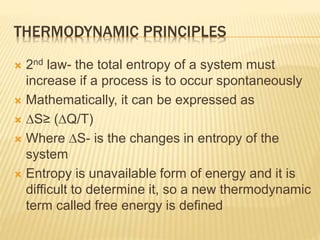
THERMODYNAMIC PRINCIPLES
 2nd law- the total entropy of a system must
increase if a process is to occur spontaneously
 Mathematically, it can be expressed as
 ∆S≥ (∆Q/T)
 Where ∆S- is the changes in entropy of the
system
 Entropy is unavailable form of energy and it is
difficult to determine it, so a new thermodynamic
term called free energy is defined
FREE ENERGY
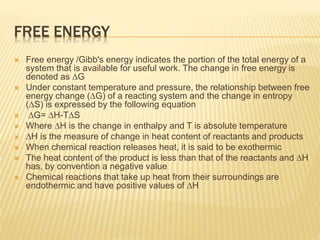
 Free energy /Gibb's energy indicates the portion of the total energy of a
system that is available for useful work. The change in free energy is
denoted as ∆G
 Under constant temperature and pressure, the relationship between free
energy change (∆G) of a reacting system and the change in entropy
(∆S) is expressed by the following equation
 ∆G= ∆H-T∆S
 Where ∆H is the change in enthalpy and T is absolute temperature
 ∆H is the measure of change in heat content of reactants and products
 When chemical reaction releases heat, it is said to be exothermic
 The heat content of the product is less than that of the reactants and ∆H
has, by convention a negative value
 Chemical reactions that take up heat from their surroundings are
endothermic and have positive values of ∆H
FREE ENERGY
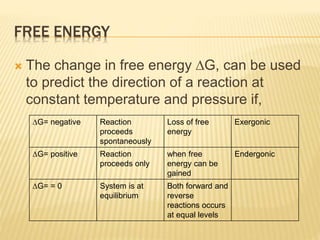
 The change in free energy ∆G, can be used
to predict the direction of a reaction at
constant temperature and pressure if,
∆G= negative Reaction
proceeds
spontaneously
Loss of free
energy
Exergonic
∆G= positive Reaction
proceeds only
when free
energy can be
gained
Endergonic
∆G= = 0 System is at
equilibrium
Both forward and
reverse
reactions occurs
at equal levels
FREE ENERGY
 ∆G of the reaction AB depends on the
concentration of reactant and product. At
constant temperature and pressure, the
following relation can be derived
 ∆G= ∆G°+RT ln [B]/[A]
 ∆G° is the standard free energy change
 R is the gas constant
 T is absolute temperature
 [A] and [B] are the actual concentrations of
reactant and product
METABOLISM –GLYCOLYSIS, CITRIC ACID CYCLE,
OXIDATIVE PHOSPHORYLATION
METABOLISM
 All cell functions as biochemical factories
 Within the living cells, biomolecules are constantly being synthesized
and transformed into some other biomolecules
 These synthesis and transformation constantly occur through enzyme
catalyzed chemical reactions
 Together all the interconnected chemical reactions occurring within a
cell are called metabolism(derived from the Greek word ‘for change’)
 Each of the chemical reactions results in the transformation of chemical
compounds and the chemical compounds involved in this process are
known as metabolites
 Majority of metabolic reactions do not occur in isolation but are always
linked to some other reactions. It occurs in a series of linked chemical
reactions called metabolic pathways in which one chemical transformed
through a series of steps into another chemical. Metabolic pathways
proceed in a stepwise manner, transforming substrates into end
products through many specific chemical intermediates
 Each step of metabolic pathways is catalyzed by a specific enzymes
METABOLISM
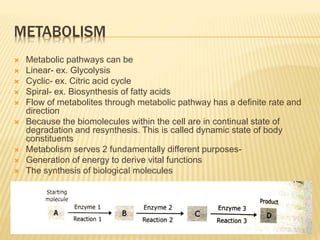
 Metabolic pathways can be
 Linear- ex. Glycolysis
 Cyclic- ex. Citric acid cycle
 Spiral- ex. Biosynthesis of fatty acids
 Flow of metabolites through metabolic pathway has a definite rate and
direction
 Because the biomolecules within the cell are in continual state of
degradation and resynthesis. This is called dynamic state of body
constituents
 Metabolism serves 2 fundamentally different purposes-
 Generation of energy to derive vital functions
 The synthesis of biological molecules
METABOLISM
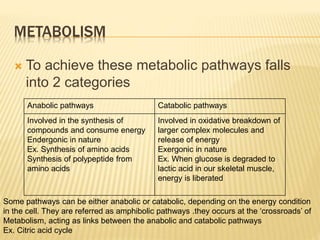
 To achieve these metabolic pathways falls
into 2 categories
Anabolic pathways Catabolic pathways
Involved in the synthesis of
compounds and consume energy
Endergonic in nature
Ex. Synthesis of amino acids
Synthesis of polypeptide from
amino acids
Involved in oxidative breakdown of
larger complex molecules and
release of energy
Exergonic in nature
Ex. When glucose is degraded to
lactic acid in our skeletal muscle,
energy is liberated
Some pathways can be either anabolic or catabolic, depending on the energy condition
in the cell. They are referred as amphibolic pathways .they occurs at the ‘crossroads’ of
Metabolism, acting as links between the anabolic and catabolic pathways
Ex. Citric acid cycle
RESPIRATION
 Living cells require an input of free energy. Energy is
required for maintenance of highly organized structures,
synthesis of cellular components, movements, generation
of electric currents and for many other purposes
 Cells acquire free energy from the oxidation of organic
compounds that are rich in potential energy. Since all
organisms use organic compounds for source of energy,
they must either make the organic compounds in a
process like photosynthesis or they must obtain energy-
containing organic compounds called food through diet
 Respiration is a metabolic process, in which free energy
released from the oxidation of organic compounds is used
in formation of ATP. The compounds that are oxidized
during this process is called respiratory substrates, which
may be carbohydrates, fats, proteins or organic acids
 Carbohydrates are more common respiratory substrates
AEROBIC RESPIRATION
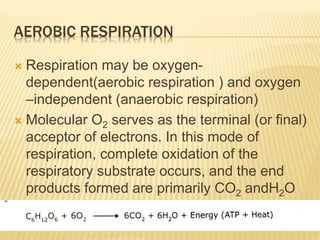
 Respiration may be oxygen-
dependent(aerobic respiration ) and oxygen
–independent (anaerobic respiration)
 Molecular O2 serves as the terminal (or final)
acceptor of electrons. In this mode of
respiration, complete oxidation of the
respiratory substrate occurs, and the end
products formed are primarily CO2 andH2O
AEROBIC RESPIRATION
 Carbohydrates, fats and proteins can all be
oxidized as fuel, but here processes have been
described by taking glucose as a respiratory
substrate. Oxidation of glucose in exergonic
process
 During aerobic respiration when glucose is
completely oxidized into CO2 and water and
energy is liberated. Part of this energy is used fir
the synthesis of ATP. For each molecule of
glucose degraded to CO2 and water by
respiration, the cell makes up ATP molecules
each with free energy
ANAEROBIC RESPIRATION
 Not all organisms (or cells) require oxygen for
oxidation of respiratory substrates. Anaerobic
respiration and fermentation do not require oxygen
for oxidation of respiratory substrates.
 Here compounds such as sulfate, nitrate, sulphur or
fumarate other than O2 serves as a terminal electron
acceptor
 Both aerobic and anaerobic respiration involve
electron transport system to establish an
electrochemical proton gradient across a membrane
and ATP synthesis occurs through both substrate-
level phosphorylation and oxidative phosphrylation
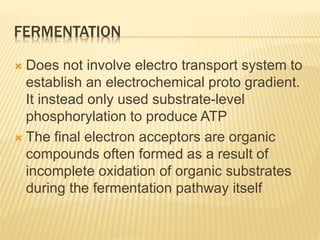
FERMENTATION
 Does not involve electro transport system to
establish an electrochemical proto gradient.
It instead only used substrate-level
phosphorylation to produce ATP
 The final electron acceptors are organic
compounds often formed as a result of
incomplete oxidation of organic substrates
during the fermentation pathway itself
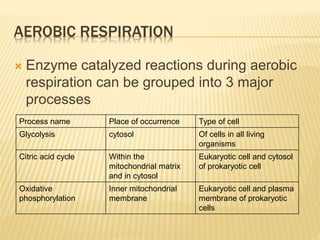
AEROBIC RESPIRATION
 Enzyme catalyzed reactions during aerobic
respiration can be grouped into 3 major
processes
Process name Place of occurrence Type of cell
Glycolysis cytosol Of cells in all living
organisms
Citric acid cycle Within the
mitochondrial matrix
and in cytosol
Eukaryotic cell and cytosol
of prokaryotic cell
Oxidative
phosphorylation
Inner mitochondrial
membrane
Eukaryotic cell and plasma
membrane of prokaryotic
cells
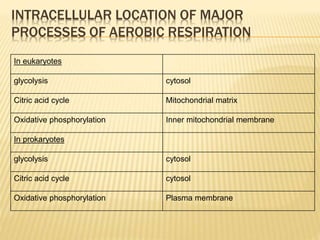
INTRACELLULAR LOCATION OF MAJOR
PROCESSES OF AEROBIC RESPIRATION
In eukaryotes
glycolysis cytosol
Citric acid cycle Mitochondrial matrix
Oxidative phosphorylation Inner mitochondrial membrane
In prokaryotes
glycolysis cytosol
Citric acid cycle cytosol
Oxidative phosphorylation Plasma membrane
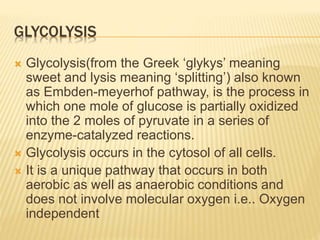
GLYCOLYSIS
GLYCOLYSIS
 Glycolysis(from the Greek ‘glykys’ meaning
sweet and lysis meaning ‘splitting’) also known
as Embden-meyerhof pathway, is the process in
which one mole of glucose is partially oxidized
into the 2 moles of pyruvate in a series of
enzyme-catalyzed reactions.
 Glycolysis occurs in the cytosol of all cells.
 It is a unique pathway that occurs in both
aerobic as well as anaerobic conditions and
does not involve molecular oxygen i.e.. Oxygen
independent
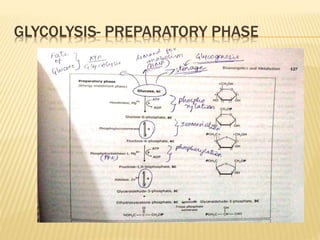
GLYCOLYSIS- PREPARATORY PHASE
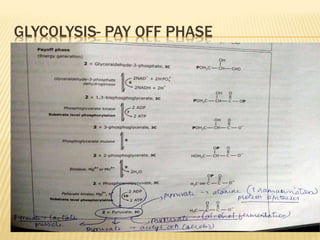
GLYCOLYSIS- PAY OFF PHASE
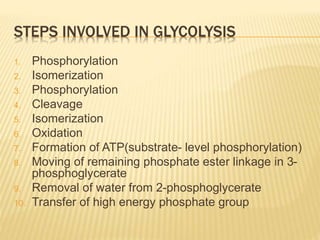
STEPS INVOLVED IN GLYCOLYSIS
1. Phosphorylation
2. Isomerization
3. Phosphorylation
4. Cleavage
5. Isomerization
6. Oxidation
7. Formation of ATP(substrate- level phosphorylation)
8. Moving of remaining phosphate ester linkage in 3-
phosphoglycerate
9. Removal of water from 2-phosphoglycerate
10. Transfer of high energy phosphate group
STEPS INVOLVED IN GLYCOLYSIS
 Step-1 phosphorylation
 Glucose is phosphorylated by ATP to form glucose-6-
phosphate
 The negative charge of phosphate prevents the passage
of the glucose-6-phosphate through the plasma
membrane, trapping glucose inside the cell
 The irreversible reaction is catalyzed by hexokinase
 hexokinase present in all cells of all organisms. It
requires divalent metal ions like Mg2+/Mn2+ for activity
 Hepatocytes and β-cells of the pancreas also contain a
form of hexokinase called glucokinase (hexokinase D)
 Hexokinase and glucokinase are isozymes
STEPS INVOLVED IN GLYCOLYSIS
 Step- 2 isomerization
 A reversible rearrangement of chemical
structure(isomerization) moves the carbonyl
oxygen from carbon 1 to carbon 2, forming a
ketose from an aldose sugar.
 Thus, the isomerization of glucose-6-phosphate
to fructose-6-phosphate is a conversion of an
aldose to a ketose
 This step is catalyzed by enzyme
phosphoglucoisomerase
STEPS INVOLVED IN GLYCOLYSIS
 Step-3 phosphorylation
 fructose-6-phosphate is phosphorylated by ATP
to fructose-1,6-bisphosphate
 The prefix bis- in bisphosphate means that 2
separate monophosphate groups are present,
whereas the prefix di- means that 2 phosphate
groups are present and are connected by an
anhydride bond .
 The irreversible reaction is catalyzed by an
allosteric enzyme phosphofructokinase -1 (PFK-
1)
STEPS INVOLVED IN GLYCOLYSIS
 Step-4 cleavage
 The fructose-1,6-bisphosphate is cleaved to
produce two three- carbon molecules-
glyceraldehyde-3-phosphate (G3P) and
dihydroxyacetone phosphate (DHAP)
 This reaction is catalyzed by enzyme
aldolase
STEPS INVOLVED IN GLYCOLYSIS
 Step-5 isomerization
 Only one of the two triose phosphates
formed by aldolase- glyceraldehyde-3-
phosphate (G3P) can be directly degraded in
the subsequent reaction step of glycolysis.
However, the other product,
dihydroxyacetone phosphate, is rapidly and
reversibly converted into glyceraldehyde-3-
phosphate by the enzyme triose phosphate
isomerase.
STEPS INVOLVED IN GLYCOLYSIS
 Step-6 oxidation
 The two molecules of glyceraldehyde-3-phosphate are
oxidized
 Enzyme dehydrogenase catalyzes the conversion of
glyceraldehyde-3-phosphate (G3P) into 1,3-
bisphosphoglycerate (1,3-BPG)
 The reaction occurs in two steps –
 1st step- oxidation of aldehyde to a carboxylic acid by
NAD+
 2nd step- the phosphorylation of carboxylic acid by
inorganic phosphate
 Iodoacetate is a potent inhibitor of glyceraldehyde-3-
phosphate dehydrogenase because it forms a covalent
derivative of the essential –SH group of the enzyme
active site, rendering it inactive
STEPS INVOLVED IN GLYCOLYSIS
 Step7- formation of ATP
 High energy phosphate group is transferred
from 1,3-bisphosphoglycerate to ADP
 This step is catalyzed by enzyme
phosphoglycerate kinase
 The formation of ATP is referred to as substrate
level- phosphorylation because the phosphate
donor, 1,3-bisphosphoglycerate , is a substrate
with high phosphoryl-transfer potential
 Formation of ATP from ADP by direct transfer of
phosphoryl group from a ‘high energy’
compound is termed as substrate-level
phosphorylation
STEPS INVOLVED IN GLYCOLYSIS
 Step-8 Moving of remaining phosphate ester
linkage in 3-phosphoglycerate
 The remaining phosphate ester linkage in 3-
phosphoglycerate, which has relatively low
free energy of hydrolysis, is moved from
carbon 3 to carbon 2 to form 2-
phosphoglycerate
STEPS INVOLVED IN GLYCOLYSIS
 Step-9 Removal of water from 2-
phosphoglycerate
 The removal of water from 2-
phosphoglycerate creates a high-energy eno
phosphate linkage
 The enzyme catalyzing this step, enolase, is
inhibited by fluoride
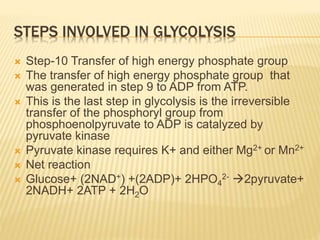
STEPS INVOLVED IN GLYCOLYSIS
 Step-10 Transfer of high energy phosphate group
 The transfer of high energy phosphate group that
was generated in step 9 to ADP from ATP.
 This is the last step in glycolysis is the irreversible
transfer of the phosphoryl group from
phosphoenolpyruvate to ADP is catalyzed by
pyruvate kinase
 Pyruvate kinase requires K+ and either Mg2+ or Mn2+
 Net reaction
 Glucose+ (2NAD+) +(2ADP)+ 2HPO4
2- 2pyruvate+
2NADH+ 2ATP + 2H2O
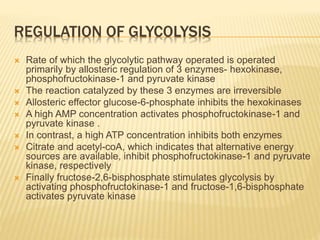
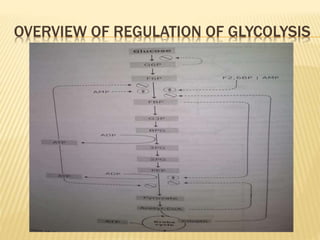
REGULATION OF GLYCOLYSIS
 Rate of which the glycolytic pathway operated is operated
primarily by allosteric regulation of 3 enzymes- hexokinase,
phosphofructokinase-1 and pyruvate kinase
 The reaction catalyzed by these 3 enzymes are irreversible
 Allosteric effector glucose-6-phosphate inhibits the hexokinases
 A high AMP concentration activates phosphofructokinase-1 and
pyruvate kinase .
 In contrast, a high ATP concentration inhibits both enzymes
 Citrate and acetyl-coA, which indicates that alternative energy
sources are available, inhibit phosphofructokinase-1 and pyruvate
kinase, respectively
 Finally fructose-2,6-bisphosphate stimulates glycolysis by
activating phosphofructokinase-1 and fructose-1,6-bisphosphate
activates pyruvate kinase
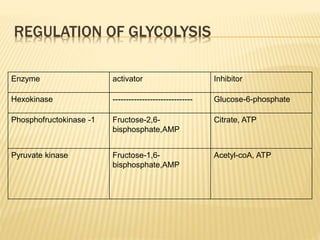
REGULATION OF GLYCOLYSIS
Enzyme activator Inhibitor
Hexokinase ------------------------------ Glucose-6-phosphate
Phosphofructokinase -1 Fructose-2,6-
bisphosphate,AMP
Citrate, ATP
Pyruvate kinase Fructose-1,6-
bisphosphate,AMP
Acetyl-coA, ATP
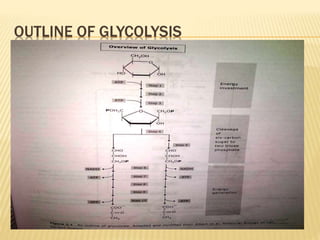
OUTLINE OF GLYCOLYSIS
OVERVIEW OF REGULATION OF GLYCOLYSIS
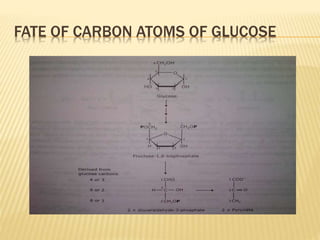
FATE OF CARBON ATOMS OF GLUCOSE
CITRIC ACID CYCLE
CITRIC ACID CYCLE
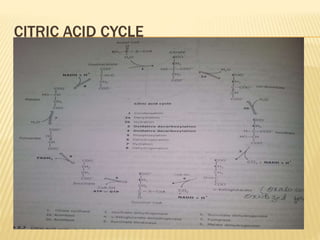
 Also known as Krebs cycle or tricarboxylic acid
cycle was discovered by H.A. Krebs, a German
born British biochemist, who received the noble
prize in 1953
 This cycle occurs in the matrix of mitochondria(
cytosol in prokaryotes)
 The net result of citric acid cycle is that for each
acetyl group entering the cycle as acetyl-coA,
two molecules of CO2 are produced
STEPS INVOLVED IN CITRIC ACID CYCLE
 Step-1
 citric acid cycle begins with the
condensation of an oxaloacetate(4 carbon
unit), and the acetyl group of acetyl-coA (2
carbon unit)
 Oxaloacetate reacts with acetyl-coA and
water to yield citrate and coenzyme A
 This reaction, which is an aldol condensation
followed by a hydrolysis, is catalyzed by
citrate synthase
STEPS INVOLVED IN CITRIC ACID CYCLE
 Step-2a and 2b
 An isomerization reaction, in which water is first
removed and then added back, moves hydroxyl
group from one carbon atom to its neighbor
 The enzyme catalyzing this step, aconitase
(nonheme iron protein ) is the target site for the
toxic compound fluoroacetate( used as a
pesticide).
 Fluoroacetate blocks the citric acid cycle by its
metabolic conversion of fluorocitrate, which is
potent inhibitor of aconitase
STEPS INVOLVED IN CITRIC ACID CYCLE
 Step-3
 Isocitrate is oxidized and decarboxylated to α-
ketoglutarate ( also called oxoglutarate)
 In first of four oxidation steps in the cycle, the
carbon carrying the hydroxyl group is converted
to a carbonyl group
 The intermediate product is unstable, losing
CO2while still bound to the enzyme
 The oxidative decarboxylation of isocitrate is
catalyzed by isocitrate dehydrogenase
STEPS INVOLVED IN CITRIC ACID CYCLE
 Step-4
 The second oxidative decarboxylation
reaction results in formation of succinyl coA
from α-ketoglutarate
 α-ketoglutarate dehydrogenase catalyzes
this oxidative step and produces NADH, CO2
and a high-energy thioester bond to
coenzyme A
STEPS INVOLVED IN CITRIC ACID CYCLE
 Step-5
 The cleavage of the thioester bond if succinyl-coA is coupled with
the phosphorylation of an ADP/ GDP ( substrate level
phosphorylation ).
 This step is catalyzed by succinyl-coA synthetase (succinate
thiokinase)
 ATP and GTP are energetically equivalent.
 This is the only step in citric acid cycle that directly yield a
compound with high phosphoryl transfer potential through a
substrate-level phosphorylation
 Animal cells have 2 isozymes of succinyl-coA synthetase, one
specific for ADP and the other for GDP. The GTP formed by
succinyl-coA synthetase can donate its terminal phosphoryl
group to ADP to form ATP, in a reversible reaction catalyzed by
nucleoside diphosphate kinase. In the cells of plants, bacteria and
some animal tissues, an ATP molecule forms directly by
substrate-level phosphorylation
STEPS INVOLVED IN CITRIC ACID CYCLE
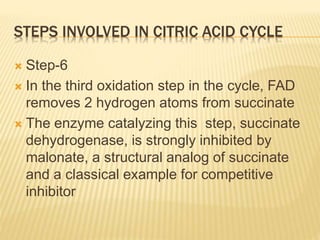
 Step-6
 In the third oxidation step in the cycle, FAD
removes 2 hydrogen atoms from succinate
 The enzyme catalyzing this step, succinate
dehydrogenase, is strongly inhibited by
malonate, a structural analog of succinate
and a classical example for competitive
inhibitor
STEPS INVOLVED IN CITRIC ACID CYCLE
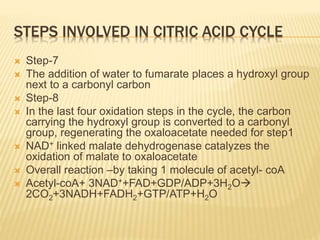
 Step-7
 The addition of water to fumarate places a hydroxyl group
next to a carbonyl carbon
 Step-8
 In the last four oxidation steps in the cycle, the carbon
carrying the hydroxyl group is converted to a carbonyl
group, regenerating the oxaloacetate needed for step1
 NAD+ linked malate dehydrogenase catalyzes the
oxidation of malate to oxaloacetate
 Overall reaction –by taking 1 molecule of acetyl- coA
 Acetyl-coA+ 3NAD++FAD+GDP/ADP+3H2O
2CO2+3NADH+FADH2+GTP/ATP+H2O
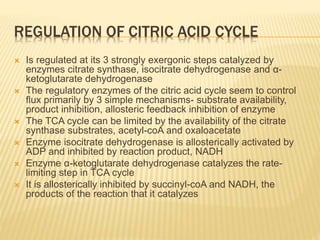
REGULATION OF CITRIC ACID CYCLE
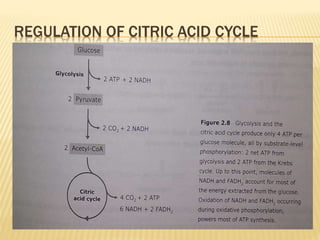
 Is regulated at its 3 strongly exergonic steps catalyzed by
enzymes citrate synthase, isocitrate dehydrogenase and α-
ketoglutarate dehydrogenase
 The regulatory enzymes of the citric acid cycle seem to control
flux primarily by 3 simple mechanisms- substrate availability,
product inhibition, allosteric feedback inhibition of enzyme
 The TCA cycle can be limited by the availability of the citrate
synthase substrates, acetyl-coA and oxaloacetate
 Enzyme isocitrate dehydrogenase is allosterically activated by
ADP and inhibited by reaction product, NADH
 Enzyme α-ketoglutarate dehydrogenase catalyzes the rate-
limiting step in TCA cycle
 It is allosterically inhibited by succinyl-coA and NADH, the
products of the reaction that it catalyzes
CITRIC ACID CYCLE
REGULATION OF CITRIC ACID CYCLE
OXIDATIVE PHOSPHORYLATION
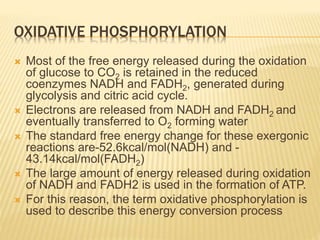
 Most of the free energy released during the oxidation
of glucose to CO2 is retained in the reduced
coenzymes NADH and FADH2, generated during
glycolysis and citric acid cycle.
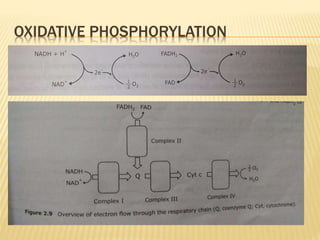
 Electrons are released from NADH and FADH2 and
eventually transferred to O2 forming water
 The standard free energy change for these exergonic
reactions are-52.6kcal/mol(NADH) and -
43.14kcal/mol(FADH2)
 The large amount of energy released during oxidation
of NADH and FADH2 is used in the formation of ATP.
 For this reason, the term oxidative phosphorylation is
used to describe this energy conversion process
OXIDATIVE PHOSPHORYLATION
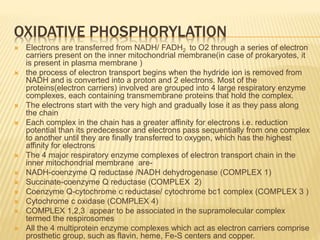
 Electrons are transferred from NADH/ FADH2 to O2 through a series of electron
carriers present on the inner mitochondrial membrane(in case of prokaryotes, it
is present in plasma membrane )
 the process of electron transport begins when the hydride ion is removed from
NADH and is converted into a proton and 2 electrons. Most of the
proteins(electron carriers) involved are grouped into 4 large respiratory enzyme
complexes, each containing transmembrane proteins that hold the complex.
 The electrons start with the very high and gradually lose it as they pass along
the chain
 Each complex in the chain has a greater affinity for electrons i.e. reduction
potential than its predecessor and electrons pass sequentially from one complex
to another until they are finally transferred to oxygen, which has the highest
affinity for electrons
 The 4 major respiratory enzyme complexes of electron transport chain in the
inner mitochondrial membrane are-
 NADH-coenzyme Q reductase /NADH dehydrogenase (COMPLEX 1)
 Succinate-coenzyme Q reductase (COMPLEX 2)
 Coenzyme Q-cytochrome c reductase/ cytochrome bc1 complex (COMPLEX 3 )
 Cytochrome c oxidase (COMPLEX 4)
 COMPLEX 1,2,3 appear to be associated in the supramolecular complex
termed the respirosomes
 All the 4 multiprotein enzyme complexes which act as electron carriers comprise
prosthetic group, such as flavin, heme, Fe-S centers and copper.
PROSTHETIC GROUPS IN EACH MULTIPROTEIN
ENZYME COMPLEX
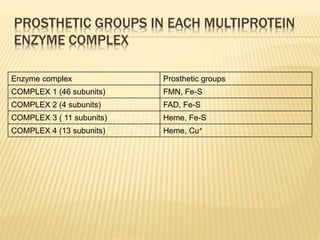
Enzyme complex Prosthetic groups
COMPLEX 1 (46 subunits) FMN, Fe-S
COMPLEX 2 (4 subunits) FAD, Fe-S
COMPLEX 3 ( 11 subunits) Heme, Fe-S
COMPLEX 4 (13 subunits) Heme, Cu+
OXIDATIVE PHOSPHORYLATION

Bioenergetics and metabolism.pptx

  • 1.
    BIOENERGETICS- THERMODYNAMIC PRINCIPLES,FREE ENERGY METABOLISM - GLYCOLYSIS, CITRIC ACID CYCLE, OXIDATIVE PHOSPHORYLATION BIOENERGETICS AND METABOLISM
  • 2.
    BIOENERGETICS  Is aquantitative study of the energy transductions(changes of one form of energy into another) that occur in living cells and of the nature and functions of the chemical processes underlying these transductions.
  • 3.
    THERMODYNAMIC PRINCIPLES  1stlaw- the energy is neither created nor destroyed, although it can be transformed from one form to another i.e. the total energy of a system, including surroundings, remains constant.  Mathematically it can be expressed as-  ∆U= ∆q- ∆w  ∆U- is the change in internal energy  ∆q- is the heat exchanged from the surroundings  ∆w- is the work done by the system  If ∆q is positive, heat has been transferred to the system, giving an increase in internal energy  When ∆q is negative, heat has been transferred to the surroundings, giving a decrease in internal energy  When ∆w is positive, work has been done by the system, giving a decrease in internal energy  When ∆w is negative, work has been done by the surroundings, giving an increase in internal energy
  • 4.
    THERMODYNAMIC PRINCIPLES  2ndlaw- the total entropy of a system must increase if a process is to occur spontaneously  Mathematically, it can be expressed as  ∆S≥ (∆Q/T)  Where ∆S- is the changes in entropy of the system  Entropy is unavailable form of energy and it is difficult to determine it, so a new thermodynamic term called free energy is defined
  • 5.
    FREE ENERGY  Freeenergy /Gibb's energy indicates the portion of the total energy of a system that is available for useful work. The change in free energy is denoted as ∆G  Under constant temperature and pressure, the relationship between free energy change (∆G) of a reacting system and the change in entropy (∆S) is expressed by the following equation  ∆G= ∆H-T∆S  Where ∆H is the change in enthalpy and T is absolute temperature  ∆H is the measure of change in heat content of reactants and products  When chemical reaction releases heat, it is said to be exothermic  The heat content of the product is less than that of the reactants and ∆H has, by convention a negative value  Chemical reactions that take up heat from their surroundings are endothermic and have positive values of ∆H
  • 6.
    FREE ENERGY  Thechange in free energy ∆G, can be used to predict the direction of a reaction at constant temperature and pressure if, ∆G= negative Reaction proceeds spontaneously Loss of free energy Exergonic ∆G= positive Reaction proceeds only when free energy can be gained Endergonic ∆G= = 0 System is at equilibrium Both forward and reverse reactions occurs at equal levels
  • 7.
    FREE ENERGY  ∆Gof the reaction AB depends on the concentration of reactant and product. At constant temperature and pressure, the following relation can be derived  ∆G= ∆G°+RT ln [B]/[A]  ∆G° is the standard free energy change  R is the gas constant  T is absolute temperature  [A] and [B] are the actual concentrations of reactant and product
  • 8.
    METABOLISM –GLYCOLYSIS, CITRICACID CYCLE, OXIDATIVE PHOSPHORYLATION
  • 9.
    METABOLISM  All cellfunctions as biochemical factories  Within the living cells, biomolecules are constantly being synthesized and transformed into some other biomolecules  These synthesis and transformation constantly occur through enzyme catalyzed chemical reactions  Together all the interconnected chemical reactions occurring within a cell are called metabolism(derived from the Greek word ‘for change’)  Each of the chemical reactions results in the transformation of chemical compounds and the chemical compounds involved in this process are known as metabolites  Majority of metabolic reactions do not occur in isolation but are always linked to some other reactions. It occurs in a series of linked chemical reactions called metabolic pathways in which one chemical transformed through a series of steps into another chemical. Metabolic pathways proceed in a stepwise manner, transforming substrates into end products through many specific chemical intermediates  Each step of metabolic pathways is catalyzed by a specific enzymes
  • 10.
    METABOLISM  Metabolic pathwayscan be  Linear- ex. Glycolysis  Cyclic- ex. Citric acid cycle  Spiral- ex. Biosynthesis of fatty acids  Flow of metabolites through metabolic pathway has a definite rate and direction  Because the biomolecules within the cell are in continual state of degradation and resynthesis. This is called dynamic state of body constituents  Metabolism serves 2 fundamentally different purposes-  Generation of energy to derive vital functions  The synthesis of biological molecules
  • 11.
    METABOLISM  To achievethese metabolic pathways falls into 2 categories Anabolic pathways Catabolic pathways Involved in the synthesis of compounds and consume energy Endergonic in nature Ex. Synthesis of amino acids Synthesis of polypeptide from amino acids Involved in oxidative breakdown of larger complex molecules and release of energy Exergonic in nature Ex. When glucose is degraded to lactic acid in our skeletal muscle, energy is liberated Some pathways can be either anabolic or catabolic, depending on the energy condition in the cell. They are referred as amphibolic pathways .they occurs at the ‘crossroads’ of Metabolism, acting as links between the anabolic and catabolic pathways Ex. Citric acid cycle
  • 12.
    RESPIRATION  Living cellsrequire an input of free energy. Energy is required for maintenance of highly organized structures, synthesis of cellular components, movements, generation of electric currents and for many other purposes  Cells acquire free energy from the oxidation of organic compounds that are rich in potential energy. Since all organisms use organic compounds for source of energy, they must either make the organic compounds in a process like photosynthesis or they must obtain energy- containing organic compounds called food through diet  Respiration is a metabolic process, in which free energy released from the oxidation of organic compounds is used in formation of ATP. The compounds that are oxidized during this process is called respiratory substrates, which may be carbohydrates, fats, proteins or organic acids  Carbohydrates are more common respiratory substrates
  • 13.
    AEROBIC RESPIRATION  Respirationmay be oxygen- dependent(aerobic respiration ) and oxygen –independent (anaerobic respiration)  Molecular O2 serves as the terminal (or final) acceptor of electrons. In this mode of respiration, complete oxidation of the respiratory substrate occurs, and the end products formed are primarily CO2 andH2O
  • 14.
    AEROBIC RESPIRATION  Carbohydrates,fats and proteins can all be oxidized as fuel, but here processes have been described by taking glucose as a respiratory substrate. Oxidation of glucose in exergonic process  During aerobic respiration when glucose is completely oxidized into CO2 and water and energy is liberated. Part of this energy is used fir the synthesis of ATP. For each molecule of glucose degraded to CO2 and water by respiration, the cell makes up ATP molecules each with free energy
  • 15.
    ANAEROBIC RESPIRATION  Notall organisms (or cells) require oxygen for oxidation of respiratory substrates. Anaerobic respiration and fermentation do not require oxygen for oxidation of respiratory substrates.  Here compounds such as sulfate, nitrate, sulphur or fumarate other than O2 serves as a terminal electron acceptor  Both aerobic and anaerobic respiration involve electron transport system to establish an electrochemical proton gradient across a membrane and ATP synthesis occurs through both substrate- level phosphorylation and oxidative phosphrylation
  • 16.
    FERMENTATION  Does notinvolve electro transport system to establish an electrochemical proto gradient. It instead only used substrate-level phosphorylation to produce ATP  The final electron acceptors are organic compounds often formed as a result of incomplete oxidation of organic substrates during the fermentation pathway itself
  • 17.
    AEROBIC RESPIRATION  Enzymecatalyzed reactions during aerobic respiration can be grouped into 3 major processes Process name Place of occurrence Type of cell Glycolysis cytosol Of cells in all living organisms Citric acid cycle Within the mitochondrial matrix and in cytosol Eukaryotic cell and cytosol of prokaryotic cell Oxidative phosphorylation Inner mitochondrial membrane Eukaryotic cell and plasma membrane of prokaryotic cells
  • 18.
    INTRACELLULAR LOCATION OFMAJOR PROCESSES OF AEROBIC RESPIRATION In eukaryotes glycolysis cytosol Citric acid cycle Mitochondrial matrix Oxidative phosphorylation Inner mitochondrial membrane In prokaryotes glycolysis cytosol Citric acid cycle cytosol Oxidative phosphorylation Plasma membrane
  • 19.
  • 20.
    GLYCOLYSIS  Glycolysis(from theGreek ‘glykys’ meaning sweet and lysis meaning ‘splitting’) also known as Embden-meyerhof pathway, is the process in which one mole of glucose is partially oxidized into the 2 moles of pyruvate in a series of enzyme-catalyzed reactions.  Glycolysis occurs in the cytosol of all cells.  It is a unique pathway that occurs in both aerobic as well as anaerobic conditions and does not involve molecular oxygen i.e.. Oxygen independent
  • 21.
  • 22.
  • 23.
    STEPS INVOLVED INGLYCOLYSIS 1. Phosphorylation 2. Isomerization 3. Phosphorylation 4. Cleavage 5. Isomerization 6. Oxidation 7. Formation of ATP(substrate- level phosphorylation) 8. Moving of remaining phosphate ester linkage in 3- phosphoglycerate 9. Removal of water from 2-phosphoglycerate 10. Transfer of high energy phosphate group
  • 24.
    STEPS INVOLVED INGLYCOLYSIS  Step-1 phosphorylation  Glucose is phosphorylated by ATP to form glucose-6- phosphate  The negative charge of phosphate prevents the passage of the glucose-6-phosphate through the plasma membrane, trapping glucose inside the cell  The irreversible reaction is catalyzed by hexokinase  hexokinase present in all cells of all organisms. It requires divalent metal ions like Mg2+/Mn2+ for activity  Hepatocytes and β-cells of the pancreas also contain a form of hexokinase called glucokinase (hexokinase D)  Hexokinase and glucokinase are isozymes
  • 25.
    STEPS INVOLVED INGLYCOLYSIS  Step- 2 isomerization  A reversible rearrangement of chemical structure(isomerization) moves the carbonyl oxygen from carbon 1 to carbon 2, forming a ketose from an aldose sugar.  Thus, the isomerization of glucose-6-phosphate to fructose-6-phosphate is a conversion of an aldose to a ketose  This step is catalyzed by enzyme phosphoglucoisomerase
  • 26.
    STEPS INVOLVED INGLYCOLYSIS  Step-3 phosphorylation  fructose-6-phosphate is phosphorylated by ATP to fructose-1,6-bisphosphate  The prefix bis- in bisphosphate means that 2 separate monophosphate groups are present, whereas the prefix di- means that 2 phosphate groups are present and are connected by an anhydride bond .  The irreversible reaction is catalyzed by an allosteric enzyme phosphofructokinase -1 (PFK- 1)
  • 27.
    STEPS INVOLVED INGLYCOLYSIS  Step-4 cleavage  The fructose-1,6-bisphosphate is cleaved to produce two three- carbon molecules- glyceraldehyde-3-phosphate (G3P) and dihydroxyacetone phosphate (DHAP)  This reaction is catalyzed by enzyme aldolase
  • 28.
    STEPS INVOLVED INGLYCOLYSIS  Step-5 isomerization  Only one of the two triose phosphates formed by aldolase- glyceraldehyde-3- phosphate (G3P) can be directly degraded in the subsequent reaction step of glycolysis. However, the other product, dihydroxyacetone phosphate, is rapidly and reversibly converted into glyceraldehyde-3- phosphate by the enzyme triose phosphate isomerase.
  • 29.
    STEPS INVOLVED INGLYCOLYSIS  Step-6 oxidation  The two molecules of glyceraldehyde-3-phosphate are oxidized  Enzyme dehydrogenase catalyzes the conversion of glyceraldehyde-3-phosphate (G3P) into 1,3- bisphosphoglycerate (1,3-BPG)  The reaction occurs in two steps –  1st step- oxidation of aldehyde to a carboxylic acid by NAD+  2nd step- the phosphorylation of carboxylic acid by inorganic phosphate  Iodoacetate is a potent inhibitor of glyceraldehyde-3- phosphate dehydrogenase because it forms a covalent derivative of the essential –SH group of the enzyme active site, rendering it inactive
  • 30.
    STEPS INVOLVED INGLYCOLYSIS  Step7- formation of ATP  High energy phosphate group is transferred from 1,3-bisphosphoglycerate to ADP  This step is catalyzed by enzyme phosphoglycerate kinase  The formation of ATP is referred to as substrate level- phosphorylation because the phosphate donor, 1,3-bisphosphoglycerate , is a substrate with high phosphoryl-transfer potential  Formation of ATP from ADP by direct transfer of phosphoryl group from a ‘high energy’ compound is termed as substrate-level phosphorylation
  • 31.
    STEPS INVOLVED INGLYCOLYSIS  Step-8 Moving of remaining phosphate ester linkage in 3-phosphoglycerate  The remaining phosphate ester linkage in 3- phosphoglycerate, which has relatively low free energy of hydrolysis, is moved from carbon 3 to carbon 2 to form 2- phosphoglycerate
  • 32.
    STEPS INVOLVED INGLYCOLYSIS  Step-9 Removal of water from 2- phosphoglycerate  The removal of water from 2- phosphoglycerate creates a high-energy eno phosphate linkage  The enzyme catalyzing this step, enolase, is inhibited by fluoride
  • 33.
    STEPS INVOLVED INGLYCOLYSIS  Step-10 Transfer of high energy phosphate group  The transfer of high energy phosphate group that was generated in step 9 to ADP from ATP.  This is the last step in glycolysis is the irreversible transfer of the phosphoryl group from phosphoenolpyruvate to ADP is catalyzed by pyruvate kinase  Pyruvate kinase requires K+ and either Mg2+ or Mn2+  Net reaction  Glucose+ (2NAD+) +(2ADP)+ 2HPO4 2- 2pyruvate+ 2NADH+ 2ATP + 2H2O
  • 34.
    REGULATION OF GLYCOLYSIS Rate of which the glycolytic pathway operated is operated primarily by allosteric regulation of 3 enzymes- hexokinase, phosphofructokinase-1 and pyruvate kinase  The reaction catalyzed by these 3 enzymes are irreversible  Allosteric effector glucose-6-phosphate inhibits the hexokinases  A high AMP concentration activates phosphofructokinase-1 and pyruvate kinase .  In contrast, a high ATP concentration inhibits both enzymes  Citrate and acetyl-coA, which indicates that alternative energy sources are available, inhibit phosphofructokinase-1 and pyruvate kinase, respectively  Finally fructose-2,6-bisphosphate stimulates glycolysis by activating phosphofructokinase-1 and fructose-1,6-bisphosphate activates pyruvate kinase
  • 35.
    REGULATION OF GLYCOLYSIS Enzymeactivator Inhibitor Hexokinase ------------------------------ Glucose-6-phosphate Phosphofructokinase -1 Fructose-2,6- bisphosphate,AMP Citrate, ATP Pyruvate kinase Fructose-1,6- bisphosphate,AMP Acetyl-coA, ATP
  • 36.
  • 37.
  • 38.
    FATE OF CARBONATOMS OF GLUCOSE
  • 39.
  • 40.
    CITRIC ACID CYCLE Also known as Krebs cycle or tricarboxylic acid cycle was discovered by H.A. Krebs, a German born British biochemist, who received the noble prize in 1953  This cycle occurs in the matrix of mitochondria( cytosol in prokaryotes)  The net result of citric acid cycle is that for each acetyl group entering the cycle as acetyl-coA, two molecules of CO2 are produced
  • 41.
    STEPS INVOLVED INCITRIC ACID CYCLE  Step-1  citric acid cycle begins with the condensation of an oxaloacetate(4 carbon unit), and the acetyl group of acetyl-coA (2 carbon unit)  Oxaloacetate reacts with acetyl-coA and water to yield citrate and coenzyme A  This reaction, which is an aldol condensation followed by a hydrolysis, is catalyzed by citrate synthase
  • 42.
    STEPS INVOLVED INCITRIC ACID CYCLE  Step-2a and 2b  An isomerization reaction, in which water is first removed and then added back, moves hydroxyl group from one carbon atom to its neighbor  The enzyme catalyzing this step, aconitase (nonheme iron protein ) is the target site for the toxic compound fluoroacetate( used as a pesticide).  Fluoroacetate blocks the citric acid cycle by its metabolic conversion of fluorocitrate, which is potent inhibitor of aconitase
  • 43.
    STEPS INVOLVED INCITRIC ACID CYCLE  Step-3  Isocitrate is oxidized and decarboxylated to α- ketoglutarate ( also called oxoglutarate)  In first of four oxidation steps in the cycle, the carbon carrying the hydroxyl group is converted to a carbonyl group  The intermediate product is unstable, losing CO2while still bound to the enzyme  The oxidative decarboxylation of isocitrate is catalyzed by isocitrate dehydrogenase
  • 44.
    STEPS INVOLVED INCITRIC ACID CYCLE  Step-4  The second oxidative decarboxylation reaction results in formation of succinyl coA from α-ketoglutarate  α-ketoglutarate dehydrogenase catalyzes this oxidative step and produces NADH, CO2 and a high-energy thioester bond to coenzyme A
  • 45.
    STEPS INVOLVED INCITRIC ACID CYCLE  Step-5  The cleavage of the thioester bond if succinyl-coA is coupled with the phosphorylation of an ADP/ GDP ( substrate level phosphorylation ).  This step is catalyzed by succinyl-coA synthetase (succinate thiokinase)  ATP and GTP are energetically equivalent.  This is the only step in citric acid cycle that directly yield a compound with high phosphoryl transfer potential through a substrate-level phosphorylation  Animal cells have 2 isozymes of succinyl-coA synthetase, one specific for ADP and the other for GDP. The GTP formed by succinyl-coA synthetase can donate its terminal phosphoryl group to ADP to form ATP, in a reversible reaction catalyzed by nucleoside diphosphate kinase. In the cells of plants, bacteria and some animal tissues, an ATP molecule forms directly by substrate-level phosphorylation
  • 46.
    STEPS INVOLVED INCITRIC ACID CYCLE  Step-6  In the third oxidation step in the cycle, FAD removes 2 hydrogen atoms from succinate  The enzyme catalyzing this step, succinate dehydrogenase, is strongly inhibited by malonate, a structural analog of succinate and a classical example for competitive inhibitor
  • 47.
    STEPS INVOLVED INCITRIC ACID CYCLE  Step-7  The addition of water to fumarate places a hydroxyl group next to a carbonyl carbon  Step-8  In the last four oxidation steps in the cycle, the carbon carrying the hydroxyl group is converted to a carbonyl group, regenerating the oxaloacetate needed for step1  NAD+ linked malate dehydrogenase catalyzes the oxidation of malate to oxaloacetate  Overall reaction –by taking 1 molecule of acetyl- coA  Acetyl-coA+ 3NAD++FAD+GDP/ADP+3H2O 2CO2+3NADH+FADH2+GTP/ATP+H2O
  • 48.
    REGULATION OF CITRICACID CYCLE  Is regulated at its 3 strongly exergonic steps catalyzed by enzymes citrate synthase, isocitrate dehydrogenase and α- ketoglutarate dehydrogenase  The regulatory enzymes of the citric acid cycle seem to control flux primarily by 3 simple mechanisms- substrate availability, product inhibition, allosteric feedback inhibition of enzyme  The TCA cycle can be limited by the availability of the citrate synthase substrates, acetyl-coA and oxaloacetate  Enzyme isocitrate dehydrogenase is allosterically activated by ADP and inhibited by reaction product, NADH  Enzyme α-ketoglutarate dehydrogenase catalyzes the rate- limiting step in TCA cycle  It is allosterically inhibited by succinyl-coA and NADH, the products of the reaction that it catalyzes
  • 49.
  • 50.
  • 51.
    OXIDATIVE PHOSPHORYLATION  Mostof the free energy released during the oxidation of glucose to CO2 is retained in the reduced coenzymes NADH and FADH2, generated during glycolysis and citric acid cycle.  Electrons are released from NADH and FADH2 and eventually transferred to O2 forming water  The standard free energy change for these exergonic reactions are-52.6kcal/mol(NADH) and - 43.14kcal/mol(FADH2)  The large amount of energy released during oxidation of NADH and FADH2 is used in the formation of ATP.  For this reason, the term oxidative phosphorylation is used to describe this energy conversion process
  • 52.
    OXIDATIVE PHOSPHORYLATION  Electronsare transferred from NADH/ FADH2 to O2 through a series of electron carriers present on the inner mitochondrial membrane(in case of prokaryotes, it is present in plasma membrane )  the process of electron transport begins when the hydride ion is removed from NADH and is converted into a proton and 2 electrons. Most of the proteins(electron carriers) involved are grouped into 4 large respiratory enzyme complexes, each containing transmembrane proteins that hold the complex.  The electrons start with the very high and gradually lose it as they pass along the chain  Each complex in the chain has a greater affinity for electrons i.e. reduction potential than its predecessor and electrons pass sequentially from one complex to another until they are finally transferred to oxygen, which has the highest affinity for electrons  The 4 major respiratory enzyme complexes of electron transport chain in the inner mitochondrial membrane are-  NADH-coenzyme Q reductase /NADH dehydrogenase (COMPLEX 1)  Succinate-coenzyme Q reductase (COMPLEX 2)  Coenzyme Q-cytochrome c reductase/ cytochrome bc1 complex (COMPLEX 3 )  Cytochrome c oxidase (COMPLEX 4)  COMPLEX 1,2,3 appear to be associated in the supramolecular complex termed the respirosomes  All the 4 multiprotein enzyme complexes which act as electron carriers comprise prosthetic group, such as flavin, heme, Fe-S centers and copper.
  • 53.
    PROSTHETIC GROUPS INEACH MULTIPROTEIN ENZYME COMPLEX Enzyme complex Prosthetic groups COMPLEX 1 (46 subunits) FMN, Fe-S COMPLEX 2 (4 subunits) FAD, Fe-S COMPLEX 3 ( 11 subunits) Heme, Fe-S COMPLEX 4 (13 subunits) Heme, Cu+
  • 54.

Editor's Notes

  • #18 Glycolysis Citric acid cycle Oxidative phosphorylation