CONTENTS 
DIGESTION OF 
CARBOHYDRATE 
ABSORPTION OF 
CARBOHYDRATE 
CLINICAL 
SIGNIFICANCE 
DR SAKINA MBBS,M.D
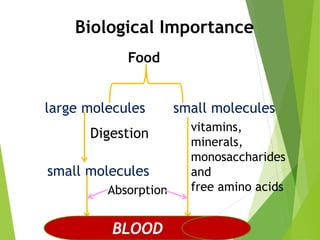
Biological Importance 
Food 
large molecules small molecules 
Digestion 
small molecules 
Absorption 
vitamins, 
minerals, 
monosaccharides 
and 
free amino acids 
BLOOD
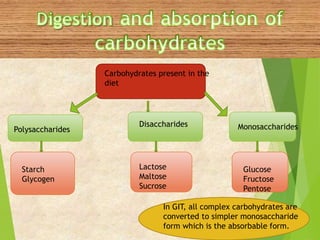
Carbohydrates present in the 
diet 
Polysaccharides 
Disaccharides Monosaccharides 
Starch 
Glycogen 
Lactose 
Maltose 
Sucrose 
Glucose 
Fructose 
Pentose 
In GIT, all complex carbohydrates are 
converted to simpler monosaccharide 
form which is the absorbable form.
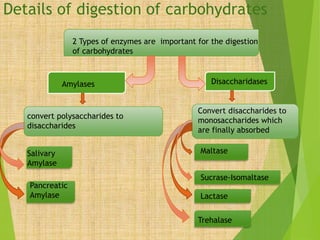
Details of digestion of carbohydrates 
2 Types of enzymes are important for the digestion 

of carbohydrates 
Amylases Disaccharidases 
convert polysaccharides to 
disaccharides 
Salivary 
Amylase 
Pancreatic 
Amylase 
Convert disaccharides to 
monosaccharides which 
are finally absorbed 
Maltase 
Sucrase-Isomaltase 
Lactase 
Trehalase
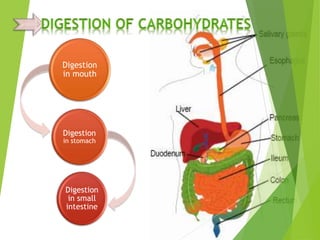
Digestion 
in mouth 
Digestion 
in stomach 
Digestion 
in small 
intestine
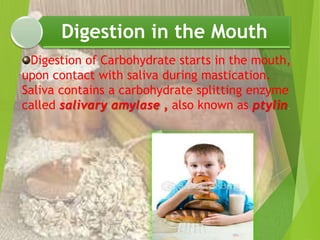
Digestion in the Mouth 
Digestion of Carbohydrate starts in the mouth, 
upon contact with saliva during mastication. 
Saliva contains a carbohydrate splitting enzyme 
called salivary amylase , also known as ptylin.
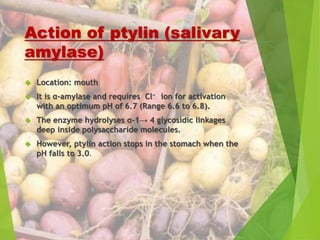
Action of ptylin (salivary 
amylase) 
 Location: mouth 
 It is α-amylase and requires Cl− ion for activation 
with an optimum pH of 6.7 (Range 6.6 to 6.8). 
 The enzyme hydrolyses α-1→ 4 glycosidic linkages 
deep inside polysaccharide molecules. 
 However, ptylin action stops in the stomach when the 
pH falls to 3.0.
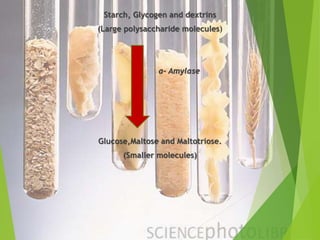
Starch, Glycogen and dextrins 
(Large polysaccharide molecules) 
α- Amylase 
Glucose,Maltose and Maltotriose. 
(Smaller molecules)
Drawback 
 Shorter duration of food in mouth. 
 Thus it is incomplete digestion of starch or glycogen 
in the mouth
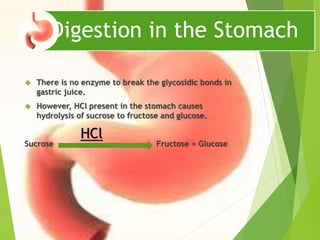
Digestion in the Stomach 
 There is no enzyme to break the glycosidic bonds in 
gastric juice. 
 However, HCl present in the stomach causes 
hydrolysis of sucrose to fructose and glucose. 
HCl 
Sucrose Fructose + Glucose
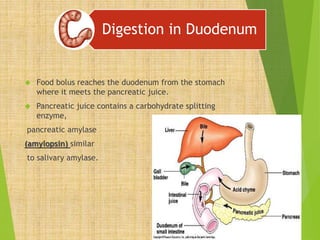
Digestion in Duodenum 
 Food bolus reaches the duodenum from the stomach 
where it meets the pancreatic juice. 
 Pancreatic juice contains a carbohydrate splitting 
enzyme, 
pancreatic amylase 
(amylopsin) similar 
to salivary amylase.
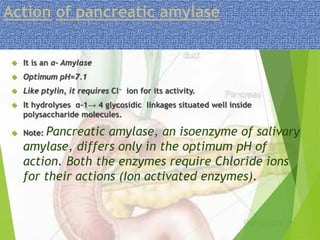
Action of pancreatic amylase 
 It is an α- Amylase 
 Optimum pH=7.1 
 Like ptylin, it requires Cl− ion for its activity. 
 It hydrolyses α-1→ 4 glycosidic linkages situated well inside 
polysaccharide molecules. 
 Note: Pancreatic amylase, an isoenzyme of salivary 
amylase, differs only in the optimum pH of 
action. Both the enzymes require Chloride ions 
for their actions (Ion activated enzymes).
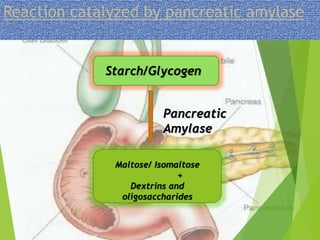
Reaction catalyzed by pancreatic amylase 
Starch/Glycogen 
Pancreatic 
Amylase 
Maltose/ Isomaltose 
+ 
Dextrins and 
oligosaccharides
Digestion in Small Intestine 
Note: 
 Main digestion takes place in the small 
intestine by pancreatic amylase 
 Digestion is completed by pancreatic 
amylase because food stays for a longer 
time in the intestine.
What are Disaccharidases? 
 They are present in the brush border epithelium of 
intestinal mucosal cells where the resultant 
monosaccharides and others arising from the diet are 
absorbed. 
 The different disaccharidases are : 
1) Maltase, 
2) Sucrase-Isomaltase (a bifunctional enzyme catalyzing 
hydrolysis of sucrose and isomaltose) 
3) Lactase
Reactions catalyzed by Disaccharidases 
Maltase 
 Maltose Glucose + Glucose 
Sucrase Isomaltase 
 Sucrose Isomaltose 3Glucose + fructose 
Lactase 
 Lactose Glucose + Galactose
Clinical significance of Digestion 
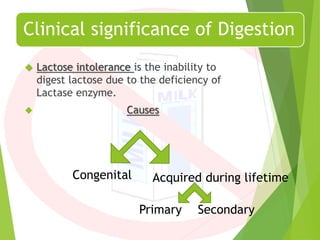
 Lactose intolerance is the inability to 
digest lactose due to the deficiency of 
Lactase enzyme. 
 Causes 
Congenital Acquired during lifetime 
Primary Secondary
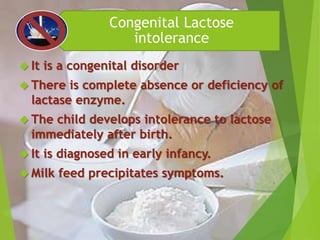
Congenital Lactose 
intolerance 
 It is a congenital disorder 
 There is complete absence or deficiency of 
lactase enzyme. 
 The child develops intolerance to lactose 
immediately after birth. 
 It is diagnosed in early infancy. 
 Milk feed precipitates symptoms.
Primary Lactase deficiency 
 Primary lactase deficiency develops over time 
 There is no congenital absence of lactase but the 
deficiency is precipitated during adulthood. 
 The gene for lactose is normally expressed upto RNA 
level but it is not translated to form enzyme. 
 It is very common in Asian population. 
 There is intolerance to milk + dairy products.
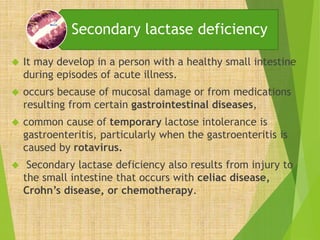
Secondary lactase deficiency 
 It may develop in a person with a healthy small intestine 
during episodes of acute illness. 
 occurs because of mucosal damage or from medications 
resulting from certain gastrointestinal diseases, 
 common cause of temporary lactose intolerance is 
gastroenteritis, particularly when the gastroenteritis is 
caused by rotavirus. 
 Secondary lactase deficiency also results from injury to 
the small intestine that occurs with celiac disease, 
Crohn’s disease, or chemotherapy.
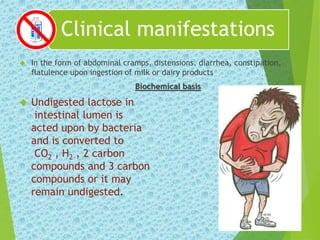
Clinical manifestations 
 In the form of abdominal cramps, distensions, diarrhea, constipation, 
flatulence upon ingestion of milk or dairy products 
Biochemical basis 
 Undigested lactose in 
intestinal lumen is 
acted upon by bacteria 
and is converted to 
CO2 , H2 , 2 carbon 
compounds and 3 carbon 
compounds or it may 
remain undigested.
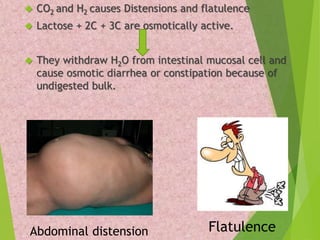
 CO2 and H2 causes Distensions and flatulence 
 Lactose + 2C + 3C are osmotically active. 
 They withdraw H2O from intestinal mucosal cell and 
cause osmotic diarrhea or constipation because of 
undigested bulk. 
Abdominal distension Flatulence
Diagnosis 
 Two tests are commonly used: - 
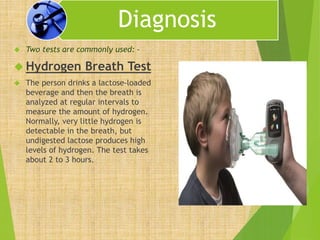
 Hydrogen Breath Test 
 The person drinks a lactose-loaded 
beverage and then the breath is 
analyzed at regular intervals to 
measure the amount of hydrogen. 
Normally, very little hydrogen is 
detectable in the breath, but 
undigested lactose produces high 
levels of hydrogen. The test takes 
about 2 to 3 hours.
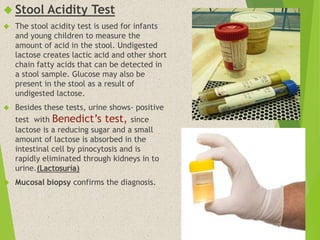
 Stool Acidity Test 
 The stool acidity test is used for infants 
and young children to measure the 
amount of acid in the stool. Undigested 
lactose creates lactic acid and other short 
chain fatty acids that can be detected in 
a stool sample. Glucose may also be 
present in the stool as a result of 
undigested lactose. 
 Besides these tests, urine shows- positive 
test with Benedict’s test, since 
lactose is a reducing sugar and a small 
amount of lactose is absorbed in the 
intestinal cell by pinocytosis and is 
rapidly eliminated through kidneys in to 
urine.(Lactosuria) 
 Mucosal biopsy confirms the diagnosis.
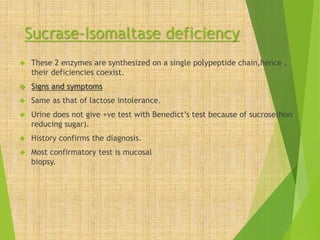
Sucrase-Isomaltase deficiency 
 These 2 enzymes are synthesized on a single polypeptide chain,hence , 
their deficiencies coexist. 
 Signs and symptoms 
 Same as that of lactose intolerance. 
 Urine does not give +ve test with Benedict’s test because of sucrose(Non 
reducing sugar). 
 History confirms the diagnosis. 
 Most confirmatory test is mucosal 
biopsy.
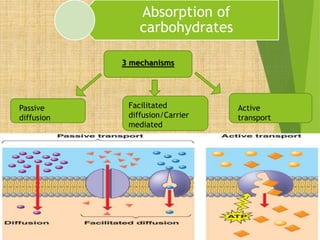
Absorption of 
carbohydrates 
3 mechanisms 
Passive 
diffusion 
Facilitated 
diffusion/Carrier 
mediated 
Active 
transport
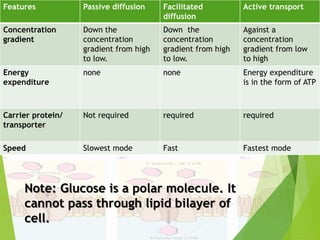
Features Passive diffusion Facilitated 
diffusion 
Active transport 
Concentration 
gradient 
Down the 
concentration 
gradient from high 
to low. 
Down the 
concentration 
gradient from high 
to low. 
Against a 
concentration 
gradient from low 
to high 
Energy 
expenditure 
none none Energy expenditure 
is in the form of ATP 
Carrier protein/ 
transporter 
Not required required required 
Speed Slowest mode Fast Fastest mode 
Note: Glucose is a polar molecule. It 
cannot pass through lipid bilayer of 
cell.
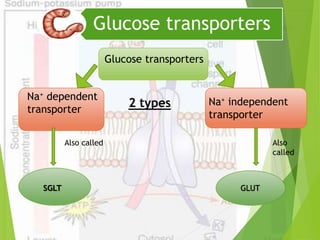
Glucose transporters 
Na+ dependent 
transporter 
Na+ independent 
transporter 
2 types 
Also called Also 
SGLT GLUT 
called
Absorption of 
Monosaccharides 
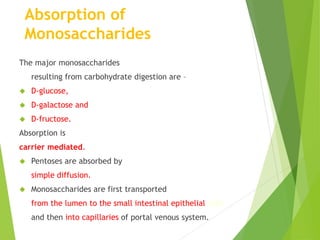
The major monosaccharides 
resulting from carbohydrate digestion are – 
 D-glucose, 
 D-galactose and 
 D-fructose. 
Absorption is 
carrier mediated. 
 Pentoses are absorbed by 
simple diffusion. 
 Monosaccharides are first transported 
from the lumen to the small intestinal epithelial cells 
and then into capillaries of portal venous system.
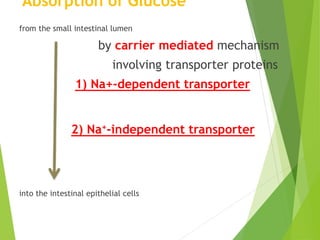
Absorption of Glucose 
from the small intestinal lumen 
by carrier mediated mechanism 
involving transporter proteins 
1) Na+-dependent transporter 
by secondary active transport 
and to a less extent by 
2) Na+-independent transporter 
by passive transport 
into the intestinal epithelial cells
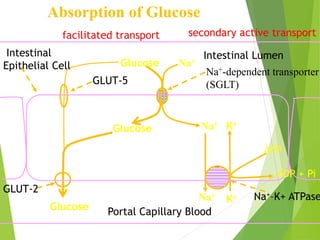
Absorption of Glucose 
facilitated transport secondary active transport 
Intestinal 
Epithelial Cell 
Glucose 
Glucose 
Glucose 
GLUT-5 
Intestinal Lumen 
Na+ 
Na+-dependent transporter 
(SGLT) 
Na+ K+ 
Na+ 
K+ 
GLUT-2 
Portal Capillary Blood 
ATP 
ADP + Pi 
Na+–K+ ATPase
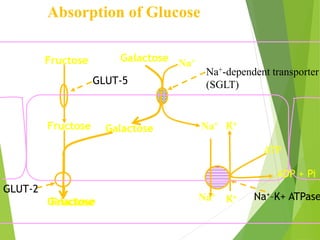
Absorption of Glucose 
Galactose 
GLUT-5 
Na+ 
Na+-dependent transporter 
(SGLT) 
Na+ K+ 
Na+ 
K+ 
GLUT-2 
ATP 
ADP + Pi 
Na+–K+ ATPase 
Galactose 
Fructose 
Fructose 
Galactose 
Fructose
Factors affecting rate of absorption of 
Monosaccharides 
 The absorption is faster through intact mucosa. 
The absorption is decreased if there is some 
inflammation or injury to the mucosa. 
 Thyroid hormones ↑ the rate of absorption of 
glucose. 
 Mineralocorticoid,i.e Aldosterone ↑ the rate of 
absorption.
 Vitamin B6,B12, pantothenic acid, folic acid are 
required for absorption of glucose. 
With advancing age, rate of absorption declines.
Clinical significance 
 In deficiency of SGLT- 1, glucose is 
left unabsorbed and is excreted in 
feces. Galactose is also 
malabsorbed. 
 In deficiency of SGLT- 2, the 
filtered glucose is not reabsorbed 
back, it is lost in urine, causing 
glycosuria.
THANK 
YOU

Digestion & absorption of carbohydrate

  • 1.
    CONTENTS DIGESTION OF CARBOHYDRATE ABSORPTION OF CARBOHYDRATE CLINICAL SIGNIFICANCE DR SAKINA MBBS,M.D
  • 2.
    Biological Importance Food large molecules small molecules Digestion small molecules Absorption vitamins, minerals, monosaccharides and free amino acids BLOOD
  • 3.
    Carbohydrates present inthe diet Polysaccharides Disaccharides Monosaccharides Starch Glycogen Lactose Maltose Sucrose Glucose Fructose Pentose In GIT, all complex carbohydrates are converted to simpler monosaccharide form which is the absorbable form.
  • 4.
    Details of digestionof carbohydrates 2 Types of enzymes are important for the digestion of carbohydrates Amylases Disaccharidases convert polysaccharides to disaccharides Salivary Amylase Pancreatic Amylase Convert disaccharides to monosaccharides which are finally absorbed Maltase Sucrase-Isomaltase Lactase Trehalase
  • 5.
    Digestion in mouth Digestion in stomach Digestion in small intestine
  • 6.
    Digestion in theMouth Digestion of Carbohydrate starts in the mouth, upon contact with saliva during mastication. Saliva contains a carbohydrate splitting enzyme called salivary amylase , also known as ptylin.
  • 7.
    Action of ptylin(salivary amylase)  Location: mouth  It is α-amylase and requires Cl− ion for activation with an optimum pH of 6.7 (Range 6.6 to 6.8).  The enzyme hydrolyses α-1→ 4 glycosidic linkages deep inside polysaccharide molecules.  However, ptylin action stops in the stomach when the pH falls to 3.0.
  • 8.
    Starch, Glycogen anddextrins (Large polysaccharide molecules) α- Amylase Glucose,Maltose and Maltotriose. (Smaller molecules)
  • 9.
    Drawback  Shorterduration of food in mouth.  Thus it is incomplete digestion of starch or glycogen in the mouth
  • 10.
    Digestion in theStomach  There is no enzyme to break the glycosidic bonds in gastric juice.  However, HCl present in the stomach causes hydrolysis of sucrose to fructose and glucose. HCl Sucrose Fructose + Glucose
  • 11.
    Digestion in Duodenum  Food bolus reaches the duodenum from the stomach where it meets the pancreatic juice.  Pancreatic juice contains a carbohydrate splitting enzyme, pancreatic amylase (amylopsin) similar to salivary amylase.
  • 12.
    Action of pancreaticamylase  It is an α- Amylase  Optimum pH=7.1  Like ptylin, it requires Cl− ion for its activity.  It hydrolyses α-1→ 4 glycosidic linkages situated well inside polysaccharide molecules.  Note: Pancreatic amylase, an isoenzyme of salivary amylase, differs only in the optimum pH of action. Both the enzymes require Chloride ions for their actions (Ion activated enzymes).
  • 13.
    Reaction catalyzed bypancreatic amylase Starch/Glycogen Pancreatic Amylase Maltose/ Isomaltose + Dextrins and oligosaccharides
  • 14.
    Digestion in SmallIntestine Note:  Main digestion takes place in the small intestine by pancreatic amylase  Digestion is completed by pancreatic amylase because food stays for a longer time in the intestine.
  • 15.
    What are Disaccharidases?  They are present in the brush border epithelium of intestinal mucosal cells where the resultant monosaccharides and others arising from the diet are absorbed.  The different disaccharidases are : 1) Maltase, 2) Sucrase-Isomaltase (a bifunctional enzyme catalyzing hydrolysis of sucrose and isomaltose) 3) Lactase
  • 16.
    Reactions catalyzed byDisaccharidases Maltase  Maltose Glucose + Glucose Sucrase Isomaltase  Sucrose Isomaltose 3Glucose + fructose Lactase  Lactose Glucose + Galactose
  • 17.
    Clinical significance ofDigestion  Lactose intolerance is the inability to digest lactose due to the deficiency of Lactase enzyme.  Causes Congenital Acquired during lifetime Primary Secondary
  • 18.
    Congenital Lactose intolerance  It is a congenital disorder  There is complete absence or deficiency of lactase enzyme.  The child develops intolerance to lactose immediately after birth.  It is diagnosed in early infancy.  Milk feed precipitates symptoms.
  • 19.
    Primary Lactase deficiency  Primary lactase deficiency develops over time  There is no congenital absence of lactase but the deficiency is precipitated during adulthood.  The gene for lactose is normally expressed upto RNA level but it is not translated to form enzyme.  It is very common in Asian population.  There is intolerance to milk + dairy products.
  • 20.
    Secondary lactase deficiency  It may develop in a person with a healthy small intestine during episodes of acute illness.  occurs because of mucosal damage or from medications resulting from certain gastrointestinal diseases,  common cause of temporary lactose intolerance is gastroenteritis, particularly when the gastroenteritis is caused by rotavirus.  Secondary lactase deficiency also results from injury to the small intestine that occurs with celiac disease, Crohn’s disease, or chemotherapy.
  • 21.
    Clinical manifestations In the form of abdominal cramps, distensions, diarrhea, constipation, flatulence upon ingestion of milk or dairy products Biochemical basis  Undigested lactose in intestinal lumen is acted upon by bacteria and is converted to CO2 , H2 , 2 carbon compounds and 3 carbon compounds or it may remain undigested.
  • 22.
     CO2 andH2 causes Distensions and flatulence  Lactose + 2C + 3C are osmotically active.  They withdraw H2O from intestinal mucosal cell and cause osmotic diarrhea or constipation because of undigested bulk. Abdominal distension Flatulence
  • 23.
    Diagnosis  Twotests are commonly used: -  Hydrogen Breath Test  The person drinks a lactose-loaded beverage and then the breath is analyzed at regular intervals to measure the amount of hydrogen. Normally, very little hydrogen is detectable in the breath, but undigested lactose produces high levels of hydrogen. The test takes about 2 to 3 hours.
  • 24.
     Stool AcidityTest  The stool acidity test is used for infants and young children to measure the amount of acid in the stool. Undigested lactose creates lactic acid and other short chain fatty acids that can be detected in a stool sample. Glucose may also be present in the stool as a result of undigested lactose.  Besides these tests, urine shows- positive test with Benedict’s test, since lactose is a reducing sugar and a small amount of lactose is absorbed in the intestinal cell by pinocytosis and is rapidly eliminated through kidneys in to urine.(Lactosuria)  Mucosal biopsy confirms the diagnosis.
  • 25.
    Sucrase-Isomaltase deficiency These 2 enzymes are synthesized on a single polypeptide chain,hence , their deficiencies coexist.  Signs and symptoms  Same as that of lactose intolerance.  Urine does not give +ve test with Benedict’s test because of sucrose(Non reducing sugar).  History confirms the diagnosis.  Most confirmatory test is mucosal biopsy.
  • 26.
    Absorption of carbohydrates 3 mechanisms Passive diffusion Facilitated diffusion/Carrier mediated Active transport
  • 27.
    Features Passive diffusionFacilitated diffusion Active transport Concentration gradient Down the concentration gradient from high to low. Down the concentration gradient from high to low. Against a concentration gradient from low to high Energy expenditure none none Energy expenditure is in the form of ATP Carrier protein/ transporter Not required required required Speed Slowest mode Fast Fastest mode Note: Glucose is a polar molecule. It cannot pass through lipid bilayer of cell.
  • 28.
    Glucose transporters Glucosetransporters Na+ dependent transporter Na+ independent transporter 2 types Also called Also SGLT GLUT called
  • 29.
    Absorption of Monosaccharides The major monosaccharides resulting from carbohydrate digestion are –  D-glucose,  D-galactose and  D-fructose. Absorption is carrier mediated.  Pentoses are absorbed by simple diffusion.  Monosaccharides are first transported from the lumen to the small intestinal epithelial cells and then into capillaries of portal venous system.
  • 30.
    Absorption of Glucose from the small intestinal lumen by carrier mediated mechanism involving transporter proteins 1) Na+-dependent transporter by secondary active transport and to a less extent by 2) Na+-independent transporter by passive transport into the intestinal epithelial cells
  • 31.
    Absorption of Glucose facilitated transport secondary active transport Intestinal Epithelial Cell Glucose Glucose Glucose GLUT-5 Intestinal Lumen Na+ Na+-dependent transporter (SGLT) Na+ K+ Na+ K+ GLUT-2 Portal Capillary Blood ATP ADP + Pi Na+–K+ ATPase
  • 32.
    Absorption of Glucose Galactose GLUT-5 Na+ Na+-dependent transporter (SGLT) Na+ K+ Na+ K+ GLUT-2 ATP ADP + Pi Na+–K+ ATPase Galactose Fructose Fructose Galactose Fructose
  • 33.
    Factors affecting rateof absorption of Monosaccharides  The absorption is faster through intact mucosa. The absorption is decreased if there is some inflammation or injury to the mucosa.  Thyroid hormones ↑ the rate of absorption of glucose.  Mineralocorticoid,i.e Aldosterone ↑ the rate of absorption.
  • 34.
     Vitamin B6,B12,pantothenic acid, folic acid are required for absorption of glucose. With advancing age, rate of absorption declines.
  • 35.
    Clinical significance In deficiency of SGLT- 1, glucose is left unabsorbed and is excreted in feces. Galactose is also malabsorbed.  In deficiency of SGLT- 2, the filtered glucose is not reabsorbed back, it is lost in urine, causing glycosuria.
  • 36.