The Chemicals of Living Cells © The Wellcome Trust
The chemicals of life All living organisms are made up of chemical substances Reactions between these substances keep the cytoplasm (and the organism) alive. They are  living processes . The chemical substances described in the next series of slides are  carbohydrates ,  proteins  and  lipids . 2
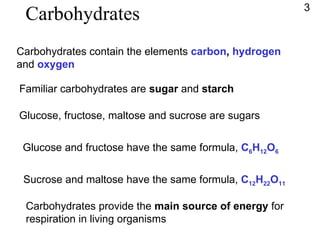
Carbohydrates Carbohydrates contain the elements  carbon ,   hydrogen  and  oxygen Familiar carbohydrates are  sugar  and  starch Glucose, fructose, maltose and sucrose are sugars Glucose and fructose have the same formula,  C 6 H 12 O 6 Sucrose and maltose have the same formula,  C 12 H 22 O 11 Carbohydrates provide the  main source of energy  for respiration in living organisms 3
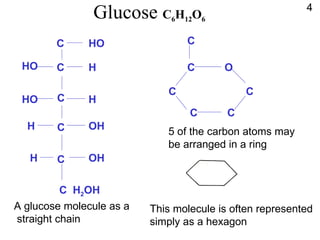
Glucose  C 6 H 12 O 6 C C C C C C HO HO H HO H H OH H OH H 2 OH A glucose molecule as a straight chain 5 of the carbon atoms may be arranged in a ring This molecule is often represented simply as a hexagon 4 C O C C C C C
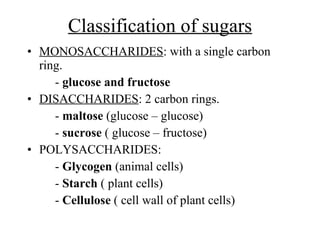
Classification of sugars MONOSACCHARIDES :  with a single carbon ring. -  glucose and fructose DISACCHARIDES : 2 carbon rings. -  maltose  (glucose – glucose) -  sucrose  ( glucose – fructose) POLYSACCHARIDES: -  Glycogen  (animal cells) -  Starch  ( plant cells) -  Cellulose  ( cell wall of plant cells)
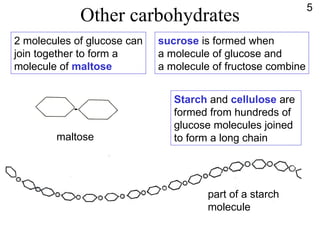
Other carbohydrates 2 molecules of glucose can join together to form a  molecule of  maltose maltose sucrose  is formed when a molecule of glucose and a molecule of fructose combine Starch  and  cellulose  are  formed from hundreds of glucose molecules joined to form a long chain part of a starch  molecule 5
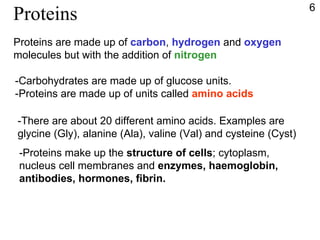
Proteins Proteins are made up of  carbon ,  hydrogen  and  oxygen molecules but with the addition of  nitrogen -Carbohydrates are made up of glucose units. -Proteins are made up of units called  amino acids -There are about 20 different amino acids. Examples are  glycine (Gly), alanine (Ala), valine (Val) and cysteine (Cyst) -Proteins make up the  structure of cells ; cytoplasm, nucleus cell membranes and  enzymes, haemoglobin, antibodies, hormones, fibrin. 6
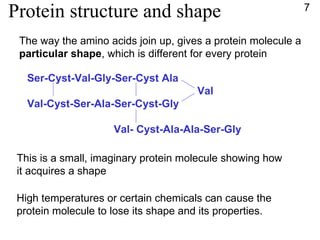
Protein structure and shape The way the amino acids join up, gives a protein molecule a  particular shape , which is different for every protein This is a small, imaginary protein molecule showing how it acquires a shape High temperatures or certain chemicals can cause the protein molecule to lose its shape and its properties. 7 Ser-Cyst-Val-Gly-Ser-Cyst Ala Val  Val-Cyst-Ser-Ala-Ser-Cyst-Gly Val- Cyst-Ala-Ala-Ser-Gly
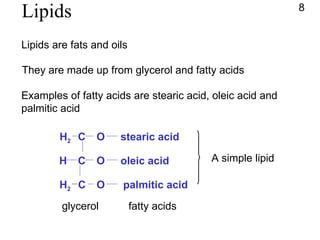
Lipids Lipids are fats and oils They are made up from glycerol and fatty acids Examples of fatty acids are stearic acid, oleic acid and  palmitic acid stearic acid oleic acid palmitic acid fatty acids 8 C C H H 2 H 2 C O O O glycerol A simple lipid
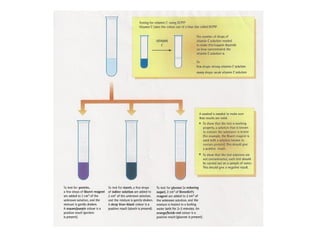
FOOD TESTS Scientists often need to know wether or not a particular type of molecule is present in a solution. For e.g, a doctor might try to detect glucose in a urine sample (if it is present suggests the patient has diabetes) Simple chemical tests can be carried out on biological solutions.
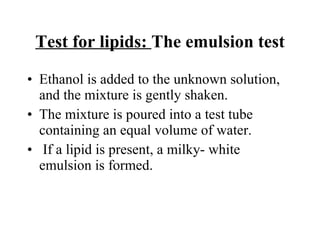
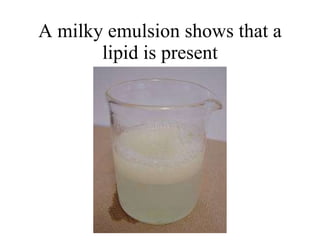
Test for lipids:  The emulsion test Ethanol is added to the unknown solution, and the mixture is gently shaken. The mixture is poured into a test tube containing an equal volume of water. If a lipid is present, a milky- white emulsion is formed.
A milky emulsion shows that a lipid is present
 
Salts and water In addition to proteins, carbohydrates and lipids, cytoplasm  contains salts and water Water makes up the bulk of cytoplasm All the chemical reactions in cytoplasm take place in  solution, i.e. in water Water itself takes part in many of these chemical reactions Salts of sodium, potassium and calcium and many others play an important part in these reactions 9
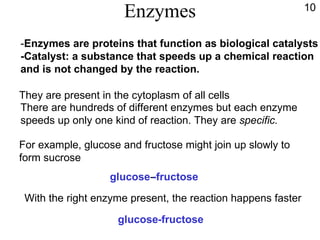
Enzymes - Enzymes   are proteins that function as biological catalysts -Catalyst: a substance that speeds up a chemical reaction and is not changed by the reaction. They are present in the cytoplasm of all cells There are hundreds of different enzymes but each enzyme speeds up only one kind of reaction. They are  specific. For example, glucose and fructose might join up slowly to form sucrose  glucose - -fructose With the right enzyme present, the reaction happens faster  glucose - -fructose 10
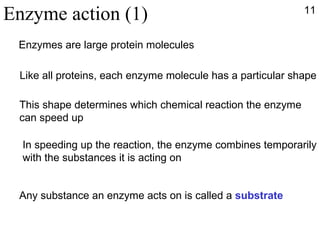
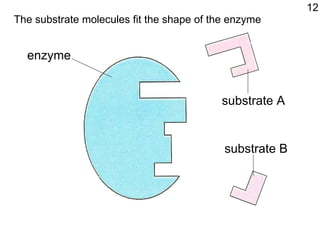
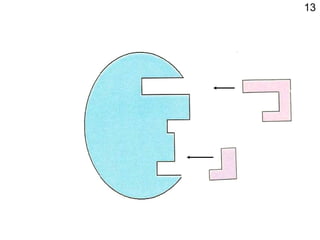
Enzyme action (1)  Enzymes are large protein molecules Like all proteins, each enzyme molecule has a particular shape This shape determines which chemical reaction the enzyme can speed up In speeding up the reaction, the enzyme combines temporarily with the substances it is acting on Any substance an enzyme acts on is called a  substrate 11
enzyme The substrate molecules fit the shape of the enzyme 12 substrate A substrate B
13
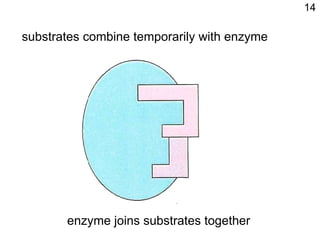
substrates combine temporarily with enzyme enzyme joins substrates together 14
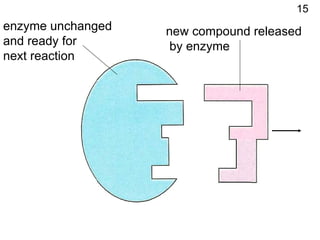
new compound released by enzyme enzyme unchanged and ready for next reaction 15
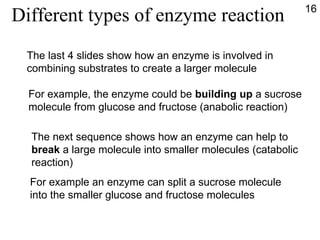
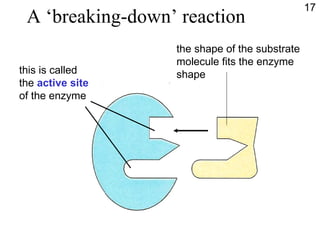
Different types of enzyme reaction The last 4 slides show how an enzyme is involved in  combining substrates to create a larger molecule For example, the enzyme could be  building up  a sucrose molecule from glucose and fructose (anabolic reaction) The next sequence shows how an enzyme can help to  break  a large molecule into smaller molecules (catabolic reaction) For example an enzyme can split a sucrose molecule into the smaller glucose and fructose molecules 16
A ‘breaking-down’ reaction this is called the  active site of the enzyme 17 the shape of the substrate molecule fits the enzyme shape
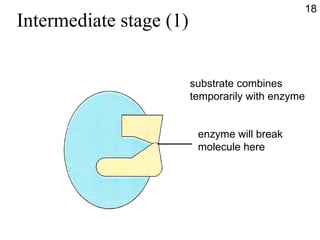
Intermediate stage (1) substrate combines temporarily with enzyme enzyme will break molecule here 18
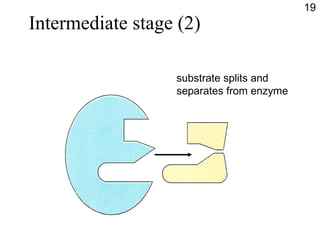
Intermediate stage (2) substrate splits and separates from enzyme 19
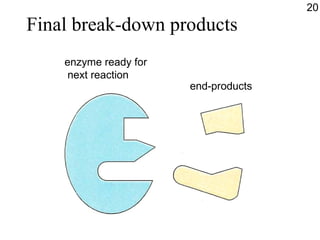
Final break-down products end-products enzyme ready for next reaction 20
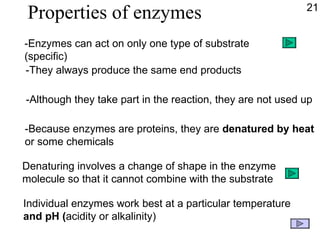
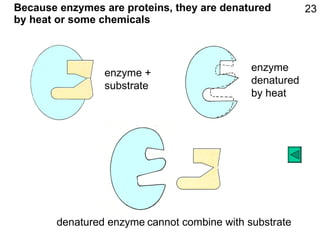
Properties of enzymes -They always produce the same end products -Although they take part in the reaction, they are not used up -Because enzymes are proteins, they are  denatured   by heat or some chemicals Individual enzymes work best at a particular temperature and pH ( acidity or alkalinity) 21 -Enzymes can act on only one type of substrate (specific) Denaturing involves a change of shape in the enzyme molecule so that it cannot combine with the substrate
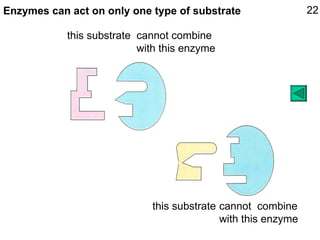
Enzymes can act on only one type of substrate cannot combine  with this enzyme cannot  combine with this enzyme 22 this substrate  this substrate
Because enzymes are proteins, they are denatured by heat or some chemicals enzyme + substrate 23 enzyme denatured by heat denatured enzyme cannot combine with substrate
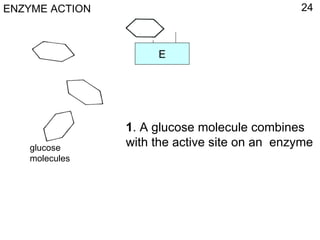
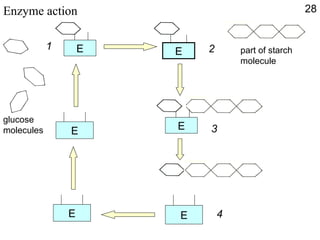
1 . A glucose molecule combines with the active site on an  enzyme ENZYME ACTION 24 1 glucose molecules E
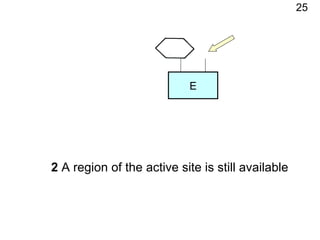
2  A region of the active site is still available 25 E
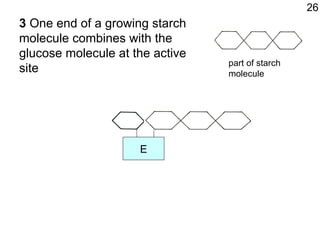
3  One end of a growing starch molecule combines with the glucose molecule at the active site 26 part of starch molecule E
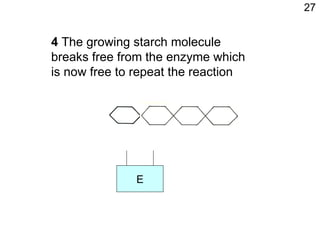
4  The growing starch molecule breaks free from the enzyme which is now free to repeat the reaction 27 E
Enzyme action  28 E E E 2 E 3 E 4 part of starch molecule 1 glucose molecules E 1
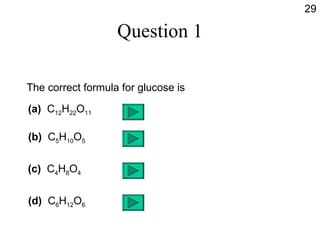
Question 1 The correct formula for glucose is (a)  C 12 H 22 O 11 (b)  C 5 H 10 O 5 (c)  C 4 H 8 O 4 (d)  C 6 H 12 O 6 29
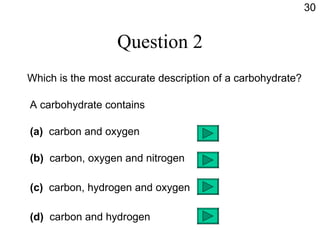
Question 2 Which is the most accurate description of a carbohydrate? A carbohydrate contains (a)   carbon and oxygen (b)   carbon, oxygen and nitrogen (c)   carbon, hydrogen and oxygen (d)   carbon and hydrogen 30
Question 3 When two molecules of glucose combine, they form (a)   maltose (b)   sucrose (c)   fructose (d)   ribose 31
Question 4 Which is the most accurate description of a protein Proteins contain (a)  carbon, hydrogen and oxygen (b)  carbon, hydrogen, oxygen and nitrogen (c)  carbon, hydrogen and nitrogen (d)  carbon, nitrogen and oxygen 32
Question 5 Which statements are correct? Proteins are present in (a)   cell membranes (b)   cell walls (c)   cytoplasm (d)   nucleus 33
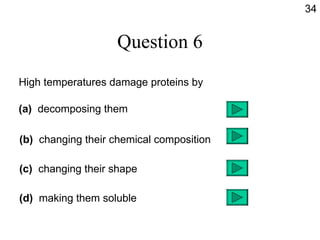
Question 6 High temperatures damage proteins by (a)   decomposing them (b)   changing their chemical composition (c)   changing their shape (d)   making them soluble 34
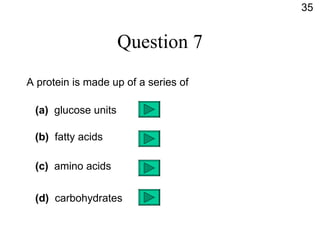
Question 7 A protein is made up of a series of (a)   glucose units (b)   fatty acids (c)   amino acids (d)   carbohydrates 35
Question 8 Lipids are made up of (a)   glycerol and amino acids (b)   glycerol and fatty acids (c)   protein and fatty acids (d)  starch and fatty acids 36
Question 9 Enzymes are (a)   proteins (b)  lipids (c)   carbohydrates (d)   a combination of these 37
Question 10 An enzyme can (a)  change a reaction (b)  prevent a reaction (c)  slow down a reaction (d)  speed up a reaction 38
Question 11 A substrate is a substance which (a)  an enzyme acts on (b)   is produced by an enzyme reaction (c)  is a particular kind of enzyme (d)   is any chemical substance in a cell  39
Question 12 An enzyme can (a)  combine with different substrates (b)   form different kinds of end-product (c)  function at temperatures above 90 o C (d)  speed up a reaction in the cytoplasm 40
Question 13 The part of an enzyme which combines with the substrate is called (a)   the reaction centre (b)  the active site (c)  the action centre (d)  the reaction site 41
Question 14 After being exposed to a high temperature an enzyme  cannot function because (a)   it has been broken down (b)   its shape has been changed (c)  its composition has been changed (d)  it cannot separate from its substrate 42

Powerpoint chemicals of-life

  • 1.
    The Chemicals ofLiving Cells © The Wellcome Trust
  • 2.
    The chemicals oflife All living organisms are made up of chemical substances Reactions between these substances keep the cytoplasm (and the organism) alive. They are living processes . The chemical substances described in the next series of slides are carbohydrates , proteins and lipids . 2
  • 3.
    Carbohydrates Carbohydrates containthe elements carbon , hydrogen and oxygen Familiar carbohydrates are sugar and starch Glucose, fructose, maltose and sucrose are sugars Glucose and fructose have the same formula, C 6 H 12 O 6 Sucrose and maltose have the same formula, C 12 H 22 O 11 Carbohydrates provide the main source of energy for respiration in living organisms 3
  • 4.
    Glucose C6 H 12 O 6 C C C C C C HO HO H HO H H OH H OH H 2 OH A glucose molecule as a straight chain 5 of the carbon atoms may be arranged in a ring This molecule is often represented simply as a hexagon 4 C O C C C C C
  • 5.
    Classification of sugarsMONOSACCHARIDES : with a single carbon ring. - glucose and fructose DISACCHARIDES : 2 carbon rings. - maltose (glucose – glucose) - sucrose ( glucose – fructose) POLYSACCHARIDES: - Glycogen (animal cells) - Starch ( plant cells) - Cellulose ( cell wall of plant cells)
  • 6.
    Other carbohydrates 2molecules of glucose can join together to form a molecule of maltose maltose sucrose is formed when a molecule of glucose and a molecule of fructose combine Starch and cellulose are formed from hundreds of glucose molecules joined to form a long chain part of a starch molecule 5
  • 7.
    Proteins Proteins aremade up of carbon , hydrogen and oxygen molecules but with the addition of nitrogen -Carbohydrates are made up of glucose units. -Proteins are made up of units called amino acids -There are about 20 different amino acids. Examples are glycine (Gly), alanine (Ala), valine (Val) and cysteine (Cyst) -Proteins make up the structure of cells ; cytoplasm, nucleus cell membranes and enzymes, haemoglobin, antibodies, hormones, fibrin. 6
  • 8.
    Protein structure andshape The way the amino acids join up, gives a protein molecule a particular shape , which is different for every protein This is a small, imaginary protein molecule showing how it acquires a shape High temperatures or certain chemicals can cause the protein molecule to lose its shape and its properties. 7 Ser-Cyst-Val-Gly-Ser-Cyst Ala Val Val-Cyst-Ser-Ala-Ser-Cyst-Gly Val- Cyst-Ala-Ala-Ser-Gly
  • 9.
    Lipids Lipids arefats and oils They are made up from glycerol and fatty acids Examples of fatty acids are stearic acid, oleic acid and palmitic acid stearic acid oleic acid palmitic acid fatty acids 8 C C H H 2 H 2 C O O O glycerol A simple lipid
  • 10.
    FOOD TESTS Scientistsoften need to know wether or not a particular type of molecule is present in a solution. For e.g, a doctor might try to detect glucose in a urine sample (if it is present suggests the patient has diabetes) Simple chemical tests can be carried out on biological solutions.
  • 11.
    Test for lipids: The emulsion test Ethanol is added to the unknown solution, and the mixture is gently shaken. The mixture is poured into a test tube containing an equal volume of water. If a lipid is present, a milky- white emulsion is formed.
  • 12.
    A milky emulsionshows that a lipid is present
  • 13.
  • 14.
    Salts and waterIn addition to proteins, carbohydrates and lipids, cytoplasm contains salts and water Water makes up the bulk of cytoplasm All the chemical reactions in cytoplasm take place in solution, i.e. in water Water itself takes part in many of these chemical reactions Salts of sodium, potassium and calcium and many others play an important part in these reactions 9
  • 15.
    Enzymes - Enzymes are proteins that function as biological catalysts -Catalyst: a substance that speeds up a chemical reaction and is not changed by the reaction. They are present in the cytoplasm of all cells There are hundreds of different enzymes but each enzyme speeds up only one kind of reaction. They are specific. For example, glucose and fructose might join up slowly to form sucrose glucose - -fructose With the right enzyme present, the reaction happens faster glucose - -fructose 10
  • 16.
    Enzyme action (1) Enzymes are large protein molecules Like all proteins, each enzyme molecule has a particular shape This shape determines which chemical reaction the enzyme can speed up In speeding up the reaction, the enzyme combines temporarily with the substances it is acting on Any substance an enzyme acts on is called a substrate 11
  • 17.
    enzyme The substratemolecules fit the shape of the enzyme 12 substrate A substrate B
  • 18.
  • 19.
    substrates combine temporarilywith enzyme enzyme joins substrates together 14
  • 20.
    new compound releasedby enzyme enzyme unchanged and ready for next reaction 15
  • 21.
    Different types ofenzyme reaction The last 4 slides show how an enzyme is involved in combining substrates to create a larger molecule For example, the enzyme could be building up a sucrose molecule from glucose and fructose (anabolic reaction) The next sequence shows how an enzyme can help to break a large molecule into smaller molecules (catabolic reaction) For example an enzyme can split a sucrose molecule into the smaller glucose and fructose molecules 16
  • 22.
    A ‘breaking-down’ reactionthis is called the active site of the enzyme 17 the shape of the substrate molecule fits the enzyme shape
  • 23.
    Intermediate stage (1)substrate combines temporarily with enzyme enzyme will break molecule here 18
  • 24.
    Intermediate stage (2)substrate splits and separates from enzyme 19
  • 25.
    Final break-down productsend-products enzyme ready for next reaction 20
  • 26.
    Properties of enzymes-They always produce the same end products -Although they take part in the reaction, they are not used up -Because enzymes are proteins, they are denatured by heat or some chemicals Individual enzymes work best at a particular temperature and pH ( acidity or alkalinity) 21 -Enzymes can act on only one type of substrate (specific) Denaturing involves a change of shape in the enzyme molecule so that it cannot combine with the substrate
  • 27.
    Enzymes can acton only one type of substrate cannot combine with this enzyme cannot combine with this enzyme 22 this substrate this substrate
  • 28.
    Because enzymes areproteins, they are denatured by heat or some chemicals enzyme + substrate 23 enzyme denatured by heat denatured enzyme cannot combine with substrate
  • 29.
    1 . Aglucose molecule combines with the active site on an enzyme ENZYME ACTION 24 1 glucose molecules E
  • 30.
    2 Aregion of the active site is still available 25 E
  • 31.
    3 Oneend of a growing starch molecule combines with the glucose molecule at the active site 26 part of starch molecule E
  • 32.
    4 Thegrowing starch molecule breaks free from the enzyme which is now free to repeat the reaction 27 E
  • 33.
    Enzyme action 28 E E E 2 E 3 E 4 part of starch molecule 1 glucose molecules E 1
  • 34.
    Question 1 Thecorrect formula for glucose is (a) C 12 H 22 O 11 (b) C 5 H 10 O 5 (c) C 4 H 8 O 4 (d) C 6 H 12 O 6 29
  • 35.
    Question 2 Whichis the most accurate description of a carbohydrate? A carbohydrate contains (a) carbon and oxygen (b) carbon, oxygen and nitrogen (c) carbon, hydrogen and oxygen (d) carbon and hydrogen 30
  • 36.
    Question 3 Whentwo molecules of glucose combine, they form (a) maltose (b) sucrose (c) fructose (d) ribose 31
  • 37.
    Question 4 Whichis the most accurate description of a protein Proteins contain (a) carbon, hydrogen and oxygen (b) carbon, hydrogen, oxygen and nitrogen (c) carbon, hydrogen and nitrogen (d) carbon, nitrogen and oxygen 32
  • 38.
    Question 5 Whichstatements are correct? Proteins are present in (a) cell membranes (b) cell walls (c) cytoplasm (d) nucleus 33
  • 39.
    Question 6 Hightemperatures damage proteins by (a) decomposing them (b) changing their chemical composition (c) changing their shape (d) making them soluble 34
  • 40.
    Question 7 Aprotein is made up of a series of (a) glucose units (b) fatty acids (c) amino acids (d) carbohydrates 35
  • 41.
    Question 8 Lipidsare made up of (a) glycerol and amino acids (b) glycerol and fatty acids (c) protein and fatty acids (d) starch and fatty acids 36
  • 42.
    Question 9 Enzymesare (a) proteins (b) lipids (c) carbohydrates (d) a combination of these 37
  • 43.
    Question 10 Anenzyme can (a) change a reaction (b) prevent a reaction (c) slow down a reaction (d) speed up a reaction 38
  • 44.
    Question 11 Asubstrate is a substance which (a) an enzyme acts on (b) is produced by an enzyme reaction (c) is a particular kind of enzyme (d) is any chemical substance in a cell 39
  • 45.
    Question 12 Anenzyme can (a) combine with different substrates (b) form different kinds of end-product (c) function at temperatures above 90 o C (d) speed up a reaction in the cytoplasm 40
  • 46.
    Question 13 Thepart of an enzyme which combines with the substrate is called (a) the reaction centre (b) the active site (c) the action centre (d) the reaction site 41
  • 47.
    Question 14 Afterbeing exposed to a high temperature an enzyme cannot function because (a) it has been broken down (b) its shape has been changed (c) its composition has been changed (d) it cannot separate from its substrate 42

Editor's Notes

  • #2 The scientist in the bottom left corner is Sir John Sulston, who spearheaded the UK contribution to the human genome project. He was awarded the Nobel Prize for Chemistry and Physiology in 2002.
  • #4 Glucose and fructose occur in fruits, e.g. grapes. Sucrose is the familiar table sugar and comes from sugar beet or sugar cane. Maltose is produced by germinating barley and is the sugar used in brewing beer. Note that the names of most sugars end in ‘-ose’.
  • #7 Glucose and fructose have the same formula but differ in the way the hydrogen and oxygen atoms are distributed. Maltose and sucrose, with the same formulae, differ in a similar way. Starch is represented by a single long chain of up to 1000 glucose units but, in fact, the main component of starch is a branched chain
  • #8 Most proteins are very large molecules, made up of hundreds of amino acids. Enzymes are proteins which carry out specific reactions in cells. They are more fully explained in slides 10-28
  • #9 A protein which loses its shape is said to be denatured . This change cannot be reversed. Egg white is a protein (albumen). When it is heated it is denatured and changes from a clear, runny liquid to a white solid. This cannot be reversed. If an enzyme is denatured it can no longer carry out its normal function.
  • #10 The fatty acids in a lipid may be all the same. In olive oil, for example, the fatty acid is oleic acid. Alternatively they may be different as shown in the slide.
  • #15 In photosynthesis (see ‘How Plants Get Their Food’ ) water reacts with carbon dioxide to form glucose. 6CO 2 + 6H 2 O = C 6 H 12 O 6 + 6O 2
  • #16 Enzymes cannot alter the end-products of a reaction. They can only speed up the reaction which would take place without the enzyme but too slowly to support life.
  • #18 The blue oval represents, in an extremely simplified form, an enzyme molecule with a particular shape. The slots in its side represent the ‘active site’ into which the substrate will fit. The pink shapes represent substrate molecules.
  • #20 The reaction between the enzyme and substrate is sometimes described as the ‘ lock and key’ mechanism.
  • #22 Enzymes are named according to the substrate on which they act and the names all end in ‘-ase’. For example the enzyme sucrase acts on sucrose to produce fructose and glucose; maltase acts on maltose to produce glucose. The many enzymes which act on proteins are called, collectively, proteinases.
  • #23 The enzyme could be, for example, sucrase , and the substrate the sugar, sucrose. The enzyme will split the sucrose molecule into glucose and fructose
  • #26 An enzyme can carry out thousands of reactions like this per second without itself being used up. Enzymes belong to the class of chemicals called catalysts. Catalysts can speed up chemical reactions without being used up. A catalytic converter in a car’s exhaust system, speeds up the conversion of carbon monoxide, oxides of nitrogen and unburned fuel to relatively harmless compounds. The catalyst may be platinum, chromium or other metals. Enzymes work a great deal faster than man-made catalysts and at much lower temperatures.
  • #28 In experiments on living material, the control often consists of material which has been boiled. The boiling temperature denatures the enzymes and kills the cells. Most enzymes are denatured after exposure to temperatures over 50 o C. There are some organisms which can survive much higher temperatures (e.g. in hot springs). Their enzymes must be able to retain their structure at these temperatures.
  • #29 The heat has changed the shape of the enzyme and distorted its active site. It can no longer combine with the substrate
  • #34 Enzymes may carry out reactions like this thousands of times a second without being used up themselves