Acids and Alkalis
Lesson Objectives
By the end of the lesson, students sbat:
•Describe acids and alkalis
– Meaning of an acid and examples
– Meaning of an alkali and examples

•State the properties of acids and alkalis
•State the reaction of acid with metal to
produce hydrogen gas
•State the reaction of acid with carbonate to
produce carbon dioxide gas.
Lesson Objectives
• State the reaction of acid with alkali to
produce salt and water.
• State the uses of acids and alkalis in daily
life
• Describe indicators
– Litmus indicator and simple test for acids and
alkalis
– Universal indicator (idea of pH)
– pH meter and pH sensor
Lesson Objectives
• Show an understanding that indicators are
substances that change colour when an
acid or alkali is added to them.
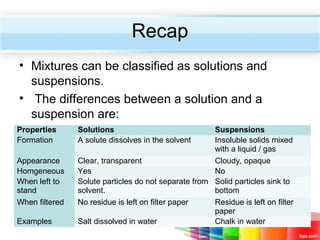
Recap
• Mixtures can be classified as solutions and
suspensions.
• The differences between a solution and a
suspension are:
Properties
Formation
Appearance
Homgeneous
When left to
stand
When filtered
Examples

Solutions
A solute dissolves in the solvent

Suspensions
Insoluble solids mixed
with a liquid / gas
Clear, transparent
Cloudy, opaque
Yes
No
Solute particles do not separate from Solid particles sink to
solvent.
bottom
No residue is left on filter paper
Residue is left on filter
paper
Salt dissolved in water
Chalk in water
Acids
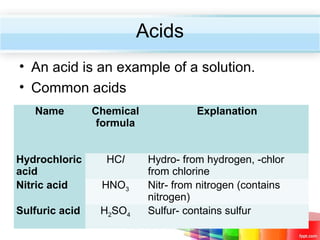
• An acid is an example of a solution.
• Common acids
Name

Chemical
formula

Hydrochloric
acid
Nitric acid

HCl
HNO3

Sulfuric acid

H2SO4

Explanation

Hydro- from hydrogen, -chlor
from chlorine
Nitr- from nitrogen (contains
nitrogen)
Sulfur- contains sulfur
Acids
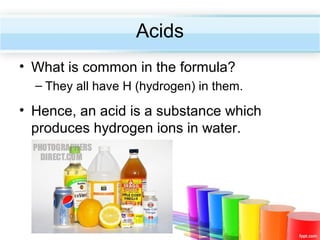
• What is common in the formula?
– They all have H (hydrogen) in them.

• Hence, an acid is a substance which
produces hydrogen ions in water.
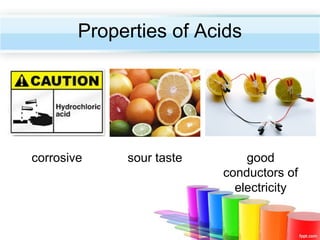
Properties of Acids

corrosive

sour taste

good
conductors of
electricity
Chemical Properties of Acids
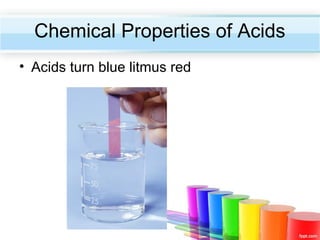
• Acids turn blue litmus red
Chemical Properties of Acids
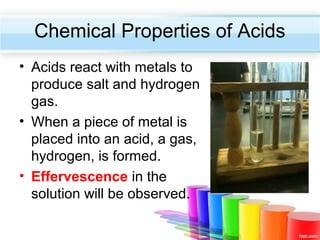
• Acids react with metals to
produce salt and hydrogen
gas.
• When a piece of metal is
placed into an acid, a gas,
hydrogen, is formed.
• Effervescence in the
solution will be observed.
EXAMPLES
• Hydrochloric acid + Magnesium ->
Magnesium chloride + Hydrogen Gas
• Hydrochloric acid + Calcium ->
Calcium chloride + Hydrogen Gas
• Hydrochloric acid + Barium ->
Barium chloride + Hydrogen Gas
EXAMPLES
• Sulfuric acid + Magnesium ->
Magnesium sulfate + Hydrogen Gas
• Nitric acid + Magnesium ->
Magnesium nitrate + Hydrogen Gas
• Hydrochloric acid + Magnesium ->
Magnesium chloride + Hydrogen Gas
Hydrogen is a colourless and odourless gas.
acid + metal → salt + hydrogen
• To confirm that gas produced is hydrogen,
Test: Place a lighted splint in the gas.
Observation: The splint will be extinguished with
a ‘pop’ sound.
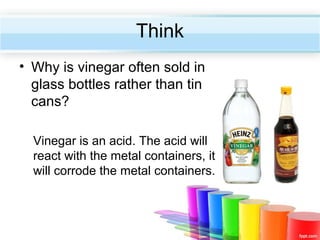
Think
• Why is vinegar often sold in
glass bottles rather than tin
cans?
Vinegar is an acid. The acid will
react with the metal containers, it
will corrode the metal containers.
Chemical Properties of Acids
• Acids react with carbonates to produce
salt, carbon dioxide and water.
acid + carbonate → salt + carbon + water
dioxide

• Observation:
– Effervescence is observed
EXAMPLES
• Hydrochloric acid + Potassium carbonate
-> Potassium chloride + Water + Carbon
dioxide gas
• Hydrochloric acid + magnesium carbonate
-> Magnesium chloride + Water + Carbon
dioxide gas
• Hydrochloric acid + Sodium carbonate
-> _________ + Water + Carbon dioxide
gas
EXAMPLES
• Sulfuric acid + sodium carbonate
-> sodium sulfate + water + carbon dioxide
gas
• Nitric acid + sodium carbonate
-> sodium nitrate + water + carbon dioxide
gas
• Magnesium carbonate + nitric acid
-> magnesium nitrate + water + carbon
dioxide gas
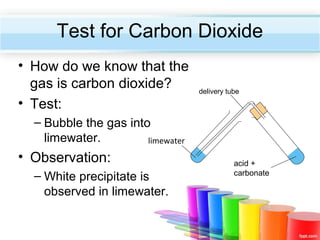
Test for Carbon Dioxide
• How do we know that the
gas is carbon dioxide?
• Test:

delivery tube

– Bubble the gas into
limewater.
limewater

• Observation:
– White precipitate is
observed in limewater.

acid +
carbonate
Think!
Indigestion pills often contain the
substances, sodium bicarbonate, calcium
carbonate and magnesium carbonate, to
react with the excess acid in the stomach.
Why is it that when these pills are consumed,
may result in frequent burping?
When the stomach acid reacts with the
carbonates, carbon dioxide is formed.
Alkalis
• Common alkalis:
– Sodium hydroxide
– Potassium hydroxide
– Calcium hydroxide

NaOH
KOH
Ca(OH)2

– Ammonium hydroxide

NH4OH

• What do you see in common?
– Hydroxide ions

An alkali is a substance that produces
hydroxide ions in water.
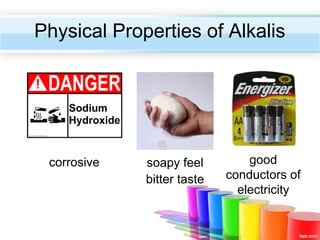
Physical Properties of Alkalis

corrosive

soapy feel
bitter taste

good
conductors of
electricity
Chemical Properties of Alkalis
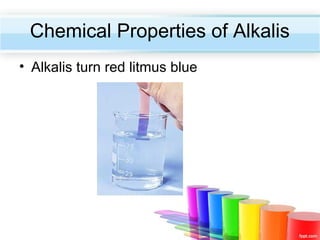
• Alkalis turn red litmus blue
Chemical Properties of Alkalis
• Alkalis react with acids to form salt and
water (neutralisation)
EXAMPLES
• Hydrochloric acid + sodium hydroxide
-> sodium chloride + water
• Hydrochloric acid + potassium hydroxide
-> potassium chloride + water
• Hydrochloric acid + calcium hydroxide
-> calcium chloride + water
• Hydrochloric acid + ammonium hydroxide
-> ammonium chloride + water
PRACTICE
• Aqueous ammonia (ammonium hydroxide)
+ nitric acid
-> ammonium nitrate + water
• Sulfuric acid + lithium carbonate
-> lithium sulfate + water + carbon dioxide
• Hydrochloric acid + zinc
-> zinc chloride + hydrogen gas
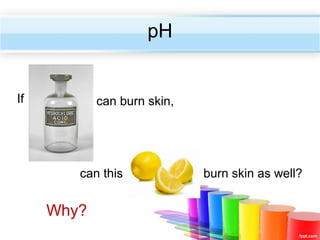
pH

If

can burn skin,

can this

Why?

burn skin as well?
pH
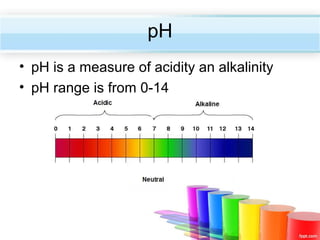
• pH is a measure of acidity an alkalinity
• pH range is from 0-14
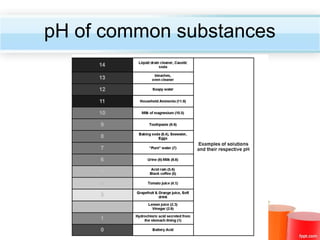
pH of common substances
pH
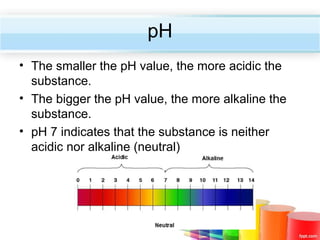
• The smaller the pH value, the more acidic the
substance.
• The bigger the pH value, the more alkaline the
substance.
• pH 7 indicates that the substance is neither
acidic nor alkaline (neutral)
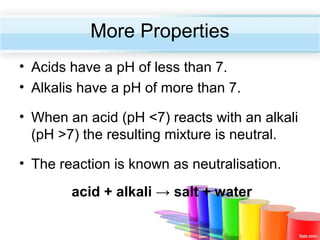
More Properties
• Acids have a pH of less than 7.
• Alkalis have a pH of more than 7.
• When an acid (pH <7) reacts with an alkali
(pH >7) the resulting mixture is neutral.
• The reaction is known as neutralisation.
acid + alkali → salt + water
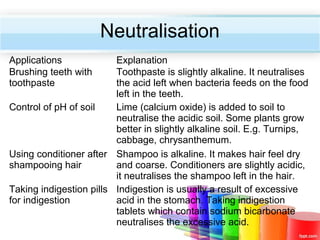
Neutralisation
Applications
Brushing teeth with
toothpaste

Explanation
Toothpaste is slightly alkaline. It neutralises
the acid left when bacteria feeds on the food
left in the teeth.
Control of pH of soil
Lime (calcium oxide) is added to soil to
neutralise the acidic soil. Some plants grow
better in slightly alkaline soil. E.g. Turnips,
cabbage, chrysanthemum.
Using conditioner after Shampoo is alkaline. It makes hair feel dry
shampooing hair
and coarse. Conditioners are slightly acidic,
it neutralises the shampoo left in the hair.
Taking indigestion pills Indigestion is usually a result of excessive
for indigestion
acid in the stomach. Taking indigestion
tablets which contain sodium bicarbonate
neutralises the excessive acid.
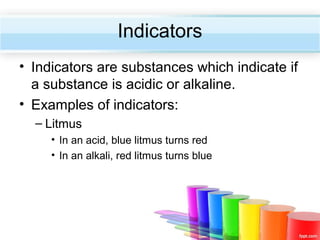
Indicators
• Indicators are substances which indicate if
a substance is acidic or alkaline.
• Examples of indicators:
– Litmus
• In an acid, blue litmus turns red
• In an alkali, red litmus turns blue
Indicators
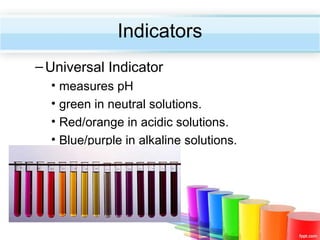
– Universal Indicator
• measures pH
• green in neutral solutions.
• Red/orange in acidic solutions.
• Blue/purple in alkaline solutions.

Lss acids and alkalis

  • 1.
  • 2.
    Lesson Objectives By theend of the lesson, students sbat: •Describe acids and alkalis – Meaning of an acid and examples – Meaning of an alkali and examples •State the properties of acids and alkalis •State the reaction of acid with metal to produce hydrogen gas •State the reaction of acid with carbonate to produce carbon dioxide gas.
  • 3.
    Lesson Objectives • Statethe reaction of acid with alkali to produce salt and water. • State the uses of acids and alkalis in daily life • Describe indicators – Litmus indicator and simple test for acids and alkalis – Universal indicator (idea of pH) – pH meter and pH sensor
  • 4.
    Lesson Objectives • Showan understanding that indicators are substances that change colour when an acid or alkali is added to them.
  • 5.
    Recap • Mixtures canbe classified as solutions and suspensions. • The differences between a solution and a suspension are: Properties Formation Appearance Homgeneous When left to stand When filtered Examples Solutions A solute dissolves in the solvent Suspensions Insoluble solids mixed with a liquid / gas Clear, transparent Cloudy, opaque Yes No Solute particles do not separate from Solid particles sink to solvent. bottom No residue is left on filter paper Residue is left on filter paper Salt dissolved in water Chalk in water
  • 6.
    Acids • An acidis an example of a solution. • Common acids Name Chemical formula Hydrochloric acid Nitric acid HCl HNO3 Sulfuric acid H2SO4 Explanation Hydro- from hydrogen, -chlor from chlorine Nitr- from nitrogen (contains nitrogen) Sulfur- contains sulfur
  • 7.
    Acids • What iscommon in the formula? – They all have H (hydrogen) in them. • Hence, an acid is a substance which produces hydrogen ions in water.
  • 8.
    Properties of Acids corrosive sourtaste good conductors of electricity
  • 9.
    Chemical Properties ofAcids • Acids turn blue litmus red
  • 10.
    Chemical Properties ofAcids • Acids react with metals to produce salt and hydrogen gas. • When a piece of metal is placed into an acid, a gas, hydrogen, is formed. • Effervescence in the solution will be observed.
  • 11.
    EXAMPLES • Hydrochloric acid+ Magnesium -> Magnesium chloride + Hydrogen Gas • Hydrochloric acid + Calcium -> Calcium chloride + Hydrogen Gas • Hydrochloric acid + Barium -> Barium chloride + Hydrogen Gas
  • 12.
    EXAMPLES • Sulfuric acid+ Magnesium -> Magnesium sulfate + Hydrogen Gas • Nitric acid + Magnesium -> Magnesium nitrate + Hydrogen Gas • Hydrochloric acid + Magnesium -> Magnesium chloride + Hydrogen Gas
  • 13.
    Hydrogen is acolourless and odourless gas. acid + metal → salt + hydrogen • To confirm that gas produced is hydrogen, Test: Place a lighted splint in the gas. Observation: The splint will be extinguished with a ‘pop’ sound.
  • 14.
    Think • Why isvinegar often sold in glass bottles rather than tin cans? Vinegar is an acid. The acid will react with the metal containers, it will corrode the metal containers.
  • 15.
    Chemical Properties ofAcids • Acids react with carbonates to produce salt, carbon dioxide and water. acid + carbonate → salt + carbon + water dioxide • Observation: – Effervescence is observed
  • 16.
    EXAMPLES • Hydrochloric acid+ Potassium carbonate -> Potassium chloride + Water + Carbon dioxide gas • Hydrochloric acid + magnesium carbonate -> Magnesium chloride + Water + Carbon dioxide gas • Hydrochloric acid + Sodium carbonate -> _________ + Water + Carbon dioxide gas
  • 17.
    EXAMPLES • Sulfuric acid+ sodium carbonate -> sodium sulfate + water + carbon dioxide gas • Nitric acid + sodium carbonate -> sodium nitrate + water + carbon dioxide gas • Magnesium carbonate + nitric acid -> magnesium nitrate + water + carbon dioxide gas
  • 18.
    Test for CarbonDioxide • How do we know that the gas is carbon dioxide? • Test: delivery tube – Bubble the gas into limewater. limewater • Observation: – White precipitate is observed in limewater. acid + carbonate
  • 19.
    Think! Indigestion pills oftencontain the substances, sodium bicarbonate, calcium carbonate and magnesium carbonate, to react with the excess acid in the stomach. Why is it that when these pills are consumed, may result in frequent burping? When the stomach acid reacts with the carbonates, carbon dioxide is formed.
  • 20.
    Alkalis • Common alkalis: –Sodium hydroxide – Potassium hydroxide – Calcium hydroxide NaOH KOH Ca(OH)2 – Ammonium hydroxide NH4OH • What do you see in common? – Hydroxide ions An alkali is a substance that produces hydroxide ions in water.
  • 21.
    Physical Properties ofAlkalis corrosive soapy feel bitter taste good conductors of electricity
  • 22.
    Chemical Properties ofAlkalis • Alkalis turn red litmus blue
  • 23.
    Chemical Properties ofAlkalis • Alkalis react with acids to form salt and water (neutralisation)
  • 24.
    EXAMPLES • Hydrochloric acid+ sodium hydroxide -> sodium chloride + water • Hydrochloric acid + potassium hydroxide -> potassium chloride + water • Hydrochloric acid + calcium hydroxide -> calcium chloride + water • Hydrochloric acid + ammonium hydroxide -> ammonium chloride + water
  • 25.
    PRACTICE • Aqueous ammonia(ammonium hydroxide) + nitric acid -> ammonium nitrate + water • Sulfuric acid + lithium carbonate -> lithium sulfate + water + carbon dioxide • Hydrochloric acid + zinc -> zinc chloride + hydrogen gas
  • 26.
    pH If can burn skin, canthis Why? burn skin as well?
  • 27.
    pH • pH isa measure of acidity an alkalinity • pH range is from 0-14
  • 28.
    pH of commonsubstances
  • 29.
    pH • The smallerthe pH value, the more acidic the substance. • The bigger the pH value, the more alkaline the substance. • pH 7 indicates that the substance is neither acidic nor alkaline (neutral)
  • 30.
    More Properties • Acidshave a pH of less than 7. • Alkalis have a pH of more than 7. • When an acid (pH <7) reacts with an alkali (pH >7) the resulting mixture is neutral. • The reaction is known as neutralisation. acid + alkali → salt + water
  • 31.
    Neutralisation Applications Brushing teeth with toothpaste Explanation Toothpasteis slightly alkaline. It neutralises the acid left when bacteria feeds on the food left in the teeth. Control of pH of soil Lime (calcium oxide) is added to soil to neutralise the acidic soil. Some plants grow better in slightly alkaline soil. E.g. Turnips, cabbage, chrysanthemum. Using conditioner after Shampoo is alkaline. It makes hair feel dry shampooing hair and coarse. Conditioners are slightly acidic, it neutralises the shampoo left in the hair. Taking indigestion pills Indigestion is usually a result of excessive for indigestion acid in the stomach. Taking indigestion tablets which contain sodium bicarbonate neutralises the excessive acid.
  • 32.
    Indicators • Indicators aresubstances which indicate if a substance is acidic or alkaline. • Examples of indicators: – Litmus • In an acid, blue litmus turns red • In an alkali, red litmus turns blue
  • 33.
    Indicators – Universal Indicator •measures pH • green in neutral solutions. • Red/orange in acidic solutions. • Blue/purple in alkaline solutions.