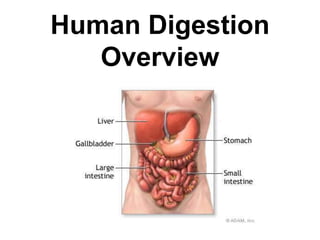
Human Digestion 
Overview
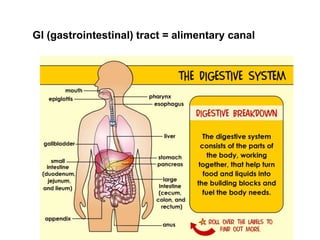
GI (gastrointestinal) tract = alimentary canal
Ingestion 
• Mouth 
– mechanical digestion 
• teeth 
– breaking up food 
– chemical digestion 
• saliva 
– Enzymes start breaking 
down molecules in food 
– Moistens and lubricates 
for easy swallowing
Pharynx 
• The back of the 
throat. 
• Larynx-passage 
for air, 
closes when we 
swallow.
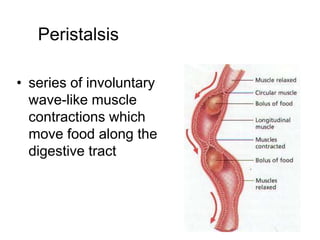
Peristalsis 
• series of involuntary 
wave-like muscle 
contractions which 
move food along the 
digestive tract
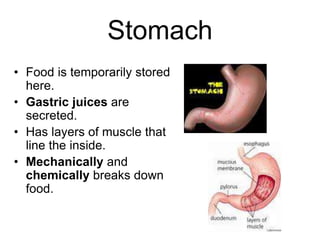
Stomach 
• Food is temporarily stored 
here. 
• Gastric juices are 
secreted. 
• Has layers of muscle that 
line the inside. 
• Mechanically and 
chemically breaks down 
food.
Gastric Juices 
• Secreted by the stomach. 
• Acidic (pH 1.5-2.5) (HCl). 
• Pepsin- an enzyme that 
breaks down large proteins 
into amino acids. 
• Food is further broken down 
into a thin liquid called chyme.
Accessory Organs 
• Liver 
• Gall Bladder 
• Pancreas
Liver 
• Function 
– produces bile 
• bile stored in gallbladder until needed 
• breaks up fats
BILE 
• Bile emulsifies lipids (physically 
breaks apart FATS) 
• Bile is a bitter, greenish-yellow 
alkaline fluid, stored in the 
gallbladder between meals and 
upon eating is discharged into 
the duodenum where it aids the 
process of digestion.
Gall bladder 
• Pouch structure located near the liver 
which concentrates and stores bile 
• Bile duct – a long tube that carries BILE. 
The top half of the common bile duct is 
associated with the liver, while the bottom 
half of the common bile duct is associated 
with the pancreas, through which it passes 
on its way to the intestine.
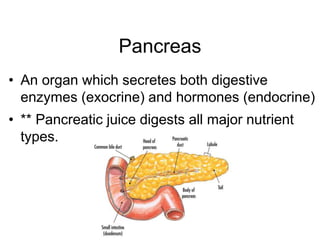
Pancreas 
• An organ which secretes both digestive 
enzymes (exocrine) and hormones (endocrine) 
• ** Pancreatic juice digests all major nutrient 
types.
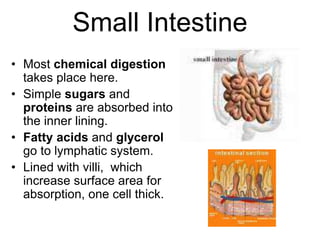
Small Intestine 
• Most chemical digestion 
takes place here. 
• Simple sugars and 
proteins are absorbed into 
the inner lining. 
• Fatty acids and glycerol 
go to lymphatic system. 
• Lined with villi, which 
increase surface area for 
absorption, one cell thick.
Small intestine 
• Function 
– chemical digestion 
• major organ of digestion & absorption 
– absorption through lining 
• over 6 meters! 
• small intestine has huge surface area = 300m2 
(~size of tennis court) 
• Structure 
– 3 sections 
• duodenum = most digestion 
• jejunum = absorption of nutrients & water 
• ileum = absorption of nutrients & water
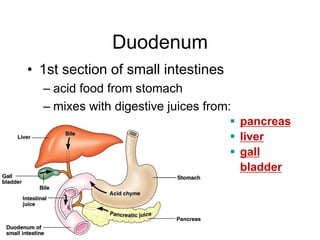
Duodenum 
• 1st section of small intestines 
– acid food from stomach 
– mixes with digestive juices from: 
 pancreas 
 liver 
 gall 
bladder
Absorption in the SI 
• Much absorption is thought to occur directly through the wall 
without the need for special adaptations 
• Almost 90% of our daily fluid intake is absorbed in the small 
intestine. 
• Villi and microvilli - increase the surface area of the small 
intestines, thus providing better absorption of materials
Large intestines 
(colon) 
• Function 
– re-absorb water 
• use ~9 liters of water every 
day in digestive juices 
• > 90% of water reabsorbed 
– not enough water absorbed 
» diarrhea 
– too much water absorbed 
» constipation
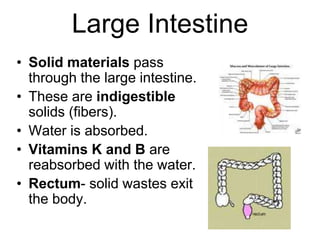
Large Intestine 
• Solid materials pass 
through the large intestine. 
• These are indigestible 
solids (fibers). 
• Water is absorbed. 
• Vitamins K and B are 
reabsorbed with the water. 
• Rectum- solid wastes exit 
the body.
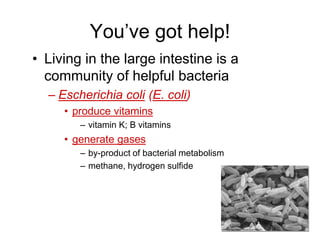
You’ve got help! 
• Living in the large intestine is a 
community of helpful bacteria 
– Escherichia coli (E. coli) 
• produce vitamins 
– vitamin K; B vitamins 
• generate gases 
– by-product of bacterial metabolism 
– methane, hydrogen sulfide
Digestive Disorders 
Most of the time, the digestive system 
works very effectively. However, there 
are some things that can happen to cause 
disruptions.
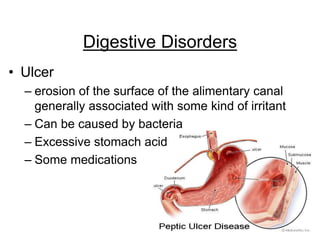
Digestive Disorders 
• Ulcer 
– erosion of the surface of the alimentary canal 
generally associated with some kind of irritant 
– Can be caused by bacteria 
– Excessive stomach acid 
– Some medications
Digestive Disorders 
• Heartburn 
– Acid from the stomach backs up 
into the esophagus. 
– If the sphincter muscles at the top 
of the stomach do not seal tightly 
enough, stomach acid can move 
up the esophagus and cause a 
burning sensation. 
– Can erode the esophagus if not 
treated
Digestive Disorders 
• Food Poisoning 
– Bacteria, viruses, parasites, or toxins in food 
cause digestive upset 
– Onset of symptoms can be from 4 hours to 28 
days. 
– Prevention is important, including cooking all 
foods thoroughly and maintaining cleanliness in 
all cooking and processing areas. 
– Symptoms: nausea, vomiting, diarrhea, fever, 
aches, cramps, and sometimes death.
Digestive Disorders 
• Constipation 
– a condition in which it 
becomes difficult to empty 
the large intestine. 
– too much water is 
reabsorbed 
– solid waste hardens
Digestive Disorders 
• Diarrhea 
– a when things move through the 
intestine quickly and not much 
water is absorbed. 
– This results in increased, 
multiple, watery feces. 
– This condition may result in 
severe dehydration, especially in 
infants
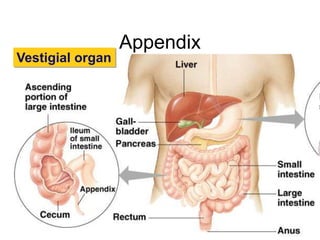
Appendix 
Vestigial organ
Digestive Disorders 
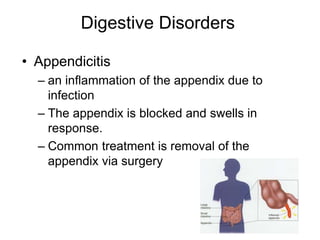
• Appendicitis 
– an inflammation of the appendix due to 
infection 
– The appendix is blocked and swells in 
response. 
– Common treatment is removal of the 
appendix via surgery
Digestive Disorders 
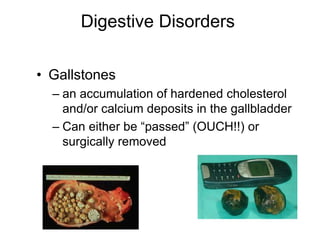
• Gallstones 
– an accumulation of hardened cholesterol 
and/or calcium deposits in the gallbladder 
– Can either be “passed” (OUCH!!) or 
surgically removed
Digestive Disorders 
-- Eating Disorders 
• Anorexia Nervosa 
– a psychological condition where an individual 
thinks they appear overweight and refuses to 
eat. 
• Bulimia 
– condition where individual forces themselves 
to vomit after eating as a weight-loss method 
– Damages teeth and esophagus

The digestivesystem and disorders

  • 1.
  • 2.
    GI (gastrointestinal) tract= alimentary canal
  • 3.
    Ingestion • Mouth – mechanical digestion • teeth – breaking up food – chemical digestion • saliva – Enzymes start breaking down molecules in food – Moistens and lubricates for easy swallowing
  • 4.
    Pharynx • Theback of the throat. • Larynx-passage for air, closes when we swallow.
  • 5.
    Peristalsis • seriesof involuntary wave-like muscle contractions which move food along the digestive tract
  • 6.
    Stomach • Foodis temporarily stored here. • Gastric juices are secreted. • Has layers of muscle that line the inside. • Mechanically and chemically breaks down food.
  • 7.
    Gastric Juices •Secreted by the stomach. • Acidic (pH 1.5-2.5) (HCl). • Pepsin- an enzyme that breaks down large proteins into amino acids. • Food is further broken down into a thin liquid called chyme.
  • 8.
    Accessory Organs •Liver • Gall Bladder • Pancreas
  • 9.
    Liver • Function – produces bile • bile stored in gallbladder until needed • breaks up fats
  • 10.
    BILE • Bileemulsifies lipids (physically breaks apart FATS) • Bile is a bitter, greenish-yellow alkaline fluid, stored in the gallbladder between meals and upon eating is discharged into the duodenum where it aids the process of digestion.
  • 11.
    Gall bladder •Pouch structure located near the liver which concentrates and stores bile • Bile duct – a long tube that carries BILE. The top half of the common bile duct is associated with the liver, while the bottom half of the common bile duct is associated with the pancreas, through which it passes on its way to the intestine.
  • 12.
    Pancreas • Anorgan which secretes both digestive enzymes (exocrine) and hormones (endocrine) • ** Pancreatic juice digests all major nutrient types.
  • 13.
    Small Intestine •Most chemical digestion takes place here. • Simple sugars and proteins are absorbed into the inner lining. • Fatty acids and glycerol go to lymphatic system. • Lined with villi, which increase surface area for absorption, one cell thick.
  • 14.
    Small intestine •Function – chemical digestion • major organ of digestion & absorption – absorption through lining • over 6 meters! • small intestine has huge surface area = 300m2 (~size of tennis court) • Structure – 3 sections • duodenum = most digestion • jejunum = absorption of nutrients & water • ileum = absorption of nutrients & water
  • 15.
    Duodenum • 1stsection of small intestines – acid food from stomach – mixes with digestive juices from:  pancreas  liver  gall bladder
  • 16.
    Absorption in theSI • Much absorption is thought to occur directly through the wall without the need for special adaptations • Almost 90% of our daily fluid intake is absorbed in the small intestine. • Villi and microvilli - increase the surface area of the small intestines, thus providing better absorption of materials
  • 17.
    Large intestines (colon) • Function – re-absorb water • use ~9 liters of water every day in digestive juices • > 90% of water reabsorbed – not enough water absorbed » diarrhea – too much water absorbed » constipation
  • 18.
    Large Intestine •Solid materials pass through the large intestine. • These are indigestible solids (fibers). • Water is absorbed. • Vitamins K and B are reabsorbed with the water. • Rectum- solid wastes exit the body.
  • 19.
    You’ve got help! • Living in the large intestine is a community of helpful bacteria – Escherichia coli (E. coli) • produce vitamins – vitamin K; B vitamins • generate gases – by-product of bacterial metabolism – methane, hydrogen sulfide
  • 20.
    Digestive Disorders Mostof the time, the digestive system works very effectively. However, there are some things that can happen to cause disruptions.
  • 21.
    Digestive Disorders •Ulcer – erosion of the surface of the alimentary canal generally associated with some kind of irritant – Can be caused by bacteria – Excessive stomach acid – Some medications
  • 22.
    Digestive Disorders •Heartburn – Acid from the stomach backs up into the esophagus. – If the sphincter muscles at the top of the stomach do not seal tightly enough, stomach acid can move up the esophagus and cause a burning sensation. – Can erode the esophagus if not treated
  • 23.
    Digestive Disorders •Food Poisoning – Bacteria, viruses, parasites, or toxins in food cause digestive upset – Onset of symptoms can be from 4 hours to 28 days. – Prevention is important, including cooking all foods thoroughly and maintaining cleanliness in all cooking and processing areas. – Symptoms: nausea, vomiting, diarrhea, fever, aches, cramps, and sometimes death.
  • 24.
    Digestive Disorders •Constipation – a condition in which it becomes difficult to empty the large intestine. – too much water is reabsorbed – solid waste hardens
  • 25.
    Digestive Disorders •Diarrhea – a when things move through the intestine quickly and not much water is absorbed. – This results in increased, multiple, watery feces. – This condition may result in severe dehydration, especially in infants
  • 26.
  • 27.
    Digestive Disorders •Appendicitis – an inflammation of the appendix due to infection – The appendix is blocked and swells in response. – Common treatment is removal of the appendix via surgery
  • 28.
    Digestive Disorders •Gallstones – an accumulation of hardened cholesterol and/or calcium deposits in the gallbladder – Can either be “passed” (OUCH!!) or surgically removed
  • 29.
    Digestive Disorders --Eating Disorders • Anorexia Nervosa – a psychological condition where an individual thinks they appear overweight and refuses to eat. • Bulimia – condition where individual forces themselves to vomit after eating as a weight-loss method – Damages teeth and esophagus