PROTEIN METABOLISM
Dr. Ifat Ara Begum
Assistant Professor
Dept. of Biochemistry
Dhaka Medical College
Dhaka
AMINO ACIDS
Any molecule that contains the amino and
carboxylic acid functional groups.
Or
Organic acids containing amino groups
are known as amino acids.
STRUCTURE OF AMINO ACID
A central carbon atom to which 4 diff groups
of atoms are attached:
An Amino group (NH2)
 A Carboxylic acid group (COOH)
 A Hydrogen atom (H)
 A Radical or R group: H, CH3, CH3-CH2 etc.
CONTD
The acidic and basic properties of NH2 &
COOH groups make the AA molecule
“Amphoteric”
FATE OF ABSORBED AMINO ACIDS
Anabolic fates:
Synthesis of:
 Tissue protein
(structural/enzyme/hormone)
 NPN subs
 FA, ketone bodies, Steroids (via
acetyl co A, end product of catabolism
of AA C skeleton)
 Glucose/glycogen (via pyruvate & TCA
cycle intermediates).
CONTD.
Catabolic fates:
Through transamination and deamination,
each AA produces NH3 & their
corresponding C-skeleton (α-keto acid).
 NH3 is converted to urea via urea cycle in
liver & then excreted with urine.
CONTD.
 C-skeleton is catabolized to –
1. Pyruvate & TCA cycle intermediates (if
glucogenic AA)
2. Acetyl co A /Aceto acetyl co A ( if
ketogenic AA)
3. CO2, H2O & ATP through oxidation in
TCA cycle.
PROTEIN TURNOVER
 It is the rate at which proteins are
constantly being degraded & again
resynthesized. It is 150-300gm/D (i.e.1-
2% of total body protein) in adult.
[Total body protein in 70kg adult is 12-
14kg]
CONTD
 If a cell takes up as much AA as it loses, it is
in a state of dynamic equilibrium.
 If the loss is greater, the cell wastes & if the
gain is greater, the cell grows.
 Not only the proteins, practically, all the
materials in the body, even the depot fat, are
in a state of dynamic equilibrium.
AMINO ACID POOL
It is the free amino acid content
distributed throughout the
extracellular fluid/body.
Quantitatively, it is about 100 gm in an
adult individual . Plasma AA level
varies throughout the day fm 4-
8mg/dl.
CONTD
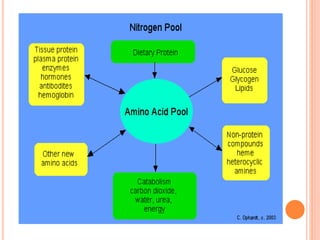
It is constantly undergoing depletion
due to disposal of AA through diff
metabolic processes usually at a rate
equal to the rate by which AA feeds
the pool.
It is always being reestablished by AA
coming from three sources- dietary
protein, endogenous AA synthesis &
endogenous protein break down.
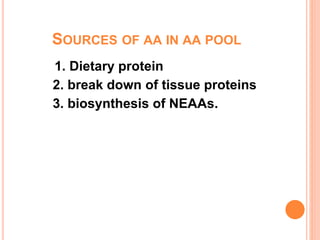
SOURCES OF AA IN AA POOL
1. Dietary protein
2. break down of tissue proteins
3. biosynthesis of NEAAs.
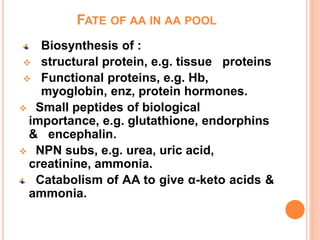
FATE OF AA IN AA POOL
Biosynthesis of :
 structural protein, e.g. tissue proteins
 Functional proteins, e.g. Hb,
myoglobin, enz, protein hormones.
 Small peptides of biological
importance, e.g. glutathione, endorphins
& encephalin.
 NPN subs, e.g. urea, uric acid,
creatinine, ammonia.
Catabolism of AA to give α-keto acids &
ammonia.
INTERMEDIARY METABOLISM OF
AMINO ACIDS
Protein synthesis & synthesis of NPN
substance
Transamination & Deamination
Urea cycle
Catabolism of AA C-skeleton &
synthesis of glucose, FA, steroids,
ketone bodies, etc.
Oxidation of AA C-skeleton via TCA
cycle
NITROGEN BALANCE
It is the diff b/w N-intake & N-
loss/excretion
N-intake occurs in the form of
protein/AA
N-excretion occurs through urine,
sweat & stool
CONTD
3 types :
 N-equilibrium: seen in normal
individual, where intake equals to
excretion.
 Positive N balance: seen during
growth, pregnancy, etc , where intake
is more than loss.
 Negative N balance: seen in DM, TB,
malignancy, surgery, starvation,
trauma, etc, where loss is more than
intake.
1. TRANSAMINATION
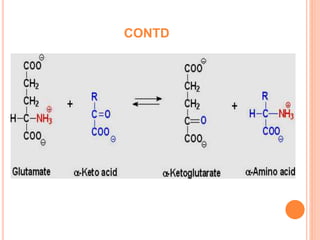
It is the transfer of amino group from
an AA to a keto acid with
simultaneous production of a
corresponding keto acid & AA
respectively.
Site: cytoplasm of liver, kidney, heart,
sk. Muscle, brain.
CONTD
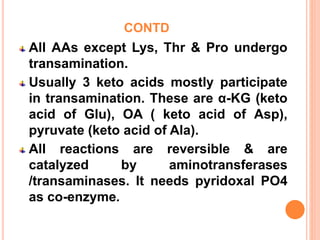
All AAs except Lys, Thr & Pro undergo
transamination.
Usually 3 keto acids mostly participate
in transamination. These are α-KG (keto
acid of Glu), OA ( keto acid of Asp),
pyruvate (keto acid of Ala).
All reactions are reversible & are
catalyzed by aminotransferases
/transaminases. It needs pyridoxal PO4
as co-enzyme.
CONTD
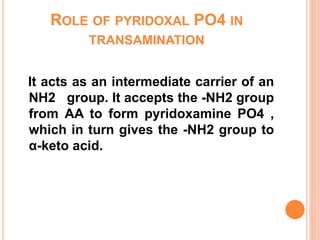
ROLE OF PYRIDOXAL PO4 IN
TRANSAMINATION
It acts as an intermediate carrier of an
NH2 group. It accepts the -NH2 group
from AA to form pyridoxamine PO4 ,
which in turn gives the -NH2 group to
α-keto acid.
EXAMPLE OF TRANSAMINASES
Alanine transaminase
Aspartate transaminase
Glutamate transaminase.
IMPORTANCE OF TRANSAMINATION
Funneling of NH2 group of diff AAs
ultimately to α-KG to form Glu & Glu is
the major AA that undergoes oxidative
deamination to liberate free NH3,
which is converted to urea.
Biosynthesis of NEAA by adding NH2
group to their corresponding keto
acid (C-skeleton), thus equalize the
quantities of NEAA.
CONTD
Formation of C-skeleton (keto acid) of
AAs that later on can be
catabolized/oxidized.
Provides a link b/w carbohydrate,
protein & fat metabolism, since the
keto acids generated by
transamination of AA can form
compounds common to their
metabolic cycle.
2. DEAMINATION
Deamination means removal of –NH2
group from an AA in the form of NH3
with simultaneous formation of its
corresponding keto acid.
Mitochondria of Liver and kidney are
the main site of deamination. It also
may occur in heart, sk. Muscle etc.
It may be oxidative/non-oxidative.
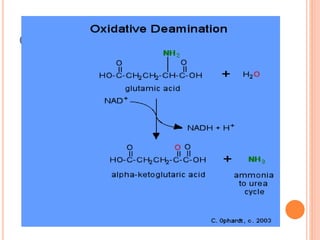
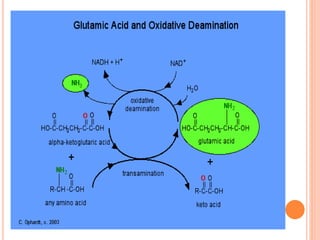
A) OXIDATIVE DEAMINATION
An oxidation (dehydrogenation)
process, where an amino acid is
converted into the corresponding keto
acid by the removal of the amine
functional group as ammonia .The
ammonia eventually goes into the urea
cycle.
It is catalyzed by one of the following
enzymes:
L-AA oxidase / D-AA oxidase /Glu DH.
CONTD
CONTD
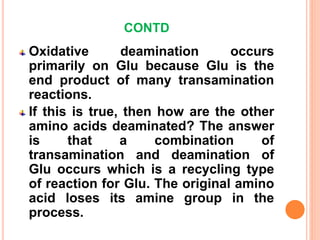
Oxidative deamination occurs
primarily on Glu because Glu is the
end product of many transamination
reactions.
If this is true, then how are the other
amino acids deaminated? The answer
is that a combination of
transamination and deamination of
Glu occurs which is a recycling type
of reaction for Glu. The original amino
acid loses its amine group in the
process.
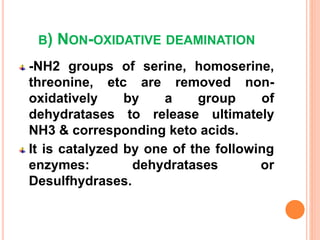
B) NON-OXIDATIVE DEAMINATION
-NH2 groups of serine, homoserine,
threonine, etc are removed non-
oxidatively by a group of
dehydratases to release ultimately
NH3 & corresponding keto acids.
It is catalyzed by one of the following
enzymes: dehydratases or
Desulfhydrases.
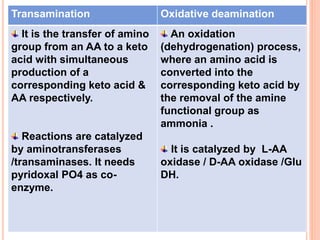
DIFF B/W TRANS DEAMINATION
Transamination Oxidative deamination
It is the transfer of amino
group from an AA to a keto
acid with simultaneous
production of a
corresponding keto acid &
AA respectively.
Reactions are catalyzed
by aminotransferases
/transaminases. It needs
pyridoxal PO4 as co-
enzyme.
An oxidation
(dehydrogenation) process,
where an amino acid is
converted into the
corresponding keto acid by
the removal of the amine
functional group as
ammonia .
It is catalyzed by L-AA
oxidase / D-AA oxidase /Glu
DH.
DIFF B/W TRANS DEAMINATION
Transamination Oxidative deamination
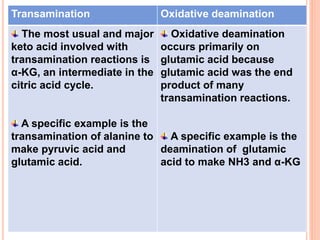
The most usual and major
keto acid involved with
transamination reactions is
α-KG, an intermediate in the
citric acid cycle.
A specific example is the
transamination of alanine to
make pyruvic acid and
glutamic acid.
Oxidative deamination
occurs primarily on
glutamic acid because
glutamic acid was the end
product of many
transamination reactions.
A specific example is the
deamination of glutamic
acid to make NH3 and α-KG
METABOLISM OF AMMONIA
Source:
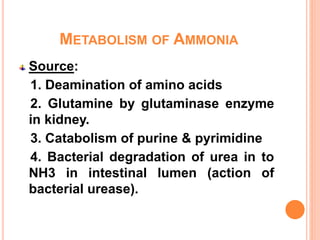
1. Deamination of amino acids
2. Glutamine by glutaminase enzyme
in kidney.
3. Catabolism of purine & pyrimidine
4. Bacterial degradation of urea in to
NH3 in intestinal lumen (action of
bacterial urease).
CONTD
Disposal of NH3:
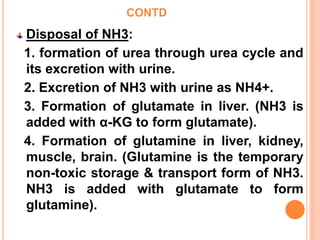
1. formation of urea through urea cycle and
its excretion with urine.
2. Excretion of NH3 with urine as NH4+.
3. Formation of glutamate in liver. (NH3 is
added with α-KG to form glutamate).
4. Formation of glutamine in liver, kidney,
muscle, brain. (Glutamine is the temporary
non-toxic storage & transport form of NH3.
NH3 is added with glutamate to form
glutamine).
NH3 INTOXICATION (HEPATIC
ENCEPHALOPATHY)
Toxicity resulting from
hyperammonemia. (Normal P/NH3
conc. 10-80 µg/dl or 5-50 µmol/L)
Occurs due to hepatic dysfunction
leading to impairment of urea cycle
and/or deficiency of urea cycle
enzymes.
CONTD
Brain tissue is mostly affected & there
is reduced cerebral activity. In neuron,
excess NH3 converts α-KG to Glu,
then to Glutamine. This causes rapid ↓
of α-KG, leading to suppression of
TCA cycle. There is ATP depletion ,
ultimately producing s/s like tremor,
slurring of speech, blurring of vision,
coma, death.
3. UREA CYCLE
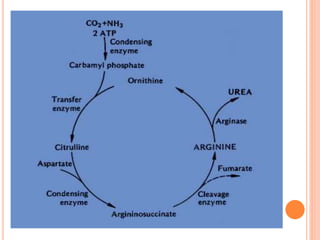
The urea cycle (Ornithine cycle) is a
cycle of biochemical reactions
occurring in many animals that
produces urea ((NH 2)2CO) from
ammonia (NH3 )
It occurs in liver
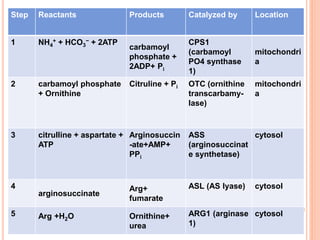
Consists of five reactions: two
mitochondrial and three cytosolic
3. UREA CYCLE
The cycle converts two amino groups
(one from NH4
+ and one from Asp) and
a carbon atom (from HCO3
−) to the
relatively nontoxic excretion product ,
urea at the cost of four "high-energy"
phosphate bonds (3 ATP hydrolyzed
to 2 ADP and one AMP)
Ornithine is the carrier of these
carbon and nitrogen atoms.
Step Reactants Products Catalyzed by Location
1 NH4
+ + HCO3
− + 2ATP
carbamoyl
phosphate +
2ADP+ Pi
CPS1
(carbamoyl
PO4 synthase
1)
mitochondri
a
2 carbamoyl phosphate
+ Ornithine
Citruline + Pi OTC (ornithine
transcarbamy-
lase)
mitochondri
a
3 citrulline + aspartate +
ATP
Arginosuccin
-ate+AMP+
PPi
ASS
(arginosuccinat
e synthetase)
cytosol
4
arginosuccinate
Arg+
fumarate
ASL (AS lyase) cytosol
5 Arg +H2O Ornithine+
urea
ARG1 (arginase
1)
cytosol
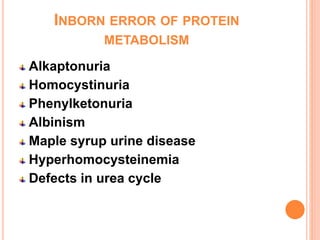
INBORN ERROR OF PROTEIN
METABOLISM
Alkaptonuria
Homocystinuria
Phenylketonuria
Albinism
Maple syrup urine disease
Hyperhomocysteinemia
Defects in urea cycle

Protein metabolism

  • 1.
    PROTEIN METABOLISM Dr. IfatAra Begum Assistant Professor Dept. of Biochemistry Dhaka Medical College Dhaka
  • 2.
    AMINO ACIDS Any moleculethat contains the amino and carboxylic acid functional groups. Or Organic acids containing amino groups are known as amino acids.
  • 3.
    STRUCTURE OF AMINOACID A central carbon atom to which 4 diff groups of atoms are attached: An Amino group (NH2)  A Carboxylic acid group (COOH)  A Hydrogen atom (H)  A Radical or R group: H, CH3, CH3-CH2 etc.
  • 4.
    CONTD The acidic andbasic properties of NH2 & COOH groups make the AA molecule “Amphoteric”
  • 5.
    FATE OF ABSORBEDAMINO ACIDS Anabolic fates: Synthesis of:  Tissue protein (structural/enzyme/hormone)  NPN subs  FA, ketone bodies, Steroids (via acetyl co A, end product of catabolism of AA C skeleton)  Glucose/glycogen (via pyruvate & TCA cycle intermediates).
  • 6.
    CONTD. Catabolic fates: Through transaminationand deamination, each AA produces NH3 & their corresponding C-skeleton (α-keto acid).  NH3 is converted to urea via urea cycle in liver & then excreted with urine.
  • 7.
    CONTD.  C-skeleton iscatabolized to – 1. Pyruvate & TCA cycle intermediates (if glucogenic AA) 2. Acetyl co A /Aceto acetyl co A ( if ketogenic AA) 3. CO2, H2O & ATP through oxidation in TCA cycle.
  • 8.
    PROTEIN TURNOVER  Itis the rate at which proteins are constantly being degraded & again resynthesized. It is 150-300gm/D (i.e.1- 2% of total body protein) in adult. [Total body protein in 70kg adult is 12- 14kg]
  • 9.
    CONTD  If acell takes up as much AA as it loses, it is in a state of dynamic equilibrium.  If the loss is greater, the cell wastes & if the gain is greater, the cell grows.  Not only the proteins, practically, all the materials in the body, even the depot fat, are in a state of dynamic equilibrium.
  • 10.
    AMINO ACID POOL Itis the free amino acid content distributed throughout the extracellular fluid/body. Quantitatively, it is about 100 gm in an adult individual . Plasma AA level varies throughout the day fm 4- 8mg/dl.
  • 11.
    CONTD It is constantlyundergoing depletion due to disposal of AA through diff metabolic processes usually at a rate equal to the rate by which AA feeds the pool. It is always being reestablished by AA coming from three sources- dietary protein, endogenous AA synthesis & endogenous protein break down.
  • 13.
    SOURCES OF AAIN AA POOL 1. Dietary protein 2. break down of tissue proteins 3. biosynthesis of NEAAs.
  • 14.
    FATE OF AAIN AA POOL Biosynthesis of :  structural protein, e.g. tissue proteins  Functional proteins, e.g. Hb, myoglobin, enz, protein hormones.  Small peptides of biological importance, e.g. glutathione, endorphins & encephalin.  NPN subs, e.g. urea, uric acid, creatinine, ammonia. Catabolism of AA to give α-keto acids & ammonia.
  • 15.
    INTERMEDIARY METABOLISM OF AMINOACIDS Protein synthesis & synthesis of NPN substance Transamination & Deamination Urea cycle Catabolism of AA C-skeleton & synthesis of glucose, FA, steroids, ketone bodies, etc. Oxidation of AA C-skeleton via TCA cycle
  • 16.
    NITROGEN BALANCE It isthe diff b/w N-intake & N- loss/excretion N-intake occurs in the form of protein/AA N-excretion occurs through urine, sweat & stool
  • 17.
    CONTD 3 types : N-equilibrium: seen in normal individual, where intake equals to excretion.  Positive N balance: seen during growth, pregnancy, etc , where intake is more than loss.  Negative N balance: seen in DM, TB, malignancy, surgery, starvation, trauma, etc, where loss is more than intake.
  • 18.
    1. TRANSAMINATION It isthe transfer of amino group from an AA to a keto acid with simultaneous production of a corresponding keto acid & AA respectively. Site: cytoplasm of liver, kidney, heart, sk. Muscle, brain.
  • 19.
    CONTD All AAs exceptLys, Thr & Pro undergo transamination. Usually 3 keto acids mostly participate in transamination. These are α-KG (keto acid of Glu), OA ( keto acid of Asp), pyruvate (keto acid of Ala). All reactions are reversible & are catalyzed by aminotransferases /transaminases. It needs pyridoxal PO4 as co-enzyme.
  • 20.
  • 21.
    ROLE OF PYRIDOXALPO4 IN TRANSAMINATION It acts as an intermediate carrier of an NH2 group. It accepts the -NH2 group from AA to form pyridoxamine PO4 , which in turn gives the -NH2 group to α-keto acid.
  • 22.
    EXAMPLE OF TRANSAMINASES Alaninetransaminase Aspartate transaminase Glutamate transaminase.
  • 23.
    IMPORTANCE OF TRANSAMINATION Funnelingof NH2 group of diff AAs ultimately to α-KG to form Glu & Glu is the major AA that undergoes oxidative deamination to liberate free NH3, which is converted to urea. Biosynthesis of NEAA by adding NH2 group to their corresponding keto acid (C-skeleton), thus equalize the quantities of NEAA.
  • 24.
    CONTD Formation of C-skeleton(keto acid) of AAs that later on can be catabolized/oxidized. Provides a link b/w carbohydrate, protein & fat metabolism, since the keto acids generated by transamination of AA can form compounds common to their metabolic cycle.
  • 25.
    2. DEAMINATION Deamination meansremoval of –NH2 group from an AA in the form of NH3 with simultaneous formation of its corresponding keto acid. Mitochondria of Liver and kidney are the main site of deamination. It also may occur in heart, sk. Muscle etc. It may be oxidative/non-oxidative.
  • 26.
    A) OXIDATIVE DEAMINATION Anoxidation (dehydrogenation) process, where an amino acid is converted into the corresponding keto acid by the removal of the amine functional group as ammonia .The ammonia eventually goes into the urea cycle. It is catalyzed by one of the following enzymes: L-AA oxidase / D-AA oxidase /Glu DH.
  • 27.
  • 28.
    CONTD Oxidative deamination occurs primarilyon Glu because Glu is the end product of many transamination reactions. If this is true, then how are the other amino acids deaminated? The answer is that a combination of transamination and deamination of Glu occurs which is a recycling type of reaction for Glu. The original amino acid loses its amine group in the process.
  • 29.
    B) NON-OXIDATIVE DEAMINATION -NH2groups of serine, homoserine, threonine, etc are removed non- oxidatively by a group of dehydratases to release ultimately NH3 & corresponding keto acids. It is catalyzed by one of the following enzymes: dehydratases or Desulfhydrases.
  • 30.
    DIFF B/W TRANSDEAMINATION Transamination Oxidative deamination It is the transfer of amino group from an AA to a keto acid with simultaneous production of a corresponding keto acid & AA respectively. Reactions are catalyzed by aminotransferases /transaminases. It needs pyridoxal PO4 as co- enzyme. An oxidation (dehydrogenation) process, where an amino acid is converted into the corresponding keto acid by the removal of the amine functional group as ammonia . It is catalyzed by L-AA oxidase / D-AA oxidase /Glu DH.
  • 31.
    DIFF B/W TRANSDEAMINATION Transamination Oxidative deamination The most usual and major keto acid involved with transamination reactions is α-KG, an intermediate in the citric acid cycle. A specific example is the transamination of alanine to make pyruvic acid and glutamic acid. Oxidative deamination occurs primarily on glutamic acid because glutamic acid was the end product of many transamination reactions. A specific example is the deamination of glutamic acid to make NH3 and α-KG
  • 33.
    METABOLISM OF AMMONIA Source: 1.Deamination of amino acids 2. Glutamine by glutaminase enzyme in kidney. 3. Catabolism of purine & pyrimidine 4. Bacterial degradation of urea in to NH3 in intestinal lumen (action of bacterial urease).
  • 34.
    CONTD Disposal of NH3: 1.formation of urea through urea cycle and its excretion with urine. 2. Excretion of NH3 with urine as NH4+. 3. Formation of glutamate in liver. (NH3 is added with α-KG to form glutamate). 4. Formation of glutamine in liver, kidney, muscle, brain. (Glutamine is the temporary non-toxic storage & transport form of NH3. NH3 is added with glutamate to form glutamine).
  • 35.
    NH3 INTOXICATION (HEPATIC ENCEPHALOPATHY) Toxicityresulting from hyperammonemia. (Normal P/NH3 conc. 10-80 µg/dl or 5-50 µmol/L) Occurs due to hepatic dysfunction leading to impairment of urea cycle and/or deficiency of urea cycle enzymes.
  • 36.
    CONTD Brain tissue ismostly affected & there is reduced cerebral activity. In neuron, excess NH3 converts α-KG to Glu, then to Glutamine. This causes rapid ↓ of α-KG, leading to suppression of TCA cycle. There is ATP depletion , ultimately producing s/s like tremor, slurring of speech, blurring of vision, coma, death.
  • 37.
    3. UREA CYCLE Theurea cycle (Ornithine cycle) is a cycle of biochemical reactions occurring in many animals that produces urea ((NH 2)2CO) from ammonia (NH3 ) It occurs in liver Consists of five reactions: two mitochondrial and three cytosolic
  • 38.
    3. UREA CYCLE Thecycle converts two amino groups (one from NH4 + and one from Asp) and a carbon atom (from HCO3 −) to the relatively nontoxic excretion product , urea at the cost of four "high-energy" phosphate bonds (3 ATP hydrolyzed to 2 ADP and one AMP) Ornithine is the carrier of these carbon and nitrogen atoms.
  • 39.
    Step Reactants ProductsCatalyzed by Location 1 NH4 + + HCO3 − + 2ATP carbamoyl phosphate + 2ADP+ Pi CPS1 (carbamoyl PO4 synthase 1) mitochondri a 2 carbamoyl phosphate + Ornithine Citruline + Pi OTC (ornithine transcarbamy- lase) mitochondri a 3 citrulline + aspartate + ATP Arginosuccin -ate+AMP+ PPi ASS (arginosuccinat e synthetase) cytosol 4 arginosuccinate Arg+ fumarate ASL (AS lyase) cytosol 5 Arg +H2O Ornithine+ urea ARG1 (arginase 1) cytosol
  • 41.
    INBORN ERROR OFPROTEIN METABOLISM Alkaptonuria Homocystinuria Phenylketonuria Albinism Maple syrup urine disease Hyperhomocysteinemia Defects in urea cycle