Protein DigestionPresented by: GROUP 1 – DAACoojacintoDe AsisGoSaunar
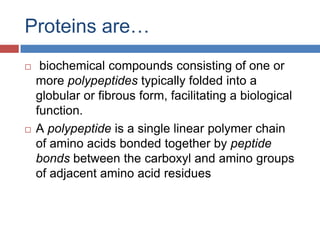
Proteins are… biochemical compounds consisting of one or more polypeptides typically folded into a globular or fibrous form, facilitating a biological function. A polypeptide is a single linear polymer chain of amino acids bonded together by peptide bonds between the carboxyl and amino groups of adjacent amino acid residues
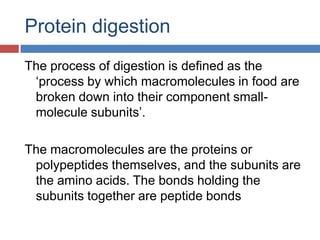
Protein digestion The process of digestion is defined as the ‘process by which macromolecules in food are broken down into their component small-molecule subunits’.The macromolecules are the proteins or polypeptides themselves, and the subunits are the amino acids. The bonds holding the subunits together are peptide bonds
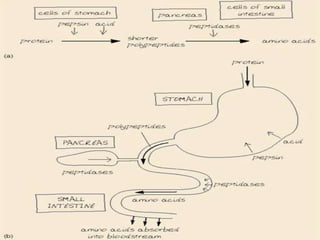
Protein Digestionis the degradation of proteins by cellular enzymes enzymes in a process called hydrolysis.Protein digestion takes place in two different phases:In the stomachIn the small intestineBoth of these phases of digestion are based on several types of enzymes that are called proteinases and proteases.
Proteases- endo- & exo- peptidases; enzymes that degrade proteins by hydrolysis of peptide bondsProteinases- endo-peptidases; proteases that show specificity for intact proteins
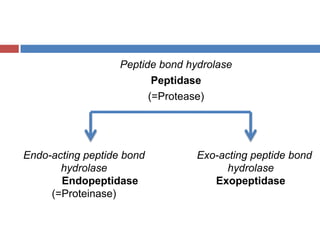
Peptide bond hydrolasePeptidase(=Protease)Endo-acting peptide bond hydrolaseEndopeptidase(=Proteinase) Exo-acting peptide bond hydrolaseExopeptidase
Mouth and Salivary Glands	 Chewing and crushing of protein  rich foods and mix them with saliva to be swallowed
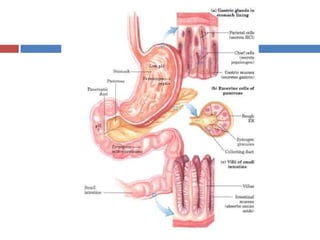
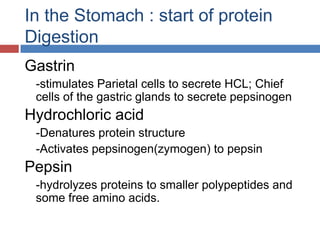
In the Stomach : start of protein DigestionGastrin	-stimulates Parietal cells to secrete HCL; Chief cells of the gastric glands to secrete pepsinogenHydrochloric acid	-Denatures protein structure	-Activates pepsinogen(zymogen) to pepsinPepsin 	-hydrolyzes proteins to smaller polypeptides and some free amino acids.
In the intestine.  The remainder of protein digestion occurs in the small intestine as the result of the action of enzymes    such as trypsin (secreted by the pancreas) and peptidases (located in the cells that line the small intestine).
In the Small Intestine : enzymesSecretin	- stimulates  the pancreas to secrete bicarbonate into the small intestine to neutralize the gastric  HClCholecystokinin-stimulates secretion of several pancreatic enzyme with activity optima pH 7 to 8.
In the Small IntestineCont....Trypsin	- activates chymotrypsinogenchymotrypsinprocarboxypeptidasescarboxypeptidasesproelastaseelastase	-further hydrolyze the peptides that were produced by pepsin in the stomach specifically the peptide bonds next to lysine and arginineChymotrypsin	-cleaves peptide bonds next to phe, tyr, trp,met, asp, and his
Cont....Carboxypeptidase A & B	-cleave amino acids from the acid (carboxyl) ends of polypeptidesElastase and collagenase	-cleave polypeptides into smaller polypeptides and tripeptides
Cont....Intestinal tripeptidases	-Cleave tripeptides to dipeptides and amino acidsIntestinal dipeptidases	-cleave dipeptides to amino acidsIntestinal aminopeptidases	-cleave amino acids from the amino ends of small polypeptides(oligopeptides)
Amino acids absorbedFree amino acid  small intestine(villi)Liverblood circulation
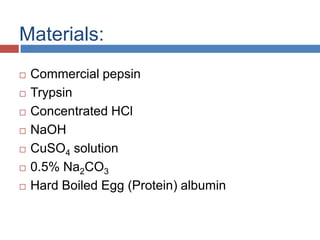
Materials:Commercial pepsinTrypsinConcentrated HClNaOHCuSO4 solution0.5% Na2CO3Hard Boiled Egg (Protein) albumin
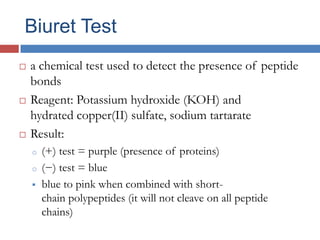
Biuret Testa chemical test used to detect the presence of peptide bondsReagent: Potassium hydroxide (KOH) and hydrated copper(II) sulfate, sodium tartarateResult:(+) test = purple (presence of proteins)
(−) test = blue
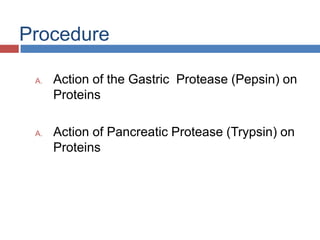
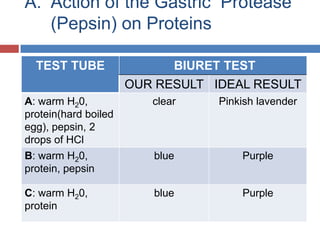
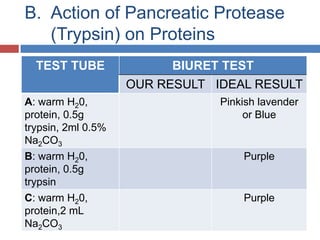
blue to pink when combined with short-chain polypeptides (it will not cleave on all peptide chains)ProcedureAction of the Gastric  Protease (Pepsin) on ProteinsAction of Pancreatic Protease (Trypsin) on Proteins
Action of the Gastric  Protease (Pepsin) on Proteins
Action of Pancreatic Protease (Trypsin) on Proteins
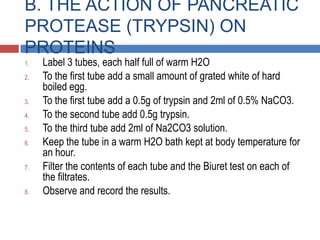
B. THE ACTION OF PANCREATIC PROTEASE (TRYPSIN) ON PROTEINSLabel 3 tubes, each half full of warm H2OTo the first tube add a small amount of grated white of hard boiled egg.To the first tube add a 0.5g of trypsin and 2ml of 0.5% NaCO3.To the second tube add 0.5g trypsin.To the third tube add 2ml of Na2CO3 solution.Keep the tube in a warm H2O bath kept at body temperature for an hour.Filter the contents of each tube and the Biuret test on each of the filtrates.Observe and record the results.
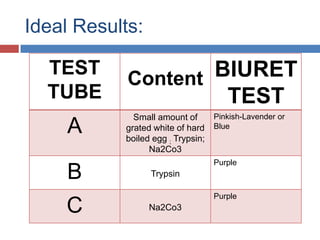
Ideal Results:
POST LAB QUESTIONS
POST LAB QUESTIONSWhat are the enzymes used in Protein Digestion?Gastric Protease (Pepsin)Pancreatic Protease (Trypsin)Small intestine enzymes (peptidases)
POST LAB QUESTIONSWhat are the similarities and differences of these enzymes?    These enzyme hydrolyze proteins and their main difference is the location where they are found.
POST LAB QUESTIONSWhat are the factors that would bring about Protein digestion?the acidity of the food and of the stomach
Temperature
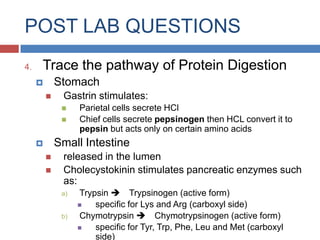
the presence of any digestion inhibitors, such as antacidsPOST LAB QUESTIONSTrace the pathway of Protein DigestionStomachGastrin stimulates:Parietal cells secrete HClChief cells secrete pepsinogen then HCL convert it to pepsin but acts only on certain amino acidsSmall Intestinereleased in the lumenCholecystokinin stimulates pancreatic enzymes such as:TrypsinTrypsinogen (active form)specific for Lys and Arg (carboxyl side)ChymotrypsinChymotrypsinogen (active form)specific for Tyr, Trp, Phe, Leu and Met (carboxyl side)
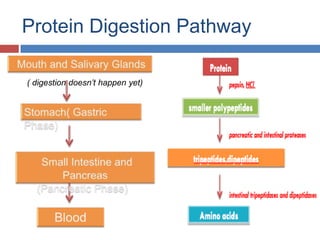
Protein Digestion Pathway  ( digestion doesn’t happen yet) Mouth and Salivary GlandsStomach( Gastric Phase)Small Intestine and Pancreas (Pancreatic Phase)	Blood
POST LAB QUESTIONSWhat tests are used to detect the completeness of protein digestion?MILLON’S TESTNITROPRUSSIDE TESTHOPKIN’S COLE TESTXANTHOPROTEIC TESTSAKAGUCHI TESTPAULY TEST
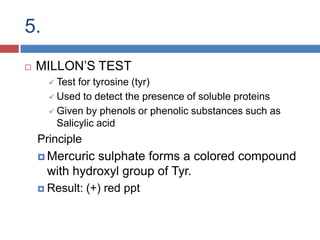
5.MILLON’S TESTTest for tyrosine (tyr)
Used to detect the presence of soluble proteins
Given by phenols or phenolic substances such as Salicylic acidPrincipleMercuric sulphate forms a colored compound with hydroxyl group of Tyr. Result: (+) red ppt
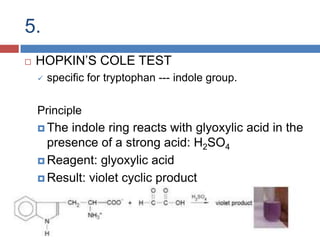
5.HOPKIN’S COLE TESTspecific for tryptophan --- indole group. PrincipleThe indole ring reacts with glyoxylic acid in the presence of a strong acid: H2SO4Reagent: glyoxylic acidResult: violet cyclic product
5.PAULY’S TESTFor tyr, trp, and his	PrincipleDiazotisedsulphanilic acid couples with amino phenol and immidazole to form a colored azocomp’d in cold condition.Result: (+) Deep red color dye

Protein digestion

  • 1.
    Protein DigestionPresented by:GROUP 1 – DAACoojacintoDe AsisGoSaunar
  • 2.
    Proteins are… biochemical compounds consisting ofone or more polypeptides typically folded into a globular or fibrous form, facilitating a biological function. A polypeptide is a single linear polymer chain of amino acids bonded together by peptide bonds between the carboxyl and amino groups of adjacent amino acid residues
  • 3.
    Protein digestion Theprocess of digestion is defined as the ‘process by which macromolecules in food are broken down into their component small-molecule subunits’.The macromolecules are the proteins or polypeptides themselves, and the subunits are the amino acids. The bonds holding the subunits together are peptide bonds
  • 4.
    Protein Digestionis thedegradation of proteins by cellular enzymes enzymes in a process called hydrolysis.Protein digestion takes place in two different phases:In the stomachIn the small intestineBoth of these phases of digestion are based on several types of enzymes that are called proteinases and proteases.
  • 5.
    Proteases- endo- &exo- peptidases; enzymes that degrade proteins by hydrolysis of peptide bondsProteinases- endo-peptidases; proteases that show specificity for intact proteins
  • 6.
    Peptide bond hydrolasePeptidase(=Protease)Endo-actingpeptide bond hydrolaseEndopeptidase(=Proteinase) Exo-acting peptide bond hydrolaseExopeptidase
  • 7.
    Mouth and SalivaryGlands Chewing and crushing of protein rich foods and mix them with saliva to be swallowed
  • 10.
    In the Stomach: start of protein DigestionGastrin -stimulates Parietal cells to secrete HCL; Chief cells of the gastric glands to secrete pepsinogenHydrochloric acid -Denatures protein structure -Activates pepsinogen(zymogen) to pepsinPepsin -hydrolyzes proteins to smaller polypeptides and some free amino acids.
  • 11.
    In the intestine. The remainder of protein digestion occurs in the small intestine as the result of the action of enzymes such as trypsin (secreted by the pancreas) and peptidases (located in the cells that line the small intestine).
  • 12.
    In the SmallIntestine : enzymesSecretin - stimulates the pancreas to secrete bicarbonate into the small intestine to neutralize the gastric HClCholecystokinin-stimulates secretion of several pancreatic enzyme with activity optima pH 7 to 8.
  • 13.
    In the SmallIntestineCont....Trypsin - activates chymotrypsinogenchymotrypsinprocarboxypeptidasescarboxypeptidasesproelastaseelastase -further hydrolyze the peptides that were produced by pepsin in the stomach specifically the peptide bonds next to lysine and arginineChymotrypsin -cleaves peptide bonds next to phe, tyr, trp,met, asp, and his
  • 14.
    Cont....Carboxypeptidase A &B -cleave amino acids from the acid (carboxyl) ends of polypeptidesElastase and collagenase -cleave polypeptides into smaller polypeptides and tripeptides
  • 15.
    Cont....Intestinal tripeptidases -Cleave tripeptidesto dipeptides and amino acidsIntestinal dipeptidases -cleave dipeptides to amino acidsIntestinal aminopeptidases -cleave amino acids from the amino ends of small polypeptides(oligopeptides)
  • 16.
    Amino acids absorbedFreeamino acid  small intestine(villi)Liverblood circulation
  • 17.
    Materials:Commercial pepsinTrypsinConcentrated HClNaOHCuSO4solution0.5% Na2CO3Hard Boiled Egg (Protein) albumin
  • 18.
    Biuret Testa chemical test usedto detect the presence of peptide bondsReagent: Potassium hydroxide (KOH) and hydrated copper(II) sulfate, sodium tartarateResult:(+) test = purple (presence of proteins)
  • 19.
  • 20.
    blue to pinkwhen combined with short-chain polypeptides (it will not cleave on all peptide chains)ProcedureAction of the Gastric Protease (Pepsin) on ProteinsAction of Pancreatic Protease (Trypsin) on Proteins
  • 21.
    Action of theGastric Protease (Pepsin) on Proteins
  • 22.
    Action of PancreaticProtease (Trypsin) on Proteins
  • 23.
    B. THE ACTIONOF PANCREATIC PROTEASE (TRYPSIN) ON PROTEINSLabel 3 tubes, each half full of warm H2OTo the first tube add a small amount of grated white of hard boiled egg.To the first tube add a 0.5g of trypsin and 2ml of 0.5% NaCO3.To the second tube add 0.5g trypsin.To the third tube add 2ml of Na2CO3 solution.Keep the tube in a warm H2O bath kept at body temperature for an hour.Filter the contents of each tube and the Biuret test on each of the filtrates.Observe and record the results.
  • 24.
  • 25.
  • 26.
    POST LAB QUESTIONSWhatare the enzymes used in Protein Digestion?Gastric Protease (Pepsin)Pancreatic Protease (Trypsin)Small intestine enzymes (peptidases)
  • 27.
    POST LAB QUESTIONSWhatare the similarities and differences of these enzymes? These enzyme hydrolyze proteins and their main difference is the location where they are found.
  • 28.
    POST LAB QUESTIONSWhatare the factors that would bring about Protein digestion?the acidity of the food and of the stomach
  • 29.
  • 30.
    the presence ofany digestion inhibitors, such as antacidsPOST LAB QUESTIONSTrace the pathway of Protein DigestionStomachGastrin stimulates:Parietal cells secrete HClChief cells secrete pepsinogen then HCL convert it to pepsin but acts only on certain amino acidsSmall Intestinereleased in the lumenCholecystokinin stimulates pancreatic enzymes such as:TrypsinTrypsinogen (active form)specific for Lys and Arg (carboxyl side)ChymotrypsinChymotrypsinogen (active form)specific for Tyr, Trp, Phe, Leu and Met (carboxyl side)
  • 31.
    Protein Digestion Pathway ( digestion doesn’t happen yet) Mouth and Salivary GlandsStomach( Gastric Phase)Small Intestine and Pancreas (Pancreatic Phase) Blood
  • 32.
    POST LAB QUESTIONSWhattests are used to detect the completeness of protein digestion?MILLON’S TESTNITROPRUSSIDE TESTHOPKIN’S COLE TESTXANTHOPROTEIC TESTSAKAGUCHI TESTPAULY TEST
  • 33.
  • 34.
    Used to detectthe presence of soluble proteins
  • 35.
    Given by phenolsor phenolic substances such as Salicylic acidPrincipleMercuric sulphate forms a colored compound with hydroxyl group of Tyr. Result: (+) red ppt
  • 36.
    5.HOPKIN’S COLE TESTspecificfor tryptophan --- indole group. PrincipleThe indole ring reacts with glyoxylic acid in the presence of a strong acid: H2SO4Reagent: glyoxylic acidResult: violet cyclic product
  • 37.
    5.PAULY’S TESTFor tyr,trp, and his PrincipleDiazotisedsulphanilic acid couples with amino phenol and immidazole to form a colored azocomp’d in cold condition.Result: (+) Deep red color dye

Editor's Notes

  • #5 The enzymes for protein digestion are collectively called proteinases (protein-ACES) or proteases (pro-tea-ACES). Proteins are broken apart by the protein-digesting enzymes in a process called hydrolysis.Proteases- enzymes that hydrolyze protein
  • #7 Protein Digestion Lab In this lab, we will use the same chemicals and enzymes our body uses to observe how we digest protein.  Proteins start breaking down in our stomach, which has an acidic pH of around 2-3 due to the hydrochloric acid.  The enzyme in the stomach that cuts up the bonds between the amino acids in the protein we eat is called pepsin, and it only works in acidic conditions.   Once the food moves into the small intestine, the pancreas releases sodium bicarbonate (NaHCO3), which makes the pH change into a slightly basic (alkaline) pH of 8.  The pancreas also makes the enzyme called trypsin, which works well in these conditions and does a similar job to what pepsin did in the stomach.  After being broken down by both enzymes, the protein you ate is pretty much amino acid
  • #8 Actually, the digestion of dietary protein begins in cooking, which DENATURES proteins.DENATURED proteins are then broken down more easily by digestive enzymes.
  • #9 The protein digesting enzyme pepsin has a pH optimum that is adapted to the normal very low pH of the stomach (a pH of less than 2). The pH of the stomach is due to the secretion of hydrochloric acid by parietal cells in gastric glands that line the stomach.
  • #11 .Entry of dietary protein into the stomachstimulates the gastric mucosa to secrete the hormone gastrin, which in turn stimulates the secretion of hydrochloric acid by the parietal cells and pepsinogen by the chief cells of the gastric glands .The acidic gastric juice (pH 1.0t o 2.5) is both an antiseptic,killing most bacteria and other foreign cells, and a denaturing agent, unfolding globular proteins and rendering their internal peptide bonds m ore accessible to enzymatic hydrolysis. Pepsinogen ,an inactive precursor or zymogen is converted to active pepsin by an autocatalytic cleavage(a cleavage mediated b y thepepsinogen it self) that occurs only at low pH. In the stomach, pepsin hydrolyzes ingested proteins at peptide bonds on the amino terminai side of the aromatic amino acid residues Phe, Ttp, and T}rr cleaving long polypeptide chains into a mixture of smaller peptides.
  • #12 Enteropeptidase ( an enzyme in the small intestine activates trpsinogen to trypsin/ it converts pancreatic trypsinogen to trypsin.)
  • #13 As the acidic stomach contents pass into the small intestine,the low pH triggers secretion of the hormone secretin into the blood. Secretin stimulates the pancreas to secrete bicarbonate into the small intestine to neutralize the gastnc HCl, abruptly increasing the pH to about 7.(All pancreatic secretions pass into the small intestine through the pancreatic duct.) The digestion of proteins now continues in the small intestine. Arrival of amino acids in the upper part of the intestine (duodenum) causes release into the blood of the hormone cholecystokinin, which stimulates secretion of several pancreatic enzyme with activity optima pH 7 to 8.
  • #14 Enteropeptidase converts pancreatic trypsinogen to trypsin.Trypsinogen,chymotrypsinogen, and procarboxypeptidases A and B—the zymogens of trypsin, chymotrypsin, and carboxypeptidases A and B--are synthesized and secreted by the exocrine cells of the pancreas. Trypsinogen is converted to its active form, trypsin, by enteropeptidase, a proteolytic enzymes secreted by intestinal cells. Free trypsin then catalyzes the conversion of additional trypsinogen to trypsin .Trypsin also activates chymotrypsinogen, the procarboxypeptidases and proelastase. Trypsin and chymotrypsin further hydrolyze the peptides that were produced by pepsin in the stomach. This stage of protein digestion is accomplished very efflciently,because pepsin, trypsin, and chymotrypsin have different amino acid speciflcities .
  • #15 Degradation of the short peptides in the small intestine is then completed by other intestinal peptidases. These include carboxypeptidases A and B (both of which are zinc-containing enzymes), which remove successive carboxyl-terminal residues from peptides,
  • #16 aminopeptidase that hydrolyzes successive amino-terminal residues from short peptides.
  • #17 The resulting mixture of free amino acids is transported into the epithelial cells lining the small intestine, through which the amino acids enter the blood capillaries in the villi and travel to the liver and then go into the blood of the general circulationIn humans, most globular proteins from animal sources are almost completely hydrolyzed to amino acids in the gastrointestinal tract, but some fibrous proteins,such as keratin, are only partly digested. In addition, theprotein content of some plant foods is protected against breakdown by indigestible cellulose husks. 
  • #24 Test Tube A: because it will not cleave on all peptide chains.
  • #28 These factors include the concentration of the enzyme, that is, how much of it is present;the amount of protein food needing action; the acidity of the food and of the stomach; the temperature of the food; time; and the presence of any digestion inhibitors, such as antacids.Cooking and chewing The low pH (~2) of the gastric juice aids protein digestion in a couple of ways. : First, the low pH denatures the tertiary structures of ingested protein, making them easier to digest enzymatically. Secondly, the low pH is required for the activation of pepsin.
  • #30 Gastric Protease (Pepsin)Pancreatic Protease (Trypsin)Alkaline environmentEnterokinasecomposed of Trypsinogen and ChymotrypsinCarboxypeptidase Aacts on the C terminal; exopeptidaseExopeptidases – outside the peptide chainEndopeptidases – within the peptide chain