VSEPR
Valence Shell Electron Pair Repulsion Theory
VSEPR
Review: Drawing in perspective
VSEPR
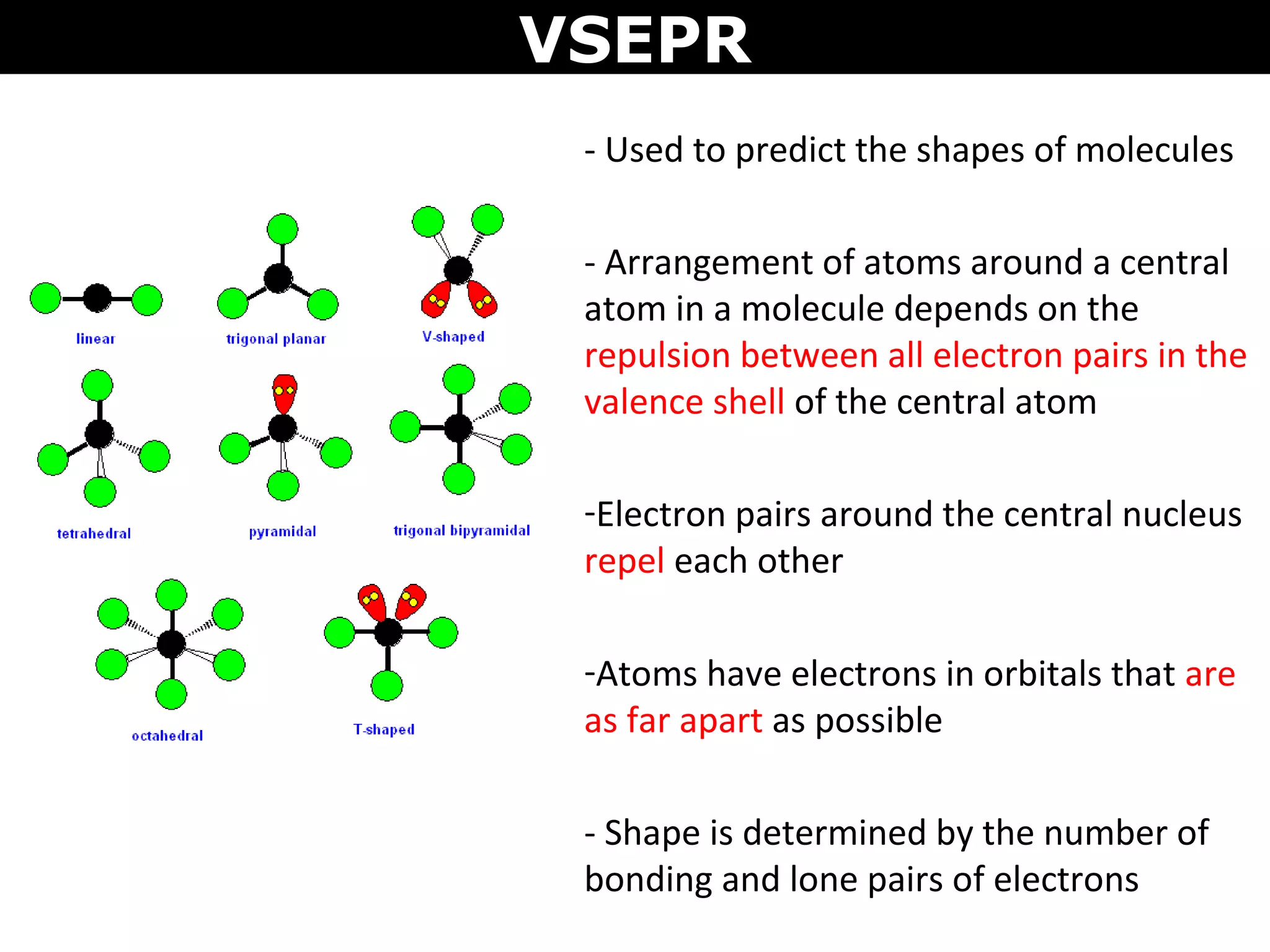
- Used to predict the shapes of molecules
- Arrangement of atoms around a central
atom in a molecule depends on the
repulsion between all electron pairs in the
valence shell of the central atom
-Electron pairs around the central nucleus
repel each other
-Atoms have electrons in orbitals that are
as far apart as possible
- Shape is determined by the number of
bonding and lone pairs of electrons
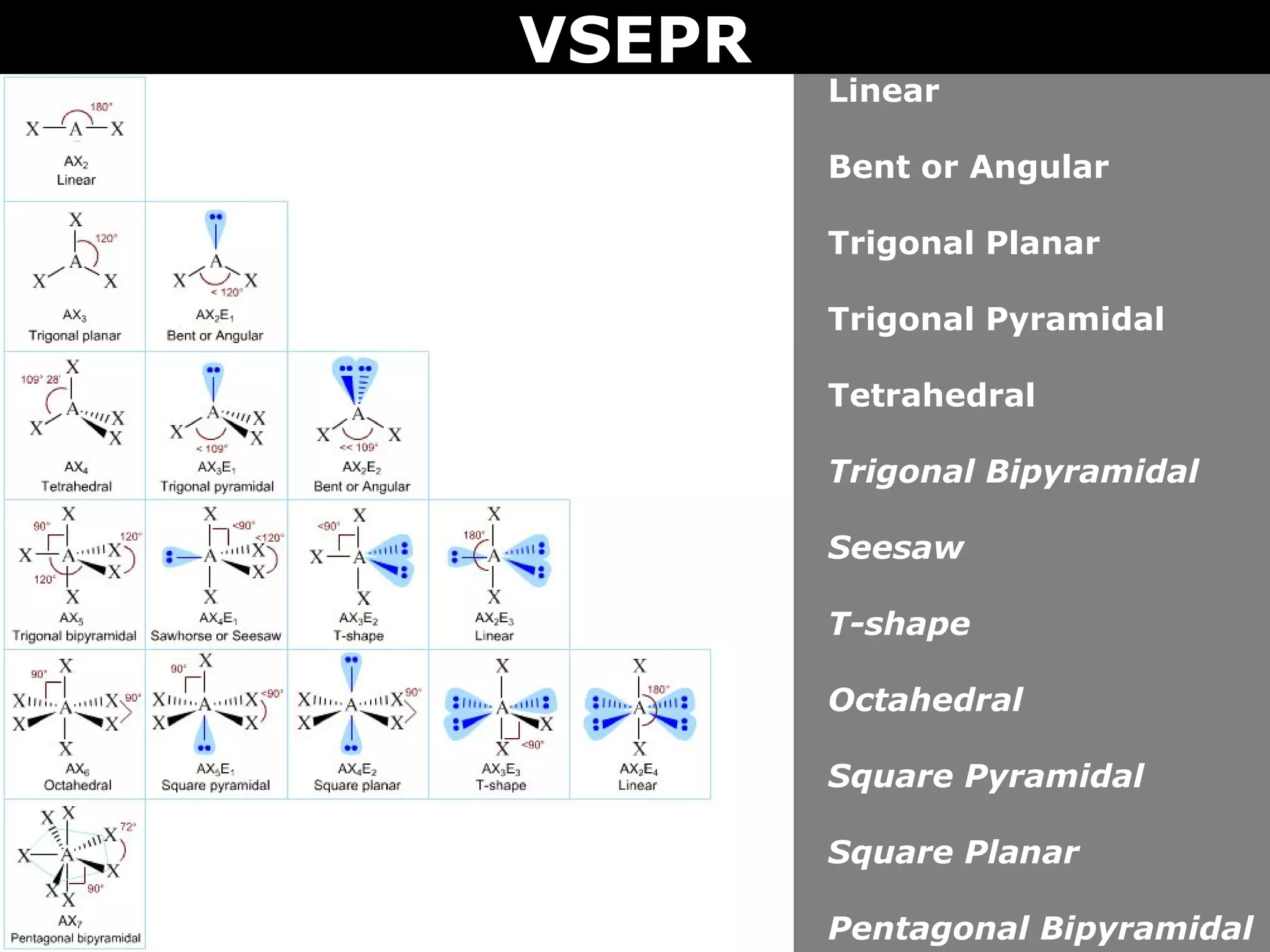
Linear
Bent or Angular
Trigonal Planar
Trigonal Pyramidal
Tetrahedral
Trigonal Bipyramidal
Seesaw
T-shape
Octahedral
Square Pyramidal
Square Planar
Pentagonal Bipyramidal
VSEPR
VSEPR
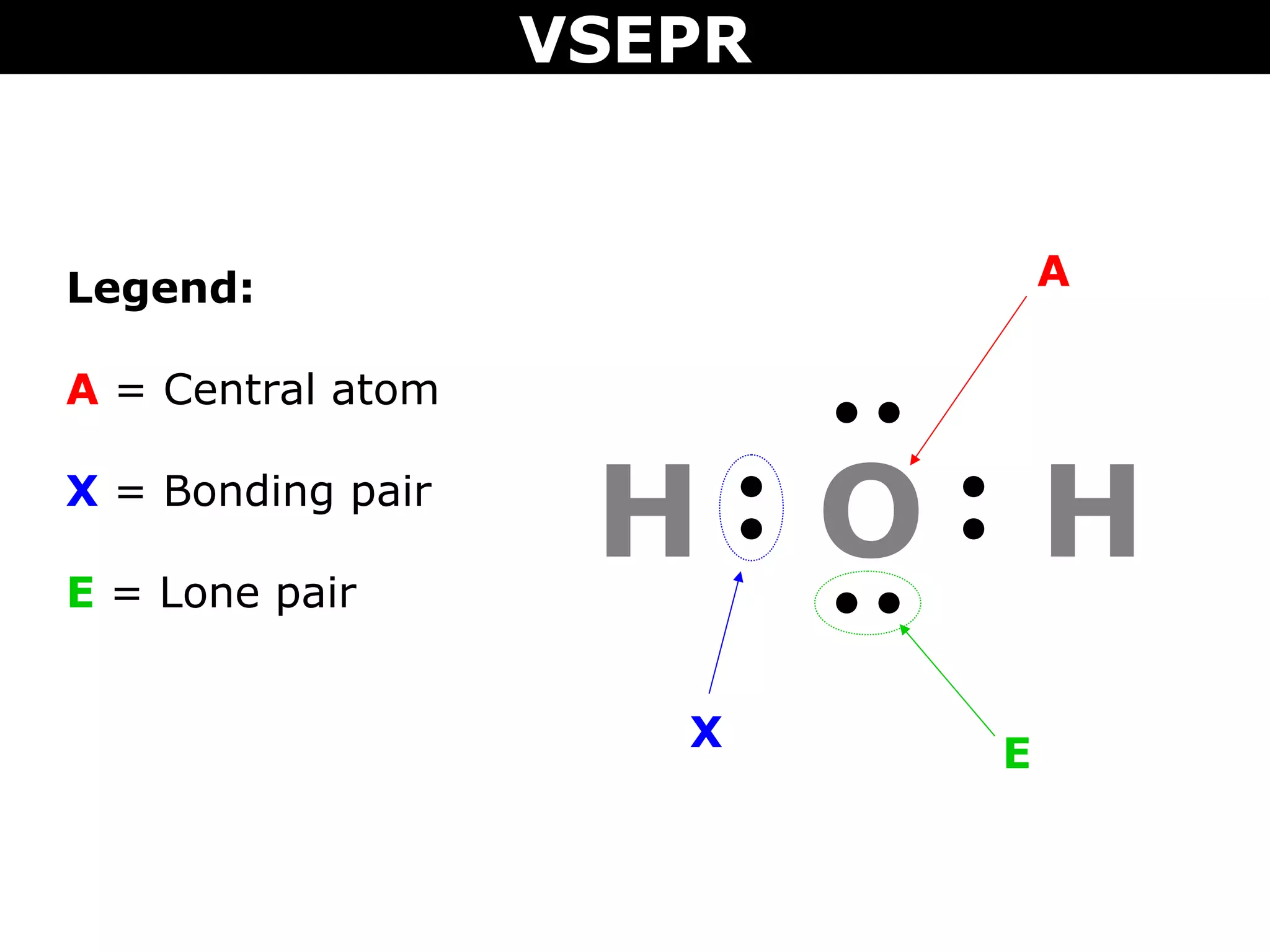
Legend:
A = Central atom
X = Bonding pair
E = Lone pair
O HH
A
X
E
VSEPR
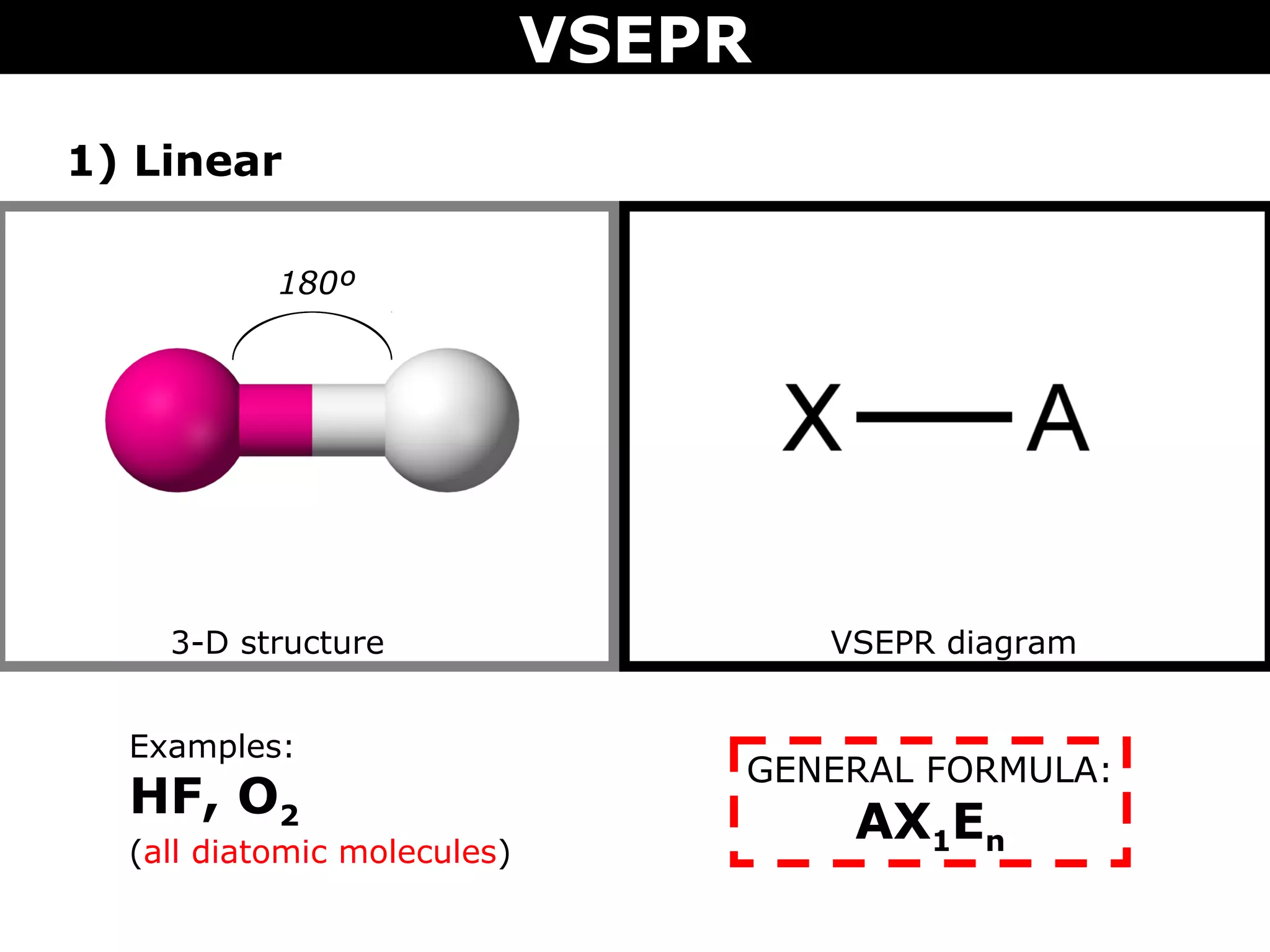
Linear
3 types
1)
2)
3)
Examples:
HF, O2
(all diatomic molecules)
GENERAL FORMULA:
AX1En
VSEPR
1) Linear
3-D structure VSEPR diagram
180º
VSEPR
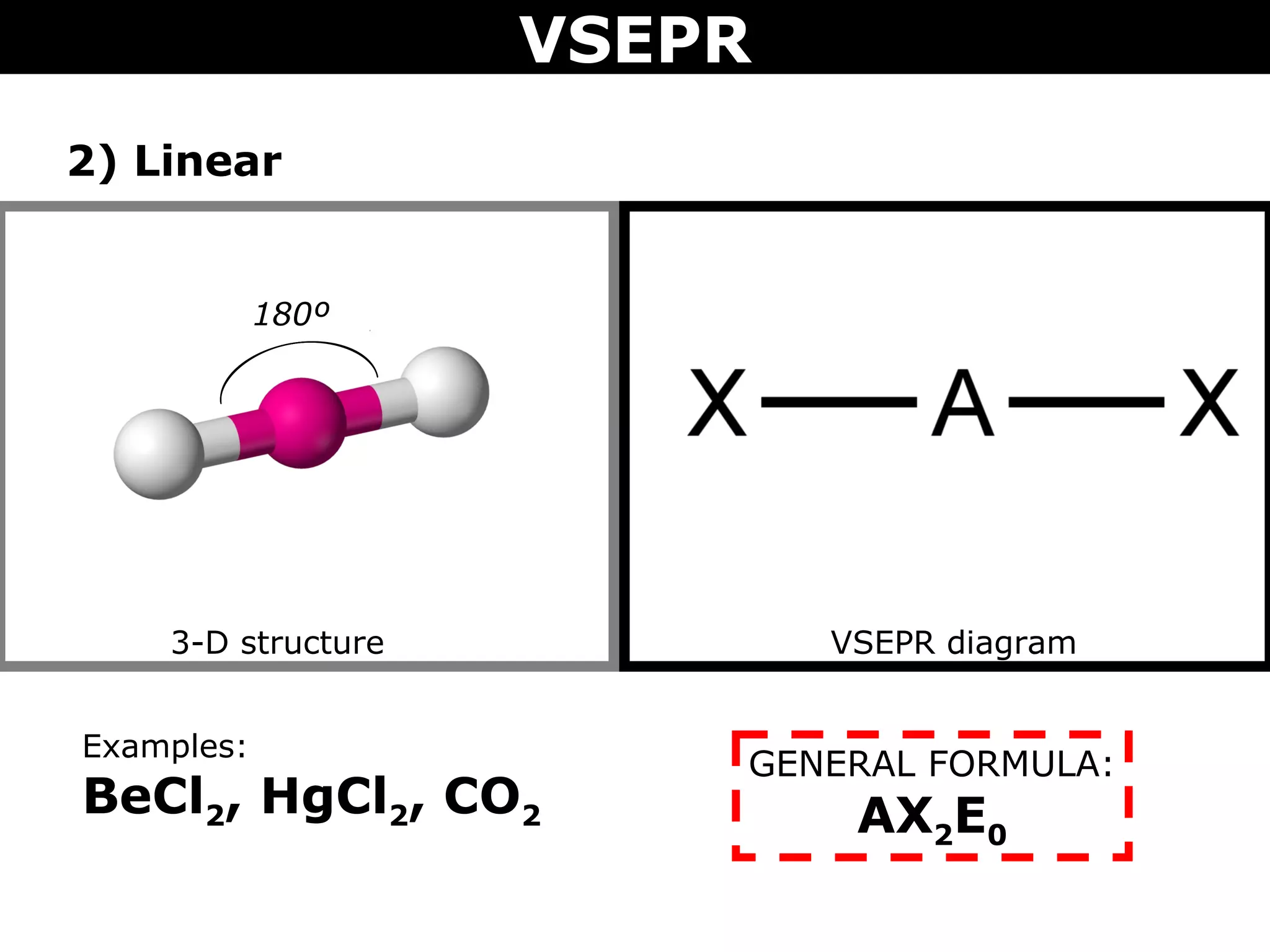
2) Linear
Examples:
BeCl2, HgCl2, CO2
GENERAL FORMULA:
AX2E0
3-D structure VSEPR diagram
180º
VSEPR
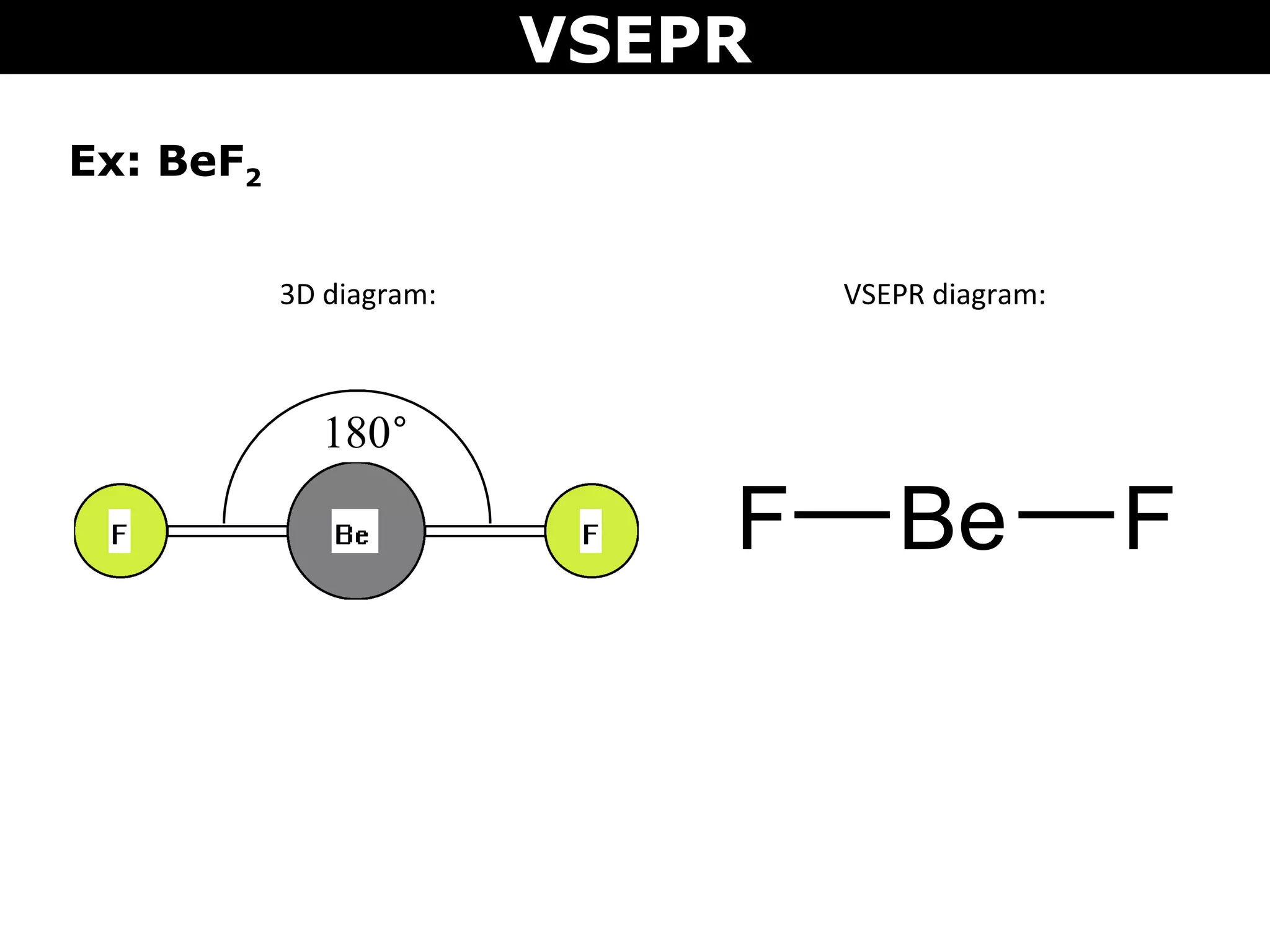
Ex: BeF2
180°
Be FF
3D diagram: VSEPR diagram:
VSEPR
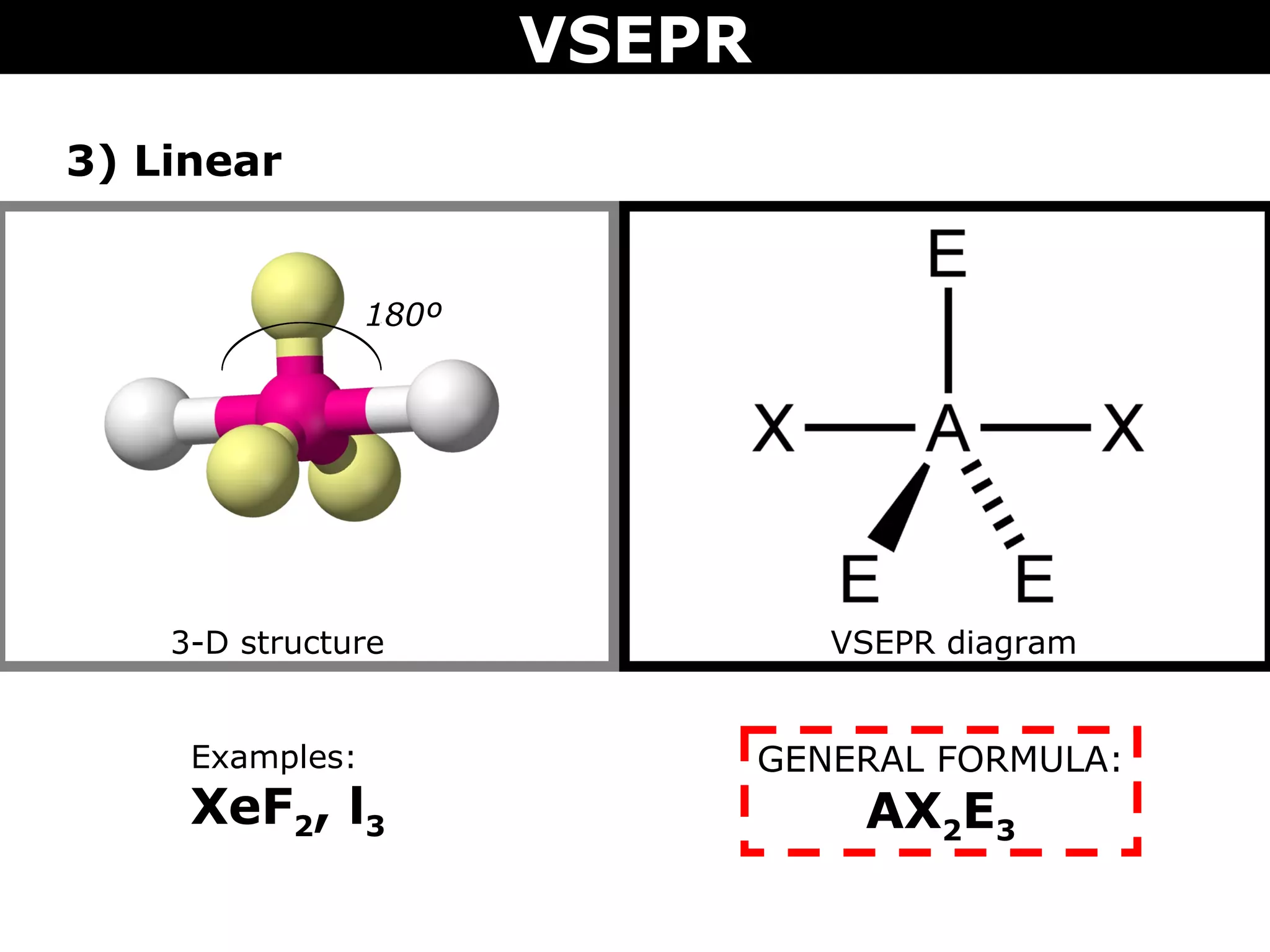
3) Linear
Examples:
XeF2, l3
GENERAL FORMULA:
AX2E3
3-D structure VSEPR diagram
180º
VSEPR
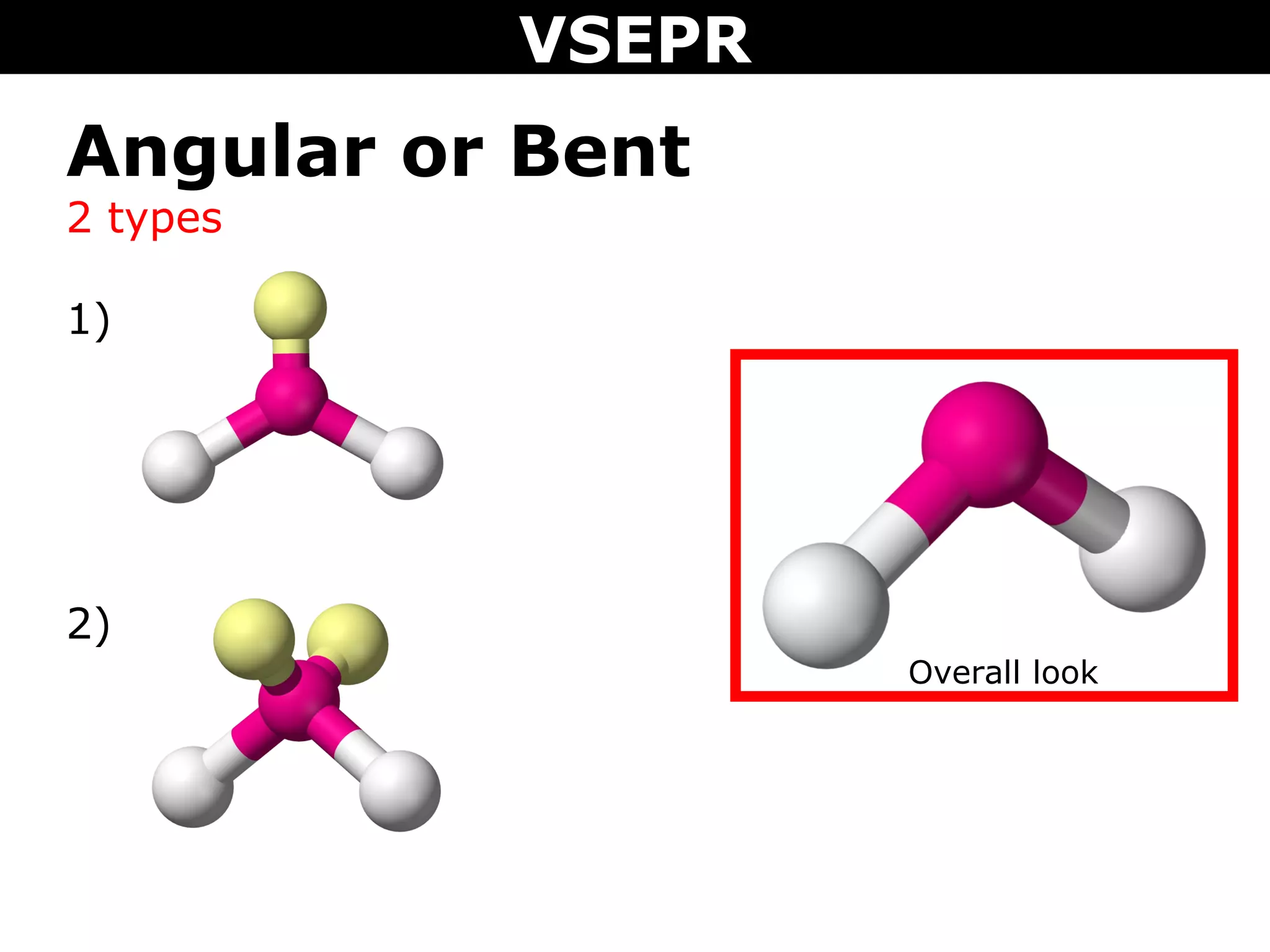
Overall look
Angular or Bent
2 types
1)
2)
VSEPR
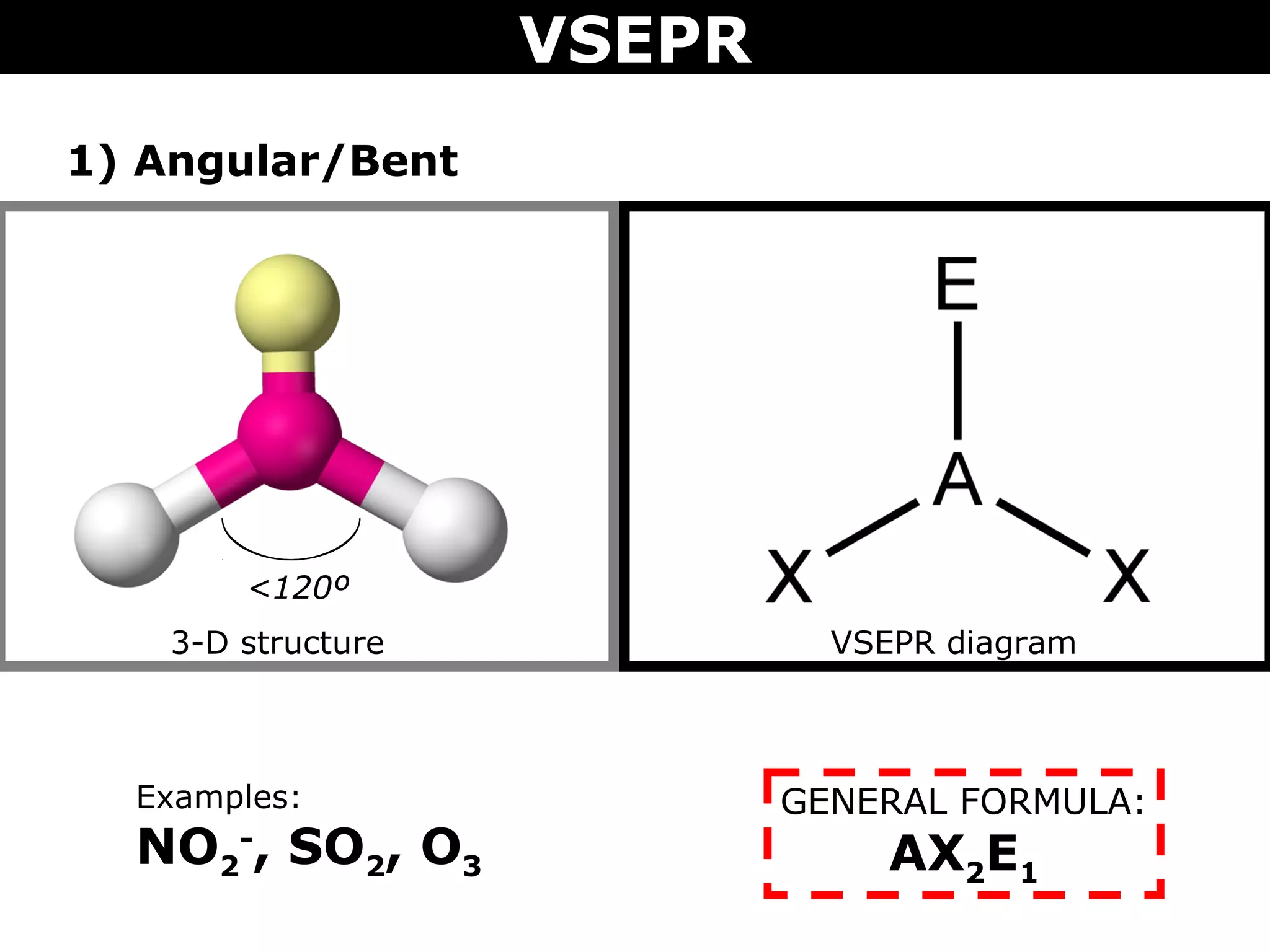
1) Angular/Bent
3-D structure VSEPR diagram
Examples:
NO2
-
, SO2, O3
GENERAL FORMULA:
AX2E1
<120º
VSEPR
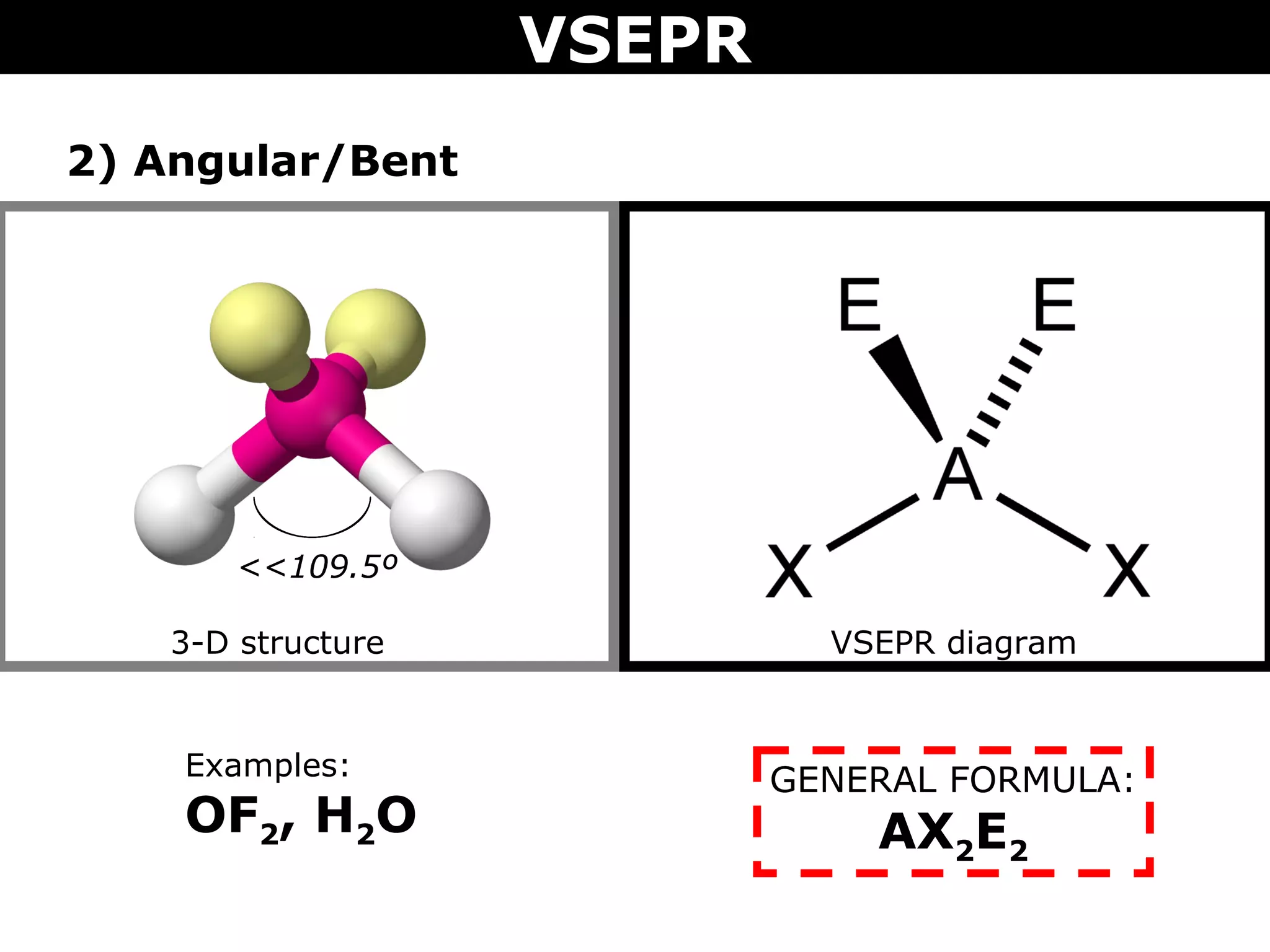
2) Angular/Bent
3-D structure VSEPR diagram
Examples:
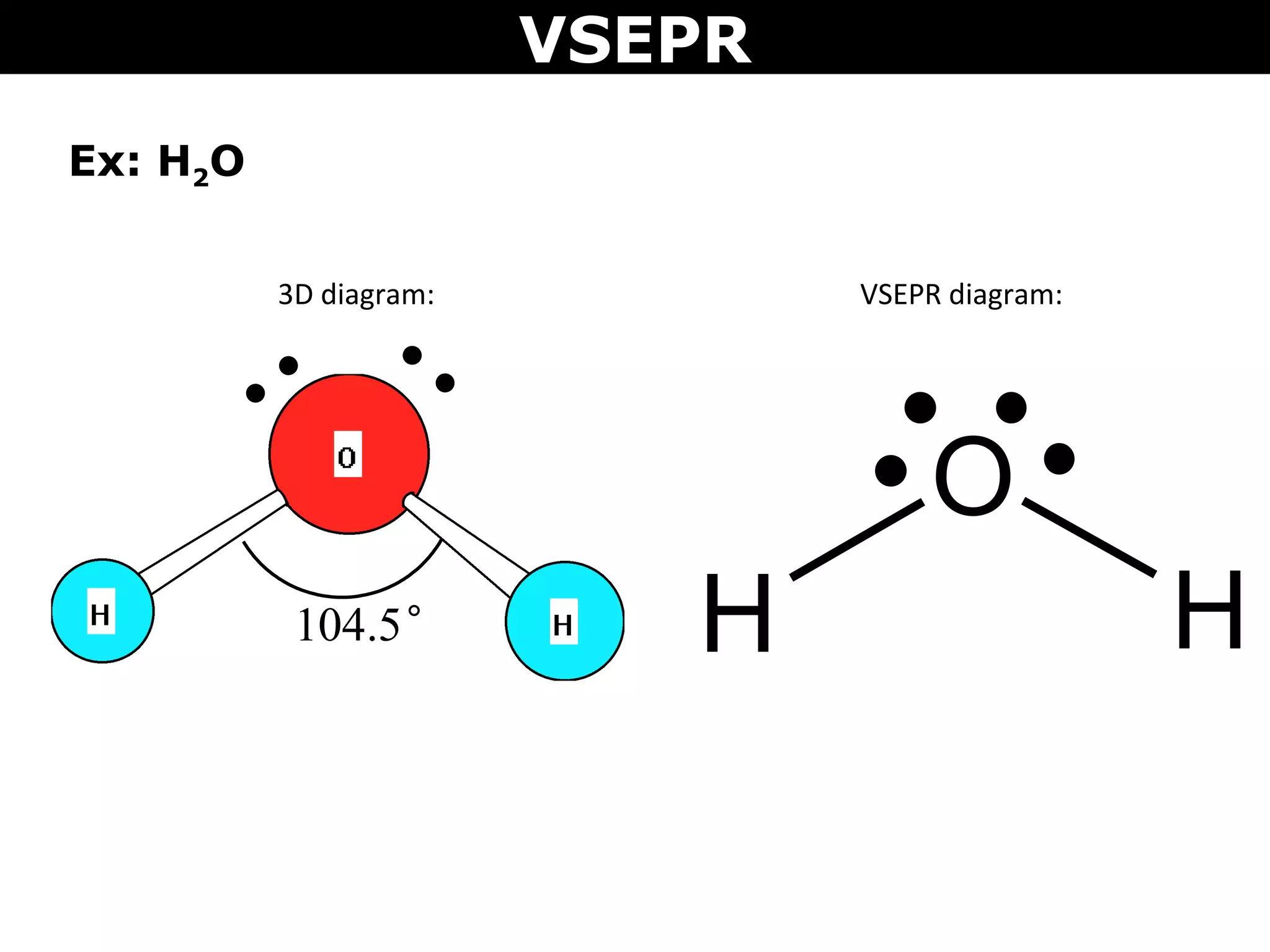
OF2, H2O
GENERAL FORMULA:
AX2E2
<<109.5º
VSEPR
Why are the bond angles different?
<120º
vs.
A lone pair is less confined in space and exerts greater repulsions on
nearby bonding pairs.
As a result, bonding pairs are pushed farther away from the lone pairs.
i.e. Water has a 104.5° bond angle (not 109.5° since lone pairs of
electrons require more space than bonding pair)
<<109.5º
VSEPR
Ex: H2O
3D diagram: VSEPR diagram:
104.5° H
O
H
VSEPR
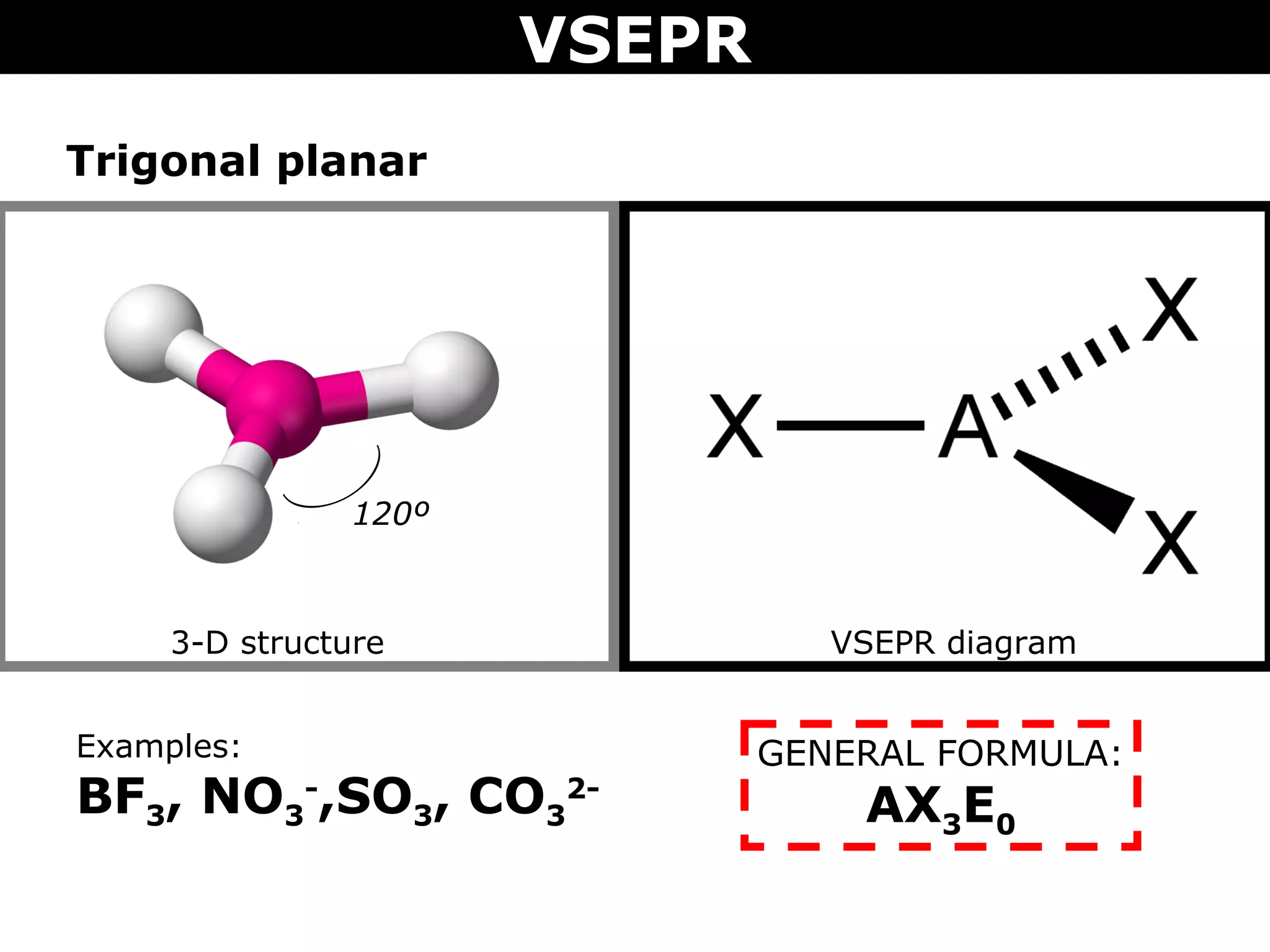
Trigonal planar
1 type
1)
VSEPR
Trigonal planar
3-D structure VSEPR diagram
Examples:
BF3, NO3
-
,SO3, CO3
2-
GENERAL FORMULA:
AX3E0
120º
VSEPR
Ex: BF3
3D diagram: VSEPR diagram:
120° B
FF
F
VSEPR
Trigonal pyramidal
1 type
1)
VSEPR
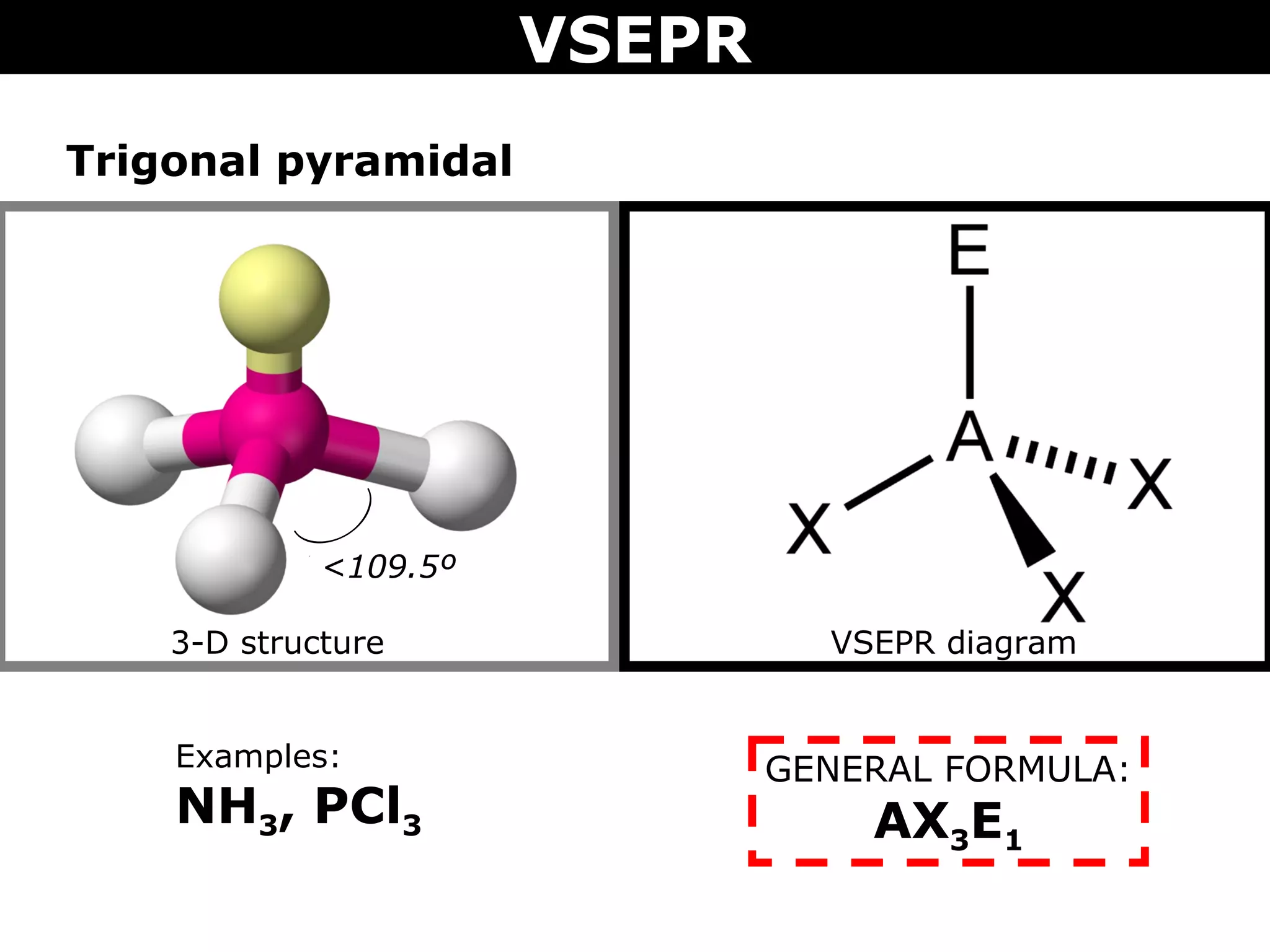
Trigonal pyramidal
3-D structure VSEPR diagram
Examples:
NH3, PCl3
GENERAL FORMULA:
AX3E1
<109.5º
VSEPR
Trigonal pyramidal
<109.5º
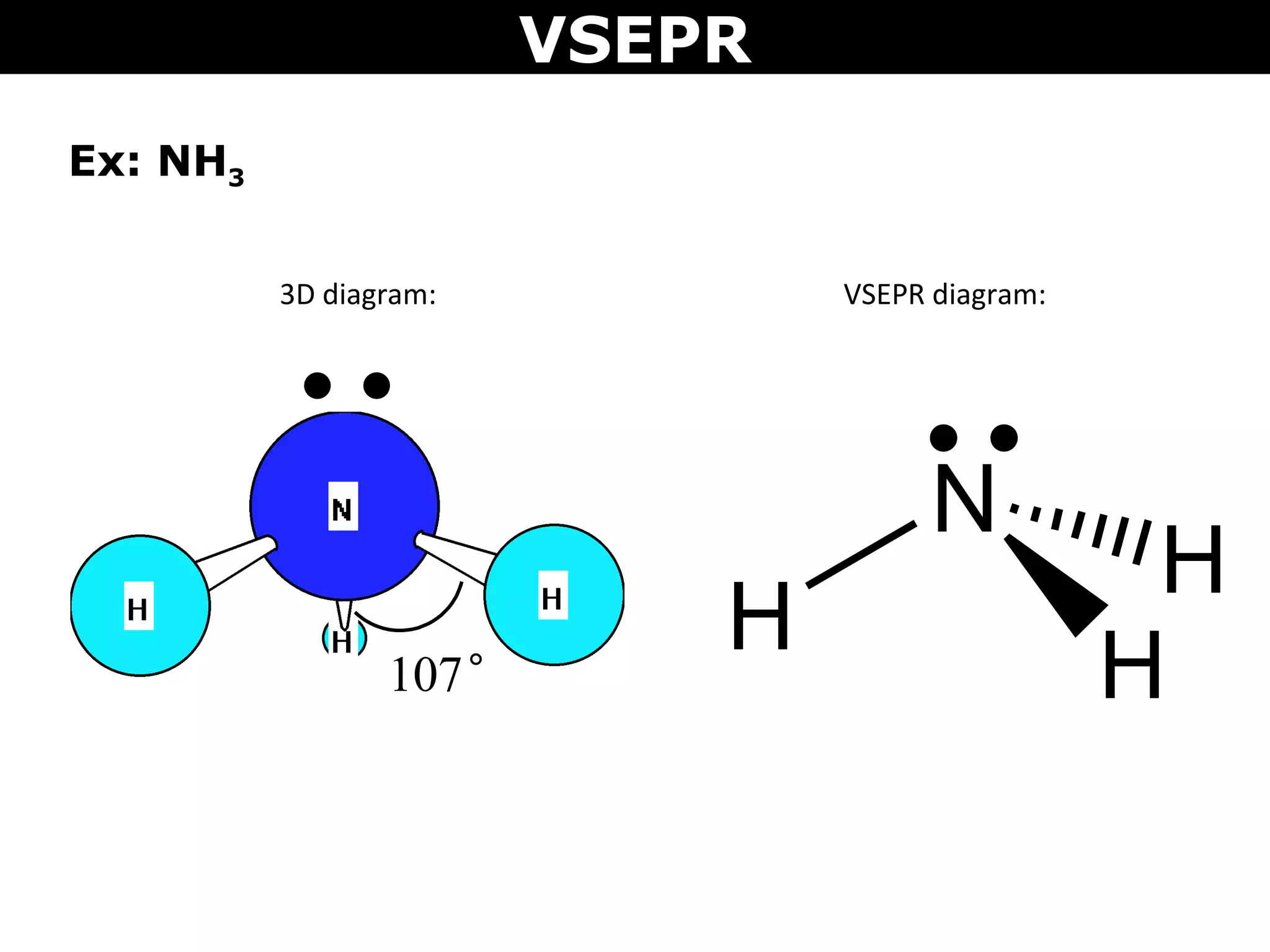
107° bond angle (not 109.5 of
tetrahedral because the lone
electron pair requires more space
than a bonding pair)
VSEPR
Ex: NH3
3D diagram: VSEPR diagram:
107°
N
H
H
H
VSEPR
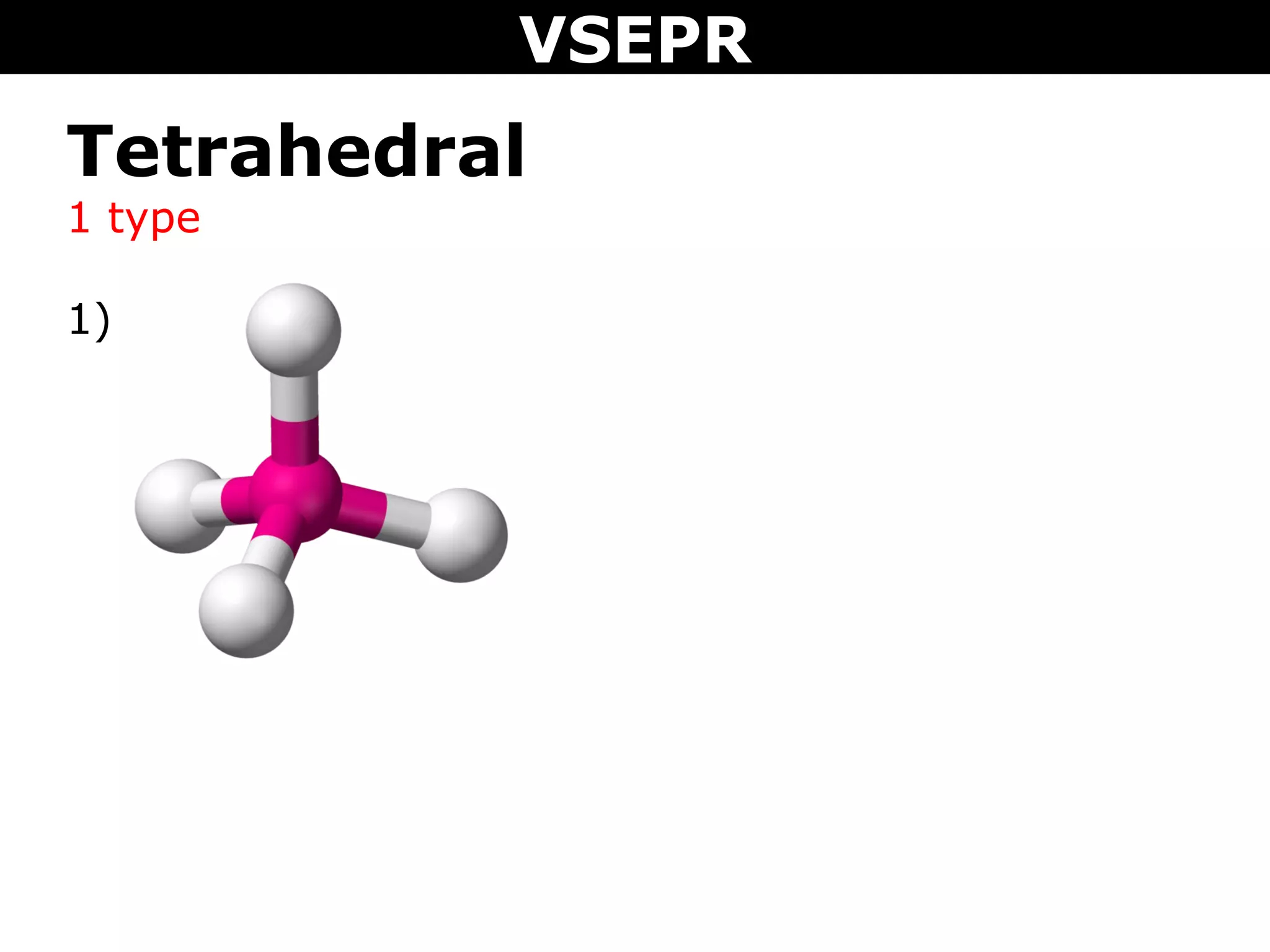
Tetrahedral
1 type
1)
VSEPR
Tetrahedral
3-D structure VSEPR diagram
Examples:
CH4, PO4
3-
, SO4
2-
, ClO4
-
GENERAL FORMULA:
AX4E0
109.5º
VSEPR
Ex: CCl4
3D diagram: VSEPR diagram:
109.5°
Cl
C
Cl
Cl
Cl
VSEPR
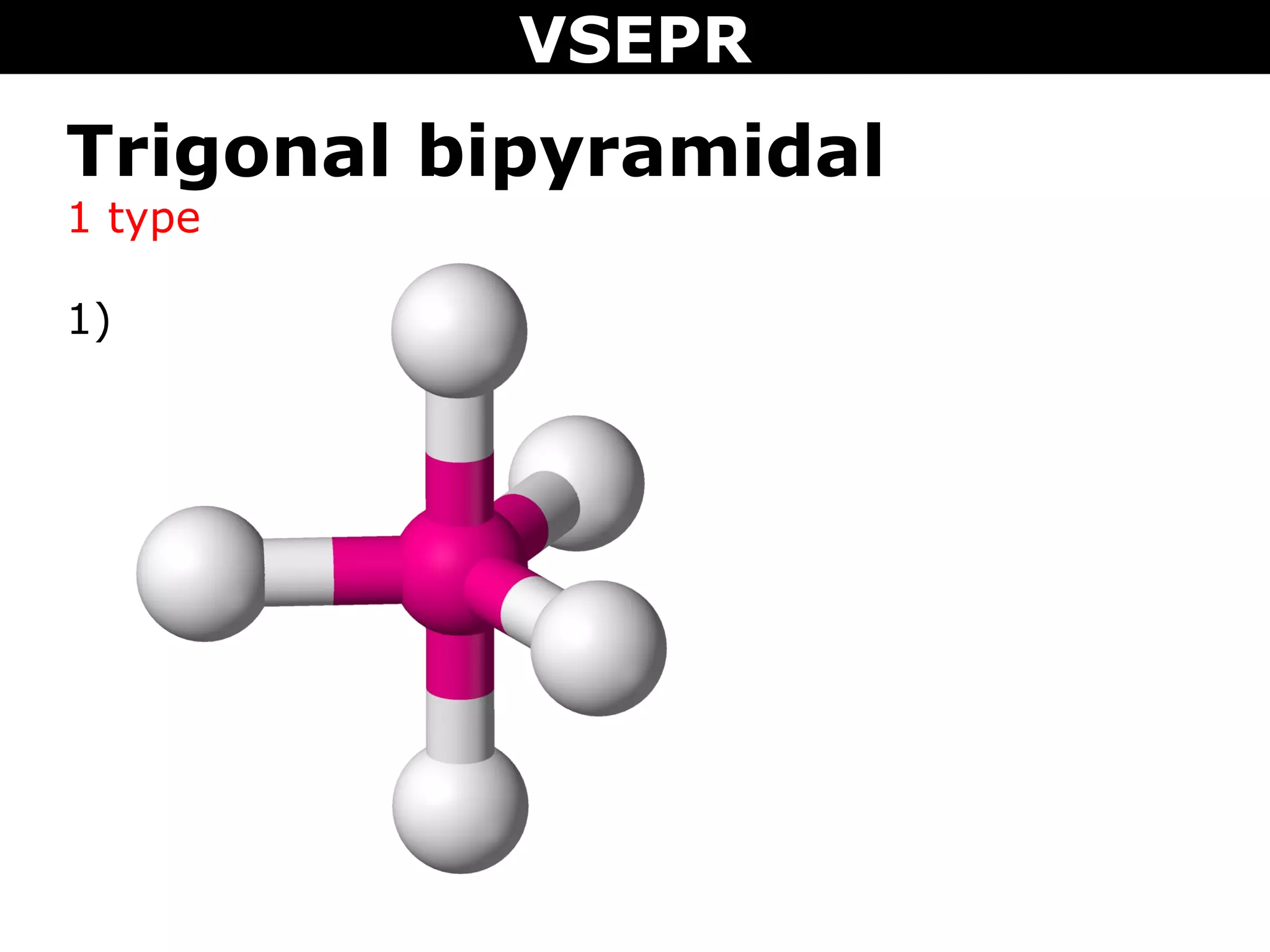
Trigonal bipyramidal
1 type
1)
VSEPR
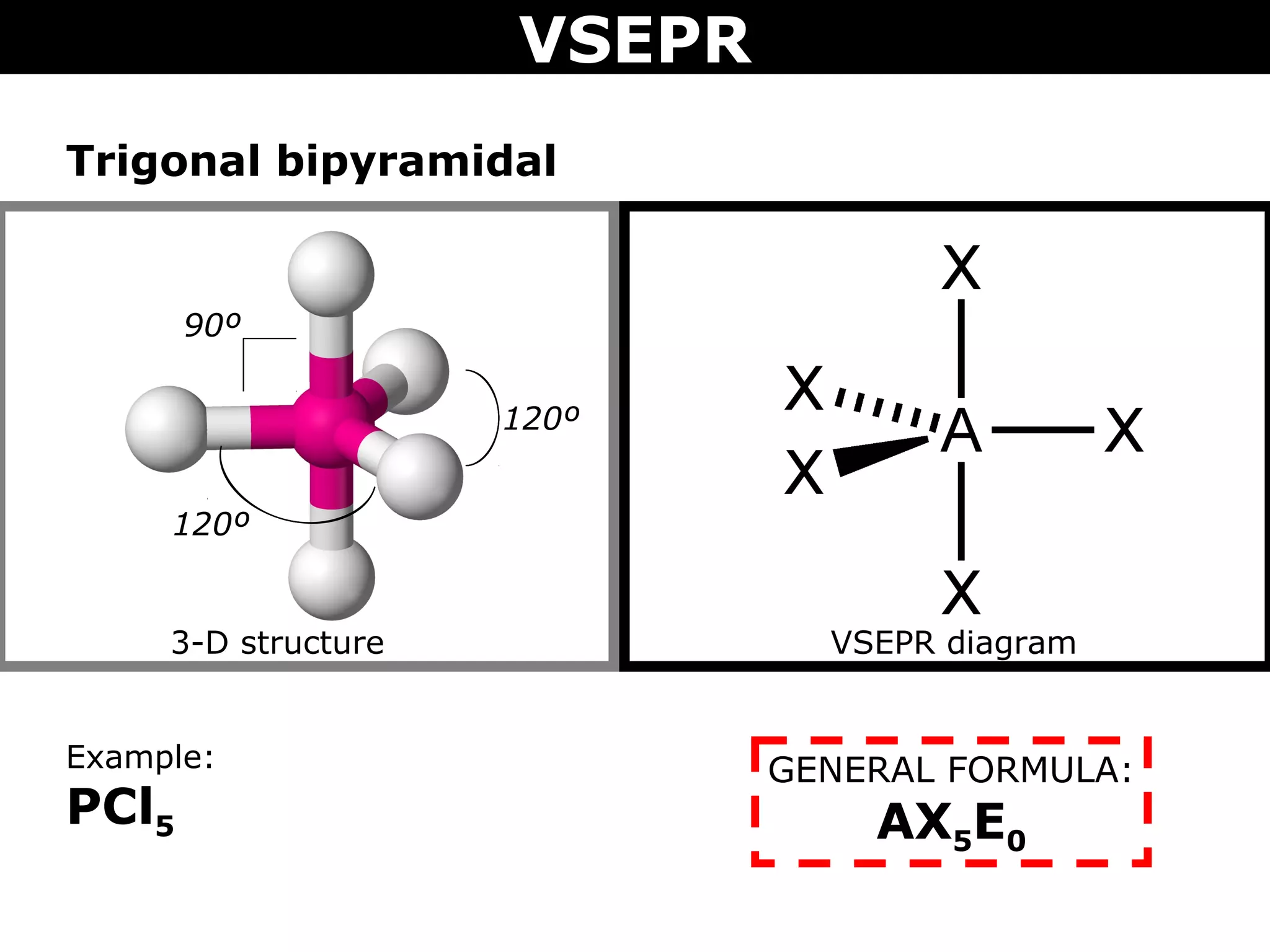
Trigonal bipyramidal
3-D structure VSEPR diagram
Example:
PCl5
GENERAL FORMULA:
AX5E0
120º
120º
90º
VSEPR
Ex: PF5
3D diagram: VSEPR diagram:
F
F
F
F
F
P
90
120
°
°
F P
F
F
F
F
VSEPR
Seesaw
1 type
1)
VSEPR
Seesaw
3-D structure VSEPR diagram
Example:
SF4
GENERAL FORMULA:
AX4E1
<120º
90º
VSEPR
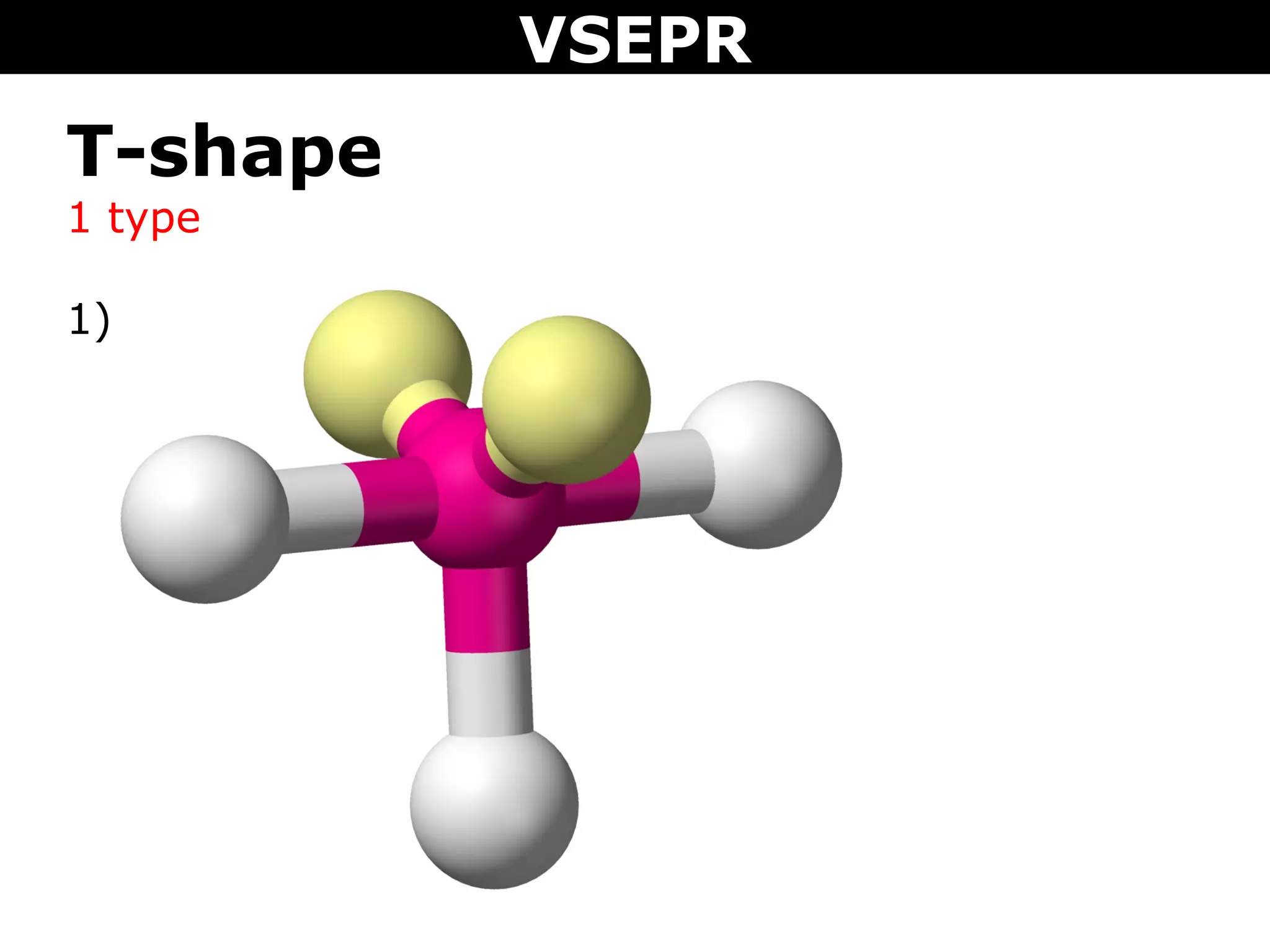
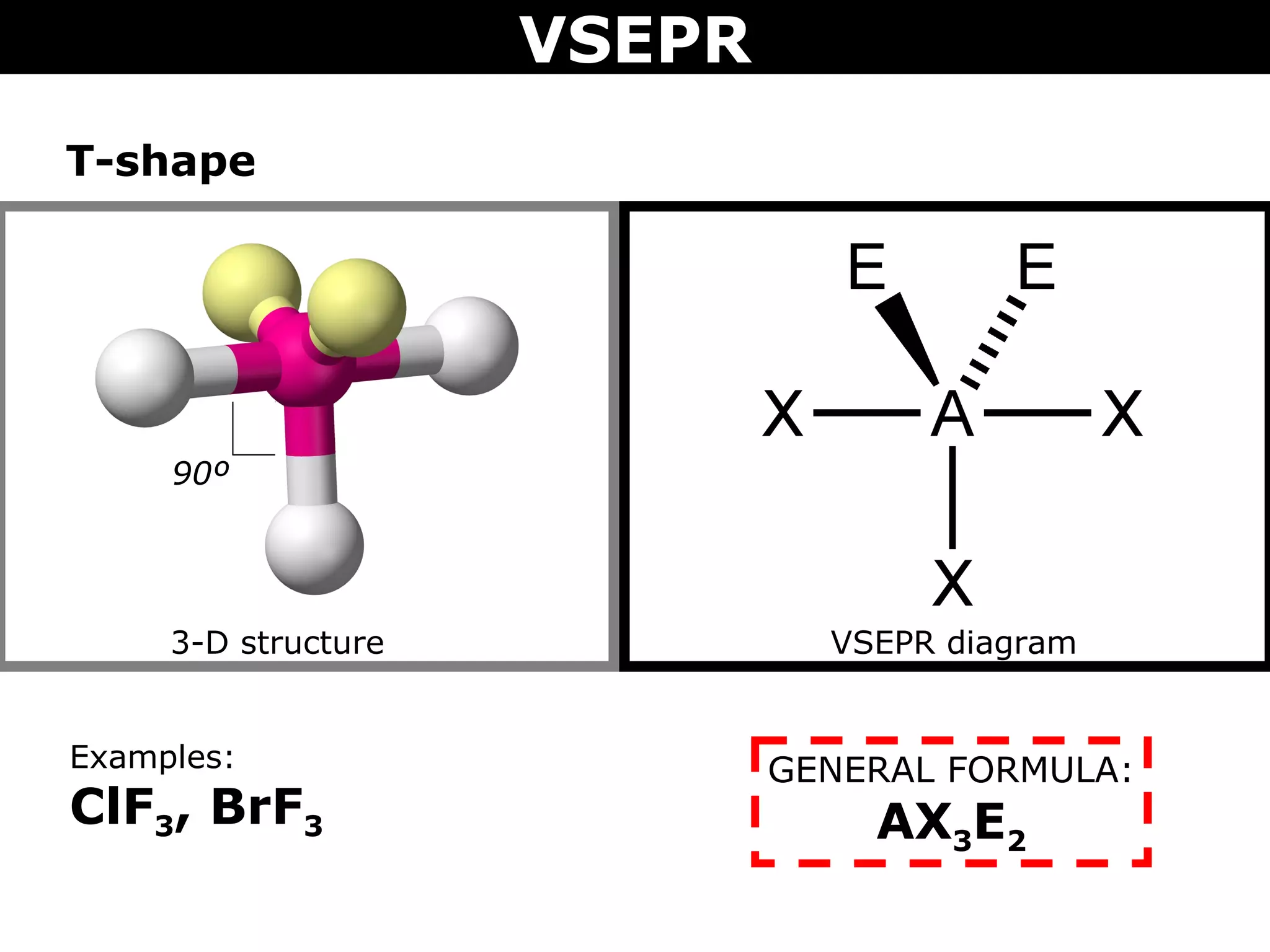
T-shape
1 type
1)
VSEPR
T-shape
3-D structure VSEPR diagram
Examples:
ClF3, BrF3
GENERAL FORMULA:
AX3E2
90º
VSEPR
Octahedral
1 type
1)
VSEPR
Octahedral
3-D structure VSEPR diagram
Examples:
SF6, WCl6
GENERAL FORMULA:
AX6E0
90º
90º
S
90°
S
F
F F
F
F
F
VSEPR
Ex: SF6
3D diagram: VSEPR diagram:
VSEPR
Square pyramidal
1 type
1)
VSEPR
Square pyramidal
3-D structure VSEPR diagram
Examples:
ClF5, BrF5, XeOF4
GENERAL FORMULA:
AX5E1
<90º
90º
VSEPR
Square planar
1 type
1)
VSEPR
Square planar
3-D structure VSEPR diagram
Example:
XeF4
GENERAL FORMULA:
AX4E2
90º
VSEPR
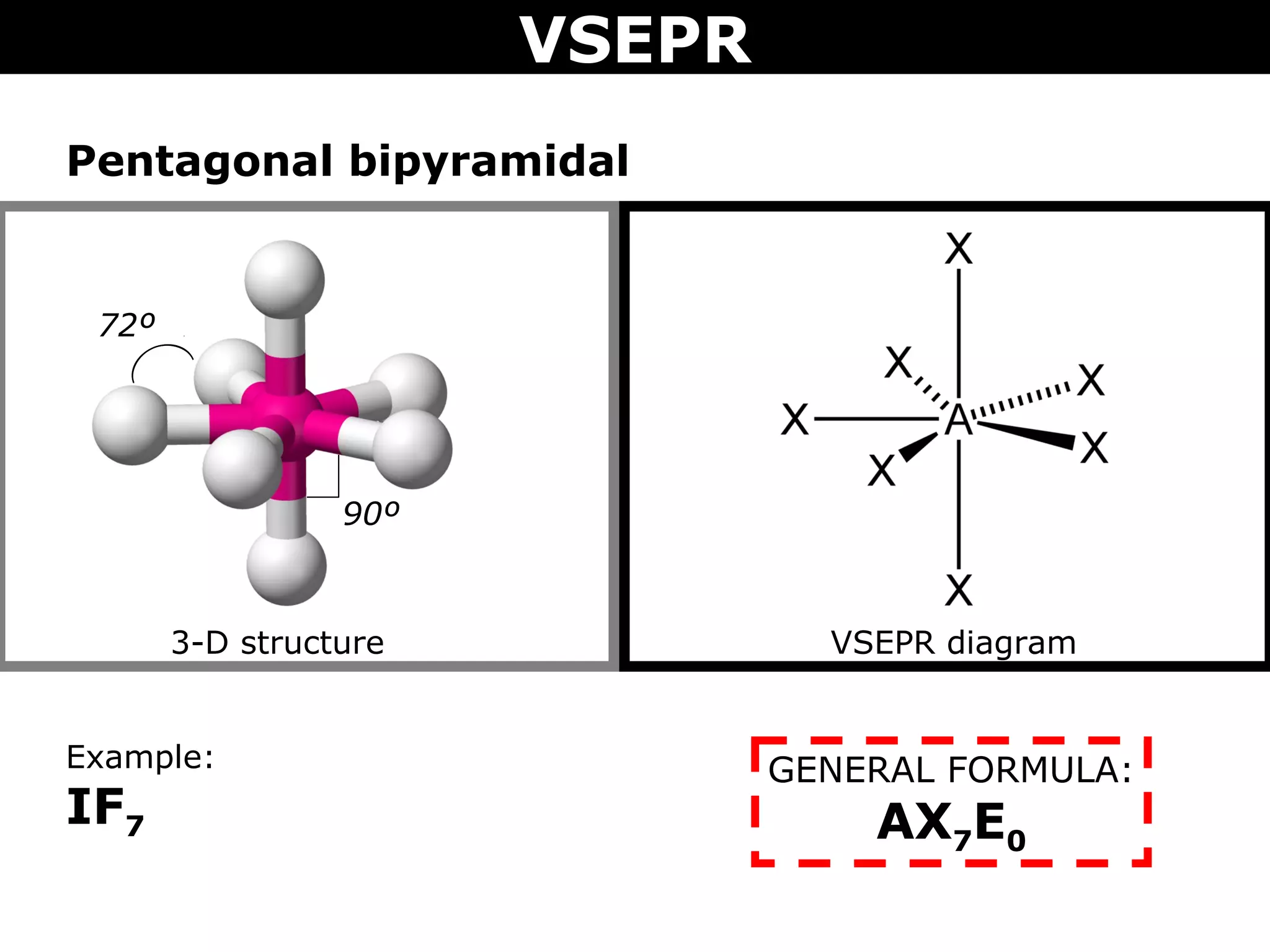
Pentagonal bipyramidal
1 type
1)
VSEPR
Pentagonal bipyramidal
3-D structure VSEPR diagram
Example:
IF7
GENERAL FORMULA:
AX7E0
72º
90º
How to Apply the VSEPR Theory?
1. Draw the Lewis structure
2. Count the electron pairs
surrounding the central atom
and maximize their distance
from each other
3. Determine the name of the
structure from the number of
bonding and lone pairs of
electrons
VSEPR
Example: OF2
2 lone pairs, 2 bonding pairs
AX2E2
Angular/bent
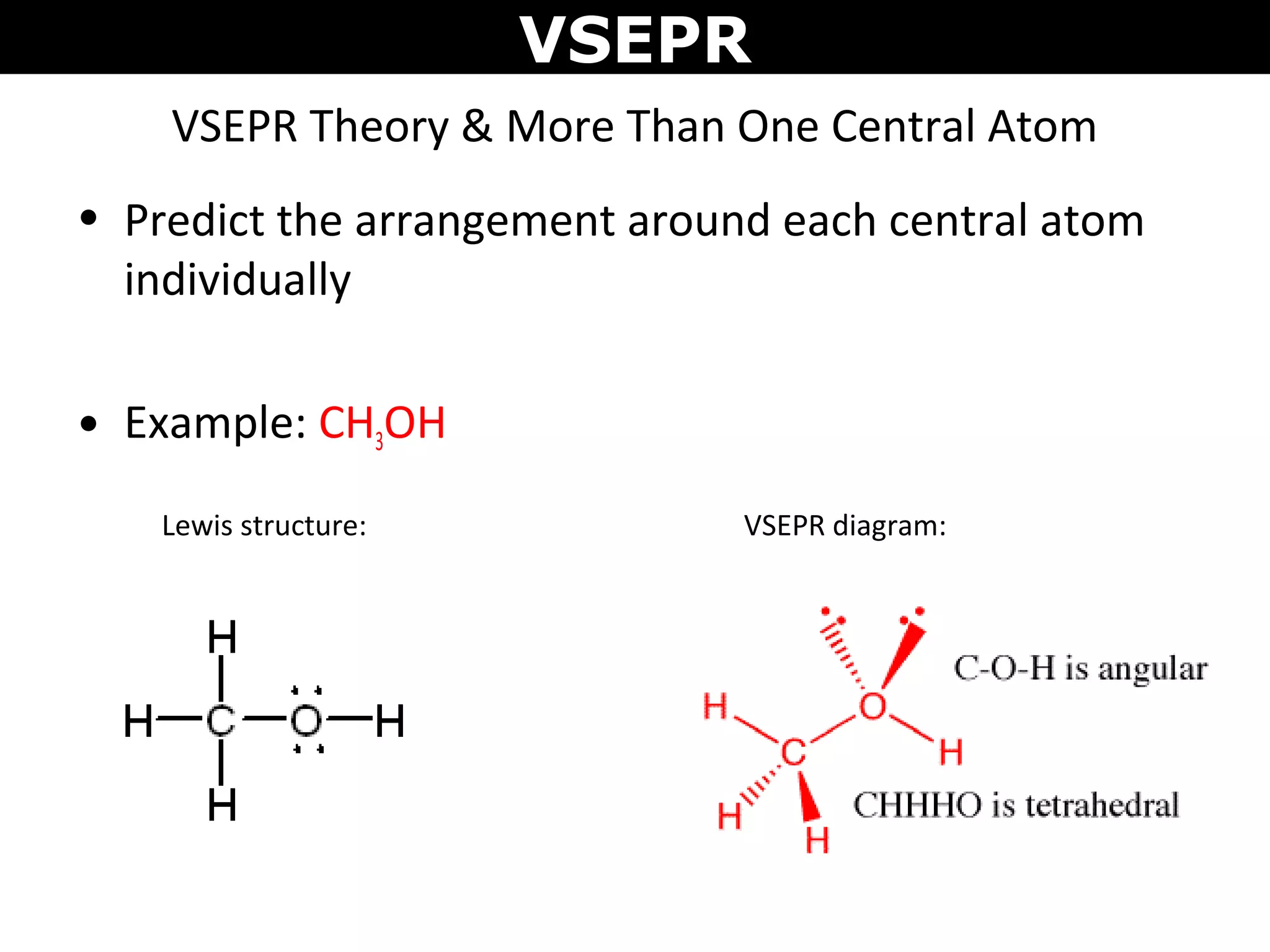
VSEPR Theory & More Than One Central Atom
• Predict the arrangement around each central atom
individually
• Example: CH3OH
VSEPR
Lewis structure: VSEPR diagram:
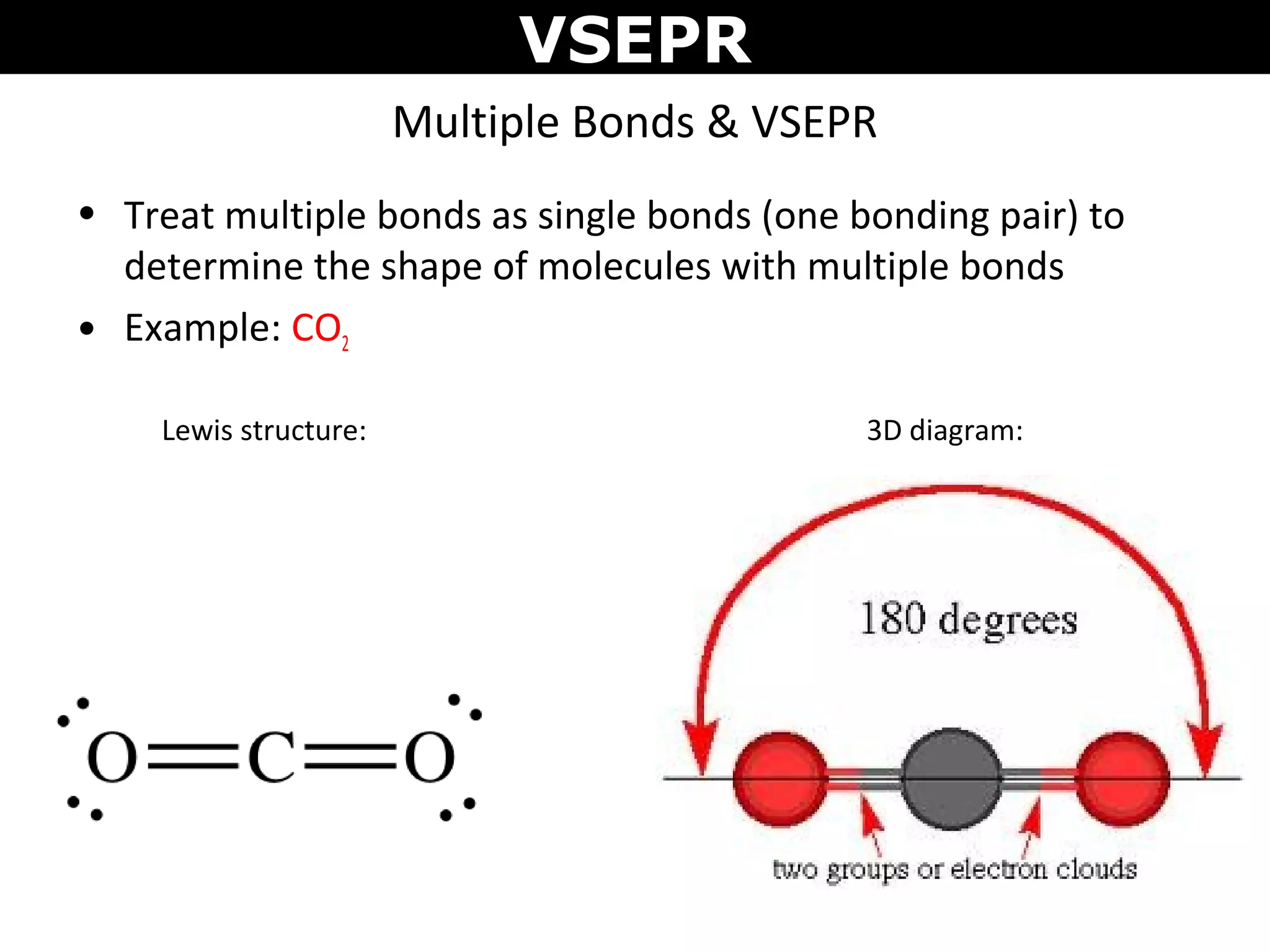
Multiple Bonds & VSEPR
• Treat multiple bonds as single bonds (one bonding pair) to
determine the shape of molecules with multiple bonds
• Example: CO2
VSEPR
Lewis structure: 3D diagram:
Homework
• Page 216 # 2 – 10
VSEPR

Tang 07 vsepr

Editor's Notes

  • #2 http://www.youtube.com/watch?v=rMIPyOuQu08&amp;feature=related