Pericyclic reactions
(Part-I)
Dr Mishu Singh
Department of Chemistry
Maharana Pratap Govt. P.G. College, Hardoi
www.mpgpdcollegehardoi.in
www.mishchemworld/wix.com
1M.Singh
NO MEACHANISHM REACTION
1965 WOODWARD & FUKUI – NOBEL PRIZE
2M.Singh
Content in Part-I
Classification of Organic Reactions
Classification of Pericyclic Reactions
3M.Singh
Broad Classification: Organic Reactions
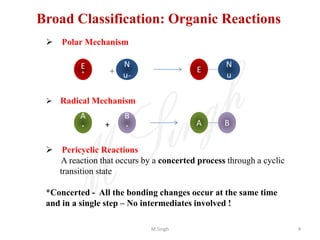
➢ Polar Mechanism
+
➢ Radical Mechanism
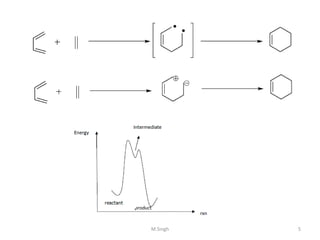
➢ Pericyclic Reactions
A reaction that occurs by a concerted process through a cyclic
transition state
*Concerted - All the bonding changes occur at the same time
and in a single step – No intermediates involved !
E
+
N
u_ E
N
u
A
. +
B
. A B
4M.Singh
5M.Singh
6
➢Polar Reactions:
Involves carbanions or carbocations as reactive intermediates
e.g. Aldol condensation, Pinacol-Pinacolone rearrangement
Mechanism:
M.Singh
7
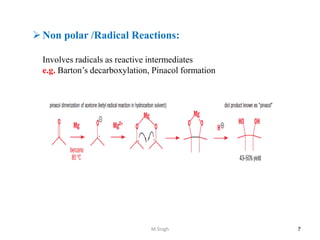
➢Non polar /Radical Reactions:
Involves radicals as reactive intermediates
e.g. Barton’s decarboxylation, Pinacol formation
M.Singh
8
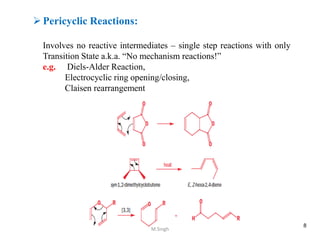
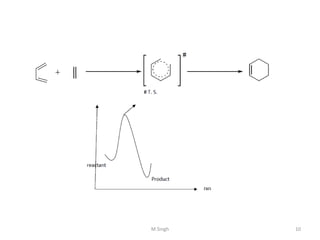
➢Pericyclic Reactions:
Involves no reactive intermediates – single step reactions with only
Transition State a.k.a. “No mechanism reactions!”
e.g. Diels-Alder Reaction,
Electrocyclic ring opening/closing,
Claisen rearrangement
M.Singh
9
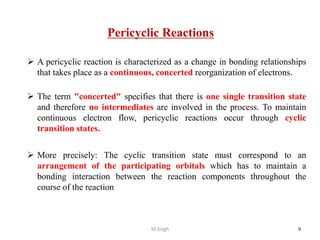
Pericyclic Reactions
➢ A pericyclic reaction is characterized as a change in bonding relationships
that takes place as a continuous, concerted reorganization of electrons.
➢ The term "concerted" specifies that there is one single transition state
and therefore no intermediates are involved in the process. To maintain
continuous electron flow, pericyclic reactions occur through cyclic
transition states.
➢ More precisely: The cyclic transition state must correspond to an
arrangement of the participating orbitals which has to maintain a
bonding interaction between the reaction components throughout the
course of the reaction
M.Singh
10M.Singh
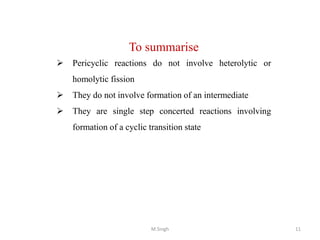
To summarise
➢ Pericyclic reactions do not involve heterolytic or
homolytic fission
➢ They do not involve formation of an intermediate
➢ They are single step concerted reactions involving
formation of a cyclic transition state
11M.Singh
Pericyclic Reactions-Classification
12M.Singh
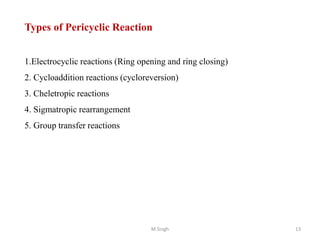
Types of Pericyclic Reaction
1.Electrocyclic reactions (Ring opening and ring closing)
2. Cycloaddition reactions (cycloreversion)
3. Cheletropic reactions
4. Sigmatropic rearrangement
5. Group transfer reactions
13M.Singh
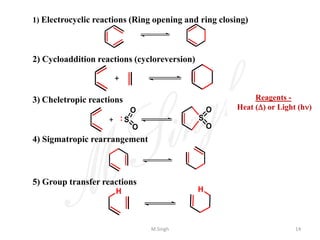
1) Electrocyclic reactions (Ring opening and ring closing)
2) Cycloaddition reactions (cycloreversion)
3) Cheletropic reactions
4) Sigmatropic rearrangement
5) Group transfer reactions
Reagents -
Heat () or Light (h)
14M.Singh
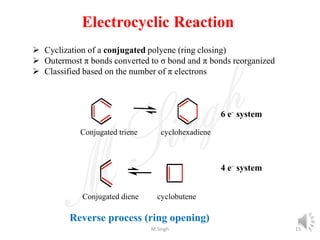
Electrocyclic Reaction
➢ Cyclization of a conjugated polyene (ring closing)
➢ Outermost π bonds converted to σ bond and π bonds reorganized
➢ Classified based on the number of π electrons
Conjugated triene
Conjugated diene
cyclohexadiene
cyclobutene
6 e⁻ system
4 e⁻ system
Reverse process (ring opening)
15M.Singh
Cycloaddition Reaction
[4π + 2π][2π + 2π]
[4π + 4π]
[4π + 6π]
➢ Condensation of two (or more) small π systems to form a ring
➢ σ bonds formed at the expense of π bonds
➢ Classified by the number of π electrons interacting
Cycloreversion is the reverse of cyclo addition
16M.Singh
Cheletropic Reaction
➢ A special type of cycloaddition/cyclo-reversion reactions.
➢ Two bonds are formed or broken at a single atom.
➢ Nomenclature same as for cycloadditions.
[4+1]
[2+1]
17M.Singh
➢ Involves the breaking and migration of a sigma bond over p
electron systems
➢ Formation of a new sigma bond occurs with reorganization of
the p systems
X = C; Cope Rearrangement
X = O; Claisen Rearrangement
Classified as [i,j] shift, because
the rearrangement occurred
when the σ-bond migrates across
i atoms of one system and j of
another
Sigmatropic Rearrangement
18M.Singh
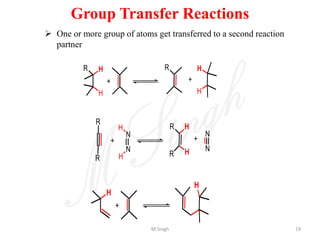
Group Transfer Reactions
➢ One or more group of atoms get transferred to a second reaction
partner
19M.Singh
20M.Singh

Pericyclic reaction part 1-converted

  • 1.
    Pericyclic reactions (Part-I) Dr MishuSingh Department of Chemistry Maharana Pratap Govt. P.G. College, Hardoi www.mpgpdcollegehardoi.in www.mishchemworld/wix.com 1M.Singh
  • 2.
    NO MEACHANISHM REACTION 1965WOODWARD & FUKUI – NOBEL PRIZE 2M.Singh
  • 3.
    Content in Part-I Classificationof Organic Reactions Classification of Pericyclic Reactions 3M.Singh
  • 4.
    Broad Classification: OrganicReactions ➢ Polar Mechanism + ➢ Radical Mechanism ➢ Pericyclic Reactions A reaction that occurs by a concerted process through a cyclic transition state *Concerted - All the bonding changes occur at the same time and in a single step – No intermediates involved ! E + N u_ E N u A . + B . A B 4M.Singh
  • 5.
  • 6.
    6 ➢Polar Reactions: Involves carbanionsor carbocations as reactive intermediates e.g. Aldol condensation, Pinacol-Pinacolone rearrangement Mechanism: M.Singh
  • 7.
    7 ➢Non polar /RadicalReactions: Involves radicals as reactive intermediates e.g. Barton’s decarboxylation, Pinacol formation M.Singh
  • 8.
    8 ➢Pericyclic Reactions: Involves noreactive intermediates – single step reactions with only Transition State a.k.a. “No mechanism reactions!” e.g. Diels-Alder Reaction, Electrocyclic ring opening/closing, Claisen rearrangement M.Singh
  • 9.
    9 Pericyclic Reactions ➢ Apericyclic reaction is characterized as a change in bonding relationships that takes place as a continuous, concerted reorganization of electrons. ➢ The term "concerted" specifies that there is one single transition state and therefore no intermediates are involved in the process. To maintain continuous electron flow, pericyclic reactions occur through cyclic transition states. ➢ More precisely: The cyclic transition state must correspond to an arrangement of the participating orbitals which has to maintain a bonding interaction between the reaction components throughout the course of the reaction M.Singh
  • 10.
  • 11.
    To summarise ➢ Pericyclicreactions do not involve heterolytic or homolytic fission ➢ They do not involve formation of an intermediate ➢ They are single step concerted reactions involving formation of a cyclic transition state 11M.Singh
  • 12.
  • 13.
    Types of PericyclicReaction 1.Electrocyclic reactions (Ring opening and ring closing) 2. Cycloaddition reactions (cycloreversion) 3. Cheletropic reactions 4. Sigmatropic rearrangement 5. Group transfer reactions 13M.Singh
  • 14.
    1) Electrocyclic reactions(Ring opening and ring closing) 2) Cycloaddition reactions (cycloreversion) 3) Cheletropic reactions 4) Sigmatropic rearrangement 5) Group transfer reactions Reagents - Heat () or Light (h) 14M.Singh
  • 15.
    Electrocyclic Reaction ➢ Cyclizationof a conjugated polyene (ring closing) ➢ Outermost π bonds converted to σ bond and π bonds reorganized ➢ Classified based on the number of π electrons Conjugated triene Conjugated diene cyclohexadiene cyclobutene 6 e⁻ system 4 e⁻ system Reverse process (ring opening) 15M.Singh
  • 16.
    Cycloaddition Reaction [4π +2π][2π + 2π] [4π + 4π] [4π + 6π] ➢ Condensation of two (or more) small π systems to form a ring ➢ σ bonds formed at the expense of π bonds ➢ Classified by the number of π electrons interacting Cycloreversion is the reverse of cyclo addition 16M.Singh
  • 17.
    Cheletropic Reaction ➢ Aspecial type of cycloaddition/cyclo-reversion reactions. ➢ Two bonds are formed or broken at a single atom. ➢ Nomenclature same as for cycloadditions. [4+1] [2+1] 17M.Singh
  • 18.
    ➢ Involves thebreaking and migration of a sigma bond over p electron systems ➢ Formation of a new sigma bond occurs with reorganization of the p systems X = C; Cope Rearrangement X = O; Claisen Rearrangement Classified as [i,j] shift, because the rearrangement occurred when the σ-bond migrates across i atoms of one system and j of another Sigmatropic Rearrangement 18M.Singh
  • 19.
    Group Transfer Reactions ➢One or more group of atoms get transferred to a second reaction partner 19M.Singh
  • 20.