“AN APPROACH TO BONDING IN WHICH
ORBITALS
ENCOMPASS THE ENTIRE MOLECULE, RATHER
THAN BEING LOCALIZED BETWEEN ATOMS.”
Satyabrata Sendh
MSc Part II(2018-19)
PG Dept of Chemistry
Berhampur University
1
 INTRODUCTION
 ASSUMPTION AND POSTULATES
 LCAO PRINCIPLE
 MO OF DIATOMIC MOLECULES
 SIGNIFICANCE AND APPLICATIONS OF MOT
BU CHEM/ Satyabrata / MOT2
 Probably the second and most applicable theory for bonding and structure of
molecules.
 Put forward by HUND and MULLIKEN.
 Later modified by JONES and COULSON.
HUND MULLIKEN
Though there was VBT to explain bonding and
structure of molecules still it was unable to explain
some features. Hence because of the drawbacks
of VBT another theory was given known as
MOLECULAR ORBITAL THEORY.
Drawbacks of VBT -
 Fails to explain paramagnetic nature of O2
 Resonance plays a major role in VBT but no role in MOT.
 VBT did not give any weightage to ionic structure BUT MOT did.
 It didn’t say about Anti bonding orbital thus failed to say about spectral lines.
BU CHEM/ Satyabrata / MOT3
If two nuclei are positioned at equilibrium distance, the electron are added and
they will go in to molecular orbitals.
 Each molecular orbital is given by a wave function Ψ known as molecular orbital
wave function.
 Ψ2 represents to probability density or total electron charge density.
 Each wave function (Ψ) is associated with a set of quantum no which
determines the energy and the shape of the orbitals.
 Each wave function (Ψ) is associated with certain amount of energy and total
amount of energy is sum of energies of occupied molecular orbitals.
 The number of molecular orbitals (MOs) formed is always equal to the number of
atomic orbitals combined.
 Filling of orbitals takes place accordingly to HUND’s rule, PAULI’s principle and
as that of Aos.
BU CHEM/ Satyabrata / MOT4
For approximation of correct MO, though there are several methods let’s do
accordingly with Liner Combination of Atomic Orbitals (LCAO)
Liner Combination of Atomic Orbitals (LCAO)
Conditions for LCAO-
 Atomic orbital's must be roughly of the same energy. Atomic orbitals with
differing energies or the wrong spatial orientation (orthogonal) do not combine,
and are called non-bonding orbitals.
 The orbital must overlap one another as much as possible- i.e. atoms must be
close enough for effective overlapping.
 In order to produce bonding and anti bonding MOs, either the symmetry of two
atomic orbital must be same or when rotated about the internuclear line both
atomic orbital's must change symmetry in identical manner.
ΨAB = N(ΨA + ΨB)
Ψ2AB = ( ΨA2 + ΨB 2 + 2 ΨA ΨB )
BU CHEM/ Satyabrata / MOT5
An analogy of atomic wave functions.
 Increased electron
density between the
two nuclei
 Lower energy than the
two separate atomic
orbitals
 Node between the two
Nuclei ,decreased electron density
 Greater energy than
the two separate
atomic orbitals
Out phase
Destructive
No resultant
wave
BU CHEM/ Satyabrata / MOT6
COMBINATION OF S ORBITALS
BU CHEM/ Satyabrata / MOT7
COMBINATION OF P ORBITALS
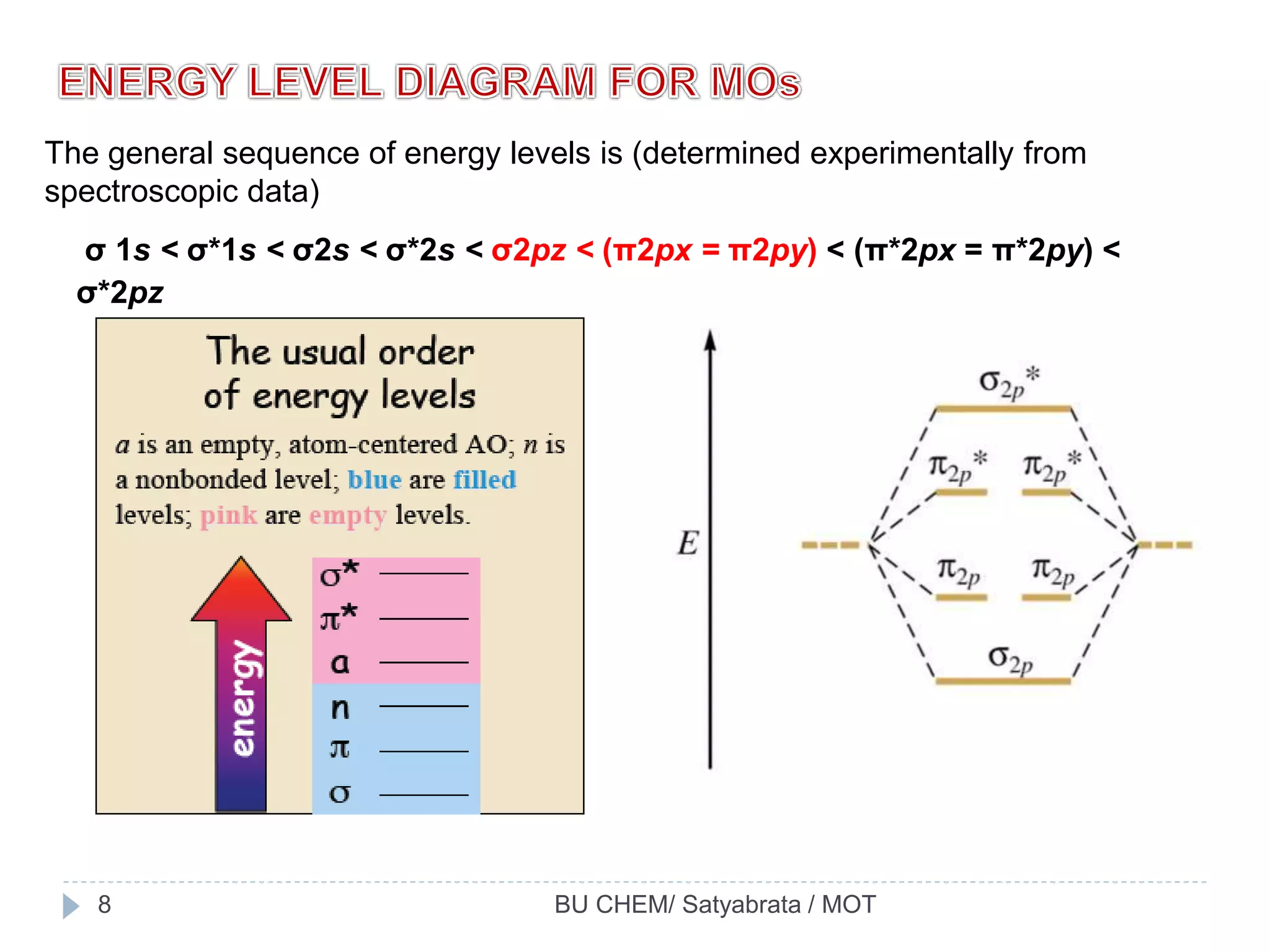
The general sequence of energy levels is (determined experimentally from
spectroscopic data)
BU CHEM/ Satyabrata / MOT8
σ 1s < σ*1s < σ2s < σ*2s < σ2pz < (π2px = π2py) < (π*2px = π*2py) <
σ*2pz
BU CHEM/ Satyabrata / MOT9
ORBITAL MIXING
σ 1s < σ*1s < σ2s < σ*2s < (π2px = π2py) < σ2pz < (π*2px = π*2py) <
σ*2pz
Lets start with the simplest molecule H2
BU CHEM/ Satyabrata / MOT10
MOLECULAR OXYGEN(O2)
σ 1s < σ*1s < σ2s < σ*2s < σ2pz < (π2px = π2py) < (π*2px = π*2py) < σ*2pz
BU CHEM/ Satyabrata / MOT11
MOLECULAR FLUORINE(F2)
σ 1s < σ*1s < σ2s < σ*2s < σ2pz < (π2px = π2py) < (π*2px = π*2py) < σ*2pz
BU CHEM/ Satyabrata / MOT12
MOLECULAR NITROGEN(N2)
σ 1s < σ*1s < σ2s < σ*2s < (π2px = π2py) < σ2pz < (π*2px = π*2py) <
σ*2pz
BU CHEM/ Satyabrata / MOT13
MO OF NO
N=1s2 2s2 2p3
O=1s2 2s2 2p4
BU CHEM/ Satyabrata / MOT14
Bond Order=2.5
Bond Length=1.15A0
MO OF CO C=1s2 2s2 2p2
O=1s2 2s2 2p4
BU CHEM/ Satyabrata / MOT15
Bond Order=3
Bond Length=1.112 A0
MO OF CO+ (coulson diagram)
BU CHEM/ Satyabrata / MOT16
CO as a Ligand
 Both σ donor and a π acceptor ligand
 This phenomenon is called back bonding.
 The increased electron density in the antibonding orbitals of CO
causes an increase in the C-O bond length and a decrease in its
stretching frequency
BU CHEM/ Satyabrata / MOT17
SIGNIFICANCE OF MOT
The molecular behavior can be described on the basis of electronic
configuration.
The distribution of electrons among various molecular orbitals is called the
electronic
configuration of the molecule. From the electronic configuration of the molecule, it
is
possible to get important information about the molecule as discussed below.
Stability of Molecules: If Nb is the number of electrons occupying bonding
orbitals and
Na the number occupying the antibonding
orbitals, then
(i) the molecule is stable if Nb>>Na, and
(ii) the molecule is unstable if Nb <<Na.
In (i) more bonding orbitals are occupied and so the bonding influence is stronger
and a
stable molecule results.
In (ii) the antibonding influence is stronger and therefore the molecule
is unstable.
BU CHEM/ Satyabrata / MOT18
Bond order
Bond order (b.o.) is defined as one half the difference between the number of
electrons
present in the bonding and the antibonding
orbitals i.e.,
Bond order (b.o.) = ½ (Nb–Na)
The rules discussed above regarding the stability of the molecule can be restated in
terms of bond order as follows: A positive bond order (i.e., Nb > Na) means a stable
molecule while a negative (i.e., Nb<Na) or zero (i.e.,
Nb = Na) bond order means an unstable molecule.
Nature of the bond
Integral bond order values of 1, 2 or 3 correspond to single, double or triple bonds
respectively as studied in the classical concept.
Bond-length
The bond order between two atoms in a molecule may be taken as an approximate
measure of the bond length. The bond length decreases as bond order increases.
Magnetic nature
If all the molecular orbitals in a molecule are doubly occupied, the substance is
diamagnetic (repelled by magnetic field). However if one or more molecular orbitals
are
singly occupied it is paramagnetic (attracted by magnetic field), e.g., O2 molecule
BU CHEM/ Satyabrata / MOT19
MO diagram for He2
+ and He2.
He2
+ bond order = ½ He2 bond order = 0
(σ1s)2(σ )1*
1s (σ1s)2(σ )2*
1s
BU CHEM/ Satyabrata / MOT20
BU CHEM/ Satyabrata / MOT21
Experimental Evidence
 Photoelectron spectroscopy (PES)
is a technique in which a beam of
ultraviolet / X ray light with is used
to irradiate molecules.
 The technique allows for the
measurement of specific ionization
energies
(I). Each ionization energy
represents the removal of an
electron from a specific molecular
orbital.
 Electrons in lower energy levels
require more energy to be
removed, and are ejected with less
kinetic energy.
BU CHEM/ Satyabrata / MOT22
hνo = IE + EKinetic
*IE = Ionisation Energy
BU CHEM/ Satyabrata / MOT23
BU CHEM/ Satyabrata / MOT24

Mot

  • 1.
    “AN APPROACH TOBONDING IN WHICH ORBITALS ENCOMPASS THE ENTIRE MOLECULE, RATHER THAN BEING LOCALIZED BETWEEN ATOMS.” Satyabrata Sendh MSc Part II(2018-19) PG Dept of Chemistry Berhampur University 1
  • 2.
     INTRODUCTION  ASSUMPTIONAND POSTULATES  LCAO PRINCIPLE  MO OF DIATOMIC MOLECULES  SIGNIFICANCE AND APPLICATIONS OF MOT BU CHEM/ Satyabrata / MOT2
  • 3.
     Probably thesecond and most applicable theory for bonding and structure of molecules.  Put forward by HUND and MULLIKEN.  Later modified by JONES and COULSON. HUND MULLIKEN Though there was VBT to explain bonding and structure of molecules still it was unable to explain some features. Hence because of the drawbacks of VBT another theory was given known as MOLECULAR ORBITAL THEORY. Drawbacks of VBT -  Fails to explain paramagnetic nature of O2  Resonance plays a major role in VBT but no role in MOT.  VBT did not give any weightage to ionic structure BUT MOT did.  It didn’t say about Anti bonding orbital thus failed to say about spectral lines. BU CHEM/ Satyabrata / MOT3
  • 4.
    If two nucleiare positioned at equilibrium distance, the electron are added and they will go in to molecular orbitals.  Each molecular orbital is given by a wave function Ψ known as molecular orbital wave function.  Ψ2 represents to probability density or total electron charge density.  Each wave function (Ψ) is associated with a set of quantum no which determines the energy and the shape of the orbitals.  Each wave function (Ψ) is associated with certain amount of energy and total amount of energy is sum of energies of occupied molecular orbitals.  The number of molecular orbitals (MOs) formed is always equal to the number of atomic orbitals combined.  Filling of orbitals takes place accordingly to HUND’s rule, PAULI’s principle and as that of Aos. BU CHEM/ Satyabrata / MOT4
  • 5.
    For approximation ofcorrect MO, though there are several methods let’s do accordingly with Liner Combination of Atomic Orbitals (LCAO) Liner Combination of Atomic Orbitals (LCAO) Conditions for LCAO-  Atomic orbital's must be roughly of the same energy. Atomic orbitals with differing energies or the wrong spatial orientation (orthogonal) do not combine, and are called non-bonding orbitals.  The orbital must overlap one another as much as possible- i.e. atoms must be close enough for effective overlapping.  In order to produce bonding and anti bonding MOs, either the symmetry of two atomic orbital must be same or when rotated about the internuclear line both atomic orbital's must change symmetry in identical manner. ΨAB = N(ΨA + ΨB) Ψ2AB = ( ΨA2 + ΨB 2 + 2 ΨA ΨB ) BU CHEM/ Satyabrata / MOT5
  • 6.
    An analogy ofatomic wave functions.  Increased electron density between the two nuclei  Lower energy than the two separate atomic orbitals  Node between the two Nuclei ,decreased electron density  Greater energy than the two separate atomic orbitals Out phase Destructive No resultant wave BU CHEM/ Satyabrata / MOT6
  • 7.
    COMBINATION OF SORBITALS BU CHEM/ Satyabrata / MOT7 COMBINATION OF P ORBITALS
  • 8.
    The general sequenceof energy levels is (determined experimentally from spectroscopic data) BU CHEM/ Satyabrata / MOT8 σ 1s < σ*1s < σ2s < σ*2s < σ2pz < (π2px = π2py) < (π*2px = π*2py) < σ*2pz
  • 9.
    BU CHEM/ Satyabrata/ MOT9 ORBITAL MIXING σ 1s < σ*1s < σ2s < σ*2s < (π2px = π2py) < σ2pz < (π*2px = π*2py) < σ*2pz
  • 10.
    Lets start withthe simplest molecule H2 BU CHEM/ Satyabrata / MOT10
  • 11.
    MOLECULAR OXYGEN(O2) σ 1s< σ*1s < σ2s < σ*2s < σ2pz < (π2px = π2py) < (π*2px = π*2py) < σ*2pz BU CHEM/ Satyabrata / MOT11
  • 12.
    MOLECULAR FLUORINE(F2) σ 1s< σ*1s < σ2s < σ*2s < σ2pz < (π2px = π2py) < (π*2px = π*2py) < σ*2pz BU CHEM/ Satyabrata / MOT12
  • 13.
    MOLECULAR NITROGEN(N2) σ 1s< σ*1s < σ2s < σ*2s < (π2px = π2py) < σ2pz < (π*2px = π*2py) < σ*2pz BU CHEM/ Satyabrata / MOT13
  • 14.
    MO OF NO N=1s22s2 2p3 O=1s2 2s2 2p4 BU CHEM/ Satyabrata / MOT14 Bond Order=2.5 Bond Length=1.15A0
  • 15.
    MO OF COC=1s2 2s2 2p2 O=1s2 2s2 2p4 BU CHEM/ Satyabrata / MOT15 Bond Order=3 Bond Length=1.112 A0
  • 16.
    MO OF CO+(coulson diagram) BU CHEM/ Satyabrata / MOT16
  • 17.
    CO as aLigand  Both σ donor and a π acceptor ligand  This phenomenon is called back bonding.  The increased electron density in the antibonding orbitals of CO causes an increase in the C-O bond length and a decrease in its stretching frequency BU CHEM/ Satyabrata / MOT17
  • 18.
    SIGNIFICANCE OF MOT Themolecular behavior can be described on the basis of electronic configuration. The distribution of electrons among various molecular orbitals is called the electronic configuration of the molecule. From the electronic configuration of the molecule, it is possible to get important information about the molecule as discussed below. Stability of Molecules: If Nb is the number of electrons occupying bonding orbitals and Na the number occupying the antibonding orbitals, then (i) the molecule is stable if Nb>>Na, and (ii) the molecule is unstable if Nb <<Na. In (i) more bonding orbitals are occupied and so the bonding influence is stronger and a stable molecule results. In (ii) the antibonding influence is stronger and therefore the molecule is unstable. BU CHEM/ Satyabrata / MOT18
  • 19.
    Bond order Bond order(b.o.) is defined as one half the difference between the number of electrons present in the bonding and the antibonding orbitals i.e., Bond order (b.o.) = ½ (Nb–Na) The rules discussed above regarding the stability of the molecule can be restated in terms of bond order as follows: A positive bond order (i.e., Nb > Na) means a stable molecule while a negative (i.e., Nb<Na) or zero (i.e., Nb = Na) bond order means an unstable molecule. Nature of the bond Integral bond order values of 1, 2 or 3 correspond to single, double or triple bonds respectively as studied in the classical concept. Bond-length The bond order between two atoms in a molecule may be taken as an approximate measure of the bond length. The bond length decreases as bond order increases. Magnetic nature If all the molecular orbitals in a molecule are doubly occupied, the substance is diamagnetic (repelled by magnetic field). However if one or more molecular orbitals are singly occupied it is paramagnetic (attracted by magnetic field), e.g., O2 molecule BU CHEM/ Satyabrata / MOT19
  • 20.
    MO diagram forHe2 + and He2. He2 + bond order = ½ He2 bond order = 0 (σ1s)2(σ )1* 1s (σ1s)2(σ )2* 1s BU CHEM/ Satyabrata / MOT20
  • 21.
  • 22.
    Experimental Evidence  Photoelectronspectroscopy (PES) is a technique in which a beam of ultraviolet / X ray light with is used to irradiate molecules.  The technique allows for the measurement of specific ionization energies (I). Each ionization energy represents the removal of an electron from a specific molecular orbital.  Electrons in lower energy levels require more energy to be removed, and are ejected with less kinetic energy. BU CHEM/ Satyabrata / MOT22 hνo = IE + EKinetic *IE = Ionisation Energy
  • 23.
  • 24.