Group 4
(to predict molecular shape)
StandardCompetence :
Understanding the structure of the atom to predict
periodically the elements, molecular structure, and
the compounds
Basic Competence :
Explaining the theory of the number of electron
pairs around a central atom to predict molecular
shape.
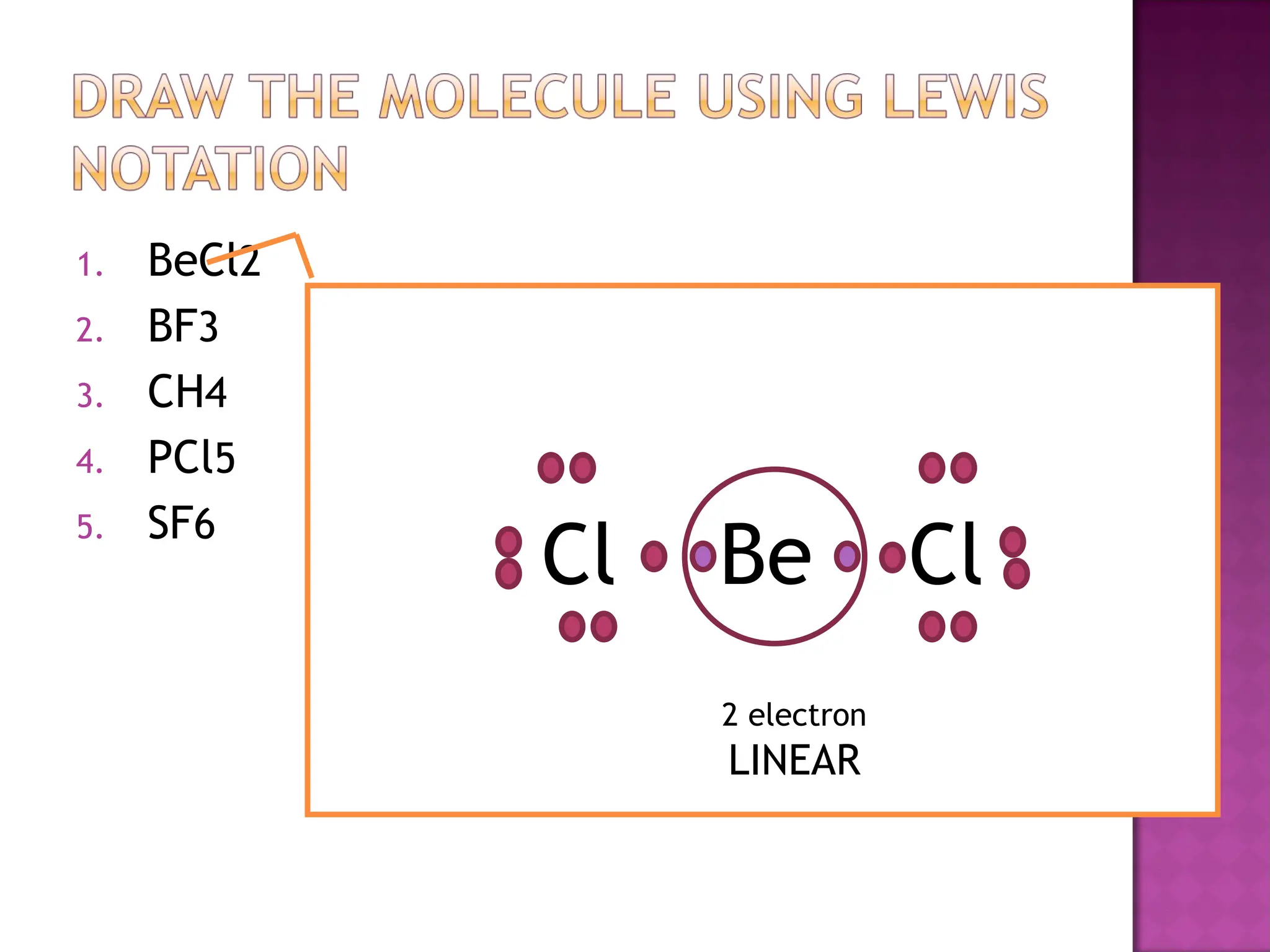
1. BeCl2
2. BF3
3. CH4
4. PCl5
5. SF6
Cl Be Cl
2 electron
LINEAR
1. BeCl2
2. BF3
3. CH4
4. PCl5
5. SF6
F
F B F
3 electron
TRIGONAL PLANAR
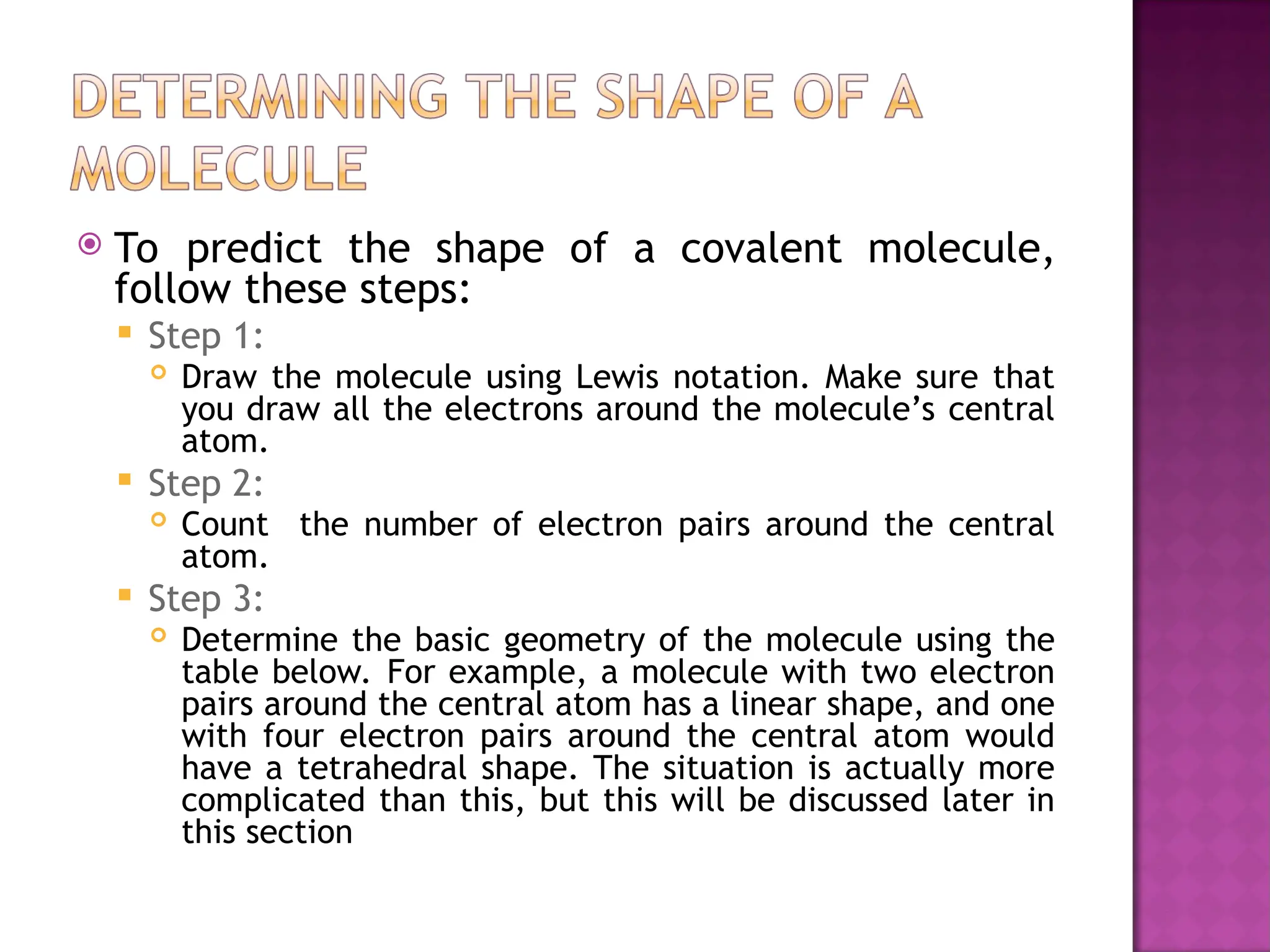
 To predict the shape of a covalent molecule,
follow these steps:
 Step 1:
 Draw the molecule using Lewis notation. Make sure that
you draw all the electrons around the molecule’s central
atom.
 Step 2:
 Count the number of electron pairs around the central
atom.
 Step 3:
 Determine the basic geometry of the molecule using the
table below. For example, a molecule with two electron
pairs around the central atom has a linear shape, and one
with four electron pairs around the central atom would
have a tetrahedral shape. The situation is actually more
complicated than this, but this will be discussed later in
this section
Number of electron
pairs
Geometry
2 linear
3 Trigonal planar
4
5
6
tetrahedral
Trigonal bipyramidal
octahedral
Valence shell electron pair repulsion theory
(VSEPR) is a model in chemistry, which is
used to predict the shape of individual
molecules, based upon the extent of their
electron-pair repulsion.
VSEPR theory is based on the idea that the
geometry of a molecule is mostly determined
by repulsion among the pairs of electrons
around a central atom. The pairs of electrons
may be bonding or non-bonding (also called
lone pairs). Only valence electrons of the
central atom influence the molecular shape
in a meaningful way.
 Group work : Building molecular models
 In groups, you are going to build a number of
molecules using wax(any other) to represent
the atoms in the molecule, and toothpicks to
represent the bonds between the atoms. In
other words, the toothpicks will hold the
atoms (wax/other) in the molecule together.
1. BeCl2
2. BF3
3. CH4
4. PCl5
5. SF6
Linear Trigonal
Planar
Tetrahedral
Trigonal
Bipyramidal
Octahedral
Number of electron
pairs
Geometry
2 linear
3 Trigonal planar
4 tetrahedral
5 Trigonal bipyramidal
6 octahedral
thank for your
Attention

The Shape of Molecules.chemsitry High school,ppt

  • 1.
    Group 4 (to predictmolecular shape)
  • 2.
    StandardCompetence : Understanding thestructure of the atom to predict periodically the elements, molecular structure, and the compounds Basic Competence : Explaining the theory of the number of electron pairs around a central atom to predict molecular shape.
  • 3.
    1. BeCl2 2. BF3 3.CH4 4. PCl5 5. SF6 Cl Be Cl 2 electron LINEAR
  • 4.
    1. BeCl2 2. BF3 3.CH4 4. PCl5 5. SF6 F F B F 3 electron TRIGONAL PLANAR
  • 5.
     To predictthe shape of a covalent molecule, follow these steps:  Step 1:  Draw the molecule using Lewis notation. Make sure that you draw all the electrons around the molecule’s central atom.  Step 2:  Count the number of electron pairs around the central atom.  Step 3:  Determine the basic geometry of the molecule using the table below. For example, a molecule with two electron pairs around the central atom has a linear shape, and one with four electron pairs around the central atom would have a tetrahedral shape. The situation is actually more complicated than this, but this will be discussed later in this section
  • 6.
    Number of electron pairs Geometry 2linear 3 Trigonal planar 4 5 6 tetrahedral Trigonal bipyramidal octahedral
  • 7.
    Valence shell electronpair repulsion theory (VSEPR) is a model in chemistry, which is used to predict the shape of individual molecules, based upon the extent of their electron-pair repulsion. VSEPR theory is based on the idea that the geometry of a molecule is mostly determined by repulsion among the pairs of electrons around a central atom. The pairs of electrons may be bonding or non-bonding (also called lone pairs). Only valence electrons of the central atom influence the molecular shape in a meaningful way.
  • 8.
     Group work: Building molecular models  In groups, you are going to build a number of molecules using wax(any other) to represent the atoms in the molecule, and toothpicks to represent the bonds between the atoms. In other words, the toothpicks will hold the atoms (wax/other) in the molecule together.
  • 9.
    1. BeCl2 2. BF3 3.CH4 4. PCl5 5. SF6
  • 10.
  • 11.
    Number of electron pairs Geometry 2linear 3 Trigonal planar 4 tetrahedral 5 Trigonal bipyramidal 6 octahedral
  • 12.