1
LABILE AND INERT
COMPLEXES
STABLE AND UNSTABLE
COMPLEXES.
AZMA FAKHAR 2
LEARNING OUTCOMES:
▪ OVERVEIW OF SUBSTITUTION AND ITS TYPES
▪ MECHANISM OF SUBSTITUTION REACTION
▪ LABILE AND INERT COMPLEXES
▪ STABLE AND UNSTABLE COMPLEXES
▪ KINETIC STABILITY AND THERMODYNAMICS
▪ DIFFERENCE BETWEEN LABILE AND INERT
▪ FACTORS
AZMA FAKHAR 3
AZMA FAKHAR 4
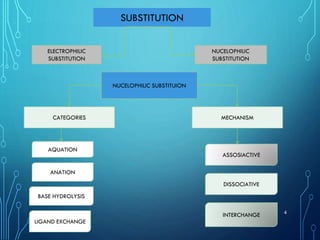
SUBSTITUTION
ELECTROPHILIC
SUBSTITUTION
NUCELOPHILIC
SUBSTITUTION
NUCELOPHILIC SUBSTITUION
CATEGORIES MECHANISM
AQUATION
ANATION
BASE HYDROLYSIS
LIGAND EXCHANGE
ASSOSIACTIVE
DISSOCIATIVE
INTERCHANGE
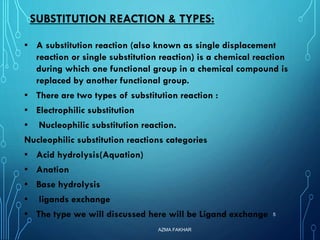
SUBSTITUTION REACTION & TYPES:
▪ A substitution reaction (also known as single displacement
reaction or single substitution reaction) is a chemical reaction
during which one functional group in a chemical compound is
replaced by another functional group.
▪ There are two types of substitution reaction :
▪ Electrophilic substitution
▪ Nucleophilic substitution reaction.
Nucleophilic substitution reactions categories
▪ Acid hydrolysis(Aquation)
▪ Anation
▪ Base hydrolysis
▪ ligands exchange
▪ The type we will discussed here will be Ligand exchange
AZMA FAKHAR
5
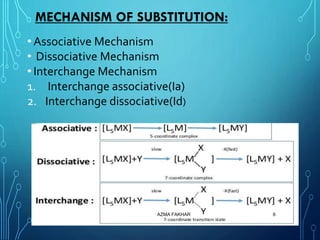
MECHANISM OF SUBSTITUTION:
AZMA FAKHAR 6
• Associative Mechanism
• Dissociative Mechanism
• Interchange Mechanism
1. Interchange associative(Ia)
2. Interchange dissociative(Id)
LABILE AND INERT COMPLEXES:
▪ The ability of a complex to engage in a reaction that
results in replacing one or more ligands in its coordination
sphere is called Liability and the complexes in which the
ligands are rapidly replaced by others are called labile
complexes
▪ The inability of a complex to engage in such reaction is
termed as inertness and the complexes which exhibit such
property are called inert complexes.
AZMA FAKHAR 7
STABILITY OF COMPLEXES:
Stability is of two types Kinetic stability and thermodynamics
In both type of stability is discussed whether a complex is stable or not.
Kinetic stability has inert complexes and labile complexes AND
in Thermodynamics stability whether the complex is stable or unstable .
Consider the reaction: M + nL ⇌ MLn ;
βn =[MLn]/[M][L]n where βn is formation constant of the complex. The
higher values of βn indicate it’s higher thermodynamic stability of the
complex. Thus it gives measure of the extent to which the reaction
proceeds but it cannot say anything about the speed with which
equilibrium is attained.
AZMA FAKHAR 8
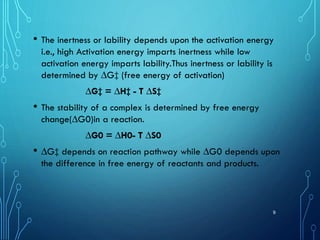
• The inertness or lability depends upon the activation energy
i.e., high Activation energy imparts inertness while low
activation energy imparts lability.Thus inertness or lability is
determined by ∆G‡ (free energy of activation)
∆G‡ = ∆H‡ - T ∆S‡
• The stability of a complex is determined by free energy
change(∆G0)in a reaction.
∆G0 = ∆H0- T ∆S0
• ∆G‡ depends on reaction pathway while ∆G0 depends upon
the difference in free energy of reactants and products.
9
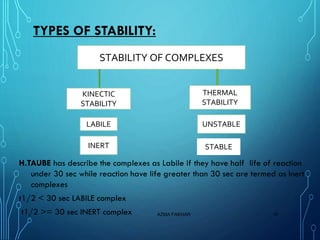
TYPES OF STABILITY:
H.TAUBE has describe the complexes as Labile if they have half life of reaction
under 30 sec while reaction have life greater than 30 sec are termed as Inert
complexes
t1/2 < 30 sec LABILE complex
t1/2 >= 30 sec INERT complex AZMA FAKHAR 10
STABILITY OF COMPLEXES
KINECTIC
STABILITY
LABILE
INERT
THERMAL
STABILITY
UNSTABLE
STABLE
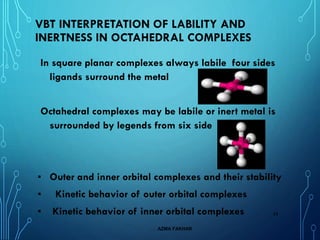
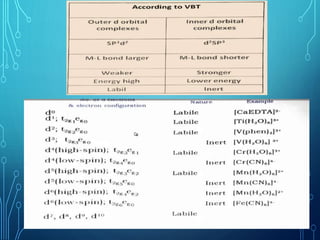
VBT INTERPRETATION OF LABILITY AND
INERTNESS IN OCTAHEDRAL COMPLEXES
In square planar complexes always labile four sides
ligands surround the metal
Octahedral complexes may be labile or inert metal is
surrounded by legends from six side
▪ Outer and inner orbital complexes and their stability
▪ Kinetic behavior of outer orbital complexes
▪ Kinetic behavior of inner orbital complexes
AZMA FAKHAR
11
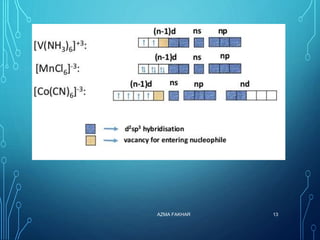
FOR OUTER ORBITAL COMPLEXES:
▪ d0,d1,d2,d7,d8,d9 highly labile
▪ d3,d4 less labile
▪ d0,d1,d2 d5,d6 highly inert
▪ Both the high spin and low spin complexes of
d0,d1,d2,d7,d9,d10 and high spin complexes of d4,d5,d6 are
generally labile. Both high spin and low spin complexes of
d3,d8 and low spin complexes of d4,d5,d6 are generally inert.
▪
AZMA FAKHAR 12
AZMA FAKHAR 13
AZMA FAKHAR 14
LABILE AND INERT COMPLEXES ON THE BASIS
OF CFT :
▪ According to CFT the ligand field splits the d-
orbitals.
▪ This splitting leads to a decrease in energy of the
system whose magnitude depends on the number
of d electrons present.
▪ If the CFSE value increases by association or
dissociation of a ligand then the complex is labile.
▪ On the other hand it is inert when there is a loss in
CFSE value
AZMA FAKHAR 15
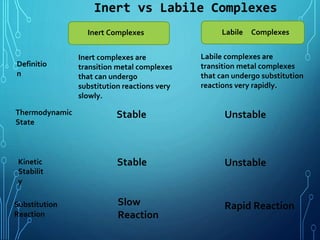
Thermodynamic
State
Kinetic
Stabilit
y
Substitution
Reaction
Definitio
n
Inert Complexes Labile Complexes
Inert complexes are
transition metal complexes
that can undergo
substitution reactions very
slowly.
Rapid Reaction
Slow
Reaction
Labile complexes are
transition metal complexes
that can undergo substitution
reactions very rapidly.
Stable
Stable Unstable
Unstable
Inert vs Labile Complexes
FACTORS AFFECTING STABILITY OF THE
COMPLEXES:
▪ Charge on Central metal ion:
Greater the charge on the metal ion, Greater will be the inertness of the complex since
the M-L bonds are stronger.
▪ Size of the central metal ion:
Smaller the size of the metal in Greater will be the inertness because the ligands are
held tightly by the metal ion
▪ Geometry of the complex:
Generally 4 coordinated complexes are more labile than six coordinates complexes.
▪ d electron configuration:
If electron are present in the antibonding eg orbitals the complex will be labile the
ligands will be weekly bonded to the metal and hence can be substituted easily, in
short ,if the complex contains less than 3 d-electron it will be labile if one or more
eg electrons are present it will be labile
AZMA FAKHAR 17
AZMA FAKHAR 18
REFERNCES:
19

labile and inert complexe stable and unstable complex

  • 1.
  • 2.
    LABILE AND INERT COMPLEXES STABLEAND UNSTABLE COMPLEXES. AZMA FAKHAR 2
  • 3.
    LEARNING OUTCOMES: ▪ OVERVEIWOF SUBSTITUTION AND ITS TYPES ▪ MECHANISM OF SUBSTITUTION REACTION ▪ LABILE AND INERT COMPLEXES ▪ STABLE AND UNSTABLE COMPLEXES ▪ KINETIC STABILITY AND THERMODYNAMICS ▪ DIFFERENCE BETWEEN LABILE AND INERT ▪ FACTORS AZMA FAKHAR 3
  • 4.
    AZMA FAKHAR 4 SUBSTITUTION ELECTROPHILIC SUBSTITUTION NUCELOPHILIC SUBSTITUTION NUCELOPHILICSUBSTITUION CATEGORIES MECHANISM AQUATION ANATION BASE HYDROLYSIS LIGAND EXCHANGE ASSOSIACTIVE DISSOCIATIVE INTERCHANGE
  • 5.
    SUBSTITUTION REACTION &TYPES: ▪ A substitution reaction (also known as single displacement reaction or single substitution reaction) is a chemical reaction during which one functional group in a chemical compound is replaced by another functional group. ▪ There are two types of substitution reaction : ▪ Electrophilic substitution ▪ Nucleophilic substitution reaction. Nucleophilic substitution reactions categories ▪ Acid hydrolysis(Aquation) ▪ Anation ▪ Base hydrolysis ▪ ligands exchange ▪ The type we will discussed here will be Ligand exchange AZMA FAKHAR 5
  • 6.
    MECHANISM OF SUBSTITUTION: AZMAFAKHAR 6 • Associative Mechanism • Dissociative Mechanism • Interchange Mechanism 1. Interchange associative(Ia) 2. Interchange dissociative(Id)
  • 7.
    LABILE AND INERTCOMPLEXES: ▪ The ability of a complex to engage in a reaction that results in replacing one or more ligands in its coordination sphere is called Liability and the complexes in which the ligands are rapidly replaced by others are called labile complexes ▪ The inability of a complex to engage in such reaction is termed as inertness and the complexes which exhibit such property are called inert complexes. AZMA FAKHAR 7
  • 8.
    STABILITY OF COMPLEXES: Stabilityis of two types Kinetic stability and thermodynamics In both type of stability is discussed whether a complex is stable or not. Kinetic stability has inert complexes and labile complexes AND in Thermodynamics stability whether the complex is stable or unstable . Consider the reaction: M + nL ⇌ MLn ; βn =[MLn]/[M][L]n where βn is formation constant of the complex. The higher values of βn indicate it’s higher thermodynamic stability of the complex. Thus it gives measure of the extent to which the reaction proceeds but it cannot say anything about the speed with which equilibrium is attained. AZMA FAKHAR 8
  • 9.
    • The inertnessor lability depends upon the activation energy i.e., high Activation energy imparts inertness while low activation energy imparts lability.Thus inertness or lability is determined by ∆G‡ (free energy of activation) ∆G‡ = ∆H‡ - T ∆S‡ • The stability of a complex is determined by free energy change(∆G0)in a reaction. ∆G0 = ∆H0- T ∆S0 • ∆G‡ depends on reaction pathway while ∆G0 depends upon the difference in free energy of reactants and products. 9
  • 10.
    TYPES OF STABILITY: H.TAUBEhas describe the complexes as Labile if they have half life of reaction under 30 sec while reaction have life greater than 30 sec are termed as Inert complexes t1/2 < 30 sec LABILE complex t1/2 >= 30 sec INERT complex AZMA FAKHAR 10 STABILITY OF COMPLEXES KINECTIC STABILITY LABILE INERT THERMAL STABILITY UNSTABLE STABLE
  • 11.
    VBT INTERPRETATION OFLABILITY AND INERTNESS IN OCTAHEDRAL COMPLEXES In square planar complexes always labile four sides ligands surround the metal Octahedral complexes may be labile or inert metal is surrounded by legends from six side ▪ Outer and inner orbital complexes and their stability ▪ Kinetic behavior of outer orbital complexes ▪ Kinetic behavior of inner orbital complexes AZMA FAKHAR 11
  • 12.
    FOR OUTER ORBITALCOMPLEXES: ▪ d0,d1,d2,d7,d8,d9 highly labile ▪ d3,d4 less labile ▪ d0,d1,d2 d5,d6 highly inert ▪ Both the high spin and low spin complexes of d0,d1,d2,d7,d9,d10 and high spin complexes of d4,d5,d6 are generally labile. Both high spin and low spin complexes of d3,d8 and low spin complexes of d4,d5,d6 are generally inert. ▪ AZMA FAKHAR 12
  • 13.
  • 14.
  • 15.
    LABILE AND INERTCOMPLEXES ON THE BASIS OF CFT : ▪ According to CFT the ligand field splits the d- orbitals. ▪ This splitting leads to a decrease in energy of the system whose magnitude depends on the number of d electrons present. ▪ If the CFSE value increases by association or dissociation of a ligand then the complex is labile. ▪ On the other hand it is inert when there is a loss in CFSE value AZMA FAKHAR 15
  • 16.
    Thermodynamic State Kinetic Stabilit y Substitution Reaction Definitio n Inert Complexes LabileComplexes Inert complexes are transition metal complexes that can undergo substitution reactions very slowly. Rapid Reaction Slow Reaction Labile complexes are transition metal complexes that can undergo substitution reactions very rapidly. Stable Stable Unstable Unstable Inert vs Labile Complexes
  • 17.
    FACTORS AFFECTING STABILITYOF THE COMPLEXES: ▪ Charge on Central metal ion: Greater the charge on the metal ion, Greater will be the inertness of the complex since the M-L bonds are stronger. ▪ Size of the central metal ion: Smaller the size of the metal in Greater will be the inertness because the ligands are held tightly by the metal ion ▪ Geometry of the complex: Generally 4 coordinated complexes are more labile than six coordinates complexes. ▪ d electron configuration: If electron are present in the antibonding eg orbitals the complex will be labile the ligands will be weekly bonded to the metal and hence can be substituted easily, in short ,if the complex contains less than 3 d-electron it will be labile if one or more eg electrons are present it will be labile AZMA FAKHAR 17
  • 18.
  • 19.