Presented by Dr. Sudha Pandeya
Concept
Evaluation is very important requirement of
education system.
It is a systematic process of collecting, analysing ,
interpreting information to determine the extent to
which pupil are achieving instructional objectives.
Characteristics of evaluation
It is a systematic process.
It is a continuous process.
It emphasises broad personality changes and
major objectives of an educational programme. It
includes not only subject matter achievements
but also attitudes, interests,and ideals, way of
thinking, work habits and personal and social
adaptability.
contd
It assumes that educational objectives have previously
been defined and identified.
A comprehensive programme of evaluation involves use of
many procedures like-analytico-synthetic,experimental,
lecture etc agreat variety of tests like-essay type objective
type and many techniques like-controlled observation ,
sociometric techniques etc
Learning is more important than teaching.
Need and objectives of
evaluation
Evaluation helps to design better education
programme.
It helps the teacher to know his pupils in detail.Today
education is child –centered. So child’s interests,
ability,interests,aptitudes are to be properly studied
so as to arrange instruction accordingly.
Contd.
It helps teacher to determine, evaluate and refine
his instructional objectives.
It helps to know the entry behaviour of the
students.
It helps the administrator in educational planning
and in decisions regarding selections
,classification and placement.
It helps parents to know the progress of their
children.
Concept of evaluation
Evaluation plays an enormous role in teaching-
learning process.
It implies a systematic process which omits the
casual uncontrolled observation of pupils.
It is a continuous process
It includes not only subject-matter achievement
but also attitudes, interests and ideals, ways of
thinking ,work habits ,personal and social
adaptability.
Contd.
A comprehensive programme of evaluation involves the
use of many procedures like analytical-synthetic, heuristic,
experimental, lecture etc.a great
variety of tests like essay type, objective type,and other
techniques like sociometric, controlled observation etc.
Learning is more important than teaching.
Evaluation is assessing the students and their complete
development brought about through education.
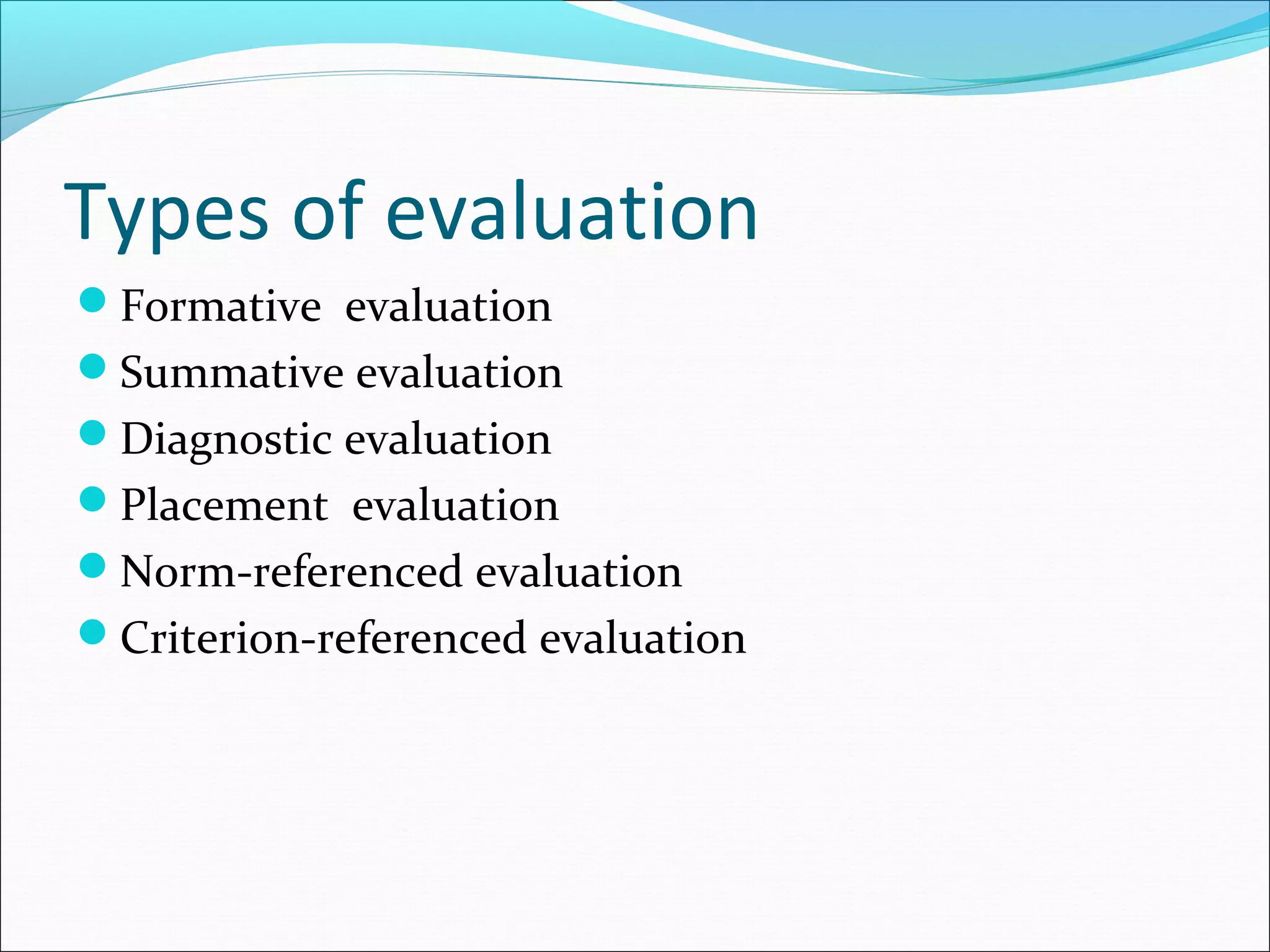
Types of evaluation
Formative evaluation
Summative evaluation
Diagnostic evaluation
Placement evaluation
Norm-referenced evaluation
Criterion-referenced evaluation
Formative evaluation
It is used to monitor the learning process of students
during the period of instruction.
It provides continuous feedback to both teacher and
student concerning learning successes and failure while
instruction is in process.
Feedback to students provides reinforcement of successful
learning and identifies the specific learning errors that
need correction.
Feedback to teacher provides information for modifying
instruction and for prescribing individual and group
remedial work.
It aims at improvement of instruction.
Contd.
It is concerned with the process of development
of learning
Cornback is the first educationist who said that
thegreatest service evaluation can perform is to
identify aspects of the course where education is
desirable.
It is a positive evaluation because it attempts to
create desirable learning goals and tools for
achieving such goals.
Types of formative evaluation
Diagnosing- It is concerned with determining the most
appropriate method or instructional materials conducive
to learning.
Placement- It is concerned with finding out the position of
an individual in the curriculum from which he has to start
learning.
Monitoring- It is concerned with keeping track of the day
today progress of the learners and to point out changes
necessary in the methods ofteaching instructional
strategies etc.
Characteristics of Formative
evaluation
It is an integral part of learning process.
It occurs frequently during the course of
instruction.
Its results are made immediately known to the
learners.
It may sometimes take teacher’s observation only.
It reinforces learning of the students.
Contd.
It pinpoints difficulties being faced by weak learners.
Its result can not be used for grading or placement
purposes.
It helps in modification of instructional strategies
including method of teaching immediately.
It motivates learners; as it provides them with knowledge
of progress made by them.
It sees the role of evaluation as a process.
It is generally teacher made test
It does not take much time to construct
Examples of formative
evaluation
Monthly test
Class test
Periodical assessment
Teacher’s observation etc.
Summative Evaluation
It is done at the end of the course of instruction
to know to what extent the objectives previously
fixed have been accomplished.
Its main objective is to assign grades to the
pupils.
It indicates the degree to which the students have
mastered the course content.
It helps to judge the appropriateness of
instructional objectives.
Contd.
It has danger of making negative effects. This
evaluation may brand a student as a failed
candidate, and thus causes frustration and setback
in the learning process of the candidate.
The tests for summative evaluation are given at
the end of a course .
The functions of summative
evaluation
Crediting- It is concerned with collecting
evidence that a learner has achieved some
instructional goals in respect to a defined
curriculum.
Certifying- It is concerned with giving evidence
that the learner is able to perform a job according
to the previously determined standards.
Contd.
Promoting- It is concerned with promoting pupils to
next higher class.
Selecting- Selecting the pupil for different courses
after completion of a particular course structure.
Characteristics of summative
evaluation
It is terminal in nature as it comes at the end of
the course of instruction.
It is judgemental in character in the sense that it
judges the achievement of pupils.
It views evaluation ‘as a product’, because its
chief concern is to point out the levels of
attainment.
It can not based on teacher’s observation only.
Contd.
It does not pin point difficulties faced by the
learner.
Its result can be used for placement and grading
purposes.
It reinforces learning of the students who has
learnt an area.
It may or may not motivate the learners.
Sometimes it may have negative effects.
Examples of summative
evaluation
Traditional school and university examinations.
Standardised tests.
Teacher made tests.
Practical and oral tests.
The term diagnosis has been taken from medical
profession.
Difficulties in learning occur at all levels and
among pupils of both high and low mental
ability.
Like a doctor teacher uses similar techniques to
diagnose the relative strength and weaknesses of
pupil in specific area of study, analyse the causes
for the same and then gives remedial measures as
per necessity.
Features
The diagnostic test takes off where formative test
leaves off
It is a means by which an individual profile is
examined and compared under certain norms or
criteria.
It is more intensive and act as a tool for analysis of
learning difficulties.
It is more limited to low ability students.
Contd.
It is corrective in nature.
It pinpoints the specific type of error each pupil is
making and searches for underlying cause of problem.
It is more comprehensive.
It can be done by constant observation of
pupils,analysis of performance,achievement test
,analysis of cumulative record and anecdotal records
Contd.
It can be conducted by observing the pupil’s participation
in class room activities, peer relationship’ independent
work.
By taking physical and health records about vision,
hearing etc.and family background.
By interviewing pupil to know the problem and their
elimination.
By parent conference.
By clinic guide like vision tester, audio-meter
etc.,consultation with doctor ,counsellors,psychologists.
By developing strong motivation, token economy.
Criterion- referenced
evaluation
A criterion-referenced test is used to ascertain an
individual’s status with respect to a defined
achievement domain.
It is concerned with the performance of an
individual in terms of what he can do or the
behaviour he can demonstrate.
In this evaluation there is a reference to a
criterion but there is no reference to the
performance of other individuals in the group.
Contd.
 In it we refer an individual’s performance to a
predetermined criterion which is well defined.
It is objective based test.
It includes the entire terminal behaviour that is
supposed to be shaped through the programme .
It is not the test of grading the students rather it
is a test designed to measure the extent to which
students have mastered their learning outcomes.
Norm- referenced evaluation-A norm referenced evaluation test is
used to ascertain an individual’s status
with respect to the performance of other
individual on that test.
Here measurement act relates to some
norm, group or a typical performance.
It is an attempt to interpret the result in
terms of the performance of certain
group
Contd.
It is used by teachers to differentiate and classify
among students of some defined group like age or
grade.
In it comparison of students is relative rather than
absolute.
Features
It is used for
discriminating students who have different
backgrounds
Classifying the students for the purpose of
selection in some course
As a guideline for students
Promoting the students in higher class
The selection of employees by the employers
Counsellors and guidance workers
Teachers to rank the students
Thank You

Formative evaluation

  • 1.
    Presented by Dr.Sudha Pandeya
  • 2.
    Concept Evaluation is veryimportant requirement of education system. It is a systematic process of collecting, analysing , interpreting information to determine the extent to which pupil are achieving instructional objectives.
  • 3.
    Characteristics of evaluation Itis a systematic process. It is a continuous process. It emphasises broad personality changes and major objectives of an educational programme. It includes not only subject matter achievements but also attitudes, interests,and ideals, way of thinking, work habits and personal and social adaptability.
  • 4.
    contd It assumes thateducational objectives have previously been defined and identified. A comprehensive programme of evaluation involves use of many procedures like-analytico-synthetic,experimental, lecture etc agreat variety of tests like-essay type objective type and many techniques like-controlled observation , sociometric techniques etc Learning is more important than teaching.
  • 5.
    Need and objectivesof evaluation Evaluation helps to design better education programme. It helps the teacher to know his pupils in detail.Today education is child –centered. So child’s interests, ability,interests,aptitudes are to be properly studied so as to arrange instruction accordingly.
  • 6.
    Contd. It helps teacherto determine, evaluate and refine his instructional objectives. It helps to know the entry behaviour of the students. It helps the administrator in educational planning and in decisions regarding selections ,classification and placement. It helps parents to know the progress of their children.
  • 7.
    Concept of evaluation Evaluationplays an enormous role in teaching- learning process. It implies a systematic process which omits the casual uncontrolled observation of pupils. It is a continuous process It includes not only subject-matter achievement but also attitudes, interests and ideals, ways of thinking ,work habits ,personal and social adaptability.
  • 8.
    Contd. A comprehensive programmeof evaluation involves the use of many procedures like analytical-synthetic, heuristic, experimental, lecture etc.a great variety of tests like essay type, objective type,and other techniques like sociometric, controlled observation etc. Learning is more important than teaching. Evaluation is assessing the students and their complete development brought about through education.
  • 9.
    Types of evaluation Formativeevaluation Summative evaluation Diagnostic evaluation Placement evaluation Norm-referenced evaluation Criterion-referenced evaluation
  • 10.
    Formative evaluation It isused to monitor the learning process of students during the period of instruction. It provides continuous feedback to both teacher and student concerning learning successes and failure while instruction is in process. Feedback to students provides reinforcement of successful learning and identifies the specific learning errors that need correction. Feedback to teacher provides information for modifying instruction and for prescribing individual and group remedial work. It aims at improvement of instruction.
  • 11.
    Contd. It is concernedwith the process of development of learning Cornback is the first educationist who said that thegreatest service evaluation can perform is to identify aspects of the course where education is desirable. It is a positive evaluation because it attempts to create desirable learning goals and tools for achieving such goals.
  • 12.
    Types of formativeevaluation Diagnosing- It is concerned with determining the most appropriate method or instructional materials conducive to learning. Placement- It is concerned with finding out the position of an individual in the curriculum from which he has to start learning. Monitoring- It is concerned with keeping track of the day today progress of the learners and to point out changes necessary in the methods ofteaching instructional strategies etc.
  • 13.
    Characteristics of Formative evaluation Itis an integral part of learning process. It occurs frequently during the course of instruction. Its results are made immediately known to the learners. It may sometimes take teacher’s observation only. It reinforces learning of the students.
  • 14.
    Contd. It pinpoints difficultiesbeing faced by weak learners. Its result can not be used for grading or placement purposes. It helps in modification of instructional strategies including method of teaching immediately. It motivates learners; as it provides them with knowledge of progress made by them. It sees the role of evaluation as a process. It is generally teacher made test It does not take much time to construct
  • 15.
    Examples of formative evaluation Monthlytest Class test Periodical assessment Teacher’s observation etc.
  • 16.
    Summative Evaluation It isdone at the end of the course of instruction to know to what extent the objectives previously fixed have been accomplished. Its main objective is to assign grades to the pupils. It indicates the degree to which the students have mastered the course content. It helps to judge the appropriateness of instructional objectives.
  • 17.
    Contd. It has dangerof making negative effects. This evaluation may brand a student as a failed candidate, and thus causes frustration and setback in the learning process of the candidate. The tests for summative evaluation are given at the end of a course .
  • 18.
    The functions ofsummative evaluation Crediting- It is concerned with collecting evidence that a learner has achieved some instructional goals in respect to a defined curriculum. Certifying- It is concerned with giving evidence that the learner is able to perform a job according to the previously determined standards.
  • 19.
    Contd. Promoting- It isconcerned with promoting pupils to next higher class. Selecting- Selecting the pupil for different courses after completion of a particular course structure.
  • 20.
    Characteristics of summative evaluation Itis terminal in nature as it comes at the end of the course of instruction. It is judgemental in character in the sense that it judges the achievement of pupils. It views evaluation ‘as a product’, because its chief concern is to point out the levels of attainment. It can not based on teacher’s observation only.
  • 21.
    Contd. It does notpin point difficulties faced by the learner. Its result can be used for placement and grading purposes. It reinforces learning of the students who has learnt an area. It may or may not motivate the learners. Sometimes it may have negative effects.
  • 22.
    Examples of summative evaluation Traditionalschool and university examinations. Standardised tests. Teacher made tests. Practical and oral tests.
  • 24.
    The term diagnosishas been taken from medical profession. Difficulties in learning occur at all levels and among pupils of both high and low mental ability. Like a doctor teacher uses similar techniques to diagnose the relative strength and weaknesses of pupil in specific area of study, analyse the causes for the same and then gives remedial measures as per necessity.
  • 25.
    Features The diagnostic testtakes off where formative test leaves off It is a means by which an individual profile is examined and compared under certain norms or criteria. It is more intensive and act as a tool for analysis of learning difficulties. It is more limited to low ability students.
  • 26.
    Contd. It is correctivein nature. It pinpoints the specific type of error each pupil is making and searches for underlying cause of problem. It is more comprehensive. It can be done by constant observation of pupils,analysis of performance,achievement test ,analysis of cumulative record and anecdotal records
  • 27.
    Contd. It can beconducted by observing the pupil’s participation in class room activities, peer relationship’ independent work. By taking physical and health records about vision, hearing etc.and family background. By interviewing pupil to know the problem and their elimination. By parent conference. By clinic guide like vision tester, audio-meter etc.,consultation with doctor ,counsellors,psychologists. By developing strong motivation, token economy.
  • 28.
    Criterion- referenced evaluation A criterion-referencedtest is used to ascertain an individual’s status with respect to a defined achievement domain. It is concerned with the performance of an individual in terms of what he can do or the behaviour he can demonstrate. In this evaluation there is a reference to a criterion but there is no reference to the performance of other individuals in the group.
  • 29.
    Contd.  In itwe refer an individual’s performance to a predetermined criterion which is well defined. It is objective based test. It includes the entire terminal behaviour that is supposed to be shaped through the programme . It is not the test of grading the students rather it is a test designed to measure the extent to which students have mastered their learning outcomes.
  • 30.
    Norm- referenced evaluation-Anorm referenced evaluation test is used to ascertain an individual’s status with respect to the performance of other individual on that test. Here measurement act relates to some norm, group or a typical performance. It is an attempt to interpret the result in terms of the performance of certain group
  • 31.
    Contd. It is usedby teachers to differentiate and classify among students of some defined group like age or grade. In it comparison of students is relative rather than absolute.
  • 32.
    Features It is usedfor discriminating students who have different backgrounds Classifying the students for the purpose of selection in some course As a guideline for students Promoting the students in higher class The selection of employees by the employers Counsellors and guidance workers Teachers to rank the students
  • 33.

Editor's Notes

  • #8 Types of evaluation