SEMINAR
ON
ASSESSMENT
Practices for the Classroom
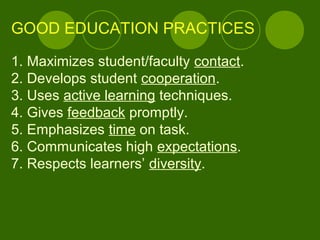
GOOD EDUCATION PRACTICES
1. Maximizes student/faculty contact.
2. Develops student cooperation.
3. Uses active learning techniques.
4. Gives feedback promptly.
5. Emphasizes time on task.
6. Communicates high expectations.
7. Respects learners’ diversity.
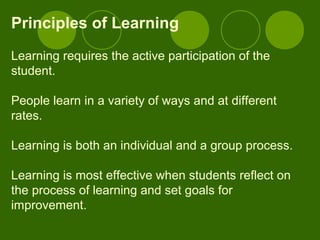
Principles of Learning
Learning requires the active participation of the
student.
People learn in a variety of ways and at different
rates.
Learning is both an individual and a group process.
Learning is most effective when students reflect on
the process of learning and set goals for
improvement.
The word ‘assess’ comes from the Latin
verb ‘assidere’ meaning ‘to sit with’.
In assessment one is supposed to sit with
the learner. This implies it is something we
do ‘with’ and ‘for’ students and not ‘to’
students (Green, 1999).
What is Assessment?
Assessment in education is the process of
gathering, interpreting, recording, and
using information about pupils’ responses
to an educational task. (Harlen, Gipps, Broadfoot,
Nuttal,1992)
Why assess students?Why assess students?
• To gather evidence of student learning
• To inform instruction
• To motivate students and increase student
achievement
1. Teachers value and believe in students.
2. Sharing learning goals with the students.
3. Involving students in self-assessment.
4. Providing feedback that helps students
recognize their next steps and how to take
them.
5. Being confident that every student can
improve.
6. Providing students with examples of what we
expect from them.
Values and Attitudes about Assessment
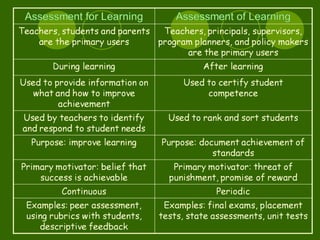
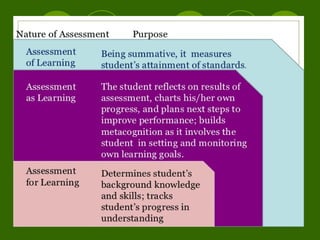
3 types of Assessment
• Assessment FOR Learning
– Formative Assessment
– Informs students and teachers
• Assessment AS Learning
– Student’s Metacognition
• Assessment OF Learning
– Summative/Final/Official Assessment
– Evaluation of students by teachers
What Is Assessment for Learning?
Assessment for learning occurs throughout the learning process.
It is designed to make each student’s understanding visible, so that
teachers can decide what they can do to help students progress.
Students learn in individual and idiosyncratic ways, yet, at the same time,
there are predictable patterns of connections and preconceptions that
some students may experience as they move along the continuum from
emergent to proficient.
In assessment for learning, teachers use assessment as an investigative
tool to find out as much as they can about what their students know and
can do, and what confusions, preconceptions, or gaps they might have.
The wide variety of information that teachers collect about their students’
learning processes provides the basis for determining what they need to
do next to move student learning forward. It provides the basis for
providing descriptive feedback for students and deciding on groupings,
instructional strategies, and resources.
What Is Assessment as Learning?
Assessment as learning focusses on students and emphasizes assessment as a
process of metacognition (knowledge of one’s own thought processes) for
students.
Assessment as learning emerges from the idea that learning is not just a matter of
transferring ideas from someone who is knowledgeable to someone who is not,
but is an active process of cognitive restructuring that occurs when individuals
interact with new ideas.
Within this view of learning, students are the critical connectors between
assessment and learning. For students to be actively engaged in creating their
own understanding, they must learn to be critical assessors who make sense of
information, relate it to prior knowledge, and use it for new learning.
This is the regulatory process in metacognition; that is, students become adept at
personally monitoring what they are learning, and use what they discover from the
monitoring to make adjustments, adaptations, and even major changes in their
thinking.
What Is Assessment of Learning?
Assessment of learning refers to strategies designed to confirm what
students know, demonstrate whether or not they have met curriculum
outcomes or the goals of their individualized programs, or to certify
proficiency and make decisions about students’ future programs or
placements.
It is designed to provide evidence of achievement to parents, other
educators, the students themselves, and sometimes to outside groups
(e.g., employers, other educational institutions).
Assessment of learning is the assessment that becomes public and
results in statements or symbols about how well students are learning. It
often contributes to pivotal decisions that will affect students’ futures. It is
important, then, that the underlying logic and measurement of
assessment of learning be credible and defensible.
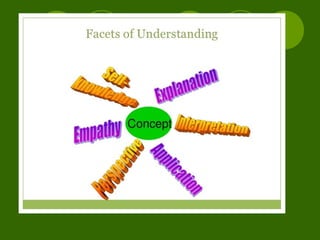
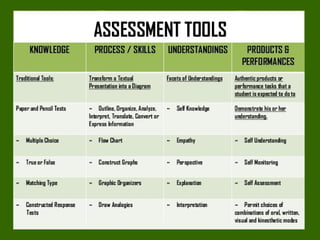
If we think of our children as plants …
Summative assessment of the plants is the process of
simply measuring them. It might be interesting to
compare and analyze measurements but, in themselves,
these do not affect the growth of the plants.
Formative assessment, on the other hand, is the
equivalent of feeding and watering the plants appropriate
to their needs - directly affecting their growth.
The Garden Analogy
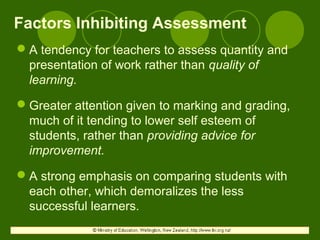
Factors Inhibiting Assessment
A tendency for teachers to assess quantity and
presentation of work rather than quality of
learning.
Greater attention given to marking and grading,
much of it tending to lower self esteem of
students, rather than providing advice for
improvement.
A strong emphasis on comparing students with
each other, which demoralizes the less
successful learners.
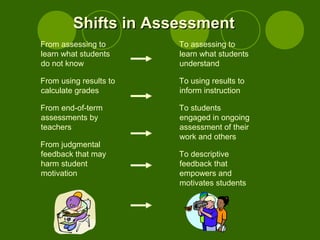
Shifts in AssessmentShifts in Assessment
From assessing to
learn what students
do not know
From using results to
calculate grades
From end-of-term
assessments by
teachers
From judgmental
feedback that may
harm student
motivation
To assessing to
learn what students
understand
To using results to
inform instruction
To students
engaged in ongoing
assessment of their
work and others
To descriptive
feedback that
empowers and
motivates students
Why these shifts in assessment?Why these shifts in assessment?
A change in the mission of schools:
A shift from a focus on sorting and ranking
students to a focus on leaving no child behind.
A strong research base:
Evidence of the substantial impact on student
achievement
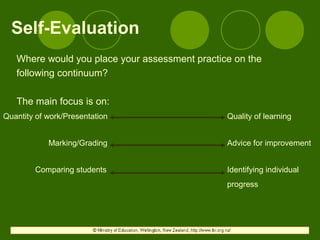
Self-Evaluation
Where would you place your assessment practice on the
following continuum?
The main focus is on:
Quantity of work/Presentation Quality of learning
Marking/Grading
Comparing students
Advice for improvement
Identifying individual
progress
Implications for classroom practice
 Share learning goals with students.
 Involve students in self-assessment.
 Provide feedback that helps students recognize their next
steps and how to take them.
 Be confident that every student can improve.
Assessment AS Learning.
Develops students’:
• skills of metacognition
• critical thinking skills
• communication and interpersonal skills
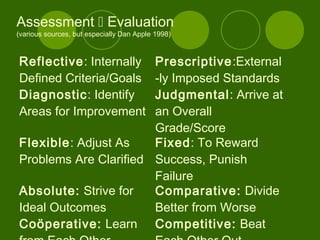
Assessment  Evaluation
(various sources, but especially Dan Apple 1998)
Reflective: Internally
Defined Criteria/Goals
Prescriptive:External
-ly Imposed Standards
Diagnostic: Identify
Areas for Improvement
Judgmental: Arrive at
an Overall
Grade/Score
Flexible: Adjust As
Problems Are Clarified
Fixed: To Reward
Success, Punish
Failure
Absolute: Strive for
Ideal Outcomes
Comparative: Divide
Better from Worse
Coöperative: Learn Competitive: Beat
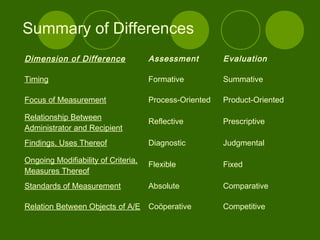
Summary of Differences
Dimension of Difference Assessment Evaluation
Timing Formative Summative
Focus of Measurement Process-Oriented Product-Oriented
Relationship Between
Administrator and Recipient
Reflective Prescriptive
Findings, Uses Thereof Diagnostic Judgmental
Ongoing Modifiability of Criteria,
Measures Thereof
Flexible Fixed
Standards of Measurement Absolute Comparative
Relation Between Objects of A/E Coöperative Competitive
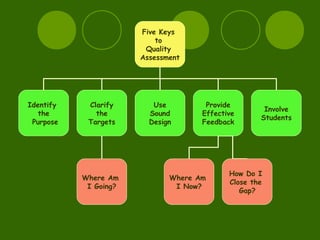
Five Keys
to
Quality
Assessment
Identify
the
Purpose
Clarify
the
Targets
Use
Sound
Design
Involve
Students
Provide
Effective
Feedback
Where Am
I Going?
Where Am
I Now?
How Do I
Close the
Gap?
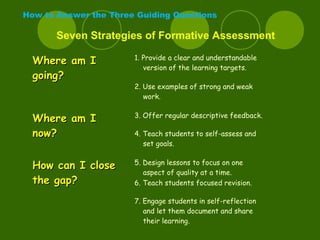
How to Answer the Three Guiding Questions
Seven Strategies of Formative Assessment
Where am IWhere am I
going?going?
1. Provide a clear and understandable
version of the learning targets.
2. Use examples of strong and weak
work.
Where am IWhere am I
now?now?
3. Offer regular descriptive feedback.
4. Teach students to self-assess and
set goals.
How can I closeHow can I close
the gap?the gap?
5. Design lessons to focus on one
aspect of quality at a time.
6. Teach students focused revision.
7. Engage students in self-reflection
and let them document and share
their learning.
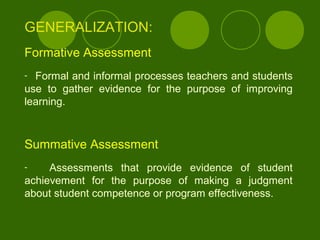
GENERALIZATION:
Formative Assessment
- Formal and informal processes teachers and students
use to gather evidence for the purpose of improving
learning.
Summative Assessment
- Assessments that provide evidence of student
achievement for the purpose of making a judgment
about student competence or program effectiveness.
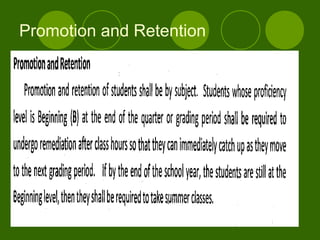
Promotion and Retention
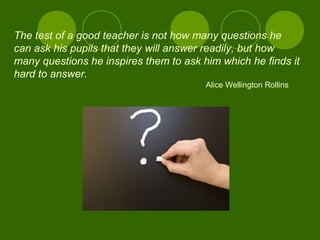
The test of a good teacher is not how many questions he
can ask his pupils that they will answer readily, but how
many questions he inspires them to ask him which he finds it
hard to answer.
Alice Wellington Rollins

Assessment of learning outcomes

  • 1.
  • 3.
    GOOD EDUCATION PRACTICES 1.Maximizes student/faculty contact. 2. Develops student cooperation. 3. Uses active learning techniques. 4. Gives feedback promptly. 5. Emphasizes time on task. 6. Communicates high expectations. 7. Respects learners’ diversity.
  • 4.
    Principles of Learning Learningrequires the active participation of the student. People learn in a variety of ways and at different rates. Learning is both an individual and a group process. Learning is most effective when students reflect on the process of learning and set goals for improvement.
  • 5.
    The word ‘assess’comes from the Latin verb ‘assidere’ meaning ‘to sit with’. In assessment one is supposed to sit with the learner. This implies it is something we do ‘with’ and ‘for’ students and not ‘to’ students (Green, 1999). What is Assessment?
  • 6.
    Assessment in educationis the process of gathering, interpreting, recording, and using information about pupils’ responses to an educational task. (Harlen, Gipps, Broadfoot, Nuttal,1992) Why assess students?Why assess students? • To gather evidence of student learning • To inform instruction • To motivate students and increase student achievement
  • 7.
    1. Teachers valueand believe in students. 2. Sharing learning goals with the students. 3. Involving students in self-assessment. 4. Providing feedback that helps students recognize their next steps and how to take them. 5. Being confident that every student can improve. 6. Providing students with examples of what we expect from them. Values and Attitudes about Assessment
  • 9.
    3 types ofAssessment • Assessment FOR Learning – Formative Assessment – Informs students and teachers • Assessment AS Learning – Student’s Metacognition • Assessment OF Learning – Summative/Final/Official Assessment – Evaluation of students by teachers
  • 10.
    What Is Assessmentfor Learning? Assessment for learning occurs throughout the learning process. It is designed to make each student’s understanding visible, so that teachers can decide what they can do to help students progress. Students learn in individual and idiosyncratic ways, yet, at the same time, there are predictable patterns of connections and preconceptions that some students may experience as they move along the continuum from emergent to proficient. In assessment for learning, teachers use assessment as an investigative tool to find out as much as they can about what their students know and can do, and what confusions, preconceptions, or gaps they might have. The wide variety of information that teachers collect about their students’ learning processes provides the basis for determining what they need to do next to move student learning forward. It provides the basis for providing descriptive feedback for students and deciding on groupings, instructional strategies, and resources.
  • 11.
    What Is Assessmentas Learning? Assessment as learning focusses on students and emphasizes assessment as a process of metacognition (knowledge of one’s own thought processes) for students. Assessment as learning emerges from the idea that learning is not just a matter of transferring ideas from someone who is knowledgeable to someone who is not, but is an active process of cognitive restructuring that occurs when individuals interact with new ideas. Within this view of learning, students are the critical connectors between assessment and learning. For students to be actively engaged in creating their own understanding, they must learn to be critical assessors who make sense of information, relate it to prior knowledge, and use it for new learning. This is the regulatory process in metacognition; that is, students become adept at personally monitoring what they are learning, and use what they discover from the monitoring to make adjustments, adaptations, and even major changes in their thinking.
  • 12.
    What Is Assessmentof Learning? Assessment of learning refers to strategies designed to confirm what students know, demonstrate whether or not they have met curriculum outcomes or the goals of their individualized programs, or to certify proficiency and make decisions about students’ future programs or placements. It is designed to provide evidence of achievement to parents, other educators, the students themselves, and sometimes to outside groups (e.g., employers, other educational institutions). Assessment of learning is the assessment that becomes public and results in statements or symbols about how well students are learning. It often contributes to pivotal decisions that will affect students’ futures. It is important, then, that the underlying logic and measurement of assessment of learning be credible and defensible.
  • 13.
    If we thinkof our children as plants … Summative assessment of the plants is the process of simply measuring them. It might be interesting to compare and analyze measurements but, in themselves, these do not affect the growth of the plants. Formative assessment, on the other hand, is the equivalent of feeding and watering the plants appropriate to their needs - directly affecting their growth. The Garden Analogy
  • 15.
    Factors Inhibiting Assessment Atendency for teachers to assess quantity and presentation of work rather than quality of learning. Greater attention given to marking and grading, much of it tending to lower self esteem of students, rather than providing advice for improvement. A strong emphasis on comparing students with each other, which demoralizes the less successful learners.
  • 16.
    Shifts in AssessmentShiftsin Assessment From assessing to learn what students do not know From using results to calculate grades From end-of-term assessments by teachers From judgmental feedback that may harm student motivation To assessing to learn what students understand To using results to inform instruction To students engaged in ongoing assessment of their work and others To descriptive feedback that empowers and motivates students
  • 17.
    Why these shiftsin assessment?Why these shifts in assessment? A change in the mission of schools: A shift from a focus on sorting and ranking students to a focus on leaving no child behind. A strong research base: Evidence of the substantial impact on student achievement
  • 18.
    Self-Evaluation Where would youplace your assessment practice on the following continuum? The main focus is on: Quantity of work/Presentation Quality of learning Marking/Grading Comparing students Advice for improvement Identifying individual progress
  • 19.
    Implications for classroompractice  Share learning goals with students.  Involve students in self-assessment.  Provide feedback that helps students recognize their next steps and how to take them.  Be confident that every student can improve. Assessment AS Learning. Develops students’: • skills of metacognition • critical thinking skills • communication and interpersonal skills
  • 21.
    Assessment  Evaluation (varioussources, but especially Dan Apple 1998) Reflective: Internally Defined Criteria/Goals Prescriptive:External -ly Imposed Standards Diagnostic: Identify Areas for Improvement Judgmental: Arrive at an Overall Grade/Score Flexible: Adjust As Problems Are Clarified Fixed: To Reward Success, Punish Failure Absolute: Strive for Ideal Outcomes Comparative: Divide Better from Worse Coöperative: Learn Competitive: Beat
  • 22.
    Summary of Differences Dimensionof Difference Assessment Evaluation Timing Formative Summative Focus of Measurement Process-Oriented Product-Oriented Relationship Between Administrator and Recipient Reflective Prescriptive Findings, Uses Thereof Diagnostic Judgmental Ongoing Modifiability of Criteria, Measures Thereof Flexible Fixed Standards of Measurement Absolute Comparative Relation Between Objects of A/E Coöperative Competitive
  • 23.
  • 24.
    How to Answerthe Three Guiding Questions Seven Strategies of Formative Assessment Where am IWhere am I going?going? 1. Provide a clear and understandable version of the learning targets. 2. Use examples of strong and weak work. Where am IWhere am I now?now? 3. Offer regular descriptive feedback. 4. Teach students to self-assess and set goals. How can I closeHow can I close the gap?the gap? 5. Design lessons to focus on one aspect of quality at a time. 6. Teach students focused revision. 7. Engage students in self-reflection and let them document and share their learning.
  • 26.
    GENERALIZATION: Formative Assessment - Formaland informal processes teachers and students use to gather evidence for the purpose of improving learning. Summative Assessment - Assessments that provide evidence of student achievement for the purpose of making a judgment about student competence or program effectiveness.
  • 45.
  • 46.
    The test ofa good teacher is not how many questions he can ask his pupils that they will answer readily, but how many questions he inspires them to ask him which he finds it hard to answer. Alice Wellington Rollins