INTRODUCTION
 Evaluation is part of life, in our life we need to make
evaluation frequently – like which dress you want to wear
in marriage – What you want to give in gift to your friend.
 In educational scenario evaluation have important role in
judging student progress to know up to what extent
student have achieved the desired set goal.
 The word ‘assess’ comes from the Latin verb ‘asadero’
meaning ‘to sit with’. Assessment can focus on the
individual learner, the learning community (class,
workshop, or other organized group of learners), the
institution, or the educational system.
DEFINITIONS
Definitions of educational Evaluation:
Evaluation is a systematic, continuous process of
determining,
 The extent to which specified educational objectives,
previously identified and defined, are attained;
 The effectiveness of the learning experience provided
in the classroom and
 How well the goals of education have been
accomplished.”
OTHER RELATED DEFINITIONS
 ASSESSMENT:
“Assessment is the process of documenting, usually in measurable
terms, knowledge, skill, attitudes, and beliefs.” “Assessment in
education is the process of gathering, interpreting, recording, and
using information about pupils’ responses to an educational task.” ___
Harlen, Gipps, Broadfoot, Nuttal,1992
IMPORTANT FEATURES OF EDUCATIONAL
EVALUATION
From the definition of educational evaluation, we derive its
important features as follows;
 It is a systematic process.
 It is a continuous process; It goes hand in hand with the
teaching-learning process.
 It emphasizes the broad personality changes and major
objectives of an educational programme.
 It assumes that educational objectives have been previously been
identified and defined.
 A comprehensive evaluation involves the uses of many tools and
techniques.
 It helps to determine the adequacy and appropriateness of the
learning experiences provided, to achieve the defined objectives.
PRINCIPLES OF EDUCATIONAL EVALUATION:
 It must be clearly stated what is to be evaluated.
 A variety of evaluation techniques should be used for a
comprehensive evaluation.
 An evaluator should know the limitations of different
evaluation techniques.
 The technique of evaluation must be appropriate for
the characteristics or performance to be measured.
 Evaluation is a means to an end but not an end in
itself.
ROLE AND FUNCTION OF EDUCATIONAL
EVALUATION:
 It is useful as a good tool for asssessing the student’s
progress in learning and observing his overall
development.
 On the basis of such assessment, individualized
instruction may be adopted whenever necessary,
 Evaluating the learning progress of public
intermittently as the instructional process proceeds is
otherwise known as Formative Evaluation.
 Evaluation undertaken at the terminal stages of the
instructional process proceeds is otherwise known as
Summative Evaluation
Scope of Evaluation
 Certification
 Feedback
 Monitoring the program
 Safeguarding the public
 Baseline for guidance and counselling
 Placement and promotion in job
 Development of tools and techniques
 Appraise the methods of instructions.
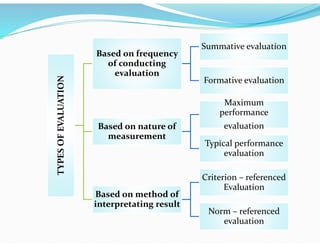
TYPES
OF
EVALUATION
Based on frequency
of conducting
evaluation
Summative evaluation
Formative evaluation
Based on nature of
measurement
Maximum
performance
evaluation
Typical performance
evaluation
Based on method of
interpretating result
Criterion – referenced
Evaluation
Norm – referenced
evaluation
Formative evaluation
1. It is used to monitor the learning process of students during the period of
instruction.
2. It provides continuous feedback to both teacher and student concerning
learning successes and failure while instruction is in process.
3. Feedback to students provides reinforcement of successful learning and
identifies the specific learning errors that need correction.
4. Feedback to teacher provides information for modifying instruction and
for prescribing individual and group remedial work.
Types of formative evaluation
1. Diagnosing- It is concerned with determining the most appropriate
method or instructional materials conducive to learning.
2. Placement- It is concerned with finding out the position of an
individual in the curriculum from which he has to start learning.
3. Monitoring- It is concerned with keeping track of the day today
progress of the learners and to point out changes necessary in the
methods of teaching instructional strategies etc.
Characteristics of Formative
evaluation
 It is an integral part of learning process.
 It occurs frequently during the course of instruction.
 Its results are made immediately known to the learners.
 It may sometimes take teacher’s observation only.
 It reinforces learning of the students.
 It pinpoints difficulties being faced by weak learners.
 Its result can not be used for grading or placement purposes.
Examples Of Formative Evaluation
Monthly Test
Class Test
Periodical Assessment
Teacher’s Observation Etc.
 It helps in modification of instructional strategies including method
of teaching immediately.
 It motivates learners; as it provides them with knowledge of progress
made by them.
 It sees the role of evaluation as a process.
 It is generally teacher made test
 It does not take much time to construct
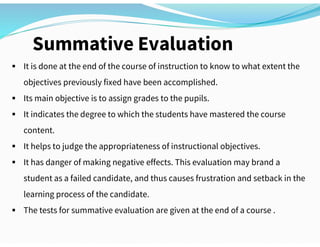
Summative Evaluation
 It is done at the end of the course of instruction to know to what extent the
objectives previously fixed have been accomplished.
 Its main objective is to assign grades to the pupils.
 It indicates the degree to which the students have mastered the course
content.
 It helps to judge the appropriateness of instructional objectives.
 It has danger of making negative effects. This evaluation may brand a
student as a failed candidate, and thus causes frustration and setback in the
learning process of the candidate.
 The tests for summative evaluation are given at the end of a course .
The functions of summative
evaluation
 Crediting- It is concerned with collecting evidence that a learner has
achieved some instructional goals in respect to a defined curriculum.
 Certifying- It is concerned with giving evidence that the learner is able to
perform a job according to the previously determined standards.
 Promoting- It is concerned with promoting pupils to next higher class.
 Selecting- Selecting the pupil for different courses after completion of a
particular course structure.
Characteristics of summative evaluation
It is judgmental in character in the sense that it judges the
achievement of pupils.
It views evaluation ‘as a product’, because its chief concern is
to point out the levels of attainment.
It may or may not motivate the learners. Sometimes it may
have negative effects.
It is terminal in nature as it comes at the end of the course of
instruction.
It reinforces learning of the students who has learnt an area.
Its result can be used for placement and grading purposes
It does not pin point difficulties faced by the learner.
It can not based on teacher’s observation only.
Maximum Performance evaluation &
TYPICAL PERFORMANCE EVALUATION
 Maximum Performance Evaluation:
 Determines what individual can do when performing at their best.
 Evaluating the person’s abilities and individual performance during motivation
 Aptitude and achievement tests are useful in measuring maximum performance
 Typical Performance Evaluation:
 Individuals performance under natural conditions i.e their typical behavior
 Individuals performance during routine and normal situation
 Attitude tests, personality inventories and observational techniques will help
measure typical behavior
(CCE) Definition:
 Continuous Evaluation refers to a system of school-
based evaluation of students that covers all aspects of
students development. It is a developmental process of
assessment which emphasizes on two fold objectives.
 CCE stands for Continuous and Comprehensive
Evaluation. It is a system which was introduced by CBSE
in India to assess all aspects of a student’s development on
a continuous basis throughout the year. It covers both
scholastic subjects as well as co-scholastic areas such as
performance in art, music, dance, sports, athletics and
other cultural activities.
 CCE
Flow chart of CCE Scheme:
Areas of co-Scholastic evaluation:
Life skills
Attitudes and values.
Co-Curricular Activities.
Self –Evaluation.
Life skills:
“Life skills have been defined as the abilities for
adaptive and positive behaviour that enable individuals
to deal effectively with the demands and challenges of
everyday life” –WHO
Life skills for children would include:
 Communication Skills
 Assertion and Refusal Skills.
 Interpersonal Skills.
 Team work.
 Emotional Management Skills.
Attitudes and values:
Attitudes and values are the qualities of life that the
child chooses for himself/ herself. The dimensions at
the Primary School level include
Respect for the values of National/State Symbols
 Compassion for all living Creatures
 Respect for School/ Community property.
 Courteousness
 Compliance with ‘Safety and Road Rules’
Co-Curricular Activities.
 Co-Curricular activities are built around each child’s
talents or areas of special interest to the child. Anyone
of the following group activities may be chosesn for
assessment such as
 Folk arts
 Indigenous games
 Club activities.
Self-Evaluation
 Student could be encouraged to evaluate themselves
their own answer scripts by comparing them with the
scoring keys / model answers provided.
 Self-Evaluation could prove to be more reliable for
performance tests.
 Self-Evaluation has to be guided and supervised by the
teachers at the initial stages.
 The system is economical reduce the work load of
teachers and promotes enthusiasm among the
students,
Observation
It is a old method
Observare – to keep open (Latin word)
Measurement without using any instrument or device
 Understanding the environment by sense organs
 External behaviour of persons in appropriate situations
 Tools such as check list and score-card, tape- recorder,
thermometers, audiometer, stop- watch, binoculars etc.
 Devices used: Anecdotal records, checklist and rating scale
Student attitude
Personal qualities and abilities
Motivation and commitments
Learning speed and style
Attainment and progress
Types
• Direct Observation
• Indirect Observation
• Natural Observation •
Artificial Observation
• Participant Observation
• Non-participant Observation
• Controlled Observation - laboratory
• Uncontrolled Observation - natural situation
• Known Observation •
Unknown Observation
• Group Observation •
Personal Observation
Uses of Observation
 In descriptive research Significant aspects of personality
which express themselves in behaviour
 Physical aspects of school buildings or students and
teachers – through physical examination, measurement,
assessment and comparison with fixed standards
 In classroom – learning behaviour
 Cumulative record – anecdotal evidence – research studies
MERITS OF DIRECT
OBSERVATION
Record of actual behavior, so more reliable and objective
Study of individual in natural situation
Employed to all section of students
Need training and experience and all teachers can use it
Used in every situation
DEMERITS OF OBSERVATION
Scope for personal prejudices and bias of the observer
May not be 100% accuracy
Difficult to observe every behaviour of the student
Reveal the overt behaviour only i.e behavior that is
expressed
PRINCIPLES OF OBSERVATION
 Observe the whole situation
 Select one student to observe at a time
 Observe in all regular activities such as in
classroom and in clinical areas
 Made over a period of time
 Observations from several teachers should be
combined
REQUISITES OF A GOOD OBSERVATION
 Proper planning of observation
 Area of behaviour
 Duration of behavior
 Scope of behavior
 Proper execution of observation
 Skill and resourcefulness
 implementing the plan properly
 Selected areas of behavior
 Decided pattern of behaviour
 Recording of observation
 Based on nature of activity and skill of behavior, observation
can be recorded simultaneously or after completion the
observation
 Proper interpretation
 Result interpret cautiously and judiciously
WEIGHTAGE TO
INSTRUCTIONAL OBJECTIVES
Percentag
e
Mark
s
Objective
Sl.No
20
10
Knowledge
1
40
20
Understandin
g
2
16
8
Application
3
10
5
Analysis
4
10
5
Synthesis
5
4
2
Evaluation
6
100
50
Total
WEIGHTAGE TO CONTENT
AREAS
Percentag
e
mark
s
Subuni
t
Sl.no
20
15
I
1
40
10
II
2
16
10
III
3
10
5
IV
4
10
10
V
5
100
50
Total
Weightage To Form Of Questions
Percentage
Marks
No. Of
Questions
Form Of
Questions
Sl.N
o
50
25
25
Objective Type
1
30
15
5
Short Answer
Type
2
20
10
1
Long Answer
Type
3
100
50
31
Total
Weightage To Difficulty Level
Percentage
Marks
Level Of
Difficulty
Sl.No
20
10
Easy
1
60
30
Average
2
20
10
Difficult
3
100
50
Total

educational evaluation 1 slide per page.pdf

  • 2.
  • 3.
     Evaluation ispart of life, in our life we need to make evaluation frequently – like which dress you want to wear in marriage – What you want to give in gift to your friend.  In educational scenario evaluation have important role in judging student progress to know up to what extent student have achieved the desired set goal.  The word ‘assess’ comes from the Latin verb ‘asadero’ meaning ‘to sit with’. Assessment can focus on the individual learner, the learning community (class, workshop, or other organized group of learners), the institution, or the educational system.
  • 4.
    DEFINITIONS Definitions of educationalEvaluation: Evaluation is a systematic, continuous process of determining,  The extent to which specified educational objectives, previously identified and defined, are attained;  The effectiveness of the learning experience provided in the classroom and  How well the goals of education have been accomplished.”
  • 5.
    OTHER RELATED DEFINITIONS ASSESSMENT: “Assessment is the process of documenting, usually in measurable terms, knowledge, skill, attitudes, and beliefs.” “Assessment in education is the process of gathering, interpreting, recording, and using information about pupils’ responses to an educational task.” ___ Harlen, Gipps, Broadfoot, Nuttal,1992
  • 6.
    IMPORTANT FEATURES OFEDUCATIONAL EVALUATION From the definition of educational evaluation, we derive its important features as follows;  It is a systematic process.  It is a continuous process; It goes hand in hand with the teaching-learning process.  It emphasizes the broad personality changes and major objectives of an educational programme.  It assumes that educational objectives have been previously been identified and defined.  A comprehensive evaluation involves the uses of many tools and techniques.  It helps to determine the adequacy and appropriateness of the learning experiences provided, to achieve the defined objectives.
  • 8.
    PRINCIPLES OF EDUCATIONALEVALUATION:  It must be clearly stated what is to be evaluated.  A variety of evaluation techniques should be used for a comprehensive evaluation.  An evaluator should know the limitations of different evaluation techniques.  The technique of evaluation must be appropriate for the characteristics or performance to be measured.  Evaluation is a means to an end but not an end in itself.
  • 9.
    ROLE AND FUNCTIONOF EDUCATIONAL EVALUATION:  It is useful as a good tool for asssessing the student’s progress in learning and observing his overall development.  On the basis of such assessment, individualized instruction may be adopted whenever necessary,  Evaluating the learning progress of public intermittently as the instructional process proceeds is otherwise known as Formative Evaluation.  Evaluation undertaken at the terminal stages of the instructional process proceeds is otherwise known as Summative Evaluation
  • 10.
    Scope of Evaluation Certification  Feedback  Monitoring the program  Safeguarding the public  Baseline for guidance and counselling  Placement and promotion in job  Development of tools and techniques  Appraise the methods of instructions.
  • 11.
    TYPES OF EVALUATION Based on frequency ofconducting evaluation Summative evaluation Formative evaluation Based on nature of measurement Maximum performance evaluation Typical performance evaluation Based on method of interpretating result Criterion – referenced Evaluation Norm – referenced evaluation
  • 12.
    Formative evaluation 1. Itis used to monitor the learning process of students during the period of instruction. 2. It provides continuous feedback to both teacher and student concerning learning successes and failure while instruction is in process. 3. Feedback to students provides reinforcement of successful learning and identifies the specific learning errors that need correction. 4. Feedback to teacher provides information for modifying instruction and for prescribing individual and group remedial work.
  • 13.
    Types of formativeevaluation 1. Diagnosing- It is concerned with determining the most appropriate method or instructional materials conducive to learning. 2. Placement- It is concerned with finding out the position of an individual in the curriculum from which he has to start learning. 3. Monitoring- It is concerned with keeping track of the day today progress of the learners and to point out changes necessary in the methods of teaching instructional strategies etc.
  • 14.
    Characteristics of Formative evaluation It is an integral part of learning process.  It occurs frequently during the course of instruction.  Its results are made immediately known to the learners.  It may sometimes take teacher’s observation only.  It reinforces learning of the students.  It pinpoints difficulties being faced by weak learners.  Its result can not be used for grading or placement purposes.
  • 15.
    Examples Of FormativeEvaluation Monthly Test Class Test Periodical Assessment Teacher’s Observation Etc.  It helps in modification of instructional strategies including method of teaching immediately.  It motivates learners; as it provides them with knowledge of progress made by them.  It sees the role of evaluation as a process.  It is generally teacher made test  It does not take much time to construct
  • 16.
    Summative Evaluation  Itis done at the end of the course of instruction to know to what extent the objectives previously fixed have been accomplished.  Its main objective is to assign grades to the pupils.  It indicates the degree to which the students have mastered the course content.  It helps to judge the appropriateness of instructional objectives.  It has danger of making negative effects. This evaluation may brand a student as a failed candidate, and thus causes frustration and setback in the learning process of the candidate.  The tests for summative evaluation are given at the end of a course .
  • 17.
    The functions ofsummative evaluation  Crediting- It is concerned with collecting evidence that a learner has achieved some instructional goals in respect to a defined curriculum.  Certifying- It is concerned with giving evidence that the learner is able to perform a job according to the previously determined standards.  Promoting- It is concerned with promoting pupils to next higher class.  Selecting- Selecting the pupil for different courses after completion of a particular course structure.
  • 18.
    Characteristics of summativeevaluation It is judgmental in character in the sense that it judges the achievement of pupils. It views evaluation ‘as a product’, because its chief concern is to point out the levels of attainment. It may or may not motivate the learners. Sometimes it may have negative effects. It is terminal in nature as it comes at the end of the course of instruction. It reinforces learning of the students who has learnt an area. Its result can be used for placement and grading purposes It does not pin point difficulties faced by the learner. It can not based on teacher’s observation only.
  • 19.
    Maximum Performance evaluation& TYPICAL PERFORMANCE EVALUATION  Maximum Performance Evaluation:  Determines what individual can do when performing at their best.  Evaluating the person’s abilities and individual performance during motivation  Aptitude and achievement tests are useful in measuring maximum performance  Typical Performance Evaluation:  Individuals performance under natural conditions i.e their typical behavior  Individuals performance during routine and normal situation  Attitude tests, personality inventories and observational techniques will help measure typical behavior
  • 20.
    (CCE) Definition:  ContinuousEvaluation refers to a system of school- based evaluation of students that covers all aspects of students development. It is a developmental process of assessment which emphasizes on two fold objectives.  CCE stands for Continuous and Comprehensive Evaluation. It is a system which was introduced by CBSE in India to assess all aspects of a student’s development on a continuous basis throughout the year. It covers both scholastic subjects as well as co-scholastic areas such as performance in art, music, dance, sports, athletics and other cultural activities.
  • 21.
  • 22.
    Flow chart ofCCE Scheme:
  • 24.
    Areas of co-Scholasticevaluation: Life skills Attitudes and values. Co-Curricular Activities. Self –Evaluation.
  • 25.
    Life skills: “Life skillshave been defined as the abilities for adaptive and positive behaviour that enable individuals to deal effectively with the demands and challenges of everyday life” –WHO Life skills for children would include:  Communication Skills  Assertion and Refusal Skills.  Interpersonal Skills.  Team work.  Emotional Management Skills.
  • 26.
    Attitudes and values: Attitudesand values are the qualities of life that the child chooses for himself/ herself. The dimensions at the Primary School level include Respect for the values of National/State Symbols  Compassion for all living Creatures  Respect for School/ Community property.  Courteousness  Compliance with ‘Safety and Road Rules’
  • 27.
    Co-Curricular Activities.  Co-Curricularactivities are built around each child’s talents or areas of special interest to the child. Anyone of the following group activities may be chosesn for assessment such as  Folk arts  Indigenous games  Club activities.
  • 28.
    Self-Evaluation  Student couldbe encouraged to evaluate themselves their own answer scripts by comparing them with the scoring keys / model answers provided.  Self-Evaluation could prove to be more reliable for performance tests.  Self-Evaluation has to be guided and supervised by the teachers at the initial stages.  The system is economical reduce the work load of teachers and promotes enthusiasm among the students,
  • 29.
    Observation It is aold method Observare – to keep open (Latin word) Measurement without using any instrument or device
  • 30.
     Understanding theenvironment by sense organs  External behaviour of persons in appropriate situations  Tools such as check list and score-card, tape- recorder, thermometers, audiometer, stop- watch, binoculars etc.  Devices used: Anecdotal records, checklist and rating scale Student attitude Personal qualities and abilities Motivation and commitments Learning speed and style Attainment and progress
  • 31.
    Types • Direct Observation •Indirect Observation • Natural Observation • Artificial Observation • Participant Observation • Non-participant Observation • Controlled Observation - laboratory • Uncontrolled Observation - natural situation • Known Observation • Unknown Observation • Group Observation • Personal Observation
  • 32.
    Uses of Observation In descriptive research Significant aspects of personality which express themselves in behaviour  Physical aspects of school buildings or students and teachers – through physical examination, measurement, assessment and comparison with fixed standards  In classroom – learning behaviour  Cumulative record – anecdotal evidence – research studies
  • 33.
    MERITS OF DIRECT OBSERVATION Recordof actual behavior, so more reliable and objective Study of individual in natural situation Employed to all section of students Need training and experience and all teachers can use it Used in every situation
  • 34.
    DEMERITS OF OBSERVATION Scopefor personal prejudices and bias of the observer May not be 100% accuracy Difficult to observe every behaviour of the student Reveal the overt behaviour only i.e behavior that is expressed
  • 35.
    PRINCIPLES OF OBSERVATION Observe the whole situation  Select one student to observe at a time  Observe in all regular activities such as in classroom and in clinical areas  Made over a period of time  Observations from several teachers should be combined
  • 36.
    REQUISITES OF AGOOD OBSERVATION  Proper planning of observation  Area of behaviour  Duration of behavior  Scope of behavior  Proper execution of observation  Skill and resourcefulness  implementing the plan properly  Selected areas of behavior  Decided pattern of behaviour  Recording of observation  Based on nature of activity and skill of behavior, observation can be recorded simultaneously or after completion the observation  Proper interpretation  Result interpret cautiously and judiciously
  • 37.
  • 38.
    Weightage To FormOf Questions Percentage Marks No. Of Questions Form Of Questions Sl.N o 50 25 25 Objective Type 1 30 15 5 Short Answer Type 2 20 10 1 Long Answer Type 3 100 50 31 Total Weightage To Difficulty Level Percentage Marks Level Of Difficulty Sl.No 20 10 Easy 1 60 30 Average 2 20 10 Difficult 3 100 50 Total