85%            Pass/Fail   A
           F       B
      C+                   93%


Assessment, Scoring,
   and Evaluation   S
                   D
Process of Evaluation
The general pattern of educational evaluation consists of
  four important steps.

1.Selection and Clarification of Objectives : Evaluation
  and teaching should start with the clear formulation and
  statement of all educational objectives.

2. Gathering of data in Terms of the Objectives : The
   gathering of data on pupil progress and evidence relating
   to stages of growth and development in terms of the
   objectives. This involves some kind of measurement
   procedure which might shed light on learning.
3.Ordering of Data : It will be necessary for the
  teacher to bring the data together in some
  systematic manner so that an appraisal can be
  made on the basis of all evidence available

4. Judgement: When the first three steps have
  been completed, teachers will make
  judgements by means of the collected data and
  with respect to the identified objectives
TYPES OF EVALUATION

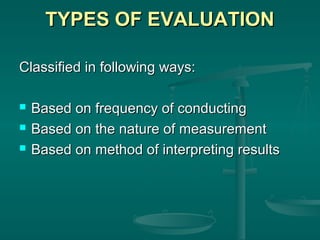
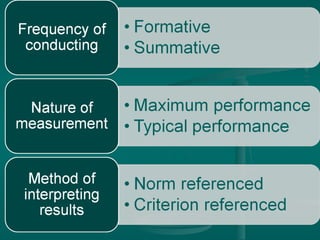
Classified in following ways:

   Based on frequency of conducting
   Based on the nature of measurement
   Based on method of interpreting results
FORMATIVE EVALUATION
 A formative        evaluation (sometimes
  referred to as internal) is a method for
  judging the worth of a program while the
  program      activities    are forming (in
  progress).
 Monitor how well the instructional goals
  and objectives are being met.
 Its main purpose is to catch deficiencies
  so that the proper learning interventions
  can take place.
   Formative evaluation is individualized by
    comparison of the students achievement
    during the various stages of course or
    curriculum,
   Formative evaluation puts the student against
    himself and not by comparison with other
    students.
   This enable the student to control his learning
    behavior at every point of course and seek
    appropriate teacher guidance.
   Formative evaluation is also useful in
    analyzing learning materials, student learning
    and achievements, and teacher effectiveness
Summative evaluation
   A summative evaluation (sometimes
    referred to as external) is a method of
    judging the worth of a program at the end
    of the program activities (summation). The
    focus is on the outcome.
   Summative evaluation refers to assigning
    a grade for students achievement at the
    end of the course or instructional program.
Formative evaluation                        Summative evaluation


Evaluation is performed to determine how    Evaluation is performed simply to grade the
well students have mastered various         students at the end of course
element.


Deals with only a segment                   Deals with the whole in detailed manner.


Test can be administered after completion   Test can be given after the completion of
of the units.                               the course/program


Immediate feedback                          Feedback not possible immediately

Diagnostic and progress test can be         Achievement examination can be
possible                                    possoble.


Weakness and strenghts of the students      Success and failure of the students will be
can be understand                           possible.
Maximum performance
             evaluation
   Determines what an individual can do when
    performing at their best.

   Determines a person’s abilities and how
    well an individual perform when motivated
    to obtain high score as possible.
Typical performance
              evaluation
   Determines what an individual will do
    under natural conditions i.e. their typical
    behavior.
   How does an individual usually behave in
    normal or routine situations.?
   Indicates what an individual will do rather
    than what they can do.
Criterion-Referenced
                  Evaluation
   Evaluation of performance by judging an
    individual's behavior, performance, or
    knowledge against specific criteria or
    standards. Based on a predetermined set of
    criteria.
   For instance,
       90% and up = A
       80% to 89.99% = B
       70% to 79.99% = C
       60% to 69.99% = D
       59.99% and below = F
   Determine individual performance in
    comparison to some standard or criterion.

   It enable us to describe what an individual
    can do, without reference to other’s
    performance.
Norm-referenced Evaluation
    Norm-referenced measures are designed to
    compare students performance according to
    relative position in some known group.

   It determine individual       performance     in
    comparison to others.

   it is inappropriate to use NRMs to determine
    the effectiveness of educational programs and
    to provide diagnostic information for individual
    students
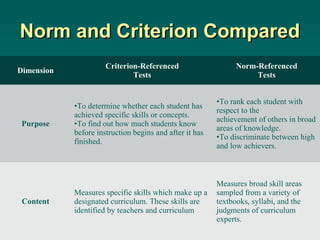
Norm and Criterion Compared
                      Criterion-Referenced                     Norm-Referenced
Dimension
                              Tests                                 Tests


                                                         •To rank each student with
            •To determine whether each student has
                                                         respect to the
            achieved specific skills or concepts.
                                                         achievement of others in broad
 Purpose    •To find out how much students know
                                                         areas of knowledge.
            before instruction begins and after it has
                                                         •To discriminate between high
            finished.
                                                         and low achievers.


                                                         Measures broad skill areas
            Measures specific skills which make up a     sampled from a variety of
 Content    designated curriculum. These skills are      textbooks, syllabi, and the
            identified by teachers and curriculum        judgments of curriculum
                                                         experts.
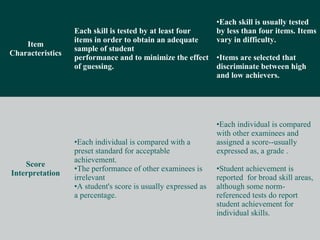
•Each skill is usually tested
                  Each skill is tested by at least four        by less than four items. Items
                  items in order to obtain an adequate         vary in difficulty.
    Item
                  sample of student
Characteristics
                  performance and to minimize the effect •Items are selected that
                  of guessing.                           discriminate between high
                                                         and low achievers.


                                                               •Each individual is compared
                                                               with other examinees and
                  •Each individual is compared with a          assigned a score--usually
                  preset standard for acceptable               expressed as, a grade .
                  achievement.
    Score
                  •The performance of other examinees is       •Student achievement is
Interpretation
                  irrelevant                                   reported for broad skill areas,
                  •A student's score is usually expressed as   although some norm-
                  a percentage.                                referenced tests do report
                                                               student achievement for
                                                               individual skills.

types of Evaluation

  • 1.
    85% Pass/Fail A F B C+ 93% Assessment, Scoring, and Evaluation S D
  • 2.
    Process of Evaluation Thegeneral pattern of educational evaluation consists of four important steps. 1.Selection and Clarification of Objectives : Evaluation and teaching should start with the clear formulation and statement of all educational objectives. 2. Gathering of data in Terms of the Objectives : The gathering of data on pupil progress and evidence relating to stages of growth and development in terms of the objectives. This involves some kind of measurement procedure which might shed light on learning.
  • 3.
    3.Ordering of Data: It will be necessary for the teacher to bring the data together in some systematic manner so that an appraisal can be made on the basis of all evidence available 4. Judgement: When the first three steps have been completed, teachers will make judgements by means of the collected data and with respect to the identified objectives
  • 4.
    TYPES OF EVALUATION Classifiedin following ways:  Based on frequency of conducting  Based on the nature of measurement  Based on method of interpreting results
  • 6.
    FORMATIVE EVALUATION  Aformative evaluation (sometimes referred to as internal) is a method for judging the worth of a program while the program activities are forming (in progress).  Monitor how well the instructional goals and objectives are being met.  Its main purpose is to catch deficiencies so that the proper learning interventions can take place.
  • 7.
    Formative evaluation is individualized by comparison of the students achievement during the various stages of course or curriculum,  Formative evaluation puts the student against himself and not by comparison with other students.  This enable the student to control his learning behavior at every point of course and seek appropriate teacher guidance.  Formative evaluation is also useful in analyzing learning materials, student learning and achievements, and teacher effectiveness
  • 8.
    Summative evaluation  A summative evaluation (sometimes referred to as external) is a method of judging the worth of a program at the end of the program activities (summation). The focus is on the outcome.  Summative evaluation refers to assigning a grade for students achievement at the end of the course or instructional program.
  • 9.
    Formative evaluation Summative evaluation Evaluation is performed to determine how Evaluation is performed simply to grade the well students have mastered various students at the end of course element. Deals with only a segment Deals with the whole in detailed manner. Test can be administered after completion Test can be given after the completion of of the units. the course/program Immediate feedback Feedback not possible immediately Diagnostic and progress test can be Achievement examination can be possible possoble. Weakness and strenghts of the students Success and failure of the students will be can be understand possible.
  • 10.
    Maximum performance evaluation  Determines what an individual can do when performing at their best.  Determines a person’s abilities and how well an individual perform when motivated to obtain high score as possible.
  • 11.
    Typical performance evaluation  Determines what an individual will do under natural conditions i.e. their typical behavior.  How does an individual usually behave in normal or routine situations.?  Indicates what an individual will do rather than what they can do.
  • 12.
    Criterion-Referenced Evaluation  Evaluation of performance by judging an individual's behavior, performance, or knowledge against specific criteria or standards. Based on a predetermined set of criteria.  For instance,  90% and up = A  80% to 89.99% = B  70% to 79.99% = C  60% to 69.99% = D  59.99% and below = F
  • 13.
    Determine individual performance in comparison to some standard or criterion.  It enable us to describe what an individual can do, without reference to other’s performance.
  • 14.
    Norm-referenced Evaluation  Norm-referenced measures are designed to compare students performance according to relative position in some known group.  It determine individual performance in comparison to others.  it is inappropriate to use NRMs to determine the effectiveness of educational programs and to provide diagnostic information for individual students
  • 15.
    Norm and CriterionCompared Criterion-Referenced Norm-Referenced Dimension Tests Tests •To rank each student with •To determine whether each student has respect to the achieved specific skills or concepts. achievement of others in broad Purpose •To find out how much students know areas of knowledge. before instruction begins and after it has •To discriminate between high finished. and low achievers. Measures broad skill areas Measures specific skills which make up a sampled from a variety of Content designated curriculum. These skills are textbooks, syllabi, and the identified by teachers and curriculum judgments of curriculum experts.
  • 16.
    •Each skill isusually tested Each skill is tested by at least four by less than four items. Items items in order to obtain an adequate vary in difficulty. Item sample of student Characteristics performance and to minimize the effect •Items are selected that of guessing. discriminate between high and low achievers. •Each individual is compared with other examinees and •Each individual is compared with a assigned a score--usually preset standard for acceptable expressed as, a grade . achievement. Score •The performance of other examinees is •Student achievement is Interpretation irrelevant reported for broad skill areas, •A student's score is usually expressed as although some norm- a percentage. referenced tests do report student achievement for individual skills.