Concept of
Evaluation
  Concept of Measurement, Assessment and Evaluation
  Need and Scope of Evaluation
  Distinction among-Measurement, Assessment and
Evaluation.
  Evaluation Approaches: Formative -Summative
  Difference between Assessment of learning,
Assessment for learning and Assessment as Learning
  Continuous and Comprehensive Assessment: Need,
Implementation Procedure
  Types of evaluation: Norm referenced and Criterion
referenced interpretations of test results
Unit I: Concept of Evaluation
 We have heard a lot of terms like
measurement, assessment, evaluation etc.
which are used to determine the learning
outcomes.
 It is a device or procedure for confronting a
subject with a standard set of questions or
tasks to which the student is to respond
independently and the results of which can be
treated in such a way to provide a quantitative
comparison of performance of different
students. It is a tool of measurement Some
examples of tests are Achievement tests,
Aptitude tests, Attitude scales etc.
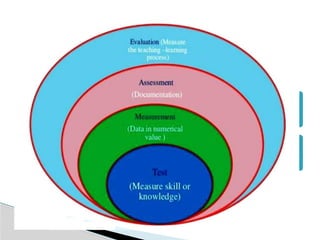
TEST
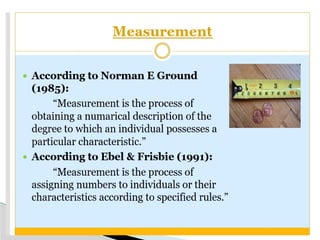
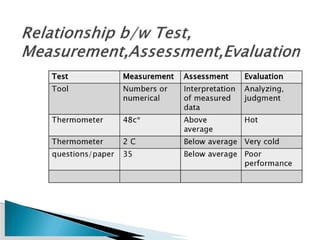
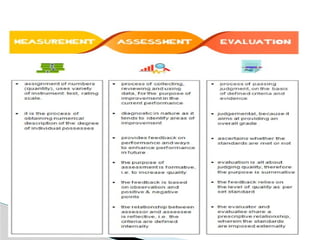
 According to J.C. Aggarwal, Measurement is
the process of obtaining numerical description
of the degree to which an individual possesses
a particular characteristic.
 We can say that when a teacher assigns
numbers, symbols, or grades to some
attributes of a student, it is called
measurement
MEASUREMENT-
 It is a part of evaluation through which we
assess the progress of a student in a particular
area. It is an attempt to measure not the pupil
as a whole, nor his worth but some of his
specific abilities in some specific areas. It is the
process of observing and measuring learning
ASSESSMENT
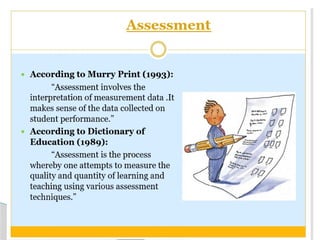
 Assessment can be as simple as a teacher’s
subjective judgment based on a single
observation of student’s performance or as
complex as a three hour standardized test.
 Assessment is a much more comprehensive
term than testing or measurement. It includes
both measurement and non-measurement
dimensions of students.
 Assessment for learning occurs when teachers use
inferences about student progress to inform their
teaching. (formative)
 Assessment as learning occurs when students reflect
on and monitor their progress to inform their future
learning goals. (formative)
 Assessment of learning occurs when teachers use
evidence of student learning to make judgements on
student achievement against goals and standards.
(summative)
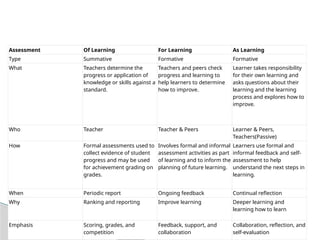
Assessment Of Learning For Learning As Learning
Type Summative Formative Formative
What Teachers determine the
progress or application of
knowledge or skills against a
standard.
Teachers and peers check
progress and learning to
help learners to determine
how to improve.
Learner takes responsibility
for their own learning and
asks questions about their
learning and the learning
process and explores how to
improve.
Who Teacher Teacher & Peers Learner & Peers,
Teachers(Passive)
How Formal assessments used to
collect evidence of student
progress and may be used
for achievement grading on
grades.
Involves formal and informal
assessment activities as part
of learning and to inform the
planning of future learning.
Learners use formal and
informal feedback and self-
assessment to help
understand the next steps in
learning.
When Periodic report Ongoing feedback Continual reflection
Why Ranking and reporting Improve learning Deeper learning and
learning how to learn
Emphasis Scoring, grades, and
competition
Feedback, support, and
collaboration
Collaboration, reflection, and
self-evaluation
Assessment
Measurement Testing
Non-
Measurement
Observation
 It is used to assess the modification in total
behavior of the child related with all the three
domains. Evaluation assesses learner’s
progress in scholastic as well as non-scholastic
areas.
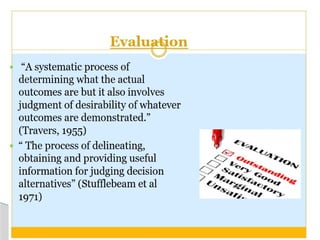
Evaluation
 Answers the question
◦ "How well did we do?"
◦ "How much did we do?
Functions?
 1) For LEARNERS-
 Assessment of personality of learners- Assessment
helps in recognizing individual differences and other
aspects of personality of learners like achievement
skills, interests, attitude, aptitude, intelligence,
physical, emotional, social and moral development.
 Diagnosing students strengths and weaknesses-
Assessment helps the students to know their
strengths and weaknesses. It motivate them and
encourage them and at the same time provide
opportunities to overcome their weaknesses.
PURPOSE/Need OF Evaluation
 .
 Monitoring students progress- Assessment includes
monitoring students progress, providing remedial teaching and
improving the learning environment. It also helps in the
classification of students in various categories like intelligent,
average and below average students. Students having same I.Q
can be grouped together for uniform progress.
 To provide Guidance- On the basis of the results of assessment
proper educational and vocational guidance can be given to the
needy students. Helping students in educational and vocational
decisions, guiding them in curricular and extra-curricular
activities and assisting them in solving personal and social
problems, all need a comprehensive knowledge of the strengths
and weaknesses of students.
PURPOSE OF Evaluation
 It gives a clear picture of teacher’ competence.
They come to know about the effectiveness of
their teaching methods, usefulness of their
instructional material and the effectiveness of
presentation of teaching learning environment.
Thus assessments results help in making
improvement in teaching learning process.
FOR TEACHERS
 The results of assessment and evaluation are
used to make improvements in the courses and
curriculum, texts and learning material for
students and teachers. The change in
curriculum is brought out to suit out the needs
of the society, individual student and the nation
as a whole. It is also modify to suit the needs of
the market so that students can get ample
employment opportunities.
CURRICULUM DEVELOPMENT
 Assessment helps parents to know about their
child’s progress and the quality of teaching
learning.
FOR PARENTS
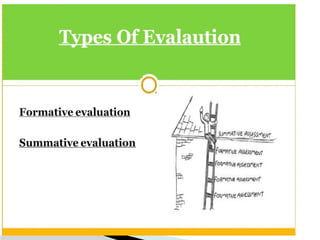
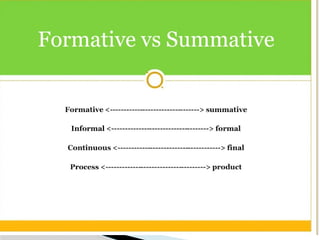
Formative & Summative
Evaluation
 Formative evaluation: If the evaluation is at the
beginning or during.
 Summative evaluation: If the evaluation is at the
end.
Formative Assessment
 Assessment for learning
 Taken at varying intervals throughout a course to
provide information and feedback that will help
improve
◦ the quality of student learning
◦ the quality of the course itself
 “…learner-centered, teacher-directed, mutually
beneficial, formative, context-specific, ongoing,
and firmly rooted in good practice" (Angelo and
Cross, 1993).
 Provides information on what an individual
student needs
◦ To practice
◦ To have re-taught
◦ To learn next
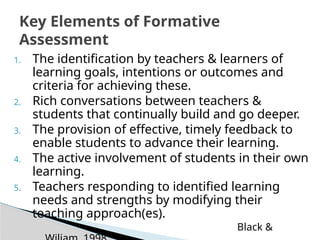
1. The identification by teachers & learners of
learning goals, intentions or outcomes and
criteria for achieving these.
2. Rich conversations between teachers &
students that continually build and go deeper.
3. The provision of effective, timely feedback to
enable students to advance their learning.
4. The active involvement of students in their own
learning.
5. Teachers responding to identified learning
needs and strengths by modifying their
teaching approach(es).
Black &
Key Elements of Formative
Assessment
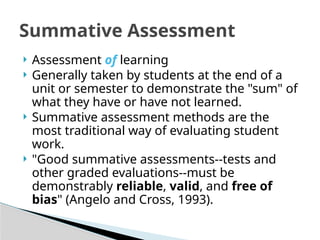
Summative Assessment
 Assessment of learning
 Generally taken by students at the end of a
unit or semester to demonstrate the "sum" of
what they have or have not learned.
 Summative assessment methods are the
most traditional way of evaluating student
work.
 "Good summative assessments--tests and
other graded evaluations--must be
demonstrably reliable, valid, and free of
bias" (Angelo and Cross, 1993).
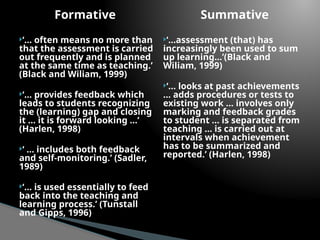
Formative
‘… often means no more than
that the assessment is carried
out frequently and is planned
at the same time as teaching.’
(Black and Wiliam, 1999)
‘… provides feedback which
leads to students recognizing
the (learning) gap and closing
it … it is forward looking …’
(Harlen, 1998)
‘ … includes both feedback
and self-monitoring.’ (Sadler,
1989)
‘… is used essentially to feed
back into the teaching and
learning process.’ (Tunstall
and Gipps, 1996)
Summative
‘…assessment (that) has
increasingly been used to sum
up learning…’(Black and
Wiliam, 1999)
‘… looks at past achievements
… adds procedures or tests to
existing work ... involves only
marking and feedback grades
to student … is separated from
teaching … is carried out at
intervals when achievement
has to be summarized and
reported.’ (Harlen, 1998)
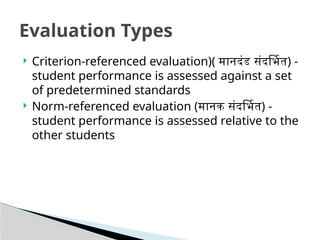
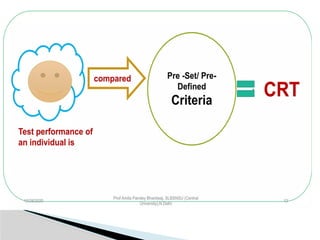
 Criterion-referenced evaluation)( मानदंड संदर्भित) -
student performance is assessed against a set
of predetermined standards
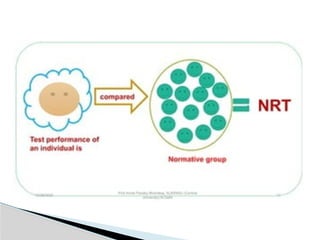
 Norm-referenced evaluation (मानक संदर्भित) -
student performance is assessed relative to the
other students
Evaluation Types
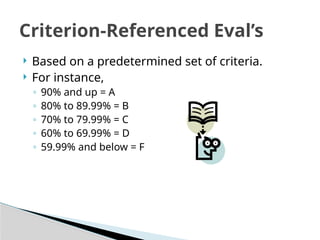
 Based on a predetermined set of criteria.
 For instance,
◦ 90% and up = A
◦ 80% to 89.99% = B
◦ 70% to 79.99% = C
◦ 60% to 69.99% = D
◦ 59.99% and below = F
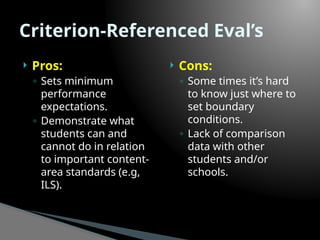
Criterion-Referenced Eval’s
 Pros:
◦ Sets minimum
performance
expectations.
◦ Demonstrate what
students can and
cannot do in relation
to important content-
area standards (e.g,
ILS).
 Cons:
◦ Some times it’s hard
to know just where to
set boundary
conditions.
◦ Lack of comparison
data with other
students and/or
schools.
Criterion-Referenced Eval’s
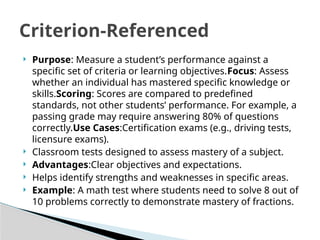
 Purpose: Measure a student’s performance against a
specific set of criteria or learning objectives.Focus: Assess
whether an individual has mastered specific knowledge or
skills.Scoring: Scores are compared to predefined
standards, not other students’ performance. For example, a
passing grade may require answering 80% of questions
correctly.Use Cases:Certification exams (e.g., driving tests,
licensure exams).
 Classroom tests designed to assess mastery of a subject.
 Advantages:Clear objectives and expectations.
 Helps identify strengths and weaknesses in specific areas.
 Example: A math test where students need to solve 8 out of
10 problems correctly to demonstrate mastery of fractions.
Criterion-Referenced
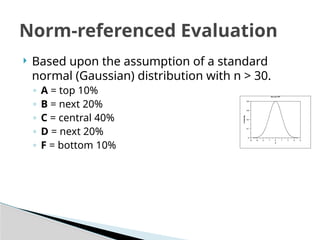
 Based upon the assumption of a standard
normal (Gaussian) distribution with n > 30.
◦ A = top 10%
◦ B = next 20%
◦ C = central 40%
◦ D = next 20%
◦ F = bottom 10%
Norm-referenced Evaluation
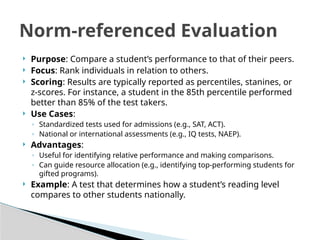
 Purpose: Compare a student’s performance to that of their peers.
 Focus: Rank individuals in relation to others.
 Scoring: Results are typically reported as percentiles, stanines, or
z-scores. For instance, a student in the 85th percentile performed
better than 85% of the test takers.
 Use Cases:
◦ Standardized tests used for admissions (e.g., SAT, ACT).
◦ National or international assessments (e.g., IQ tests, NAEP).
 Advantages:
◦ Useful for identifying relative performance and making comparisons.
◦ Can guide resource allocation (e.g., identifying top-performing students for
gifted programs).
 Example: A test that determines how a student’s reading level
compares to other students nationally.
Norm-referenced Evaluation
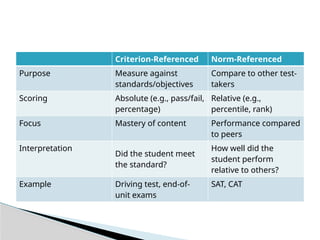
Criterion-Referenced Norm-Referenced
Purpose Measure against
standards/objectives
Compare to other test-
takers
Scoring Absolute (e.g., pass/fail,
percentage)
Relative (e.g.,
percentile, rank)
Focus Mastery of content Performance compared
to peers
Interpretation
Did the student meet
the standard?
How well did the
student perform
relative to others?
Example Driving test, end-of-
unit exams
SAT, CAT
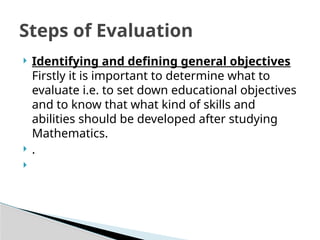
 Identifying and defining general objectives
Firstly it is important to determine what to
evaluate i.e. to set down educational objectives
and to know that what kind of skills and
abilities should be developed after studying
Mathematics.
 .

Steps of Evaluation
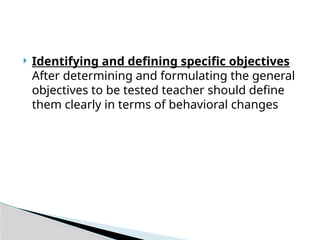
 Identifying and defining specific objectives
After determining and formulating the general
objectives to be tested teacher should define
them clearly in terms of behavioral changes
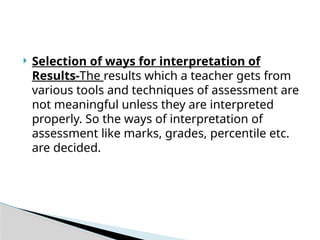
 Selection of ways for interpretation of
Results-The results which a teacher gets from
various tools and techniques of assessment are
not meaningful unless they are interpreted
properly. So the ways of interpretation of
assessment like marks, grades, percentile etc.
are decided.
 Selection of tools and techniques of
assessment- During this stage teacher selects
the tools and techniques for assessing
student’s progress, construct or select tools,
construct items and prepare tests. Tools and
techniques must provide evidence on the
teaching objectives to which they are
concerned. They should also satisfy the criteria
of a good test paper.
CONTINUOUS AND COMPREHENSIVE EVALUATION
  It refers to a particular process of evaluation
which is school based and aims at all round
development of the student.
  This process includes continuity of testing
with reasonable intervals and covering
different aspects of curricular and co-curricular
areas so as to help the students.
Concept of Continuous and
Comprehensive Evaluation
 ‘Continuous’:  It refers to continuity and regularity of
assessment during the whole session. The frequency of

class tests, unit tests and terminal tests can make the
evaluation regular. The tests may be followed by the

diagnosis of the hard spots of learners and remedial
intervention to correct them. Retesting and getting

feedback may help the teachers and for their self-evaluation.
 ‘Comprehensive’: It refers to the areas of assessment which

includes both scholastic and co-scholastic aspects of pupils
growth helping the all round development of the child. 
Scholastic aspect include curricular area or subject specific
areas and Co-scholastic aspects include Life skills, Co-
curricular activities, Attitudes and Values.
KEY WORDS:
 In scholastic aspect, cognitive growth in subject
specific areas are covered and in co-scholastic aspect the
growth in affective and psychomotor areas are covered.
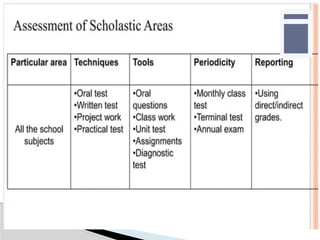
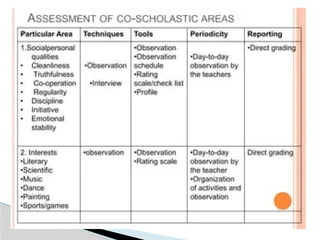
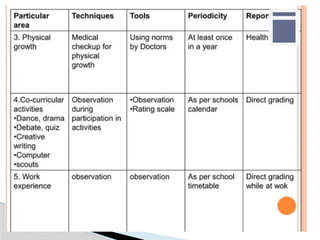
 The scholastic areas are meant for intellectual growth
whereas co-scholastic areas are required to develop
physical growth, development of social personal
qualities, interests, attitudes and values.
 The evaluation tools and techniques used for these
two areas are entirely different in nature. For instance,
the scholastic areas can be tested through written and
oral tests, whereas co-scholastic areas can be assessed
basically through observation and similar techniques.
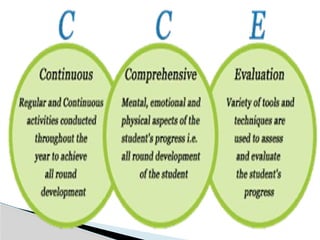
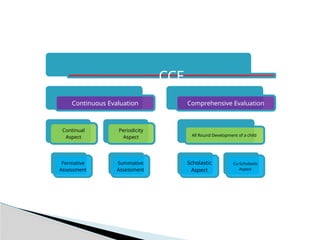
CCE
Continuous Evaluation
Continual
Aspect
Formative
Assessment
Periodicity
Aspect
Summative
Assessment
Comprehensive Evaluation
All Round Development of a child
Scholastic
Aspect
Co-Scholastic
Aspect
1)To make evaluation an integral part of
teaching-learning process.
2) To use evaluation for improvement of students
achievement through diagnosis and remediation.
3)To make sound judgment and take timely
decisions for learner’s growth, learning process,
learning pace and learning environment.
4) To maintain desired standard of attainment. 5)
To provide scope for self-evaluation
Objectives of CCE:
 1) It helps to make the education process a student-centric
activity.
 2) To develop cognitive, psychomotor and interpersonal skills.
 3) It helps the teacher to organize effective teaching strategies.
 4) To develop students’ achievement through continuous
assessment, diagnosis and remediation, assessment in co-
scholastic area.
 5) By continuous evaluation, children can know their strength
and weakness. It provides the child a realistic self assessment of
how he/she studies. It helps a learner to determine the areas of
instruction in where more emphasis is required.
 6) It helps in making decisions for the future, regarding choice
of subjects, courses and careers.
NEED AND RELEVANCE OF CCE
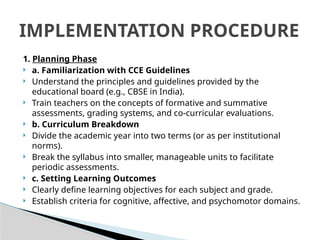
1. Planning Phase
 a. Familiarization with CCE Guidelines
 Understand the principles and guidelines provided by the
educational board (e.g., CBSE in India).
 Train teachers on the concepts of formative and summative
assessments, grading systems, and co-curricular evaluations.
 b. Curriculum Breakdown
 Divide the academic year into two terms (or as per institutional
norms).
 Break the syllabus into smaller, manageable units to facilitate
periodic assessments.
 c. Setting Learning Outcomes
 Clearly define learning objectives for each subject and grade.
 Establish criteria for cognitive, affective, and psychomotor domains.
IMPLEMENTATION PROCEDURE
2. Designing Assessments
 a. Formative Assessments (FA)
 Plan continuous assessments like quizzes, oral tests,
projects, group activities, and assignments.
 Ensure assessments are diagnostic and remedial to
address learning gaps.
 b. Summative Assessments (SA)
 Schedule end-of-term exams to assess cumulative
knowledge.
 Prepare question papers that test higher-order
thinking skills (HOTS) alongside basic concepts.
3. Implementation Phase
 a. Conduct Formative Assessments
 Include diverse activities to test both academic and non-academic skills.
 Provide immediate feedback and encourage student reflection on their
performance.
 b. Conduct Summative Assessments
 Conduct exams as per the schedule with a well-defined evaluation scheme.
 Maintain a balance between objective and subjective questions.
 c. Assess Co-curricular Activities
 Assess students on parameters like teamwork, leadership, creativity, and
participation in sports, arts, or other activities.
 Use rubrics or descriptive indicators for evaluation.
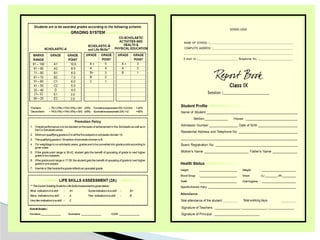
4. Documentation and Record Keeping
 Maintain detailed records of students' academic and non-academic performances.
 Use report cards that provide a comprehensive overview of students' strengths
and areas of improvement.
5. Grading and Reporting
 a. Use a Grading System
 Replace marks with grades (A, B, C, etc.) to reduce the stress of marks.
 Ensure grades reflect overall development, including academics and co-
curricular aspects.
 b. Provide Detailed Feedback
 Share progress reports with parents, highlighting strengths and improvement
areas.
 Focus on constructive feedback to support student growth.
6. Review and Feedback
 Conduct regular meetings with teachers, parents, and students to assess the
effectiveness of CCE.
 Use feedback to improve assessment techniques and classroom practices.
7. Supporting Students
 Identify slow learners and provide remedial support.
 Encourage peer learning and mentorship programs to help students improve.
Assessment and Evaluation: Meaning and Difference

Assessment and Evaluation: Meaning and Difference

  • 1.
  • 2.
      Conceptof Measurement, Assessment and Evaluation   Need and Scope of Evaluation   Distinction among-Measurement, Assessment and Evaluation.   Evaluation Approaches: Formative -Summative   Difference between Assessment of learning, Assessment for learning and Assessment as Learning   Continuous and Comprehensive Assessment: Need, Implementation Procedure   Types of evaluation: Norm referenced and Criterion referenced interpretations of test results Unit I: Concept of Evaluation
  • 3.
     We haveheard a lot of terms like measurement, assessment, evaluation etc. which are used to determine the learning outcomes.
  • 4.
     It isa device or procedure for confronting a subject with a standard set of questions or tasks to which the student is to respond independently and the results of which can be treated in such a way to provide a quantitative comparison of performance of different students. It is a tool of measurement Some examples of tests are Achievement tests, Aptitude tests, Attitude scales etc. TEST
  • 5.
     According toJ.C. Aggarwal, Measurement is the process of obtaining numerical description of the degree to which an individual possesses a particular characteristic.  We can say that when a teacher assigns numbers, symbols, or grades to some attributes of a student, it is called measurement MEASUREMENT-
  • 15.
     It isa part of evaluation through which we assess the progress of a student in a particular area. It is an attempt to measure not the pupil as a whole, nor his worth but some of his specific abilities in some specific areas. It is the process of observing and measuring learning ASSESSMENT
  • 16.
     Assessment canbe as simple as a teacher’s subjective judgment based on a single observation of student’s performance or as complex as a three hour standardized test.  Assessment is a much more comprehensive term than testing or measurement. It includes both measurement and non-measurement dimensions of students.
  • 17.
     Assessment forlearning occurs when teachers use inferences about student progress to inform their teaching. (formative)  Assessment as learning occurs when students reflect on and monitor their progress to inform their future learning goals. (formative)  Assessment of learning occurs when teachers use evidence of student learning to make judgements on student achievement against goals and standards. (summative)
  • 18.
    Assessment Of LearningFor Learning As Learning Type Summative Formative Formative What Teachers determine the progress or application of knowledge or skills against a standard. Teachers and peers check progress and learning to help learners to determine how to improve. Learner takes responsibility for their own learning and asks questions about their learning and the learning process and explores how to improve. Who Teacher Teacher & Peers Learner & Peers, Teachers(Passive) How Formal assessments used to collect evidence of student progress and may be used for achievement grading on grades. Involves formal and informal assessment activities as part of learning and to inform the planning of future learning. Learners use formal and informal feedback and self- assessment to help understand the next steps in learning. When Periodic report Ongoing feedback Continual reflection Why Ranking and reporting Improve learning Deeper learning and learning how to learn Emphasis Scoring, grades, and competition Feedback, support, and collaboration Collaboration, reflection, and self-evaluation
  • 19.
  • 20.
     It isused to assess the modification in total behavior of the child related with all the three domains. Evaluation assesses learner’s progress in scholastic as well as non-scholastic areas. Evaluation
  • 23.
     Answers thequestion ◦ "How well did we do?" ◦ "How much did we do? Functions?
  • 24.
     1) ForLEARNERS-  Assessment of personality of learners- Assessment helps in recognizing individual differences and other aspects of personality of learners like achievement skills, interests, attitude, aptitude, intelligence, physical, emotional, social and moral development.  Diagnosing students strengths and weaknesses- Assessment helps the students to know their strengths and weaknesses. It motivate them and encourage them and at the same time provide opportunities to overcome their weaknesses. PURPOSE/Need OF Evaluation
  • 25.
     .  Monitoringstudents progress- Assessment includes monitoring students progress, providing remedial teaching and improving the learning environment. It also helps in the classification of students in various categories like intelligent, average and below average students. Students having same I.Q can be grouped together for uniform progress.  To provide Guidance- On the basis of the results of assessment proper educational and vocational guidance can be given to the needy students. Helping students in educational and vocational decisions, guiding them in curricular and extra-curricular activities and assisting them in solving personal and social problems, all need a comprehensive knowledge of the strengths and weaknesses of students. PURPOSE OF Evaluation
  • 26.
     It givesa clear picture of teacher’ competence. They come to know about the effectiveness of their teaching methods, usefulness of their instructional material and the effectiveness of presentation of teaching learning environment. Thus assessments results help in making improvement in teaching learning process. FOR TEACHERS
  • 27.
     The resultsof assessment and evaluation are used to make improvements in the courses and curriculum, texts and learning material for students and teachers. The change in curriculum is brought out to suit out the needs of the society, individual student and the nation as a whole. It is also modify to suit the needs of the market so that students can get ample employment opportunities. CURRICULUM DEVELOPMENT
  • 28.
     Assessment helpsparents to know about their child’s progress and the quality of teaching learning. FOR PARENTS
  • 34.
    Formative & Summative Evaluation Formative evaluation: If the evaluation is at the beginning or during.  Summative evaluation: If the evaluation is at the end.
  • 35.
    Formative Assessment  Assessmentfor learning  Taken at varying intervals throughout a course to provide information and feedback that will help improve ◦ the quality of student learning ◦ the quality of the course itself
  • 36.
     “…learner-centered, teacher-directed,mutually beneficial, formative, context-specific, ongoing, and firmly rooted in good practice" (Angelo and Cross, 1993).  Provides information on what an individual student needs ◦ To practice ◦ To have re-taught ◦ To learn next
  • 37.
    1. The identificationby teachers & learners of learning goals, intentions or outcomes and criteria for achieving these. 2. Rich conversations between teachers & students that continually build and go deeper. 3. The provision of effective, timely feedback to enable students to advance their learning. 4. The active involvement of students in their own learning. 5. Teachers responding to identified learning needs and strengths by modifying their teaching approach(es). Black & Key Elements of Formative Assessment
  • 39.
    Summative Assessment  Assessmentof learning  Generally taken by students at the end of a unit or semester to demonstrate the "sum" of what they have or have not learned.  Summative assessment methods are the most traditional way of evaluating student work.  "Good summative assessments--tests and other graded evaluations--must be demonstrably reliable, valid, and free of bias" (Angelo and Cross, 1993).
  • 42.
    Formative ‘… often meansno more than that the assessment is carried out frequently and is planned at the same time as teaching.’ (Black and Wiliam, 1999) ‘… provides feedback which leads to students recognizing the (learning) gap and closing it … it is forward looking …’ (Harlen, 1998) ‘ … includes both feedback and self-monitoring.’ (Sadler, 1989) ‘… is used essentially to feed back into the teaching and learning process.’ (Tunstall and Gipps, 1996) Summative ‘…assessment (that) has increasingly been used to sum up learning…’(Black and Wiliam, 1999) ‘… looks at past achievements … adds procedures or tests to existing work ... involves only marking and feedback grades to student … is separated from teaching … is carried out at intervals when achievement has to be summarized and reported.’ (Harlen, 1998)
  • 43.
     Criterion-referenced evaluation)(मानदंड संदर्भित) - student performance is assessed against a set of predetermined standards  Norm-referenced evaluation (मानक संदर्भित) - student performance is assessed relative to the other students Evaluation Types
  • 46.
     Based ona predetermined set of criteria.  For instance, ◦ 90% and up = A ◦ 80% to 89.99% = B ◦ 70% to 79.99% = C ◦ 60% to 69.99% = D ◦ 59.99% and below = F Criterion-Referenced Eval’s
  • 47.
     Pros: ◦ Setsminimum performance expectations. ◦ Demonstrate what students can and cannot do in relation to important content- area standards (e.g, ILS).  Cons: ◦ Some times it’s hard to know just where to set boundary conditions. ◦ Lack of comparison data with other students and/or schools. Criterion-Referenced Eval’s
  • 48.
     Purpose: Measurea student’s performance against a specific set of criteria or learning objectives.Focus: Assess whether an individual has mastered specific knowledge or skills.Scoring: Scores are compared to predefined standards, not other students’ performance. For example, a passing grade may require answering 80% of questions correctly.Use Cases:Certification exams (e.g., driving tests, licensure exams).  Classroom tests designed to assess mastery of a subject.  Advantages:Clear objectives and expectations.  Helps identify strengths and weaknesses in specific areas.  Example: A math test where students need to solve 8 out of 10 problems correctly to demonstrate mastery of fractions. Criterion-Referenced
  • 49.
     Based uponthe assumption of a standard normal (Gaussian) distribution with n > 30. ◦ A = top 10% ◦ B = next 20% ◦ C = central 40% ◦ D = next 20% ◦ F = bottom 10% Norm-referenced Evaluation
  • 50.
     Purpose: Comparea student’s performance to that of their peers.  Focus: Rank individuals in relation to others.  Scoring: Results are typically reported as percentiles, stanines, or z-scores. For instance, a student in the 85th percentile performed better than 85% of the test takers.  Use Cases: ◦ Standardized tests used for admissions (e.g., SAT, ACT). ◦ National or international assessments (e.g., IQ tests, NAEP).  Advantages: ◦ Useful for identifying relative performance and making comparisons. ◦ Can guide resource allocation (e.g., identifying top-performing students for gifted programs).  Example: A test that determines how a student’s reading level compares to other students nationally. Norm-referenced Evaluation
  • 51.
    Criterion-Referenced Norm-Referenced Purpose Measureagainst standards/objectives Compare to other test- takers Scoring Absolute (e.g., pass/fail, percentage) Relative (e.g., percentile, rank) Focus Mastery of content Performance compared to peers Interpretation Did the student meet the standard? How well did the student perform relative to others? Example Driving test, end-of- unit exams SAT, CAT
  • 52.
     Identifying anddefining general objectives Firstly it is important to determine what to evaluate i.e. to set down educational objectives and to know that what kind of skills and abilities should be developed after studying Mathematics.  .  Steps of Evaluation
  • 53.
     Identifying anddefining specific objectives After determining and formulating the general objectives to be tested teacher should define them clearly in terms of behavioral changes
  • 54.
     Selection ofways for interpretation of Results-The results which a teacher gets from various tools and techniques of assessment are not meaningful unless they are interpreted properly. So the ways of interpretation of assessment like marks, grades, percentile etc. are decided.
  • 55.
     Selection oftools and techniques of assessment- During this stage teacher selects the tools and techniques for assessing student’s progress, construct or select tools, construct items and prepare tests. Tools and techniques must provide evidence on the teaching objectives to which they are concerned. They should also satisfy the criteria of a good test paper.
  • 56.
  • 58.
      Itrefers to a particular process of evaluation which is school based and aims at all round development of the student.   This process includes continuity of testing with reasonable intervals and covering different aspects of curricular and co-curricular areas so as to help the students. Concept of Continuous and Comprehensive Evaluation
  • 59.
     ‘Continuous’: It refers to continuity and regularity of assessment during the whole session. The frequency of  class tests, unit tests and terminal tests can make the evaluation regular. The tests may be followed by the  diagnosis of the hard spots of learners and remedial intervention to correct them. Retesting and getting  feedback may help the teachers and for their self-evaluation.  ‘Comprehensive’: It refers to the areas of assessment which  includes both scholastic and co-scholastic aspects of pupils growth helping the all round development of the child.  Scholastic aspect include curricular area or subject specific areas and Co-scholastic aspects include Life skills, Co- curricular activities, Attitudes and Values. KEY WORDS:
  • 60.
     In scholasticaspect, cognitive growth in subject specific areas are covered and in co-scholastic aspect the growth in affective and psychomotor areas are covered.  The scholastic areas are meant for intellectual growth whereas co-scholastic areas are required to develop physical growth, development of social personal qualities, interests, attitudes and values.  The evaluation tools and techniques used for these two areas are entirely different in nature. For instance, the scholastic areas can be tested through written and oral tests, whereas co-scholastic areas can be assessed basically through observation and similar techniques.
  • 61.
  • 62.
    1)To make evaluationan integral part of teaching-learning process. 2) To use evaluation for improvement of students achievement through diagnosis and remediation. 3)To make sound judgment and take timely decisions for learner’s growth, learning process, learning pace and learning environment. 4) To maintain desired standard of attainment. 5) To provide scope for self-evaluation Objectives of CCE:
  • 63.
     1) Ithelps to make the education process a student-centric activity.  2) To develop cognitive, psychomotor and interpersonal skills.  3) It helps the teacher to organize effective teaching strategies.  4) To develop students’ achievement through continuous assessment, diagnosis and remediation, assessment in co- scholastic area.  5) By continuous evaluation, children can know their strength and weakness. It provides the child a realistic self assessment of how he/she studies. It helps a learner to determine the areas of instruction in where more emphasis is required.  6) It helps in making decisions for the future, regarding choice of subjects, courses and careers. NEED AND RELEVANCE OF CCE
  • 67.
    1. Planning Phase a. Familiarization with CCE Guidelines  Understand the principles and guidelines provided by the educational board (e.g., CBSE in India).  Train teachers on the concepts of formative and summative assessments, grading systems, and co-curricular evaluations.  b. Curriculum Breakdown  Divide the academic year into two terms (or as per institutional norms).  Break the syllabus into smaller, manageable units to facilitate periodic assessments.  c. Setting Learning Outcomes  Clearly define learning objectives for each subject and grade.  Establish criteria for cognitive, affective, and psychomotor domains. IMPLEMENTATION PROCEDURE
  • 68.
    2. Designing Assessments a. Formative Assessments (FA)  Plan continuous assessments like quizzes, oral tests, projects, group activities, and assignments.  Ensure assessments are diagnostic and remedial to address learning gaps.  b. Summative Assessments (SA)  Schedule end-of-term exams to assess cumulative knowledge.  Prepare question papers that test higher-order thinking skills (HOTS) alongside basic concepts.
  • 69.
    3. Implementation Phase a. Conduct Formative Assessments  Include diverse activities to test both academic and non-academic skills.  Provide immediate feedback and encourage student reflection on their performance.  b. Conduct Summative Assessments  Conduct exams as per the schedule with a well-defined evaluation scheme.  Maintain a balance between objective and subjective questions.  c. Assess Co-curricular Activities  Assess students on parameters like teamwork, leadership, creativity, and participation in sports, arts, or other activities.  Use rubrics or descriptive indicators for evaluation. 4. Documentation and Record Keeping  Maintain detailed records of students' academic and non-academic performances.  Use report cards that provide a comprehensive overview of students' strengths and areas of improvement.
  • 70.
    5. Grading andReporting  a. Use a Grading System  Replace marks with grades (A, B, C, etc.) to reduce the stress of marks.  Ensure grades reflect overall development, including academics and co- curricular aspects.  b. Provide Detailed Feedback  Share progress reports with parents, highlighting strengths and improvement areas.  Focus on constructive feedback to support student growth. 6. Review and Feedback  Conduct regular meetings with teachers, parents, and students to assess the effectiveness of CCE.  Use feedback to improve assessment techniques and classroom practices. 7. Supporting Students  Identify slow learners and provide remedial support.  Encourage peer learning and mentorship programs to help students improve.