 HAVE YOU EVER BEEN EVALUATED?
 HAVE YOU EVER EVALUATED SOMEONE?
It refers to the collection of information on which
judgment might be made about the worth and the
effectiveness of a particular programme. It includes
making those judgments so that decision might be
made about the future of programme, whether to
retain the programme as it stand, modify it or throw it
out altogether.
According to Gatawa (1990: 50), the term curriculum
evaluation has three major meanings:
The process of:
1. describing and judging an educational programme or
subject.
2. comparing a student’s performance with
behaviourally stated objectives.
3. defining, obtaining and using relevant information for
decision-making purposes.
 According to the ICT curriculum,” it is expected that
students are not only proficient enough in using some
computer applications but also be able to understand
what they are doing with computer.” (National
Curriculum Framework, 2005).
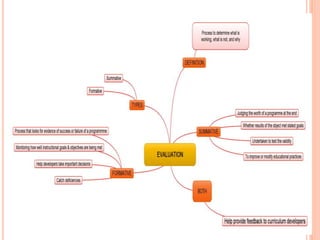
TYPES OF EVALUATION
 Formative Evaluation
 Summative Evaluation
FORMATIVE EVALUATION
 The term ‘formative evaluation’ was originally
coined by Scriven (1967) to classify evaluation
that gathered information for the purpose of
improving instruction as the instruction was
being given.
 It is a conceptual and physical exercise that is carried out
before a programme comes to an end.
 It can be considered to be the process that looks for
evidence of success or failure of a programme, a syllabus
or a subject taught during implementation.
 Formative evaluation answers two questions:
 Is the instruction successful?
 If it is not successful, what can be done to avoid
failure?
 In education, its aim is usually to obtain information to
improve a programme.
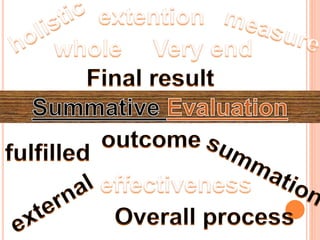
SUMMATIVE EVALUATION
 A method to judge the worth of a curriculum at the
end of the syllabus where the focus is on the
outcome. (Scriven,1967)
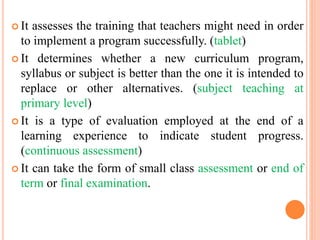
 It assesses the training that teachers might need in order
to implement a program successfully. (tablet)
 It determines whether a new curriculum program,
syllabus or subject is better than the one it is intended to
replace or other alternatives. (subject teaching at
primary level)
 It is a type of evaluation employed at the end of a
learning experience to indicate student progress.
(continuous assessment)
 It can take the form of small class assessment or end of
term or final examination.
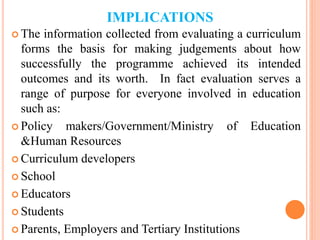
IMPLICATIONS
 The information collected from evaluating a curriculum
forms the basis for making judgements about how
successfully the programme achieved its intended
outcomes and its worth. In fact evaluation serves a
range of purpose for everyone involved in education
such as:
 Policy makers/Government/Ministry of Education
&Human Resources
 Curriculum developers
 School
 Educators
 Students
 Parents, Employers and Tertiary Institutions
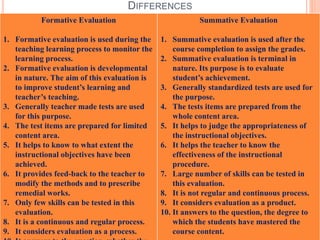
DIFFERENCES
Formative Evaluation
1. Formative evaluation is used during the
teaching learning process to monitor the
learning process.
2. Formative evaluation is developmental
in nature. The aim of this evaluation is
to improve student’s learning and
teacher’s teaching.
3. Generally teacher made tests are used
for this purpose.
4. The test items are prepared for limited
content area.
5. It helps to know to what extent the
instructional objectives have been
achieved.
6. It provides feed-back to the teacher to
modify the methods and to prescribe
remedial works.
7. Only few skills can be tested in this
evaluation.
8. It is a continuous and regular process.
9. It considers evaluation as a process.
Summative Evaluation
1. Summative evaluation is used after the
course completion to assign the grades.
2. Summative evaluation is terminal in
nature. Its purpose is to evaluate
student’s achievement.
3. Generally standardized tests are used for
the purpose.
4. The tests items are prepared from the
whole content area.
5. It helps to judge the appropriateness of
the instructional objectives.
6. It helps the teacher to know the
effectiveness of the instructional
procedure.
7. Large number of skills can be tested in
this evaluation.
8. It is not regular and continuous process.
9. It considers evaluation as a product.
10. It answers to the question, the degree to
which the students have mastered the
course content.
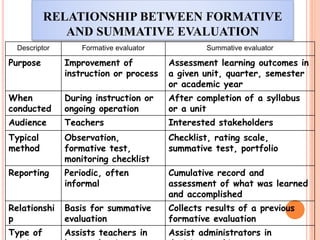
RELATIONSHIP BETWEEN FORMATIVE
AND SUMMATIVE EVALUATION
Descriptor Formative evaluator Summative evaluator
Purpose Improvement of
instruction or process
Assessment learning outcomes in
a given unit, quarter, semester
or academic year
When
conducted
During instruction or
ongoing operation
After completion of a syllabus
or a unit
Audience Teachers Interested stakeholders
Typical
method
Observation,
formative test,
monitoring checklist
Checklist, rating scale,
summative test, portfolio
Reporting Periodic, often
informal
Cumulative record and
assessment of what was learned
and accomplished
Relationshi
p
Basis for summative
evaluation
Collects results of a previous
formative evaluation
Type of Assists teachers in Assist administrators in
“When the cook taste the soup, that’s
Formative; When the guest taste the soup,
that’s Summative”
CONCLUSION
 A curriculum that operates satisfactorily over a certain
period of time may gradually become obsolete or
deteriorate over time.
 To prevent this from occurring permanent follow-up and
quality control of the program should be maintained.
 Quality control may reveal when some or all portions of
the program should be altered or replaced. In this way
quality control may lead toward the updating of an old
programme and production of “second generation
programme”.
In detail…..
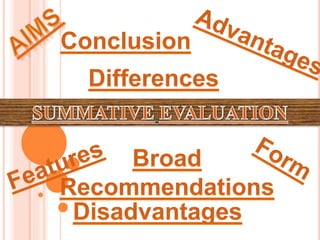
AIMS:
 To assess the learners achievement at the end of a
teaching-learning process, for instance, at the end
of the unit.
 Measures the learners attainment of specific
objectives at the end of a given period of time
 Put lights on the ultimate effectiveness of the
overall process or training that is carried out.
 To benefit comparison
 To measure the effectiveness of curriculum,
teaching methods and programs.
FORM:
 Chapter test
 Unit test
 Departmental test
 Feedback
FEATURES
 The most important features of summative
evaluation is that they come at the end of a
learning a process, whether a chapter, unit
semester or year. They typically use
quantitative measure, such as numeric,
scores.
ADVANTAGES:
 Allow for the evaluator to see the entire
picture of the event being evaluated to ensure
that the program’s over all goals and
objectives were met.
 Individuals groups maybe compared to help
instructors gain a better understanding of
which teaching method work best for various
groups.
 Provides essential data for this process.
 Provides a means to find out whether your
project has reached its goals/objectives
outcomes.
 Allows you to quantify the changes in resource
use attributable to your project so that you can
track how you are the impact of your project
 Allow you to compare the impact of the different
projects and make result-based decisions on future
spending allocations (taking into account an
intended a consequences).
 Allow you to develop a better understanding of the
process of cahange, and finding out what works,
what does’nt and why. This allows you to gather the
knowledge to learn and improve future project
designs and implementation.
 End of a specific learning period.
 Questionnaires are the least expensive
procedures for the external evaluations and can
be used to collect large samples of graduate
information.
DISADVANTAGES
 Questions are asked in ways that students do not
understand or have a difficulties answering.
Neither of these get at wheter this student really
know the material that was taught.
 The model and methodology used to gather the
data should be a specified step by step
procedure. It should be carefully designed and
executive to ensure the data is accurate and
valid.
“When the cook taste the soup, that’s
Formative; When the guest taste the soup,
that’s Summative”
“Never-ending process”
BROAD RECOMMENDATIONS:
Used a balance of both quantitave and
qualitative methods in order to get a better
understanding of what your project has achieved,
and how or why this has occurred.
Formative and summative evaluations both
include summaries of the researcher’s findings
that include recommendations for future actions.
CONCLUSION:
Formative and summative evaluation are a
never-ending process of evaluating how well
they deliver education. They evaluate everthing
from achievement trends in individual
classrooms to school, district and statewide
scores on test. Without these evaluations,
educational institutions might have tell their
blindly, uncertain of what works and what does
not.

Curriculum (formative & summative) evaluation

  • 1.
     HAVE YOUEVER BEEN EVALUATED?  HAVE YOU EVER EVALUATED SOMEONE?
  • 2.
    It refers tothe collection of information on which judgment might be made about the worth and the effectiveness of a particular programme. It includes making those judgments so that decision might be made about the future of programme, whether to retain the programme as it stand, modify it or throw it out altogether.
  • 3.
    According to Gatawa(1990: 50), the term curriculum evaluation has three major meanings: The process of: 1. describing and judging an educational programme or subject. 2. comparing a student’s performance with behaviourally stated objectives. 3. defining, obtaining and using relevant information for decision-making purposes.  According to the ICT curriculum,” it is expected that students are not only proficient enough in using some computer applications but also be able to understand what they are doing with computer.” (National Curriculum Framework, 2005).
  • 4.
    TYPES OF EVALUATION Formative Evaluation  Summative Evaluation
  • 5.
    FORMATIVE EVALUATION  Theterm ‘formative evaluation’ was originally coined by Scriven (1967) to classify evaluation that gathered information for the purpose of improving instruction as the instruction was being given.
  • 6.
     It isa conceptual and physical exercise that is carried out before a programme comes to an end.  It can be considered to be the process that looks for evidence of success or failure of a programme, a syllabus or a subject taught during implementation.  Formative evaluation answers two questions:  Is the instruction successful?  If it is not successful, what can be done to avoid failure?  In education, its aim is usually to obtain information to improve a programme.
  • 7.
    SUMMATIVE EVALUATION  Amethod to judge the worth of a curriculum at the end of the syllabus where the focus is on the outcome. (Scriven,1967)
  • 8.
     It assessesthe training that teachers might need in order to implement a program successfully. (tablet)  It determines whether a new curriculum program, syllabus or subject is better than the one it is intended to replace or other alternatives. (subject teaching at primary level)  It is a type of evaluation employed at the end of a learning experience to indicate student progress. (continuous assessment)  It can take the form of small class assessment or end of term or final examination.
  • 9.
    IMPLICATIONS  The informationcollected from evaluating a curriculum forms the basis for making judgements about how successfully the programme achieved its intended outcomes and its worth. In fact evaluation serves a range of purpose for everyone involved in education such as:  Policy makers/Government/Ministry of Education &Human Resources  Curriculum developers  School  Educators  Students  Parents, Employers and Tertiary Institutions
  • 10.
    DIFFERENCES Formative Evaluation 1. Formativeevaluation is used during the teaching learning process to monitor the learning process. 2. Formative evaluation is developmental in nature. The aim of this evaluation is to improve student’s learning and teacher’s teaching. 3. Generally teacher made tests are used for this purpose. 4. The test items are prepared for limited content area. 5. It helps to know to what extent the instructional objectives have been achieved. 6. It provides feed-back to the teacher to modify the methods and to prescribe remedial works. 7. Only few skills can be tested in this evaluation. 8. It is a continuous and regular process. 9. It considers evaluation as a process. Summative Evaluation 1. Summative evaluation is used after the course completion to assign the grades. 2. Summative evaluation is terminal in nature. Its purpose is to evaluate student’s achievement. 3. Generally standardized tests are used for the purpose. 4. The tests items are prepared from the whole content area. 5. It helps to judge the appropriateness of the instructional objectives. 6. It helps the teacher to know the effectiveness of the instructional procedure. 7. Large number of skills can be tested in this evaluation. 8. It is not regular and continuous process. 9. It considers evaluation as a product. 10. It answers to the question, the degree to which the students have mastered the course content.
  • 11.
    RELATIONSHIP BETWEEN FORMATIVE ANDSUMMATIVE EVALUATION Descriptor Formative evaluator Summative evaluator Purpose Improvement of instruction or process Assessment learning outcomes in a given unit, quarter, semester or academic year When conducted During instruction or ongoing operation After completion of a syllabus or a unit Audience Teachers Interested stakeholders Typical method Observation, formative test, monitoring checklist Checklist, rating scale, summative test, portfolio Reporting Periodic, often informal Cumulative record and assessment of what was learned and accomplished Relationshi p Basis for summative evaluation Collects results of a previous formative evaluation Type of Assists teachers in Assist administrators in
  • 12.
    “When the cooktaste the soup, that’s Formative; When the guest taste the soup, that’s Summative”
  • 13.
    CONCLUSION  A curriculumthat operates satisfactorily over a certain period of time may gradually become obsolete or deteriorate over time.  To prevent this from occurring permanent follow-up and quality control of the program should be maintained.  Quality control may reveal when some or all portions of the program should be altered or replaced. In this way quality control may lead toward the updating of an old programme and production of “second generation programme”.
  • 15.
  • 18.
    AIMS:  To assessthe learners achievement at the end of a teaching-learning process, for instance, at the end of the unit.  Measures the learners attainment of specific objectives at the end of a given period of time  Put lights on the ultimate effectiveness of the overall process or training that is carried out.  To benefit comparison  To measure the effectiveness of curriculum, teaching methods and programs.
  • 19.
    FORM:  Chapter test Unit test  Departmental test  Feedback
  • 20.
    FEATURES  The mostimportant features of summative evaluation is that they come at the end of a learning a process, whether a chapter, unit semester or year. They typically use quantitative measure, such as numeric, scores.
  • 21.
    ADVANTAGES:  Allow forthe evaluator to see the entire picture of the event being evaluated to ensure that the program’s over all goals and objectives were met.  Individuals groups maybe compared to help instructors gain a better understanding of which teaching method work best for various groups.
  • 22.
     Provides essentialdata for this process.  Provides a means to find out whether your project has reached its goals/objectives outcomes.  Allows you to quantify the changes in resource use attributable to your project so that you can track how you are the impact of your project
  • 23.
     Allow youto compare the impact of the different projects and make result-based decisions on future spending allocations (taking into account an intended a consequences).  Allow you to develop a better understanding of the process of cahange, and finding out what works, what does’nt and why. This allows you to gather the knowledge to learn and improve future project designs and implementation.  End of a specific learning period.
  • 24.
     Questionnaires arethe least expensive procedures for the external evaluations and can be used to collect large samples of graduate information.
  • 25.
    DISADVANTAGES  Questions areasked in ways that students do not understand or have a difficulties answering. Neither of these get at wheter this student really know the material that was taught.  The model and methodology used to gather the data should be a specified step by step procedure. It should be carefully designed and executive to ensure the data is accurate and valid.
  • 26.
    “When the cooktaste the soup, that’s Formative; When the guest taste the soup, that’s Summative”
  • 27.
  • 28.
    BROAD RECOMMENDATIONS: Used abalance of both quantitave and qualitative methods in order to get a better understanding of what your project has achieved, and how or why this has occurred. Formative and summative evaluations both include summaries of the researcher’s findings that include recommendations for future actions.
  • 29.
    CONCLUSION: Formative and summativeevaluation are a never-ending process of evaluating how well they deliver education. They evaluate everthing from achievement trends in individual classrooms to school, district and statewide scores on test. Without these evaluations, educational institutions might have tell their blindly, uncertain of what works and what does not.