The process bywhich
information about the
attributes or characteristics
of things are determined
and differentiated
6.
Assessment
A proccessby which information
is obtained RELATIVE to/IN
CONNECTION with some known
objective or goal.
We assess to determine whether
or not an objective or goal has
been attained.
7.
1. Assessmentfor Learning
2. Assessment of Learning
3. Assessment as Learning
3 Approaches to Assessment
8.
◦ “for” impliesthat assessment is done to improve and
ensure learning.
◦ FORmative assessment, assessment that is given while
the teacher is in the process of student formation
(learning).
◦ ensures that learning is going on while the teacher is in
the process of teaching.
◦ the teacher checks for understanding now and then.
◦ to ensure that before she proceeds further or comes near
the end of the chapter, the students have understood the
lesson.
◦ teachers use assessment results to inform or adjust their
teaching.
1. Assessment for Learning
9.
It issummative and done at the end of the unit, task, process,
grading period or term like a semester.
Its purpose is to provide evidence of the student’s level of
achievement in relation to curricular outcomes.
Unit tests and final projects are typical examples of
summative assessment.
AoL is used for grading, evaluation and reporting purposes.
Evaluative feedback on the student’s proficiency level is given
to the student concerned, likewise to his/her parents and
other stakeholders.
It is meant to assess learning for grading purposes.
It also provides the foundation for decisions on student’s
placement and promotion.
2. Assessment of Learning
10.
employs tasksor activities that provide students with an
opportunity to monitor and further their own learning- to
think about their personal learning habits and how they can
adjust their learning strategies to achieve their goals
involves metacognitive processes like reflection and self-
regulation to allow students to utilize their strengths and
work on their weaknesses by directing and regulating their
learning
students are responsible and accountable for their own
learning
is associated with self-assessment
assessment by itself is already a form of learning for the
students
3. Assessment as Learning
11.
Evaluation
A processdesigned to provide
information towards making a
value-judgment (i.e. worthiness,
appropriateness, goodness,
validity, legality, etc, of something
for which a reliable measurement
or assessment has been made.
12.
It impliesthat measurements
and assessments of an
educational characteristics has
been done and that it is now
desired to pass on value
judgment on that educational
outcome.
13.
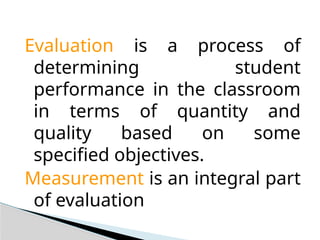
Evaluation is aprocess of
determining student
performance in the classroom
in terms of quantity and
quality based on some
specified objectives.
Measurement is an integral part
of evaluation
14.
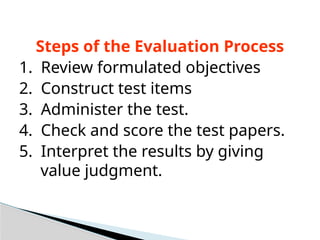
Steps of theEvaluation Process
1. Review formulated objectives
2. Construct test items
3. Administer the test.
4. Check and score the test papers.
5. Interpret the results by giving
value judgment.
15.
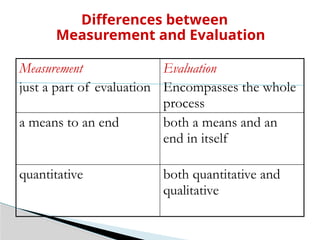
Measurement
just a partof evaluation
Evaluation
Encompasses the whole
process
a means to an end both a means and an
end in itself
quantitative both quantitative and
qualitative
Differences between
Measurement and Evaluation
16.
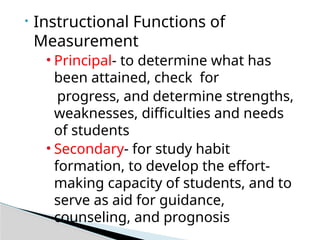
• Instructional Functionsof
Measurement
• Principal- to determine what has
been attained, check for
progress, and determine strengths,
weaknesses, difficulties and needs
of students
• Secondary- for study habit
formation, to develop the effort-
making capacity of students, and to
serve as aid for guidance,
counseling, and prognosis
17.
• Administrative Functionsof
Measurement
• to maintain standards, classify/select
students for special purposes,
determine teacher efficiency and
standard of instruction, guide for
curriculum making and dev’t and for
educational planning, to set up
norms of performance, information
and research.
18.
Functions of Evaluation
1.To find out if the objectives are met.
2. To cause improvement on the
individual learner
3. To discover weaknesses and strengths
of both the students and teachers.
4. To have basis for grading.
5. To offer solutions to problems and
improvement of instruction.
6. Prognosis, diagnosis, and research
19.
Requisites for aTeacher to be
Competent in Educational
Evaluation
1. Must know educational uses and limitations of
test.
2. Must know criteria by which quality of test
should be judged.
3. Must know how to plan the test and write the
questions to be included.
4. Must know how to administer the test
properly.
5. Must know how to interpret the test scores.
20.
Principles of Evaluation
1.Evaluation is based on clearly
stated objetives.
2. It is a cooperative and democratic
enterprise.
3. It is comprehensive and cumulative
4. It is continuous and an integral
part of the teaching-learning
process.
5. It makes use of varied instruments.
21.
6. Both immediateand long term.
7. It should be diagnostic and functional.
8. It should be used judiciously.
9. The criteria should be selected in the
light of clearly stated objectives.
10. It should be positive and action-
directed.
i
22.
11. Itshould include all significant
evidence from every possible source
12. It should take into consideration the
limitations of the particular educational
situations.
13. It should give the students
opportunity to become increasingly
independent in self-appraisal and self-
direction.
A. As towhen the evaluation is conducted:
1. Formative Evaluation
conducted during instruction.
It aims:
to obtain ongoing feedback about
strengths and weaknesses of both
the students and the teacher on
progress and any learning problems.
25.
2. Summative Evaluation
conducted or carried out at the
end of a unit or specified time
period.
It aims:
to assess attainment of initial
objectives
to determine the effectiveness of
an educational program; and ,
to identify other outcomes.
26.
3. Diagnostic Evaluation
conducted or administered prior to
instruction.
It aims:
to determine the starting point
to identify needed prerequisite skills
to identify causes of learning
difficulties; and,
to place students in learning groups.
27.
B. As towhether the score of one student will
affect the score of another student:
1. Norm-referenced Evaluation
the score of one student will affect
the score of another student.
2. Criterion-referenced Evaluation
The score of one student will not
affect the score of another student.
Criterion - Referencedtest
– describes the performance of
one directly, such as ‘type 90
words per minute with 3 errors”.
This describes what an examinee
can do without reference to the
performance of others.
30.
Norm-referenced Test
– describesthe performance
of one in terms of relative
position held in a group such
as “spelled better than 75%
of the class”.
This describes how one
performs in comparison with
that of others.
31.
Comparison between
Norm-Referenced &Criterion-Referenced
1. Scope
Criterion-referenced is mainly applied to a
class; a Norm-Referenced is applied to a group
of which the class may just be one-member.
32.
2. Content
Cr isoften narrow-
targeted at specific skills;
NR is usually wider in
coverage and samples
concept from many skills
competencies.
33.
Criterion-Referenced Evaluation
It isdesigned to determine
whether or not a student has
reached a target performance
level on a specific skill called
for by the test items
34.
Example:
A teacher mayaim for the
students to learn addition of
similar fractions with 90% accuracy.
If Juan scores 85%, he did not meet
the set criterion of 90%. If Mary
scores 95%, she exceeds the target
by 5%. We are not comparing Juan
and Mary in this skill.
35.
Norm-Referenced Evaluation
This aimsto determine the
performance of a student with
reference to a larger group. The
purpose is not just to determine
whether a student reached a
preset target but rather on “how
well he performed in reference
to a group”.
36.
Example:
A student getsa score of
80% in the test, which tells
him that he fared well
relative to the group who
took the test.