



FORMATIVE EVALUATION
PRESENTED TO,
MRS. PRIYADARSHINI
JOHN
ASSOC. PROFESSOR
DYPSON
PRESENTED BY ,
MISS. JAYS GEORGE
1ST YEAR MSC(N)
DYPSON
INTRODUCTION
 The realisation of educational goals and
objectives in the educative process is based on
the accuracy of the judgements and inferences
made by decision makers at every stage.
 To arrive at a good decision the test,
measurements and evaluation are being used in
all educational situations.
 Evaluation is an act or process that allows one to
make a valuable judgement about the desirability
or value of a measure.
MEANING
 The term evaluation is derived from the word
‘valoir’ which means ‘to be worth’.
 ‘To evaluate’ means to ascertain the value or
amount of: appraise carefully’
 It is the judging of the worth or value of
something that represents the satisfaction of a
human need ; eg : an
object/event/process/product.
DEFINITION
 Evaluation is the process of determining what extent
the educational objectives are being realised.
- RALPH TYLER
 Evaluation is a broader term than measurement , it is
not only concerned with the determination of results.
It includes techniques of testing or measurement ,
which can be utilized. It is a co operative process or
activity in which the principal, the teacher , pupils
and parents will participate.
- LESLER D CROW
FORMATIVE EVALUATION
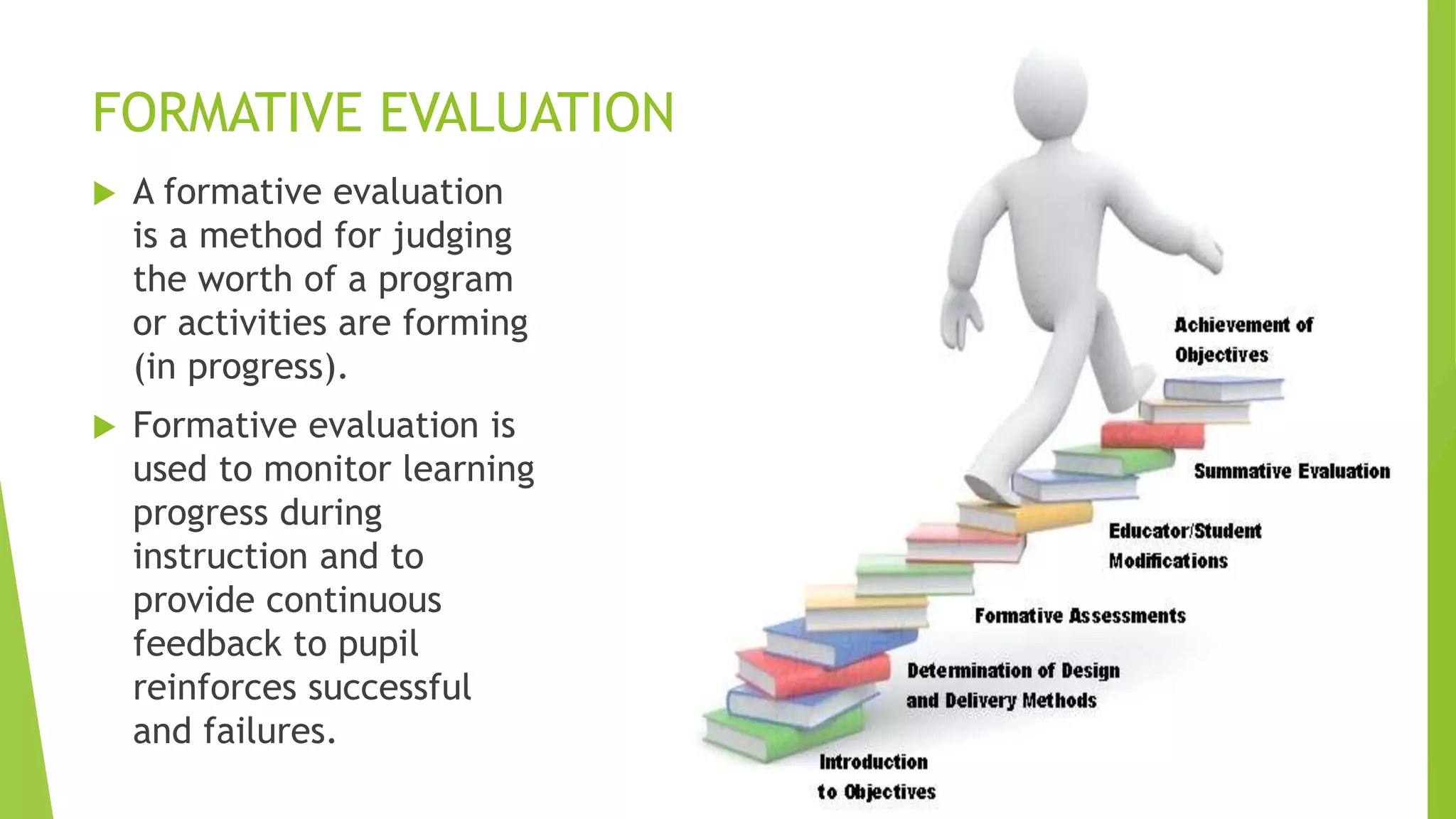
 A formative evaluation
is a method for judging
the worth of a program
or activities are forming
(in progress).
 Formative evaluation is
used to monitor learning
progress during
instruction and to
provide continuous
feedback to pupil
reinforces successful
and failures.
PURPOSE
 To provide feedback to teacher to modify
subsequent learning activities and
experience.
 To identify group or individual deficiencies.
 To frequent ongoing assessment turning of
instruction and student focus on progress.
CHARACTERISTICS
 It is relatively focused on molecular analysis.
 It is cause seeking.
 It is interested in the broader experience of the
program users.
 Exploratory and flexible.
 It tend to ignore the local effects of particular
program.
 It require analysis of instructional material for
mapping the hierarchical structure of the
learning tasks and actual teaching of course for
certain period.
IMPLICATION OF CLASSROOM TEACHER IN
FORMATIVE EVALUATION
 Formative evaluation done during an
instructional program.
 The instructional program should aim
at the attainment of certain objective
during the implementation of the
program.
 Formative evaluation is done to
monitor learning and modifying the
program if needed before its
completion.
 Formative evaluation is for current
students.
BENEFITS OF STUDENTS IN FORMATIVE
EVALUATION
 Students are motivated to learn.
 Students take responsibility for their own
learning.
 Students can become users of assessments along
side the teachers.
 Students learn valuable life long skills such self
evaluation, self assessment and goal setting.
 Student become more adapt to self assessment.
USES OF FORMATIVE EVALUATION
 It provides the student with information on his
progress or gains.
 It must be continuous , it starts with commencement
of the programme until the time he completes it.
 Informs the student about the extent of learning is
needed to reach the educational objectives.
 Enables learning activities to be adjusted in
accordance with progress made or lack of it.
 It controlled in its use by the student (results should
not appear in any official record).
CONTD……..
 Useful in guiding the student and prompting
him to ask for help.
 It is carried out frequently whenever the
students or teachers feels it as necessary.
 Provides the teacher with qualitative and
quantitative data for modification of his
teaching.
BIBLIOGRAPHY
 K.p neeraja , textbook of nursing
education, jaypee publications , page:
no:405-413.
 Shankarnarayan , text book of learning and
teaching nursing , page : no:203 – 210.
 Latha venkatesan / Poonam joshi text book
of nursing education , Elsevier publications
, page : no:120 – 127.
 www.Wikipedia.com
Formative evaluation

Formative evaluation

  • 1.
    FORMATIVE EVALUATION PRESENTED TO, MRS.PRIYADARSHINI JOHN ASSOC. PROFESSOR DYPSON PRESENTED BY , MISS. JAYS GEORGE 1ST YEAR MSC(N) DYPSON
  • 2.
    INTRODUCTION  The realisationof educational goals and objectives in the educative process is based on the accuracy of the judgements and inferences made by decision makers at every stage.  To arrive at a good decision the test, measurements and evaluation are being used in all educational situations.  Evaluation is an act or process that allows one to make a valuable judgement about the desirability or value of a measure.
  • 3.
    MEANING  The termevaluation is derived from the word ‘valoir’ which means ‘to be worth’.  ‘To evaluate’ means to ascertain the value or amount of: appraise carefully’  It is the judging of the worth or value of something that represents the satisfaction of a human need ; eg : an object/event/process/product.
  • 4.
    DEFINITION  Evaluation isthe process of determining what extent the educational objectives are being realised. - RALPH TYLER  Evaluation is a broader term than measurement , it is not only concerned with the determination of results. It includes techniques of testing or measurement , which can be utilized. It is a co operative process or activity in which the principal, the teacher , pupils and parents will participate. - LESLER D CROW
  • 5.
    FORMATIVE EVALUATION  Aformative evaluation is a method for judging the worth of a program or activities are forming (in progress).  Formative evaluation is used to monitor learning progress during instruction and to provide continuous feedback to pupil reinforces successful and failures.
  • 6.
    PURPOSE  To providefeedback to teacher to modify subsequent learning activities and experience.  To identify group or individual deficiencies.  To frequent ongoing assessment turning of instruction and student focus on progress.
  • 7.
    CHARACTERISTICS  It isrelatively focused on molecular analysis.  It is cause seeking.  It is interested in the broader experience of the program users.  Exploratory and flexible.  It tend to ignore the local effects of particular program.  It require analysis of instructional material for mapping the hierarchical structure of the learning tasks and actual teaching of course for certain period.
  • 8.
    IMPLICATION OF CLASSROOMTEACHER IN FORMATIVE EVALUATION  Formative evaluation done during an instructional program.  The instructional program should aim at the attainment of certain objective during the implementation of the program.  Formative evaluation is done to monitor learning and modifying the program if needed before its completion.  Formative evaluation is for current students.
  • 9.
    BENEFITS OF STUDENTSIN FORMATIVE EVALUATION  Students are motivated to learn.  Students take responsibility for their own learning.  Students can become users of assessments along side the teachers.  Students learn valuable life long skills such self evaluation, self assessment and goal setting.  Student become more adapt to self assessment.
  • 10.
    USES OF FORMATIVEEVALUATION  It provides the student with information on his progress or gains.  It must be continuous , it starts with commencement of the programme until the time he completes it.  Informs the student about the extent of learning is needed to reach the educational objectives.  Enables learning activities to be adjusted in accordance with progress made or lack of it.  It controlled in its use by the student (results should not appear in any official record).
  • 11.
    CONTD……..  Useful inguiding the student and prompting him to ask for help.  It is carried out frequently whenever the students or teachers feels it as necessary.  Provides the teacher with qualitative and quantitative data for modification of his teaching.
  • 13.
    BIBLIOGRAPHY  K.p neeraja, textbook of nursing education, jaypee publications , page: no:405-413.  Shankarnarayan , text book of learning and teaching nursing , page : no:203 – 210.  Latha venkatesan / Poonam joshi text book of nursing education , Elsevier publications , page : no:120 – 127.  www.Wikipedia.com