A real voyage of discovery consists not of seeking new landscapes but of seeing through new eyes.                                                                                                 — Marcel ProustAssessment:Do they (the Students) Get It?April EllisC I 583March 30, 2011
Problem Statement	Education changes with time and there are even more rigorous standards being set, but one thing that seems to stay the same is assessment practicesused by the teachers. Do they (the students) get it??
  The purpose of this research is to refine our current understanding on assessment in education. The main focal point is to help educators move from promoting accountability in separating the successful from the unsuccessful learners to motivating students and increasing their achievement levels. Purpose
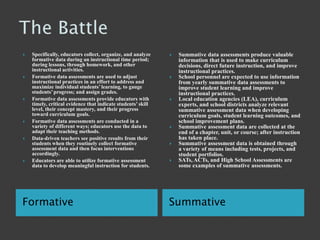
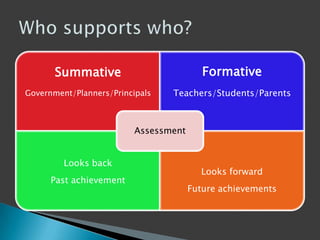
The Battle Formative 	Summative Specifically, educators collect, organize, and analyze formative data during an instructional time period; during lessons, through homework, and other instructional activities.Formative data assessments are used to adjust instructional practices in an effort to address and maximize individual students’ learning, to gauge students’ progress; and assign grades.Formative data assessments provide educators with timely, critical evidence that indicate students’ skill level, their concept mastery, and their progress toward curriculum goals.Formative data assessments are conducted in a variety of different ways; educators use the data to adapt their teaching methods.Data-driven teachers see positive results from their students when they routinely collect formative assessment data and then focus interventions accordingly.Educators are able to utilize formative assessment data to develop meaningful instruction for students. Summative data assessments produce valuable information that is used to make curriculum decisions, direct future instruction, and improve instructional practices.School personnel are expected to use information from yearly summative data assessments to improve student learning and improve instructional practices.Local education agencies (LEA), curriculum experts, and school districts analyze relevant summative assessment data when developing curriculum goals, student learning outcomes, and school improvement plans.Summative assessment data are collected at the end of a chapter, unit, or course; after instruction has taken place.Summative assessment data is obtained through a variety of means including tests, projects, and student portfolios.SATs, ACTs, and High School Assessments are some examples of summative assessments.
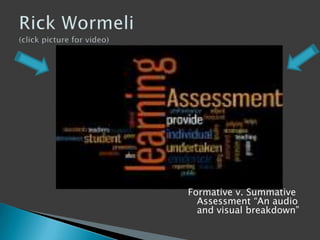
Rick Wormeli(click picture for video)Formative v. Summative Assessment “An audio and visual breakdown”
Who supports who?
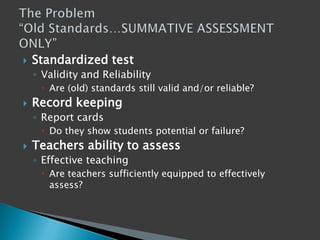
The Problem“Old Standards…SUMMATIVE ASSESSMENT     ONLY”Standardized testValidity and ReliabilityAre (old) standards still valid and/or reliable?Record keepingReport cardsDo they show students potential or failure?Teachers ability to assessEffective teachingAre teachers sufficiently equipped to effectively assess?
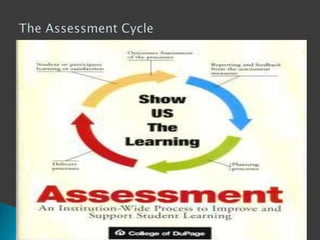
The Assessment Cycle
  The new standards suggest that teachers must use the evidence gathered through assessments for two purposes: inform instructional decisions  AND to encourage student to try to learn. The Plan “New Standards…FORMATIVE ASSESSMENT” cont’d
The Plan“New Standards” cont’d Dr. Rick Stiggins is one of the pioneers for the “Assessment for Learning” and he offers some valid information for educators to adapt to this new age education. (click book to see the informational clip).
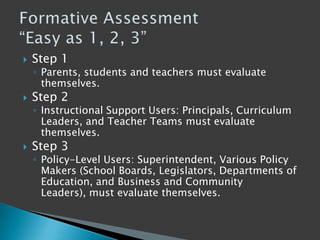
Step 1Parents, students and teachers must evaluate themselves. Step 2 Instructional Support Users: Principals, Curriculum Leaders, and Teacher Teams must evaluate themselves. Step 3 Policy-Level Users: Superintendent, Various Policy Makers (School Boards, Legislators, Departments of Education, and Business and Community Leaders), must evaluate themselves. Formative Assessment“Easy as 1, 2, 3”
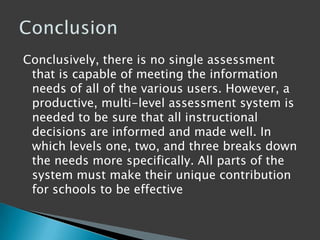
Conclusively, there is no single assessment that is capable of meeting the information needs of all of the various users. However, a productive, multi-level assessment system is needed to be sure that all instructional decisions are informed and made well. In which levels one, two, and three breaks down the needs more specifically. All parts of the system must make their unique contribution for schools to be effectiveConclusion
Stiggins, R. (2006). Assessment for Learning: A Key to Motivation and Achievement. Edge, 2, 1-18Snowman, Jack., McCown, Rick., Biehler, Rober., (2009). Psychology Applied to  Teaching(12ed.). Houghton Mifflin Company/Bostonwww.montgomeryschoolsmd.orgwww.youtube.comBibliography

Assessment ppt

  • 1.
    A real voyageof discovery consists not of seeking new landscapes but of seeing through new eyes. — Marcel ProustAssessment:Do they (the Students) Get It?April EllisC I 583March 30, 2011
  • 2.
    Problem Statement Education changeswith time and there are even more rigorous standards being set, but one thing that seems to stay the same is assessment practicesused by the teachers. Do they (the students) get it??
  • 3.
    Thepurpose of this research is to refine our current understanding on assessment in education. The main focal point is to help educators move from promoting accountability in separating the successful from the unsuccessful learners to motivating students and increasing their achievement levels. Purpose
  • 4.
    The Battle Formative Summative Specifically, educators collect, organize, and analyze formative data during an instructional time period; during lessons, through homework, and other instructional activities.Formative data assessments are used to adjust instructional practices in an effort to address and maximize individual students’ learning, to gauge students’ progress; and assign grades.Formative data assessments provide educators with timely, critical evidence that indicate students’ skill level, their concept mastery, and their progress toward curriculum goals.Formative data assessments are conducted in a variety of different ways; educators use the data to adapt their teaching methods.Data-driven teachers see positive results from their students when they routinely collect formative assessment data and then focus interventions accordingly.Educators are able to utilize formative assessment data to develop meaningful instruction for students. Summative data assessments produce valuable information that is used to make curriculum decisions, direct future instruction, and improve instructional practices.School personnel are expected to use information from yearly summative data assessments to improve student learning and improve instructional practices.Local education agencies (LEA), curriculum experts, and school districts analyze relevant summative assessment data when developing curriculum goals, student learning outcomes, and school improvement plans.Summative assessment data are collected at the end of a chapter, unit, or course; after instruction has taken place.Summative assessment data is obtained through a variety of means including tests, projects, and student portfolios.SATs, ACTs, and High School Assessments are some examples of summative assessments.
  • 5.
    Rick Wormeli(click picturefor video)Formative v. Summative Assessment “An audio and visual breakdown”
  • 6.
  • 7.
    The Problem“Old Standards…SUMMATIVEASSESSMENT ONLY”Standardized testValidity and ReliabilityAre (old) standards still valid and/or reliable?Record keepingReport cardsDo they show students potential or failure?Teachers ability to assessEffective teachingAre teachers sufficiently equipped to effectively assess?
  • 8.
  • 9.
    Thenew standards suggest that teachers must use the evidence gathered through assessments for two purposes: inform instructional decisions AND to encourage student to try to learn. The Plan “New Standards…FORMATIVE ASSESSMENT” cont’d
  • 10.
    The Plan“New Standards”cont’d Dr. Rick Stiggins is one of the pioneers for the “Assessment for Learning” and he offers some valid information for educators to adapt to this new age education. (click book to see the informational clip).
  • 11.
    Step 1Parents, studentsand teachers must evaluate themselves. Step 2 Instructional Support Users: Principals, Curriculum Leaders, and Teacher Teams must evaluate themselves. Step 3 Policy-Level Users: Superintendent, Various Policy Makers (School Boards, Legislators, Departments of Education, and Business and Community Leaders), must evaluate themselves. Formative Assessment“Easy as 1, 2, 3”
  • 12.
    Conclusively, there isno single assessment that is capable of meeting the information needs of all of the various users. However, a productive, multi-level assessment system is needed to be sure that all instructional decisions are informed and made well. In which levels one, two, and three breaks down the needs more specifically. All parts of the system must make their unique contribution for schools to be effectiveConclusion
  • 13.
    Stiggins, R. (2006).Assessment for Learning: A Key to Motivation and Achievement. Edge, 2, 1-18Snowman, Jack., McCown, Rick., Biehler, Rober., (2009). Psychology Applied to Teaching(12ed.). Houghton Mifflin Company/Bostonwww.montgomeryschoolsmd.orgwww.youtube.comBibliography