(Sem. 4)
ASSESSMENT FOR LEARNING
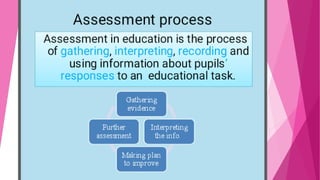
Concept of assessment
Assessment is embedded in the learning process.
It is tightly interconnected with curriculum and
instruction.

achievement
As teachers and students work
oftowards the
curriculum outcomes, assessment
plays a constant role in informing
instruction, guiding the student’s next
progress andsteps, and checking
achievement.
Definitions
Allen (2004):
Assessment involves the use of empirical data on student learning
to refine programs and improve student learning.
Huba and Freed (2000):
Assessment is the process of gathering and discussing information
from multiple and diverse sources in order to develop a deep
understanding of what students know, understand, and can do with their
knowledge as a result of their educational experiences;
the process culminates when assessment results are used to
improve subsequent learning.
Erwin (1991):
Assessment is the systematic basis for making
development ofinferences about the learning and
students. It is the process of defining, selecting,
designing, collecting, analyzing, interpreting, and using
students’ learning andinformation to increase
development.
Palomba and Banta (1999):
Assessment is the systematic collection, review,
and use of information about educational programs
undertaken for the purpose of improving student
learning and development.
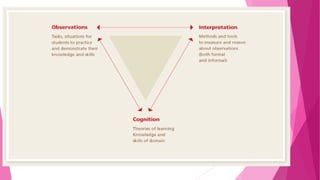
The Assessment Triangle
Assessment is the process of reasoning from evidence. To
design assessments of student learning that will provide
useful evidence requires that we coordinate and align
three key components:
1.cognition, which refers to a model of the thinking and
learning of students within the subject domain,
2.observations, the tasks or activities that students
engage in that provide evidence of learning, and
3. interpretations, the process or methods for making
sense of the evidence.
Assessments are effective and useful
only to the degree that these three
components work together. If we
design tasks without aligning these
3.we may end up with data that
doesn’t address our goals.
Nature of assessment
❑ Classroom assessment involves in continuous monitoring of students’
learning.
❑ Or It provides opportunity for close observation of students in the
process of learning.
❑ It helps in collection of frequent students’ feedback on
learning and how they respond to particular teaching
approaches
Thus ‘assessment’ includes all those activities
undertaken by teachers, and by their students in
assessing themselves, which provide information to
be used as feedback to modify the teaching and
learning activities in which they are engaged.
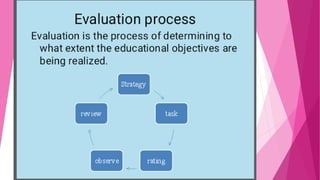
According to the Dictionary of Education,
“evaluation is the process of
ascertaining or judging the value or
amount of something by careful
appraisal.”
Concept of evaluation
The terms measurement and evaluation assessment are sometimes used
interchangeably; The word ‘evaluation’ is often confused with
assessment, testing and measurement.
Testing is only a technique to collect evidence regarding pupil
behaviour.
Measurement on the other hand, is limited to quantitative description
of the student behaviour.
Evaluation is a more comprehensive term which
includes testing and measurement and also qualitative description
of the student behaviour. It also includes value judgment regarding
the worth or desirability of the behaviour measured or assessed.
Measurement = quantitative description of pupils
(measurement) + value judgment
Evaluation = qualitative description of pupils (non-
measurement) + value judgment
Thus, evaluation may not be based on
measurement alone but it goes beyond the simple
quantitative score.
1.Evaluation is important to the classroom
teachers, supervisors, and administrators in
directing as well as guiding teaching and
learning.
2.Evaluation aids in devising more
effective instructional materials and
procedures of instruction.
IMPORTANCE OF EVALUATION
3.Evaluation also helps to measure the
validity and reliability of instruction.
4.Evaluation stimulates students to
study.
5.Evaluation helps teachers to
discover the needs of the pupils.
6.Evaluation can be used to enforce external
standards upon the individual class or
school.
7.Evaluation, likewise, helps to provide
objective evidences for effective
cooperation between parents and
teachers.
8.Evaluation helps parents to understand pupil-
growth, interests, and potentials.
8. Evaluation is helpful to the teacher.
9.Evaluation is helpful in securing support for
the school from the government.
PURPOSES OF
EVALUATION
1. To Improve programme design and implementation
2. To Demonstrate Programme Impact.
 Stimulates students study.
 Helps to Understand Pupils.
 Evaluation helps teachers to discover the needs of the pupils.
 Evaluation helps and assists students in their problems of
adjustments.
 Useful for Research .
 Helpful to the teachers.
 Helpful to Administration.
 Helpful in Employment.
 Information to higher authorities.
 Support for the school from Govts.
Types of evaluation
It is the type of evaluation that
determines pupils performance at the
beginning of instruction. In other
words , it is concerned with the pupils
entry performance.
PLACEMENT EVALUATION
Placement evaluation, also
referred to as pre-assessment or
initial assessment, is conducted
to establish a baseline from
which individual student growth
can be measured. This type of an
assessment is used to know what
the student's skill level is about
the subject.
 It is designed to place the right person in the
right place.
 It require use of a variety of techniques,
aptitude tests , pre-tests on course objectives,
oberservational techniques and so on.
 The Goal of placement evaluation is to
determine the position in the instructional
sequence.
 Placement assessment are used to ‘Place’
student into a course level, or academic
programme.
FORMATIVE EVALUATION
 Formative evaluation term was coined by Scrivan in
1967.
 Definition: Formative evaluation refers to the
evaluation of worth of the instructional programme
which is still going on and can still be modified.
 Formative evaluation is assessment for learning, not
of learning.
FEATURES
1.Part of the instructional process.
2.Provides feedback to teachers and students.
3. It gives emphasis on learning, not allocating grades or marks.
4.Developmental in nature.
5.Diagnose strength and weaknesses of pupils.
6.Results of formative evaluation are produced on the spot, students and teachers get
them immediately.
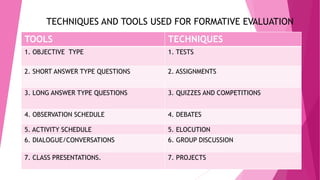
TECHNIQUES AND TOOLS USED FOR FORMATIVE EVALUATION
TOOLS TECHNIQUES
1. OBJECTIVE TYPE 1. TESTS
2. SHORT ANSWER TYPE QUESTIONS 2. ASSIGNMENTS
3. LONG ANSWER TYPE QUESTIONS 3. QUIZZES AND COMPETITIONS
4. OBSERVATION SCHEDULE 4. DEBATES
5. ACTIVITY SCHEDULE 5. ELOCUTION
6. DIALOGUE/CONVERSATIONS 6. GROUP DISCUSSION
7. CLASS PRESENTATIONS. 7. PROJECTS
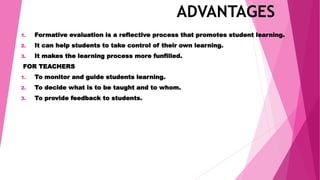
ADVANTAGES
1. Formative evaluation is a reflective process that promotes student learning.
2. It can help students to take control of their own learning.
3. It makes the learning process more funfilled.
FOR TEACHERS
1. To monitor and guide students learning.
2. To decide what is to be taught and to whom.
3. To provide feedback to students.
FOR PARENTS
1. Plan educational resources.
2. Establish home learning environments.
3. Assist with instruction based on their understanding of the achievements of
their children.
FOR SCHOOL and AUTHORITIES
1. Planning development activities.
2. Working with parents and parents’ groups.
3. Planning extended enrichment or remedial programmes.
LIMITATIONS
1. Intensive dedication require on the part of teachers and students to
continue ongoing assessment.
2. It is highly time consuming process.
3. Students need different kinds of formative evaluation at different
stages in their learning journeys.
SUMMATIVE EVALUATION
Summative evaluation comes at the end of the course
or unit of instruction. It is designed to determine the
extent to which the instructional objectives have been
achieved and is used primarily for assigning course
grade or for clarifying pupils mastery of the intended
learning outcomes.
According to SCRIVAN(1967), “ Summative evaluation
is a method to judge the worth of a curriculum at the
end of the syllabus, when the focus is on the
outcome.”
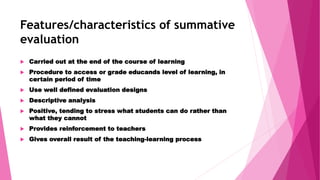
Features/characteristics of summative
evaluation
 Carried out at the end of the course of learning
 Procedure to access or grade educands level of learning, in
certain period of time
 Use well defined evaluation designs
 Descriptive analysis
 Positive, tending to stress what students can do rather than
what they cannot
 Provides reinforcement to teachers
 Gives overall result of the teaching-learning process
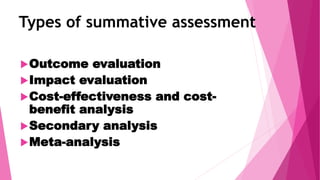
Types of summative assessment
Outcome evaluation
Impact evaluation
Cost-effectiveness and cost-
benefit analysis
Secondary analysis
Meta-analysis
Tests for students summative
evaluation
1. Pencil or paper tests
Limited-choice questions
Open-ended questions
2. Diagnostic test
3. Performance tests
Advantages of summative evaluation
 Employed at the end of learning experiences to indicate student
progress
 Records achievement of students through the award of certificates and
diplomas
 Inticipate further achievement of the students
 Allows learners to progress to higher studies
 Judges to what extent objectives are realized on the basis of the
learner’s performance
 Helps in planning and organization of further teaching
 Determines whether a new curriculum, programme, syllabus or subject
is better than the one it is intended to replace or other alternatives
 Results are used for classifying, placement and prediction for future
success
Assessment for learning chapter 1  - copy-converted

Assessment for learning chapter 1 - copy-converted

  • 1.
  • 2.
    Concept of assessment Assessmentis embedded in the learning process. It is tightly interconnected with curriculum and instruction. achievement As teachers and students work oftowards the curriculum outcomes, assessment plays a constant role in informing instruction, guiding the student’s next progress andsteps, and checking achievement.

  • 3.
    Definitions Allen (2004): Assessment involvesthe use of empirical data on student learning to refine programs and improve student learning. Huba and Freed (2000): Assessment is the process of gathering and discussing information from multiple and diverse sources in order to develop a deep understanding of what students know, understand, and can do with their knowledge as a result of their educational experiences; the process culminates when assessment results are used to improve subsequent learning.
  • 4.
    Erwin (1991): Assessment isthe systematic basis for making development ofinferences about the learning and students. It is the process of defining, selecting, designing, collecting, analyzing, interpreting, and using students’ learning andinformation to increase development. Palomba and Banta (1999): Assessment is the systematic collection, review, and use of information about educational programs undertaken for the purpose of improving student learning and development.
  • 5.
    The Assessment Triangle Assessmentis the process of reasoning from evidence. To design assessments of student learning that will provide useful evidence requires that we coordinate and align three key components: 1.cognition, which refers to a model of the thinking and learning of students within the subject domain, 2.observations, the tasks or activities that students engage in that provide evidence of learning, and 3. interpretations, the process or methods for making sense of the evidence.
  • 7.
    Assessments are effectiveand useful only to the degree that these three components work together. If we design tasks without aligning these 3.we may end up with data that doesn’t address our goals.
  • 8.
    Nature of assessment ❑Classroom assessment involves in continuous monitoring of students’ learning. ❑ Or It provides opportunity for close observation of students in the process of learning. ❑ It helps in collection of frequent students’ feedback on learning and how they respond to particular teaching approaches
  • 9.
    Thus ‘assessment’ includesall those activities undertaken by teachers, and by their students in assessing themselves, which provide information to be used as feedback to modify the teaching and learning activities in which they are engaged.
  • 12.
    According to theDictionary of Education, “evaluation is the process of ascertaining or judging the value or amount of something by careful appraisal.”
  • 13.
    Concept of evaluation Theterms measurement and evaluation assessment are sometimes used interchangeably; The word ‘evaluation’ is often confused with assessment, testing and measurement. Testing is only a technique to collect evidence regarding pupil behaviour. Measurement on the other hand, is limited to quantitative description of the student behaviour. Evaluation is a more comprehensive term which includes testing and measurement and also qualitative description of the student behaviour. It also includes value judgment regarding the worth or desirability of the behaviour measured or assessed.
  • 14.
    Measurement = quantitativedescription of pupils (measurement) + value judgment Evaluation = qualitative description of pupils (non- measurement) + value judgment Thus, evaluation may not be based on measurement alone but it goes beyond the simple quantitative score.
  • 18.
    1.Evaluation is importantto the classroom teachers, supervisors, and administrators in directing as well as guiding teaching and learning. 2.Evaluation aids in devising more effective instructional materials and procedures of instruction. IMPORTANCE OF EVALUATION
  • 19.
    3.Evaluation also helpsto measure the validity and reliability of instruction. 4.Evaluation stimulates students to study. 5.Evaluation helps teachers to discover the needs of the pupils.
  • 20.
    6.Evaluation can beused to enforce external standards upon the individual class or school. 7.Evaluation, likewise, helps to provide objective evidences for effective cooperation between parents and teachers.
  • 21.
    8.Evaluation helps parentsto understand pupil- growth, interests, and potentials. 8. Evaluation is helpful to the teacher. 9.Evaluation is helpful in securing support for the school from the government.
  • 25.
  • 26.
    1. To Improveprogramme design and implementation 2. To Demonstrate Programme Impact.  Stimulates students study.  Helps to Understand Pupils.  Evaluation helps teachers to discover the needs of the pupils.  Evaluation helps and assists students in their problems of adjustments.  Useful for Research .  Helpful to the teachers.  Helpful to Administration.  Helpful in Employment.  Information to higher authorities.  Support for the school from Govts.

  • 27.
  • 28.
    It is thetype of evaluation that determines pupils performance at the beginning of instruction. In other words , it is concerned with the pupils entry performance. PLACEMENT EVALUATION

  • 29.
    Placement evaluation, also referredto as pre-assessment or initial assessment, is conducted to establish a baseline from which individual student growth can be measured. This type of an assessment is used to know what the student's skill level is about the subject.
  • 30.
     It isdesigned to place the right person in the right place.  It require use of a variety of techniques, aptitude tests , pre-tests on course objectives, oberservational techniques and so on.  The Goal of placement evaluation is to determine the position in the instructional sequence.  Placement assessment are used to ‘Place’ student into a course level, or academic programme.

  • 31.
    FORMATIVE EVALUATION  Formativeevaluation term was coined by Scrivan in 1967.  Definition: Formative evaluation refers to the evaluation of worth of the instructional programme which is still going on and can still be modified.  Formative evaluation is assessment for learning, not of learning.
  • 32.
    FEATURES 1.Part of theinstructional process. 2.Provides feedback to teachers and students. 3. It gives emphasis on learning, not allocating grades or marks. 4.Developmental in nature. 5.Diagnose strength and weaknesses of pupils. 6.Results of formative evaluation are produced on the spot, students and teachers get them immediately.
  • 33.
    TECHNIQUES AND TOOLSUSED FOR FORMATIVE EVALUATION TOOLS TECHNIQUES 1. OBJECTIVE TYPE 1. TESTS 2. SHORT ANSWER TYPE QUESTIONS 2. ASSIGNMENTS 3. LONG ANSWER TYPE QUESTIONS 3. QUIZZES AND COMPETITIONS 4. OBSERVATION SCHEDULE 4. DEBATES 5. ACTIVITY SCHEDULE 5. ELOCUTION 6. DIALOGUE/CONVERSATIONS 6. GROUP DISCUSSION 7. CLASS PRESENTATIONS. 7. PROJECTS
  • 34.
    ADVANTAGES 1. Formative evaluationis a reflective process that promotes student learning. 2. It can help students to take control of their own learning. 3. It makes the learning process more funfilled. FOR TEACHERS 1. To monitor and guide students learning. 2. To decide what is to be taught and to whom. 3. To provide feedback to students.
  • 35.
    FOR PARENTS 1. Planeducational resources. 2. Establish home learning environments. 3. Assist with instruction based on their understanding of the achievements of their children. FOR SCHOOL and AUTHORITIES 1. Planning development activities. 2. Working with parents and parents’ groups. 3. Planning extended enrichment or remedial programmes.

  • 36.
    LIMITATIONS 1. Intensive dedicationrequire on the part of teachers and students to continue ongoing assessment. 2. It is highly time consuming process. 3. Students need different kinds of formative evaluation at different stages in their learning journeys.
  • 37.
  • 38.
    Summative evaluation comesat the end of the course or unit of instruction. It is designed to determine the extent to which the instructional objectives have been achieved and is used primarily for assigning course grade or for clarifying pupils mastery of the intended learning outcomes. According to SCRIVAN(1967), “ Summative evaluation is a method to judge the worth of a curriculum at the end of the syllabus, when the focus is on the outcome.”
  • 39.
    Features/characteristics of summative evaluation Carried out at the end of the course of learning  Procedure to access or grade educands level of learning, in certain period of time  Use well defined evaluation designs  Descriptive analysis  Positive, tending to stress what students can do rather than what they cannot  Provides reinforcement to teachers  Gives overall result of the teaching-learning process
  • 40.
    Types of summativeassessment Outcome evaluation Impact evaluation Cost-effectiveness and cost- benefit analysis Secondary analysis Meta-analysis
  • 41.
    Tests for studentssummative evaluation 1. Pencil or paper tests Limited-choice questions Open-ended questions 2. Diagnostic test 3. Performance tests
  • 42.
    Advantages of summativeevaluation  Employed at the end of learning experiences to indicate student progress  Records achievement of students through the award of certificates and diplomas  Inticipate further achievement of the students  Allows learners to progress to higher studies  Judges to what extent objectives are realized on the basis of the learner’s performance  Helps in planning and organization of further teaching  Determines whether a new curriculum, programme, syllabus or subject is better than the one it is intended to replace or other alternatives  Results are used for classifying, placement and prediction for future success