SEMINAR ON 
X‾ AND R CHARTS 
1.AKHIL KRISHNAN G 
2.MADHUSOODHANAN 
3.MOHAMMED SHAFEEQ P K 
4.VARUN RAJ M 
5.VISHNU S
INTRODUCTION 
 X‾ -R Chart maximum utilization of information 
available from data & provide detailed 
information in process average & variation for 
control of individual dimensions. 
 Samples(subgroup size) are drawn at intervals 
and measures are taken.
Control charts for X‾ & R are 
constructed for 
a) A process is behaving normally. 
b) No assignable cause are present. 
c) Ensure product quality level.
The chart is advantageous in the 
following situations 
 The sample size is relatively small (say, n 
≤ 10)— x‾and s charts are typically used 
for larger sample sizes) 
 The sample size is constant 
 Humans must perform the calculations for 
the chart
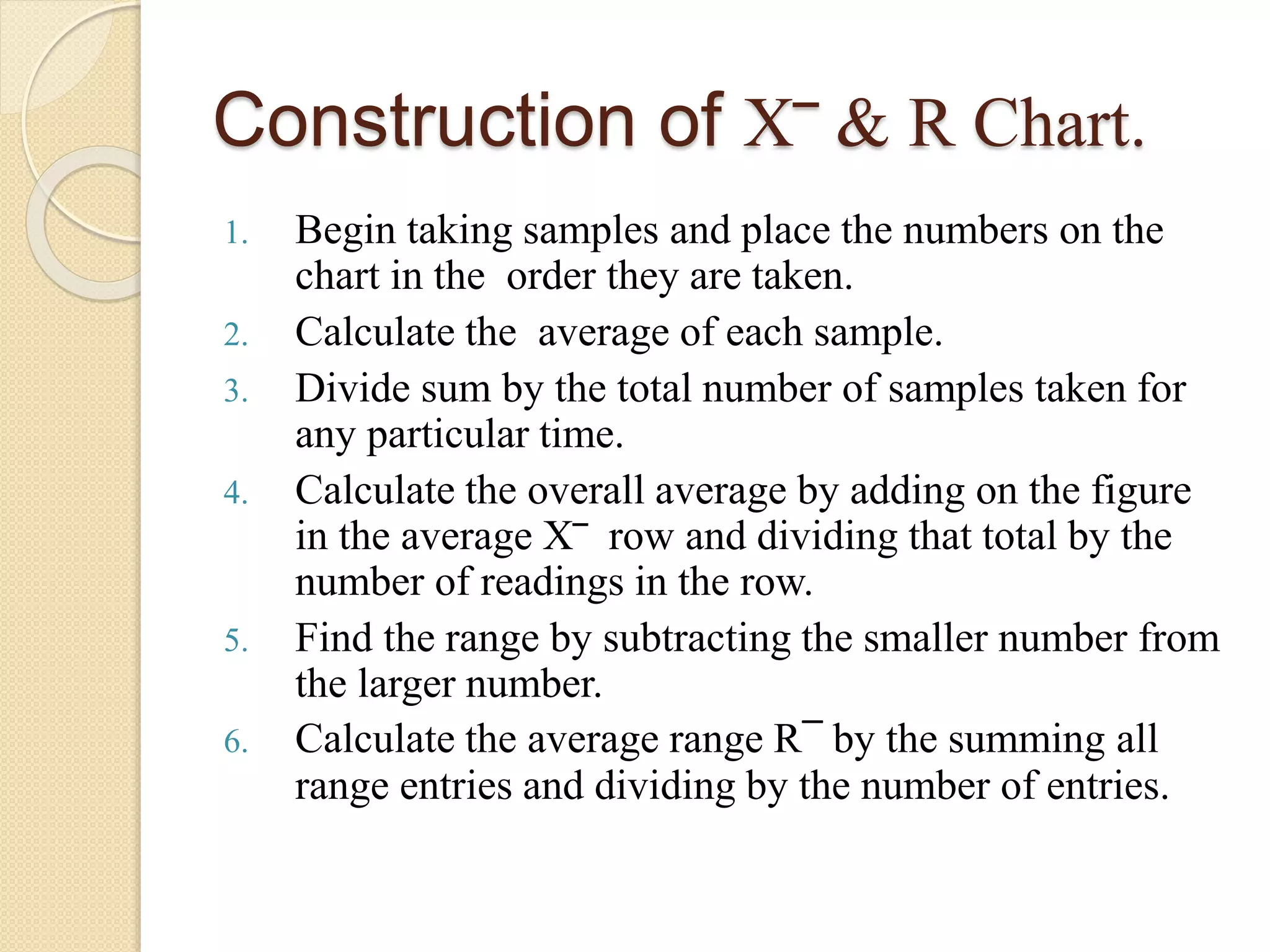
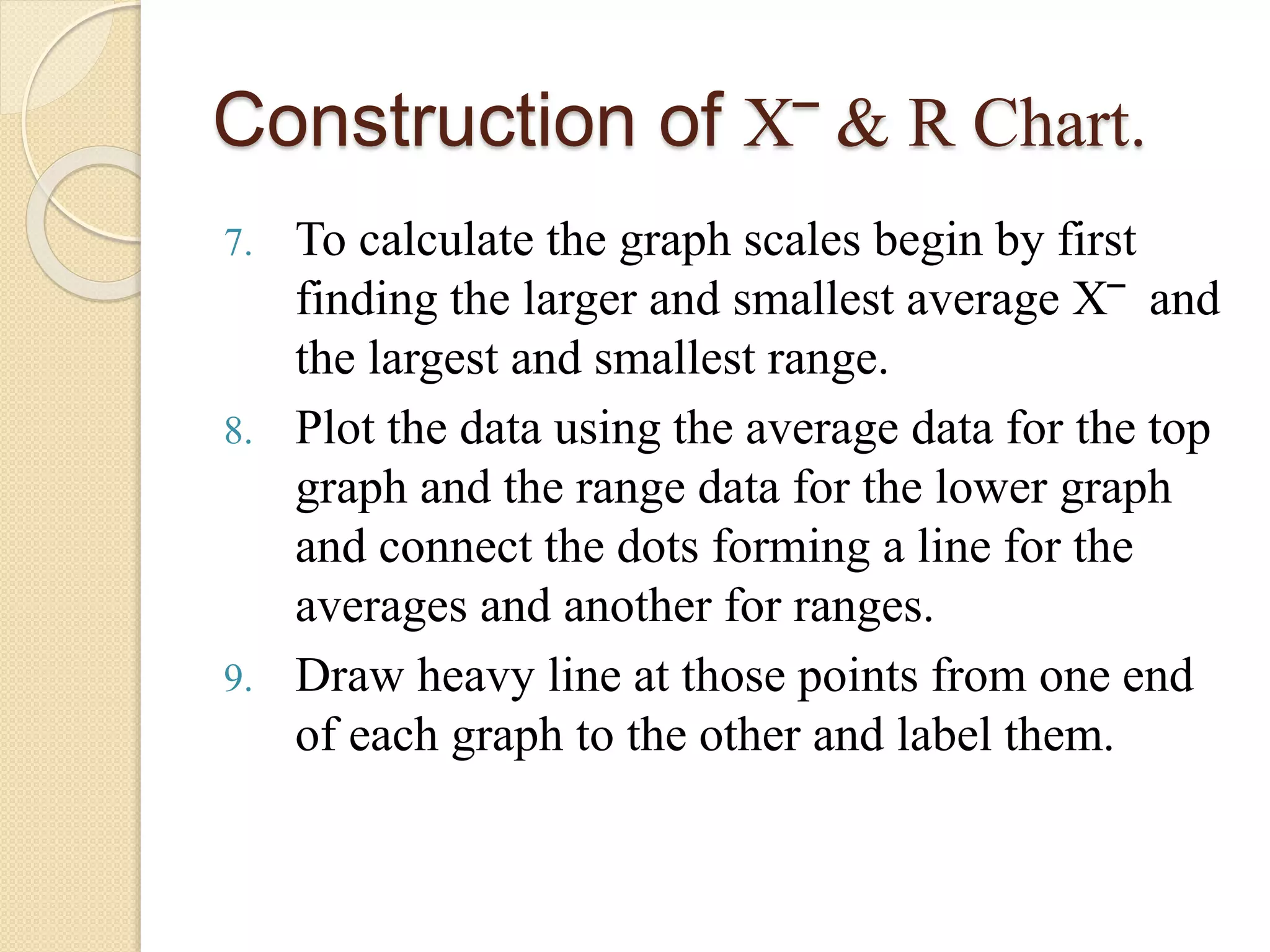
Construction of X‾ & R Chart. 
1. Begin taking samples and place the numbers on the 
chart in the order they are taken. 
2. Calculate the average of each sample. 
3. Divide sum by the total number of samples taken for 
any particular time. 
4. Calculate the overall average by adding on the figure 
in the average X‾ row and dividing that total by the 
number of readings in the row. 
5. Find the range by subtracting the smaller number from 
the larger number. 
6. Calculate the average range R‾ by the summing all 
range entries and dividing by the number of entries.
Construction of X‾ & R Chart. 
7. To calculate the graph scales begin by first 
finding the larger and smallest average X‾ and 
the largest and smallest range. 
8. Plot the data using the average data for the top 
graph and the range data for the lower graph 
and connect the dots forming a line for the 
averages and another for ranges. 
9. Draw heavy line at those points from one end 
of each graph to the other and label them.
CASE STUDY 
 Here we are considering 100 finished 
work pieces from fitting workshop for 
our analysis 
 Width of each work piece was 
measured and as taken as desired 
dimension 
 Study leads to the following results
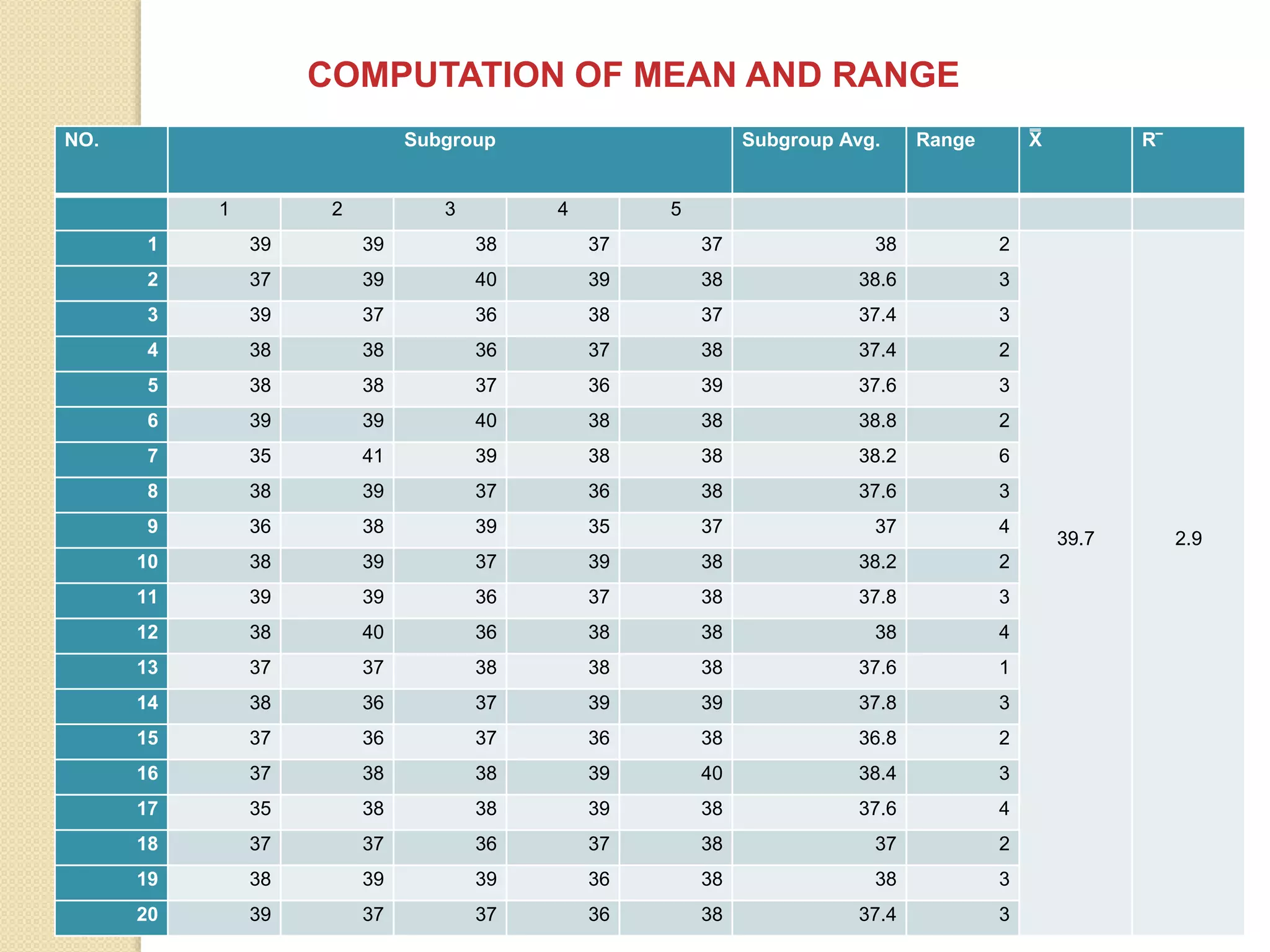
COMPUTATION OF MEAN AND RANGE 
NO. Subgroup Subgroup Avg. Range X̿ R‾ 
1 2 3 4 5 
1 39 39 38 37 37 38 2 
39.7 2.9 
2 37 39 40 39 38 38.6 3 
3 39 37 36 38 37 37.4 3 
4 38 38 36 37 38 37.4 2 
5 38 38 37 36 39 37.6 3 
6 39 39 40 38 38 38.8 2 
7 35 41 39 38 38 38.2 6 
8 38 39 37 36 38 37.6 3 
9 36 38 39 35 37 37 4 
10 38 39 37 39 38 38.2 2 
11 39 39 36 37 38 37.8 3 
12 38 40 36 38 38 38 4 
13 37 37 38 38 38 37.6 1 
14 38 36 37 39 39 37.8 3 
15 37 36 37 36 38 36.8 2 
16 37 38 38 39 40 38.4 3 
17 35 38 38 39 38 37.6 4 
18 37 37 36 37 38 37 2 
19 38 39 39 36 38 38 3 
20 39 37 37 36 38 37.4 3
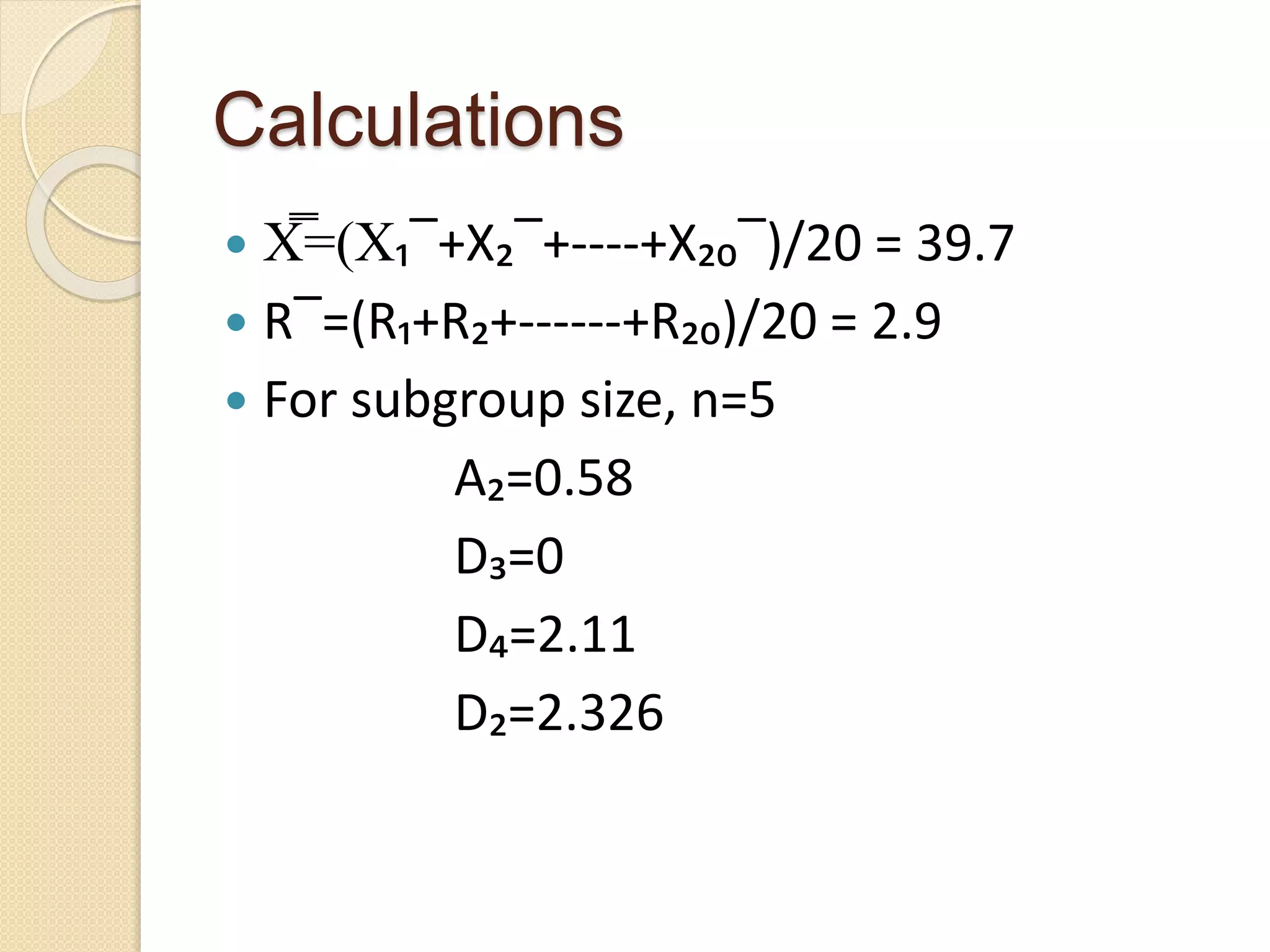
Calculations 
 X̿=(X₁‾+X₂‾+----+X₂₀‾)/20 = 39.7 
 R‾=(R₁+R₂+------+R₂₀)/20 = 2.9 
 For subgroup size, n=5 
A₂=0.58 
D₃=0 
D₄=2.11 
D₂=2.326
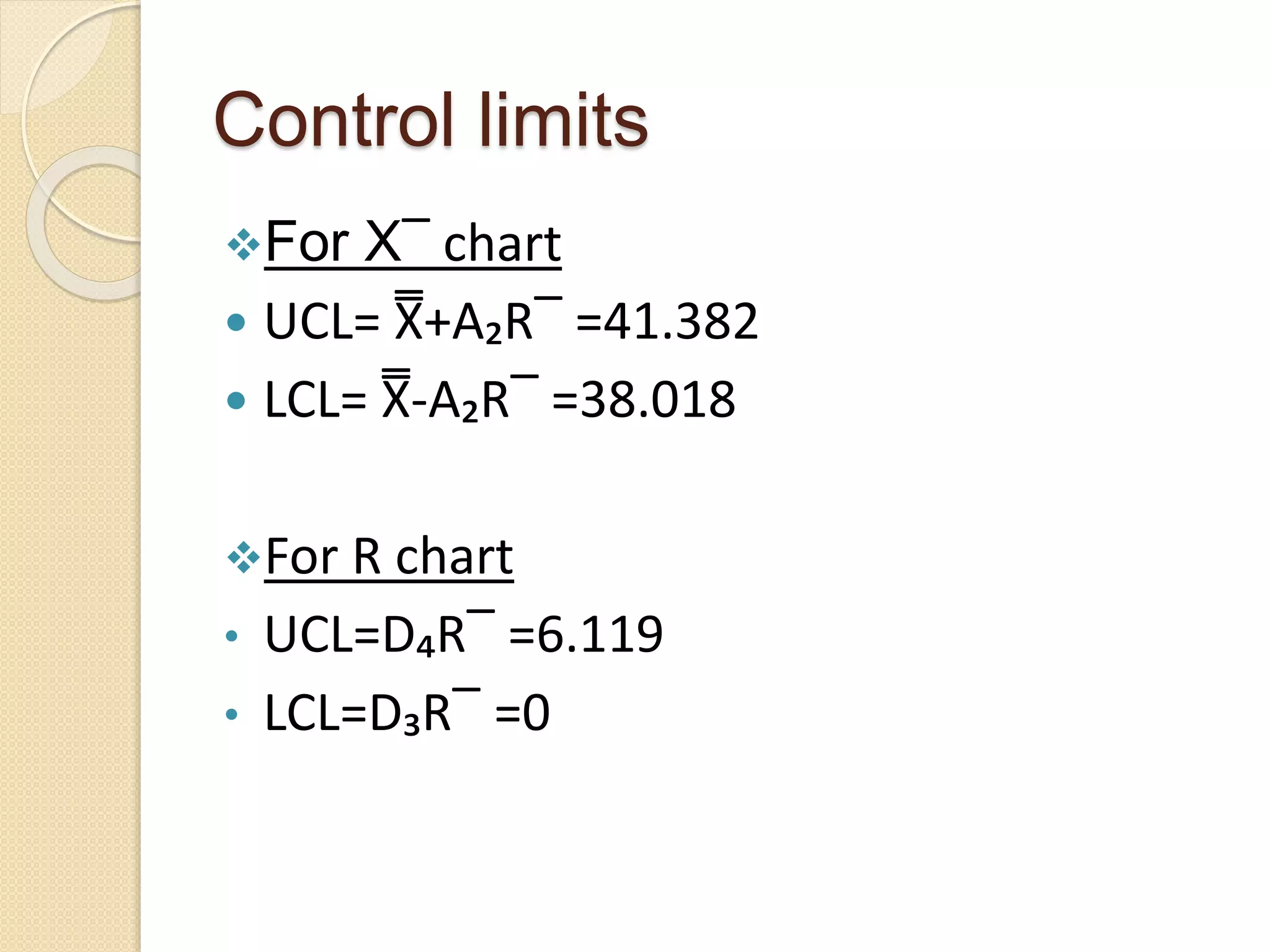
Control limits 
For X‾ chart 
 UCL= X̿ +A₂R‾ =41.382 
 LCL= X̿ -A₂R‾ =38.018 
For R chart 
• UCL=D₄R‾ =6.119 
• LCL=D₃R‾ =0
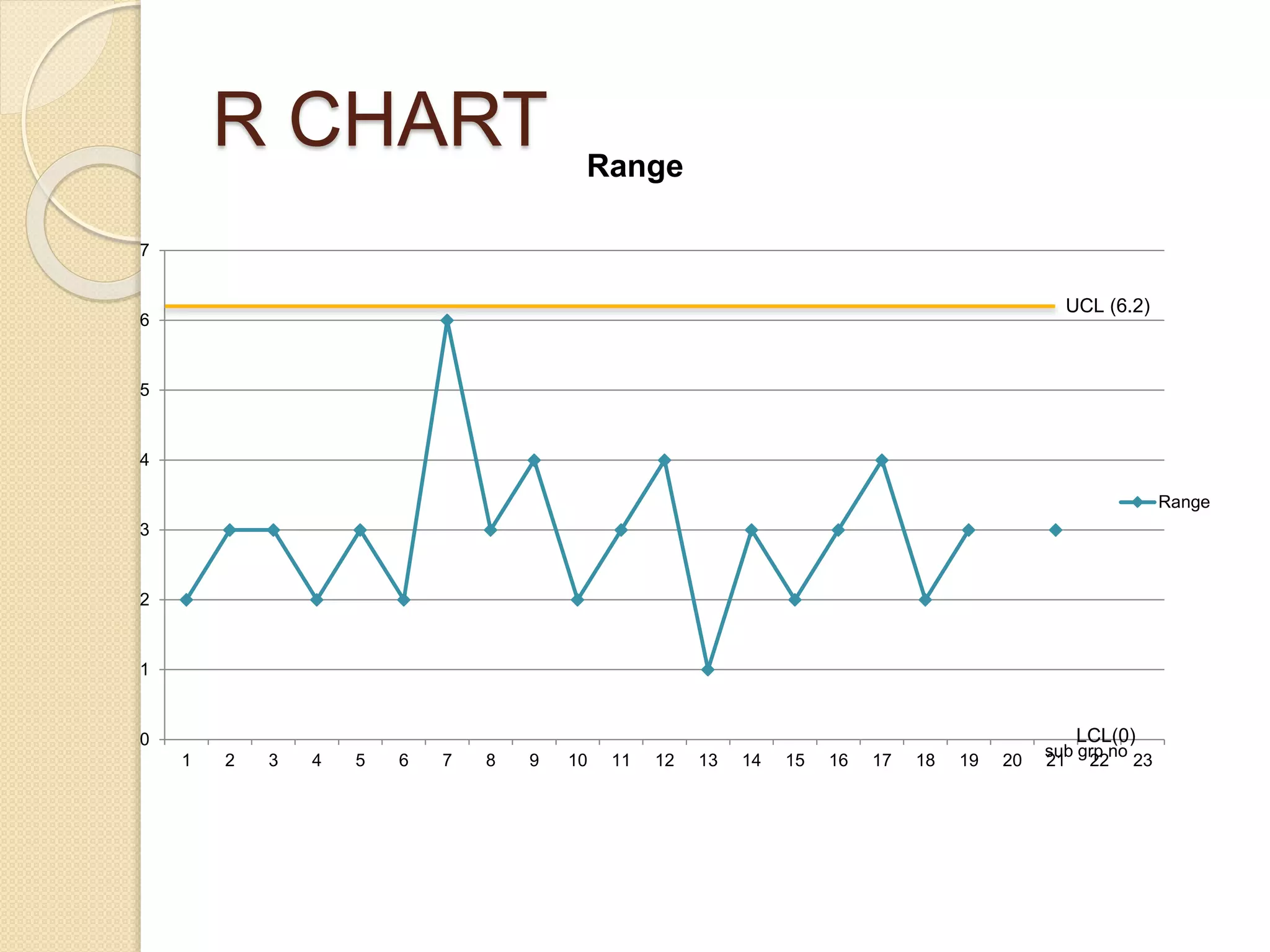
R CHART 
7 
6 
5 
4 
3 
2 
1 
0 
Range 
UCL (6.2) 
LCL(0) 
1 2 3 4 5 6 7 8 9 10 11 12 13 14 15 16 17 18 19 20 21 22 23 
Range 
sub grp no
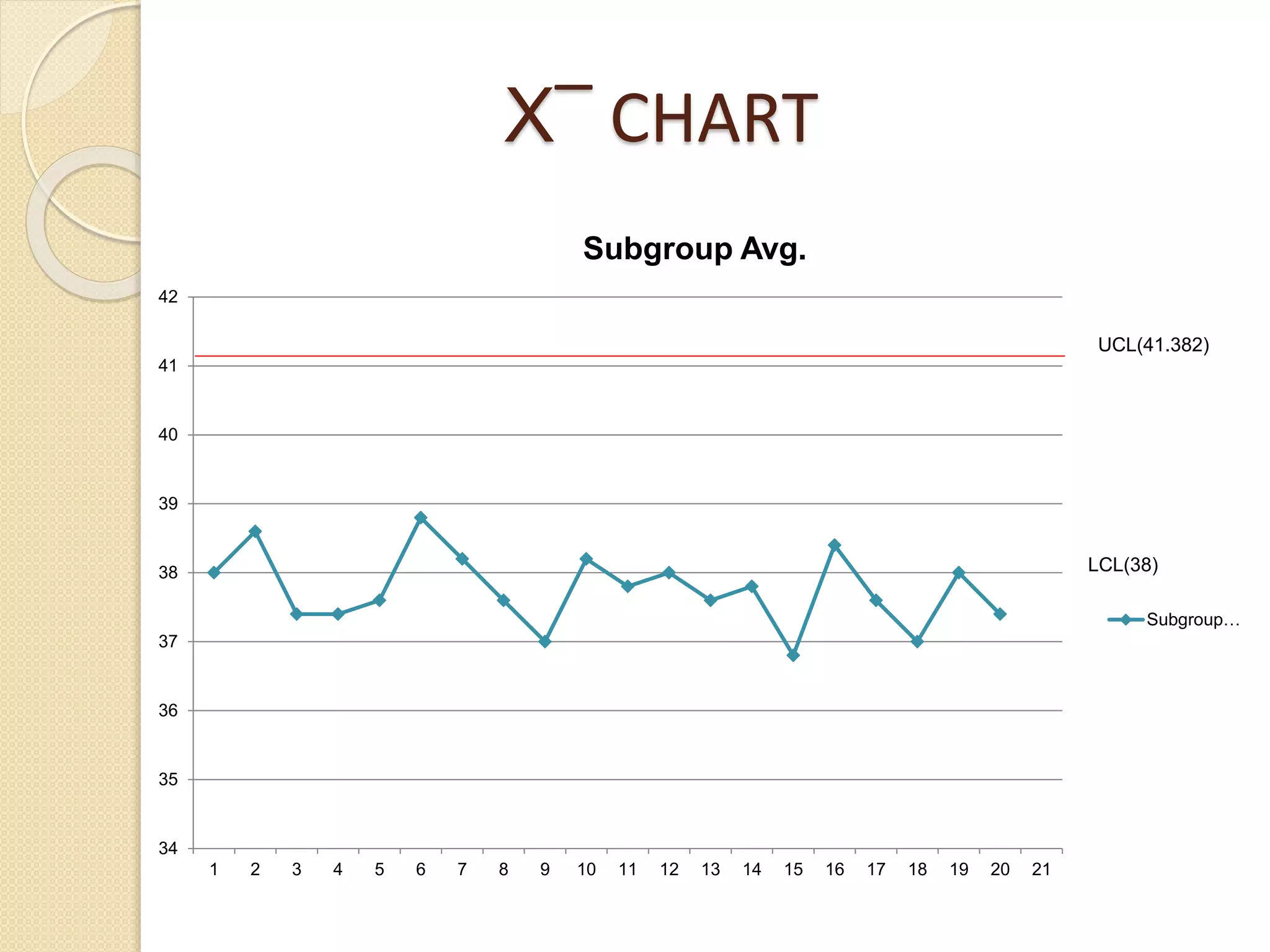
X‾ CHART 
42 
41 
40 
39 
38 
37 
36 
35 
34 
Subgroup Avg. 
1 2 3 4 5 6 7 8 9 10 11 12 13 14 15 16 17 18 19 20 21 
UCL(41.382) 
LCL(38) 
Subgroup…
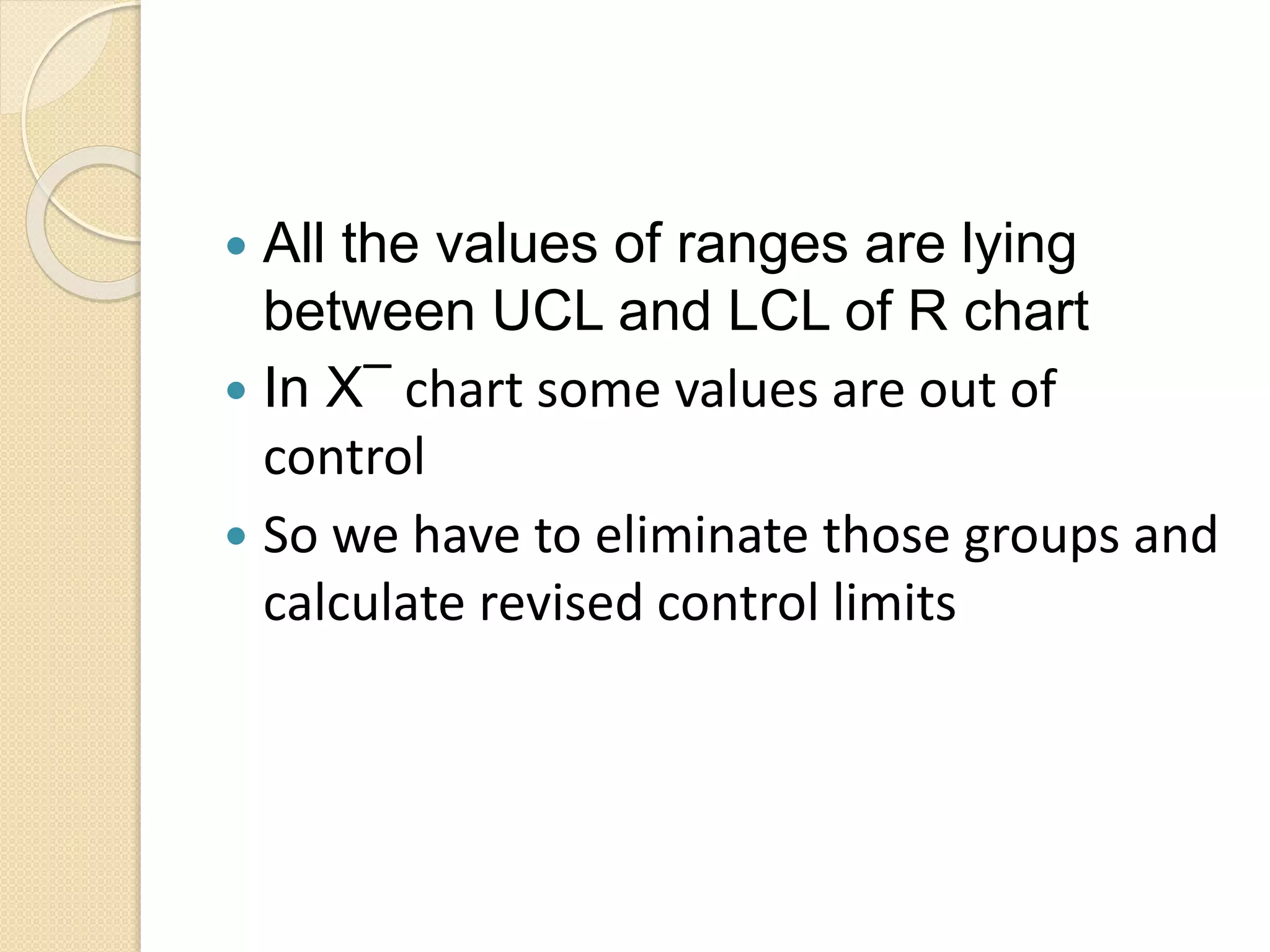
 All the values of ranges are lying 
between UCL and LCL of R chart 
 In X‾ chart some values are out of 
control 
 So we have to eliminate those groups and 
calculate revised control limits
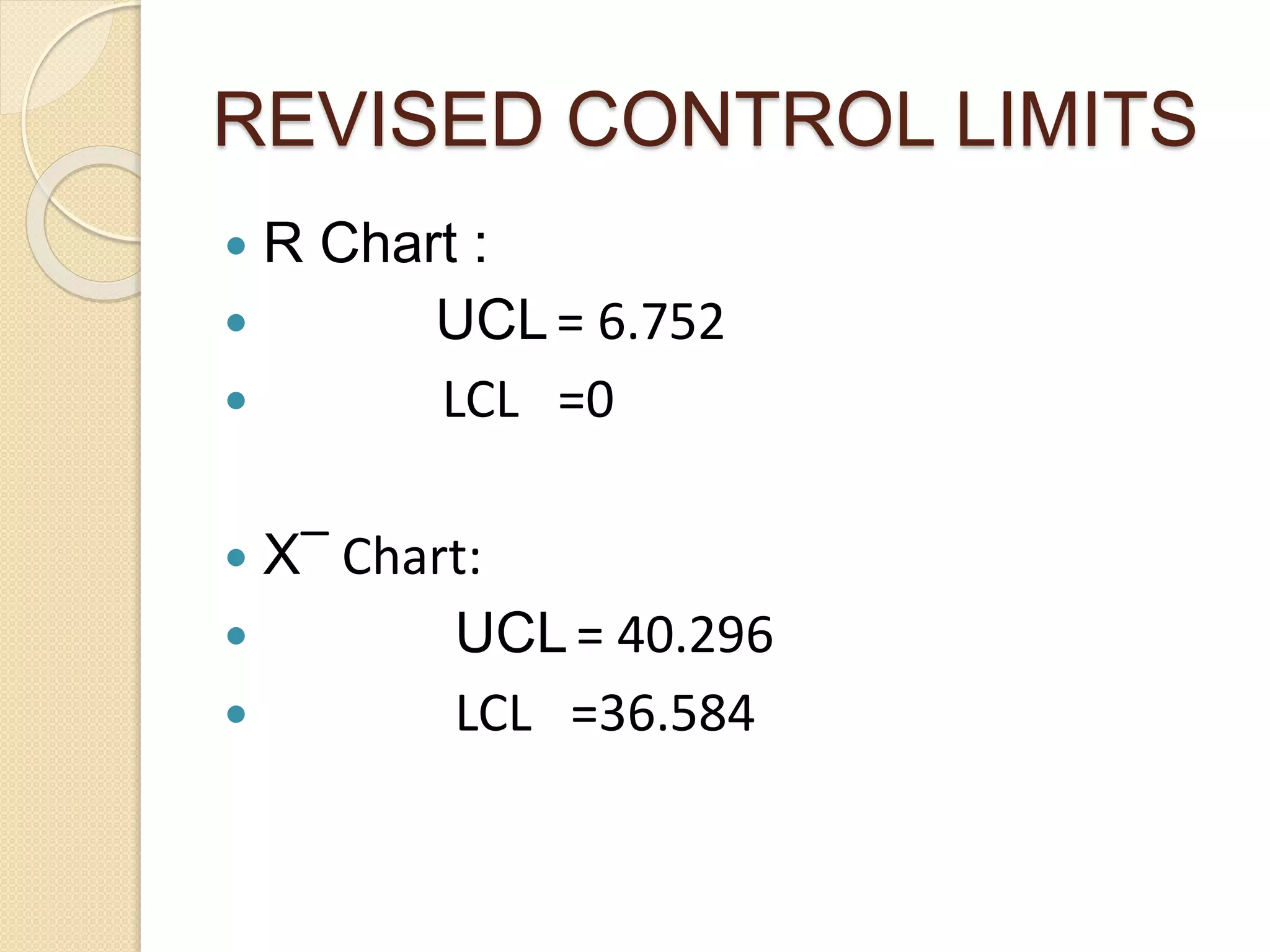
REVISED CONTROL LIMITS 
 R Chart : 
 UCL= 6.752 
 LCL =0 
 X‾ Chart: 
 UCL= 40.296 
 LCL =36.584
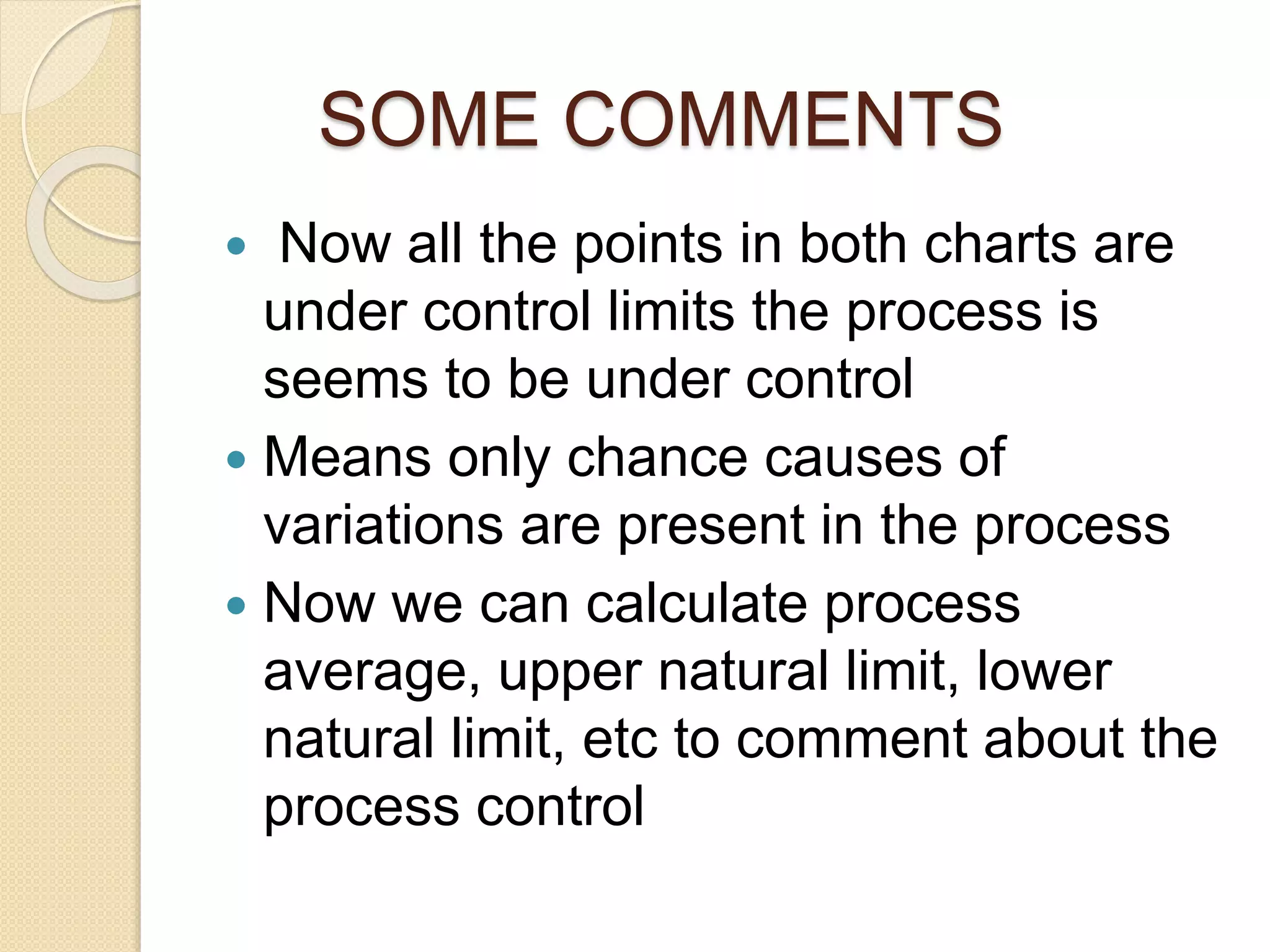
SOME COMMENTS 
 Now all the points in both charts are 
under control limits the process is 
seems to be under control 
 Means only chance causes of 
variations are present in the process 
 Now we can calculate process 
average, upper natural limit, lower 
natural limit, etc to comment about the 
process control
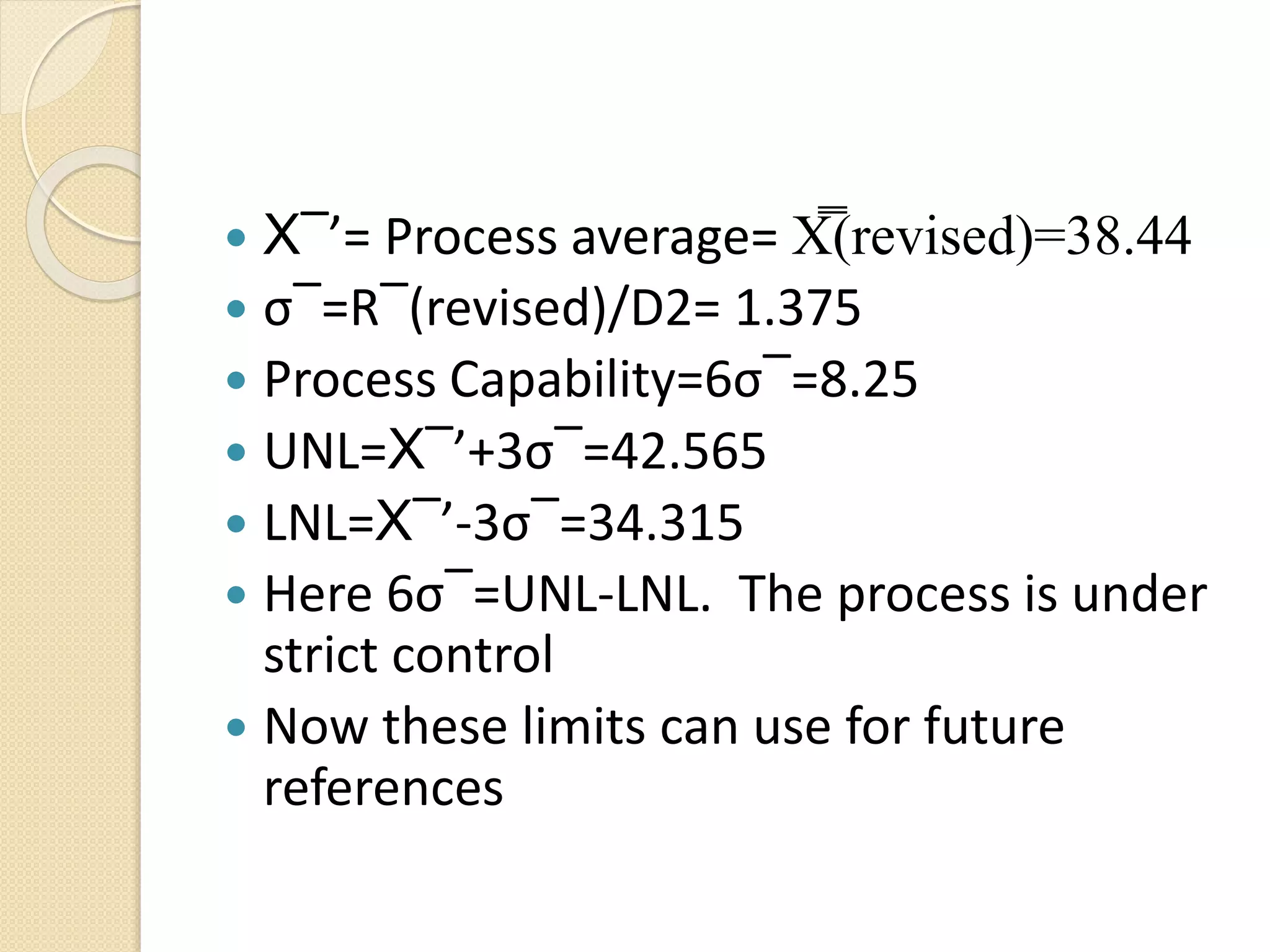
 X‾’= Process average= X̿(revised)=38.44 
 σ‾=R‾(revised)/D2= 1.375 
 Process Capability=6σ‾=8.25 
 UNL=X‾’+3σ‾=42.565 
 LNL=X‾’-3σ‾=34.315 
 Here 6σ‾=UNL-LNL. The process is under 
strict control 
 Now these limits can use for future 
references
 THANKYOU

X‾ and r charts

  • 1.
    SEMINAR ON X‾AND R CHARTS 1.AKHIL KRISHNAN G 2.MADHUSOODHANAN 3.MOHAMMED SHAFEEQ P K 4.VARUN RAJ M 5.VISHNU S
  • 2.
    INTRODUCTION  X‾-R Chart maximum utilization of information available from data & provide detailed information in process average & variation for control of individual dimensions.  Samples(subgroup size) are drawn at intervals and measures are taken.
  • 3.
    Control charts forX‾ & R are constructed for a) A process is behaving normally. b) No assignable cause are present. c) Ensure product quality level.
  • 4.
    The chart isadvantageous in the following situations  The sample size is relatively small (say, n ≤ 10)— x‾and s charts are typically used for larger sample sizes)  The sample size is constant  Humans must perform the calculations for the chart
  • 5.
    Construction of X‾& R Chart. 1. Begin taking samples and place the numbers on the chart in the order they are taken. 2. Calculate the average of each sample. 3. Divide sum by the total number of samples taken for any particular time. 4. Calculate the overall average by adding on the figure in the average X‾ row and dividing that total by the number of readings in the row. 5. Find the range by subtracting the smaller number from the larger number. 6. Calculate the average range R‾ by the summing all range entries and dividing by the number of entries.
  • 6.
    Construction of X‾& R Chart. 7. To calculate the graph scales begin by first finding the larger and smallest average X‾ and the largest and smallest range. 8. Plot the data using the average data for the top graph and the range data for the lower graph and connect the dots forming a line for the averages and another for ranges. 9. Draw heavy line at those points from one end of each graph to the other and label them.
  • 7.
    CASE STUDY Here we are considering 100 finished work pieces from fitting workshop for our analysis  Width of each work piece was measured and as taken as desired dimension  Study leads to the following results
  • 8.
    COMPUTATION OF MEANAND RANGE NO. Subgroup Subgroup Avg. Range X̿ R‾ 1 2 3 4 5 1 39 39 38 37 37 38 2 39.7 2.9 2 37 39 40 39 38 38.6 3 3 39 37 36 38 37 37.4 3 4 38 38 36 37 38 37.4 2 5 38 38 37 36 39 37.6 3 6 39 39 40 38 38 38.8 2 7 35 41 39 38 38 38.2 6 8 38 39 37 36 38 37.6 3 9 36 38 39 35 37 37 4 10 38 39 37 39 38 38.2 2 11 39 39 36 37 38 37.8 3 12 38 40 36 38 38 38 4 13 37 37 38 38 38 37.6 1 14 38 36 37 39 39 37.8 3 15 37 36 37 36 38 36.8 2 16 37 38 38 39 40 38.4 3 17 35 38 38 39 38 37.6 4 18 37 37 36 37 38 37 2 19 38 39 39 36 38 38 3 20 39 37 37 36 38 37.4 3
  • 9.
    Calculations  X̿=(X₁‾+X₂‾+----+X₂₀‾)/20= 39.7  R‾=(R₁+R₂+------+R₂₀)/20 = 2.9  For subgroup size, n=5 A₂=0.58 D₃=0 D₄=2.11 D₂=2.326
  • 10.
    Control limits ForX‾ chart  UCL= X̿ +A₂R‾ =41.382  LCL= X̿ -A₂R‾ =38.018 For R chart • UCL=D₄R‾ =6.119 • LCL=D₃R‾ =0
  • 11.
    R CHART 7 6 5 4 3 2 1 0 Range UCL (6.2) LCL(0) 1 2 3 4 5 6 7 8 9 10 11 12 13 14 15 16 17 18 19 20 21 22 23 Range sub grp no
  • 12.
    X‾ CHART 42 41 40 39 38 37 36 35 34 Subgroup Avg. 1 2 3 4 5 6 7 8 9 10 11 12 13 14 15 16 17 18 19 20 21 UCL(41.382) LCL(38) Subgroup…
  • 13.
     All thevalues of ranges are lying between UCL and LCL of R chart  In X‾ chart some values are out of control  So we have to eliminate those groups and calculate revised control limits
  • 14.
    REVISED CONTROL LIMITS  R Chart :  UCL= 6.752  LCL =0  X‾ Chart:  UCL= 40.296  LCL =36.584
  • 15.
    SOME COMMENTS Now all the points in both charts are under control limits the process is seems to be under control  Means only chance causes of variations are present in the process  Now we can calculate process average, upper natural limit, lower natural limit, etc to comment about the process control
  • 16.
     X‾’= Processaverage= X̿(revised)=38.44  σ‾=R‾(revised)/D2= 1.375  Process Capability=6σ‾=8.25  UNL=X‾’+3σ‾=42.565  LNL=X‾’-3σ‾=34.315  Here 6σ‾=UNL-LNL. The process is under strict control  Now these limits can use for future references
  • 17.