DEFINITION 
Glass is an amorphous, hard, brittle, transparent or 
translucent super cooled liquid of infinite viscosity, having 
no definite melting point obtained by fusing a mixture of a 
number of metallic silicates or borates of Sodium, 
Potassium, Calcium, and Lead. 
It possess no definite formula or crystalline structure. 
“An inorganic product of fusion which has cooled to a rigid 
condition without crystallizing” 
Does not have a specific melting point 
Softens over a temperature range
PROPERTIES OF GLASS 
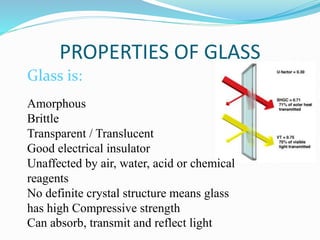
Glass is: 
Amorphous 
Brittle 
Transparent / Translucent 
Good electrical insulator 
Unaffected by air, water, acid or chemical 
reagents 
No definite crystal structure means glass 
has high Compressive strength 
Can absorb, transmit and reflect light
RAW MATERIALS USED IN MANUFACTURING GLASS 
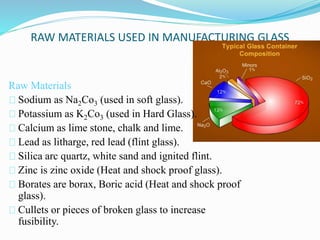
Raw Materials 
Sodium as Na2Co3 (used in soft glass). 
Potassium as K2Co3 (used in Hard Glass). 
Calcium as lime stone, chalk and lime. 
Lead as litharge, red lead (flint glass). 
Silica arc quartz, white sand and ignited flint. 
Zinc is zinc oxide (Heat and shock proof glass). 
Borates are borax, Boric acid (Heat and shock proof 
glass). 
Cullets or pieces of broken glass to increase 
fusibility.
GLASS PRODUCTION AND PROCESSING 
MAJOR STEPS 
1.Melting and refining. 
2.Forming and shaping. 
3.Heat treatment 
4.Finishing
1.MELTING AND REFINING 
The mixed batch of raw materials, along with broken 
or reclaimed glass, is fed into one end of a continuous 
–type furnace where it melts and remains molten at 
around 1500 deg. 
Molten glass is drawn continuously from the furnace 
and runs in troughs to the working area, where it is 
drawn off for fabrication at a temperature of about 
1000 deg.
2.FORMING METHODS 
PRESSING 
low cost fabrication method. 
Used to manufacture table- and ovenware, insulators, 
lenses, and reflectors. 
Gobs of glass are fed into molds on a rotating press. 
The molds are moved beneath a plunger which forces 
the glass into final shape.
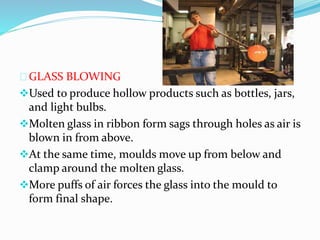
GLASS BLOWING 
Used to produce hollow products such as bottles, jars, 
and light bulbs. 
Molten glass in ribbon form sags through holes as air is 
blown in from above. 
At the same time, moulds move up from below and 
clamp around the molten glass. 
More puffs of air forces the glass into the mould to 
form final shape.
3.HEAT-TREATMENT OF GLASS 
ANNEALING 
When glass cools from the forming range to room 
temperature , thermal stresses develop that adversely 
affect strength properties. 
Annealing is done to eliminate this stress. 
Involves heating the glass to annealing range, holding 
it there for a period of time, and then cooling it slowly 
to room temperature.
TEMPERING 
Involves heating glass to around the softening point 
and then cooling it rapidly with blasts of air or by 
quenching it in oil. 
Heat tempered glass is 3 to 5 times stronger than 
annealed glass while still retaining its initial clarity, 
hardness, and expansion co-efficient.
4.FINISHING GLASS SURFACE 
Hydrofluoric acid is used for polishing and etching. 
Also be stained by copper and silver compounds. 
Ferric or cerium oxides are used to produce smooth, 
accurately finished surfaces.
VARIETIES OF GLASS
SODALIME OR SOFT GLASS 
About 90% of all glass is soda-lime glass made with silica 
(sand), Calcium carbonate and soda ash. 
The approximate composition is Na2CO3.CaO.6SiO2. 
They are low cost, resistant to water but not to acids. 
They can melt easily and hence can be hot worked. 
Uses: 
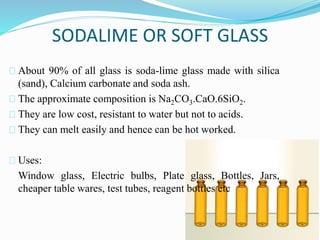
Window glass, Electric bulbs, Plate glass, Bottles, Jars, 
cheaper table wares, test tubes, reagent bottles etc
POTASH LIME OR HARD GLASS 
Potash lime glass is made with silica (sand), Calcium 
carbonate and potassium carbonate. 
The approximate composition is K2CO3.CaO.6SiO2. 
They posses high melting point, fuse with difficulty and are 
less acted upon by acids, alkaline and other solvents than 
ordinary glass. 
Uses: 
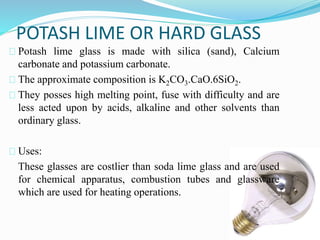
These glasses are costlier than soda lime glass and are used 
for chemical apparatus, combustion tubes and glassware 
which are used for heating operations.
LEAD GLASS OR FLINT GLASS 
It is made up of lead oxide fluxed with silica and K2CO3 is used instead of 
sodium oxide. 
Its approximate composition is K2Co3.PbO.SiO2. 
To get dense optical glasses about 80% lead oxide is used. Lead glasses has 
a lower softening temperature than soda glass and higher refractive index 
and good electrical properties. It is bright lustrous and possess high specific 
gravity. 
Uses: 
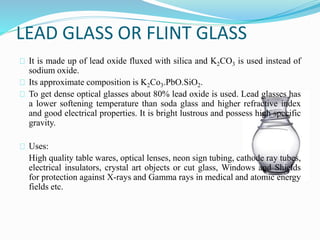
High quality table wares, optical lenses, neon sign tubing, cathode ray tubes, 
electrical insulators, crystal art objects or cut glass, Windows and Shields 
for protection against X-rays and Gamma rays in medical and atomic energy 
fields etc.
BOROSILICATE / PYREX / JENA GLASS 
It is common hard glass containing silica 
and boron with small amount of alumina 
and less alkaline solids. 
It contains SiO2(80.5%), B2O3(13%), 
Al2O3(03%), K2O(3%) and Na2O(0.5%). 
These glass have low thermal coefficient of 
expansion, and high chemical resistance 
i.e..shock proof. 
Uses: 
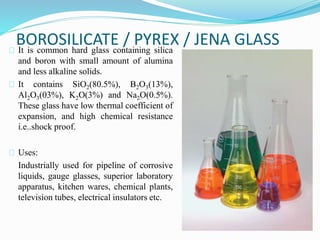
Industrially used for pipeline of corrosive 
liquids, gauge glasses, superior laboratory 
apparatus, kitchen wares, chemical plants, 
television tubes, electrical insulators etc.
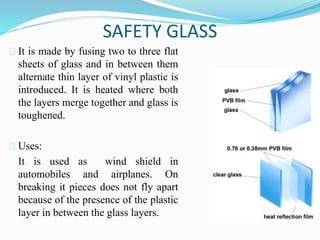
SAFETY GLASS 
It is made by fusing two to three flat 
sheets of glass and in between them 
alternate thin layer of vinyl plastic is 
introduced. It is heated where both 
the layers merge together and glass is 
toughened. 
Uses: 
It is used as wind shield in 
automobiles and airplanes. On 
breaking it pieces does not fly apart 
because of the presence of the plastic 
layer in between the glass layers.
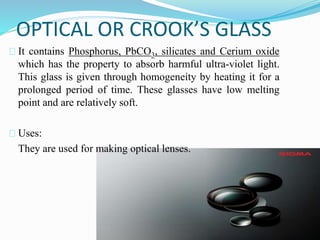
OPTICAL OR CROOK’S GLASS 
It contains Phosphorus, PbCO3, silicates and Cerium oxide 
which has the property to absorb harmful ultra-violet light. 
This glass is given through homogeneity by heating it for a 
prolonged period of time. These glasses have low melting 
point and are relatively soft. 
Uses: 
They are used for making optical lenses.
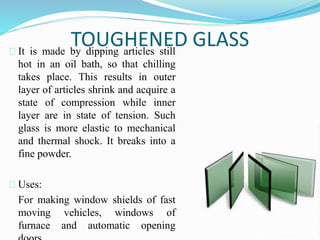
TOUGHENED GLASS 
It is made by dipping articles still 
hot in an oil bath, so that chilling 
takes place. This results in outer 
layer of articles shrink and acquire a 
state of compression while inner 
layer are in state of tension. Such 
glass is more elastic to mechanical 
and thermal shock. It breaks into a 
fine powder. 
Uses: 
For making window shields of fast 
moving vehicles, windows of 
furnace and automatic opening 
doors.
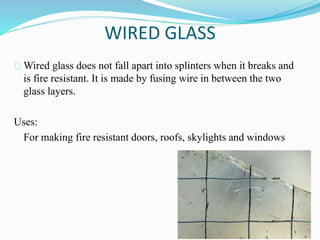
WIRED GLASS 
Wired glass does not fall apart into splinters when it breaks and 
is fire resistant. It is made by fusing wire in between the two 
glass layers. 
Uses: 
For making fire resistant doors, roofs, skylights and windows
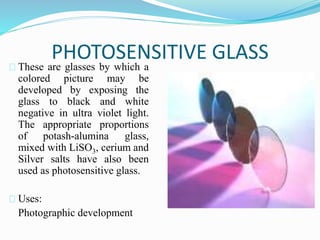
PHOTOSENSITIVE GLASS 
These are glasses by which a 
colored picture may be 
developed by exposing the 
glass to black and white 
negative in ultra violet light. 
The appropriate proportions 
of potash-alumina glass, 
mixed with LiSO3, cerium and 
Silver salts have also been 
used as photosensitive glass. 
Uses: 
Photographic development
RECENT DEVELOPMENTS 
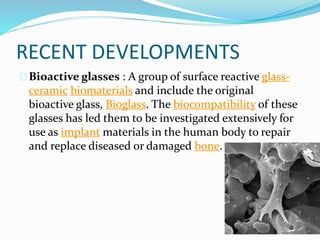
Bioactive glasses : A group of surface reactive glass-ceramic 
biomaterials and include the original 
bioactive glass, Bioglass. The biocompatibility of these 
glasses has led them to be investigated extensively for 
use as implant materials in the human body to repair 
and replace diseased or damaged bone.
Glass

Glass

  • 2.
    DEFINITION Glass isan amorphous, hard, brittle, transparent or translucent super cooled liquid of infinite viscosity, having no definite melting point obtained by fusing a mixture of a number of metallic silicates or borates of Sodium, Potassium, Calcium, and Lead. It possess no definite formula or crystalline structure. “An inorganic product of fusion which has cooled to a rigid condition without crystallizing” Does not have a specific melting point Softens over a temperature range
  • 3.
    PROPERTIES OF GLASS Glass is: Amorphous Brittle Transparent / Translucent Good electrical insulator Unaffected by air, water, acid or chemical reagents No definite crystal structure means glass has high Compressive strength Can absorb, transmit and reflect light
  • 4.
    RAW MATERIALS USEDIN MANUFACTURING GLASS Raw Materials Sodium as Na2Co3 (used in soft glass). Potassium as K2Co3 (used in Hard Glass). Calcium as lime stone, chalk and lime. Lead as litharge, red lead (flint glass). Silica arc quartz, white sand and ignited flint. Zinc is zinc oxide (Heat and shock proof glass). Borates are borax, Boric acid (Heat and shock proof glass). Cullets or pieces of broken glass to increase fusibility.
  • 5.
    GLASS PRODUCTION ANDPROCESSING MAJOR STEPS 1.Melting and refining. 2.Forming and shaping. 3.Heat treatment 4.Finishing
  • 6.
    1.MELTING AND REFINING The mixed batch of raw materials, along with broken or reclaimed glass, is fed into one end of a continuous –type furnace where it melts and remains molten at around 1500 deg. Molten glass is drawn continuously from the furnace and runs in troughs to the working area, where it is drawn off for fabrication at a temperature of about 1000 deg.
  • 7.
    2.FORMING METHODS PRESSING low cost fabrication method. Used to manufacture table- and ovenware, insulators, lenses, and reflectors. Gobs of glass are fed into molds on a rotating press. The molds are moved beneath a plunger which forces the glass into final shape.
  • 8.
    GLASS BLOWING Usedto produce hollow products such as bottles, jars, and light bulbs. Molten glass in ribbon form sags through holes as air is blown in from above. At the same time, moulds move up from below and clamp around the molten glass. More puffs of air forces the glass into the mould to form final shape.
  • 9.
    3.HEAT-TREATMENT OF GLASS ANNEALING When glass cools from the forming range to room temperature , thermal stresses develop that adversely affect strength properties. Annealing is done to eliminate this stress. Involves heating the glass to annealing range, holding it there for a period of time, and then cooling it slowly to room temperature.
  • 10.
    TEMPERING Involves heatingglass to around the softening point and then cooling it rapidly with blasts of air or by quenching it in oil. Heat tempered glass is 3 to 5 times stronger than annealed glass while still retaining its initial clarity, hardness, and expansion co-efficient.
  • 11.
    4.FINISHING GLASS SURFACE Hydrofluoric acid is used for polishing and etching. Also be stained by copper and silver compounds. Ferric or cerium oxides are used to produce smooth, accurately finished surfaces.
  • 12.
  • 13.
    SODALIME OR SOFTGLASS About 90% of all glass is soda-lime glass made with silica (sand), Calcium carbonate and soda ash. The approximate composition is Na2CO3.CaO.6SiO2. They are low cost, resistant to water but not to acids. They can melt easily and hence can be hot worked. Uses: Window glass, Electric bulbs, Plate glass, Bottles, Jars, cheaper table wares, test tubes, reagent bottles etc
  • 14.
    POTASH LIME ORHARD GLASS Potash lime glass is made with silica (sand), Calcium carbonate and potassium carbonate. The approximate composition is K2CO3.CaO.6SiO2. They posses high melting point, fuse with difficulty and are less acted upon by acids, alkaline and other solvents than ordinary glass. Uses: These glasses are costlier than soda lime glass and are used for chemical apparatus, combustion tubes and glassware which are used for heating operations.
  • 15.
    LEAD GLASS ORFLINT GLASS It is made up of lead oxide fluxed with silica and K2CO3 is used instead of sodium oxide. Its approximate composition is K2Co3.PbO.SiO2. To get dense optical glasses about 80% lead oxide is used. Lead glasses has a lower softening temperature than soda glass and higher refractive index and good electrical properties. It is bright lustrous and possess high specific gravity. Uses: High quality table wares, optical lenses, neon sign tubing, cathode ray tubes, electrical insulators, crystal art objects or cut glass, Windows and Shields for protection against X-rays and Gamma rays in medical and atomic energy fields etc.
  • 16.
    BOROSILICATE / PYREX/ JENA GLASS It is common hard glass containing silica and boron with small amount of alumina and less alkaline solids. It contains SiO2(80.5%), B2O3(13%), Al2O3(03%), K2O(3%) and Na2O(0.5%). These glass have low thermal coefficient of expansion, and high chemical resistance i.e..shock proof. Uses: Industrially used for pipeline of corrosive liquids, gauge glasses, superior laboratory apparatus, kitchen wares, chemical plants, television tubes, electrical insulators etc.
  • 17.
    SAFETY GLASS Itis made by fusing two to three flat sheets of glass and in between them alternate thin layer of vinyl plastic is introduced. It is heated where both the layers merge together and glass is toughened. Uses: It is used as wind shield in automobiles and airplanes. On breaking it pieces does not fly apart because of the presence of the plastic layer in between the glass layers.
  • 18.
    OPTICAL OR CROOK’SGLASS It contains Phosphorus, PbCO3, silicates and Cerium oxide which has the property to absorb harmful ultra-violet light. This glass is given through homogeneity by heating it for a prolonged period of time. These glasses have low melting point and are relatively soft. Uses: They are used for making optical lenses.
  • 19.
    TOUGHENED GLASS Itis made by dipping articles still hot in an oil bath, so that chilling takes place. This results in outer layer of articles shrink and acquire a state of compression while inner layer are in state of tension. Such glass is more elastic to mechanical and thermal shock. It breaks into a fine powder. Uses: For making window shields of fast moving vehicles, windows of furnace and automatic opening doors.
  • 20.
    WIRED GLASS Wiredglass does not fall apart into splinters when it breaks and is fire resistant. It is made by fusing wire in between the two glass layers. Uses: For making fire resistant doors, roofs, skylights and windows
  • 21.
    PHOTOSENSITIVE GLASS Theseare glasses by which a colored picture may be developed by exposing the glass to black and white negative in ultra violet light. The appropriate proportions of potash-alumina glass, mixed with LiSO3, cerium and Silver salts have also been used as photosensitive glass. Uses: Photographic development
  • 22.
    RECENT DEVELOPMENTS Bioactiveglasses : A group of surface reactive glass-ceramic biomaterials and include the original bioactive glass, Bioglass. The biocompatibility of these glasses has led them to be investigated extensively for use as implant materials in the human body to repair and replace diseased or damaged bone.