Statistical Process Control
Relating Applied Statistics to Quality Control
Contents


Introduction to Statistics





Descriptive Analysis
Inferential Analysis

Statistical Quality Control


Descriptive Statistics



Statistical Process Control (SPC)




SPC: 7 Basic Quality Tools

Acceptance Sampling
Introduction to Statistics
The Nature of Statistics and the Collection of Data
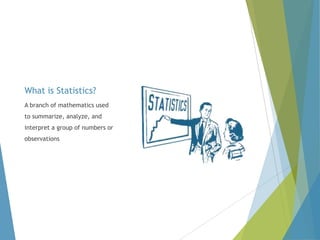
What is Statistics?
A branch of mathematics used
to summarize, analyze, and
interpret a group of numbers or
observations
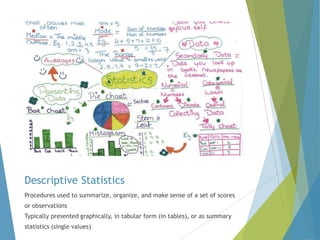
Descriptive Statistics
Procedures used to summarize, organize, and make sense of a set of scores
or observations
Typically presented graphically, in tabular form (in tables), or as summary

statistics (single values)
Inferential Statistics
Procedures used that allow researchers to infer or generalize observations
made with samples to the larger population from which they were selected
Before we go…
Which type of tables, graphs,

and summary measures to use
with our data?

Data
Measurements or observations
that are typically numeric

Datum = raw score
(a single measurement or observation)
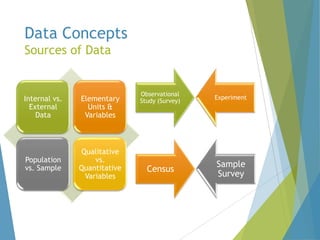
Data Concepts
Sources of Data

Internal vs.
External
Data

Elementary
Units &
Variables

Population
vs. Sample

Qualitative
vs.
Quantitative
Variables

Observational
Study (Survey)

Experiment

Census

Sample
Survey
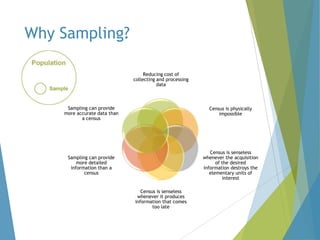
Why Sampling?
Reducing cost of
collecting and processing
data

Sampling can provide
more accurate data than
a census

Census is physically
impossible

Sampling can provide
more detailed
information than a
census

Census is senseless
whenever the acquisition
of the desired
information destroys the
elementary units of
interest

Census is senseless
whenever it produces
information that comes
too late
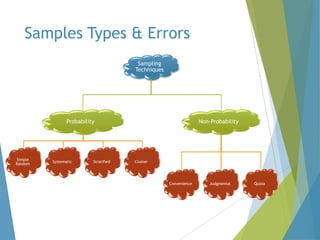
Samples Types & Errors
Sampling
Techniques

Probability

Simple
Random

Systematic

Stratified

Non-Probability

Cluster

Convenience

Judgmental

Quota
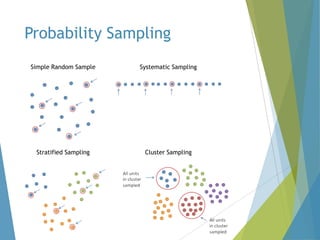
Probability Sampling
Simple Random Sample

Systematic Sampling

Stratified Sampling

Cluster Sampling
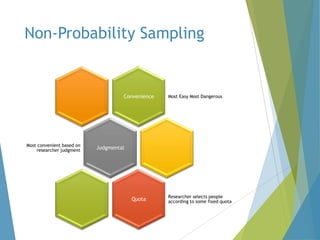
Non-Probability Sampling

Convenience

Most convenient based on
researcher judgment

Most Easy Most Dangerous

Judgmental

Quota

Researcher selects people
according to some fixed quota
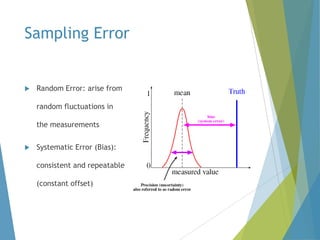
Sampling Error



Random Error: arise from
random fluctuations in
the measurements



Systematic Error (Bias):

consistent and repeatable
(constant offset)
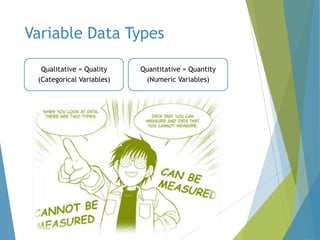
Variable Data Types
Qualitative = Quality
(Categorical Variables)

Quantitative = Quantity
(Numeric Variables)
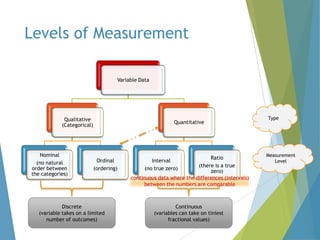
Levels of Measurement
Variable Data

Qualitative
(Categorical)

Nominal
(no natural
order between
the categories)

Quantitative

Ordinal
(ordering)

Discrete
(variable takes on a limited
number of outcomes)

Ratio
(there is a true
zero)
continuous data where the differences (intervals)
between the numbers are comparable
Interval
(no true zero)

Continuous
(variables can take on tiniest
fractional values)

Type

Measurement
Level
Minitab 16 Software
A statistical software used to
analyze data
o

Calculating basic statistics

o

Graphing data

o

Running hypothesis tests
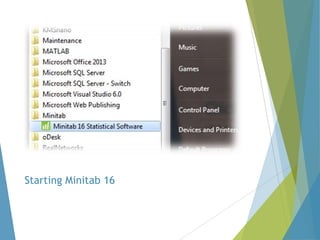
Starting Minitab 16
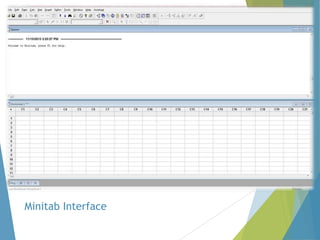
Minitab Interface
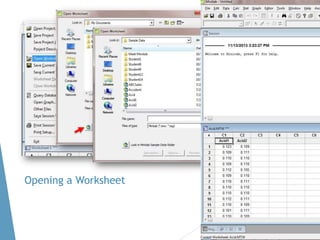
Opening a Worksheet
Descriptive Statistics
The Effective Presentation of Data
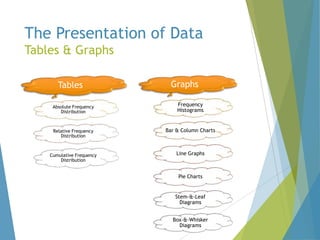
The Presentation of Data
Tables & Graphs
Tables
Absolute Frequency
Distribution

Graphs
Frequency
Histograms

Relative Frequency
Distribution

Bar & Column Charts

Cumulative Frequency
Distribution

Line Graphs

Pie Charts

Stem-&-Leaf
Diagrams
Box-&-Whisker
Diagrams
Absolute Frequency
Distribution
Absolute Class Frequency (number of companies in class)
Class (size of profit in
million of dollars)

Tally

Count

-1,500 to under 0

||
|

0 to under 500

|| |||| |||| |||| |||
|||| |||| |||| ||||

41

500 to under 1,000

|| |||| |||| |||
|||| |||| |||| |

32

1,000 to under 1,500

|| ||
||||

9

1,500 to under 2,000

||
|||

6

2,000 to under 2,500

||
|||

6

2,500 to under 5,500

||
|

3

Total

3

100
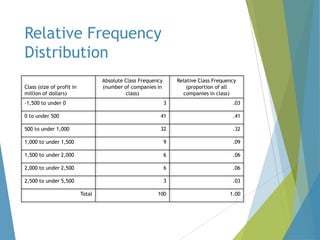
Relative Frequency
Distribution
Absolute Class Frequency
(number of companies in
class)

Class (size of profit in
million of dollars)
-1,500 to under 0

Relative Class Frequency
(proportion of all
companies in class)
3

.03

0 to under 500

41

.41

500 to under 1,000

32

.32

1,000 to under 1,500

9

.09

1,500 to under 2,000

6

.06

2,000 to under 2,500

6

.06

2,500 to under 5,500

3

.03

100

1.00

Total
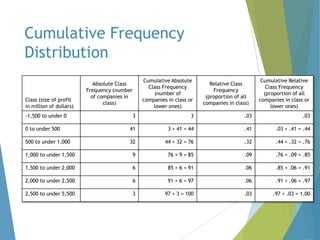
Cumulative Frequency
Distribution
Class (size of profit
in million of dollars)
-1,500 to under 0

Cumulative Absolute
Class Frequency
(number of
companies in class or
lower ones)

Absolute Class
Frequency (number
of companies in
class)

Relative Class
Frequency
(proportion of all
companies in class)

Cumulative Relative
Class Frequency
(proportion of all
companies in class or
lower ones)

3

3

.03

.03

0 to under 500

41

3 + 41 = 44

.41

.03 + .41 = .44

500 to under 1,000

32

44 + 32 = 76

.32

.44 + .32 = .76

1,000 to under 1,500

9

76 + 9 = 85

.09

.76 + .09 = .85

1,500 to under 2,000

6

85 + 6 = 91

.06

.85 + .06 = .91

2,000 to under 2,500

6

91 + 6 = 97

.06

.91 + .06 = .97

2,500 to under 5,500

3

97 + 3 = 100

.03

.97 + .03 = 1.00
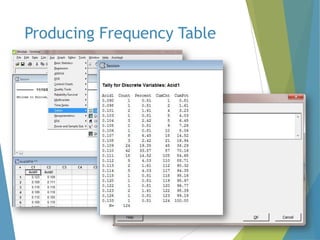
Producing Frequency Table
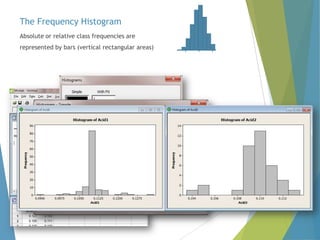
The Frequency Histogram
Absolute or relative class frequencies are
represented by bars (vertical rectangular areas)
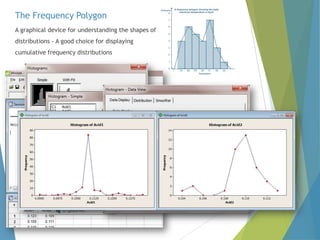
The Frequency Polygon
A graphical device for understanding the shapes of
distributions - A good choice for displaying
cumulative frequency distributions
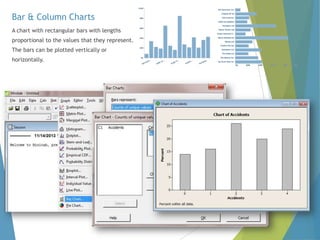
Bar & Column Charts
A chart with rectangular bars with lengths
proportional to the values that they represent.
The bars can be plotted vertically or
horizontally.
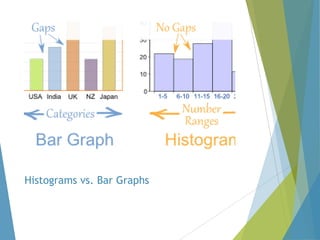
Histograms vs. Bar Graphs
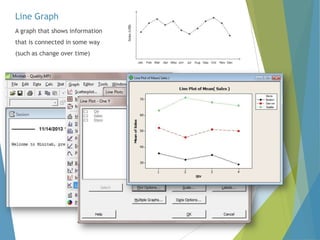
Line Graph
A graph that shows information
that is connected in some way
(such as change over time)
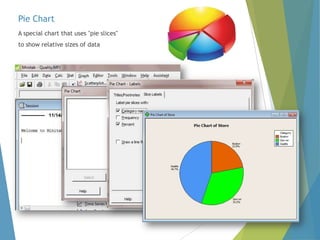
Pie Chart
A special chart that uses "pie slices"
to show relative sizes of data
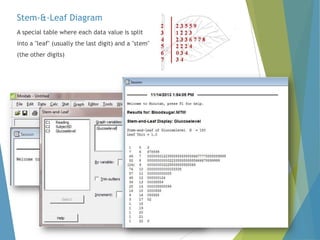
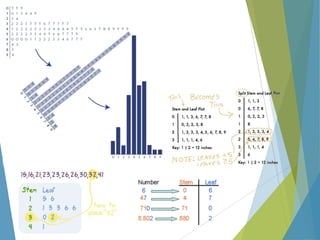
Stem-&-Leaf Diagram
A special table where each data value is split
into a "leaf" (usually the last digit) and a "stem"
(the other digits)
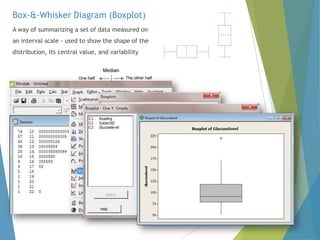
Box-&-Whisker Diagram (Boxplot)
A way of summarizing a set of data measured on
an interval scale - used to show the shape of the
distribution, its central value, and variability
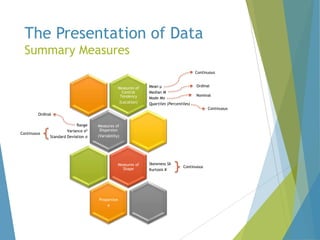
The Presentation of Data
Summary Measures
Continuous

Measures of
Central
Tendency
(Location)

Mean µ
Median M
Mode Mo
Quartiles (Percentiles)

Ordinal
Nominal
Continuous

Ordinal

Continuous

Range
Variance σ2
Standard Deviation σ

Measures of
Dispersion
(Variability)

Measures of
Shape

Proportion
π

Skewness Sk
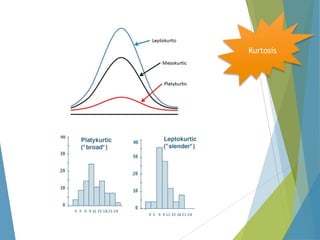
Kurtosis K

Continuous
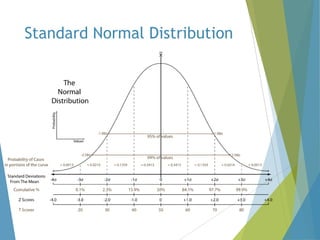
Standard Normal Distribution
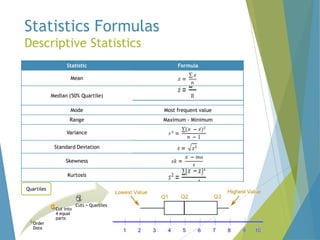
Statistics Formulas
Descriptive Statistics
Statistic

Formula

Mean
Median (50% Quartile)
Mode

Most frequent value

Range

Maximum - Minimum

Variance
Standard Deviation
Skewness
Kurtosis
Quartiles

Cut into
4 equal
parts
Order
Data

Cuts = Quartiles
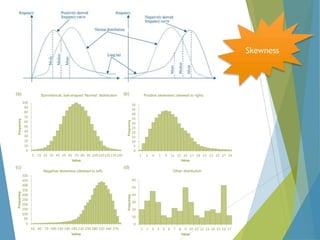
Skewness
Kurtosis
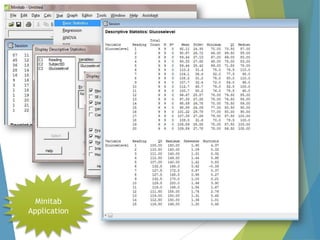
Minitab
Application
Inferential Statistics
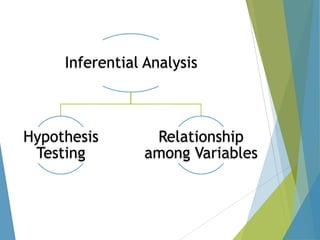
Inferential Analysis

Hypothesis
Testing

Relationship
among Variables
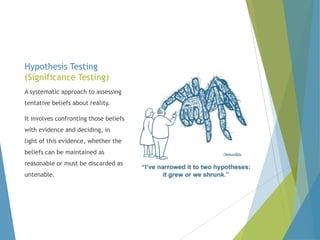
Hypothesis Testing
(Significance Testing)
A systematic approach to assessing
tentative beliefs about reality.
It involves confronting those beliefs
with evidence and deciding, in
light of this evidence, whether the
beliefs can be maintained as
reasonable or must be discarded as
untenable.
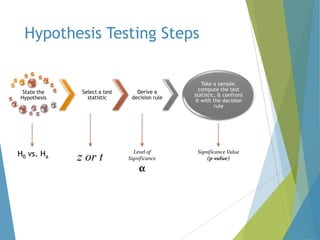
Hypothesis Testing Steps

State the
Hypothesis

H0 vs. Ha

Select a test
statistic

z or t

Derive a
decision rule

Level of
Significance

α

Take a sample,
compute the test
statistic, & confront
it with the decision
rule

Significance Value
(p-value)
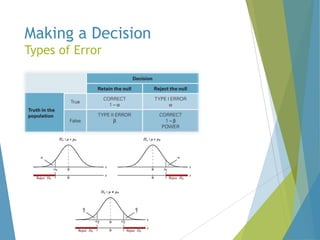
Making a Decision
Types of Error
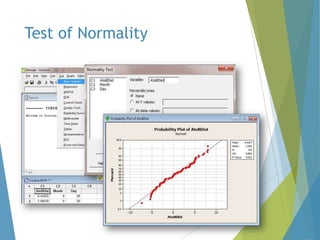
Test of Normality
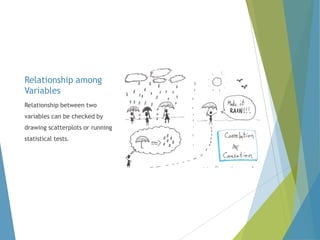
Relationship among
Variables
Relationship between two
variables can be checked by
drawing scatterplots or running
statistical tests.
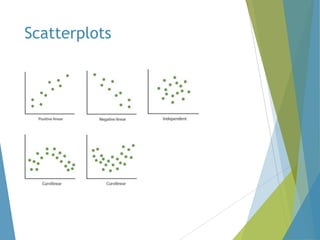
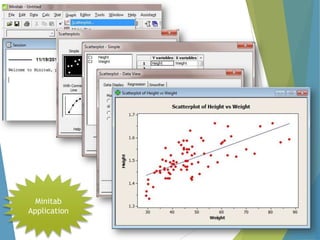
Scatterplots
Minitab
Application
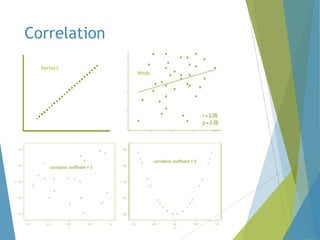
Correlation
Perfect

Weak
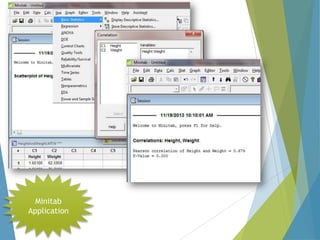
Minitab
Application
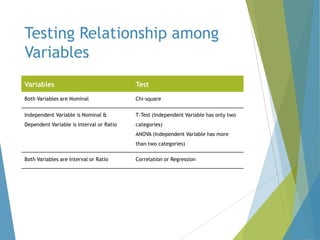
Testing Relationship among
Variables
Variables

Test

Both Variables are Nominal

Chi-square

Independent Variable is Nominal &

T-Test (Independent Variable has only two

Dependent Variable is Interval or Ratio

categories)
ANOVA (Independent Variable has more
than two categories)

Both Variables are Interval or Ratio

Correlation or Regression
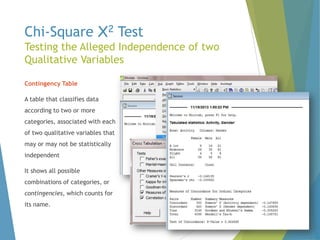
Chi-Square X2 Test

Testing the Alleged Independence of two
Qualitative Variables
Contingency Table
A table that classifies data

according to two or more
categories, associated with each
of two qualitative variables that
may or may not be statistically
independent
It shows all possible
combinations of categories, or
contingencies, which counts for
its name.
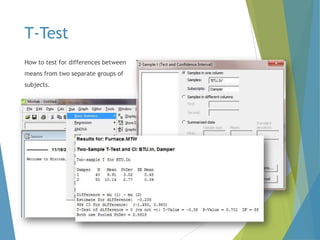
T-Test
How to test for differences between

means from two separate groups of
subjects.
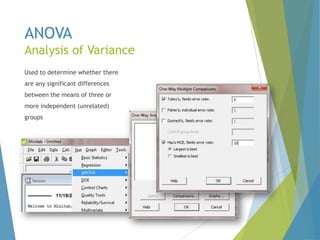
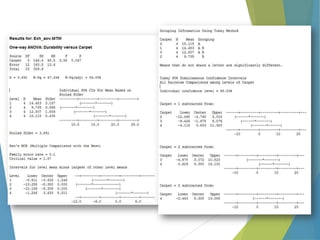
ANOVA
Analysis of Variance
Used to determine whether there

are any significant differences
between the means of three or
more independent (unrelated)
groups
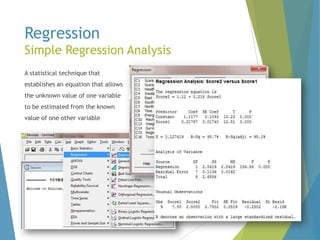
Regression
Simple Regression Analysis
A statistical technique that
establishes an equation that allows

the unknown value of one variable
to be estimated from the known
value of one other variable
Statistical Quality Control
The general category of statistical tools used to evaluate
organizational quality
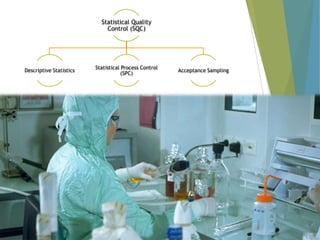
Statistical Quality
Control (SQC)

Descriptive Statistics

Statistical Process Control
(SPC)

Acceptance Sampling
Descriptive Statistics
Statistics used to describe quality
characteristics and relationships

Acceptance Sampling
Statistical Process
Control (SPC)
A statistical tool that involves
inspecting a random sample of the

The process of randomly inspecting
a sample of goods and deciding
whether to accept the entire lot
based on the results

output from a process and
deciding whether the process is

Process Capability

producing products with

The ability of a production process to

characteristics that fall within a

meet or exceed preset specifications

predetermined range

All three of these statistical quality control categories are helpful in measuring and evaluating
the quality of products or services. However, statistical process control (SPC) tools are used most
frequently because they identify quality problems during the production process.
Why SPC is the Most
Important Tool of the SQC?


Measure the value of a quality characteristic



Help to identify a change or variation in
some quality characteristic of the product

or process
Some Information about SPC


SPC can be applied to any process.



There is inherent variation in any process which can be
measured and “controlled”.



SPC doesn’t eliminate variation, but it does allow the user to
track special cause variation.



“SPC is a statistical method of separating variation resulting
from special causes from natural variation and to establish and
maintain consistency in the process, enabling process
improvement.” (Goetsch & Davis, 2003. p. 631)
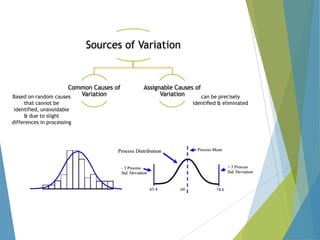
Sources of Variation

Common Causes of
Variation
Based on random causes
that cannot be
identified, unavoidable
& due to slight
differences in processing

Assignable Causes of
Variation
can be precisely
identified & eliminated
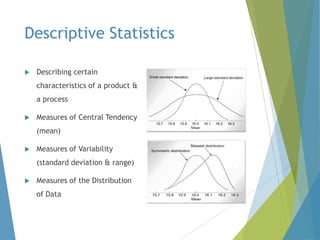
Descriptive Statistics


Describing certain
characteristics of a product &
a process



Measures of Central Tendency
(mean)



Measures of Variability
(standard deviation & range)



Measures of the Distribution
of Data
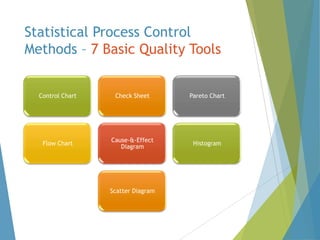
Statistical Process Control
Methods – 7 Basic Quality Tools
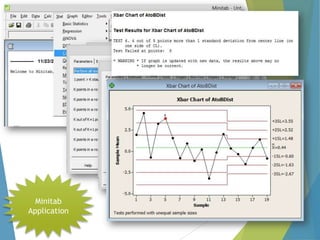
Control Chart

Check Sheet

Pareto Chart

Flow Chart

Cause-&-Effect
Diagram

Histogram

Scatter Diagram
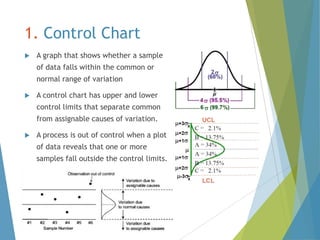
1. Control Chart


A graph that shows whether a sample
of data falls within the common or

normal range of variation


A control chart has upper and lower
control limits that separate common
from assignable causes of variation.



A process is out of control when a plot
of data reveals that one or more
samples fall outside the control limits.
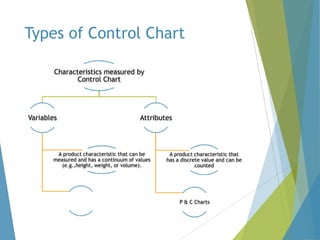
Types of Control Chart
Characteristics measured by
Control Chart

Variables

Attributes

A product characteristic that can be
measured and has a continuum of values
(e.g.,height, weight, or volume).

A product characteristic that
has a discrete value and can be
counted

P & C Charts
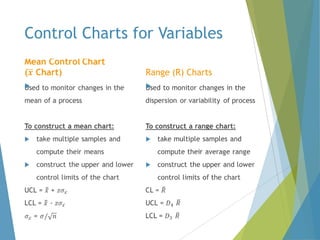
Control Charts for Variables
Range (R) Charts



Minitab
Application
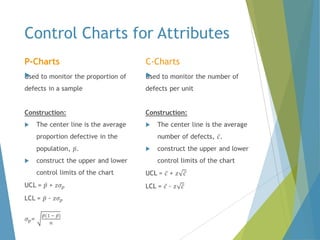
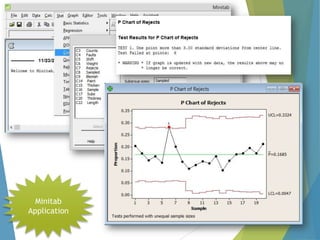
Control Charts for Attributes
P-Charts

C-Charts




Minitab
Application
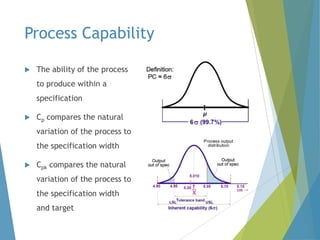
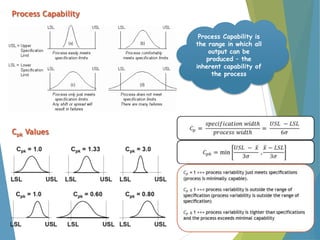
Process Capability


The ability of the process
to produce within a
specification



Cp compares the natural
variation of the process to
the specification width



Cpk compares the natural
variation of the process to
the specification width
and target
Process Capability
Process Capability is
the range in which all
output can be
produced – the
inherent capability of
the process

Cpk Values
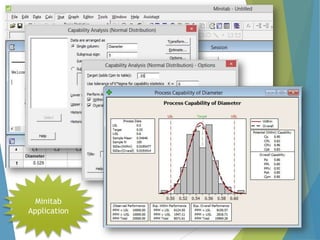
Minitab
Application
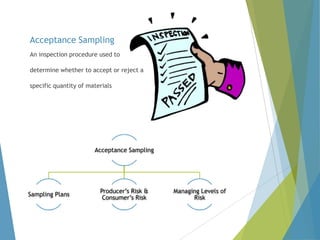
Acceptance Sampling
An inspection procedure used to
determine whether to accept or reject a
specific quantity of materials

Acceptance Sampling

Sampling Plans

Producer’s Risk &
Consumer’s Risk

Managing Levels of
Risk
Sampling Plan


A plan for acceptance sampling that precisely specifies the
parameters of the sampling process and the
acceptance/rejection criteria



No 100% Inspection



The most widely used sampling plans are given by Military
Standard (MIL-STD-105E)



Determines the quality level of an incoming shipment or at
the end of production



Judges whether quality level is within the level that has
been predetermined
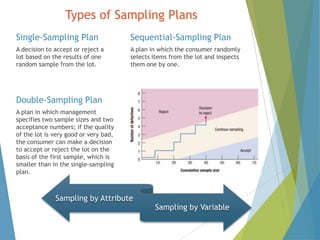
Types of Sampling Plans
Single-Sampling Plan

Sequential-Sampling Plan

A decision to accept or reject a
lot based on the results of one
random sample from the lot.

A plan in which the consumer randomly
selects items from the lot and inspects
them one by one.

Double-Sampling Plan
A plan in which management
specifies two sample sizes and two
acceptance numbers; if the quality
of the lot is very good or very bad,
the consumer can make a decision
to accept or reject the lot on the
basis of the first sample, which is
smaller than in the single-sampling
plan.

Sampling by Attribute

Sampling by Variable
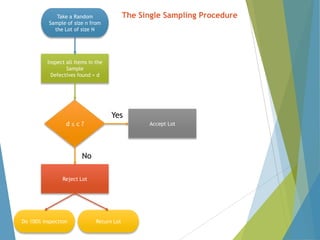
The Single Sampling Procedure

Take a Random
Sample of size n from
the Lot of size N

Inspect all items in the
Sample
Defectives found = d

Yes
d≤c?

Accept Lot

No
Reject Lot

Do 100% Inspection

Return Lot
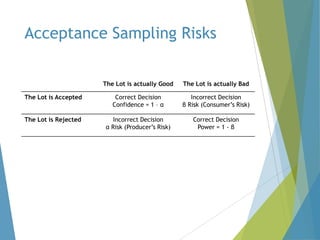
Acceptance Sampling Risks
The Lot is actually Good

The Lot is actually Bad

The Lot is Accepted

Correct Decision
Confidence = 1 – α

Incorrect Decision
β Risk (Consumer’s Risk)

The Lot is Rejected

Incorrect Decision
α Risk (Producer’s Risk)

Correct Decision
Power = 1 - β
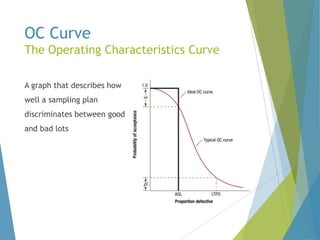
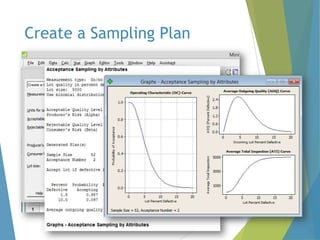
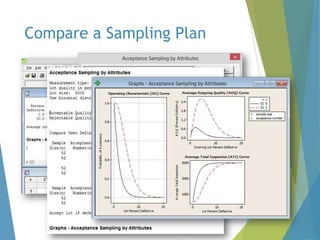
OC Curve
The Operating Characteristics Curve
A graph that describes how
well a sampling plan
discriminates between good
and bad lots
Quality & Risk Decisions


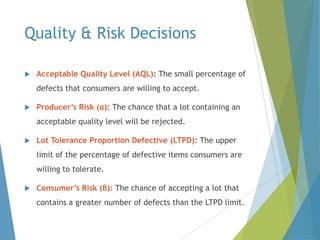
Acceptable Quality Level (AQL): The small percentage of
defects that consumers are willing to accept.



Producer’s Risk (α): The chance that a lot containing an
acceptable quality level will be rejected.



Lot Tolerance Proportion Defective (LTPD): The upper
limit of the percentage of defective items consumers are
willing to tolerate.



Consumer’s Risk (β): The chance of accepting a lot that
contains a greater number of defects than the LTPD limit.
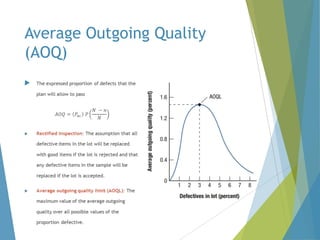
Average Outgoing Quality
(AOQ)

Create a Sampling Plan
Compare a Sampling Plan
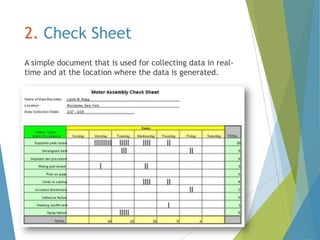
2. Check Sheet
A simple document that is used for collecting data in realtime and at the location where the data is generated.
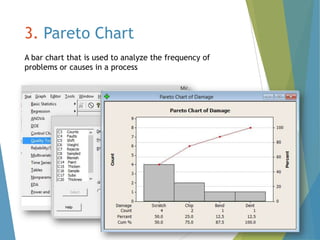
3. Pareto Chart
A bar chart that is used to analyze the frequency of
problems or causes in a process
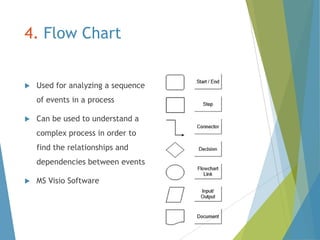
4. Flow Chart



Used for analyzing a sequence
of events in a process



Can be used to understand a
complex process in order to
find the relationships and

dependencies between events


MS Visio Software
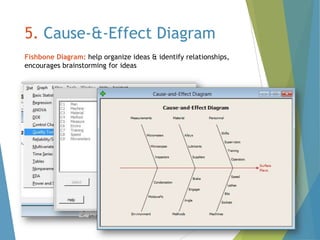
5. Cause-&-Effect Diagram
Fishbone Diagram: help organize ideas & identify relationships,
encourages brainstorming for ideas
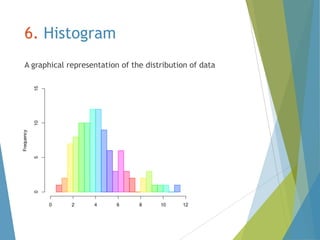
6. Histogram
A graphical representation of the distribution of data
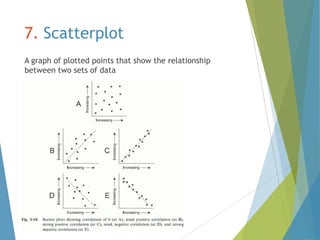
7. Scatterplot
A graph of plotted points that show the relationship
between two sets of data
“

Thank You!

Presenter:

Marwa Abo Amra

statistician.marwa@gmail.com

”

Statistical Process Control

  • 1.
    Statistical Process Control RelatingApplied Statistics to Quality Control
  • 2.
    Contents  Introduction to Statistics    DescriptiveAnalysis Inferential Analysis Statistical Quality Control  Descriptive Statistics  Statistical Process Control (SPC)   SPC: 7 Basic Quality Tools Acceptance Sampling
  • 3.
    Introduction to Statistics TheNature of Statistics and the Collection of Data
  • 5.
    What is Statistics? Abranch of mathematics used to summarize, analyze, and interpret a group of numbers or observations
  • 6.
    Descriptive Statistics Procedures usedto summarize, organize, and make sense of a set of scores or observations Typically presented graphically, in tabular form (in tables), or as summary statistics (single values)
  • 7.
    Inferential Statistics Procedures usedthat allow researchers to infer or generalize observations made with samples to the larger population from which they were selected
  • 8.
    Before we go… Whichtype of tables, graphs, and summary measures to use with our data? Data Measurements or observations that are typically numeric Datum = raw score (a single measurement or observation)
  • 9.
    Data Concepts Sources ofData Internal vs. External Data Elementary Units & Variables Population vs. Sample Qualitative vs. Quantitative Variables Observational Study (Survey) Experiment Census Sample Survey
  • 10.
    Why Sampling? Reducing costof collecting and processing data Sampling can provide more accurate data than a census Census is physically impossible Sampling can provide more detailed information than a census Census is senseless whenever the acquisition of the desired information destroys the elementary units of interest Census is senseless whenever it produces information that comes too late
  • 11.
    Samples Types &Errors Sampling Techniques Probability Simple Random Systematic Stratified Non-Probability Cluster Convenience Judgmental Quota
  • 12.
    Probability Sampling Simple RandomSample Systematic Sampling Stratified Sampling Cluster Sampling
  • 13.
    Non-Probability Sampling Convenience Most convenientbased on researcher judgment Most Easy Most Dangerous Judgmental Quota Researcher selects people according to some fixed quota
  • 14.
    Sampling Error  Random Error:arise from random fluctuations in the measurements  Systematic Error (Bias): consistent and repeatable (constant offset)
  • 15.
    Variable Data Types Qualitative= Quality (Categorical Variables) Quantitative = Quantity (Numeric Variables)
  • 16.
    Levels of Measurement VariableData Qualitative (Categorical) Nominal (no natural order between the categories) Quantitative Ordinal (ordering) Discrete (variable takes on a limited number of outcomes) Ratio (there is a true zero) continuous data where the differences (intervals) between the numbers are comparable Interval (no true zero) Continuous (variables can take on tiniest fractional values) Type Measurement Level
  • 17.
    Minitab 16 Software Astatistical software used to analyze data o Calculating basic statistics o Graphing data o Running hypothesis tests
  • 18.
  • 19.
  • 20.
  • 21.
  • 22.
    The Presentation ofData Tables & Graphs Tables Absolute Frequency Distribution Graphs Frequency Histograms Relative Frequency Distribution Bar & Column Charts Cumulative Frequency Distribution Line Graphs Pie Charts Stem-&-Leaf Diagrams Box-&-Whisker Diagrams
  • 23.
    Absolute Frequency Distribution Absolute ClassFrequency (number of companies in class) Class (size of profit in million of dollars) Tally Count -1,500 to under 0 || | 0 to under 500 || |||| |||| |||| ||| |||| |||| |||| |||| 41 500 to under 1,000 || |||| |||| ||| |||| |||| |||| | 32 1,000 to under 1,500 || || |||| 9 1,500 to under 2,000 || ||| 6 2,000 to under 2,500 || ||| 6 2,500 to under 5,500 || | 3 Total 3 100
  • 24.
    Relative Frequency Distribution Absolute ClassFrequency (number of companies in class) Class (size of profit in million of dollars) -1,500 to under 0 Relative Class Frequency (proportion of all companies in class) 3 .03 0 to under 500 41 .41 500 to under 1,000 32 .32 1,000 to under 1,500 9 .09 1,500 to under 2,000 6 .06 2,000 to under 2,500 6 .06 2,500 to under 5,500 3 .03 100 1.00 Total
  • 25.
    Cumulative Frequency Distribution Class (sizeof profit in million of dollars) -1,500 to under 0 Cumulative Absolute Class Frequency (number of companies in class or lower ones) Absolute Class Frequency (number of companies in class) Relative Class Frequency (proportion of all companies in class) Cumulative Relative Class Frequency (proportion of all companies in class or lower ones) 3 3 .03 .03 0 to under 500 41 3 + 41 = 44 .41 .03 + .41 = .44 500 to under 1,000 32 44 + 32 = 76 .32 .44 + .32 = .76 1,000 to under 1,500 9 76 + 9 = 85 .09 .76 + .09 = .85 1,500 to under 2,000 6 85 + 6 = 91 .06 .85 + .06 = .91 2,000 to under 2,500 6 91 + 6 = 97 .06 .91 + .06 = .97 2,500 to under 5,500 3 97 + 3 = 100 .03 .97 + .03 = 1.00
  • 26.
  • 27.
    The Frequency Histogram Absoluteor relative class frequencies are represented by bars (vertical rectangular areas)
  • 28.
    The Frequency Polygon Agraphical device for understanding the shapes of distributions - A good choice for displaying cumulative frequency distributions
  • 29.
    Bar & ColumnCharts A chart with rectangular bars with lengths proportional to the values that they represent. The bars can be plotted vertically or horizontally.
  • 30.
  • 31.
    Line Graph A graphthat shows information that is connected in some way (such as change over time)
  • 32.
    Pie Chart A specialchart that uses "pie slices" to show relative sizes of data
  • 33.
    Stem-&-Leaf Diagram A specialtable where each data value is split into a "leaf" (usually the last digit) and a "stem" (the other digits)
  • 35.
    Box-&-Whisker Diagram (Boxplot) Away of summarizing a set of data measured on an interval scale - used to show the shape of the distribution, its central value, and variability
  • 36.
    The Presentation ofData Summary Measures Continuous Measures of Central Tendency (Location) Mean µ Median M Mode Mo Quartiles (Percentiles) Ordinal Nominal Continuous Ordinal Continuous Range Variance σ2 Standard Deviation σ Measures of Dispersion (Variability) Measures of Shape Proportion π Skewness Sk Kurtosis K Continuous
  • 37.
  • 38.
    Statistics Formulas Descriptive Statistics Statistic Formula Mean Median(50% Quartile) Mode Most frequent value Range Maximum - Minimum Variance Standard Deviation Skewness Kurtosis Quartiles Cut into 4 equal parts Order Data Cuts = Quartiles
  • 39.
  • 40.
  • 41.
  • 42.
  • 43.
  • 44.
    Hypothesis Testing (Significance Testing) Asystematic approach to assessing tentative beliefs about reality. It involves confronting those beliefs with evidence and deciding, in light of this evidence, whether the beliefs can be maintained as reasonable or must be discarded as untenable.
  • 45.
    Hypothesis Testing Steps Statethe Hypothesis H0 vs. Ha Select a test statistic z or t Derive a decision rule Level of Significance α Take a sample, compute the test statistic, & confront it with the decision rule Significance Value (p-value)
  • 46.
  • 47.
  • 48.
    Relationship among Variables Relationship betweentwo variables can be checked by drawing scatterplots or running statistical tests.
  • 49.
  • 50.
  • 51.
  • 52.
  • 53.
    Testing Relationship among Variables Variables Test BothVariables are Nominal Chi-square Independent Variable is Nominal & T-Test (Independent Variable has only two Dependent Variable is Interval or Ratio categories) ANOVA (Independent Variable has more than two categories) Both Variables are Interval or Ratio Correlation or Regression
  • 54.
    Chi-Square X2 Test Testingthe Alleged Independence of two Qualitative Variables Contingency Table A table that classifies data according to two or more categories, associated with each of two qualitative variables that may or may not be statistically independent It shows all possible combinations of categories, or contingencies, which counts for its name.
  • 55.
    T-Test How to testfor differences between means from two separate groups of subjects.
  • 56.
    ANOVA Analysis of Variance Usedto determine whether there are any significant differences between the means of three or more independent (unrelated) groups
  • 58.
    Regression Simple Regression Analysis Astatistical technique that establishes an equation that allows the unknown value of one variable to be estimated from the known value of one other variable
  • 59.
    Statistical Quality Control Thegeneral category of statistical tools used to evaluate organizational quality
  • 60.
    Statistical Quality Control (SQC) DescriptiveStatistics Statistical Process Control (SPC) Acceptance Sampling
  • 61.
    Descriptive Statistics Statistics usedto describe quality characteristics and relationships Acceptance Sampling Statistical Process Control (SPC) A statistical tool that involves inspecting a random sample of the The process of randomly inspecting a sample of goods and deciding whether to accept the entire lot based on the results output from a process and deciding whether the process is Process Capability producing products with The ability of a production process to characteristics that fall within a meet or exceed preset specifications predetermined range All three of these statistical quality control categories are helpful in measuring and evaluating the quality of products or services. However, statistical process control (SPC) tools are used most frequently because they identify quality problems during the production process.
  • 62.
    Why SPC isthe Most Important Tool of the SQC?  Measure the value of a quality characteristic  Help to identify a change or variation in some quality characteristic of the product or process
  • 63.
    Some Information aboutSPC  SPC can be applied to any process.  There is inherent variation in any process which can be measured and “controlled”.  SPC doesn’t eliminate variation, but it does allow the user to track special cause variation.  “SPC is a statistical method of separating variation resulting from special causes from natural variation and to establish and maintain consistency in the process, enabling process improvement.” (Goetsch & Davis, 2003. p. 631)
  • 64.
    Sources of Variation CommonCauses of Variation Based on random causes that cannot be identified, unavoidable & due to slight differences in processing Assignable Causes of Variation can be precisely identified & eliminated
  • 65.
    Descriptive Statistics  Describing certain characteristicsof a product & a process  Measures of Central Tendency (mean)  Measures of Variability (standard deviation & range)  Measures of the Distribution of Data
  • 66.
    Statistical Process Control Methods– 7 Basic Quality Tools Control Chart Check Sheet Pareto Chart Flow Chart Cause-&-Effect Diagram Histogram Scatter Diagram
  • 67.
    1. Control Chart  Agraph that shows whether a sample of data falls within the common or normal range of variation  A control chart has upper and lower control limits that separate common from assignable causes of variation.  A process is out of control when a plot of data reveals that one or more samples fall outside the control limits.
  • 68.
    Types of ControlChart Characteristics measured by Control Chart Variables Attributes A product characteristic that can be measured and has a continuum of values (e.g.,height, weight, or volume). A product characteristic that has a discrete value and can be counted P & C Charts
  • 69.
    Control Charts forVariables Range (R) Charts  
  • 70.
  • 71.
    Control Charts forAttributes P-Charts C-Charts  
  • 72.
  • 73.
    Process Capability  The abilityof the process to produce within a specification  Cp compares the natural variation of the process to the specification width  Cpk compares the natural variation of the process to the specification width and target
  • 74.
    Process Capability Process Capabilityis the range in which all output can be produced – the inherent capability of the process Cpk Values
  • 75.
  • 76.
    Acceptance Sampling An inspectionprocedure used to determine whether to accept or reject a specific quantity of materials Acceptance Sampling Sampling Plans Producer’s Risk & Consumer’s Risk Managing Levels of Risk
  • 77.
    Sampling Plan  A planfor acceptance sampling that precisely specifies the parameters of the sampling process and the acceptance/rejection criteria  No 100% Inspection  The most widely used sampling plans are given by Military Standard (MIL-STD-105E)  Determines the quality level of an incoming shipment or at the end of production  Judges whether quality level is within the level that has been predetermined
  • 78.
    Types of SamplingPlans Single-Sampling Plan Sequential-Sampling Plan A decision to accept or reject a lot based on the results of one random sample from the lot. A plan in which the consumer randomly selects items from the lot and inspects them one by one. Double-Sampling Plan A plan in which management specifies two sample sizes and two acceptance numbers; if the quality of the lot is very good or very bad, the consumer can make a decision to accept or reject the lot on the basis of the first sample, which is smaller than in the single-sampling plan. Sampling by Attribute Sampling by Variable
  • 79.
    The Single SamplingProcedure Take a Random Sample of size n from the Lot of size N Inspect all items in the Sample Defectives found = d Yes d≤c? Accept Lot No Reject Lot Do 100% Inspection Return Lot
  • 80.
    Acceptance Sampling Risks TheLot is actually Good The Lot is actually Bad The Lot is Accepted Correct Decision Confidence = 1 – α Incorrect Decision β Risk (Consumer’s Risk) The Lot is Rejected Incorrect Decision α Risk (Producer’s Risk) Correct Decision Power = 1 - β
  • 81.
    OC Curve The OperatingCharacteristics Curve A graph that describes how well a sampling plan discriminates between good and bad lots
  • 82.
    Quality & RiskDecisions  Acceptable Quality Level (AQL): The small percentage of defects that consumers are willing to accept.  Producer’s Risk (α): The chance that a lot containing an acceptable quality level will be rejected.  Lot Tolerance Proportion Defective (LTPD): The upper limit of the percentage of defective items consumers are willing to tolerate.  Consumer’s Risk (β): The chance of accepting a lot that contains a greater number of defects than the LTPD limit.
  • 83.
  • 84.
  • 85.
  • 86.
    2. Check Sheet Asimple document that is used for collecting data in realtime and at the location where the data is generated.
  • 87.
    3. Pareto Chart Abar chart that is used to analyze the frequency of problems or causes in a process
  • 88.
    4. Flow Chart  Usedfor analyzing a sequence of events in a process  Can be used to understand a complex process in order to find the relationships and dependencies between events  MS Visio Software
  • 89.
    5. Cause-&-Effect Diagram FishboneDiagram: help organize ideas & identify relationships, encourages brainstorming for ideas
  • 90.
    6. Histogram A graphicalrepresentation of the distribution of data
  • 91.
    7. Scatterplot A graphof plotted points that show the relationship between two sets of data
  • 92.
    “ Thank You! Presenter: Marwa AboAmra statistician.marwa@gmail.com ”