Statistical Process Control 
Nicola Mezzetti, Ph.D. 
Department of Information Engineering and Computer Science 
University of Trento 
nicola.mezzetti@gmail.com 
A.A. 2014/2015 
Nicola Mezzetti, Ph.D. Statistical Process Control
"How much variation should we leave to 
chance?" 
W. A. Shewhart 
Nicola Mezzetti, Ph.D. Statistical Process Control
What is Statistical Process Control? 
Statistical Process Control (SPC) is an industry standard 
methodology for measuring and controlling quality during the 
manufacturing process. 
Attribute data (measurements) is collected from products as they 
are being produced. 
By establishing upper and lower limits, variations in the 
processes are monitored before they result in a defective 
product, 
reducing the amount of material scrap along with direct and 
indirect labor waste 
eliminating the need for
nal inspection 
increasing pro
tability 
Nicola Mezzetti, Ph.D. Statistical Process Control
History of Statistical Process Control 
In 1924 Walter Shewhart developed a simple graphical method 
for plotting collected data with predetermined control limits. This 
was the
rst of a growing range of SPC charts, commissioned by 
Bell Laboratories to improve the quality of telephones 
manufactured. 
Understanding the causes of variation within an industrial process 
proved indispensable to identify actions to improve process and 
output. In the 1950's, with the eective use of SPC, Deming 
converted post war Japan into the world leader of manufacturing 
excellence. 
This approach is increasingly being applied in service industry by 
thinking of systems as processes. As well as providing a basis for 
quality improvement, SPC Charts also oer alternative methods of 
displaying data. 
Nicola Mezzetti, Ph.D. Statistical Process Control
When to use Statistical Process Control? 
Are your quality costs really known? 
Can current data be used to improve your processes, or is it 
just data for the sake of data? 
Are the right kinds of data being collected in the right areas? 
Are decisions being made based on true data? 
Can you easily determine the cause of quality issues? 
Do you know when to perform preventative maintenance on 
machines? 
Can you accurately predict yields and output results? 
Nicola Mezzetti, Ph.D. Statistical Process Control
About Statistical Process Control 
Dr. W. Edwards Deming claimed that the majority of variation in a 
process is due to operator over adjustment. 
SPC gives operators a tool to determine when a statistically 
signi
cant change has taken place in the process or when an 
seemingly signi
cant change is just due to chance causes. 
Nicola Mezzetti, Ph.D. Statistical Process Control
Why do Companies use SPC? 
SPC itself will not make improvements. 
SPC will give operating personnel a tool to identify when a 
special cause of variation has entered the process so that the 
special cause can be 
eliminated (if the special cause has a negative impact on the 
process), or 
built into the process (if the special cause has a positive 
impact on the process) 
Moreover, SPC allows to 
eliminate constant tweaking of the process 
identify opportunities for improvement that can lead to 
reduced variation and processes that are better aimed at their 
target 
Nicola Mezzetti, Ph.D. Statistical Process Control
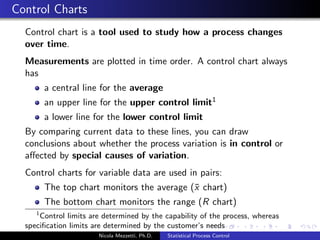
Control Charts 
Control chart is a tool used to study how a process changes 
over time. 
Measurements are plotted in time order. A control chart always 
has 
a central line for the average 
an upper line for the upper control limit1 
a lower line for the lower control limit 
By comparing current data to these lines, you can draw 
conclusions about whether the process variation is in control or 
aected by special causes of variation. 
Control charts for variable data are used in pairs: 
The top chart monitors the average (x chart) 
The bottom chart monitors the range (R chart) 
1Control limits are determined by the capability of the process, whereas 
speci
cation limits are determined by the customer's needs 
Nicola Mezzetti, Ph.D. Statistical Process Control
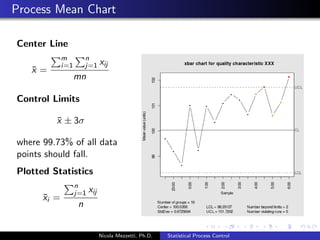
Process Mean Chart 
Center Line 
x = 
Pm 
i=1 
Pn 
j=1 xij 
mn 
Control Limits 
x  3 
where 99.73% of all data 
points should fall. 
Plotted Statistics 
xi = 
Pn 
j=1 xij 
n 
Nicola Mezzetti, Ph.D. Statistical Process Control
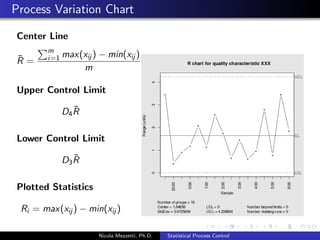
Process Variation Chart 
Center Line 
R 
= 
Pm 
i=1 max(xij )  min(xij ) 
m 
Upper Control Limit 
D4R 
Lower Control Limit 
D3R 
Plotted Statistics 
Ri = max(xij )  min(xij ) 
Nicola Mezzetti, Ph.D. Statistical Process Control
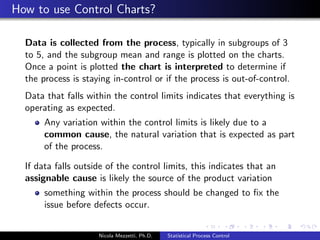
How to use Control Charts? 
Data is collected from the process, typically in subgroups of 3 
to 5, and the subgroup mean and range is plotted on the charts. 
Once a point is plotted the chart is interpreted to determine if 
the process is staying in-control or if the process is out-of-control. 
Data that falls within the control limits indicates that everything is 
operating as expected. 
Any variation within the control limits is likely due to a 
common cause, the natural variation that is expected as part 
of the process. 
If data falls outside of the control limits, this indicates that an 
assignable cause is likely the source of the product variation 
something within the process should be changed to
x the 
issue before defects occur. 
Nicola Mezzetti, Ph.D. Statistical Process Control
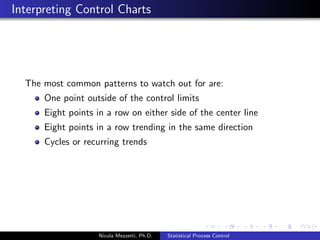
Interpreting Control Charts 
The most common patterns to watch out for are: 
One point outside of the control limits 
Eight points in a row on either side of the center line 
Eight points in a row trending in the same direction 
Cycles or recurring trends 
Nicola Mezzetti, Ph.D. Statistical Process Control
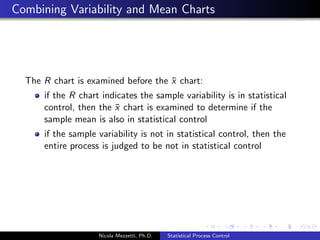
Combining Variability and Mean Charts 
The R chart is examined before the x chart: 
if the R chart indicates the sample variability is in statistical 
control, then the x chart is examined to determine if the 
sample mean is also in statistical control 
if the sample variability is not in statistical control, then the 
entire process is judged to be not in statistical control 
Nicola Mezzetti, Ph.D. Statistical Process Control
Control Points 
Before initiating any SPC program it is necessary to identify what 
to count, that is control points. Control points can be related to 
Process 
Product 
Financials 
Nicola Mezzetti, Ph.D. Statistical Process Control
When to Use a Control Chart 
Putting spec limits on control charts 
Using control charts only to satisfy customer needs 
Plotting data after the process has already been run 
Using the wrong type of control chart for the process 
Not reviewing control charts and how they are used on a 
regular basis 
Not
rst conducting a process capability study 
Not taking random samples from the process, or not using a 
sampling frequency or sample size that captures the variation 
in the process 
Nicola Mezzetti, Ph.D. Statistical Process Control
When to Use a Control Chart 
When controlling ongoing processes by
nding and correcting 
problems as they occur 
When predicting the expected range of outcomes from a 
process 
When determining whether a process is stable (in statistical 
control) 
When analyzing patterns of process variation from special 
causes (non-routine events) or common causes (built into the 
process) 
When determining whether your quality improvement project 
should aim to prevent speci
c problems or to make 
fundamental changes to the process 
Nicola Mezzetti, Ph.D. Statistical Process Control
The Seven Step Process 
The use of a Seven Step Process improves statistical process 
control. Proper application of SPC will improve process, product 
and
nancial results. 
Investigation and benchmarking of current process 
Identi
cation of appropriate measurable variables 
Estimation of available resources and project cost 
Estimation of project time line 
Application of appropriate statistical techniques 
Implementation of corrective action 
Statistical monitoring of identi
ed variables 
Nicola Mezzetti, Ph.D. Statistical Process Control
Process Capability Indices 
We sometimes talk about Process Capability and de

Statistical Process Control

  • 1.
    Statistical Process Control Nicola Mezzetti, Ph.D. Department of Information Engineering and Computer Science University of Trento nicola.mezzetti@gmail.com A.A. 2014/2015 Nicola Mezzetti, Ph.D. Statistical Process Control
  • 2.
    "How much variationshould we leave to chance?" W. A. Shewhart Nicola Mezzetti, Ph.D. Statistical Process Control
  • 3.
    What is StatisticalProcess Control? Statistical Process Control (SPC) is an industry standard methodology for measuring and controlling quality during the manufacturing process. Attribute data (measurements) is collected from products as they are being produced. By establishing upper and lower limits, variations in the processes are monitored before they result in a defective product, reducing the amount of material scrap along with direct and indirect labor waste eliminating the need for
  • 4.
  • 5.
    tability Nicola Mezzetti,Ph.D. Statistical Process Control
  • 6.
    History of StatisticalProcess Control In 1924 Walter Shewhart developed a simple graphical method for plotting collected data with predetermined control limits. This was the
  • 7.
    rst of agrowing range of SPC charts, commissioned by Bell Laboratories to improve the quality of telephones manufactured. Understanding the causes of variation within an industrial process proved indispensable to identify actions to improve process and output. In the 1950's, with the eective use of SPC, Deming converted post war Japan into the world leader of manufacturing excellence. This approach is increasingly being applied in service industry by thinking of systems as processes. As well as providing a basis for quality improvement, SPC Charts also oer alternative methods of displaying data. Nicola Mezzetti, Ph.D. Statistical Process Control
  • 8.
    When to useStatistical Process Control? Are your quality costs really known? Can current data be used to improve your processes, or is it just data for the sake of data? Are the right kinds of data being collected in the right areas? Are decisions being made based on true data? Can you easily determine the cause of quality issues? Do you know when to perform preventative maintenance on machines? Can you accurately predict yields and output results? Nicola Mezzetti, Ph.D. Statistical Process Control
  • 9.
    About Statistical ProcessControl Dr. W. Edwards Deming claimed that the majority of variation in a process is due to operator over adjustment. SPC gives operators a tool to determine when a statistically signi
  • 10.
    cant change hastaken place in the process or when an seemingly signi
  • 11.
    cant change isjust due to chance causes. Nicola Mezzetti, Ph.D. Statistical Process Control
  • 12.
    Why do Companiesuse SPC? SPC itself will not make improvements. SPC will give operating personnel a tool to identify when a special cause of variation has entered the process so that the special cause can be eliminated (if the special cause has a negative impact on the process), or built into the process (if the special cause has a positive impact on the process) Moreover, SPC allows to eliminate constant tweaking of the process identify opportunities for improvement that can lead to reduced variation and processes that are better aimed at their target Nicola Mezzetti, Ph.D. Statistical Process Control
  • 13.
    Control Charts Controlchart is a tool used to study how a process changes over time. Measurements are plotted in time order. A control chart always has a central line for the average an upper line for the upper control limit1 a lower line for the lower control limit By comparing current data to these lines, you can draw conclusions about whether the process variation is in control or aected by special causes of variation. Control charts for variable data are used in pairs: The top chart monitors the average (x chart) The bottom chart monitors the range (R chart) 1Control limits are determined by the capability of the process, whereas speci
  • 14.
    cation limits aredetermined by the customer's needs Nicola Mezzetti, Ph.D. Statistical Process Control
  • 15.
    Process Mean Chart Center Line x = Pm i=1 Pn j=1 xij mn Control Limits x 3 where 99.73% of all data points should fall. Plotted Statistics xi = Pn j=1 xij n Nicola Mezzetti, Ph.D. Statistical Process Control
  • 16.
    Process Variation Chart Center Line R = Pm i=1 max(xij ) min(xij ) m Upper Control Limit D4R Lower Control Limit D3R Plotted Statistics Ri = max(xij ) min(xij ) Nicola Mezzetti, Ph.D. Statistical Process Control
  • 17.
    How to useControl Charts? Data is collected from the process, typically in subgroups of 3 to 5, and the subgroup mean and range is plotted on the charts. Once a point is plotted the chart is interpreted to determine if the process is staying in-control or if the process is out-of-control. Data that falls within the control limits indicates that everything is operating as expected. Any variation within the control limits is likely due to a common cause, the natural variation that is expected as part of the process. If data falls outside of the control limits, this indicates that an assignable cause is likely the source of the product variation something within the process should be changed to
  • 18.
    x the issuebefore defects occur. Nicola Mezzetti, Ph.D. Statistical Process Control
  • 19.
    Interpreting Control Charts The most common patterns to watch out for are: One point outside of the control limits Eight points in a row on either side of the center line Eight points in a row trending in the same direction Cycles or recurring trends Nicola Mezzetti, Ph.D. Statistical Process Control
  • 20.
    Combining Variability andMean Charts The R chart is examined before the x chart: if the R chart indicates the sample variability is in statistical control, then the x chart is examined to determine if the sample mean is also in statistical control if the sample variability is not in statistical control, then the entire process is judged to be not in statistical control Nicola Mezzetti, Ph.D. Statistical Process Control
  • 21.
    Control Points Beforeinitiating any SPC program it is necessary to identify what to count, that is control points. Control points can be related to Process Product Financials Nicola Mezzetti, Ph.D. Statistical Process Control
  • 22.
    When to Usea Control Chart Putting spec limits on control charts Using control charts only to satisfy customer needs Plotting data after the process has already been run Using the wrong type of control chart for the process Not reviewing control charts and how they are used on a regular basis Not
  • 23.
    rst conducting aprocess capability study Not taking random samples from the process, or not using a sampling frequency or sample size that captures the variation in the process Nicola Mezzetti, Ph.D. Statistical Process Control
  • 24.
    When to Usea Control Chart When controlling ongoing processes by
  • 25.
    nding and correcting problems as they occur When predicting the expected range of outcomes from a process When determining whether a process is stable (in statistical control) When analyzing patterns of process variation from special causes (non-routine events) or common causes (built into the process) When determining whether your quality improvement project should aim to prevent speci
  • 26.
    c problems orto make fundamental changes to the process Nicola Mezzetti, Ph.D. Statistical Process Control
  • 27.
    The Seven StepProcess The use of a Seven Step Process improves statistical process control. Proper application of SPC will improve process, product and
  • 28.
    nancial results. Investigationand benchmarking of current process Identi
  • 29.
    cation of appropriatemeasurable variables Estimation of available resources and project cost Estimation of project time line Application of appropriate statistical techniques Implementation of corrective action Statistical monitoring of identi
  • 30.
    ed variables NicolaMezzetti, Ph.D. Statistical Process Control
  • 31.
    Process Capability Indices We sometimes talk about Process Capability and de