12/7/2019 1
Points To Be Discussed .....
 Introduction
 Definition
 Objectives
 Importance
 Principle
 Statistical Control Tool
 Applications
 Advantages
 Conclusion
 Reference
12/7/2019 2
•Statistical process control is a method of quality control which employs statistical
method to monitor and control process
•This help to ensure that the process operates efficiently producing more
specification-conforming products with less waste
•Key tools used in statistical process control include run chats ,control charts
Focus on continuous improvement
•it is impossible to inspect or test quality into a product ,the product must be built
right the first time.
•This implies that the manufacturing process must be stable and that all individual
involved with the process(including operators ,engineers quality assurance personnel
and management.)must continuously seek to improve process performance and
reduce variablity in key parameters
Introduction
12/7/2019
3
Definition
• Statistical process control is a collection of tools that when used together
can result in process stability and variance reduction.
12/7/2019 4
Objectives
• To give a signal when item to variability has increased.
• In either case appropriate action must be taken by a machine operator or an
engineer .
• Statistics can only give the signal, the action relies on other skill.
• To give a signal when the process mean has moved away from the target .
Principle
• A process that is operating with only chance causes of variation present is
said to be in statistical control.
• A process that is operating in the presence of assignable causes is said to
be out of control.
• The eventual goal of SPC is the elimination of variability in process.
12/7/2019 5
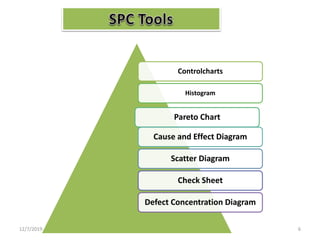
Controlcharts
Histogram
Pareto Chart
Cause and Effect Diagram
Scatter Diagram
Check Sheet
Defect Concentration Diagram
12/7/2019 6
Control charts
12/7/2019 7
•Control chart are the statistical process control tool used to analyze process
performance over time. Control chart plot data and calculate average and
sigma line to evaluate the stability of the process
•Control chart constructed from historical data, the purpose of control charts
is to help distinguish between natural variation and variations due to
assignable causes
•The most common method of statistical process control is take sample at
regular interval and to plot the sample mean on control chart
Variable charts
• Charts for variable data requires measurements on continuous scale such as
lengths, weight, PH or resistance
• variable data include more information than attribute data , thus are
preferred for SPC and essential for diagnosis
• types of variable charts :
1) X-Bar
2) R-Bar
12/7/2019 8
Attribute charts
• Attribute data requires only a count of discrete measurements such as good
or bad.
• The charts for attributes will be useful provided the defective rate is high
enough to show on the chart with a reasonable subgroup size .
• Current competitive quality requirement in many industries are so high that
attribute charts are not useful .
12/7/2019 9
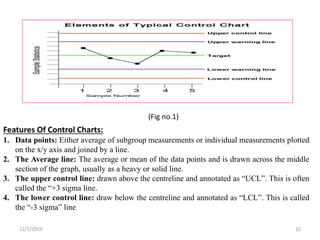
Features Of Control Charts:
1. Data points: Either average of subgroup measurements or individual measurements plotted
on the x/y axis and joined by a line.
2. The Average line: The average or mean of the data points and is drawn across the middle
section of the graph, usually as a heavy or solid line.
3. The upper control line: drawn above the centreline and annotated as “UCL”. This is often
called the “+3 sigma line.
4. The lower control line: draw below the centreline and annotated as “LCL”. This is called
the “-3 sigma” line
(Fig no.1)
12/7/2019 10
Importance of control charts:
12/7/2019 11
Control charts are a proven technique for improving productivity.
Control charts are effective in defect prevention .
Control charts prevent unnecessary process adjustment .
Control charts provide diagnostic information .
Control charts provide information about process capability
Process capabilities
• The natural variation of a process should be small enough to produce products that
meet the standard required
• A process in statistical control does not necessarily meet the design specifications
• Process capability is a measure of the relation ship between the natural variation of
the process and the design specifications
• Process capability is inherent variation of the product turned out by the process
.process capability provides the quantified prediction of the process adequacy and
refers to uniformity of the process .if it is a measurement with respect to the
precision of manufacturing.
12/7/2019 12
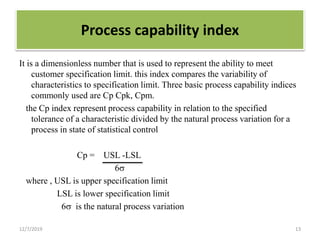
Process capability index
It is a dimensionless number that is used to represent the ability to meet
customer specification limit. this index compares the variability of
characteristics to specification limit. Three basic process capability indices
commonly used are Cp Cpk, Cpm.
the Cp index represent process capability in relation to the specified
tolerance of a characteristic divided by the natural process variation for a
process in state of statistical control
Cp = USL -LSL
6
where , USL is upper specification limit
LSL is lower specification limit
6 is the natural process variation
12/7/2019 13
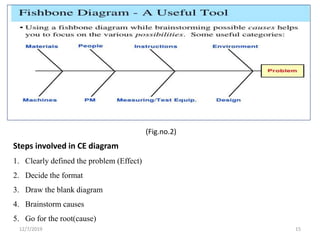
Cause And Effect Diagram
 Cause and effect diagram is also called as fishbone diagram
– These are also called Ishikawa diagram, because Kaouru Ishikawa
developed them in 1943
– Cause and effect analysis is a technique for identifying all the possible
causes associated with a particular problem/effect before narrowing
down to a small number of main root cause which need to be addressed
– This chart helps the organize the brainstorming process
– A tree like structure results showing the many facets of the problem
12/7/2019 14
Steps involved in CE diagram
1. Clearly defined the problem (Effect)
2. Decide the format
3. Draw the blank diagram
4. Brainstorm causes
5. Go for the root(cause)
(Fig.no.2)
12/7/2019 15
Basic benefits of cause –Effect diagram
• Helps determining root causes.
• Encourages group participation.
• Uses an orderly ,easy to read format.
• Indicates possible causes of variation.
• Increase process knowledge.
• Identifies areas for collection
12/7/2019 16
Histogram
• Graphical representation of the frequency distribution of data in bar form is
called histogram.
• Histogram provide the easiest way to evaluate the distribution of data
• Histogram helps you analyze what is going on in the process and helps
show the capability of the process, whether the data is falling inside the bell
shaped curve and within specification .
12/7/2019 17
(Fig.no.3)
12/7/2019 18
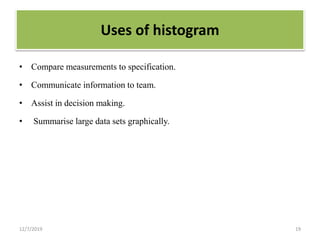
Uses of histogram
• Compare measurements to specification.
• Communicate information to team.
• Assist in decision making.
• Summarise large data sets graphically.
12/7/2019 19
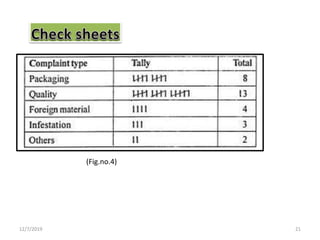
Check sheets
• A structured form for collecting and analyzing data. Is is basic tool that can be
adapted for wide variety of purpose in quality systems management.
• Check sheet are simply charts for gathering data. When check sheets are
designed clearly and cleanly ,they assist in gathering accurate and pertinent
data and allow the data to be easily read and used.
Function of check sheet
• To check the shape of the probability distribution of a process
• To quantify defects by type
• To quantify defects by location
• To quantify defects by cause (machine, worker)
• To keep track of the completion of steps in a multistep procedure
12/7/2019 20
(Fig.no.4)
12/7/2019 21
Advantages of SPC
• Reduces waste
• Cost reduction
• Customer satisfaction
• It emphasis on early detection and prevention of problem.
• Lead to produce reduction in time required to produce the product or
service from end to end
12/7/2019 22
APPLICATIONS
• Applications of SPC involve in three main phases of activity:
• 1. Understanding the process and the specification of variation, so that the
process is stable.
• 2. Eliminating assignable (special) sources of variation , so that the process
is stable.
• 3. Monitoring the ongoing production process, assisted the use of control
charts, to detect significant changes of mean or variation .
12/7/2019 23
Conclusion
12/7/2019 24
• Statistical process control improve the quality of process. Several drawback
of conventional approach of drug for formulation development can be
solved by using control chart as a tool in statistical process control to
determine whether a manufacturing of dosage form in pharmaceutical
industry in state of statistical control or not .
• Statistical process control help construction industry to understand the
process and improve its efficiency and capability to meet customer
specification and requirement .
References
1. R. C. Gupta ,Statistical Quality Control, khanna publication ,Delhi
2. Rami hikmat found, adman mukattash ,Statistical process control toll: A
practical for Jordanian industrial organization ,JJMIE, December 2010
page no.693-700
12/7/2019
25
12/7/2019 26

Statistical process control (spc)

  • 1.
  • 2.
    Points To BeDiscussed .....  Introduction  Definition  Objectives  Importance  Principle  Statistical Control Tool  Applications  Advantages  Conclusion  Reference 12/7/2019 2
  • 3.
    •Statistical process controlis a method of quality control which employs statistical method to monitor and control process •This help to ensure that the process operates efficiently producing more specification-conforming products with less waste •Key tools used in statistical process control include run chats ,control charts Focus on continuous improvement •it is impossible to inspect or test quality into a product ,the product must be built right the first time. •This implies that the manufacturing process must be stable and that all individual involved with the process(including operators ,engineers quality assurance personnel and management.)must continuously seek to improve process performance and reduce variablity in key parameters Introduction 12/7/2019 3
  • 4.
    Definition • Statistical processcontrol is a collection of tools that when used together can result in process stability and variance reduction. 12/7/2019 4 Objectives • To give a signal when item to variability has increased. • In either case appropriate action must be taken by a machine operator or an engineer . • Statistics can only give the signal, the action relies on other skill. • To give a signal when the process mean has moved away from the target .
  • 5.
    Principle • A processthat is operating with only chance causes of variation present is said to be in statistical control. • A process that is operating in the presence of assignable causes is said to be out of control. • The eventual goal of SPC is the elimination of variability in process. 12/7/2019 5
  • 6.
    Controlcharts Histogram Pareto Chart Cause andEffect Diagram Scatter Diagram Check Sheet Defect Concentration Diagram 12/7/2019 6
  • 7.
    Control charts 12/7/2019 7 •Controlchart are the statistical process control tool used to analyze process performance over time. Control chart plot data and calculate average and sigma line to evaluate the stability of the process •Control chart constructed from historical data, the purpose of control charts is to help distinguish between natural variation and variations due to assignable causes •The most common method of statistical process control is take sample at regular interval and to plot the sample mean on control chart
  • 8.
    Variable charts • Chartsfor variable data requires measurements on continuous scale such as lengths, weight, PH or resistance • variable data include more information than attribute data , thus are preferred for SPC and essential for diagnosis • types of variable charts : 1) X-Bar 2) R-Bar 12/7/2019 8
  • 9.
    Attribute charts • Attributedata requires only a count of discrete measurements such as good or bad. • The charts for attributes will be useful provided the defective rate is high enough to show on the chart with a reasonable subgroup size . • Current competitive quality requirement in many industries are so high that attribute charts are not useful . 12/7/2019 9
  • 10.
    Features Of ControlCharts: 1. Data points: Either average of subgroup measurements or individual measurements plotted on the x/y axis and joined by a line. 2. The Average line: The average or mean of the data points and is drawn across the middle section of the graph, usually as a heavy or solid line. 3. The upper control line: drawn above the centreline and annotated as “UCL”. This is often called the “+3 sigma line. 4. The lower control line: draw below the centreline and annotated as “LCL”. This is called the “-3 sigma” line (Fig no.1) 12/7/2019 10
  • 11.
    Importance of controlcharts: 12/7/2019 11 Control charts are a proven technique for improving productivity. Control charts are effective in defect prevention . Control charts prevent unnecessary process adjustment . Control charts provide diagnostic information . Control charts provide information about process capability
  • 12.
    Process capabilities • Thenatural variation of a process should be small enough to produce products that meet the standard required • A process in statistical control does not necessarily meet the design specifications • Process capability is a measure of the relation ship between the natural variation of the process and the design specifications • Process capability is inherent variation of the product turned out by the process .process capability provides the quantified prediction of the process adequacy and refers to uniformity of the process .if it is a measurement with respect to the precision of manufacturing. 12/7/2019 12
  • 13.
    Process capability index Itis a dimensionless number that is used to represent the ability to meet customer specification limit. this index compares the variability of characteristics to specification limit. Three basic process capability indices commonly used are Cp Cpk, Cpm. the Cp index represent process capability in relation to the specified tolerance of a characteristic divided by the natural process variation for a process in state of statistical control Cp = USL -LSL 6 where , USL is upper specification limit LSL is lower specification limit 6 is the natural process variation 12/7/2019 13
  • 14.
    Cause And EffectDiagram  Cause and effect diagram is also called as fishbone diagram – These are also called Ishikawa diagram, because Kaouru Ishikawa developed them in 1943 – Cause and effect analysis is a technique for identifying all the possible causes associated with a particular problem/effect before narrowing down to a small number of main root cause which need to be addressed – This chart helps the organize the brainstorming process – A tree like structure results showing the many facets of the problem 12/7/2019 14
  • 15.
    Steps involved inCE diagram 1. Clearly defined the problem (Effect) 2. Decide the format 3. Draw the blank diagram 4. Brainstorm causes 5. Go for the root(cause) (Fig.no.2) 12/7/2019 15
  • 16.
    Basic benefits ofcause –Effect diagram • Helps determining root causes. • Encourages group participation. • Uses an orderly ,easy to read format. • Indicates possible causes of variation. • Increase process knowledge. • Identifies areas for collection 12/7/2019 16
  • 17.
    Histogram • Graphical representationof the frequency distribution of data in bar form is called histogram. • Histogram provide the easiest way to evaluate the distribution of data • Histogram helps you analyze what is going on in the process and helps show the capability of the process, whether the data is falling inside the bell shaped curve and within specification . 12/7/2019 17
  • 18.
  • 19.
    Uses of histogram •Compare measurements to specification. • Communicate information to team. • Assist in decision making. • Summarise large data sets graphically. 12/7/2019 19
  • 20.
    Check sheets • Astructured form for collecting and analyzing data. Is is basic tool that can be adapted for wide variety of purpose in quality systems management. • Check sheet are simply charts for gathering data. When check sheets are designed clearly and cleanly ,they assist in gathering accurate and pertinent data and allow the data to be easily read and used. Function of check sheet • To check the shape of the probability distribution of a process • To quantify defects by type • To quantify defects by location • To quantify defects by cause (machine, worker) • To keep track of the completion of steps in a multistep procedure 12/7/2019 20
  • 21.
  • 22.
    Advantages of SPC •Reduces waste • Cost reduction • Customer satisfaction • It emphasis on early detection and prevention of problem. • Lead to produce reduction in time required to produce the product or service from end to end 12/7/2019 22
  • 23.
    APPLICATIONS • Applications ofSPC involve in three main phases of activity: • 1. Understanding the process and the specification of variation, so that the process is stable. • 2. Eliminating assignable (special) sources of variation , so that the process is stable. • 3. Monitoring the ongoing production process, assisted the use of control charts, to detect significant changes of mean or variation . 12/7/2019 23
  • 24.
    Conclusion 12/7/2019 24 • Statisticalprocess control improve the quality of process. Several drawback of conventional approach of drug for formulation development can be solved by using control chart as a tool in statistical process control to determine whether a manufacturing of dosage form in pharmaceutical industry in state of statistical control or not . • Statistical process control help construction industry to understand the process and improve its efficiency and capability to meet customer specification and requirement .
  • 25.
    References 1. R. C.Gupta ,Statistical Quality Control, khanna publication ,Delhi 2. Rami hikmat found, adman mukattash ,Statistical process control toll: A practical for Jordanian industrial organization ,JJMIE, December 2010 page no.693-700 12/7/2019 25
  • 26.