WRITING INSTRUCTIONAL
OBJECTIVES IN BEHAVIOURAL TERM
Various approaches of writing objectives
PREREQUISITE (आधार)
 Aims and objectives of teaching commerce at
school level (meaning and difference).
 Characteristics and need of stating objectives.
 Types of objectives- instructional and teaching.
 Three domains of learning-Taxonomy of
instructional objectives-– cognitive,psychomotor
and effective domain)
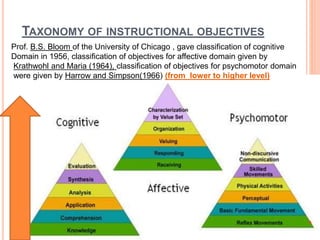
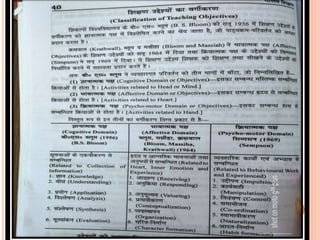
TAXONOMY OF INSTRUCTIONAL OBJECTIVES
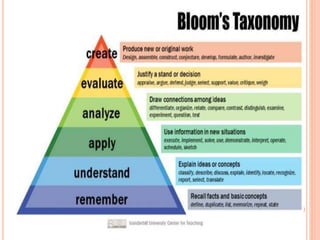
Prof. B.S. Bloom of the University of Chicago , gave classification of cognitive
Domain in 1956, classification of objectives for affective domain given by
Krathwohl and Maria (1964), classification of objectives for psychomotor domain
were given by Harrow and Simpson(1966) (from lower to higher level)
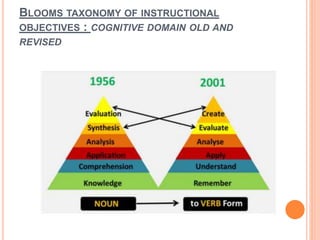
BLOOMS TAXONOMY OF INSTRUCTIONAL
OBJECTIVES : COGNITIVE DOMAIN OLD AND
REVISED
Writing of instructional objectives
WRITING OBJECTIVES IN BEHAVIOURAL
TERMS
 A behavioral objective is a learning
outcome stated in measurable terms, which gives
direction to the learner’s experience and becomes
the basis for student evaluation.(एक व्यवहारिक
उद्देश्य औसत दर्जे का शब्दों में कहा गया एक सीखने
का परिणाम है, र्जो सीखने वाले के अनुभव को ददशा
देता है औि छात्र मूलयाांकन का आधाि बन र्जाता है)
 Importance of writing objectives in
behavioural terms is - according to Scaffold:
 It helps in selection of items for preparing test.
 Teaching can be related to learning.
 It helps in selection of appropriate teaching
stratagies,tactics and teaching aids.

यह पिीक्षण की तैयािी के ललए वस्तुओां के चयन में
मदद किता है।
 लशक्षण का सांबांध लशक्षण से हो सकता है।
 यह उपयुक्त लशक्षण स्रैदिर्जी, िणनीतत औि लशक्षण
सहायक सामग्री के चयन में मदद किता है।
METHODS OF WRITING OBJECTIVES IN
BEHAVIOURAL TERM
 Recently the statement of objectives in behavioural
terms i.e. in terms of expected terminal behaviour
of the students has received greater importance…
 We have to specify action verbs when we write
objectives in behavioural terms. Action verbs
specify the behaviour that we want students to
learn.(र्जब हम व्यवहाि के सांदभभ में उद्देश्यों को ललखते
हैं तो हमें क्रियाओां को तनददभष्ि किना होता है। क्रिया
क्रियाएां उस व्यवहाि को तनददभष्ि किती हैं र्जो हम छात्रों
को सीखना चाहते हैं।)
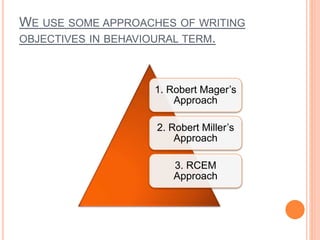
WE USE SOME APPROACHES OF WRITING
OBJECTIVES IN BEHAVIOURAL TERM.
1. Robert Mager’s
Approach
2. Robert Miller’s
Approach
3. RCEM
Approach
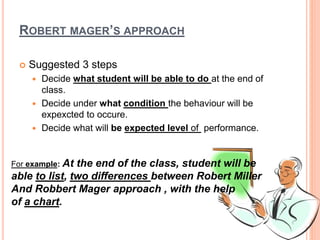
ROBERT MAGER’S APPROACH
 Suggested 3 steps
 Decide what student will be able to do at the end of
class.
 Decide under what condition the behaviour will be
expexcted to occure.
 Decide what will be expected level of performance.
For example: At the end of the class, student will be
able to list, two differences between Robert Miller
And Robbert Mager approach , with the help
of a chart.
 सुझाए गए 3 चिण
 तनणभय लें क्रक कक्षा के अांत में छात्र क्या कर पाएगा।
 तनणभय लें क्रक व्यवहार ककस स्थिति में क्रकया र्जाएगा।
 तनणभय लें क्रक प्रदर्शन का अपेक्षिि थिर क्या होगा।
उदाहिण के ललए: किा के अंि में छात्र ,रॉबर्श ममलर और रोबर्श मेगर
दृस्टर्कोण के बीच , एक चार्श के मदद के साि, दो अंिर,
सूचीबद्ध
करने में सिम होगा ।
CONTD…
 He laid much stress on action verbs. Action vrbs
should be unambiguous and direct.
 His action verbs were performance based.
 He adopted Blooms Taxonomy of objectives as the
bases of writing objectives in behavioural terms.
 Verbs open to many interpretations should be
avoided and verbs with definite interpretation
should be used. For example :
 to know to write
 to believe to list, to recite etc.
 उन्होंने एक्शन क्रियाओां पि ज्यादा र्जोि ददया। क्रिया
स्वि असांददग्ध औि प्रत्यक्ष होना चादहए।
 उनके एक्शन क्रिया प्रदशभन आधारित थे
 उन्होंने व्यवहाि के सांदभभ में उद्देश्यों को ललखने के
आधाि के रूप में उद्देश्यों के ब्लूम्स िैक्सोनॉमी को
अपनाया।
 कई व्याख्याओां के ललए खुली क्रियाओां से बचा र्जाना
चादहए औि तनश्श्चत व्याख्या वाली क्रियाओां का उपयोग
क्रकया र्जाना चादहए। उदाहिण के ललए :
र्जानते हैं ललखना
ववश्वास किने सूची बनाने,सुनाना आदद।
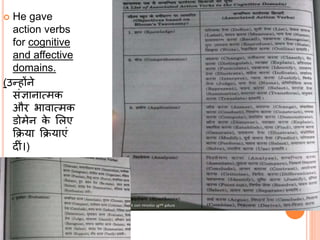
 He gave
action verbs
for cognitive
and affective
domains.
(उन्होंने
सांज्ञानात्मक
औि भावात्मक
डोमेन के ललए
क्रिया क्रियाएां
दीां।)
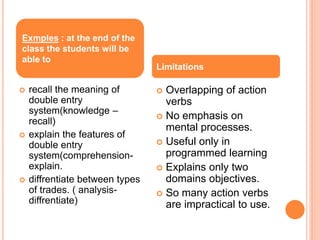
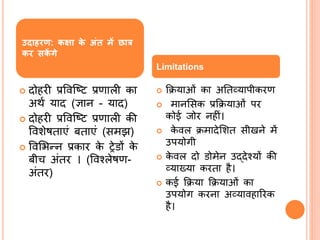
 recall the meaning of
double entry
system(knowledge –
recall)
 explain the features of
double entry
system(comprehension-
explain.
 diffrentiate between types
of trades. ( analysis-
diffrentiate)
 Overlapping of action
verbs
 No emphasis on
mental processes.
 Useful only in
programmed learning
 Explains only two
domains objectives.
 So many action verbs
are impractical to use.
Exmples : at the end of the
class the students will be
able to
Limitations
 दोहिी प्रववश्ष्ि प्रणाली का
अथभ याद (ज्ञान - याद)
 दोहिी प्रववश्ष्ि प्रणाली की
ववशेषताएां बताएां (समझ)
 ववलभन्न प्रकाि के रेडों के
बीच अांति । (ववश्लेषण-
अांति)
 क्रियाओां का अततव्यापीकिण
 मानलसक प्रक्रियाओां पि
कोई र्जोि नहीां।
 के वल िमादेलशत सीखने में
उपयोगी
 के वल दो डोमेन उद्देश्यों की
व्याख्या किता है।
 कई क्रिया क्रियाओां का
उपयोग किना अव्यावहारिक
है।
उदाहरण: किा के अंि में छात्र
कर सकें गे
Limitations
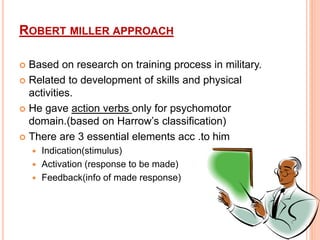
ROBERT MILLER APPROACH
 Based on research on training process in military.
 Related to development of skills and physical
activities.
 He gave action verbs only for psychomotor
domain.(based on Harrow’s classification)
 There are 3 essential elements acc .to him
 Indication(stimulus)
 Activation (response to be made)
 Feedback(info of made response)
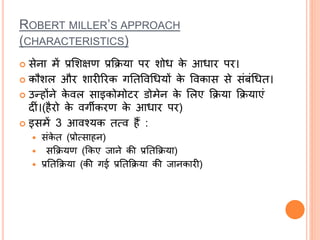
ROBERT MILLER’S APPROACH
(CHARACTERISTICS)
 सेना में प्रलशक्षण प्रक्रिया पि शोध के आधाि पि।
 कौशल औि शािीरिक गततववधधयों के ववकास से सांबांधधत।
 उन्होंने के वल साइकोमोिि डोमेन के ललए क्रिया क्रियाएां
दीां।(हैिो के वगीकिण के आधाि पि)
 इसमें 3 आवश्यक तत्व हैं :
 सांके त (प्रोत्साहन)
 सक्रियण (क्रकए र्जाने की प्रततक्रिया)
 प्रततक्रिया (की गई प्रततक्रिया की र्जानकािी)
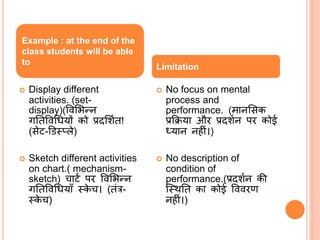
 Display different
activities. (set-
display)(ववलभन्न
गततववधधयों को प्रदलशभत!
(सेि-डडस््ले)
 Sketch different activities
on chart.( mechanism-
sketch) चािभ पि ववलभन्न
गततववधधयााँ स्के च। (तांत्र-
स्के च)
 No focus on mental
process and
performance. (मानलसक
प्रक्रिया औि प्रदशभन पि कोई
ध्यान नहीां।)
 No description of
condition of
performance.(प्रदशभन की
श्स्थतत का कोई ववविण
नहीां।)
Example : at the end of the
class students will be able
to
Limitation
RCEM APPROACH (1972)
 The teachers of Regional College of Education
Mysore (RCEM) realised the limitation of Magor’s
and Miller’s approach so they worked out very
systematic RCEM approach.
 (िीर्जनल कॉलेर्ज ऑफ एर्जुके शन मैसूि (आिसीईएम) के
लशक्षकों को मैगि औि लमलि के दृश्ष्िकोण की सीमा का
एहसास हुआ, इसललए उन्होंने बहुत व्यवश्स्थत
आिसीईएम दृश्ष्िकोण का काम क्रकया।)
CONTD…
 It overcome all the limitation of previous
approaches. ( वपछले दृश्ष्िकोणों की सभी सीमा को
पाि कि ललया।)
 It Uses “mental process” or “mental abilities” on the
place of “action verbs”(यह "क्रिया" के स्थान पि
"मानलसक प्रक्रिया" या "मानलसक क्षमताओां" का उपयोग
किता है)
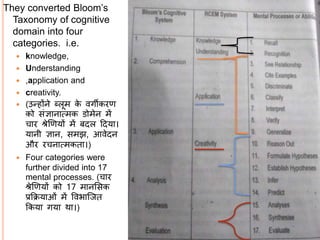
They converted Bloom’s
Taxonomy of cognitive
domain into four
categories. i.e.
 knowledge,
 Understanding
 ,application and
 creativity.
 (उन्होंने ब्लूम के वगीकिण
को सांज्ञानात्मक डोमेन में
चाि श्रेणणयों में बदल ददया।
यानी ज्ञान, समझ, आवेदन
औि िचनात्मकता।)
 Four categories were
further divided into 17
mental processes. (चाि
श्रेणणयों को 17 मानलसक
प्रक्रियाओां में ववभाश्र्जत
क्रकया गया था।)
CONTD…
 It consider content and objectives which are
identified after considering entry behaviour of
students.(यह सामग्री औि उद्देश्यों पि ववचाि किता है
र्जो छात्रों के प्रवेश व्यवहाि पि ववचाि किने के बाद
पहचाने र्जाते हैं।)
 Emphasis on given on mental process and
selection of content so as to achieve the
objectives(modification of behaviour).(
मानलसक प्रक्रिया औि सामग्री के चयन पि र्जोि ददया
गया ताक्रक उद्देश्यों (व्यवहाि में सांशोधन) को प्रा्त
क्रकया र्जा सके ।)
EXAMPLE:
 Topic : outsourcing of services.
Instructional objectives: at the end of the class,
students will be able to
 Recall the meaning of outsourcing of services.
 Classify different types of outsourcing of services.
 Predict the effect of outsourcing of services.
 Analyse the needs of these services.
CONCLUSION
 Thus, with help of writing objectives in behavioural
terms teaching /learning experiences are
determined and delimited.
 So, teaching learning process can be made
effective if the objectives are properly stated in well
defines terms and clear language.
Thank you
Writing instructional objectives in behavioural terms

  • 1.
    WRITING INSTRUCTIONAL OBJECTIVES INBEHAVIOURAL TERM Various approaches of writing objectives
  • 2.
    PREREQUISITE (आधार)  Aimsand objectives of teaching commerce at school level (meaning and difference).  Characteristics and need of stating objectives.  Types of objectives- instructional and teaching.  Three domains of learning-Taxonomy of instructional objectives-– cognitive,psychomotor and effective domain)
  • 3.
    TAXONOMY OF INSTRUCTIONALOBJECTIVES Prof. B.S. Bloom of the University of Chicago , gave classification of cognitive Domain in 1956, classification of objectives for affective domain given by Krathwohl and Maria (1964), classification of objectives for psychomotor domain were given by Harrow and Simpson(1966) (from lower to higher level)
  • 5.
    BLOOMS TAXONOMY OFINSTRUCTIONAL OBJECTIVES : COGNITIVE DOMAIN OLD AND REVISED
  • 7.
  • 8.
    WRITING OBJECTIVES INBEHAVIOURAL TERMS  A behavioral objective is a learning outcome stated in measurable terms, which gives direction to the learner’s experience and becomes the basis for student evaluation.(एक व्यवहारिक उद्देश्य औसत दर्जे का शब्दों में कहा गया एक सीखने का परिणाम है, र्जो सीखने वाले के अनुभव को ददशा देता है औि छात्र मूलयाांकन का आधाि बन र्जाता है)
  • 9.
     Importance ofwriting objectives in behavioural terms is - according to Scaffold:  It helps in selection of items for preparing test.  Teaching can be related to learning.  It helps in selection of appropriate teaching stratagies,tactics and teaching aids.  यह पिीक्षण की तैयािी के ललए वस्तुओां के चयन में मदद किता है।  लशक्षण का सांबांध लशक्षण से हो सकता है।  यह उपयुक्त लशक्षण स्रैदिर्जी, िणनीतत औि लशक्षण सहायक सामग्री के चयन में मदद किता है।
  • 10.
    METHODS OF WRITINGOBJECTIVES IN BEHAVIOURAL TERM  Recently the statement of objectives in behavioural terms i.e. in terms of expected terminal behaviour of the students has received greater importance…  We have to specify action verbs when we write objectives in behavioural terms. Action verbs specify the behaviour that we want students to learn.(र्जब हम व्यवहाि के सांदभभ में उद्देश्यों को ललखते हैं तो हमें क्रियाओां को तनददभष्ि किना होता है। क्रिया क्रियाएां उस व्यवहाि को तनददभष्ि किती हैं र्जो हम छात्रों को सीखना चाहते हैं।)
  • 11.
    WE USE SOMEAPPROACHES OF WRITING OBJECTIVES IN BEHAVIOURAL TERM. 1. Robert Mager’s Approach 2. Robert Miller’s Approach 3. RCEM Approach
  • 12.
    ROBERT MAGER’S APPROACH Suggested 3 steps  Decide what student will be able to do at the end of class.  Decide under what condition the behaviour will be expexcted to occure.  Decide what will be expected level of performance. For example: At the end of the class, student will be able to list, two differences between Robert Miller And Robbert Mager approach , with the help of a chart.
  • 13.
     सुझाए गए3 चिण  तनणभय लें क्रक कक्षा के अांत में छात्र क्या कर पाएगा।  तनणभय लें क्रक व्यवहार ककस स्थिति में क्रकया र्जाएगा।  तनणभय लें क्रक प्रदर्शन का अपेक्षिि थिर क्या होगा। उदाहिण के ललए: किा के अंि में छात्र ,रॉबर्श ममलर और रोबर्श मेगर दृस्टर्कोण के बीच , एक चार्श के मदद के साि, दो अंिर, सूचीबद्ध करने में सिम होगा ।
  • 14.
    CONTD…  He laidmuch stress on action verbs. Action vrbs should be unambiguous and direct.  His action verbs were performance based.  He adopted Blooms Taxonomy of objectives as the bases of writing objectives in behavioural terms.  Verbs open to many interpretations should be avoided and verbs with definite interpretation should be used. For example :  to know to write  to believe to list, to recite etc.
  • 15.
     उन्होंने एक्शनक्रियाओां पि ज्यादा र्जोि ददया। क्रिया स्वि असांददग्ध औि प्रत्यक्ष होना चादहए।  उनके एक्शन क्रिया प्रदशभन आधारित थे  उन्होंने व्यवहाि के सांदभभ में उद्देश्यों को ललखने के आधाि के रूप में उद्देश्यों के ब्लूम्स िैक्सोनॉमी को अपनाया।  कई व्याख्याओां के ललए खुली क्रियाओां से बचा र्जाना चादहए औि तनश्श्चत व्याख्या वाली क्रियाओां का उपयोग क्रकया र्जाना चादहए। उदाहिण के ललए : र्जानते हैं ललखना ववश्वास किने सूची बनाने,सुनाना आदद।
  • 16.
     He gave actionverbs for cognitive and affective domains. (उन्होंने सांज्ञानात्मक औि भावात्मक डोमेन के ललए क्रिया क्रियाएां दीां।)
  • 17.
     recall themeaning of double entry system(knowledge – recall)  explain the features of double entry system(comprehension- explain.  diffrentiate between types of trades. ( analysis- diffrentiate)  Overlapping of action verbs  No emphasis on mental processes.  Useful only in programmed learning  Explains only two domains objectives.  So many action verbs are impractical to use. Exmples : at the end of the class the students will be able to Limitations
  • 18.
     दोहिी प्रववश्ष्िप्रणाली का अथभ याद (ज्ञान - याद)  दोहिी प्रववश्ष्ि प्रणाली की ववशेषताएां बताएां (समझ)  ववलभन्न प्रकाि के रेडों के बीच अांति । (ववश्लेषण- अांति)  क्रियाओां का अततव्यापीकिण  मानलसक प्रक्रियाओां पि कोई र्जोि नहीां।  के वल िमादेलशत सीखने में उपयोगी  के वल दो डोमेन उद्देश्यों की व्याख्या किता है।  कई क्रिया क्रियाओां का उपयोग किना अव्यावहारिक है। उदाहरण: किा के अंि में छात्र कर सकें गे Limitations
  • 19.
    ROBERT MILLER APPROACH Based on research on training process in military.  Related to development of skills and physical activities.  He gave action verbs only for psychomotor domain.(based on Harrow’s classification)  There are 3 essential elements acc .to him  Indication(stimulus)  Activation (response to be made)  Feedback(info of made response)
  • 20.
    ROBERT MILLER’S APPROACH (CHARACTERISTICS) सेना में प्रलशक्षण प्रक्रिया पि शोध के आधाि पि।  कौशल औि शािीरिक गततववधधयों के ववकास से सांबांधधत।  उन्होंने के वल साइकोमोिि डोमेन के ललए क्रिया क्रियाएां दीां।(हैिो के वगीकिण के आधाि पि)  इसमें 3 आवश्यक तत्व हैं :  सांके त (प्रोत्साहन)  सक्रियण (क्रकए र्जाने की प्रततक्रिया)  प्रततक्रिया (की गई प्रततक्रिया की र्जानकािी)
  • 21.
     Display different activities.(set- display)(ववलभन्न गततववधधयों को प्रदलशभत! (सेि-डडस््ले)  Sketch different activities on chart.( mechanism- sketch) चािभ पि ववलभन्न गततववधधयााँ स्के च। (तांत्र- स्के च)  No focus on mental process and performance. (मानलसक प्रक्रिया औि प्रदशभन पि कोई ध्यान नहीां।)  No description of condition of performance.(प्रदशभन की श्स्थतत का कोई ववविण नहीां।) Example : at the end of the class students will be able to Limitation
  • 22.
    RCEM APPROACH (1972) The teachers of Regional College of Education Mysore (RCEM) realised the limitation of Magor’s and Miller’s approach so they worked out very systematic RCEM approach.  (िीर्जनल कॉलेर्ज ऑफ एर्जुके शन मैसूि (आिसीईएम) के लशक्षकों को मैगि औि लमलि के दृश्ष्िकोण की सीमा का एहसास हुआ, इसललए उन्होंने बहुत व्यवश्स्थत आिसीईएम दृश्ष्िकोण का काम क्रकया।)
  • 23.
    CONTD…  It overcomeall the limitation of previous approaches. ( वपछले दृश्ष्िकोणों की सभी सीमा को पाि कि ललया।)  It Uses “mental process” or “mental abilities” on the place of “action verbs”(यह "क्रिया" के स्थान पि "मानलसक प्रक्रिया" या "मानलसक क्षमताओां" का उपयोग किता है)
  • 24.
    They converted Bloom’s Taxonomyof cognitive domain into four categories. i.e.  knowledge,  Understanding  ,application and  creativity.  (उन्होंने ब्लूम के वगीकिण को सांज्ञानात्मक डोमेन में चाि श्रेणणयों में बदल ददया। यानी ज्ञान, समझ, आवेदन औि िचनात्मकता।)  Four categories were further divided into 17 mental processes. (चाि श्रेणणयों को 17 मानलसक प्रक्रियाओां में ववभाश्र्जत क्रकया गया था।)
  • 25.
    CONTD…  It considercontent and objectives which are identified after considering entry behaviour of students.(यह सामग्री औि उद्देश्यों पि ववचाि किता है र्जो छात्रों के प्रवेश व्यवहाि पि ववचाि किने के बाद पहचाने र्जाते हैं।)  Emphasis on given on mental process and selection of content so as to achieve the objectives(modification of behaviour).( मानलसक प्रक्रिया औि सामग्री के चयन पि र्जोि ददया गया ताक्रक उद्देश्यों (व्यवहाि में सांशोधन) को प्रा्त क्रकया र्जा सके ।)
  • 26.
    EXAMPLE:  Topic :outsourcing of services. Instructional objectives: at the end of the class, students will be able to  Recall the meaning of outsourcing of services.  Classify different types of outsourcing of services.  Predict the effect of outsourcing of services.  Analyse the needs of these services.
  • 27.
    CONCLUSION  Thus, withhelp of writing objectives in behavioural terms teaching /learning experiences are determined and delimited.  So, teaching learning process can be made effective if the objectives are properly stated in well defines terms and clear language. Thank you