COURSE- EDUC311
METHODS AND TECHNIQUES OF EDUCATIONAL
RESEARCH
DIKSHA VERMA
Department. Of Education (HPU)
M.Ed , M.Sc.(Mathematics) , Research Scholar (JRF)
IN TODAY’S CLASS
 Descriptive research –
 Meaning ,
 Importance,
 Steps of descriptive research
 Types of Descriptive Research .( survey study ,
case study)
A SHORT RECAP TO EDUCATIONAL RESEARCH
 Research : the systematic investigation into and study of
materials and sources in order to establish facts and reach new
conclusions.
 Educational research refers to the systematic collection and
analysis of data related to the field of education.
student learning
teaching methods
teacher training
classroom environment
curriculum effect
evaluation
child psychology
sociology etc…..
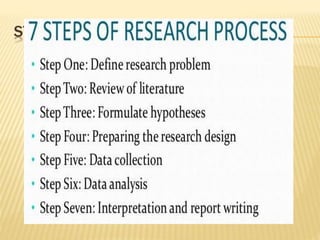
STEPS OF EDUCATIONAL RESEARCH.
Methods and techniques
of educational research
CATEGORY OF RESEARCH METHODOLOGIES
 Descriptive research: which provide a
method of investigation to study, describe
and interpret what exist in the present.
 Historical research : which provide a method
of investigation to study, describe and
interpret what exist in the past.
 Experimental : which provide a method of
investigation to derive basic relationship
among phenomenon under controlled
conditions.
DESCRIPTIVE RESEARCH
 Descriptive research is a type of research
that describes a population, situation, or
phenomenon that is being studied.
 It focuses on answering the how, what,
when, and where questions If a research
problem, rather than the why.
 It studies current situation of a phenomena in
natural settings.
CHARACTERISTICS OF DESCRIPTIVE RESEARCH
 Quantitativeness
 Qualitativeness
 Uncontrolled variables
 The basis for further research
 Investigation of current status of a phenomenon
 Investigation in natural settings
 Deals with the present
 The results obtained from descriptive research
is in statistical form
IMPORTANCE OF DESCRIPTIVE RESEARCH
 It provide in-depth description of the phenomenon or
population under study.
 It provides the basis for secondary research.
 Data collected from descriptive research is helpful in
important decision-making because the data is obtained
from a large population.
 A variety of data can be obtained using different
descriptive research methods like surveys, observation,
and vase study. These three research methods provide
different type of data which can be used to analysis for a
research problem. For example, using the case study
research method can be used to develop a hypothesis
about a research problem.
CONTD…
 One advantage of descriptive research over
other research methods is that it is cheap and
quick to conduct descriptive research.
 Descriptive research provides both quantitative
and qualitative data. The variety of data
provides a holistic understanding of the
research problem.
 Descriptive research can be conducted in
natural settings. There is no need to have a
designated space to conduct research using
any of the descriptive research methods.
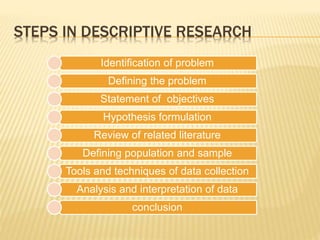
STEPS IN DESCRIPTIVE RESEARCH
Identification of problem
Defining the problem
Statement of objectives
Hypothesis formulation
Review of related literature
Defining population and sample
Tools and techniques of data collection
Analysis and interpretation of data
conclusion
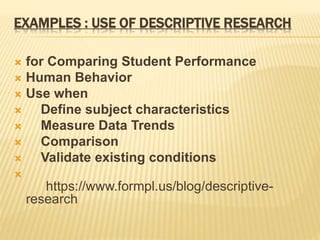
EXAMPLES : USE OF DESCRIPTIVE RESEARCH
 for Comparing Student Performance
 Human Behavior
 Use when
 Define subject characteristics
 Measure Data Trends
 Comparison
 Validate existing conditions

https://www.formpl.us/blog/descriptive-
research
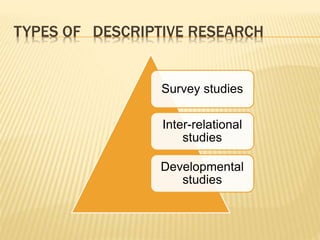
TYPES OF DESCRIPTIVE RESEARCH
Survey studies
Inter-relational
studies
Developmental
studies
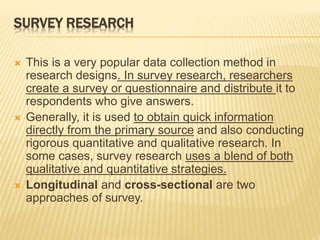
SURVEY RESEARCH
 This is a very popular data collection method in
research designs. In survey research, researchers
create a survey or questionnaire and distribute it to
respondents who give answers.
 Generally, it is used to obtain quick information
directly from the primary source and also conducting
rigorous quantitative and qualitative research. In
some cases, survey research uses a blend of both
qualitative and quantitative strategies.
 Longitudinal and cross-sectional are two
approaches of survey.
SURVEY STUDY
 survey study or Descriptive-survey research
uses surveys to gather data about varying
subjects.
 For example, a researcher wants to determine
the qualification of employed professionals in
schools of shimla . He uses a survey as his
research instrument, and each item on the
survey related to qualifications is subjected to a
Yes/No answer.
 This way, the researcher can describe the
qualifications possessed by the employed
demographics of this community.
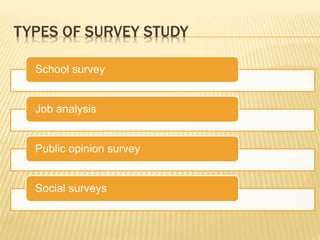
TYPES OF SURVEY STUDY
School survey
Job analysis
Public opinion survey
Social surveys
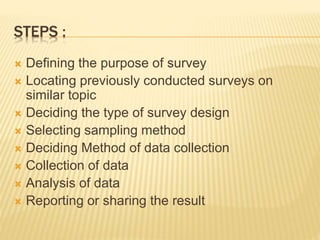
STEPS :
 Defining the purpose of survey
 Locating previously conducted surveys on
similar topic
 Deciding the type of survey design
 Selecting sampling method
 Deciding Method of data collection
 Collection of data
 Analysis of data
 Reporting or sharing the result
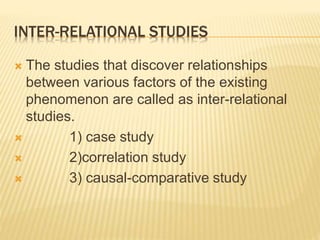
INTER-RELATIONAL STUDIES
 The studies that discover relationships
between various factors of the existing
phenomenon are called as inter-relational
studies.
 1) case study
 2)correlation study
 3) causal-comparative study
CASE STUDY METHOD
 A case study is a sample group (an individual, a
group of people, organizations, events, etc.) whose
characteristics are used to describe the
characteristics of a larger group in which the case
study is a subgroup.
 The information gathered from investigating a case
study may be generalized to serve the larger group.
 In depth investigation of a social unit.
 This generalization, may, however, be risky because
case studies are not sufficient to make accurate
predictions about larger groups. Case studies are a
poor case of generalization.
NATURE
 In depth study of a single case.
 Its result can be generalized but Case
studies are a poor case of generalization.
 Its scope is narrower in scope but more
extensive and informative than survey.
 They are done for the purpose of hypothesis
testing sometimes.
 Guidance workers and counselor do case
study to investigate/diagnose a particular
condition.
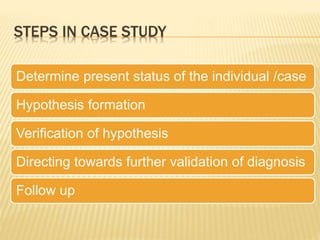
STEPS IN CASE STUDY
Determine present status of the individual /case
Hypothesis formation
Verification of hypothesis
Directing towards further validation of diagnosis
Follow up
… CORRELATIONAL STUDY
 A correlational study is a type of research
design where a researcher seeks to
understand what kind of relationships
naturally occurring variables have with one
another.
 In simple terms, correlational research
seeks to figure out if two or more variables
are related and, if so, in what way.
 THIS STUDY Shows direction( +,-.0) and
degree of correlation.
CORRELATIONAL RESEARCH
 It is a type of descriptive research, which is used to measure the extent
of relationship between variables, with the researcher having no control
over them. It aims to find whether there is;
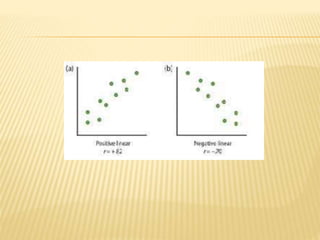
 positive correlation (both variables change in the same direction),
 negative correlation (the variables change in the opposite direction),
or
 zero correlation (there is no relationship between the variables).
 Correlation research may be used in 2 situations;
(i) when trying to find out if there is a relationship between two
variables, and
(ii) when a causal relationship is suspected between two variables,
but it is impractical or unethical to conduct experimental research that
manipulates one of the variables.
The magnitude of relation is determined by use of coffecient of corelation.
EXAMPLE :
 The relation between school distance and
student achievement.
 (suppose it shows negative corelation i.e
school distance increases then student
achievement decreases) but, note that
 it doesn't mean that school distance
causing low achievement. No facts
establishment in this study.
EXAMPLE:
 Relation between a performance on an
intelligence test and an achievement test in
mathematics.
 direction of co-relation:
positive,negative,zero
 degree of correlation: perfect, strong,
moderate, weak, zero(+1 to -1)
 It is done by plotting scattergram and
calculating corelation coffecient.
METHODS AND TECHNIQUES OF RESEARCH

METHODS AND TECHNIQUES OF RESEARCH

  • 1.
    COURSE- EDUC311 METHODS ANDTECHNIQUES OF EDUCATIONAL RESEARCH DIKSHA VERMA Department. Of Education (HPU) M.Ed , M.Sc.(Mathematics) , Research Scholar (JRF)
  • 2.
    IN TODAY’S CLASS Descriptive research –  Meaning ,  Importance,  Steps of descriptive research  Types of Descriptive Research .( survey study , case study)
  • 3.
    A SHORT RECAPTO EDUCATIONAL RESEARCH  Research : the systematic investigation into and study of materials and sources in order to establish facts and reach new conclusions.  Educational research refers to the systematic collection and analysis of data related to the field of education. student learning teaching methods teacher training classroom environment curriculum effect evaluation child psychology sociology etc…..
  • 4.
  • 5.
    Methods and techniques ofeducational research
  • 6.
    CATEGORY OF RESEARCHMETHODOLOGIES  Descriptive research: which provide a method of investigation to study, describe and interpret what exist in the present.  Historical research : which provide a method of investigation to study, describe and interpret what exist in the past.  Experimental : which provide a method of investigation to derive basic relationship among phenomenon under controlled conditions.
  • 7.
    DESCRIPTIVE RESEARCH  Descriptiveresearch is a type of research that describes a population, situation, or phenomenon that is being studied.  It focuses on answering the how, what, when, and where questions If a research problem, rather than the why.  It studies current situation of a phenomena in natural settings.
  • 8.
    CHARACTERISTICS OF DESCRIPTIVERESEARCH  Quantitativeness  Qualitativeness  Uncontrolled variables  The basis for further research  Investigation of current status of a phenomenon  Investigation in natural settings  Deals with the present  The results obtained from descriptive research is in statistical form
  • 9.
    IMPORTANCE OF DESCRIPTIVERESEARCH  It provide in-depth description of the phenomenon or population under study.  It provides the basis for secondary research.  Data collected from descriptive research is helpful in important decision-making because the data is obtained from a large population.  A variety of data can be obtained using different descriptive research methods like surveys, observation, and vase study. These three research methods provide different type of data which can be used to analysis for a research problem. For example, using the case study research method can be used to develop a hypothesis about a research problem.
  • 10.
    CONTD…  One advantageof descriptive research over other research methods is that it is cheap and quick to conduct descriptive research.  Descriptive research provides both quantitative and qualitative data. The variety of data provides a holistic understanding of the research problem.  Descriptive research can be conducted in natural settings. There is no need to have a designated space to conduct research using any of the descriptive research methods.
  • 11.
    STEPS IN DESCRIPTIVERESEARCH Identification of problem Defining the problem Statement of objectives Hypothesis formulation Review of related literature Defining population and sample Tools and techniques of data collection Analysis and interpretation of data conclusion
  • 12.
    EXAMPLES : USEOF DESCRIPTIVE RESEARCH  for Comparing Student Performance  Human Behavior  Use when  Define subject characteristics  Measure Data Trends  Comparison  Validate existing conditions  https://www.formpl.us/blog/descriptive- research
  • 13.
    TYPES OF DESCRIPTIVERESEARCH Survey studies Inter-relational studies Developmental studies
  • 14.
    SURVEY RESEARCH  Thisis a very popular data collection method in research designs. In survey research, researchers create a survey or questionnaire and distribute it to respondents who give answers.  Generally, it is used to obtain quick information directly from the primary source and also conducting rigorous quantitative and qualitative research. In some cases, survey research uses a blend of both qualitative and quantitative strategies.  Longitudinal and cross-sectional are two approaches of survey.
  • 15.
    SURVEY STUDY  surveystudy or Descriptive-survey research uses surveys to gather data about varying subjects.  For example, a researcher wants to determine the qualification of employed professionals in schools of shimla . He uses a survey as his research instrument, and each item on the survey related to qualifications is subjected to a Yes/No answer.  This way, the researcher can describe the qualifications possessed by the employed demographics of this community.
  • 16.
    TYPES OF SURVEYSTUDY School survey Job analysis Public opinion survey Social surveys
  • 17.
    STEPS :  Definingthe purpose of survey  Locating previously conducted surveys on similar topic  Deciding the type of survey design  Selecting sampling method  Deciding Method of data collection  Collection of data  Analysis of data  Reporting or sharing the result
  • 18.
    INTER-RELATIONAL STUDIES  Thestudies that discover relationships between various factors of the existing phenomenon are called as inter-relational studies.  1) case study  2)correlation study  3) causal-comparative study
  • 19.
    CASE STUDY METHOD A case study is a sample group (an individual, a group of people, organizations, events, etc.) whose characteristics are used to describe the characteristics of a larger group in which the case study is a subgroup.  The information gathered from investigating a case study may be generalized to serve the larger group.  In depth investigation of a social unit.  This generalization, may, however, be risky because case studies are not sufficient to make accurate predictions about larger groups. Case studies are a poor case of generalization.
  • 20.
    NATURE  In depthstudy of a single case.  Its result can be generalized but Case studies are a poor case of generalization.  Its scope is narrower in scope but more extensive and informative than survey.  They are done for the purpose of hypothesis testing sometimes.  Guidance workers and counselor do case study to investigate/diagnose a particular condition.
  • 21.
    STEPS IN CASESTUDY Determine present status of the individual /case Hypothesis formation Verification of hypothesis Directing towards further validation of diagnosis Follow up
  • 22.
    … CORRELATIONAL STUDY A correlational study is a type of research design where a researcher seeks to understand what kind of relationships naturally occurring variables have with one another.  In simple terms, correlational research seeks to figure out if two or more variables are related and, if so, in what way.  THIS STUDY Shows direction( +,-.0) and degree of correlation.
  • 23.
    CORRELATIONAL RESEARCH  Itis a type of descriptive research, which is used to measure the extent of relationship between variables, with the researcher having no control over them. It aims to find whether there is;  positive correlation (both variables change in the same direction),  negative correlation (the variables change in the opposite direction), or  zero correlation (there is no relationship between the variables).  Correlation research may be used in 2 situations; (i) when trying to find out if there is a relationship between two variables, and (ii) when a causal relationship is suspected between two variables, but it is impractical or unethical to conduct experimental research that manipulates one of the variables. The magnitude of relation is determined by use of coffecient of corelation.
  • 24.
    EXAMPLE :  Therelation between school distance and student achievement.  (suppose it shows negative corelation i.e school distance increases then student achievement decreases) but, note that  it doesn't mean that school distance causing low achievement. No facts establishment in this study.
  • 25.
    EXAMPLE:  Relation betweena performance on an intelligence test and an achievement test in mathematics.  direction of co-relation: positive,negative,zero  degree of correlation: perfect, strong, moderate, weak, zero(+1 to -1)  It is done by plotting scattergram and calculating corelation coffecient.