•Presenter- Diksha Verma
(research scholar)
HPU https://tse4.mm.bing.net/th?id=OIP.hcnJwaym-
bsJkdV1mr_p0AHaDX&pid=Api&P=0
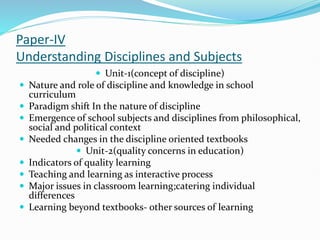
Paper-IV
Understanding Disciplines and Subjects
 Unit-1(concept of discipline)
 Nature and role of discipline and knowledge in school
curriculum
 Paradigm shift In the nature of discipline
 Emergence of school subjects and disciplines from philosophical,
social and political context
 Needed changes in the discipline oriented textbooks
 Unit-2(quality concerns in education)
 Indicators of quality learning
 Teaching and learning as interactive process
 Major issues in classroom learning;catering individual
differences
 Learning beyond textbooks- other sources of learning
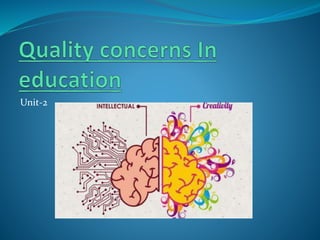
Unit-2
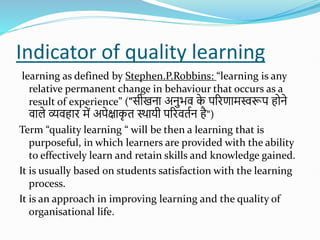
Indicator of quality learning
learning as defined by Stephen.P.Robbins: “learning is any
relative permanent change in behaviour that occurs as a
result of experience” ("सीखना अनुभव क
े परिणामस्वरूप होने
वाले व्यवहाि में अपेक्षाक
ृ त स्थायी परिवततन है“)
Term “quality learning “ will be then a learning that is
purposeful, in which learners are provided with the ability
to effectively learn and retain skills and knowledge gained.
It is usually based on students satisfaction with the learning
process.
It is an approach in improving learning and the quality of
organisational life.
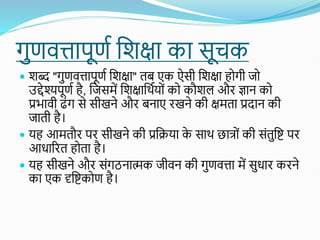
गुणवत्तापूणत शिक्षा का सूचक
 िब्द "गुणवत्तापूणत शिक्षा" तब एक ऐसी शिक्षा होगी जो
उद्देश्यपूणत है, शजसमें शिक्षाशथतयोों को कौिल औि ज्ञान को
प्रभावी ढोंग से सीखने औि बनाए िखने की क्षमता प्रदान की
जाती है।
 यह आमतौि पि सीखने की प्रशिया क
े साथ छात्ोों की सोंतुशि पि
आधारित होता है।
 यह सीखने औि सोंगठनात्मक जीवन की गुणवत्ता में सुधाि किने
का एक दृशिकोण है।
Educational indicators
 These are certain statistics or data that describe key
aspects of schooling which permit the evaluational
monitoring of schools, teachers and students.(सोंक
े तक-
ये क
ु छ आँकडे या डेटा हैं जो स्क
ू ली शिक्षा क
े प्रमुख पहलुओों
का वणतन किते हैं जो स्क
ू लोों, शिक्षकोों औि छात्ोों क
े मूल्ाोंकन
की शनगिानी की अनुमशत देते हैं।)
Classification of educational
indicators
 Indicators tends to be classified depending on whether
they reflect means, the process or the end in achieving
the objectives of a particular set of program/project or
scheme. सोंक
े तकोों को इस आधाि पि वगीक
ृ त शकया जाता है
शक क्या वे शकसी शविेष कायतिम/परियोजना या योजना क
े
उद्देश्योों को प्राप्त किने क
े साधनोों, प्रशिया या अोंत को दिातते
हैं।
 Indicators could be classified as follows
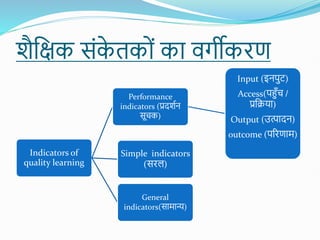
िैशक्षक सोंक
े तकोों का वगीकिण
Indicators of
quality learning
Performance
indicators (प्रदितन
सूचक)
Input (इनपुट)
Access(पहँच /
प्रशिया)
Output (उत्पादन)
outcome (परिणाम)
Simple indicators
(सिल)
General
indicators(सामान्य)
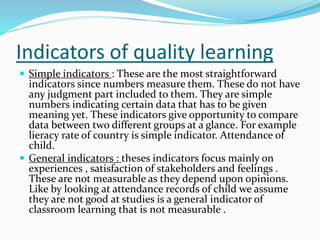
Indicators of quality learning
 Simple indicators : These are the most straightforward
indicators since numbers measure them. These do not have
any judgment part included to them. They are simple
numbers indicating certain data that has to be given
meaning yet. These indicators give opportunity to compare
data between two different groups at a glance. For example
lieracy rate of country is simple indicator. Attendance of
child.
 General indicators : theses indicators focus mainly on
experiences , satisfaction of stakeholders and feelings .
These are not measurable as they depend upon opinions.
Like by looking at attendance records of child we assume
they are not good at studies is a general indicator of
classroom learning that is not measurable .
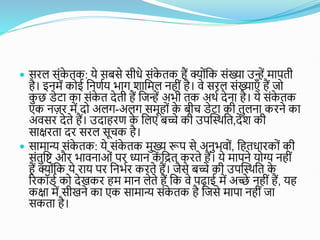
 सिल सोंक
े तक: ये सबसे सीधे सोंक
े तक हैं क्योोंशक सोंख्या उन्हें मापती
है। इनमें कोई शनणतय भाग िाशमल नहीों है। वे सिल सोंख्याएँ हैं जो
क
ु छ डेटा का सोंक
े त देती हैं शजन्हें अभी तक अथत देना है। ये सोंक
े तक
एक नज़ि में दो अलग-अलग समूहोों क
े बीच डेटा की तुलना किने का
अवसि देते हैं। उदाहिण क
े शलए बच्चे की उपस्स्थशत,देि की
साक्षिता दि सिल सूचक है।
 सामान्य सोंक
े तक: ये सोंक
े तक मुख्य रूप से अनुभवोों, शहतधािकोों की
सोंतुशि औि भावनाओों पि ध्यान क
ें शित किते हैं। ये मापने योग्य नहीों
हैं क्योोंशक ये िाय पि शनभति किते हैं। जैसे बच्चे की उपस्स्थशत क
े
रिकॉडत को देखकि हम मान लेते हैं शक वे पढाई में अच्छे नहीों हैं, यह
कक्षा में सीखने का एक सामान्य सोंक
े तक है शजसे मापा नहीों जा
सकता है।
Indicators of quality learning
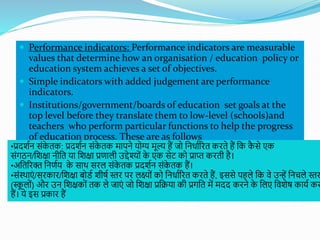
 Performance indicators: Performance indicators are measurable
values that determine how an organisation / education policy or
education system achieves a set of objectives.
 Simple indicators with added judgement are performance
indicators.
 Institutions/government/boards of education set goals at the
top level before they translate them to low-level (schools)and
teachers who perform particular functions to help the progress
of education process. These are as follows
•प्रदितन सोंक
े तक: प्रदितन सोंक
े तक मापने योग्य मूल् हैं जो शनधातरित किते हैं शक क
ै से एक
सोंगठन/शिक्षा नीशत या शिक्षा प्रणाली उद्देश्योों क
े एक सेट को प्राप्त किती है।
•अशतरिक्त शनणतय क
े साथ सिल सोंक
े तक प्रदितन सोंक
े तक हैं।
•सोंस्थाएों /सिकाि/शिक्षा बोडत िीषत स्ति पि लक्ष्ोों को शनधातरित किते हैं, इससे पहले शक वे उन्हें शनचले स्ति
(स्क
ू लोों) औि उन शिक्षकोों तक ले जाएों जो शिक्षा प्रशिया की प्रगशत में मदद किने क
े शलए शविेष कायत कि
हैं। ये इस प्रकाि हैं
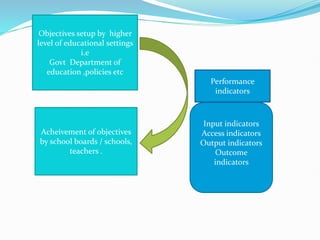
Performance
indicators
Objectives setup by higher
level of educational settings
i.e
Govt Department of
education ,policies etc
Acheivement of objectives
by school boards / schools,
teachers .
Input indicators
Access indicators
Output indicators
Outcome
indicators
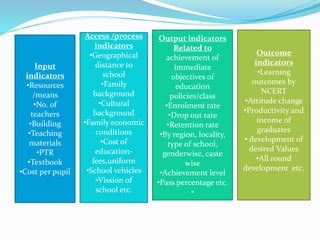
Input
indicators
•Resources
/means
•No. of
teachers
•Building
•Teaching
materials
•PTR
•Textbook
•Cost per pupil
Access /process
indicators
•Geographical
distance to
school
•Family
background
•Cultural
background
•Family economic
conditions
•Cost of
education-
fees,uniform
•School vehicles
•Vission of
school etc.
Outcome
indicators
•Learning
outcomes by
NCERT
•Attitude change
•Productivity and
income of
graduates
• development of
desired Values
•All round
development etc.
Output indicators
Related to
achievement of
immediate
objectives of
education
policies/class
•Enrolment rate
•Drop out rate
•Retention rate
•By region, locality,
type of school,
genderwise, caste
wise
•Achievement level
•Pass percentage etc.
•
https://au.indeed.com/career-advice/career-development/what-is-performance-
indicator?utm_campaign=earnedsocial%3Acareerguide%3Asharedirectshare%3AAU&utm_content=What%20Is%20a%20Performanc
e%20Indicator%3F%20%28And%20How%20To%20Create%20One%29&utm_medium=social&utm_source=directshare
types of performance indicators
 Input indicators measure the number of resources a company
requires for a particular project. Examples of input indicators
include cash at hand, equipment acquired and staff time.
 Process / access indicators :it measures or indicate the demands
of resources and access related factors of population i.e how
much population demands a particular facility/training and
how much have access to that facility.
 Output indicators: Output indicators measure the failure or
success of a process or access activity. Examples of output
indicators include profits, dropout and new enrollment. They
may also refer to the efficiency of training sessions or technical
assistance.
 Outcome indicators : It measure the effect or impact of policies
and projects on living standard of population.
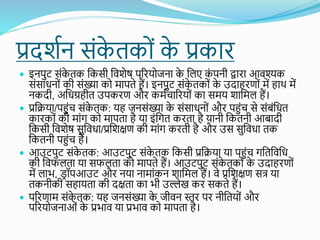
प्रदितन सोंक
े तकोों क
े प्रकाि
 इनपुट सोंक
े तक शकसी शविेष परियोजना क
े शलए क
ों पनी द्वािा आवश्यक
सोंसाधनोों की सोंख्या को मापते हैं। इनपुट सोंक
े तकोों क
े उदाहिणोों में हाथ में
नकदी, अशधग्रहीत उपकिण औि कमतचारियोों का समय िाशमल हैं।
 प्रशिया/पहोंच सोंक
े तक: यह जनसोंख्या क
े सोंसाधनोों औि पहोंच से सोंबोंशधत
कािकोों की माोंग को मापता है या इोंशगत किता है यानी शकतनी आबादी
शकसी शविेष सुशवधा/प्रशिक्षण की माोंग किती है औि उस सुशवधा तक
शकतनी पहोंच है।
 आउटपुट सोंक
े तक: आउटपुट सोंक
े तक शकसी प्रशिया या पहोंच गशतशवशध
की शवफलता या सफलता को मापते हैं। आउटपुट सोंक
े तकोों क
े उदाहिणोों
में लाभ, ड
र ॉपआउट औि नया नामाोंकन िाशमल हैं। वे प्रशिक्षण सत् या
तकनीकी सहायता की दक्षता का भी उल्लेख कि सकते हैं।
 परिणाम सोंक
े तक: यह जनसोंख्या क
े जीवन स्ति पि नीशतयोों औि
परियोजनाओों क
े प्रभाव या प्रभाव को मापता है।
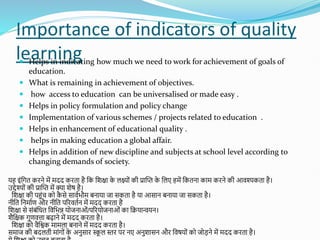
Importance of indicators of quality
learning
 Helps in indicating how much we need to work for achievement of goals of
education.
 What is remaining in achievement of objectives.
 how access to education can be universalised or made easy .
 Helps in policy formulation and policy change
 Implementation of various schemes / projects related to education .
 Helps in enhancement of educational quality .
 helps in making education a global affair.
 Helps in addition of new discipline and subjects at school level according to
changing demands of society.
यह इोंशगत किने में मदद किता है शक शिक्षा क
े लक्ष्ोों की प्रास्प्त क
े शलए हमें शकतना काम किने की आवश्यकता है।
उद्देश्योों की प्रास्प्त में क्या िेष है।
शिक्षा की पहोंच को क
ै से सावतभौम बनाया जा सकता है या आसान बनाया जा सकता है।
नीशत शनमातण औि नीशत परिवततन में मदद किता है
शिक्षा से सोंबोंशधत शवशभन्न योजनाओों/परियोजनाओों का शियान्वयन।
िैशक्षक गुणवत्ता बढाने में मदद किता है।
शिक्षा को वैशिक मामला बनाने में मदद किता है।
समाज की बदलती माोंगोों क
े अनुसाि स्क
ू ल स्ति पि नए अनुिासन औि शवषयोों को जोडने में मदद किता है।
शिक्षण तथा अशधगम -सोंवादात्मक प्रशिया क
े रूप में
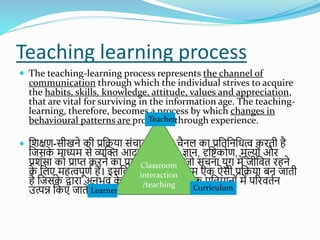
Teaching learning process
 The teaching-learning process represents the channel of
communication through which the individual strives to acquire
the habits, skills, knowledge, attitude, values and appreciation,
that are vital for surviving in the information age. The teaching-
learning, therefore, becomes a process by which changes in
behavioural patterns are produced through experience.
 शिक्षण-सीखने की प्रशिया सोंचाि क
े उस चैनल का प्रशतशनशधत्व किती है
शजसक
े माध्यम से व्यस्क्त आदतोों, कौिल, ज्ञान, दृशिकोण, मूल्ोों औि
प्रिोंसा को प्राप्त किने का प्रयास किता है, जो सूचना युग में जीशवत िहने
क
े शलए महत्वपूणत हैं। इसशलए, शिक्षण-अशधगम एक ऐसी प्रशिया बन जाती
है शजसक
े द्वािा अनुभव क
े माध्यम से व्यवहारिक प्रशतमानोों में परिवततन
उत्पन्न शकए जाते हैं।
Classroom
interaction
/teaching
Teacher
Learner Curriculum
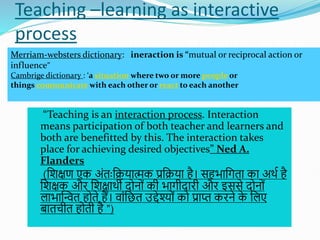
Teaching –learning as interactive
process
 “Teaching is an interaction process. Interaction
means participation of both teacher and learners and
both are benefitted by this. The interaction takes
place for achieving desired objectives” Ned A.
Flanders
 (शिक्षण एक अोंतःशियात्मक प्रशिया है। सहभाशगता का अथत है
शिक्षक औि शिक्षाथी दोनोों की भागीदािी औि इससे दोनोों
लाभास्न्वत होते हैं। वाोंशछत उद्देश्योों को प्राप्त किने क
े शलए
बातचीत होती है ”)
Merriam-websters dictionary: ineraction is “mutual or reciprocal action or
influence”
Cambrige dictionary : ‘a situation where two or more people or
things communicate with each other or react to each another
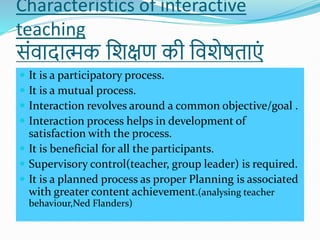
Characteristics of interactive
teaching
सोंवादात्मक शिक्षण की शविेषताएों
 It is a participatory process.
 It is a mutual process.
 Interaction revolves around a common objective/goal .
 Interaction process helps in development of
satisfaction with the process.
 It is beneficial for all the participants.
 Supervisory control(teacher, group leader) is required.
 It is a planned process as proper Planning is associated
with greater content achievement.(analysing teacher
behaviour,Ned Flanders)
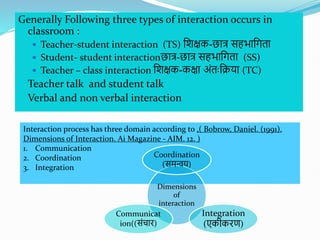
Generally Following three types of interaction occurs in
classroom :
 Teacher-student interaction (TS) शिक्षक-छात् सहभाशगता
 Student- student interactionछात्-छात् सहभाशगता (SS)
 Teacher – class interaction शिक्षक-कक्षा अोंतःशिया (TC)
 Teacher talk and student talk
 Verbal and non verbal interaction
Interaction process has three domain according to ,( Bobrow, Daniel. (1991).
Dimensions of Interaction. Ai Magazine - AIM. 12. )
1. Communication
2. Coordination
3. Integration
Dimensions
of
interaction
Coordination
(समन्वय)
Integration
(एकीकिण)
Communicat
ion((सोंचाि)
Success of interactive process
 Barnes McConnell (1978) says faculty members will
be more successful if they see themselves less as judges
or dispensor of wisdom and more as a resource pesron.
 https://www.deepdyve.com/lp/wiley/teaching-as-an-
interactive-process-8KYof3c0J8?
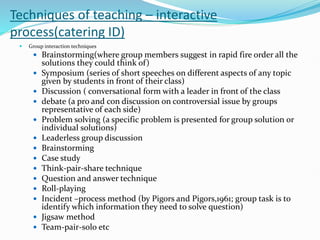
Techniques of teaching – interactive
process(catering ID)
 Group interaction techniques
 Brainstorming(where group members suggest in rapid fire order all the
solutions they could think of)
 Symposium (series of short speeches on different aspects of any topic
given by students in front of their class)
 Discussion ( conversational form with a leader in front of the class
 debate (a pro and con discussion on controversial issue by groups
representative of each side)
 Problem solving (a specific problem is presented for group solution or
individual solutions)
 Leaderless group discussion
 Brainstorming
 Case study
 Think-pair-share technique
 Question and answer technique
 Roll-playing
 Incident –process method (by Pigors and Pigors,1961; group task is to
identify which information they need to solve question)
 Jigsaw method
 Team-pair-solo etc
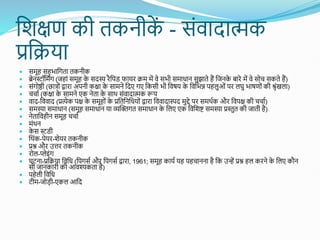
शिक्षण की तकनीक
ें - सोंवादात्मक
प्रशिया
 समूह सहभाशगता तकनीक
 ब्रेनस्टॉशमिंग (जहाों समूह क
े सदस्य िैशपड फायि िम में वे सभी समाधान सुझाते हैं शजनक
े बािे में वे सोच सकते हैं)
 सोंगोष्ठी (छात्ोों द्वािा अपनी कक्षा क
े सामने शदए गए शकसी भी शवषय क
े शवशभन्न पहलुओों पि लघु भाषणोों की श्ृोंखला)
 चचात (कक्षा क
े सामने एक नेता क
े साथ सोंवादात्मक रूप
 वाद-शववाद (प्रत्येक पक्ष क
े समूहोों क
े प्रशतशनशधयोों द्वािा शववादास्पद मुद्दे पि समथतक औि शवपक्ष की चचात)
 समस्या समाधान (समूह समाधान या व्यस्क्तगत समाधान क
े शलए एक शवशिि समस्या प्रस्तुत की जाती है)
 नेताशवहीन समूह चचात
 मोंथन
 क
े स स्टडी
 शथोंक-पेयि-िेयि तकनीक
 प्रश्न औि उत्ति तकनीक
 िोल-प्लेइोंग
 घटना-प्रशिया शवशध (शपगसत औि शपगसत द्वािा, 1961; समूह कायत यह पहचानना है शक उन्हें प्रश्न हल किने क
े शलए कौन
सी जानकािी की आवश्यकता है)
 पहेली शवशध
 टीम-जोडी-एकल आशद
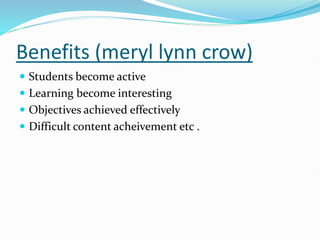
Benefits (meryl lynn crow)
 Students become active
 Learning become interesting
 Objectives achieved effectively
 Difficult content acheivement etc .
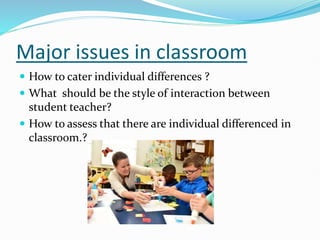
Major issues in classroom
 How to cater individual differences ?
 What should be the style of interaction between
student teacher?
 How to assess that there are individual differenced in
classroom.? …
Individual difference –concept
 Individual differences are crucial for teachers who are
responsible for guiding all forms of learning. In fact, many
educators would suggest that the primary role of teachers
is to provide education to meet the individual differences
and to. develop student cognitive processes.
 James drever : variations or deviations from the average of
the group ,with respect to the mental or physical
characters, occurring in the individual members of the
group are individual differences…जेम्स ड
रेवि: समूह क
े प्रत्येक
सदस्य में होने वाले मानशसक या िािीरिक लक्षणोों क
े सोंबोंध में समूह
क
े औसत से शवचलन या शवचलन व्यस्क्तगत अोंति हैं ...
Factors affecting individual
differences
 Heredity – height , giftedness, interest, eye color etc
आनुवोंशिकता - ऊ
ों चाई, प्रशतभा, रुशच, आोंखोों का िोंग आशद
 Enviornment factors : economic status,community,
society, school, peer ,culture ,media, eating
habits,language पयातविणीय कािक: आशथतक स्स्थशत, समुदाय,
समाज, स्क
ू ल, सहकमी, सोंस्क
ृ शत, मीशडया, खाने की आदतें, भाषा,,
 Personal factors : interest, motivation, gender , physical
defects , health-mental and physical,injury. व्यस्क्तगत
कािक: रुशच, प्रेिणा, शलोंग, िािीरिक दोष, स्वास्थ्य-मानशसक औि
िािीरिक, चोट
Types of individual difference
1.Inter(among) and intra(within) individual differences
(अोंतिव्यस्क्तगत औि अोंतःव्यस्क्तगत).
2. Individual differences on cognitive basis(. सोंज्ञानात्मक
आधाि पि व्यस्क्तगत अोंति)
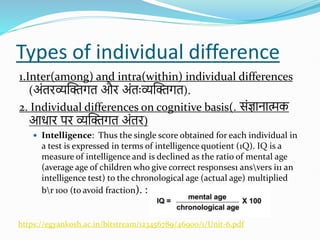
 Intelligence: Thus the single score obtained for each individual in
a test is expressed in terms of intelligence quotient (1Q). IQ is a
measure of intelligence and is declined as the ratio of mental age
(average age of children who give correct responses1 ansvers i11 an
intelligence test) to the chronological age (actual age) multiplied
br 100 (to avoid fraction). :
https://egyankosh.ac.in/bitstream/123456789/46900/1/Unit-6.pdf
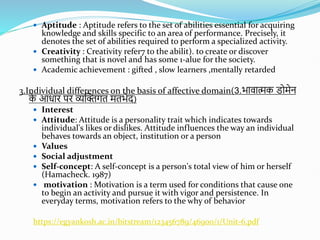
 Aptitude : Aptitude refers to the set of abilities essential for acquiring
knowledge and skills specific to an area of performance. Precisely, it
denotes the set of abilities required to perform a specialized activity.
 Creativity : Creativity refer7 to the abilit). to create or discover
something that is novel and has some 1-alue for the society.
 Academic achievement : gifted , slow learners ,mentally retarded
3.Individual differences on the basis of affective domain(3.भावात्मक डोमेन
क
े आधाि पि व्यस्क्तगत मतभेद)
 Interest
 Attitude: Attitude is a personality trait which indicates towards
individual's likes or dislikes. Attitude influences the way an individual
behaves towards an object, institution or a person
 Values
 Social adjustment
 Self-concept: A self-concept is a person's total view of him or herself
(Hamacheck. 1987)
 motivation : Motivation is a term used for conditions that cause one
to begin an activity and pursue it with vigor and persistence. In
everyday terms, motivation refers to the why of behavior
https://egyankosh.ac.in/bitstream/123456789/46900/1/Unit-6.pdf
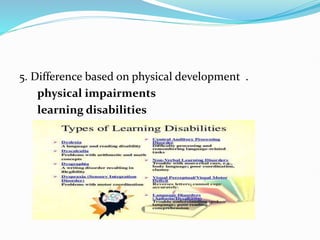
5. Difference based on physical development .
physical impairments
learning disabilities
 एप्टीट्यूड: एप्टीट्यूड, प्रदितन क
े क्षेत् क
े शलए शवशिि ज्ञान औि कौिल प्राप्त किने क
े शलए आवश्यक
क्षमताओों क
े सेट को सोंदशभतत किता है। सोंक्षेप में, यह एक शविेष गशतशवशध किने क
े शलए आवश्यक
क्षमताओों क
े सेट को दिातता है।
 सृजनात्मकता : सृजनात्मकता क्षमता से सोंबोंशधत है)। क
ु छ ऐसा बनाने या खोजने क
े शलए जो नया हो औि
शजसमें समाज क
े शलए क
ु छ 1-मूल् हो।
 िैशक्षक उपलस्ि
 3.भावात्मक डोमेन क
े आधाि पि व्यस्क्तगत अोंति(3.भावात्मक डोमेन क
े आधाि पि व्यस्क्तगत जाशत)
 शदलचस्पी
 मनोवृशत्त: अशभवृशत्त एक व्यस्क्तत्व शविेषता है जो व्यस्क्त की पसोंद या नापसोंद की ओि सोंक
े त किती है।
अशभवृशत्त शकसी वस्तु, सोंस्था या व्यस्क्त क
े प्रशत व्यस्क्त क
े व्यवहाि को प्रभाशवत किती है
 मूल्ोों
 सामाशजक समायोजन
 आत्म-अवधािणा: एक आत्म-अवधािणा एक व्यस्क्त का स्वयों क
े बािे में सोंपूणत दृशिकोण है (हैमाचेक।
1987)।
 अशभप्रेिणा: अशभप्रेिणा एक िब्द है शजसका उपयोग उन स्स्थशतयोों क
े शलए शकया जाता है जो शकसी
गशतशवशध को िुरू किने औि उसे जोि औि दृढता क
े साथ आगे बढाने क
े शलए प्रेरित किती हैं।
िोजमिात क
े सोंदभत में, प्रेिणा व्यवहाि क
े कािण को सोंदशभतत किती है
Catering ID: teachers role
( classroom interaction teachers role)
 Adjusting curriculum
 Limited size of class
 Adjusting method of teaching
 Educational guidance
 Vocational guidance
 Individual training
 Ability grouping
 Team teaching
 Group techniques
 Portfolios maintanace
पाठ्यिम का समायोजन
वगत का सीशमत आकाि
शिक्षण की समायोजन शवशध
िैशक्षक मागतदितन
व्यावसाशयक मागतदितन
व्यस्क्तगत प्रशिक्षण
क्षमता समूहन
Effective teacher interaction can
happen in class
 Following ways help teachers to improve classroom interactions
 The size of the class should be as small as possible.
 Try to pay individual attention to pupils
 Keep in view different needs of pupils
 Use variation of techniques of teaching
 Proper organisation of content/academic activities/lab activities.
 Creation of democratic environment in class.
 Render guidance and counselling to students.
 Provide an atmosphere of sympathy and warmth ,understanding
and confidence.
 Encourage students and inspire them
 Give time for hand on experience
 Remain open to new ideas,technologies.
कक्षा में प्रभावी शिक्षक सोंवाद हो
सकता है:
 शनम्नशलस्खत तिीक
े शिक्षकोों को कक्षा की बातचीत को बेहति बनाने में मदद
किते हैं
 कक्षा का आकाि यथासोंभव छोटा होना चाशहए।
 शवद्याशथतयोों पि व्यस्क्तगत ध्यान देने का प्रयास किें
 शवद्याशथतयोों की शवशभन्न आवश्यकताओों को ध्यान में िखें
 शिक्षण की तकनीकोों में शभन्नता का उपयोग किें
 सामग्री/अकादशमक गशतशवशधयोों/प्रयोगिाला गशतशवशधयोों का उशचत सोंगठन।
 कक्षा में लोकताोंशत्क वाताविण का शनमातण।
 छात्ोों को मागतदितन औि पिामित प्रदान किना।
 सहानुभूशत औि गमतजोिी, समझ औि शविास का वाताविण प्रदान किें।
 छात्ोों को प्रोत्साशहत किें औि उन्हें प्रेरित किें
 अनुभव क
े शलए समय दें
 नए शवचािोों, तकनीकोों क
े शलए खुले िहें।
 Learning beyond textbook
 Thank you

understanding disciplines and subjects.pptx

  • 1.
    •Presenter- Diksha Verma (researchscholar) HPU https://tse4.mm.bing.net/th?id=OIP.hcnJwaym- bsJkdV1mr_p0AHaDX&pid=Api&P=0
  • 2.
    Paper-IV Understanding Disciplines andSubjects  Unit-1(concept of discipline)  Nature and role of discipline and knowledge in school curriculum  Paradigm shift In the nature of discipline  Emergence of school subjects and disciplines from philosophical, social and political context  Needed changes in the discipline oriented textbooks  Unit-2(quality concerns in education)  Indicators of quality learning  Teaching and learning as interactive process  Major issues in classroom learning;catering individual differences  Learning beyond textbooks- other sources of learning
  • 3.
  • 4.
    Indicator of qualitylearning learning as defined by Stephen.P.Robbins: “learning is any relative permanent change in behaviour that occurs as a result of experience” ("सीखना अनुभव क े परिणामस्वरूप होने वाले व्यवहाि में अपेक्षाक ृ त स्थायी परिवततन है“) Term “quality learning “ will be then a learning that is purposeful, in which learners are provided with the ability to effectively learn and retain skills and knowledge gained. It is usually based on students satisfaction with the learning process. It is an approach in improving learning and the quality of organisational life.
  • 5.
    गुणवत्तापूणत शिक्षा कासूचक  िब्द "गुणवत्तापूणत शिक्षा" तब एक ऐसी शिक्षा होगी जो उद्देश्यपूणत है, शजसमें शिक्षाशथतयोों को कौिल औि ज्ञान को प्रभावी ढोंग से सीखने औि बनाए िखने की क्षमता प्रदान की जाती है।  यह आमतौि पि सीखने की प्रशिया क े साथ छात्ोों की सोंतुशि पि आधारित होता है।  यह सीखने औि सोंगठनात्मक जीवन की गुणवत्ता में सुधाि किने का एक दृशिकोण है।
  • 6.
    Educational indicators  Theseare certain statistics or data that describe key aspects of schooling which permit the evaluational monitoring of schools, teachers and students.(सोंक े तक- ये क ु छ आँकडे या डेटा हैं जो स्क ू ली शिक्षा क े प्रमुख पहलुओों का वणतन किते हैं जो स्क ू लोों, शिक्षकोों औि छात्ोों क े मूल्ाोंकन की शनगिानी की अनुमशत देते हैं।)
  • 7.
    Classification of educational indicators Indicators tends to be classified depending on whether they reflect means, the process or the end in achieving the objectives of a particular set of program/project or scheme. सोंक े तकोों को इस आधाि पि वगीक ृ त शकया जाता है शक क्या वे शकसी शविेष कायतिम/परियोजना या योजना क े उद्देश्योों को प्राप्त किने क े साधनोों, प्रशिया या अोंत को दिातते हैं।  Indicators could be classified as follows
  • 8.
    िैशक्षक सोंक े तकोोंका वगीकिण Indicators of quality learning Performance indicators (प्रदितन सूचक) Input (इनपुट) Access(पहँच / प्रशिया) Output (उत्पादन) outcome (परिणाम) Simple indicators (सिल) General indicators(सामान्य)
  • 9.
    Indicators of qualitylearning  Simple indicators : These are the most straightforward indicators since numbers measure them. These do not have any judgment part included to them. They are simple numbers indicating certain data that has to be given meaning yet. These indicators give opportunity to compare data between two different groups at a glance. For example lieracy rate of country is simple indicator. Attendance of child.  General indicators : theses indicators focus mainly on experiences , satisfaction of stakeholders and feelings . These are not measurable as they depend upon opinions. Like by looking at attendance records of child we assume they are not good at studies is a general indicator of classroom learning that is not measurable .
  • 10.
     सिल सोंक ेतक: ये सबसे सीधे सोंक े तक हैं क्योोंशक सोंख्या उन्हें मापती है। इनमें कोई शनणतय भाग िाशमल नहीों है। वे सिल सोंख्याएँ हैं जो क ु छ डेटा का सोंक े त देती हैं शजन्हें अभी तक अथत देना है। ये सोंक े तक एक नज़ि में दो अलग-अलग समूहोों क े बीच डेटा की तुलना किने का अवसि देते हैं। उदाहिण क े शलए बच्चे की उपस्स्थशत,देि की साक्षिता दि सिल सूचक है।  सामान्य सोंक े तक: ये सोंक े तक मुख्य रूप से अनुभवोों, शहतधािकोों की सोंतुशि औि भावनाओों पि ध्यान क ें शित किते हैं। ये मापने योग्य नहीों हैं क्योोंशक ये िाय पि शनभति किते हैं। जैसे बच्चे की उपस्स्थशत क े रिकॉडत को देखकि हम मान लेते हैं शक वे पढाई में अच्छे नहीों हैं, यह कक्षा में सीखने का एक सामान्य सोंक े तक है शजसे मापा नहीों जा सकता है।
  • 11.
    Indicators of qualitylearning  Performance indicators: Performance indicators are measurable values that determine how an organisation / education policy or education system achieves a set of objectives.  Simple indicators with added judgement are performance indicators.  Institutions/government/boards of education set goals at the top level before they translate them to low-level (schools)and teachers who perform particular functions to help the progress of education process. These are as follows •प्रदितन सोंक े तक: प्रदितन सोंक े तक मापने योग्य मूल् हैं जो शनधातरित किते हैं शक क ै से एक सोंगठन/शिक्षा नीशत या शिक्षा प्रणाली उद्देश्योों क े एक सेट को प्राप्त किती है। •अशतरिक्त शनणतय क े साथ सिल सोंक े तक प्रदितन सोंक े तक हैं। •सोंस्थाएों /सिकाि/शिक्षा बोडत िीषत स्ति पि लक्ष्ोों को शनधातरित किते हैं, इससे पहले शक वे उन्हें शनचले स्ति (स्क ू लोों) औि उन शिक्षकोों तक ले जाएों जो शिक्षा प्रशिया की प्रगशत में मदद किने क े शलए शविेष कायत कि हैं। ये इस प्रकाि हैं
  • 12.
    Performance indicators Objectives setup byhigher level of educational settings i.e Govt Department of education ,policies etc Acheivement of objectives by school boards / schools, teachers . Input indicators Access indicators Output indicators Outcome indicators
  • 13.
    Input indicators •Resources /means •No. of teachers •Building •Teaching materials •PTR •Textbook •Cost perpupil Access /process indicators •Geographical distance to school •Family background •Cultural background •Family economic conditions •Cost of education- fees,uniform •School vehicles •Vission of school etc. Outcome indicators •Learning outcomes by NCERT •Attitude change •Productivity and income of graduates • development of desired Values •All round development etc. Output indicators Related to achievement of immediate objectives of education policies/class •Enrolment rate •Drop out rate •Retention rate •By region, locality, type of school, genderwise, caste wise •Achievement level •Pass percentage etc. •
  • 14.
    https://au.indeed.com/career-advice/career-development/what-is-performance- indicator?utm_campaign=earnedsocial%3Acareerguide%3Asharedirectshare%3AAU&utm_content=What%20Is%20a%20Performanc e%20Indicator%3F%20%28And%20How%20To%20Create%20One%29&utm_medium=social&utm_source=directshare types of performanceindicators  Input indicators measure the number of resources a company requires for a particular project. Examples of input indicators include cash at hand, equipment acquired and staff time.  Process / access indicators :it measures or indicate the demands of resources and access related factors of population i.e how much population demands a particular facility/training and how much have access to that facility.  Output indicators: Output indicators measure the failure or success of a process or access activity. Examples of output indicators include profits, dropout and new enrollment. They may also refer to the efficiency of training sessions or technical assistance.  Outcome indicators : It measure the effect or impact of policies and projects on living standard of population.
  • 15.
    प्रदितन सोंक े तकोोंक े प्रकाि  इनपुट सोंक े तक शकसी शविेष परियोजना क े शलए क ों पनी द्वािा आवश्यक सोंसाधनोों की सोंख्या को मापते हैं। इनपुट सोंक े तकोों क े उदाहिणोों में हाथ में नकदी, अशधग्रहीत उपकिण औि कमतचारियोों का समय िाशमल हैं।  प्रशिया/पहोंच सोंक े तक: यह जनसोंख्या क े सोंसाधनोों औि पहोंच से सोंबोंशधत कािकोों की माोंग को मापता है या इोंशगत किता है यानी शकतनी आबादी शकसी शविेष सुशवधा/प्रशिक्षण की माोंग किती है औि उस सुशवधा तक शकतनी पहोंच है।  आउटपुट सोंक े तक: आउटपुट सोंक े तक शकसी प्रशिया या पहोंच गशतशवशध की शवफलता या सफलता को मापते हैं। आउटपुट सोंक े तकोों क े उदाहिणोों में लाभ, ड र ॉपआउट औि नया नामाोंकन िाशमल हैं। वे प्रशिक्षण सत् या तकनीकी सहायता की दक्षता का भी उल्लेख कि सकते हैं।  परिणाम सोंक े तक: यह जनसोंख्या क े जीवन स्ति पि नीशतयोों औि परियोजनाओों क े प्रभाव या प्रभाव को मापता है।
  • 16.
    Importance of indicatorsof quality learning  Helps in indicating how much we need to work for achievement of goals of education.  What is remaining in achievement of objectives.  how access to education can be universalised or made easy .  Helps in policy formulation and policy change  Implementation of various schemes / projects related to education .  Helps in enhancement of educational quality .  helps in making education a global affair.  Helps in addition of new discipline and subjects at school level according to changing demands of society. यह इोंशगत किने में मदद किता है शक शिक्षा क े लक्ष्ोों की प्रास्प्त क े शलए हमें शकतना काम किने की आवश्यकता है। उद्देश्योों की प्रास्प्त में क्या िेष है। शिक्षा की पहोंच को क ै से सावतभौम बनाया जा सकता है या आसान बनाया जा सकता है। नीशत शनमातण औि नीशत परिवततन में मदद किता है शिक्षा से सोंबोंशधत शवशभन्न योजनाओों/परियोजनाओों का शियान्वयन। िैशक्षक गुणवत्ता बढाने में मदद किता है। शिक्षा को वैशिक मामला बनाने में मदद किता है। समाज की बदलती माोंगोों क े अनुसाि स्क ू ल स्ति पि नए अनुिासन औि शवषयोों को जोडने में मदद किता है।
  • 17.
    शिक्षण तथा अशधगम-सोंवादात्मक प्रशिया क े रूप में
  • 18.
    Teaching learning process The teaching-learning process represents the channel of communication through which the individual strives to acquire the habits, skills, knowledge, attitude, values and appreciation, that are vital for surviving in the information age. The teaching- learning, therefore, becomes a process by which changes in behavioural patterns are produced through experience.  शिक्षण-सीखने की प्रशिया सोंचाि क े उस चैनल का प्रशतशनशधत्व किती है शजसक े माध्यम से व्यस्क्त आदतोों, कौिल, ज्ञान, दृशिकोण, मूल्ोों औि प्रिोंसा को प्राप्त किने का प्रयास किता है, जो सूचना युग में जीशवत िहने क े शलए महत्वपूणत हैं। इसशलए, शिक्षण-अशधगम एक ऐसी प्रशिया बन जाती है शजसक े द्वािा अनुभव क े माध्यम से व्यवहारिक प्रशतमानोों में परिवततन उत्पन्न शकए जाते हैं। Classroom interaction /teaching Teacher Learner Curriculum
  • 19.
    Teaching –learning asinteractive process  “Teaching is an interaction process. Interaction means participation of both teacher and learners and both are benefitted by this. The interaction takes place for achieving desired objectives” Ned A. Flanders  (शिक्षण एक अोंतःशियात्मक प्रशिया है। सहभाशगता का अथत है शिक्षक औि शिक्षाथी दोनोों की भागीदािी औि इससे दोनोों लाभास्न्वत होते हैं। वाोंशछत उद्देश्योों को प्राप्त किने क े शलए बातचीत होती है ”) Merriam-websters dictionary: ineraction is “mutual or reciprocal action or influence” Cambrige dictionary : ‘a situation where two or more people or things communicate with each other or react to each another
  • 20.
    Characteristics of interactive teaching सोंवादात्मकशिक्षण की शविेषताएों  It is a participatory process.  It is a mutual process.  Interaction revolves around a common objective/goal .  Interaction process helps in development of satisfaction with the process.  It is beneficial for all the participants.  Supervisory control(teacher, group leader) is required.  It is a planned process as proper Planning is associated with greater content achievement.(analysing teacher behaviour,Ned Flanders)
  • 21.
    Generally Following threetypes of interaction occurs in classroom :  Teacher-student interaction (TS) शिक्षक-छात् सहभाशगता  Student- student interactionछात्-छात् सहभाशगता (SS)  Teacher – class interaction शिक्षक-कक्षा अोंतःशिया (TC)  Teacher talk and student talk  Verbal and non verbal interaction Interaction process has three domain according to ,( Bobrow, Daniel. (1991). Dimensions of Interaction. Ai Magazine - AIM. 12. ) 1. Communication 2. Coordination 3. Integration Dimensions of interaction Coordination (समन्वय) Integration (एकीकिण) Communicat ion((सोंचाि)
  • 22.
    Success of interactiveprocess  Barnes McConnell (1978) says faculty members will be more successful if they see themselves less as judges or dispensor of wisdom and more as a resource pesron.  https://www.deepdyve.com/lp/wiley/teaching-as-an- interactive-process-8KYof3c0J8?
  • 23.
    Techniques of teaching– interactive process(catering ID)  Group interaction techniques  Brainstorming(where group members suggest in rapid fire order all the solutions they could think of)  Symposium (series of short speeches on different aspects of any topic given by students in front of their class)  Discussion ( conversational form with a leader in front of the class  debate (a pro and con discussion on controversial issue by groups representative of each side)  Problem solving (a specific problem is presented for group solution or individual solutions)  Leaderless group discussion  Brainstorming  Case study  Think-pair-share technique  Question and answer technique  Roll-playing  Incident –process method (by Pigors and Pigors,1961; group task is to identify which information they need to solve question)  Jigsaw method  Team-pair-solo etc
  • 24.
    शिक्षण की तकनीक ें- सोंवादात्मक प्रशिया  समूह सहभाशगता तकनीक  ब्रेनस्टॉशमिंग (जहाों समूह क े सदस्य िैशपड फायि िम में वे सभी समाधान सुझाते हैं शजनक े बािे में वे सोच सकते हैं)  सोंगोष्ठी (छात्ोों द्वािा अपनी कक्षा क े सामने शदए गए शकसी भी शवषय क े शवशभन्न पहलुओों पि लघु भाषणोों की श्ृोंखला)  चचात (कक्षा क े सामने एक नेता क े साथ सोंवादात्मक रूप  वाद-शववाद (प्रत्येक पक्ष क े समूहोों क े प्रशतशनशधयोों द्वािा शववादास्पद मुद्दे पि समथतक औि शवपक्ष की चचात)  समस्या समाधान (समूह समाधान या व्यस्क्तगत समाधान क े शलए एक शवशिि समस्या प्रस्तुत की जाती है)  नेताशवहीन समूह चचात  मोंथन  क े स स्टडी  शथोंक-पेयि-िेयि तकनीक  प्रश्न औि उत्ति तकनीक  िोल-प्लेइोंग  घटना-प्रशिया शवशध (शपगसत औि शपगसत द्वािा, 1961; समूह कायत यह पहचानना है शक उन्हें प्रश्न हल किने क े शलए कौन सी जानकािी की आवश्यकता है)  पहेली शवशध  टीम-जोडी-एकल आशद
  • 25.
    Benefits (meryl lynncrow)  Students become active  Learning become interesting  Objectives achieved effectively  Difficult content acheivement etc .
  • 27.
    Major issues inclassroom  How to cater individual differences ?  What should be the style of interaction between student teacher?  How to assess that there are individual differenced in classroom.? …
  • 28.
    Individual difference –concept Individual differences are crucial for teachers who are responsible for guiding all forms of learning. In fact, many educators would suggest that the primary role of teachers is to provide education to meet the individual differences and to. develop student cognitive processes.  James drever : variations or deviations from the average of the group ,with respect to the mental or physical characters, occurring in the individual members of the group are individual differences…जेम्स ड रेवि: समूह क े प्रत्येक सदस्य में होने वाले मानशसक या िािीरिक लक्षणोों क े सोंबोंध में समूह क े औसत से शवचलन या शवचलन व्यस्क्तगत अोंति हैं ...
  • 29.
    Factors affecting individual differences Heredity – height , giftedness, interest, eye color etc आनुवोंशिकता - ऊ ों चाई, प्रशतभा, रुशच, आोंखोों का िोंग आशद  Enviornment factors : economic status,community, society, school, peer ,culture ,media, eating habits,language पयातविणीय कािक: आशथतक स्स्थशत, समुदाय, समाज, स्क ू ल, सहकमी, सोंस्क ृ शत, मीशडया, खाने की आदतें, भाषा,,  Personal factors : interest, motivation, gender , physical defects , health-mental and physical,injury. व्यस्क्तगत कािक: रुशच, प्रेिणा, शलोंग, िािीरिक दोष, स्वास्थ्य-मानशसक औि िािीरिक, चोट
  • 30.
    Types of individualdifference 1.Inter(among) and intra(within) individual differences (अोंतिव्यस्क्तगत औि अोंतःव्यस्क्तगत). 2. Individual differences on cognitive basis(. सोंज्ञानात्मक आधाि पि व्यस्क्तगत अोंति)  Intelligence: Thus the single score obtained for each individual in a test is expressed in terms of intelligence quotient (1Q). IQ is a measure of intelligence and is declined as the ratio of mental age (average age of children who give correct responses1 ansvers i11 an intelligence test) to the chronological age (actual age) multiplied br 100 (to avoid fraction). : https://egyankosh.ac.in/bitstream/123456789/46900/1/Unit-6.pdf
  • 31.
     Aptitude :Aptitude refers to the set of abilities essential for acquiring knowledge and skills specific to an area of performance. Precisely, it denotes the set of abilities required to perform a specialized activity.  Creativity : Creativity refer7 to the abilit). to create or discover something that is novel and has some 1-alue for the society.  Academic achievement : gifted , slow learners ,mentally retarded 3.Individual differences on the basis of affective domain(3.भावात्मक डोमेन क े आधाि पि व्यस्क्तगत मतभेद)  Interest  Attitude: Attitude is a personality trait which indicates towards individual's likes or dislikes. Attitude influences the way an individual behaves towards an object, institution or a person  Values  Social adjustment  Self-concept: A self-concept is a person's total view of him or herself (Hamacheck. 1987)  motivation : Motivation is a term used for conditions that cause one to begin an activity and pursue it with vigor and persistence. In everyday terms, motivation refers to the why of behavior https://egyankosh.ac.in/bitstream/123456789/46900/1/Unit-6.pdf
  • 32.
    5. Difference basedon physical development . physical impairments learning disabilities
  • 33.
     एप्टीट्यूड: एप्टीट्यूड,प्रदितन क े क्षेत् क े शलए शवशिि ज्ञान औि कौिल प्राप्त किने क े शलए आवश्यक क्षमताओों क े सेट को सोंदशभतत किता है। सोंक्षेप में, यह एक शविेष गशतशवशध किने क े शलए आवश्यक क्षमताओों क े सेट को दिातता है।  सृजनात्मकता : सृजनात्मकता क्षमता से सोंबोंशधत है)। क ु छ ऐसा बनाने या खोजने क े शलए जो नया हो औि शजसमें समाज क े शलए क ु छ 1-मूल् हो।  िैशक्षक उपलस्ि  3.भावात्मक डोमेन क े आधाि पि व्यस्क्तगत अोंति(3.भावात्मक डोमेन क े आधाि पि व्यस्क्तगत जाशत)  शदलचस्पी  मनोवृशत्त: अशभवृशत्त एक व्यस्क्तत्व शविेषता है जो व्यस्क्त की पसोंद या नापसोंद की ओि सोंक े त किती है। अशभवृशत्त शकसी वस्तु, सोंस्था या व्यस्क्त क े प्रशत व्यस्क्त क े व्यवहाि को प्रभाशवत किती है  मूल्ोों  सामाशजक समायोजन  आत्म-अवधािणा: एक आत्म-अवधािणा एक व्यस्क्त का स्वयों क े बािे में सोंपूणत दृशिकोण है (हैमाचेक। 1987)।  अशभप्रेिणा: अशभप्रेिणा एक िब्द है शजसका उपयोग उन स्स्थशतयोों क े शलए शकया जाता है जो शकसी गशतशवशध को िुरू किने औि उसे जोि औि दृढता क े साथ आगे बढाने क े शलए प्रेरित किती हैं। िोजमिात क े सोंदभत में, प्रेिणा व्यवहाि क े कािण को सोंदशभतत किती है
  • 34.
    Catering ID: teachersrole ( classroom interaction teachers role)  Adjusting curriculum  Limited size of class  Adjusting method of teaching  Educational guidance  Vocational guidance  Individual training  Ability grouping  Team teaching  Group techniques  Portfolios maintanace पाठ्यिम का समायोजन वगत का सीशमत आकाि शिक्षण की समायोजन शवशध िैशक्षक मागतदितन व्यावसाशयक मागतदितन व्यस्क्तगत प्रशिक्षण क्षमता समूहन
  • 35.
    Effective teacher interactioncan happen in class  Following ways help teachers to improve classroom interactions  The size of the class should be as small as possible.  Try to pay individual attention to pupils  Keep in view different needs of pupils  Use variation of techniques of teaching  Proper organisation of content/academic activities/lab activities.  Creation of democratic environment in class.  Render guidance and counselling to students.  Provide an atmosphere of sympathy and warmth ,understanding and confidence.  Encourage students and inspire them  Give time for hand on experience  Remain open to new ideas,technologies.
  • 36.
    कक्षा में प्रभावीशिक्षक सोंवाद हो सकता है:  शनम्नशलस्खत तिीक े शिक्षकोों को कक्षा की बातचीत को बेहति बनाने में मदद किते हैं  कक्षा का आकाि यथासोंभव छोटा होना चाशहए।  शवद्याशथतयोों पि व्यस्क्तगत ध्यान देने का प्रयास किें  शवद्याशथतयोों की शवशभन्न आवश्यकताओों को ध्यान में िखें  शिक्षण की तकनीकोों में शभन्नता का उपयोग किें  सामग्री/अकादशमक गशतशवशधयोों/प्रयोगिाला गशतशवशधयोों का उशचत सोंगठन।  कक्षा में लोकताोंशत्क वाताविण का शनमातण।  छात्ोों को मागतदितन औि पिामित प्रदान किना।  सहानुभूशत औि गमतजोिी, समझ औि शविास का वाताविण प्रदान किें।  छात्ोों को प्रोत्साशहत किें औि उन्हें प्रेरित किें  अनुभव क े शलए समय दें  नए शवचािोों, तकनीकोों क े शलए खुले िहें।
  • 37.
  • 38.