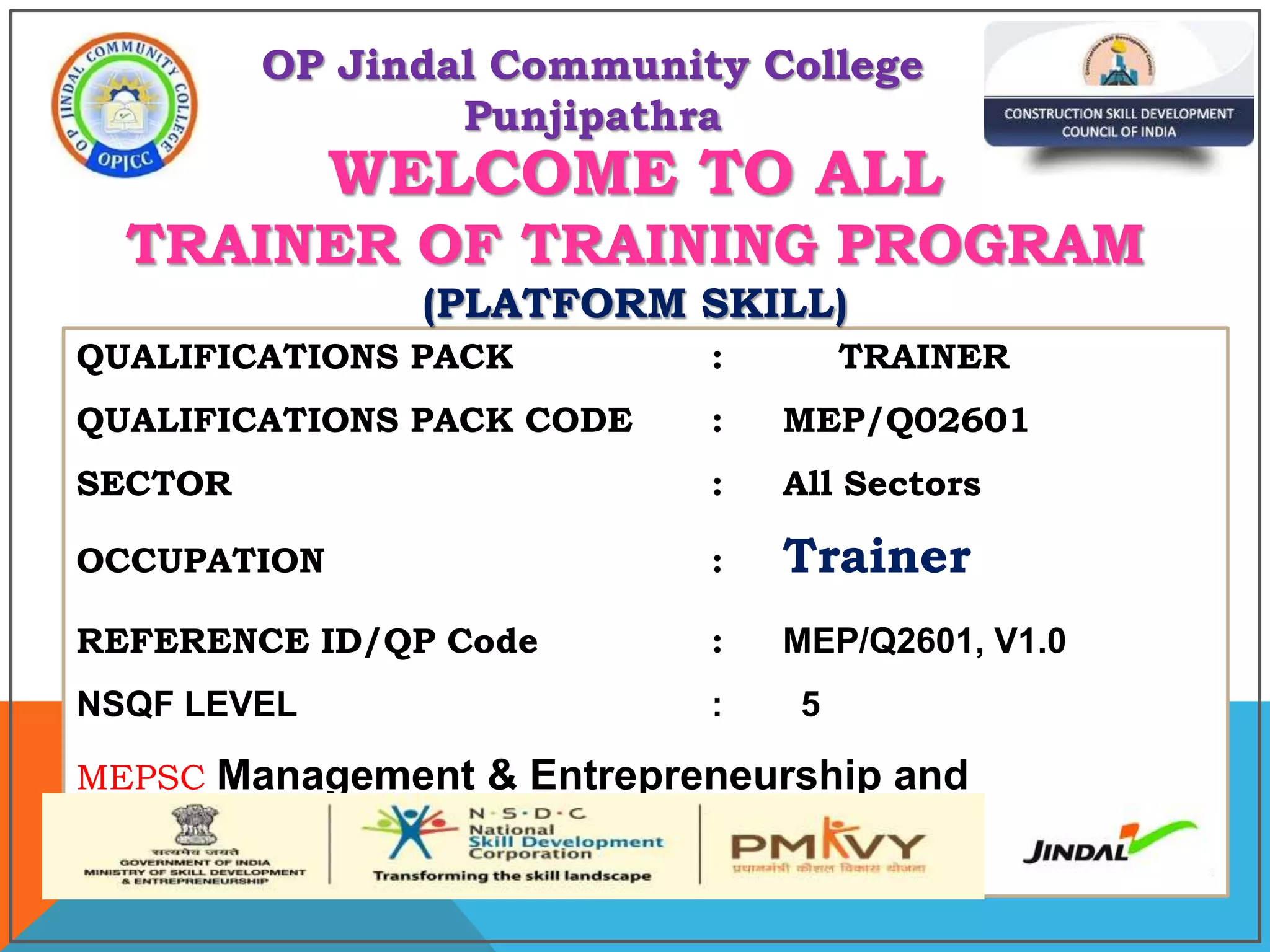
QUALIFICATIONS PACK : TRAINER
QUALIFICATIONS PACK CODE : MEP/Q02601
SECTOR : All Sectors
OCCUPATION : Trainer
REFERENCE ID/QP Code : MEP/Q2601, V1.0
NSQF LEVEL : 5
MEPSC Management & Entrepreneurship and
Professional Skills Council
WELCOME TO ALL
TRAINER OF TRAINING PROGRAM
(PLATFORM SKILL)
OP Jindal Community College
Punjipathra
1. MEP/N2601 Plan and organize for facilitation of a training
program
2. MEP/N2602 Deliver competency based, instructor-led training
sessions as per session plan
3. MEP/N2618 Facilitate learning through on-the-job or in a
simulated training
4. MEP/N2604 Undertake assessment of competence as per
required standards
5. MEP/N9903 Apply health and safety practices at the workplace
6. MEP/N9912 Apply principles of professional practice at the
workplace
 Interpret learning environment and delivery requirements
सीखने क
े माहौल और वितरण आिश्यकताओं की व्याख्या करें
 Prepare session plans सत्र की योजना तैयार करें
 Prepare resources for delivery वितरण क
े वलए संसाधन तैयार करें
 Deliver and facilitate training sessions वितररत करें और प्रविक्षण सत्रों
की सुविधा प्रदान करें
 Organize training environment प्रविक्षण का िातािरण व्यिस्थित करें
Performance Criteria:
1. Access, read and interpret learning program documentation to
determine delivery requirements
वितरण आिश्यकताओं को वनधााररत करने क
े वलए सीखने क
े कायाक्रम प्रलेखन तक पहंच, पढ़ना और व्याख्या करना
2. Use available information and documentation to identify group and
individual learner needs and learner characteristics
समूह और व्यस्िगत विक्षाविायों की जरूरतों और सीखने की वििेषताओं की पहचान करने क
े वलए उपलब्ध जानकारी और
प्रलेखन का उपयोग करें
3. Identify and assess constraint and risks to delivery
पहचान और आकलन और वितरण क
े वलए जोस्खम
4. Confirm personal role and responsibilities in planning and delivering
training with relevant personnel
संबंवधत कवमायों क
े साि प्रविक्षण की योजना बनाने और वितररत करने में व्यस्िगत भूवमका और वजम्मेदाररयों की पुवि करें
Interpret learning environment and delivery requirements
सीखने क
े माहौल और वितरण आिश्यकताओं की व्याख्या करें
Performance Criteria:
1. Refine existing learning objectives according to program
requirements and specific needs of individual learners
कायाक्रम की आिश्यकताओं और व्यस्िगत विक्षाविायों की विविि आिश्यकताओं क
े अनुसार मौजूदा
विक्षण उद्देश्यों को पररष्क
ृ त करें
2. Develop session plans and document these for each
segment of the learning program
लवनिंग प्रोग्राम क
े प्रत्येक सेगमेंट क
े वलए सत्र योजनाएं और इनका विकास करें
3. Use knowledge of learning principles and theories to
generate ideas for managing session delivery
सत्र वितरण क
े प्रबंधन क
े वलए विचारों को उत्पन्न करने क
े वलए सीखने क
े वसद्ांतों और वसद्ांतों क
े ज्ञान का
उपयोग करें
Prepare session plans सत्र की योजना तैयार करें
Performance Criteria:
1. Contextualize existing learning materials to meet the needs of the
specific learner group
विविि विक्षािी समूह की जरूरतों को पूरा करने क
े वलए मौजूदा विक्षण सामग्री का संदभा
2. Finalize learning materials and organize facility, technology and
equipment needs in time for delivery of learning sessions
सीखने की सामग्री को अंवतम रूप दें और विक्षण सत्रों क
े वितरण क
े वलए समय में सुविधा,
तकनीक और उपकरणों की आिश्यकता को व्यिस्थित करें
3. Confirm overall delivery arrangements with relevant personnel
संबंवधत कवमायों क
े साि समग्र वितरण व्यिथिा की पुवि करें
Prepare resources for delivery
वितरण क
े वलए संसाधन तैयार करें
Performance Criteria:
1. Conduct each session according to session plan, modified where
appropriate to meet learner needs
सत्र की योजना क
े अनुसार प्रत्येक सत्र का संचालन करें, जहां विक्षाविायों की जरूरतों को पूरा
करने क
े वलए उपयुि संिोवधत वकया गया हो
2. Use the diversity of the group as another resource to support learning
सीखने का समिान करने क
े वलए एक और संसाधन क
े रूप में समूह की विविधता का उपयोग करें
3. Employ a range of delivery methods as training aids to optimise learner
experiences सीखने क
े अनुभिों को अनुक
ू वलत करने क
े वलए प्रविक्षण सहायता क
े रूप में
वितरण विवधयों की एक श्ृंखला को रोजगार दें
4. Demonstrate effective facilitation skills to ensure effective participation
and group management
प्रभािी भागीदारी और समूह प्रबंधन सुवनवित करने क
े वलए प्रभािी सुविधा कौिल का प्रदिान
Deliver and facilitate training sessions
वितररत करें और प्रविक्षण सत्रों की सुविधा प्रदान करें
Performance Criteria:
 Ensure availability of adequate training materials, facility, technology, tools
and equipment in time for delivery of learning sessions
 विक्षण सत्रों क
े वितरण क
े वलए समय में पयााप्त प्रविक्षण सामग्री, सुविधा, प्रौद्योवगकी, उपकरण और
उपकरण की उपलब्धता सुवनवित करना
Organize training environment प्रविक्षण का िातािरण व्यिस्थित करें
 There are four types of learning environments, each with unique elements.
Learning environments can be student- or learner-centered; knowledge-
centered; assessment-centered; and community-centered
 सीखने क
े िातािरण चार प्रकार क
े होते हैं, प्रत्येक अवितीय तत्ों क
े साि। सीखने का िातािरण छात्र-
या सीखने-क
ें वित हो सकता है; ज्ञान क
ें वित; मूल्ांकन क
ें वित; और समुदाय-क
ें वित
 Ensure timely availability of support services as per requirement by
coordinating with training coordinator.
 प्रविक्षण समन्वयक क
े साि समन्वय करक
े आिश्यकता क
े अनुसार समिान सेिाओं की समय पर
उपलब्धता सुवनवित करें
 Ensure training area is risk free and equipped with necessary health and
safety resources like fire extinguishers, safety signage, clean toilets, dry
flooring, security arrangements, etc.
 सुवनवित करें वक प्रविक्षण क्षेत्र जोस्खम मुि है और आिश्यक स्वास्थ्य और सुरक्षा संसाधनों
से लैस है जैसे अवििामक यंत्र, सुरक्षा साइनेज, स्वच्छ िौचालय, िुष्क फिा, सुरक्षा व्यिथिा,
आवद।
The learning outcomes for this course will enable the learner to:
इस पाठ्यक्रम क
े वलए सीखने क
े पररणाम विक्षािी को सक्षम बनाएं गे
 Facilitate group-based learning by preparing and delivering a series
of training sessions,
प्रविक्षण सत्रों की एक श्ृंखला तैयार करक
े और वितररत करक
े समूह-आधाररत सीखने की
सुविधा प्रदान करना
 Identify and respond to diversity and individual needs
विविधता और व्यस्िगत आिश्यकताओं की पहचान और प्रवतवक्रया
 Access and use documented resources and support personnel to
guide inclusive practice
समािेिी अभ्यास का मागादिान करने क
े वलए प्रलेस्खत संसाधनों और सहायता कवमायों का
उपयोग और उपयोग
Learning Outcomes वसखने का पररणाम
 Room/space appropriate to the style of delivery,
 Data projector and laptop/computer and speakers, projection
screen,
 Flip charts with markers,
 Whiteboard and whiteboard markers,
 Trainer manual,
 Learner handbook/workbook and any other learning materials and
resources,
 Other equipment specified in session plan
How to set up training facilities, training equipment and too
 Writing a training session or lesson plan – templates:
Templates for writing a training session or a lesson plan can be a confusing
task to people new to the world of learning. One of the challenges for a new
trainer is the development of a lesson or session plan for a training course or
module.
 प्रविक्षण सत्र या पाठ योजना वलखना - टेम्प्लेट:
प्रविक्षण सत्र या एक पाठ योजना वलखने क
े वलए टेम्पलेट सीखने की दुवनया में नए लोगों क
े वलए एक
भ्रामक काया हो सकता है। एक नए प्रविक्षक क
े वलए चुनौवतयों में से एक प्रविक्षण पाठ्यक्रम या मॉड्यूल क
े
वलए एक पाठ या सत्र योजना का विकास है
How to create and modify session plan? सत्र योजना क
ै से बनाएं और संिोवधत करें?
 Assessing Needs जरूरतों का आकलन
 Writing Learning Objectives लेखन उद्देश्य
 Measuring success (evaluation) मापने की सफलता (मूल्ांकन)
 Outlining Content रूपरेखा सामग्री
 Selecting Methods and Media चयन क
े तरीक
े और मीविया
 Writing the Lesson Plan पाठ योजना वलखना
 Once the information has been collected, the development of the lesson plan
can begin in a sequential, logical manner.
एक बार जानकारी एकत्र हो जाने क
े बाद, पाठ योजना का विकास क्रमबद्, तावक
ा क तरीक
े से
िुरू हो सकता है।
When writing a lesson or session plans, consider the following factors: पाठ या
सत्र योजना वलखते समय, वनम्नवलस्खत कारकों पर विचार करें:
Prescribed and standard session plan template
Typical cover page of a course or lesson plan (template) & Content template:
ACRONYMS
 CBET - Competency- based education and training
 CBLM - Competency-based learning material
 CCE - Continuous and Comprehensive Evaluation
 CII - Confederation of Indian Industry
 CNIC - National Innovation Council for Competitiveness

 CSWDF - Core Skills for Work Developmental Framework
 CTS - Craftsmen Training Scheme
 DGET -Directorate General of Employment and Training

 GDP -Gross Domestic Product
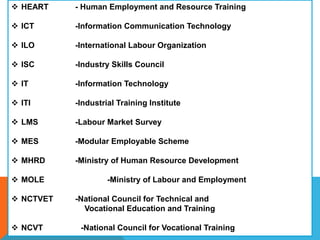
 HEART - Human Employment and Resource Training
 ICT -Information Communication Technology
 ILO -International Labour Organization
 ISC -Industry Skills Council
 IT -Information Technology
 ITI -Industrial Training Institute
 LMS -Labour Market Survey
 MES -Modular Employable Scheme
 MHRD -Ministry of Human Resource Development
 MOLE -Ministry of Labour and Employment
 NCTVET -National Council for Technical and
Vocational Education and Training
 NCVT -National Council for Vocational Training
NOS -National Occupational Standards
NQF -National Qualifications Framework
NSDC -National Skill Development Corporation
NSO -National Statistics Office
NSQF -National Skills Qualification Framework
NSSC -National Skills Standards Council
NTA -National Training Agency
NTR -No Training Regulations
NVEQF -National Vocational Education Qualification Framework
SSC -Sector Skills Council
TESDA -Technical Education and Skills Development Authority
TEVET -Technical, Entrepreneurial and Vocational Education and
Training
TEVETA -Technical, Entrepreneurial and Vocational, Education and
Training Authority
TRs -Training regulations
TVET -Technical Vocational Education and Training
VET -Vocational Education and Training
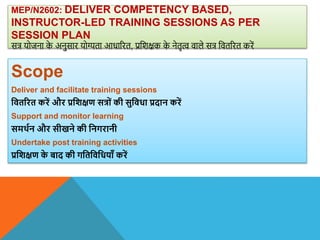
MEP/N2602: DELIVER COMPETENCY BASED,
INSTRUCTOR-LED TRAINING SESSIONS AS PER
SESSION PLAN
सत्र योजना क
े अनुसार योग्यता आधाररत, प्रविक्षक क
े नेतृत्व िाले सत्र वितररत करें
Scope
Deliver and facilitate training sessions
वितररत करें और प्रविक्षण सत्रों की सुविधा प्रदान करें
Support and monitor learning
समिान और सीखने की वनगरानी
Undertake post training activities
प्रविक्षण क
े बाद की गवतविवधयााँ करें
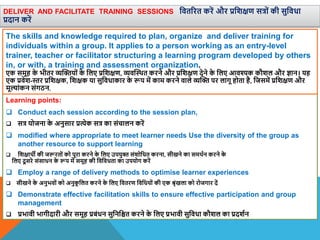
DELIVER AND FACILITATE TRAINING SESSIONS वितररत करें और प्रविक्षण सत्रों की सुविधा
प्रदान करें
Learning points:
 Conduct each session according to the session plan,
 सत्र योजना क
े अनुसार प्रत्येक सत्र का संचालन करें
 modified where appropriate to meet learner needs Use the diversity of the group as
another resource to support learning
 विक्षािी की जरूरतों को पूरा करने क
े वलए उपयुि संिोवधत करना, सीखने का समिान करने क
े
वलए दू सरे संसाधन क
े रूप में समूह की विविधता का उपयोग करें
 Employ a range of delivery methods to optimise learner experiences
 सीखने क
े अनुभिों को अनुक
ू वलत करने क
े वलए वितरण विवधयों की एक श्ृंखला को रोजगार दें
 Demonstrate effective facilitation skills to ensure effective participation and group
management
 प्रभािी भागीदारी और समूह प्रबंधन सुवनवित करने क
े वलए प्रभािी सुविधा कौिल का प्रदिान
The skills and knowledge required to plan, organize and deliver training for
individuals within a group. It applies to a person working as an entry-level
trainer, teacher or facilitator structuring a learning program developed by others
in, or with, a training and assessment organization.
एक समूह क
े भीतर व्यस्ियों क
े वलए प्रविक्षण, व्यिस्थित करने और प्रविक्षण देने क
े वलए आिश्यक कौिल और ज्ञान। यह
एक प्रिेि-स्तर प्रविक्षक, विक्षक या सुविधाकार क
े रूप में काम करने िाले व्यस्ि पर लागू होता है, वजसमें प्रविक्षण और
मूल्ांकन संगठन,
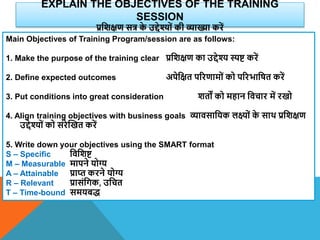
EXPLAIN THE OBJECTIVES OF THE TRAINING
SESSION
प्रविक्षण सत्र क
े उद्देश्यों की व्याख्या करें
Main Objectives of Training Program/session are as follows:
1. Make the purpose of the training clear प्रविक्षण का उद्देश्य स्पि करें
2. Define expected outcomes अपेवक्षत पररणामों को पररभावषत करें
3. Put conditions into great consideration ितों को महान विचार में रखो
4. Align training objectives with business goals व्यािसावयक लक्ष्ों क
े साि प्रविक्षण
उद्देश्यों को संरेस्खत करें
5. Write down your objectives using the SMART format
S – Specific विविि
M – Measurable मापने योग्य
A – Attainable प्राप्त करने योग्य
R – Relevant प्रासंवगक, उवचत
T – Time-bound समयबद्
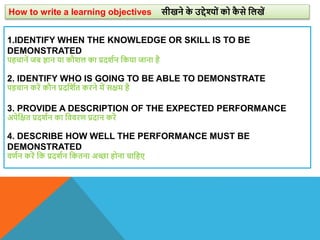
1.IDENTIFY WHEN THE KNOWLEDGE OR SKILL IS TO BE
DEMONSTRATED
पहचानें जब ज्ञान या कौिल का प्रदिान वकया जाना है
2. IDENTIFY WHO IS GOING TO BE ABLE TO DEMONSTRATE
पहचान करें कौन प्रदविात करने में सक्षम है
3. PROVIDE A DESCRIPTION OF THE EXPECTED PERFORMANCE
अपेवक्षत प्रदिान का वििरण प्रदान करें
4. DESCRIBE HOW WELL THE PERFORMANCE MUST BE
DEMONSTRATED
िणान करें वक प्रदिान वकतना अच्छा होना चावहए
How to write a learning objectives सीखने क
े उद्देश्यों को क
ै से वलखें
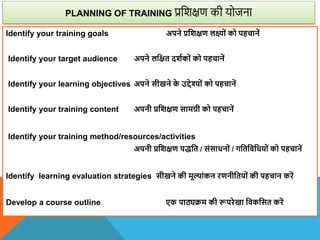
PLANNING OF TRAINING प्रविक्षण की योजना
Identify your training goals अपने प्रविक्षण लक्ष्ों को पहचानें
Identify your target audience अपने लवक्षत दिाकों को पहचानें
Identify your learning objectives अपने सीखने क
े उद्देश्यों को पहचानें
Identify your training content अपनी प्रविक्षण सामग्री को पहचानें
Identify your training method/resources/activities
अपनी प्रविक्षण पद्वत / संसाधनों / गवतविवधयों को पहचानें
Identify learning evaluation strategies सीखने की मूल्ांकन रणनीवतयों की पहचान करें
Develop a course outline एक पाठ्यक्रम की रूपरेखा विकवसत करें
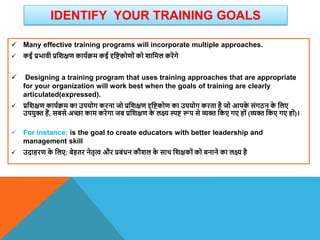
IDENTIFY YOUR TRAINING GOALS
 Many effective training programs will incorporate multiple approaches.
 कई प्रभािी प्रविक्षण कायाक्रम कई दृविकोणों को िावमल करेंगे
 Designing a training program that uses training approaches that are appropriate
for your organization will work best when the goals of training are clearly
articulated(expressed).
 प्रविक्षण कायाक्रम का उपयोग करना जो प्रविक्षण दृविकोण का उपयोग करता है जो आपक
े संगठन क
े वलए
उपयुि हैं, सबसे अच्छा काम करेगा जब प्रविक्षण क
े लक्ष् स्पि रूप से व्यि वकए गए हों (व्यि वकए गए हों)।
 For instance: is the goal to create educators with better leadership and
management skill
 उदाहरण क
े वलए: बेहतर नेतृत् और प्रबंधन कौिल क
े साि विक्षकों को बनाने का लक्ष् है
 Who needs the training in the organization? संगठन में प्रविक्षण की आिश्यकता
वकसे है?
 What attitudes will the trainees likely hold towards the training?
प्रविक्षुओं क
े प्रविक्षण क
े प्रवत क्या दृविकोण होगा
 What KSAs do the trainees already possess? प्रविक्षुओं क
े पास पहले से ही क
े एसए
क्या हैं?
 What specific KSAs would you want the trainees to obtain?
आप प्रविक्षुओं को क्या विविि KSAs प्राप्त करना चाहेंगे?
 How do you collect the above information? आप उपरोि जानकारी क
ै से एकवत्रत
करते हैं?
IDENTIFY YOUR TARGET
AUDIENCE/LEARNER
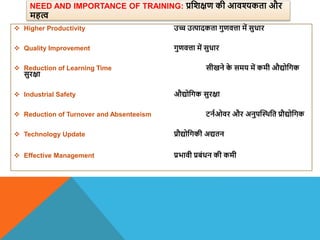
NEED AND IMPORTANCE OF TRAINING: प्रविक्षण की आिश्यकता और
महत्
 Higher Productivity उच्च उत्पादकता गुणित्ता में सुधार
 Quality Improvement गुणित्ता में सुधार
 Reduction of Learning Time सीखने क
े समय में कमी औद्योवगक
सुरक्षा
 Industrial Safety औद्योवगक सुरक्षा
 Reduction of Turnover and Absenteeism टनाओिर और अनुपस्थिवत प्रौद्योवगक
 Technology Update प्रौद्योवगकी अद्यतन
 Effective Management प्रभािी प्रबंधन की कमी
 Be concise संवक्षप्त रखें
 Be focused ध्यान क
ें वित वकया
 Keep schedule िेड्यूल रखें
 Use experts वििेषज्ों का उपयोग करें
 Use visuals दृश्यों का उपयोग करें
 Encourage questions प्रश्ों को प्रोत्सावहत करें
 Create reading materials पठन सामग्री बनाएँ
RULES OF A SUCCESSFUL TRAINING PROGRAM:
एक सफल प्रविक्षण कायाक्रम क
े वनयम
USED TRAINING DELIVERY METHODS, PROCESS FACILITATION
TECHNIQUES APPROPRIATE TO FACE-TO-FACE GROUP DELIVERY
प्रयुि प्रविक्षण वितरण पद्वत, फ
े स टू फ
े स ग्रुप विलीिरी क
े वलए उपयुि प्रवक्रया सुगम तकनीक
Training methods:
 Lecture भाषण
 Group discussion & presentation समूह चचाा और प्रस्तुवत
 Group activities समूह गवतविवधयां
 Role-plays भूवमका वनभाते हैं
 Demonstration and practice प्रदिान और अभ्यास
 Field trips, case-studies फील्ड वटि प, क
े स-स्टिी
 Self-study स्वयं अध्ययन
Training processes:
 Connecting to previous learning वपछली विक्षा से जुडे
 Delivering information in a step by step fashion, एक कदम से कदम फ
ै िन
में जानकारी देने
 Explanation with examples उदाहरण क
े साि
स्पिीकरण
 Two-way interaction दोतरफा बातचीत
 Step by step demonstration कदम से कदम प्रदिान
 Guided learner practice and recap/consolidation to optimise learner
experiences
सीखने क
े अनुभिों को अनुक
ू वलत करने क
े वलए वनदेवित विक्षािी अभ्यास और
पुनक
ा िन / समेकन
ENSURE EFFECTIVE PARTICIPATION AND GROUP MANAGEMENT BY
USING BASIC FACILITATION TECHNIQUES
बुवनयादी सुविधा तकनीकों का उपयोग करक
े प्रभािी भागीदारी और समूह प्रबंधन सुवनवित करें
Basic facilitation techniques बुवनयादी सुविधा तकनीक
 Active listening सवक्रय होकर सुनना
 Questioning पूछताछ
 Brainstorming बुस्द्िीलता
 Setting ground rules जमीनी वनयम तय करना
 Encouraging participation उत्साहजनक भागीदारी
 Not criticizing आलोचना नहींकर रहा है
 Use existing मौजूदा का इस्तेमाल करें
 Knowledge in the group effectively
प्रभािी ढंग से समूह में ज्ञान
PRINCIPLES OF ADULT LEARNING
Adults prefer situations which:
 Training needs to be learner-centred to engage learners
विक्षाविायों को संलि करने क
े वलए प्रविक्षण को सीखने-क
ें वित करने की आिश्यकता है
 Adults have a need to be self-directing and decide for themselves what they
want to learn
ियस्ों को स्वयं-वनदेिन करने और खुद को तय करने की आिश्यकता है वक िे क्या
सीखना चाहते हैं
 Adults have a range of life experience, so connecting learning to experience is
meaningful
ियस्ों क
े पास जीिन का अनुभि है, इसवलए सीखने को अनुभि से जोडना सािाक है
 Adults have a need to know why they are learning something
ियस्ों को यह जानने की आिश्यकता है वक िे क
ु छ क्यों सीख रहे हैं
 The learning process needs to support increasing learner
independence
सीखने की प्रवक्रया को बढ़ाने क
े विक्षािी स्वतंत्रता का समिान करने की जरूरत
है
 Emphasis on experimental and participative learning
प्रयोगात्मक और भागीदारी सीखने पर जोर
 Use of modeling
मॉिवलंग का उपयोग
 The learning process should reflect individual circumstances
सीखने की प्रवक्रया अलग-अलग पररस्थिवतयों को प्रवतवबंवबत करना चावहए
WHAT FACTORS AFFECT LEARNING क्या कारक सीखने को प्रभावित
करते हैं
A: 1, Physical भौवतक
2, Temperature तापमान
3, Health स्वास्थ्य
4, Personal concerns व्यस्िगत वचंताएाँ
B: 1, Social, emotional सामावजक, भािनात्मक
2, Attitude रिैया
3, Motivation प्रेरणा
4, Behaviour व्यिहार
5, Cognitive संज्ञानात्मक
6, Environmental पयाािरण
VARIOUS WAYS TO HANDLE INAPPROPRIATE BEHAVIOUR IN A PROFESSIONAL
MANNER पेिेिर तरीक
े से अनुवचत व्यिहार को संभालने क
े विवभन्न तरीक
े
 Inappropriate behaviours: अनुवचत व्यिहार
 Abusing कोस
 Violence वहंसा
 Harassment; उत्पीडन
 Disruption of session सत्र का व्यिधान
 Pilfering उठाईवगरी/चुराना
 Intentional mishandling of equipment and materials
उपकरण और सामग्री का जानबूझकर गलत तरीक
े से
इस्तेमाल
 Habitual absenteeism, etc आदतन अनुपस्थिवत, आवद
Various ways:
 Set ground rules at the beginning of the session and implement
strictly.
सत्र की िुरुआत में जमीनी वनयम वनधााररत करें और सख्ती से लागू करें
 Identifying the reason for inappropriate behaviour and suggesting a
more appropriate method . अनुवचत व्यिहार क
े कारण की पहचान करना और अवधक
उपयुि विवध का सुझाि देना।
 Prepare and follow escalation matrix for reporting inappropriate
behaviour. अनुवचत व्यिहार की ररपोटा करने क
े वलए िृस्द् मैवटि क्स तैयार करें और उसका पालन
करें।
 Discuss consequences of inappropriate behaviour to self and others.
स्वयं और दू सरों क
े साि अनुवचत व्यिहार क
े पररणामों पर चचाा करें।
 Counseling परामिा
 Detention/suspension/rustication in accordance with the rules of the
organization/institution, etc.
संगठन / संथिा, आवद क
े वनयमों क
े अनुसार वनरोध / वनलंबन / रुकािट।
Scope
 Identify audience for demonstration
 Prepare for the demonstration
 Conduct demonstration
 Undertake post demonstration activities
MEP/N2610: Demonstrate work skills on-the-job or in a simulated work
environment
काम पर या एक नकली काम क
े माहौल में काम कौिल का प्रदिान
THE DEMONSTRATION METHOD
What is a demonstration?
 When a trainer has the audience actually perform a task by showing and
explaining how to do it this is called demonstration.
जब एक टिेनर क
े पास दिाकों को िास्ति में यह वदखाने और समझाने क
े वलए एक काया होता है वक यह
क
ै से वकया जाता है तो इसे प्रदिान कहा जाता है।
 During a demonstration, the student is encouraged to ask questions
and request assistance as they try to do the task by themselves.
एक प्रदिान क
े दौरान, छात्र को प्रश्न पूछने और सहायता का अनुरोध करने क
े वलए प्रोत्सावहत वकया
जाता है क्योंवक िे स्वयं काया करने का प्रयास करते हैं
When should demonstrations be used?
 The demonstrations method is effective when teaching skill.
कौिल वसखाते समय प्रदिान विवध प्रभािी होती है।
 Demonstration are appropriate when there is plentry of time for
interaction because practice is necessary to master most skill.
जब बातचीत क
े वलए समय की भरपूरता हो तो प्रदिान उवचत है क्योंवक अवधकांि कौिल में
महारत हावसल करने क
े वलए अभ्यास आिश्यक है।
 Demonstrations are beat for small groups, or when adequate available
to work with a large group.
छोटे समूहों क
े वलए या बडे समूह क
े साि काम करने क
े वलए पयााप्त उपलब्ध होने पर प्रदिानों
को हराया जाता है
KEY POINTS
Characteristics of effective demonstrations:
 Purposefulness वनरुउद्देश्यता
 Clarity स्पिता
 Completeness संपूणाता
 Speed and duration optimization गवत और अिवध अनुक
ू लन
 Correct sequencing सही सीक्व
ें वसंग
 Freedom for errors त्रुवटयों क
े वलए स्वतंत्रता
 Cost optimization लागत अनुक
ू लन
 Propose of demonstrations: प्रदिानों का प्रस्ताि:
 To training the audience, दिाकों को प्रविक्षण देने क
े वलए,
 To generate awareness, जागरूकता उत्पन्न करने क
े वलए,
 To sell a product or service, वकसी उत्पाद या सेिा को बेचने
क
े वलए,
 To prove own competence, etc. खुद की क्षमता सावबत करने क
े वलए,
आवद
 How can you explain science or particular scientific principles that require
‘visualization’?
आप विज्ञान या वििेष िैज्ञावनक वसद्ांतों की व्याख्या क
ै से कर सकते हैं वजनक
े वलए or
विजुअलाइजेिन की आिश्यकता होती है
 How can you better describe an experiment?
आप वकसी प्रयोग का बेहतर िणान क
ै से कर सकते हैं?
 How can you explain to your students how skills are used in different
situations?
आप अपने छात्रों को क
ै से समझा सकते हैं वक विवभन्न पररस्थिवतयों में कौिल का
उपयोग क
ै से वकया जाता है?
 The best way to do this is to demonstrate or illustrate everything
ऐसा करने का सबसे अच्छा तरीका सब क
ु छ प्रदविात करना या वचत्रण करना है
Definition of demonstration method of teaching
विक्षण की प्रदिान विवध की पररभाषा
ADVANTAGES AND DISADVANTAGES OF DEMONSTRATION METHOD OF
TEACHING
विक्षण क
े प्रदिान विवध क
े फायदे और नुकसान
Pros: पेिेिरों
 This strategy improves the understanding of complex
skills and principles.
यह रणनीवत जवटल कौिल और वसद्ांतों की समझ में सुधार करती है
 Students can pay their attention and follow along with the
learning process.
छात्र सीखने की प्रवक्रया क
े साि-साि अपना ध्यान और अनुसरण कर सकते हैं।
 Knowledge becomes permanent because this method
requires different human senses
ज्ञान थिायी हो जाता है क्योंवक इस पद्वत क
े वलए विवभन्न मानिीय
इंवियों की आिश्यकता होती है
 Students are motivated to study and gain necessary skills.
छात्रों को अध्ययन करने और आिश्यक कौिल प्राप्त करने क
े वलए प्रेररत वकया जाता
है।
 The psychomotor objective is easily achieved through this method.
इस विवध क
े माध्यम से साइकोमोटर उद्देश्य आसानी से प्राप्त वकया जाता है।
 No time is wasted because students see the process live and
understand how to apply theoretical knowledge practically.
कोई भी समय बबााद नहींहोता है क्योंवक छात्र प्रवक्रया को लाइि देखते हैं और समझते
हैं वक व्यािहाररक रूप से सैद्ांवतक ज्ञान क
ै से लागू वकया जाए
Cons दोष
o Students are not allowed to ask questions or start discussions during
the demonstration.
o छात्रों को प्रदिान क
े दौरान सिाल पूछने या चचाा िुरू करने की अनुमवत नहींहै
o Only technical and training skills can be taught this way.
o क
े िल तकनीकी और प्रविक्षण कौिल को इस तरह से पढ़ाया जा सकता है।
o Universities and colleges often lack the equipment necessary for
making the ‘demonstrative’ models.
o विश्वविद्यालयों और कॉलेजों में अक्सर colleges प्रदिानकारी ’मॉिल बनाने क
े वलए
आिश्यक उपकरणों का अभाि होता है
o This method requires a significant effort from the teacher.
o इस पद्वत क
े वलए विक्षक से महत्पूणा प्रयास की आिश्यकता होती है
o The method is limited to particular teaching situations only
विवध क
े िल वििेष विक्षण स्थिवतयों तक सीवमत है
PREPARE FOR THE DEMONSTRATION
 The general aim for practical classes is to enhance
students’ understanding of methods of scientific enquiry.
व्यािहाररक कक्षाओं क
े वलए सामान्य उद्देश्य छात्रों की िैज्ञावनक जांच क
े तरीकों की
समझ को बढ़ाना है।
 This is pursued in a variety of ways where students are
given the opportunity to undertake experiments
यह विवभन्न तरीकों से वकया जाता है जहां छात्रों को प्रयोग करने का अिसर वदया जाता
है
 Tackle problem-solving exercises समस्या हल करने िाले अभ्यासों
से वनपटें
 Carry out survey and project work and experience at
firsthand how the theory and principles of their discipline
are applied
सिेक्षण और पररयोजना क
े काम को आगे बढ़ाएं और अनुभि करें वक उनक
े अनुिासन
क
े वसद्ांत और वसद्ांत क
ै से लागू होते हैं
THE KEY LEARNING AIMS
 Consolidate subject knowledge विषय ज्ञान को समेवकत करें
 Introduce disciplinary methods and procedures
अनुिासनात्मक तरीकों और प्रवक्रयाओं का पररचय दें
 Develop technical skill तकनीकी कौिल विकवसत करना
 Develop cognitative skill संज्ञानात्मक कौिल विकवसत करना
 Promote teamwork skill टीम िक
ा कौिल को बढ़ािा दें
 Increase motivation प्रेरणा बढ़ाएाँ
TEACHING DEMONSTRATIONविक्षण प्रदिशन
The following four tips will help you better prepare for your
teaching demonstration:
 Content Mastery सामग्री महारत
 Content Structure सामग्री संरचना
 Visual Aids दृश्य एि्स
 Teaching Rehearsal विक्षण ररहसाल
MEP/N2603 : FACILITATE LEARNING OF WORK SKILLS ON-THE-JOB OR IN A
SIMULATED WORK ENVIRONMENT
काम पर या एक नकली काम क
े माहौल में काम कौिल सीखने की सुविधा
Scope
 Organize for training of work skills on-the-job or in a
simulated environment
नौकरी पर या एक नकली िातािरण में काया कौिल क
े प्रविक्षण क
े वलए व्यिस्थित करें
 Impart training of work skills on-the-job or in a simulated
environment
नौकरी पर या एक नकली िातािरण में काया कौिल का समकक्ष प्रविक्षण
 Monitor and evaluate performance on-the job or in a
simulated work environment
काम पर या एक नकली काम क
े माहौल में प्रदिान की वनगरानी और मूल्ांकन करें
 Carry out post-training activities
प्रविक्षण क
े बाद की गवतविवधयों को पूरा करें
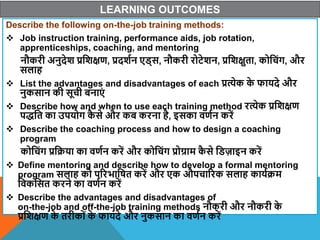
LEARNING OUTCOMES
Describe the following on-the-job training methods:
 Job instruction training, performance aids, job rotation,
apprenticeships, coaching, and mentoring
नौकरी अनुदेि प्रविक्षण, प्रदिान एि्स, नौकरी रोटेिन, प्रविक्षुता, कोवचंग, और
सलाह
 List the advantages and disadvantages of each प्रत्येक क
े फायदे और
नुकसान की सूची बनाएं
 Describe how and when to use each training method रत्येक प्रविक्षण
पद्वत का उपयोग क
ै से और कब करना है, इसका िणान करें
 Describe the coaching process and how to design a coaching
program
कोवचंग प्रवक्रया का िणान करें और कोवचंग प्रोग्राम क
ै से विजाइन करें
 Define mentoring and describe how to develop a formal mentoring
program सलाह को पररभावषत करें और एक औपचाररक सलाह कायाक्रम
विकवसत करने का िणान करें
 Describe the advantages and disadvantages of
on-the-job and off-the-job training methods नौकरी और नौकरी क
े
प्रविक्षण क
े तरीकों क
े फायदे और नुकसान का िणान करें
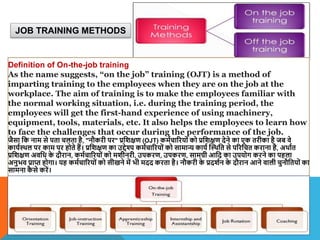
JOB TRAINING METHODS
Definition of On-the-job training
As the name suggests, “on the job” training (OJT) is a method of
imparting training to the employees when they are on the job at the
workplace. The aim of training is to make the employees familiar with
the normal working situation, i.e. during the training period, the
employees will get the first-hand experience of using machinery,
equipment, tools, materials, etc. It also helps the employees to learn how
to face the challenges that occur during the performance of the job.
जैसा वक नाम से पता चलता है, "नौकरी पर" प्रविक्षण (OJT) कमाचाररयों को प्रविक्षण देने का एक तरीका है जब िे
कायाथिल पर काम पर होते हैं। प्रविक्षण का उद्देश्य कमाचाररयों को सामान्य काया स्थिवत से पररवचत कराना है, अिाात
प्रविक्षण अिवध क
े दौरान, कमाचाररयों को मिीनरी, उपकरण, उपकरण, सामग्री आवद का उपयोग करने का पहला
अनुभि प्राप्त होगा। यह कमाचाररयों को सीखने में भी मदद करता है। नौकरी क
े प्रदिान क
े दौरान आने िाली चुनौवतयों का
सामना क
ै से करें।
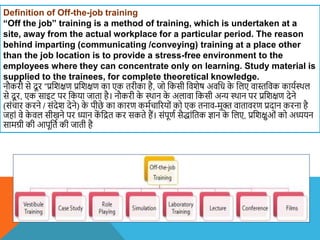
Definition of Off-the-job training
“Off the job” training is a method of training, which is undertaken at a
site, away from the actual workplace for a particular period. The reason
behind imparting (communicating /conveying) training at a place other
than the job location is to provide a stress-free environment to the
employees where they can concentrate only on learning. Study material is
supplied to the trainees, for complete theoretical knowledge.
नौकरी से दू र ”प्रविक्षण प्रविक्षण का एक तरीका है, जो वकसी वििेष अिवध क
े वलए िास्तविक कायशस्थल
से दू र, एक साइट पर वकया जाता है। नौकरी क
े स्थान क
े अलािा वकसी अन्य स्थान पर प्रविक्षण देने
(संचार करने / संदेि देने) क
े पीछे का कारण कमशचाररयों को एक तनाि-मुक्त िातािरण प्रदान करना है
जहां िे क
े िल सीखने पर ध्यान क
ें वित कर सकते हैं। संपूणश सैद्ांवतक ज्ान क
े वलए, प्रविक्षुओं को अध्ययन
सामग्री की आपूवतश की जाती है
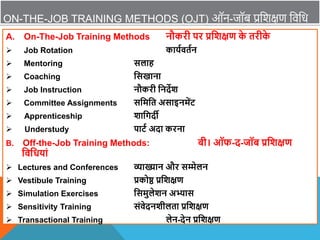
ON-THE-JOB TRAINING METHODS (OJT) ऑन-जॉब प्रविक्षण विवध
A. On-The-Job Training Methods नौकरी पर प्रविक्षण क
े तरीक
े
 Job Rotation कायाितान
 Mentoring सलाह
 Coaching वसखाना
 Job Instruction नौकरी वनदेि
 Committee Assignments सवमवत असाइनमेंट
 Apprenticeship िावगदी
 Understudy पाटा अदा करना
B. Off-the-Job Training Methods: बी। ऑफ-द-जॉब प्रविक्षण
विवधयां
 Lectures and Conferences व्याख्यान और सम्मेलन
 Vestibule Training प्रकोष्ठ प्रविक्षण
 Simulation Exercises वसमुलेिन अभ्यास
 Sensitivity Training संिेदनिीलता प्रविक्षण
 Transactional Training लेन-देन प्रविक्षण
ON-THE-JOB TRAINING METHODS (OJT) ऑन-जॉब प्रविक्षण विवध
(OJT)
Trainee receives instruction and training at work station from a supervisor
or experienced co-worker
प्रविक्षु पयािेक्षक या अनुभिी सह कायाकताा से काया स्टेिन पर वनदेि और प्रविक्षण प्राप्त करता है
 Most common approach to training प्रविक्षण क
े वलए सबसे आम दृविकोण
 Especially useful for small businesses वििेष रूप से छोटे व्यिसायों क
े वलए उपयोगी
 Most misused: सबसे ज्यादा दुरुपयोग हआ
 Often not well planned or structured अक्सर अच्छी तरह से वनयोवजत या संरवचत
नहीं
 People assigned to train have no training to be trainer
टिेन को सौंपा गया लोगों क
े पास टिेनर बनने क
े वलए कोई प्रविक्षण नहींहै
 Potential transfer of undesirable habits/attitudes
अिांछनीय आदतों / दृविकोणों का संभावित हस्तांतरण
 Trainers worry about someone taking their job
प्रविक्षक वकसी को अपनी नौकरी लेने की वचंता करते हैं
 Structured approach most effective संरवचत दृविकोण सबसे प्रभािी
 It is directly in the context/situation of job यह सीधे नौकरी क
े संदभा /
स्थिवत में है
 It is often informal यह अक्सर अनौपचाररक होता है
 It is most effective because it is learning by experience
यह सबसे प्रभािी है क्योंवक यह अनुभि से सीख रहा है
 It is least expensive यह कम से कम महंगा है
 Trainees are highly motivated प्रविक्षु अत्यवधक प्रेररत होते हैं
 It is free from artificial classroom situations यह क
ृ वत्रम कक्षा स्थिवतयों से
मुि है
Disadvantages of On-the-Job Training:
 Trainer may not be experienced enough to train or he may not be so inclined.
टिेनर को प्रविवक्षत करने क
े वलए पयााप्त
अनुभि नहीं हो सकता है या िह इतना इच्छुक नहीं हो सकता है।
 It is not systematically organized यह व्यिस्थित रूप से व्यिस्थित
नहीं है
 Poorly conducted programs may create safety hazards.
Advantages of On-the-Job Training:
 Address students by name छात्रों को नाम से संबोवधत करें
 Use “please” and “thank you ” क
ृ पया" और "धन्यिाद" का प्रयोग करें
 Listen बात सुनो
 Don’t allow bullying/teasing/put downs धमकाने / वचढ़ाने / नीचे िालने की अनुमवत न दें
 Make Eye Contact आाँख से संपक
ा करें
 Accept more than one answer एक से अवधक उत्तर स्वीकार करें
 Allow for anonymous(unspecified/unkonwn) positive feedback.
अनाम (अवनवदाि / अप्रकावित) सकारात्मक प्रवतवक्रया क
े वलए अनुमवत दें।
 Do a lineup लाइनअप करें
 Use a variety of inquiry methods विवभन्न प्रकार की जांच विवधयों का उपयोग करें
 Greet students at the door दरिाजे पर छात्रों का अवभिादन वकया
 encouraging learner participation विक्षािी की भागीदारी को प्रोत्सावहत करना
 using interactive learning approaches to transfer skills and knowledge to
learners
कौिल और ज्ञान क
े हस्तांतरण क
े वलए इंटरैस्िि सीखने क
े दृविकोण का
उपयोग करना सीखने िालों क
े वलए
HOW TO CREATE AND MAINTAIN A POSITIVE LEARNING ENVIRONMENT
एक सकारात्मक सीखने क
े माहौल को क
ै से बनाएं और बनाए रखें
KEY DIFFERENCES BETWEEN ON-THE-JOB AND OFF-THE-JOB
TRAINING
O N - T H E - J O B T R A I N I N G
 The training method used to impart training to employees while he is at the
workplace performing the
 कमाचाररयों को प्रविक्षण प्रदान करने क
े वलए इस्तेमाल की जाने िाली प्रविक्षण पद्वत, जब िह कायाथिल
पर होता है
 job is known as On-the-job training.
 नौकरी को ऑन-द-जॉब प्रविक्षण क
े रूप में जाना जाता है।
 On the job training has a practical approach
 नौकरी प्रविक्षण पर एक व्यािहाररक दृविकोण है
 On the job training involves the hands-on experience of the trainees
 नौकरी पर प्रविक्षण में प्रविक्षुओं का व्यािहाररक अनुभि िावमल है
 On the job’ training involves learning by doing
 नौकरी पर 'प्रविक्षण में करक
े सीखना िावमल है
 On-the-job training is carried out by the experienced employees
 ऑन-द-जॉब प्रविक्षण अनुभिी कमाचाररयों िारा वकया जाता है
 On the job training is appropriate for manufacturing entities
 नौकरी पर प्रविक्षण विवनमााण संथिाओं क
े वलए उपयुि है
KEY DIFFERENCES BETWEEN ON-THE-JOB AND OFF-THE-JOB
O F F - T H E - J O B
T R A I N I N G
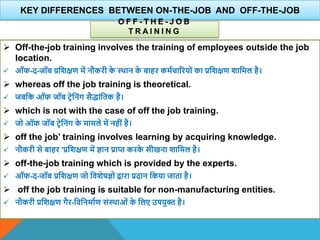
 Off-the-job training involves the training of employees outside the job
location.
 ऑफ-द-जॉब प्रविक्षण में नौकरी क
े थिान क
े बाहर कमाचाररयों का प्रविक्षण िावमल है।
 whereas off the job training is theoretical.
 जबवक ऑफ जॉब टिेवनंग सैद्ांवतक है।
 which is not with the case of off the job training.
 जो ऑफ जॉब टिेवनंग क
े मामले में नहीं है।
 off the job’ training involves learning by acquiring knowledge.
 नौकरी से बाहर 'प्रविक्षण में ज्ञान प्राप्त करक
े सीखना िावमल है।
 off-the-job training which is provided by the experts.
 ऑफ-द-जॉब प्रविक्षण जो वििेषज्ञों िारा प्रदान वकया जाता है।
 off the job training is suitable for non-manufacturing entities.
 नौकरी प्रविक्षण गैर-विवनमााण संथिाओं क
े वलए उपयुि है।
MONITOR AND EVALUATE PERFORMANCE ON-THE JOB OR IN A SIMULATED WORK
ENVIRONMENT
काम पर या एक नकली काम क
े माहौल में प्रदिान की वनगरानी और मूल्ांकन करें
key points
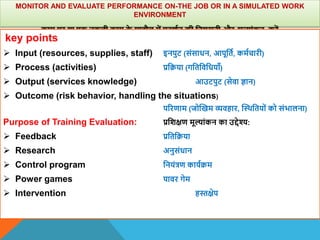
 Input (resources, supplies, staff) इनपुट (संसाधन, आपूवता, कमाचारी)
 Process (activities) प्रवक्रया (गवतविवधयााँ)
 Output (services knowledge) आउटपुट (सेिा ज्ञान)
 Outcome (risk behavior, handling the situations)
पररणाम (जोस्खम व्यिहार, स्थिवतयों को संभालना)
Purpose of Training Evaluation: प्रविक्षण मूल्ांकन का उद्देश्य:
 Feedback प्रवतवक्रया
 Research अनुसंधान
 Control program वनयंत्रण कायाक्रम
 Power games पािर गेम
 Intervention हस्तक्षेप
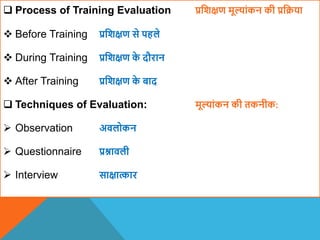
 Process of Training Evaluation प्रविक्षण मूल्ांकन की प्रवक्रया
 Before Training प्रविक्षण से पहले
 During Training प्रविक्षण क
े दौरान
 After Training प्रविक्षण क
े बाद
 Techniques of Evaluation: मूल्ांकन की तकनीक:
 Observation अिलोकन
 Questionnaire प्रश्नािली
 Interview साक्षात्कार
CARRY OUT POST-TRAINING ACTIVITIES
प्रविक्षण क
े बाद की गवतविवधयों को पूरा करें
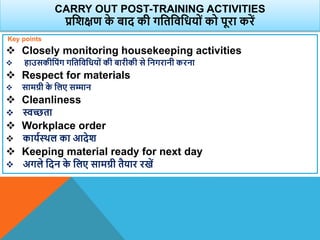
Key points
 Closely monitoring housekeeping activities
 हाउसकीवपंग गवतविवधयों की बारीकी से वनगरानी करना
 Respect for materials
 सामग्री क
े वलए सम्मान
 Cleanliness
 स्वच्छता
 Workplace order
 कायाथिल का आदेि
 Keeping material ready for next day
 अगले वदन क
े वलए सामग्री तैयार रखें
MEP/N2604 UNDERTAKE ASSESSMENT OF COMPETENCE AS PER REQUIRED
STANDARDS
आिश्यक मानकों क
े अनुसार क्षमता का अंिरटेवक
ं ग मूल्ांकन
Scope
Prepare for undertaking assessment of competence as per standards
 Training Schedule प्रविक्षण कायाक्रम
 Training Plan प्रविक्षण की योजना
 Unity of Competency as per benchmarks बेंचमाक
ा क
े अनुसार योग्यता की एकता
 Assessment tools (required for evidence) मूल्ांकन उपकरण (सबूत क
े वलए
आिश्यक)
 Required tools & equipment आिश्यक उपकरण और
उपकरण
 Required raw materials as per no of students छात्रों क
े अनुसार आिश्यक
कच्चे माल
What is Benchmark?
 As per job role standards of Sector Skill Council announcement
qualification packs NSDC approved i.e. QP & NoSs
सेिर स्स्ल काउंवसल की नौकरी क
े मानकों क
े अनुसार, योग्यता की घोषणा NSDC करती है स्वीक
ृ त यानी
QP & NoSs
 Training Organization’s system policies and procedures:
प्रविक्षण संगठन की नीवतयों और प्रवक्रयाओं:
a. candidate selection उम्मीदिार का चयन
b. rationale and purpose of competency-based assessment
योग्यता आधाररत मूल्ांकन का औवचत्य और उद्देश्य
c. costs/resourcing लागत / संसाधनों
Conduct assessment of competence
How to use assessment tools for various purposes?
 Evaluate level of competence
 क्षमता क
े स्तर का मूल्ांकन
 Evaluate learning retention
 सीखने की अिधारण का मूल्ांकन
 Monitor learner progress against program and session objectives
 कायाक्रम और सत्र उद्देश्यों क
े स्खलाफ सीखने की प्रगवत की वनगरानी करना
 Identify learner learning needs against required curriculum
 आिश्यक पाठ्यक्रम क
े विरुद् सीखने िाले की पहचान करना
 Provide feedback to learners on progress
 प्रगवत पर विक्षाविायों को प्रवतवक्रया प्रदान करना
 Create development plan for further learning
 आगे सीखने क
े वलए विकास योजना बनाएं
 Assess learning styles
 सीखने की िैवलयों का आकलन करें;
 Assess learner soft skills
 सीखने िाले सॉफ्ट स्स्ल का आकलन करें
How does gather evidence of performance applying the principles of assessment?
valid, reliable, flexible and fair.
Assessors must ensure that assessment decisions involve the evaluation of sufficient
evidence to enable a judgement to be made on the competence of the candidate.
मूल्ांकनकतााओं को यह सुवनवित करना चावहए वक मूल्ांकन वनणायों में उम्मीदिार की सक्षमता पर वनणाय लेने क
े वलए पयााप्त
साक्ष् का मूल्ांकन िावमल है
Validity - An assessment is valid if the assessment methods and materials reflect the
elements, performance criteria and critical aspects of evidence in the evidence guide of the
unit(s) of competency.
िैधता - एक मूल्ांकन मान्य है यवद मूल्ांकन क
े तरीक
े और सामग्री तत्, प्रदिान मानदंि और सबूत क
े महत्पूणा पहलुओं को
दिााते हैं जो वक सक्षमता क
े यूवनट (एस) क
े साक्ष् गाइि में हैं।
Reliability - Refers to the degree of consistency and accuracy of the assessment
outcomes. That is, the extent to which the assessment will provide similar outcomes for
candidates with equal competence at different times or places, regardless of the assessor
conducting the assessment.
विश्वसनीयता, मूल्ांकन पररणामों की स्थिरता और सटीकता की विग्री को संदवभात करता है। यह है वक, मूल्ांकन करने िाले
का मूल्ांकन करने िाले की परिाह वकए वबना, मूल्ांकन अलग-अलग समय या थिानों पर समान योग्यता िाले उम्मीदिारों क
े
वलए समान पररणाम प्रदान करेगा।
Flexibility - Refers to the opportunity for a candidate to negotiate certain aspects of their
assessment (for example, timing) with their assessor.
लचीलापन - एक उम्मीदिार को अपने मूल्ांकनकताा क
े साि अपने मूल्ांकन क
े क
ु छ पहलुओं (उदाहरण क
े वलए, समय) पर
बातचीत करने क
े अिसर क
े वलए संदवभात करता है।
Fair - Assessment does not advantage or disadvantage particular learners or groups of
learners. (No partiality )
RULES OF EVIDENCE
Valid
 Relates to the unit or units of competency appropriately
 Reflects all four dimensions of competency
 Provides evidence of Employability Skills
 Appropriate to the NSQF alignment being assessed.
Sufficient
 Provides enough evidence to make a judgment about the competence of the
individual in relation to all four dimensions of competency.
 Meets all the evidence requirements for the unit of competence.
Current
 Recent enough to show that the skills and knowledge are still able
to be applied to a current work situation.
Authentic
 Is the candidate’s own work (and procedures have been developed
to ensure this).
What is the principle of reasonable adjustment and when they are
applicable?
 Reasonable adjustment in VET is the term applied to modifying the learning
environment or making changes to the training delivered to assist a learner
with a disability.
 VET में उवचत समायोजन सीखने क
े माहौल को संिोवधत करने या विकलांगता से सीखने िाले की सहायता क
े वलए वदए
गए प्रविक्षण में बदलाि करने क
े वलए लागू वकया गया िब्द है।
 A reasonable adjustment in teaching, learning and assessment activity needs
to be justifiable and uphold the integrity of the qualification.
 विक्षण, सीखने और मूल्ांकन गवतविवध में एक उवचत समायोजन उवचत होना चावहए और योग्यता की अखंिता को बनाए
रखना चावहए
 There are specific things you might consider in the decision making process.
Think about the learner’s needs around:
 writing
 reading
 hearing
 communicating with others or getting ideas across
दू सरों क
े साि संिाद करना या विचार प्राप्त करना
 moving or manipulating (influencing) objects
िस्तुओं को वहलाना या हेरफ
े र (प्रभावित करना)
 paying attention / staying on track टिैक पर ध्यान देना / रहना
 sitting for long periods लंबे समय तक बैठे रहना
 moving around the learning environment सीखने क
े माहौल में घूमना
 remembering / retention याद / प्रवतधारण
 dealing with frustration(disappointment). हतािा (वनरािा) से वनपटना।
What is training?
Training means helping people to learn how to do
something, telling people what they should or should not
do, or simply giving them information. Training isn’t just
about formal ‘classroom’ courses.
प्रविक्षण का मतलब लोगों को यह जानने में मदद करना है वक क
ु छ क
ै से करें, लोगों को बताएं वक उन्हें क्या
करना चावहए या क्या नहीं करना चावहए, या बस उन्हें जानकारी देनी चावहए। प्रविक्षण क
े िल औपचाररक
’कक्षा क
े पाठ्यक्रमों क
े बारे में नहीं है।
 Why provide health and safety training?
Providing health and safety information and training helps
you to:
ensure that people who work for you know how to work
safely and without risks to health;
सुवनवित करें वक जो लोग आपक
े वलए काम करते हैं िे जानते हैं वक स्वास्थ्य क
े वलए सुरवक्षत रूप से और
जोस्खम क
े वबना क
ै से काम करें
Develop a positive health and safety culture, where safe and
healthy working becomes second nature to everyone;
एक सकारात्मक स्वास्थ्य और सुरक्षा संस्
ृ वत विकवसत करना, जहां सुरवक्षत और स्वथि काम
MEP/N9911 Apply health and safety practices applicable in a training and
assessment environment
 Meet your legal duty to protect the health and safety of your
employees
 अपने कमाचाररयों क
े स्वास्थ्य और सुरक्षा की रक्षा क
े वलए अपने कानूनी कताव्य को पूरा करें
Effective training:
 Will contribute towards making your employees competent in
health and safety;
 अपने कमाचाररयों को स्वास्थ्य और सुरक्षा में सक्षम बनाने में योगदान देगा
 Can help our business/training avoid the distress that
accidents and ill health cause;
 आपक
े व्यिसाय / प्रविक्षण को संकट और दुघाटना क
े कारण से बचने में मदद कर सकता है;
 Can help you avoid the financial costs of accidents and
occupational ill health, such as damaged products, lost
production and demotivated staff.
 आप दुघाटनाओं और व्यािसावयक बीमार स्वास्थ्य की वित्तीय लागत से बचने में मदद कर सकते हैं, जैसे
क्षवतग्रस्त उत्पाद, खोया उत्पादन और ध्वस्त कमाचारी।
 Don’t forget that your insurance might not cover all these
costs.
 यह मत भूलो वक आपका बीमा इन सभी लागतों को किर नहीं कर सकता है
Who needs health and safety training?
 You do! Whether you are an employer or self-employed, are you sure
that you’re up to date with how to identify the hazards and control the
risks from your work?
तुम करो! चाहे आप एक वनयोिा या स्व-वनयोवजत हैं, क्या आप सुवनवित हैं वक आप अपने काम क
े खतरों को
पहचानने और जोस्खमों को वनयंवत्रत करने की तारीख क
े साि हैं |
 Your managers and supervisors do! If you employ managers or
supervisors they need to know what you expect from them in terms of
health and safety, and how you expect them to deliver.
आपक
े प्रबंधक और पयािेक्षक करते हैं! यवद आप प्रबंधकों या पयािेक्षकों को वनयुि करते हैं, तो उन्हें यह
जानना होगा वक आप स्वास्थ्य और सुरक्षा क
े मामले में उनसे क्या अपेक्षा करते हैं, और आप उन्हें क
ै से प्रदान
करने की अपेक्षा करते हैं।
 Your employees do! Everyone who works for you, including self-
employed people, needs to know how to work safely and without risks
to health.
आपक
े कमाचारी करते हैं! हर कोई जो आपक
े वलए काम करता है, वजसमें स्व-वनयोवजत लोग भी िावमल हैं, यह
जानना आिश्यक है वक स्वास्थ्य क
े वलए सुरवक्षत और जोस्खम रवहत काम क
ै से करें।
 You should:
1- take into account the capabilities, training, knowledge and experience
of workers.
श्वमकों की क्षमताओं, प्रविक्षण, ज्ञान और अनुभि को ध्यान में रखना |
2- ensure that the demands of the job do not exceed their ability to carry
out their work without risk to themselves and others.
The individual on the job needs to know and understand:
Health Safety and Environment (HSE) practices including the
appropriate use of personal protective equipment-
 Safety helmet
 hand gloves,
 safety shoes,
 Safety Harness /lanyard
 Safety goggles,
 Safety masks, apron,
 Safe use of tools and equipment,
 Taking action and reporting hazardous events,
 Communication protocols for reporting risks and hazardous
events
 Various best practices for effectively facilitating learning of work
skills on-the job or in a simulated work environment (SWE)
नौकरी पर या वसम्युलेटेि काया िातािरण (SWE) में काया कौिल सीखने की सुविधा क
े वलए
विवभन्न सिोत्तम अभ्यास
 What is the SWE?
This one-day learning experience is an excellent example of how
through standard work; teamwork, communication and
collaboration, a team can become significantly more productive
and cost effective whilst(at the same time as) improving quality and
identifying as well as reducing safety issues.
यह एक वदिसीय सीखने का अनुभि मानक काया क
े माध्यम से एक उत्क
ृ ि उदाहरण है; टीमिक
ा , संचार
और सहयोग, एक टीम गुणित्ता में सुधार और सुरक्षा क
े मुद्दों को कम करने क
े साि-साि गुणित्ता में
सुधार और पहचान करने क
े साि-साि काफी अवधक उत्पादक और लागत प्रभािी हो सकती है।
The theories and disciplines learnt can be transferred to all work
environments such as:
Administration िासन प्रबंध
Manufacturing उत्पादन
Engineering अवभयांवत्रकी
Service Sector सेिा क्षेत्र
Office कायाालय
 Roles and responsibilities of key personnel (workers, staff &
employees ,etc.)
प्रमुख कवमायों की भूवमकाएं और वजम्मेदाररयां (कायाकताा, कमाचारी और कमाचारी, आवद)
 Responsibilities of learners विक्षाविायों की वजम्मेदाररयां
 Hazard identification जोस्खम को पहचानना
 Risk assessment जोस्खम आकलन
 safe use of equipment and emergency procedures
उपकरण और आपातकालीन प्रवक्रयाओं का सुरवक्षत उपयोग
 risk controls for the specific learning environment
सीखने क
े विविि िातािरण क
े वलए जोस्खम वनयंत्रण
 how to handle hazardous materials, tools and equipment
क
ै से खतरनाक सामग्री, उपकरण और उपकरणों को संभालने क
े वलए
 long term value of good posture and use of appropriate
handling equipment
अच्छी मुिा का दीघाकावलक मूल् और उवचत हैंिवलंग का उपयोग उपकरण
Key workplace health and safety (WHS) issues in the learning
environment.
MEP/N9912 Apply principles of professional practice at the
workplace.
Maintain a professional image and behaviour:
Understanding examples of professional and ethical behavior can help you to
develop your own effective work habits. Be conscious of how you treat co-
workers/trainees and your workplace attitude and you can improve your
productivity /positive environment and effectiveness.
I. Communication: Ethical treatment of your co-workers and managers
means being respectful of the need for efficient and accurate communication
II. Time Management: Techniques of effective time management
1. Eliminate the Unnecessary (Get up early)
2. Plan Your Work
(Always plan ahead and make daily ‘to-do’ lists)
3. Multitasking
(Start with difficult and less exciting tasks first)
4. Know When To Multitask
(Schedule and organize your time)
5. Reduce Interruptions (Prioritizing
A-Reliability विश्वसनीयता
B-Competence क्षमता
C-Ethics आचार
D-Maintaining Your Poise (dignity/decorum/self-respect)
आपकी कविता को बनाए रखना (गररमा / अलंकार / आत्म-सम्मान)
E-Phone Etiquette(manner) फोन वििाचार (ढंग)
F-Written Correspondence वलस्खत पत्राचार
G-Organizational Skills संगठनात्मक कौिल
H-Accountability जिाबदेही
I-Sense of Responsibility & Discipline
वजम्मेदारी और अनुिासन
J-Dedication to the Job & Emphasis on Quality of training
नौकरी और विक्षा की गुणित्ता पर समपाण
10 Characteristics of Professionalism
MAINTAIN A SAFE ENVIRONMENT
 It’s an employer’s responsibility to make sure employees are working in a safe and
healthy environment. यह सुवनवित करना वनयोिा की वजम्मेदारी है वक कमाचारी सुरवक्षत और स्वथि िातािरण में
काम कर रहे हैं
 That is why they must take measures to ensure the safety of everyone- that includes
their physical safety and welfare. The safety and health of employees needs to be a
main priority for employers. इसवलए उन्हें हर वकसी की सुरक्षा सुवनवित करने क
े उपाय करने चावहए- वजसमें
उनकी िारीररक सुरक्षा और कल्ाण िावमल हो। वनयोिाओं क
े वलए कमाचाररयों की सुरक्षा और स्वास्थ्य एक मुख्य
प्रािवमकता होनी चावहए
1- Involve your employees/trainees in safety planning. सुरक्षा योजना में अपने कमाचाररयों /
प्रविक्षुओं को िावमल करें।
2- Provide clear work instructions. स्पि काया वनदेि प्रदान करें।
3- Focus your safety efforts on the most likely issues. सबसे अवधक संभावित मुद्दों पर अपने
सुरक्षा प्रयासों पर ध्यान दें।
4- Create a safe work area. एक सुरवक्षत काया क्षेत्र बनाएं ।
5- Maintain a clean work area. एक स्वच्छ काया क्षेत्र को बनाए रखें।
6- Encourage your employees/trainees to have a voice in safety. अपने कमाचाररयों /
प्रविक्षुओं को सुरक्षा क
े वलए आिाज देने क
े वलए प्रोत्सावहत करें।
7- Focus on how each employee/trainees performs his/her job. प्रत्येक कमाचारी / प्रविक्षु
अपना काम क
ै से करता है, इस पर ध्यान दें।
8- Maintain all tools & machinery in good working order. सभी उपकरणों और मिीनरी को अच्छे
काया क्रम में बनाए रखें।
9- Avoid and remove unnecessary hazards. अनािश्यक खतरों से बचें और दू र करें।
10- Revisit your safety guidelines every year. हर साल अपने सुरक्षा वदिावनदेिों का पुनरीक्षण करें।
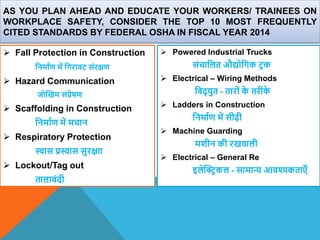
AS YOU PLAN AHEAD AND EDUCATE YOUR WORKERS/ TRAINEES ON
WORKPLACE SAFETY, CONSIDER THE TOP 10 MOST FREQUENTLY
CITED STANDARDS BY FEDERAL OSHA IN FISCAL YEAR 2014
 Fall Protection in Construction
वनमााण में वगरािट संरक्षण
 Hazard Communication
जोस्खम संप्रेषण
 Scaffolding in Construction
वनमााण में मचान
 Respiratory Protection
स्वास प्रस्वास सुरक्षाा
 Lockout/Tag out
तालाबंदी
 Powered Industrial Trucks
संचावलत औद्योवगक टि क
 Electrical – Wiring Methods
विद् युत - तारों क
े तरीक
े
 Ladders in Construction
वनमााण में सीढ़ी
 Machine Guarding
मिीन की रखिाली
 Electrical – General Re
इलेस्िि कल - सामान्य आिश्यकताएाँ
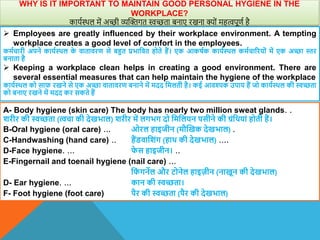
WHY IS IT IMPORTANT TO MAINTAIN GOOD PERSONAL HYGIENE IN THE
WORKPLACE?
कायशस्थल में अच्छी व्यक्तक्तगत स्वच्छता बनाए रखना क्ों महत्वपूणश है
 Employees are greatly influenced by their workplace environment. A tempting
workplace creates a good level of comfort in the employees.
कमाचारी अपने कायाथिल क
े िातािरण से बहत प्रभावित होते हैं। एक आकषाक कायाथिल कमाचाररयों में एक अच्छा स्तर
बनाता है
 Keeping a workplace clean helps in creating a good environment. There are
several essential measures that can help maintain the hygiene of the workplace
कायाथिल को साफ रखने से एक अच्छा िातािरण बनाने में मदद वमलती है। कई आिश्यक उपाय हैं जो कायाथिल की स्वच्छता
को बनाए रखने में मदद कर सकते हैं
A- Body hygiene (skin care) The body has nearly two million sweat glands. .
िरीर की स्वच्छता (त्चा की देखभाल) िरीर में लगभग दो वमवलयन पसीने की ग्रंवियां होती हैं।
B-Oral hygiene (oral care) ... ओरल हाइजीन (मौस्खक देखभाल) .
C-Handwashing (hand care) .. हैंििाविंग (हाि की देखभाल) ....
D-Face hygiene. ... फ
े स हाइजीन। ..
E-Fingernail and toenail hygiene (nail care) ...
वफ
ं गनेल और टोनेल हाइजीन (नाखून की देखभाल)
D- Ear hygiene. ... कान की स्वच्छता।
F- Foot hygiene (foot care) पैर की स्वच्छता (पैर की देखभाल)
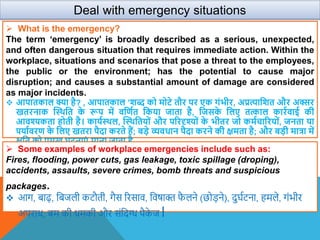
 What is the emergency?
The term ‘emergency’ is broadly described as a serious, unexpected,
and often dangerous situation that requires immediate action. Within the
workplace, situations and scenarios that pose a threat to the employees,
the public or the environment; has the potential to cause major
disruption; and causes a substantial amount of damage are considered
as major incidents.
 आपातकाल क्या है? , आपातकाल ’िब्द को मोटे तौर पर एक गंभीर, अप्रत्यावित और अक्सर
खतरनाक स्थिवत क
े रूप में िवणात वकया जाता है, वजसक
े वलए तत्काल कारािाई की
आिश्यकता होती है। कायाथिल, स्थिवतयों और पररदृश्यों क
े भीतर जो कमाचाररयों, जनता या
पयाािरण क
े वलए खतरा पैदा करते हैं; बडे व्यिधान पैदा करने की क्षमता है; और बडी मात्रा में
क्षवत को प्रमुख घटनाएं माना जाता है
Deal with emergency situations
 Some examples of workplace emergencies include such as:
Fires, flooding, power cuts, gas leakage, toxic spillage (droping),
accidents, assaults, severe crimes, bomb threats and suspicious
packages.
 आग, बाढ़, वबजली कटौती, गैस ररसाि, विषाक्त फ
ै लने (छोड़ने), दुर्शटना, हमले, गंभीर
अपराध, बम की धमकी और संवदग्ध पैक
े ज।
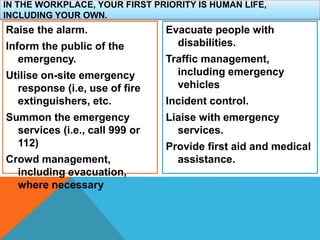
IN THE WORKPLACE, YOUR FIRST PRIORITY IS HUMAN LIFE,
INCLUDING YOUR OWN.
Raise the alarm.
Inform the public of the
emergency.
Utilise on-site emergency
response (i.e, use of fire
extinguishers, etc.
Summon the emergency
services (i.e., call 999 or
112)
Crowd management,
including evacuation,
where necessary
Evacuate people with
disabilities.
Traffic management,
including emergency
vehicles
Incident control.
Liaise with emergency
services.
Provide first aid and medical
assistance.
new TOT ppt 2601 - Copy.pptx

new TOT ppt 2601 - Copy.pptx

  • 1.
    QUALIFICATIONS PACK :TRAINER QUALIFICATIONS PACK CODE : MEP/Q02601 SECTOR : All Sectors OCCUPATION : Trainer REFERENCE ID/QP Code : MEP/Q2601, V1.0 NSQF LEVEL : 5 MEPSC Management & Entrepreneurship and Professional Skills Council WELCOME TO ALL TRAINER OF TRAINING PROGRAM (PLATFORM SKILL) OP Jindal Community College Punjipathra
  • 2.
    1. MEP/N2601 Planand organize for facilitation of a training program 2. MEP/N2602 Deliver competency based, instructor-led training sessions as per session plan 3. MEP/N2618 Facilitate learning through on-the-job or in a simulated training 4. MEP/N2604 Undertake assessment of competence as per required standards 5. MEP/N9903 Apply health and safety practices at the workplace 6. MEP/N9912 Apply principles of professional practice at the workplace
  • 3.
     Interpret learningenvironment and delivery requirements सीखने क े माहौल और वितरण आिश्यकताओं की व्याख्या करें  Prepare session plans सत्र की योजना तैयार करें  Prepare resources for delivery वितरण क े वलए संसाधन तैयार करें  Deliver and facilitate training sessions वितररत करें और प्रविक्षण सत्रों की सुविधा प्रदान करें  Organize training environment प्रविक्षण का िातािरण व्यिस्थित करें
  • 4.
    Performance Criteria: 1. Access,read and interpret learning program documentation to determine delivery requirements वितरण आिश्यकताओं को वनधााररत करने क े वलए सीखने क े कायाक्रम प्रलेखन तक पहंच, पढ़ना और व्याख्या करना 2. Use available information and documentation to identify group and individual learner needs and learner characteristics समूह और व्यस्िगत विक्षाविायों की जरूरतों और सीखने की वििेषताओं की पहचान करने क े वलए उपलब्ध जानकारी और प्रलेखन का उपयोग करें 3. Identify and assess constraint and risks to delivery पहचान और आकलन और वितरण क े वलए जोस्खम 4. Confirm personal role and responsibilities in planning and delivering training with relevant personnel संबंवधत कवमायों क े साि प्रविक्षण की योजना बनाने और वितररत करने में व्यस्िगत भूवमका और वजम्मेदाररयों की पुवि करें Interpret learning environment and delivery requirements सीखने क े माहौल और वितरण आिश्यकताओं की व्याख्या करें
  • 5.
    Performance Criteria: 1. Refineexisting learning objectives according to program requirements and specific needs of individual learners कायाक्रम की आिश्यकताओं और व्यस्िगत विक्षाविायों की विविि आिश्यकताओं क े अनुसार मौजूदा विक्षण उद्देश्यों को पररष्क ृ त करें 2. Develop session plans and document these for each segment of the learning program लवनिंग प्रोग्राम क े प्रत्येक सेगमेंट क े वलए सत्र योजनाएं और इनका विकास करें 3. Use knowledge of learning principles and theories to generate ideas for managing session delivery सत्र वितरण क े प्रबंधन क े वलए विचारों को उत्पन्न करने क े वलए सीखने क े वसद्ांतों और वसद्ांतों क े ज्ञान का उपयोग करें Prepare session plans सत्र की योजना तैयार करें
  • 6.
    Performance Criteria: 1. Contextualizeexisting learning materials to meet the needs of the specific learner group विविि विक्षािी समूह की जरूरतों को पूरा करने क े वलए मौजूदा विक्षण सामग्री का संदभा 2. Finalize learning materials and organize facility, technology and equipment needs in time for delivery of learning sessions सीखने की सामग्री को अंवतम रूप दें और विक्षण सत्रों क े वितरण क े वलए समय में सुविधा, तकनीक और उपकरणों की आिश्यकता को व्यिस्थित करें 3. Confirm overall delivery arrangements with relevant personnel संबंवधत कवमायों क े साि समग्र वितरण व्यिथिा की पुवि करें Prepare resources for delivery वितरण क े वलए संसाधन तैयार करें
  • 7.
    Performance Criteria: 1. Conducteach session according to session plan, modified where appropriate to meet learner needs सत्र की योजना क े अनुसार प्रत्येक सत्र का संचालन करें, जहां विक्षाविायों की जरूरतों को पूरा करने क े वलए उपयुि संिोवधत वकया गया हो 2. Use the diversity of the group as another resource to support learning सीखने का समिान करने क े वलए एक और संसाधन क े रूप में समूह की विविधता का उपयोग करें 3. Employ a range of delivery methods as training aids to optimise learner experiences सीखने क े अनुभिों को अनुक ू वलत करने क े वलए प्रविक्षण सहायता क े रूप में वितरण विवधयों की एक श्ृंखला को रोजगार दें 4. Demonstrate effective facilitation skills to ensure effective participation and group management प्रभािी भागीदारी और समूह प्रबंधन सुवनवित करने क े वलए प्रभािी सुविधा कौिल का प्रदिान Deliver and facilitate training sessions वितररत करें और प्रविक्षण सत्रों की सुविधा प्रदान करें
  • 8.
    Performance Criteria:  Ensureavailability of adequate training materials, facility, technology, tools and equipment in time for delivery of learning sessions  विक्षण सत्रों क े वितरण क े वलए समय में पयााप्त प्रविक्षण सामग्री, सुविधा, प्रौद्योवगकी, उपकरण और उपकरण की उपलब्धता सुवनवित करना Organize training environment प्रविक्षण का िातािरण व्यिस्थित करें  There are four types of learning environments, each with unique elements. Learning environments can be student- or learner-centered; knowledge- centered; assessment-centered; and community-centered  सीखने क े िातािरण चार प्रकार क े होते हैं, प्रत्येक अवितीय तत्ों क े साि। सीखने का िातािरण छात्र- या सीखने-क ें वित हो सकता है; ज्ञान क ें वित; मूल्ांकन क ें वित; और समुदाय-क ें वित  Ensure timely availability of support services as per requirement by coordinating with training coordinator.  प्रविक्षण समन्वयक क े साि समन्वय करक े आिश्यकता क े अनुसार समिान सेिाओं की समय पर उपलब्धता सुवनवित करें  Ensure training area is risk free and equipped with necessary health and safety resources like fire extinguishers, safety signage, clean toilets, dry flooring, security arrangements, etc.  सुवनवित करें वक प्रविक्षण क्षेत्र जोस्खम मुि है और आिश्यक स्वास्थ्य और सुरक्षा संसाधनों से लैस है जैसे अवििामक यंत्र, सुरक्षा साइनेज, स्वच्छ िौचालय, िुष्क फिा, सुरक्षा व्यिथिा, आवद।
  • 9.
    The learning outcomesfor this course will enable the learner to: इस पाठ्यक्रम क े वलए सीखने क े पररणाम विक्षािी को सक्षम बनाएं गे  Facilitate group-based learning by preparing and delivering a series of training sessions, प्रविक्षण सत्रों की एक श्ृंखला तैयार करक े और वितररत करक े समूह-आधाररत सीखने की सुविधा प्रदान करना  Identify and respond to diversity and individual needs विविधता और व्यस्िगत आिश्यकताओं की पहचान और प्रवतवक्रया  Access and use documented resources and support personnel to guide inclusive practice समािेिी अभ्यास का मागादिान करने क े वलए प्रलेस्खत संसाधनों और सहायता कवमायों का उपयोग और उपयोग Learning Outcomes वसखने का पररणाम
  • 10.
     Room/space appropriateto the style of delivery,  Data projector and laptop/computer and speakers, projection screen,  Flip charts with markers,  Whiteboard and whiteboard markers,  Trainer manual,  Learner handbook/workbook and any other learning materials and resources,  Other equipment specified in session plan How to set up training facilities, training equipment and too
  • 11.
     Writing atraining session or lesson plan – templates: Templates for writing a training session or a lesson plan can be a confusing task to people new to the world of learning. One of the challenges for a new trainer is the development of a lesson or session plan for a training course or module.  प्रविक्षण सत्र या पाठ योजना वलखना - टेम्प्लेट: प्रविक्षण सत्र या एक पाठ योजना वलखने क े वलए टेम्पलेट सीखने की दुवनया में नए लोगों क े वलए एक भ्रामक काया हो सकता है। एक नए प्रविक्षक क े वलए चुनौवतयों में से एक प्रविक्षण पाठ्यक्रम या मॉड्यूल क े वलए एक पाठ या सत्र योजना का विकास है How to create and modify session plan? सत्र योजना क ै से बनाएं और संिोवधत करें?
  • 12.
     Assessing Needsजरूरतों का आकलन  Writing Learning Objectives लेखन उद्देश्य  Measuring success (evaluation) मापने की सफलता (मूल्ांकन)  Outlining Content रूपरेखा सामग्री  Selecting Methods and Media चयन क े तरीक े और मीविया  Writing the Lesson Plan पाठ योजना वलखना  Once the information has been collected, the development of the lesson plan can begin in a sequential, logical manner. एक बार जानकारी एकत्र हो जाने क े बाद, पाठ योजना का विकास क्रमबद्, तावक ा क तरीक े से िुरू हो सकता है। When writing a lesson or session plans, consider the following factors: पाठ या सत्र योजना वलखते समय, वनम्नवलस्खत कारकों पर विचार करें:
  • 13.
    Prescribed and standardsession plan template Typical cover page of a course or lesson plan (template) & Content template:
  • 14.
    ACRONYMS  CBET -Competency- based education and training  CBLM - Competency-based learning material  CCE - Continuous and Comprehensive Evaluation  CII - Confederation of Indian Industry  CNIC - National Innovation Council for Competitiveness   CSWDF - Core Skills for Work Developmental Framework  CTS - Craftsmen Training Scheme  DGET -Directorate General of Employment and Training   GDP -Gross Domestic Product
  • 15.
     HEART -Human Employment and Resource Training  ICT -Information Communication Technology  ILO -International Labour Organization  ISC -Industry Skills Council  IT -Information Technology  ITI -Industrial Training Institute  LMS -Labour Market Survey  MES -Modular Employable Scheme  MHRD -Ministry of Human Resource Development  MOLE -Ministry of Labour and Employment  NCTVET -National Council for Technical and Vocational Education and Training  NCVT -National Council for Vocational Training
  • 16.
    NOS -National OccupationalStandards NQF -National Qualifications Framework NSDC -National Skill Development Corporation NSO -National Statistics Office NSQF -National Skills Qualification Framework NSSC -National Skills Standards Council NTA -National Training Agency NTR -No Training Regulations NVEQF -National Vocational Education Qualification Framework SSC -Sector Skills Council TESDA -Technical Education and Skills Development Authority TEVET -Technical, Entrepreneurial and Vocational Education and Training TEVETA -Technical, Entrepreneurial and Vocational, Education and Training Authority TRs -Training regulations TVET -Technical Vocational Education and Training VET -Vocational Education and Training
  • 17.
    MEP/N2602: DELIVER COMPETENCYBASED, INSTRUCTOR-LED TRAINING SESSIONS AS PER SESSION PLAN सत्र योजना क े अनुसार योग्यता आधाररत, प्रविक्षक क े नेतृत्व िाले सत्र वितररत करें Scope Deliver and facilitate training sessions वितररत करें और प्रविक्षण सत्रों की सुविधा प्रदान करें Support and monitor learning समिान और सीखने की वनगरानी Undertake post training activities प्रविक्षण क े बाद की गवतविवधयााँ करें
  • 18.
    DELIVER AND FACILITATETRAINING SESSIONS वितररत करें और प्रविक्षण सत्रों की सुविधा प्रदान करें Learning points:  Conduct each session according to the session plan,  सत्र योजना क े अनुसार प्रत्येक सत्र का संचालन करें  modified where appropriate to meet learner needs Use the diversity of the group as another resource to support learning  विक्षािी की जरूरतों को पूरा करने क े वलए उपयुि संिोवधत करना, सीखने का समिान करने क े वलए दू सरे संसाधन क े रूप में समूह की विविधता का उपयोग करें  Employ a range of delivery methods to optimise learner experiences  सीखने क े अनुभिों को अनुक ू वलत करने क े वलए वितरण विवधयों की एक श्ृंखला को रोजगार दें  Demonstrate effective facilitation skills to ensure effective participation and group management  प्रभािी भागीदारी और समूह प्रबंधन सुवनवित करने क े वलए प्रभािी सुविधा कौिल का प्रदिान The skills and knowledge required to plan, organize and deliver training for individuals within a group. It applies to a person working as an entry-level trainer, teacher or facilitator structuring a learning program developed by others in, or with, a training and assessment organization. एक समूह क े भीतर व्यस्ियों क े वलए प्रविक्षण, व्यिस्थित करने और प्रविक्षण देने क े वलए आिश्यक कौिल और ज्ञान। यह एक प्रिेि-स्तर प्रविक्षक, विक्षक या सुविधाकार क े रूप में काम करने िाले व्यस्ि पर लागू होता है, वजसमें प्रविक्षण और मूल्ांकन संगठन,
  • 19.
    EXPLAIN THE OBJECTIVESOF THE TRAINING SESSION प्रविक्षण सत्र क े उद्देश्यों की व्याख्या करें Main Objectives of Training Program/session are as follows: 1. Make the purpose of the training clear प्रविक्षण का उद्देश्य स्पि करें 2. Define expected outcomes अपेवक्षत पररणामों को पररभावषत करें 3. Put conditions into great consideration ितों को महान विचार में रखो 4. Align training objectives with business goals व्यािसावयक लक्ष्ों क े साि प्रविक्षण उद्देश्यों को संरेस्खत करें 5. Write down your objectives using the SMART format S – Specific विविि M – Measurable मापने योग्य A – Attainable प्राप्त करने योग्य R – Relevant प्रासंवगक, उवचत T – Time-bound समयबद्
  • 20.
    1.IDENTIFY WHEN THEKNOWLEDGE OR SKILL IS TO BE DEMONSTRATED पहचानें जब ज्ञान या कौिल का प्रदिान वकया जाना है 2. IDENTIFY WHO IS GOING TO BE ABLE TO DEMONSTRATE पहचान करें कौन प्रदविात करने में सक्षम है 3. PROVIDE A DESCRIPTION OF THE EXPECTED PERFORMANCE अपेवक्षत प्रदिान का वििरण प्रदान करें 4. DESCRIBE HOW WELL THE PERFORMANCE MUST BE DEMONSTRATED िणान करें वक प्रदिान वकतना अच्छा होना चावहए How to write a learning objectives सीखने क े उद्देश्यों को क ै से वलखें
  • 21.
    PLANNING OF TRAININGप्रविक्षण की योजना Identify your training goals अपने प्रविक्षण लक्ष्ों को पहचानें Identify your target audience अपने लवक्षत दिाकों को पहचानें Identify your learning objectives अपने सीखने क े उद्देश्यों को पहचानें Identify your training content अपनी प्रविक्षण सामग्री को पहचानें Identify your training method/resources/activities अपनी प्रविक्षण पद्वत / संसाधनों / गवतविवधयों को पहचानें Identify learning evaluation strategies सीखने की मूल्ांकन रणनीवतयों की पहचान करें Develop a course outline एक पाठ्यक्रम की रूपरेखा विकवसत करें
  • 22.
    IDENTIFY YOUR TRAININGGOALS  Many effective training programs will incorporate multiple approaches.  कई प्रभािी प्रविक्षण कायाक्रम कई दृविकोणों को िावमल करेंगे  Designing a training program that uses training approaches that are appropriate for your organization will work best when the goals of training are clearly articulated(expressed).  प्रविक्षण कायाक्रम का उपयोग करना जो प्रविक्षण दृविकोण का उपयोग करता है जो आपक े संगठन क े वलए उपयुि हैं, सबसे अच्छा काम करेगा जब प्रविक्षण क े लक्ष् स्पि रूप से व्यि वकए गए हों (व्यि वकए गए हों)।  For instance: is the goal to create educators with better leadership and management skill  उदाहरण क े वलए: बेहतर नेतृत् और प्रबंधन कौिल क े साि विक्षकों को बनाने का लक्ष् है
  • 23.
     Who needsthe training in the organization? संगठन में प्रविक्षण की आिश्यकता वकसे है?  What attitudes will the trainees likely hold towards the training? प्रविक्षुओं क े प्रविक्षण क े प्रवत क्या दृविकोण होगा  What KSAs do the trainees already possess? प्रविक्षुओं क े पास पहले से ही क े एसए क्या हैं?  What specific KSAs would you want the trainees to obtain? आप प्रविक्षुओं को क्या विविि KSAs प्राप्त करना चाहेंगे?  How do you collect the above information? आप उपरोि जानकारी क ै से एकवत्रत करते हैं? IDENTIFY YOUR TARGET AUDIENCE/LEARNER
  • 24.
    NEED AND IMPORTANCEOF TRAINING: प्रविक्षण की आिश्यकता और महत्  Higher Productivity उच्च उत्पादकता गुणित्ता में सुधार  Quality Improvement गुणित्ता में सुधार  Reduction of Learning Time सीखने क े समय में कमी औद्योवगक सुरक्षा  Industrial Safety औद्योवगक सुरक्षा  Reduction of Turnover and Absenteeism टनाओिर और अनुपस्थिवत प्रौद्योवगक  Technology Update प्रौद्योवगकी अद्यतन  Effective Management प्रभािी प्रबंधन की कमी
  • 25.
     Be conciseसंवक्षप्त रखें  Be focused ध्यान क ें वित वकया  Keep schedule िेड्यूल रखें  Use experts वििेषज्ों का उपयोग करें  Use visuals दृश्यों का उपयोग करें  Encourage questions प्रश्ों को प्रोत्सावहत करें  Create reading materials पठन सामग्री बनाएँ RULES OF A SUCCESSFUL TRAINING PROGRAM: एक सफल प्रविक्षण कायाक्रम क े वनयम
  • 26.
    USED TRAINING DELIVERYMETHODS, PROCESS FACILITATION TECHNIQUES APPROPRIATE TO FACE-TO-FACE GROUP DELIVERY प्रयुि प्रविक्षण वितरण पद्वत, फ े स टू फ े स ग्रुप विलीिरी क े वलए उपयुि प्रवक्रया सुगम तकनीक Training methods:  Lecture भाषण  Group discussion & presentation समूह चचाा और प्रस्तुवत  Group activities समूह गवतविवधयां  Role-plays भूवमका वनभाते हैं  Demonstration and practice प्रदिान और अभ्यास  Field trips, case-studies फील्ड वटि प, क े स-स्टिी  Self-study स्वयं अध्ययन
  • 27.
    Training processes:  Connectingto previous learning वपछली विक्षा से जुडे  Delivering information in a step by step fashion, एक कदम से कदम फ ै िन में जानकारी देने  Explanation with examples उदाहरण क े साि स्पिीकरण  Two-way interaction दोतरफा बातचीत  Step by step demonstration कदम से कदम प्रदिान  Guided learner practice and recap/consolidation to optimise learner experiences सीखने क े अनुभिों को अनुक ू वलत करने क े वलए वनदेवित विक्षािी अभ्यास और पुनक ा िन / समेकन
  • 28.
    ENSURE EFFECTIVE PARTICIPATIONAND GROUP MANAGEMENT BY USING BASIC FACILITATION TECHNIQUES बुवनयादी सुविधा तकनीकों का उपयोग करक े प्रभािी भागीदारी और समूह प्रबंधन सुवनवित करें Basic facilitation techniques बुवनयादी सुविधा तकनीक  Active listening सवक्रय होकर सुनना  Questioning पूछताछ  Brainstorming बुस्द्िीलता  Setting ground rules जमीनी वनयम तय करना  Encouraging participation उत्साहजनक भागीदारी  Not criticizing आलोचना नहींकर रहा है  Use existing मौजूदा का इस्तेमाल करें  Knowledge in the group effectively प्रभािी ढंग से समूह में ज्ञान
  • 29.
    PRINCIPLES OF ADULTLEARNING Adults prefer situations which:  Training needs to be learner-centred to engage learners विक्षाविायों को संलि करने क े वलए प्रविक्षण को सीखने-क ें वित करने की आिश्यकता है  Adults have a need to be self-directing and decide for themselves what they want to learn ियस्ों को स्वयं-वनदेिन करने और खुद को तय करने की आिश्यकता है वक िे क्या सीखना चाहते हैं  Adults have a range of life experience, so connecting learning to experience is meaningful ियस्ों क े पास जीिन का अनुभि है, इसवलए सीखने को अनुभि से जोडना सािाक है
  • 30.
     Adults havea need to know why they are learning something ियस्ों को यह जानने की आिश्यकता है वक िे क ु छ क्यों सीख रहे हैं  The learning process needs to support increasing learner independence सीखने की प्रवक्रया को बढ़ाने क े विक्षािी स्वतंत्रता का समिान करने की जरूरत है  Emphasis on experimental and participative learning प्रयोगात्मक और भागीदारी सीखने पर जोर  Use of modeling मॉिवलंग का उपयोग  The learning process should reflect individual circumstances सीखने की प्रवक्रया अलग-अलग पररस्थिवतयों को प्रवतवबंवबत करना चावहए
  • 31.
    WHAT FACTORS AFFECTLEARNING क्या कारक सीखने को प्रभावित करते हैं A: 1, Physical भौवतक 2, Temperature तापमान 3, Health स्वास्थ्य 4, Personal concerns व्यस्िगत वचंताएाँ B: 1, Social, emotional सामावजक, भािनात्मक 2, Attitude रिैया 3, Motivation प्रेरणा 4, Behaviour व्यिहार 5, Cognitive संज्ञानात्मक 6, Environmental पयाािरण
  • 32.
    VARIOUS WAYS TOHANDLE INAPPROPRIATE BEHAVIOUR IN A PROFESSIONAL MANNER पेिेिर तरीक े से अनुवचत व्यिहार को संभालने क े विवभन्न तरीक े  Inappropriate behaviours: अनुवचत व्यिहार  Abusing कोस  Violence वहंसा  Harassment; उत्पीडन  Disruption of session सत्र का व्यिधान  Pilfering उठाईवगरी/चुराना  Intentional mishandling of equipment and materials उपकरण और सामग्री का जानबूझकर गलत तरीक े से इस्तेमाल  Habitual absenteeism, etc आदतन अनुपस्थिवत, आवद
  • 33.
    Various ways:  Setground rules at the beginning of the session and implement strictly. सत्र की िुरुआत में जमीनी वनयम वनधााररत करें और सख्ती से लागू करें  Identifying the reason for inappropriate behaviour and suggesting a more appropriate method . अनुवचत व्यिहार क े कारण की पहचान करना और अवधक उपयुि विवध का सुझाि देना।  Prepare and follow escalation matrix for reporting inappropriate behaviour. अनुवचत व्यिहार की ररपोटा करने क े वलए िृस्द् मैवटि क्स तैयार करें और उसका पालन करें।  Discuss consequences of inappropriate behaviour to self and others. स्वयं और दू सरों क े साि अनुवचत व्यिहार क े पररणामों पर चचाा करें।  Counseling परामिा  Detention/suspension/rustication in accordance with the rules of the organization/institution, etc. संगठन / संथिा, आवद क े वनयमों क े अनुसार वनरोध / वनलंबन / रुकािट।
  • 34.
    Scope  Identify audiencefor demonstration  Prepare for the demonstration  Conduct demonstration  Undertake post demonstration activities MEP/N2610: Demonstrate work skills on-the-job or in a simulated work environment काम पर या एक नकली काम क े माहौल में काम कौिल का प्रदिान
  • 35.
    THE DEMONSTRATION METHOD Whatis a demonstration?  When a trainer has the audience actually perform a task by showing and explaining how to do it this is called demonstration. जब एक टिेनर क े पास दिाकों को िास्ति में यह वदखाने और समझाने क े वलए एक काया होता है वक यह क ै से वकया जाता है तो इसे प्रदिान कहा जाता है।  During a demonstration, the student is encouraged to ask questions and request assistance as they try to do the task by themselves. एक प्रदिान क े दौरान, छात्र को प्रश्न पूछने और सहायता का अनुरोध करने क े वलए प्रोत्सावहत वकया जाता है क्योंवक िे स्वयं काया करने का प्रयास करते हैं When should demonstrations be used?  The demonstrations method is effective when teaching skill. कौिल वसखाते समय प्रदिान विवध प्रभािी होती है।  Demonstration are appropriate when there is plentry of time for interaction because practice is necessary to master most skill. जब बातचीत क े वलए समय की भरपूरता हो तो प्रदिान उवचत है क्योंवक अवधकांि कौिल में महारत हावसल करने क े वलए अभ्यास आिश्यक है।  Demonstrations are beat for small groups, or when adequate available to work with a large group. छोटे समूहों क े वलए या बडे समूह क े साि काम करने क े वलए पयााप्त उपलब्ध होने पर प्रदिानों को हराया जाता है
  • 36.
    KEY POINTS Characteristics ofeffective demonstrations:  Purposefulness वनरुउद्देश्यता  Clarity स्पिता  Completeness संपूणाता  Speed and duration optimization गवत और अिवध अनुक ू लन  Correct sequencing सही सीक्व ें वसंग  Freedom for errors त्रुवटयों क े वलए स्वतंत्रता  Cost optimization लागत अनुक ू लन  Propose of demonstrations: प्रदिानों का प्रस्ताि:  To training the audience, दिाकों को प्रविक्षण देने क े वलए,  To generate awareness, जागरूकता उत्पन्न करने क े वलए,  To sell a product or service, वकसी उत्पाद या सेिा को बेचने क े वलए,  To prove own competence, etc. खुद की क्षमता सावबत करने क े वलए, आवद
  • 37.
     How canyou explain science or particular scientific principles that require ‘visualization’? आप विज्ञान या वििेष िैज्ञावनक वसद्ांतों की व्याख्या क ै से कर सकते हैं वजनक े वलए or विजुअलाइजेिन की आिश्यकता होती है  How can you better describe an experiment? आप वकसी प्रयोग का बेहतर िणान क ै से कर सकते हैं?  How can you explain to your students how skills are used in different situations? आप अपने छात्रों को क ै से समझा सकते हैं वक विवभन्न पररस्थिवतयों में कौिल का उपयोग क ै से वकया जाता है?  The best way to do this is to demonstrate or illustrate everything ऐसा करने का सबसे अच्छा तरीका सब क ु छ प्रदविात करना या वचत्रण करना है Definition of demonstration method of teaching विक्षण की प्रदिान विवध की पररभाषा
  • 38.
    ADVANTAGES AND DISADVANTAGESOF DEMONSTRATION METHOD OF TEACHING विक्षण क े प्रदिान विवध क े फायदे और नुकसान Pros: पेिेिरों  This strategy improves the understanding of complex skills and principles. यह रणनीवत जवटल कौिल और वसद्ांतों की समझ में सुधार करती है  Students can pay their attention and follow along with the learning process. छात्र सीखने की प्रवक्रया क े साि-साि अपना ध्यान और अनुसरण कर सकते हैं।  Knowledge becomes permanent because this method requires different human senses ज्ञान थिायी हो जाता है क्योंवक इस पद्वत क े वलए विवभन्न मानिीय इंवियों की आिश्यकता होती है
  • 39.
     Students aremotivated to study and gain necessary skills. छात्रों को अध्ययन करने और आिश्यक कौिल प्राप्त करने क े वलए प्रेररत वकया जाता है।  The psychomotor objective is easily achieved through this method. इस विवध क े माध्यम से साइकोमोटर उद्देश्य आसानी से प्राप्त वकया जाता है।  No time is wasted because students see the process live and understand how to apply theoretical knowledge practically. कोई भी समय बबााद नहींहोता है क्योंवक छात्र प्रवक्रया को लाइि देखते हैं और समझते हैं वक व्यािहाररक रूप से सैद्ांवतक ज्ञान क ै से लागू वकया जाए
  • 40.
    Cons दोष o Studentsare not allowed to ask questions or start discussions during the demonstration. o छात्रों को प्रदिान क े दौरान सिाल पूछने या चचाा िुरू करने की अनुमवत नहींहै o Only technical and training skills can be taught this way. o क े िल तकनीकी और प्रविक्षण कौिल को इस तरह से पढ़ाया जा सकता है। o Universities and colleges often lack the equipment necessary for making the ‘demonstrative’ models. o विश्वविद्यालयों और कॉलेजों में अक्सर colleges प्रदिानकारी ’मॉिल बनाने क े वलए आिश्यक उपकरणों का अभाि होता है o This method requires a significant effort from the teacher. o इस पद्वत क े वलए विक्षक से महत्पूणा प्रयास की आिश्यकता होती है o The method is limited to particular teaching situations only विवध क े िल वििेष विक्षण स्थिवतयों तक सीवमत है
  • 41.
    PREPARE FOR THEDEMONSTRATION  The general aim for practical classes is to enhance students’ understanding of methods of scientific enquiry. व्यािहाररक कक्षाओं क े वलए सामान्य उद्देश्य छात्रों की िैज्ञावनक जांच क े तरीकों की समझ को बढ़ाना है।  This is pursued in a variety of ways where students are given the opportunity to undertake experiments यह विवभन्न तरीकों से वकया जाता है जहां छात्रों को प्रयोग करने का अिसर वदया जाता है  Tackle problem-solving exercises समस्या हल करने िाले अभ्यासों से वनपटें  Carry out survey and project work and experience at firsthand how the theory and principles of their discipline are applied सिेक्षण और पररयोजना क े काम को आगे बढ़ाएं और अनुभि करें वक उनक े अनुिासन क े वसद्ांत और वसद्ांत क ै से लागू होते हैं
  • 42.
    THE KEY LEARNINGAIMS  Consolidate subject knowledge विषय ज्ञान को समेवकत करें  Introduce disciplinary methods and procedures अनुिासनात्मक तरीकों और प्रवक्रयाओं का पररचय दें  Develop technical skill तकनीकी कौिल विकवसत करना  Develop cognitative skill संज्ञानात्मक कौिल विकवसत करना  Promote teamwork skill टीम िक ा कौिल को बढ़ािा दें  Increase motivation प्रेरणा बढ़ाएाँ
  • 43.
    TEACHING DEMONSTRATIONविक्षण प्रदिशन Thefollowing four tips will help you better prepare for your teaching demonstration:  Content Mastery सामग्री महारत  Content Structure सामग्री संरचना  Visual Aids दृश्य एि्स  Teaching Rehearsal विक्षण ररहसाल
  • 44.
    MEP/N2603 : FACILITATELEARNING OF WORK SKILLS ON-THE-JOB OR IN A SIMULATED WORK ENVIRONMENT काम पर या एक नकली काम क े माहौल में काम कौिल सीखने की सुविधा Scope  Organize for training of work skills on-the-job or in a simulated environment नौकरी पर या एक नकली िातािरण में काया कौिल क े प्रविक्षण क े वलए व्यिस्थित करें  Impart training of work skills on-the-job or in a simulated environment नौकरी पर या एक नकली िातािरण में काया कौिल का समकक्ष प्रविक्षण  Monitor and evaluate performance on-the job or in a simulated work environment काम पर या एक नकली काम क े माहौल में प्रदिान की वनगरानी और मूल्ांकन करें  Carry out post-training activities प्रविक्षण क े बाद की गवतविवधयों को पूरा करें
  • 45.
    LEARNING OUTCOMES Describe thefollowing on-the-job training methods:  Job instruction training, performance aids, job rotation, apprenticeships, coaching, and mentoring नौकरी अनुदेि प्रविक्षण, प्रदिान एि्स, नौकरी रोटेिन, प्रविक्षुता, कोवचंग, और सलाह  List the advantages and disadvantages of each प्रत्येक क े फायदे और नुकसान की सूची बनाएं  Describe how and when to use each training method रत्येक प्रविक्षण पद्वत का उपयोग क ै से और कब करना है, इसका िणान करें  Describe the coaching process and how to design a coaching program कोवचंग प्रवक्रया का िणान करें और कोवचंग प्रोग्राम क ै से विजाइन करें  Define mentoring and describe how to develop a formal mentoring program सलाह को पररभावषत करें और एक औपचाररक सलाह कायाक्रम विकवसत करने का िणान करें  Describe the advantages and disadvantages of on-the-job and off-the-job training methods नौकरी और नौकरी क े प्रविक्षण क े तरीकों क े फायदे और नुकसान का िणान करें
  • 46.
    JOB TRAINING METHODS Definitionof On-the-job training As the name suggests, “on the job” training (OJT) is a method of imparting training to the employees when they are on the job at the workplace. The aim of training is to make the employees familiar with the normal working situation, i.e. during the training period, the employees will get the first-hand experience of using machinery, equipment, tools, materials, etc. It also helps the employees to learn how to face the challenges that occur during the performance of the job. जैसा वक नाम से पता चलता है, "नौकरी पर" प्रविक्षण (OJT) कमाचाररयों को प्रविक्षण देने का एक तरीका है जब िे कायाथिल पर काम पर होते हैं। प्रविक्षण का उद्देश्य कमाचाररयों को सामान्य काया स्थिवत से पररवचत कराना है, अिाात प्रविक्षण अिवध क े दौरान, कमाचाररयों को मिीनरी, उपकरण, उपकरण, सामग्री आवद का उपयोग करने का पहला अनुभि प्राप्त होगा। यह कमाचाररयों को सीखने में भी मदद करता है। नौकरी क े प्रदिान क े दौरान आने िाली चुनौवतयों का सामना क ै से करें।
  • 47.
    Definition of Off-the-jobtraining “Off the job” training is a method of training, which is undertaken at a site, away from the actual workplace for a particular period. The reason behind imparting (communicating /conveying) training at a place other than the job location is to provide a stress-free environment to the employees where they can concentrate only on learning. Study material is supplied to the trainees, for complete theoretical knowledge. नौकरी से दू र ”प्रविक्षण प्रविक्षण का एक तरीका है, जो वकसी वििेष अिवध क े वलए िास्तविक कायशस्थल से दू र, एक साइट पर वकया जाता है। नौकरी क े स्थान क े अलािा वकसी अन्य स्थान पर प्रविक्षण देने (संचार करने / संदेि देने) क े पीछे का कारण कमशचाररयों को एक तनाि-मुक्त िातािरण प्रदान करना है जहां िे क े िल सीखने पर ध्यान क ें वित कर सकते हैं। संपूणश सैद्ांवतक ज्ान क े वलए, प्रविक्षुओं को अध्ययन सामग्री की आपूवतश की जाती है
  • 48.
    ON-THE-JOB TRAINING METHODS(OJT) ऑन-जॉब प्रविक्षण विवध A. On-The-Job Training Methods नौकरी पर प्रविक्षण क े तरीक े  Job Rotation कायाितान  Mentoring सलाह  Coaching वसखाना  Job Instruction नौकरी वनदेि  Committee Assignments सवमवत असाइनमेंट  Apprenticeship िावगदी  Understudy पाटा अदा करना B. Off-the-Job Training Methods: बी। ऑफ-द-जॉब प्रविक्षण विवधयां  Lectures and Conferences व्याख्यान और सम्मेलन  Vestibule Training प्रकोष्ठ प्रविक्षण  Simulation Exercises वसमुलेिन अभ्यास  Sensitivity Training संिेदनिीलता प्रविक्षण  Transactional Training लेन-देन प्रविक्षण
  • 49.
    ON-THE-JOB TRAINING METHODS(OJT) ऑन-जॉब प्रविक्षण विवध (OJT) Trainee receives instruction and training at work station from a supervisor or experienced co-worker प्रविक्षु पयािेक्षक या अनुभिी सह कायाकताा से काया स्टेिन पर वनदेि और प्रविक्षण प्राप्त करता है  Most common approach to training प्रविक्षण क े वलए सबसे आम दृविकोण  Especially useful for small businesses वििेष रूप से छोटे व्यिसायों क े वलए उपयोगी  Most misused: सबसे ज्यादा दुरुपयोग हआ  Often not well planned or structured अक्सर अच्छी तरह से वनयोवजत या संरवचत नहीं  People assigned to train have no training to be trainer टिेन को सौंपा गया लोगों क े पास टिेनर बनने क े वलए कोई प्रविक्षण नहींहै  Potential transfer of undesirable habits/attitudes अिांछनीय आदतों / दृविकोणों का संभावित हस्तांतरण  Trainers worry about someone taking their job प्रविक्षक वकसी को अपनी नौकरी लेने की वचंता करते हैं  Structured approach most effective संरवचत दृविकोण सबसे प्रभािी
  • 50.
     It isdirectly in the context/situation of job यह सीधे नौकरी क े संदभा / स्थिवत में है  It is often informal यह अक्सर अनौपचाररक होता है  It is most effective because it is learning by experience यह सबसे प्रभािी है क्योंवक यह अनुभि से सीख रहा है  It is least expensive यह कम से कम महंगा है  Trainees are highly motivated प्रविक्षु अत्यवधक प्रेररत होते हैं  It is free from artificial classroom situations यह क ृ वत्रम कक्षा स्थिवतयों से मुि है Disadvantages of On-the-Job Training:  Trainer may not be experienced enough to train or he may not be so inclined. टिेनर को प्रविवक्षत करने क े वलए पयााप्त अनुभि नहीं हो सकता है या िह इतना इच्छुक नहीं हो सकता है।  It is not systematically organized यह व्यिस्थित रूप से व्यिस्थित नहीं है  Poorly conducted programs may create safety hazards. Advantages of On-the-Job Training:
  • 51.
     Address studentsby name छात्रों को नाम से संबोवधत करें  Use “please” and “thank you ” क ृ पया" और "धन्यिाद" का प्रयोग करें  Listen बात सुनो  Don’t allow bullying/teasing/put downs धमकाने / वचढ़ाने / नीचे िालने की अनुमवत न दें  Make Eye Contact आाँख से संपक ा करें  Accept more than one answer एक से अवधक उत्तर स्वीकार करें  Allow for anonymous(unspecified/unkonwn) positive feedback. अनाम (अवनवदाि / अप्रकावित) सकारात्मक प्रवतवक्रया क े वलए अनुमवत दें।  Do a lineup लाइनअप करें  Use a variety of inquiry methods विवभन्न प्रकार की जांच विवधयों का उपयोग करें  Greet students at the door दरिाजे पर छात्रों का अवभिादन वकया  encouraging learner participation विक्षािी की भागीदारी को प्रोत्सावहत करना  using interactive learning approaches to transfer skills and knowledge to learners कौिल और ज्ञान क े हस्तांतरण क े वलए इंटरैस्िि सीखने क े दृविकोण का उपयोग करना सीखने िालों क े वलए HOW TO CREATE AND MAINTAIN A POSITIVE LEARNING ENVIRONMENT एक सकारात्मक सीखने क े माहौल को क ै से बनाएं और बनाए रखें
  • 52.
    KEY DIFFERENCES BETWEENON-THE-JOB AND OFF-THE-JOB TRAINING O N - T H E - J O B T R A I N I N G  The training method used to impart training to employees while he is at the workplace performing the  कमाचाररयों को प्रविक्षण प्रदान करने क े वलए इस्तेमाल की जाने िाली प्रविक्षण पद्वत, जब िह कायाथिल पर होता है  job is known as On-the-job training.  नौकरी को ऑन-द-जॉब प्रविक्षण क े रूप में जाना जाता है।  On the job training has a practical approach  नौकरी प्रविक्षण पर एक व्यािहाररक दृविकोण है  On the job training involves the hands-on experience of the trainees  नौकरी पर प्रविक्षण में प्रविक्षुओं का व्यािहाररक अनुभि िावमल है  On the job’ training involves learning by doing  नौकरी पर 'प्रविक्षण में करक े सीखना िावमल है  On-the-job training is carried out by the experienced employees  ऑन-द-जॉब प्रविक्षण अनुभिी कमाचाररयों िारा वकया जाता है  On the job training is appropriate for manufacturing entities  नौकरी पर प्रविक्षण विवनमााण संथिाओं क े वलए उपयुि है
  • 53.
    KEY DIFFERENCES BETWEENON-THE-JOB AND OFF-THE-JOB O F F - T H E - J O B T R A I N I N G  Off-the-job training involves the training of employees outside the job location.  ऑफ-द-जॉब प्रविक्षण में नौकरी क े थिान क े बाहर कमाचाररयों का प्रविक्षण िावमल है।  whereas off the job training is theoretical.  जबवक ऑफ जॉब टिेवनंग सैद्ांवतक है।  which is not with the case of off the job training.  जो ऑफ जॉब टिेवनंग क े मामले में नहीं है।  off the job’ training involves learning by acquiring knowledge.  नौकरी से बाहर 'प्रविक्षण में ज्ञान प्राप्त करक े सीखना िावमल है।  off-the-job training which is provided by the experts.  ऑफ-द-जॉब प्रविक्षण जो वििेषज्ञों िारा प्रदान वकया जाता है।  off the job training is suitable for non-manufacturing entities.  नौकरी प्रविक्षण गैर-विवनमााण संथिाओं क े वलए उपयुि है।
  • 54.
    MONITOR AND EVALUATEPERFORMANCE ON-THE JOB OR IN A SIMULATED WORK ENVIRONMENT काम पर या एक नकली काम क े माहौल में प्रदिान की वनगरानी और मूल्ांकन करें key points  Input (resources, supplies, staff) इनपुट (संसाधन, आपूवता, कमाचारी)  Process (activities) प्रवक्रया (गवतविवधयााँ)  Output (services knowledge) आउटपुट (सेिा ज्ञान)  Outcome (risk behavior, handling the situations) पररणाम (जोस्खम व्यिहार, स्थिवतयों को संभालना) Purpose of Training Evaluation: प्रविक्षण मूल्ांकन का उद्देश्य:  Feedback प्रवतवक्रया  Research अनुसंधान  Control program वनयंत्रण कायाक्रम  Power games पािर गेम  Intervention हस्तक्षेप
  • 55.
     Process ofTraining Evaluation प्रविक्षण मूल्ांकन की प्रवक्रया  Before Training प्रविक्षण से पहले  During Training प्रविक्षण क े दौरान  After Training प्रविक्षण क े बाद  Techniques of Evaluation: मूल्ांकन की तकनीक:  Observation अिलोकन  Questionnaire प्रश्नािली  Interview साक्षात्कार
  • 56.
    CARRY OUT POST-TRAININGACTIVITIES प्रविक्षण क े बाद की गवतविवधयों को पूरा करें Key points  Closely monitoring housekeeping activities  हाउसकीवपंग गवतविवधयों की बारीकी से वनगरानी करना  Respect for materials  सामग्री क े वलए सम्मान  Cleanliness  स्वच्छता  Workplace order  कायाथिल का आदेि  Keeping material ready for next day  अगले वदन क े वलए सामग्री तैयार रखें
  • 57.
    MEP/N2604 UNDERTAKE ASSESSMENTOF COMPETENCE AS PER REQUIRED STANDARDS आिश्यक मानकों क े अनुसार क्षमता का अंिरटेवक ं ग मूल्ांकन Scope Prepare for undertaking assessment of competence as per standards  Training Schedule प्रविक्षण कायाक्रम  Training Plan प्रविक्षण की योजना  Unity of Competency as per benchmarks बेंचमाक ा क े अनुसार योग्यता की एकता  Assessment tools (required for evidence) मूल्ांकन उपकरण (सबूत क े वलए आिश्यक)  Required tools & equipment आिश्यक उपकरण और उपकरण  Required raw materials as per no of students छात्रों क े अनुसार आिश्यक कच्चे माल
  • 58.
    What is Benchmark? As per job role standards of Sector Skill Council announcement qualification packs NSDC approved i.e. QP & NoSs सेिर स्स्ल काउंवसल की नौकरी क े मानकों क े अनुसार, योग्यता की घोषणा NSDC करती है स्वीक ृ त यानी QP & NoSs  Training Organization’s system policies and procedures: प्रविक्षण संगठन की नीवतयों और प्रवक्रयाओं: a. candidate selection उम्मीदिार का चयन b. rationale and purpose of competency-based assessment योग्यता आधाररत मूल्ांकन का औवचत्य और उद्देश्य c. costs/resourcing लागत / संसाधनों
  • 59.
    Conduct assessment ofcompetence How to use assessment tools for various purposes?  Evaluate level of competence  क्षमता क े स्तर का मूल्ांकन  Evaluate learning retention  सीखने की अिधारण का मूल्ांकन  Monitor learner progress against program and session objectives  कायाक्रम और सत्र उद्देश्यों क े स्खलाफ सीखने की प्रगवत की वनगरानी करना  Identify learner learning needs against required curriculum  आिश्यक पाठ्यक्रम क े विरुद् सीखने िाले की पहचान करना  Provide feedback to learners on progress  प्रगवत पर विक्षाविायों को प्रवतवक्रया प्रदान करना  Create development plan for further learning  आगे सीखने क े वलए विकास योजना बनाएं  Assess learning styles  सीखने की िैवलयों का आकलन करें;  Assess learner soft skills  सीखने िाले सॉफ्ट स्स्ल का आकलन करें
  • 60.
    How does gatherevidence of performance applying the principles of assessment? valid, reliable, flexible and fair. Assessors must ensure that assessment decisions involve the evaluation of sufficient evidence to enable a judgement to be made on the competence of the candidate. मूल्ांकनकतााओं को यह सुवनवित करना चावहए वक मूल्ांकन वनणायों में उम्मीदिार की सक्षमता पर वनणाय लेने क े वलए पयााप्त साक्ष् का मूल्ांकन िावमल है Validity - An assessment is valid if the assessment methods and materials reflect the elements, performance criteria and critical aspects of evidence in the evidence guide of the unit(s) of competency. िैधता - एक मूल्ांकन मान्य है यवद मूल्ांकन क े तरीक े और सामग्री तत्, प्रदिान मानदंि और सबूत क े महत्पूणा पहलुओं को दिााते हैं जो वक सक्षमता क े यूवनट (एस) क े साक्ष् गाइि में हैं। Reliability - Refers to the degree of consistency and accuracy of the assessment outcomes. That is, the extent to which the assessment will provide similar outcomes for candidates with equal competence at different times or places, regardless of the assessor conducting the assessment. विश्वसनीयता, मूल्ांकन पररणामों की स्थिरता और सटीकता की विग्री को संदवभात करता है। यह है वक, मूल्ांकन करने िाले का मूल्ांकन करने िाले की परिाह वकए वबना, मूल्ांकन अलग-अलग समय या थिानों पर समान योग्यता िाले उम्मीदिारों क े वलए समान पररणाम प्रदान करेगा। Flexibility - Refers to the opportunity for a candidate to negotiate certain aspects of their assessment (for example, timing) with their assessor. लचीलापन - एक उम्मीदिार को अपने मूल्ांकनकताा क े साि अपने मूल्ांकन क े क ु छ पहलुओं (उदाहरण क े वलए, समय) पर बातचीत करने क े अिसर क े वलए संदवभात करता है। Fair - Assessment does not advantage or disadvantage particular learners or groups of learners. (No partiality )
  • 61.
    RULES OF EVIDENCE Valid Relates to the unit or units of competency appropriately  Reflects all four dimensions of competency  Provides evidence of Employability Skills  Appropriate to the NSQF alignment being assessed. Sufficient  Provides enough evidence to make a judgment about the competence of the individual in relation to all four dimensions of competency.  Meets all the evidence requirements for the unit of competence. Current  Recent enough to show that the skills and knowledge are still able to be applied to a current work situation. Authentic  Is the candidate’s own work (and procedures have been developed to ensure this).
  • 62.
    What is theprinciple of reasonable adjustment and when they are applicable?  Reasonable adjustment in VET is the term applied to modifying the learning environment or making changes to the training delivered to assist a learner with a disability.  VET में उवचत समायोजन सीखने क े माहौल को संिोवधत करने या विकलांगता से सीखने िाले की सहायता क े वलए वदए गए प्रविक्षण में बदलाि करने क े वलए लागू वकया गया िब्द है।  A reasonable adjustment in teaching, learning and assessment activity needs to be justifiable and uphold the integrity of the qualification.  विक्षण, सीखने और मूल्ांकन गवतविवध में एक उवचत समायोजन उवचत होना चावहए और योग्यता की अखंिता को बनाए रखना चावहए  There are specific things you might consider in the decision making process. Think about the learner’s needs around:  writing  reading  hearing  communicating with others or getting ideas across दू सरों क े साि संिाद करना या विचार प्राप्त करना  moving or manipulating (influencing) objects िस्तुओं को वहलाना या हेरफ े र (प्रभावित करना)  paying attention / staying on track टिैक पर ध्यान देना / रहना  sitting for long periods लंबे समय तक बैठे रहना  moving around the learning environment सीखने क े माहौल में घूमना  remembering / retention याद / प्रवतधारण  dealing with frustration(disappointment). हतािा (वनरािा) से वनपटना।
  • 63.
    What is training? Trainingmeans helping people to learn how to do something, telling people what they should or should not do, or simply giving them information. Training isn’t just about formal ‘classroom’ courses. प्रविक्षण का मतलब लोगों को यह जानने में मदद करना है वक क ु छ क ै से करें, लोगों को बताएं वक उन्हें क्या करना चावहए या क्या नहीं करना चावहए, या बस उन्हें जानकारी देनी चावहए। प्रविक्षण क े िल औपचाररक ’कक्षा क े पाठ्यक्रमों क े बारे में नहीं है।  Why provide health and safety training? Providing health and safety information and training helps you to: ensure that people who work for you know how to work safely and without risks to health; सुवनवित करें वक जो लोग आपक े वलए काम करते हैं िे जानते हैं वक स्वास्थ्य क े वलए सुरवक्षत रूप से और जोस्खम क े वबना क ै से काम करें Develop a positive health and safety culture, where safe and healthy working becomes second nature to everyone; एक सकारात्मक स्वास्थ्य और सुरक्षा संस् ृ वत विकवसत करना, जहां सुरवक्षत और स्वथि काम MEP/N9911 Apply health and safety practices applicable in a training and assessment environment
  • 64.
     Meet yourlegal duty to protect the health and safety of your employees  अपने कमाचाररयों क े स्वास्थ्य और सुरक्षा की रक्षा क े वलए अपने कानूनी कताव्य को पूरा करें Effective training:  Will contribute towards making your employees competent in health and safety;  अपने कमाचाररयों को स्वास्थ्य और सुरक्षा में सक्षम बनाने में योगदान देगा  Can help our business/training avoid the distress that accidents and ill health cause;  आपक े व्यिसाय / प्रविक्षण को संकट और दुघाटना क े कारण से बचने में मदद कर सकता है;  Can help you avoid the financial costs of accidents and occupational ill health, such as damaged products, lost production and demotivated staff.  आप दुघाटनाओं और व्यािसावयक बीमार स्वास्थ्य की वित्तीय लागत से बचने में मदद कर सकते हैं, जैसे क्षवतग्रस्त उत्पाद, खोया उत्पादन और ध्वस्त कमाचारी।  Don’t forget that your insurance might not cover all these costs.  यह मत भूलो वक आपका बीमा इन सभी लागतों को किर नहीं कर सकता है
  • 65.
    Who needs healthand safety training?  You do! Whether you are an employer or self-employed, are you sure that you’re up to date with how to identify the hazards and control the risks from your work? तुम करो! चाहे आप एक वनयोिा या स्व-वनयोवजत हैं, क्या आप सुवनवित हैं वक आप अपने काम क े खतरों को पहचानने और जोस्खमों को वनयंवत्रत करने की तारीख क े साि हैं |  Your managers and supervisors do! If you employ managers or supervisors they need to know what you expect from them in terms of health and safety, and how you expect them to deliver. आपक े प्रबंधक और पयािेक्षक करते हैं! यवद आप प्रबंधकों या पयािेक्षकों को वनयुि करते हैं, तो उन्हें यह जानना होगा वक आप स्वास्थ्य और सुरक्षा क े मामले में उनसे क्या अपेक्षा करते हैं, और आप उन्हें क ै से प्रदान करने की अपेक्षा करते हैं।  Your employees do! Everyone who works for you, including self- employed people, needs to know how to work safely and without risks to health. आपक े कमाचारी करते हैं! हर कोई जो आपक े वलए काम करता है, वजसमें स्व-वनयोवजत लोग भी िावमल हैं, यह जानना आिश्यक है वक स्वास्थ्य क े वलए सुरवक्षत और जोस्खम रवहत काम क ै से करें।  You should: 1- take into account the capabilities, training, knowledge and experience of workers. श्वमकों की क्षमताओं, प्रविक्षण, ज्ञान और अनुभि को ध्यान में रखना | 2- ensure that the demands of the job do not exceed their ability to carry out their work without risk to themselves and others.
  • 66.
    The individual onthe job needs to know and understand: Health Safety and Environment (HSE) practices including the appropriate use of personal protective equipment-  Safety helmet  hand gloves,  safety shoes,  Safety Harness /lanyard  Safety goggles,  Safety masks, apron,  Safe use of tools and equipment,  Taking action and reporting hazardous events,  Communication protocols for reporting risks and hazardous events
  • 67.
     Various bestpractices for effectively facilitating learning of work skills on-the job or in a simulated work environment (SWE) नौकरी पर या वसम्युलेटेि काया िातािरण (SWE) में काया कौिल सीखने की सुविधा क े वलए विवभन्न सिोत्तम अभ्यास  What is the SWE? This one-day learning experience is an excellent example of how through standard work; teamwork, communication and collaboration, a team can become significantly more productive and cost effective whilst(at the same time as) improving quality and identifying as well as reducing safety issues. यह एक वदिसीय सीखने का अनुभि मानक काया क े माध्यम से एक उत्क ृ ि उदाहरण है; टीमिक ा , संचार और सहयोग, एक टीम गुणित्ता में सुधार और सुरक्षा क े मुद्दों को कम करने क े साि-साि गुणित्ता में सुधार और पहचान करने क े साि-साि काफी अवधक उत्पादक और लागत प्रभािी हो सकती है। The theories and disciplines learnt can be transferred to all work environments such as: Administration िासन प्रबंध Manufacturing उत्पादन Engineering अवभयांवत्रकी Service Sector सेिा क्षेत्र Office कायाालय
  • 68.
     Roles andresponsibilities of key personnel (workers, staff & employees ,etc.) प्रमुख कवमायों की भूवमकाएं और वजम्मेदाररयां (कायाकताा, कमाचारी और कमाचारी, आवद)  Responsibilities of learners विक्षाविायों की वजम्मेदाररयां  Hazard identification जोस्खम को पहचानना  Risk assessment जोस्खम आकलन  safe use of equipment and emergency procedures उपकरण और आपातकालीन प्रवक्रयाओं का सुरवक्षत उपयोग  risk controls for the specific learning environment सीखने क े विविि िातािरण क े वलए जोस्खम वनयंत्रण  how to handle hazardous materials, tools and equipment क ै से खतरनाक सामग्री, उपकरण और उपकरणों को संभालने क े वलए  long term value of good posture and use of appropriate handling equipment अच्छी मुिा का दीघाकावलक मूल् और उवचत हैंिवलंग का उपयोग उपकरण Key workplace health and safety (WHS) issues in the learning environment.
  • 69.
    MEP/N9912 Apply principlesof professional practice at the workplace. Maintain a professional image and behaviour: Understanding examples of professional and ethical behavior can help you to develop your own effective work habits. Be conscious of how you treat co- workers/trainees and your workplace attitude and you can improve your productivity /positive environment and effectiveness. I. Communication: Ethical treatment of your co-workers and managers means being respectful of the need for efficient and accurate communication II. Time Management: Techniques of effective time management 1. Eliminate the Unnecessary (Get up early) 2. Plan Your Work (Always plan ahead and make daily ‘to-do’ lists) 3. Multitasking (Start with difficult and less exciting tasks first) 4. Know When To Multitask (Schedule and organize your time) 5. Reduce Interruptions (Prioritizing
  • 70.
    A-Reliability विश्वसनीयता B-Competence क्षमता C-Ethicsआचार D-Maintaining Your Poise (dignity/decorum/self-respect) आपकी कविता को बनाए रखना (गररमा / अलंकार / आत्म-सम्मान) E-Phone Etiquette(manner) फोन वििाचार (ढंग) F-Written Correspondence वलस्खत पत्राचार G-Organizational Skills संगठनात्मक कौिल H-Accountability जिाबदेही I-Sense of Responsibility & Discipline वजम्मेदारी और अनुिासन J-Dedication to the Job & Emphasis on Quality of training नौकरी और विक्षा की गुणित्ता पर समपाण 10 Characteristics of Professionalism
  • 71.
    MAINTAIN A SAFEENVIRONMENT  It’s an employer’s responsibility to make sure employees are working in a safe and healthy environment. यह सुवनवित करना वनयोिा की वजम्मेदारी है वक कमाचारी सुरवक्षत और स्वथि िातािरण में काम कर रहे हैं  That is why they must take measures to ensure the safety of everyone- that includes their physical safety and welfare. The safety and health of employees needs to be a main priority for employers. इसवलए उन्हें हर वकसी की सुरक्षा सुवनवित करने क े उपाय करने चावहए- वजसमें उनकी िारीररक सुरक्षा और कल्ाण िावमल हो। वनयोिाओं क े वलए कमाचाररयों की सुरक्षा और स्वास्थ्य एक मुख्य प्रािवमकता होनी चावहए 1- Involve your employees/trainees in safety planning. सुरक्षा योजना में अपने कमाचाररयों / प्रविक्षुओं को िावमल करें। 2- Provide clear work instructions. स्पि काया वनदेि प्रदान करें। 3- Focus your safety efforts on the most likely issues. सबसे अवधक संभावित मुद्दों पर अपने सुरक्षा प्रयासों पर ध्यान दें। 4- Create a safe work area. एक सुरवक्षत काया क्षेत्र बनाएं । 5- Maintain a clean work area. एक स्वच्छ काया क्षेत्र को बनाए रखें। 6- Encourage your employees/trainees to have a voice in safety. अपने कमाचाररयों / प्रविक्षुओं को सुरक्षा क े वलए आिाज देने क े वलए प्रोत्सावहत करें। 7- Focus on how each employee/trainees performs his/her job. प्रत्येक कमाचारी / प्रविक्षु अपना काम क ै से करता है, इस पर ध्यान दें। 8- Maintain all tools & machinery in good working order. सभी उपकरणों और मिीनरी को अच्छे काया क्रम में बनाए रखें। 9- Avoid and remove unnecessary hazards. अनािश्यक खतरों से बचें और दू र करें। 10- Revisit your safety guidelines every year. हर साल अपने सुरक्षा वदिावनदेिों का पुनरीक्षण करें।
  • 72.
    AS YOU PLANAHEAD AND EDUCATE YOUR WORKERS/ TRAINEES ON WORKPLACE SAFETY, CONSIDER THE TOP 10 MOST FREQUENTLY CITED STANDARDS BY FEDERAL OSHA IN FISCAL YEAR 2014  Fall Protection in Construction वनमााण में वगरािट संरक्षण  Hazard Communication जोस्खम संप्रेषण  Scaffolding in Construction वनमााण में मचान  Respiratory Protection स्वास प्रस्वास सुरक्षाा  Lockout/Tag out तालाबंदी  Powered Industrial Trucks संचावलत औद्योवगक टि क  Electrical – Wiring Methods विद् युत - तारों क े तरीक े  Ladders in Construction वनमााण में सीढ़ी  Machine Guarding मिीन की रखिाली  Electrical – General Re इलेस्िि कल - सामान्य आिश्यकताएाँ
  • 73.
    WHY IS ITIMPORTANT TO MAINTAIN GOOD PERSONAL HYGIENE IN THE WORKPLACE? कायशस्थल में अच्छी व्यक्तक्तगत स्वच्छता बनाए रखना क्ों महत्वपूणश है  Employees are greatly influenced by their workplace environment. A tempting workplace creates a good level of comfort in the employees. कमाचारी अपने कायाथिल क े िातािरण से बहत प्रभावित होते हैं। एक आकषाक कायाथिल कमाचाररयों में एक अच्छा स्तर बनाता है  Keeping a workplace clean helps in creating a good environment. There are several essential measures that can help maintain the hygiene of the workplace कायाथिल को साफ रखने से एक अच्छा िातािरण बनाने में मदद वमलती है। कई आिश्यक उपाय हैं जो कायाथिल की स्वच्छता को बनाए रखने में मदद कर सकते हैं A- Body hygiene (skin care) The body has nearly two million sweat glands. . िरीर की स्वच्छता (त्चा की देखभाल) िरीर में लगभग दो वमवलयन पसीने की ग्रंवियां होती हैं। B-Oral hygiene (oral care) ... ओरल हाइजीन (मौस्खक देखभाल) . C-Handwashing (hand care) .. हैंििाविंग (हाि की देखभाल) .... D-Face hygiene. ... फ े स हाइजीन। .. E-Fingernail and toenail hygiene (nail care) ... वफ ं गनेल और टोनेल हाइजीन (नाखून की देखभाल) D- Ear hygiene. ... कान की स्वच्छता। F- Foot hygiene (foot care) पैर की स्वच्छता (पैर की देखभाल)
  • 74.
     What isthe emergency? The term ‘emergency’ is broadly described as a serious, unexpected, and often dangerous situation that requires immediate action. Within the workplace, situations and scenarios that pose a threat to the employees, the public or the environment; has the potential to cause major disruption; and causes a substantial amount of damage are considered as major incidents.  आपातकाल क्या है? , आपातकाल ’िब्द को मोटे तौर पर एक गंभीर, अप्रत्यावित और अक्सर खतरनाक स्थिवत क े रूप में िवणात वकया जाता है, वजसक े वलए तत्काल कारािाई की आिश्यकता होती है। कायाथिल, स्थिवतयों और पररदृश्यों क े भीतर जो कमाचाररयों, जनता या पयाािरण क े वलए खतरा पैदा करते हैं; बडे व्यिधान पैदा करने की क्षमता है; और बडी मात्रा में क्षवत को प्रमुख घटनाएं माना जाता है Deal with emergency situations  Some examples of workplace emergencies include such as: Fires, flooding, power cuts, gas leakage, toxic spillage (droping), accidents, assaults, severe crimes, bomb threats and suspicious packages.  आग, बाढ़, वबजली कटौती, गैस ररसाि, विषाक्त फ ै लने (छोड़ने), दुर्शटना, हमले, गंभीर अपराध, बम की धमकी और संवदग्ध पैक े ज।
  • 75.
    IN THE WORKPLACE,YOUR FIRST PRIORITY IS HUMAN LIFE, INCLUDING YOUR OWN. Raise the alarm. Inform the public of the emergency. Utilise on-site emergency response (i.e, use of fire extinguishers, etc. Summon the emergency services (i.e., call 999 or 112) Crowd management, including evacuation, where necessary Evacuate people with disabilities. Traffic management, including emergency vehicles Incident control. Liaise with emergency services. Provide first aid and medical assistance.