SANKHYA PHILOSOPHY
Concept Of Prakrit And Purusha
7/9/2020
1
byDikshaVerma
INTRODUCTION
 Hindu philosophy refers to philosophies, world
views and teachings that emerged in ancient India.
These include six systems (shad-darśana) –
Sankhya, Yoga, Nyaya, Vaisheshika, Mimamsa
and Vedanta. In Indian tradition, the word used for
philosophy is Darshana.
 (ह िंदू दर्शन में दार्शननकों, विश्ि विचारों और शर्क्षाओिं का
उल्लेख ै जो प्राचीन भारत में सामने आया था। इनमें
छः प्रणाशलयााँ (र्द-दर्शन) - सािंख्य, योग, न्याय,
िैर्ेविका, मीमािंसा और िेदािंत र्ाशमल ैं। भारतीय परिंपरा
में दर्शन के शलए प्रयुक्त र्ब्द दर्शन ै।)
7/9/2020
2
byDikshaVerma
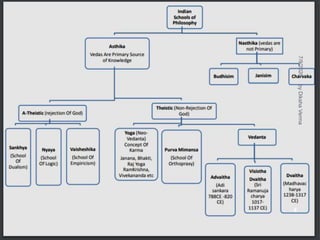
These can be
 Orthodox (astika) school of philosophy ( believe in
supremacy of vedanta )
• OR
 Heterodox ,(Nastika) school of philosophy ( dosn’t
believe in supremacy of vedanta)
Sankhya philosophy is an orthodox philosophy which
believes in two realities.
7/9/2020
3
byDikshaVerma
7/9/2020
4
byDikshaVerma
SANKHYA PHILOSOPHY
 The dualistic theory of creation or causation is
called Sankhya Philosophy and it appears in texts
as ancient as the Upanishads and the Bhagavad
Gita.
 Its founder was the sage Kapila .
 (सृजन या कायश के द्िैतिादी शसद््ािंत को सािंख्य दर्शन
क ा जाता ै और य उपननिदों और भगिद् गीता के
रूप में प्राचीन ग्रिंथों में प्रकट ोता ै। इसके सिंस्थापक
ऋवि कवपला थे)
7/9/2020
5
byDikshaVerma
SANKHYA PHILOSOPHY
 Etymologically : Samkhya (सािंख्य), also referred to
as Sankhya, Sāṃkhya, or Sāṅkhya, is a Sanskrit
word that means
 “to count, reason, reasoning by numeric enumeration,
relating to number, rational.”
सिंख्या, तकश सिंगत से सिंबिंध्त सिंख्यात्मक गणना
द्िारा तकश , कारण, गणना करना।)
 The term ‘Sankhya’ also means right knowledge.
Knowledge of ultimate. This is not worldly or
empirical knowledge. This is the discriminatory
knowledge. Discrimination between Purusha
(consciousness) and Prakriti (matter).('सािंख्य' र्ब्द
का अथश स ी ज्ञान भी ै। परम का ज्ञान। ये सािंसाररक
या अनुभिजन्य ज्ञान न ीिं ै।)
7/9/2020
6
byDikshaVerma
 In sankhya philosophy : number of those elements
are counted whose knowledge helps us in attaining
salvation or kaivalya .(सािंख्य दर्शन में: उन तत्िों की
सिंख्या धगनी जाती ै जजनके ज्ञान से में मोक्ष या
कै िल्य प्राप्त करने में मदद शमलती ै)
 The term ‘Sankhya’ means number. Sankhya
philosophy believes that the whole universe is
constituted by 25 tattvas or elements. (सािंख्य' र्ब्द
का अथश सिंख्या ै। सािंख्य दर्शन का मानना ​​ ै कक सिंपूणश
ब्रहमािंड 25 तातिों द्िारा ननशमशत ै।)
7/9/2020
7
byDikshaVerma
 It is dualistic in nature . It regards universe as
consisting of two realities i.e (य प्रकृ नत में द्िैतिादी
ै। य ब्रहमािंड को दो िास्तविकताओिं से शमलकर मानता
ै )
purusha ( consciousness) and prakrit (matter).
 It is pluralistic also because it states that there are
many purushas that coexist with prakriti in this
world.(य ब ुलतािादी भी ै क्योंकक य बताता ै कक
इस दुननया में कई पुरु ि ैं जो प्राकृ त के साथ ैं।)
 Sankhya darshan is related to yoga darshan alot.
so it is also called as Sankhya Yoga
Darshana.(सािंख्य दर्शन योग दर्शन से सिंबिंध्त ै।
इसशलए, इसे सािंख्य योग दर्शन भी क ा जाता ै।)
7/9/2020
8
byDikshaVerma
 It is realistic as it believes that both the matter
(Prakriti) and spirit (Purusha) are equal and real. (
य यथाथशिादी ै क्योंकक य मानता ै कक (प्राकृ त)
और आत्मा (पुरुि) दोनों समान ैं और िास्तविक ैं ।
 It is based on theory of causation (satkaryavada)
य कायश-कारण शसद््ािंत पर आ्ाररत ै (सतकायशिाद)
 Effect is already present in the cause in different potential. So
its not new creation and diff from material cause.
प्रभाि अलग-अलग क्षमता में प ले से मौजूद ै। तो इसका नया
ननमाशण न ीिं ै और भौनतक कारण से अलग ै। लेककन प्रभाि के िल
उसी का एक स्पष्ट प्रकटीकरण ै जो इसमें ननह त ै )
 There are two divisions of Satkāryavāda - Pariṇāmavāda and
Vivartavāda.
7/9/2020
9
byDikshaVerma
 Sankhya says that the main purpose of the
evolution of the prakriti into this world is to give the
purusha one more chance for liberation (सािंख्य दर्शन
के अनुसार, इस दुननया में प्राकृ त के विकास का मुख्य
उद्देश्य पुरुिाथश की मुजक्त ै।.
 Main cause of bondage of the Purusha and his
consequent suffering in the world is ignorance, non-
discrimination between himself as pure
consciousness and Prakriti. (दुननया में पुरुि और
उसके पररणामी दुःख के बिं्न का मुख्य कारण अज्ञानता
ै, अपने आप को र्ुद्् चेतना और प्रकृ नत के बीच
भेदभाि न करना।)
Purusha is prakriti = main cause of suffering
7/9/2020
10
byDikshaVerma
CONCEPT OF PRAKRITI AND PURUSHA
Concept of Prakriti
Prakriti is the most imp element of sankhya
philosophy.
According to Sankhya philosophy
prakriti is the root cause of universe. A root cause
is one from which concrete ( tree,water etc.) and
abstract (ego,psyche) can be producesd. (सािंख्य
दर्शन के अनुसार प्राकृ त ब्रहमािंड का मूल कारण ै। मूल
कारण ि ै जजसमें से किं क्रीट (पेड़, पानी आहद) और
अमूतश (अ िंकार, मानस) का उत्पादन ककया जा सकता
ै।)
7/9/2020
11
byDikshaVerma
 Each object has a cause but it has no cause. It is timeless therefor
root cause of everything.(
प्रत्येक िस्तु का एक कारण ोता ै लेककन उसका कोई कारण न ीिं ोता
ै। य सब कु छ के मूल कारण ,कालातीत ै।)
 This is first or primary element of earth hence called chief element
(mahat)(य पृथ्िी का प ला या प्राथशमक तत्ि ै जजसे मुख्य तत्ि
(म त) क ा जाता ै)
 It is called avidya (ignorance) because it apposes learning.(
इसे अविद्या (अज्ञान) क ा जाता ै क्योंकक इसने सीखने का विरो्
ककया।)
 It is called maya (illusion), because it produces strange
universe.
 it is also called jada (matter) in its unconscious form.(इसे अचेतन
रूप में जड (पदाथश) भी क ा जाता ै।)
 It is called shakti(power) in its eternal dynamic infinite power
form.(
इसे र्ाश्ित गनतर्ील अनिंत र्जक्त रूप में र्जक्त (र्जक्त) क ा जाता ै।)
 It is called avyakta , in the form of unexpresssed elemnts.
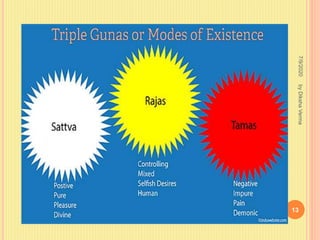
 3 gunas satva, rajas,tamas are found in prakriti . So its called
trigunamayi.(प्राकृ त में ३ गुन सत्ि, रज, तम पाए जाते ैं। तो इसका
नाम त्रिमुणमयी ै।)
7/9/2020
12
byDikshaVerma
7/9/2020
13
byDikshaVerma
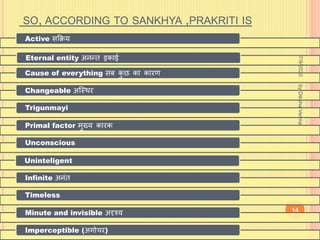
SO, ACCORDING TO SANKHYA ,PRAKRITI IS
Active सकक्रय
Eternal entity अनन्त इकाई
Cause of everything सब कु छ का कारण
Changeable अजस्थर
Trigunmayi
Primal factor मुख्य कारक
Unconscious
Uninteligent
Infinite अनिंत
Timeless
Minute and invisible अदृश्य
Imperceptible (अगोचर)
7/9/2020
14
byDikshaVerma
CONCEPT OF PURUSHA
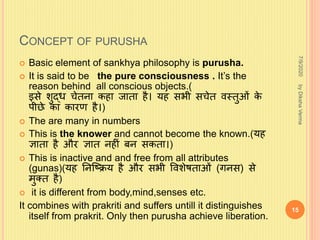
 Basic element of sankhya philosophy is purusha.
 It is said to be the pure consciousness . It’s the
reason behind all conscious objects.(
इसे र्ुद्् चेतना क ा जाता ै। य सभी सचेत िस्तुओिं के
पीछे का कारण ै।)
 The are many in numbers
 This is the knower and cannot become the known.(य
ज्ञाता ै और ज्ञात न ीिं बन सकता।)
 This is inactive and and free from all attributes
(gunas)(य ननजष्क्रय ै और सभी विर्ेिताओिं (गनस) से
मुक्त ै)
 it is different from body,mind,senses etc.
It combines with prakriti and suffers untill it distinguishes
itself from prakrit. Only then purusha achieve liberation.
7/9/2020
15
byDikshaVerma
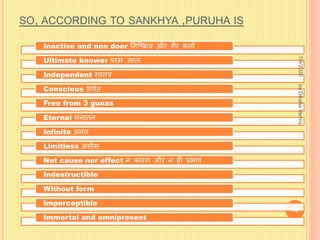
SO, ACCORDING TO SANKHYA ,PURUHA IS
Inactive and non doer ननजष्क्रय और गैर कताश
Ultimate knower परम ज्ञाता
Independent स्ितिंि
Conscious सचेत
Free from 3 gunas
Eternal सनातन
Infinite अनिंत
Limitless असीम
Not cause nor effect न कारण और न ी प्रभाि
Indestructible
Without form
Imperceptible
Immortal and omnipresent
7/9/2020
16
byDikshaVerma
RELATIONSHIP BETWEEN PRAKRITI AND
PURUSHA
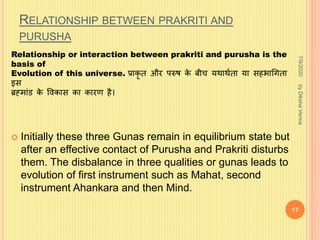
Relationship or interaction between prakriti and purusha is the
basis of
Evolution of this universe. प्राकृ त और परुि के बीच यथाथशता या स भाधगता
इस
ब्रहमािंड के विकास का कारण ै।
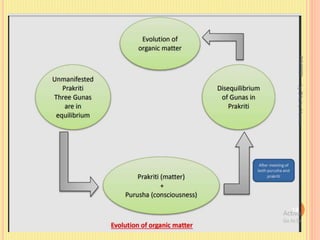
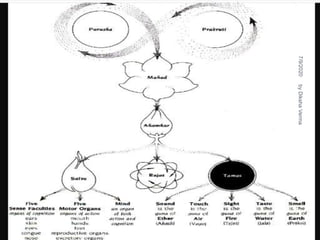
 Initially these three Gunas remain in equilibrium state but
after an effective contact of Purusha and Prakriti disturbs
them. The disbalance in three qualities or gunas leads to
evolution of first instrument such as Mahat, second
instrument Ahankara and then Mind.
7/9/2020
17
byDikshaVerma
7/9/2020
18
byDikshaVerma
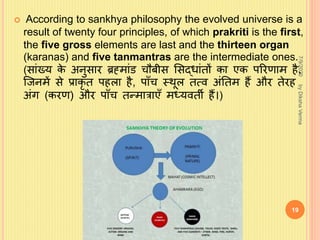
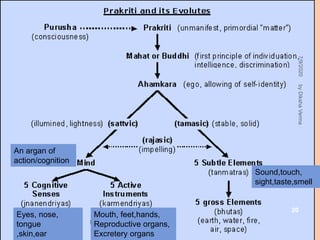
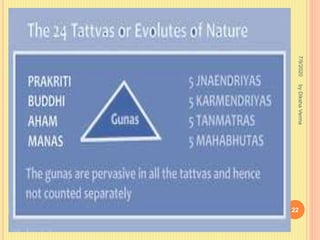
 According to sankhya philosophy the evolved universe is a
result of twenty four principles, of which prakriti is the first,
the five gross elements are last and the thirteen organ
(karanas) and five tanmantras are the intermediate ones.
(सािंख्य के अनुसार ब्रहमािंड चौबीस शसद््ािंतों का एक पररणाम ै,
जजनमें से प्राकृ त प ला ै, पााँच स्थूल तत्ि अिंनतम ैं और तेर
अिंग (करण) और पााँच तन्मािाएाँ मध्यिती ैं।)
7/9/2020
19
byDikshaVerma
7/9/2020
20
byDikshaVerma
Eyes, nose,
tongue
,skin,ear
Mouth, feet,hands,
Reproductive organs,
Excretery organs
An argan of
action/cognition
Sound,touch,
sight,taste,smell
7/9/2020
21
byDikshaVerma
7/9/2020
22
byDikshaVerma
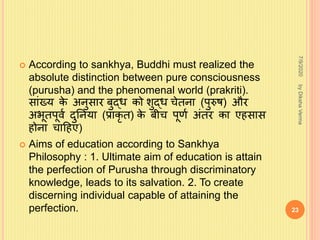
 According to sankhya, Buddhi must realized the
absolute distinction between pure consciousness
(purusha) and the phenomenal world (prakriti).
सािंख्य के अनुसार बुद्् को र्ुद्् चेतना (पुरुि) और
अभूतपूिश दुननया (प्राकृ त) के बीच पूणश अिंतर का ए सास
ोना चाह ए)
 Aims of education according to Sankhya
Philosophy : 1. Ultimate aim of education is attain
the perfection of Purusha through discriminatory
knowledge, leads to its salvation. 2. To create
discerning individual capable of attaining the
perfection.
7/9/2020
23
byDikshaVerma
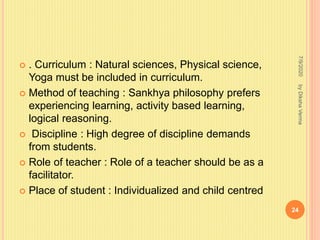
 . Curriculum : Natural sciences, Physical science,
Yoga must be included in curriculum.
 Method of teaching : Sankhya philosophy prefers
experiencing learning, activity based learning,
logical reasoning.
 Discipline : High degree of discipline demands
from students.
 Role of teacher : Role of a teacher should be as a
facilitator.
 Place of student : Individualized and child centred
7/9/2020
24
byDikshaVerma

Sankhya philosophy unit2

  • 1.
    SANKHYA PHILOSOPHY Concept OfPrakrit And Purusha 7/9/2020 1 byDikshaVerma
  • 2.
    INTRODUCTION  Hindu philosophyrefers to philosophies, world views and teachings that emerged in ancient India. These include six systems (shad-darśana) – Sankhya, Yoga, Nyaya, Vaisheshika, Mimamsa and Vedanta. In Indian tradition, the word used for philosophy is Darshana.  (ह िंदू दर्शन में दार्शननकों, विश्ि विचारों और शर्क्षाओिं का उल्लेख ै जो प्राचीन भारत में सामने आया था। इनमें छः प्रणाशलयााँ (र्द-दर्शन) - सािंख्य, योग, न्याय, िैर्ेविका, मीमािंसा और िेदािंत र्ाशमल ैं। भारतीय परिंपरा में दर्शन के शलए प्रयुक्त र्ब्द दर्शन ै।) 7/9/2020 2 byDikshaVerma
  • 3.
    These can be Orthodox (astika) school of philosophy ( believe in supremacy of vedanta ) • OR  Heterodox ,(Nastika) school of philosophy ( dosn’t believe in supremacy of vedanta) Sankhya philosophy is an orthodox philosophy which believes in two realities. 7/9/2020 3 byDikshaVerma
  • 4.
  • 5.
    SANKHYA PHILOSOPHY  Thedualistic theory of creation or causation is called Sankhya Philosophy and it appears in texts as ancient as the Upanishads and the Bhagavad Gita.  Its founder was the sage Kapila .  (सृजन या कायश के द्िैतिादी शसद््ािंत को सािंख्य दर्शन क ा जाता ै और य उपननिदों और भगिद् गीता के रूप में प्राचीन ग्रिंथों में प्रकट ोता ै। इसके सिंस्थापक ऋवि कवपला थे) 7/9/2020 5 byDikshaVerma
  • 6.
    SANKHYA PHILOSOPHY  Etymologically: Samkhya (सािंख्य), also referred to as Sankhya, Sāṃkhya, or Sāṅkhya, is a Sanskrit word that means  “to count, reason, reasoning by numeric enumeration, relating to number, rational.” सिंख्या, तकश सिंगत से सिंबिंध्त सिंख्यात्मक गणना द्िारा तकश , कारण, गणना करना।)  The term ‘Sankhya’ also means right knowledge. Knowledge of ultimate. This is not worldly or empirical knowledge. This is the discriminatory knowledge. Discrimination between Purusha (consciousness) and Prakriti (matter).('सािंख्य' र्ब्द का अथश स ी ज्ञान भी ै। परम का ज्ञान। ये सािंसाररक या अनुभिजन्य ज्ञान न ीिं ै।) 7/9/2020 6 byDikshaVerma
  • 7.
     In sankhyaphilosophy : number of those elements are counted whose knowledge helps us in attaining salvation or kaivalya .(सािंख्य दर्शन में: उन तत्िों की सिंख्या धगनी जाती ै जजनके ज्ञान से में मोक्ष या कै िल्य प्राप्त करने में मदद शमलती ै)  The term ‘Sankhya’ means number. Sankhya philosophy believes that the whole universe is constituted by 25 tattvas or elements. (सािंख्य' र्ब्द का अथश सिंख्या ै। सािंख्य दर्शन का मानना ​​ ै कक सिंपूणश ब्रहमािंड 25 तातिों द्िारा ननशमशत ै।) 7/9/2020 7 byDikshaVerma
  • 8.
     It isdualistic in nature . It regards universe as consisting of two realities i.e (य प्रकृ नत में द्िैतिादी ै। य ब्रहमािंड को दो िास्तविकताओिं से शमलकर मानता ै ) purusha ( consciousness) and prakrit (matter).  It is pluralistic also because it states that there are many purushas that coexist with prakriti in this world.(य ब ुलतािादी भी ै क्योंकक य बताता ै कक इस दुननया में कई पुरु ि ैं जो प्राकृ त के साथ ैं।)  Sankhya darshan is related to yoga darshan alot. so it is also called as Sankhya Yoga Darshana.(सािंख्य दर्शन योग दर्शन से सिंबिंध्त ै। इसशलए, इसे सािंख्य योग दर्शन भी क ा जाता ै।) 7/9/2020 8 byDikshaVerma
  • 9.
     It isrealistic as it believes that both the matter (Prakriti) and spirit (Purusha) are equal and real. ( य यथाथशिादी ै क्योंकक य मानता ै कक (प्राकृ त) और आत्मा (पुरुि) दोनों समान ैं और िास्तविक ैं ।  It is based on theory of causation (satkaryavada) य कायश-कारण शसद््ािंत पर आ्ाररत ै (सतकायशिाद)  Effect is already present in the cause in different potential. So its not new creation and diff from material cause. प्रभाि अलग-अलग क्षमता में प ले से मौजूद ै। तो इसका नया ननमाशण न ीिं ै और भौनतक कारण से अलग ै। लेककन प्रभाि के िल उसी का एक स्पष्ट प्रकटीकरण ै जो इसमें ननह त ै )  There are two divisions of Satkāryavāda - Pariṇāmavāda and Vivartavāda. 7/9/2020 9 byDikshaVerma
  • 10.
     Sankhya saysthat the main purpose of the evolution of the prakriti into this world is to give the purusha one more chance for liberation (सािंख्य दर्शन के अनुसार, इस दुननया में प्राकृ त के विकास का मुख्य उद्देश्य पुरुिाथश की मुजक्त ै।.  Main cause of bondage of the Purusha and his consequent suffering in the world is ignorance, non- discrimination between himself as pure consciousness and Prakriti. (दुननया में पुरुि और उसके पररणामी दुःख के बिं्न का मुख्य कारण अज्ञानता ै, अपने आप को र्ुद्् चेतना और प्रकृ नत के बीच भेदभाि न करना।) Purusha is prakriti = main cause of suffering 7/9/2020 10 byDikshaVerma
  • 11.
    CONCEPT OF PRAKRITIAND PURUSHA Concept of Prakriti Prakriti is the most imp element of sankhya philosophy. According to Sankhya philosophy prakriti is the root cause of universe. A root cause is one from which concrete ( tree,water etc.) and abstract (ego,psyche) can be producesd. (सािंख्य दर्शन के अनुसार प्राकृ त ब्रहमािंड का मूल कारण ै। मूल कारण ि ै जजसमें से किं क्रीट (पेड़, पानी आहद) और अमूतश (अ िंकार, मानस) का उत्पादन ककया जा सकता ै।) 7/9/2020 11 byDikshaVerma
  • 12.
     Each objecthas a cause but it has no cause. It is timeless therefor root cause of everything.( प्रत्येक िस्तु का एक कारण ोता ै लेककन उसका कोई कारण न ीिं ोता ै। य सब कु छ के मूल कारण ,कालातीत ै।)  This is first or primary element of earth hence called chief element (mahat)(य पृथ्िी का प ला या प्राथशमक तत्ि ै जजसे मुख्य तत्ि (म त) क ा जाता ै)  It is called avidya (ignorance) because it apposes learning.( इसे अविद्या (अज्ञान) क ा जाता ै क्योंकक इसने सीखने का विरो् ककया।)  It is called maya (illusion), because it produces strange universe.  it is also called jada (matter) in its unconscious form.(इसे अचेतन रूप में जड (पदाथश) भी क ा जाता ै।)  It is called shakti(power) in its eternal dynamic infinite power form.( इसे र्ाश्ित गनतर्ील अनिंत र्जक्त रूप में र्जक्त (र्जक्त) क ा जाता ै।)  It is called avyakta , in the form of unexpresssed elemnts.  3 gunas satva, rajas,tamas are found in prakriti . So its called trigunamayi.(प्राकृ त में ३ गुन सत्ि, रज, तम पाए जाते ैं। तो इसका नाम त्रिमुणमयी ै।) 7/9/2020 12 byDikshaVerma
  • 13.
  • 14.
    SO, ACCORDING TOSANKHYA ,PRAKRITI IS Active सकक्रय Eternal entity अनन्त इकाई Cause of everything सब कु छ का कारण Changeable अजस्थर Trigunmayi Primal factor मुख्य कारक Unconscious Uninteligent Infinite अनिंत Timeless Minute and invisible अदृश्य Imperceptible (अगोचर) 7/9/2020 14 byDikshaVerma
  • 15.
    CONCEPT OF PURUSHA Basic element of sankhya philosophy is purusha.  It is said to be the pure consciousness . It’s the reason behind all conscious objects.( इसे र्ुद्् चेतना क ा जाता ै। य सभी सचेत िस्तुओिं के पीछे का कारण ै।)  The are many in numbers  This is the knower and cannot become the known.(य ज्ञाता ै और ज्ञात न ीिं बन सकता।)  This is inactive and and free from all attributes (gunas)(य ननजष्क्रय ै और सभी विर्ेिताओिं (गनस) से मुक्त ै)  it is different from body,mind,senses etc. It combines with prakriti and suffers untill it distinguishes itself from prakrit. Only then purusha achieve liberation. 7/9/2020 15 byDikshaVerma
  • 16.
    SO, ACCORDING TOSANKHYA ,PURUHA IS Inactive and non doer ननजष्क्रय और गैर कताश Ultimate knower परम ज्ञाता Independent स्ितिंि Conscious सचेत Free from 3 gunas Eternal सनातन Infinite अनिंत Limitless असीम Not cause nor effect न कारण और न ी प्रभाि Indestructible Without form Imperceptible Immortal and omnipresent 7/9/2020 16 byDikshaVerma
  • 17.
    RELATIONSHIP BETWEEN PRAKRITIAND PURUSHA Relationship or interaction between prakriti and purusha is the basis of Evolution of this universe. प्राकृ त और परुि के बीच यथाथशता या स भाधगता इस ब्रहमािंड के विकास का कारण ै।  Initially these three Gunas remain in equilibrium state but after an effective contact of Purusha and Prakriti disturbs them. The disbalance in three qualities or gunas leads to evolution of first instrument such as Mahat, second instrument Ahankara and then Mind. 7/9/2020 17 byDikshaVerma
  • 18.
  • 19.
     According tosankhya philosophy the evolved universe is a result of twenty four principles, of which prakriti is the first, the five gross elements are last and the thirteen organ (karanas) and five tanmantras are the intermediate ones. (सािंख्य के अनुसार ब्रहमािंड चौबीस शसद््ािंतों का एक पररणाम ै, जजनमें से प्राकृ त प ला ै, पााँच स्थूल तत्ि अिंनतम ैं और तेर अिंग (करण) और पााँच तन्मािाएाँ मध्यिती ैं।) 7/9/2020 19 byDikshaVerma
  • 20.
    7/9/2020 20 byDikshaVerma Eyes, nose, tongue ,skin,ear Mouth, feet,hands, Reproductiveorgans, Excretery organs An argan of action/cognition Sound,touch, sight,taste,smell
  • 21.
  • 22.
  • 23.
     According tosankhya, Buddhi must realized the absolute distinction between pure consciousness (purusha) and the phenomenal world (prakriti). सािंख्य के अनुसार बुद्् को र्ुद्् चेतना (पुरुि) और अभूतपूिश दुननया (प्राकृ त) के बीच पूणश अिंतर का ए सास ोना चाह ए)  Aims of education according to Sankhya Philosophy : 1. Ultimate aim of education is attain the perfection of Purusha through discriminatory knowledge, leads to its salvation. 2. To create discerning individual capable of attaining the perfection. 7/9/2020 23 byDikshaVerma
  • 24.
     . Curriculum: Natural sciences, Physical science, Yoga must be included in curriculum.  Method of teaching : Sankhya philosophy prefers experiencing learning, activity based learning, logical reasoning.  Discipline : High degree of discipline demands from students.  Role of teacher : Role of a teacher should be as a facilitator.  Place of student : Individualized and child centred 7/9/2020 24 byDikshaVerma