The document discusses the Herbartian model of memory-level teaching in mathematics, emphasizing the role of the teacher in imparting factual knowledge through structured processes. It outlines six key steps of teaching: preparation, presentation, association/comparison, generalization, application, and recapitulation, which support the effective retention and recall of information. The model also stresses the importance of evaluating student comprehension and employing supportive materials and techniques to enhance learning.
Introduction to approaches of teaching including memory, understanding, and reflective levels. Unit and lesson planning aspects are highlighted.
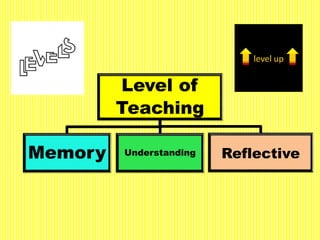
Overview of the three levels of teaching: Memory, Understanding, Reflective, which are frameworks for educational strategies.
Focus on Herbart's Memory Model which emphasizes teacher-centered methods aimed at enhancing memory capacity.
Details of Herbart’s model focusing on cramming facts, preparation, and the structured six-step teaching syntax.
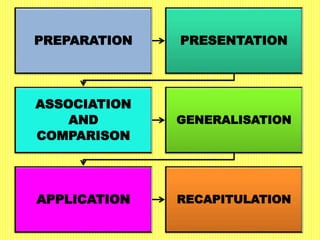
In-depth explanation of the six steps: Preparation, Presentation, Association, Generalisation, Application, and Recapitulation within Herbart’s framework.
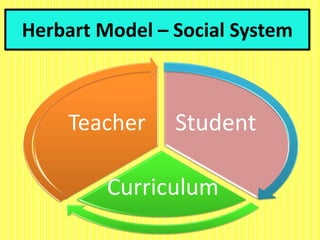
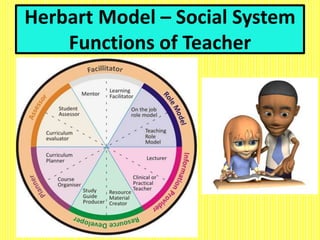
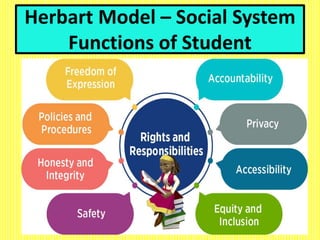
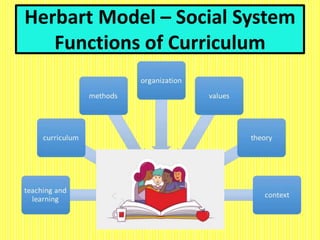
Exploration of the roles of teachers, students, and curriculum within the social system of education according to Herbart.
Discussion on supportive devices such as audio-visual aids and materials that enhance effective learning experiences.
Highlights the importance of evaluation in teaching effectiveness, discussing techniques for assessing student knowledge retention.
Conclusion reiterating that the memory level of teaching focuses primarily on imparting factual knowledge through rote learning.
PEDAGOGY OF MATHEMATICS
MsR SRIDEVI
Assistant Professor of Pedagogy of Mathematics
Loyola College of Education
Chennai 34
UNIT III
APPROACHES OF TEACHING
Memory Level (Herbartian Model)
SEMESTER 1
CODE BD1MA
2.
• Approaches ofLesson Planning
• Steps – Level of Teaching
• Organising Teaching:
–Memory Level (Herbartian Model)
–Understanding Level (Morrison Teaching
Model)
–Reflective Level (Bigge and Hunt Teaching
Model)
• Unit Plan
• Lesson Plan Writing
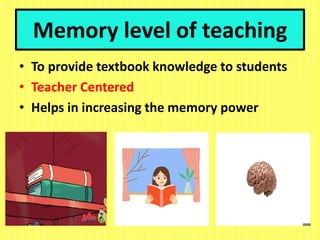
Memory level ofteaching
• To provide textbook knowledge to students
• Teacher Centered
• Helps in increasing the memory power
8.
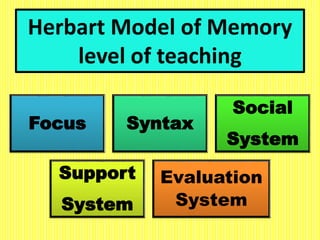
Herbart Model ofMemory
level of teaching
Focus Syntax
Social
System
Support
System
Evaluation
System
9.
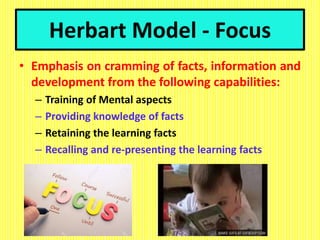
Herbart Model -Focus
• Emphasis on cramming of facts, information and
development from the following capabilities:
– Training of Mental aspects
– Providing knowledge of facts
– Retaining the learning facts
– Recalling and re-presenting the learning facts
PREPARATION
• Testing theprevious knowledge by asking
questions, activities, stories, charts, pictures,
song & etc
• Utilising the previous knowledge for new lesson
• Prepared and motivating the students to receive
new knowledge
• Thus, testing previous knowledge, developing
interest in the minds of students and
maintaining curiosity of the students can be
achieved with the help of this step.
PRESENTATION
• Statement ofthe Aim: Topic should be clear to the
student and the topic should be written on the BB
• Stimulating the students through mental activities
• To make the concepts understandable to the
students.
• Appropriate and specific examples and illustrations
of the concepts will make the understanding better.
• The interest of the students on the subject matter
should be maintained continuously by the way of
asking questions from time to time in this stage.
16.
PRESENTATION
• The teachershould carefully and skillfully
arrange his material so that his pupils may
clearly and readily grasp it.
• The teacher should make proper use of
questions, charts, graphs, pictures, models
and other illustrative for demonstration and
explanation.
• Simple language is used
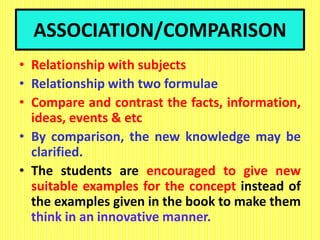
ASSOCIATION/COMPARISON
• Relationship withsubjects
• Relationship with two formulae
• Compare and contrast the facts, information,
ideas, events & etc
• By comparison, the new knowledge may be
clarified.
• The students are encouraged to give new
suitable examples for the concept instead of
the examples given in the book to make them
think in an innovative manner.
GENERALISATION
• Opportunity tothink and reflect
• Formulate principles, facts, information, ideas &
etc
• To develop an understanding skills
• The teacher at this stage should try to remain in
the background for providing only necessary
guidance and correction.
• The teacher puts new & alternate questions &
examples to help students arrive at answers,
conclusions, & generalizations on their own.
APPLICATION
• The teachermakes the students to use the
understood knowledge in an unfamiliar
situation.
• Verified through questions
• Whether new learnt knowledge can be used
in new situations or not.
• Strengthening our learning and make the
learning permanent.
• The study will be meaningless if not applied
in our day-to-day life
RECAPITULATION
• This canbe achieved by reviewing a
lesson or by giving assignments to
the students.
• This is reviewing the students’
achievement
• This is used for assessing or
evaluating the effectiveness of the
lesson.
Herbart Model –Support System
• Requires some supportive devices to
make learning more effective.
• Meaningful material should be used
• The audio – video aids may be used to
involve the students
• Charts, Working model, non-working
model, graph sheets, rotating cards,
matching cards can be used inside to get
the attention of the students.
30.
Herbart Model
Evaluation System
•It is important aspect of teaching
because it produces evidences about
the realisation of goals of teaching.
• Usually oral tests are given to measure
the retention of the learnt material.
• The objective tests of recall and
recognition type are administrated to
evaluate the knowledge of the students.
31.
Memory level -Conclusion
• The objective of the Memory Level of teaching
is just to impart information or knowledge to
the learner.
• This knowledge or information is factual in
nature, which is acquired through a mechanical
process (i.e. memorization or rote learning).