•Teaching Methods And Techniques of teaching Physical
Science(meaning, types of methods/techniques)
•Techniques and strategies of teaching sciences: drill and
practice, brain storming ,quiz, play way and activity based
techniques.
•Ways of developing scientific attitude and aptitude among
children.
Unit- 3
Teaching Methods And Techniques
Teaching Methods And
Techniques
 Teaching methods and techniques are important
aspect of every successful class.
 Every teacher must use his/her knowledge to
combine various teaching methods and
techniques in his/her class to achieve goal of
teaching learning process.
 Method and Techniques: By Merriam Webster
dictionary “method is a systematic plan followed
in presenting material for instruction” (
एक विधि एक व्यिस्थित योजना है जो अनुदेश के
लिए सामग्री प्रथतुत करने में अनुसरण की जाती है)
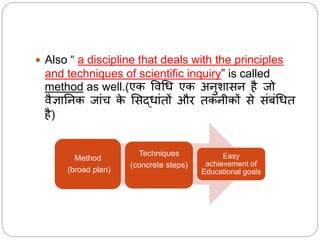
 Also “ a discipline that deals with the principles
and techniques of scientific inquiry” is called
method as well.(एक विधि एक अनुशासन है जो
िैज्ञाननक जाांच के लसदिाांतों और तकनीकों से सांबांधित
है)
Method
(broad plan)
Techniques
(concrete steps)
Easy
achievement of
Educational goals
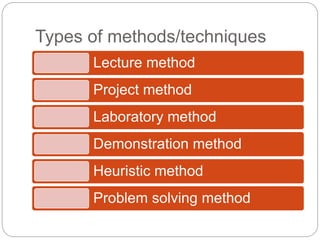
Types of methods/techniques
Lecture method
Project method
Laboratory method
Demonstration method
Heuristic method
Problem solving method
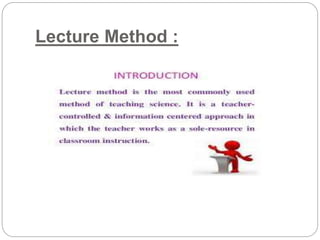
Lecture Method :
 According to wikipaedia :A lecture (from the
French lecture, meaning reading) is an oral
presentation intended to present information or
teach people about a particular subject.(एक
व्याख्यान (फ्ाांसीसी व्याख्यान से, स्जसका अिथ है
पढ़ना) एक मौखिक प्रथतुनत है स्जसका उददेश्य ककसी
विशेष विषय के बारे में िोगों को जानकारी देना या
लसिाना है)
Advantages and disadvantages
Advantages Disadvantages
 quick exposure to new material, नई
सामग्री के त्िररत सांपकथ ,
 greater teacher control in the
classroom, कक्षा में अधिक लशक्षक
ननयांत्रण,
 an engaging format, which may
complement and clarify course
material, and facilitating large-class
communication. एक आकषथक प्रारूप,
जो पाठ्यक्रम सामग्री को पूरक और
थपष्ट कर सकता है, और बडे िगथ के
सांचार को सुवििाजनक बनाता है।
 Lecturing also permits the
dissemination of unpublished or not
readily available material. व्याख्यान
अप्रकालशत या आसानी से उपिब्ि
सामग्री के प्रसार की अनुमनत देता है
 Not interesting
 Teacher oriented
method
 It become
monotonous if used
alone.
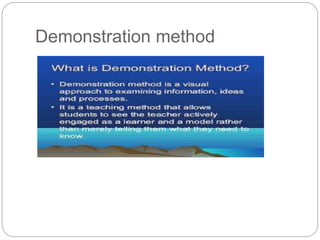
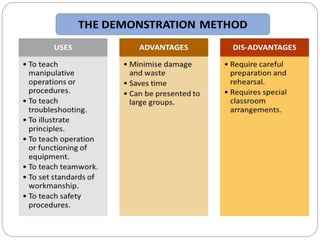
Demonstration method
Problem solving method
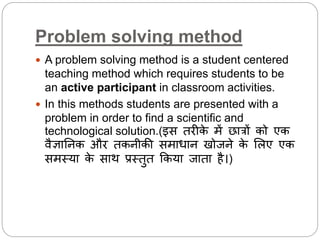
 A problem solving method is a student centered
teaching method which requires students to be
an active participant in classroom activities.
 In this methods students are presented with a
problem in order to find a scientific and
technological solution.(इस तरीके में छात्रों को एक
िैज्ञाननक और तकनीकी समािान िोजने के लिए एक
समथया के साि प्रथतुत ककया जाता है।)
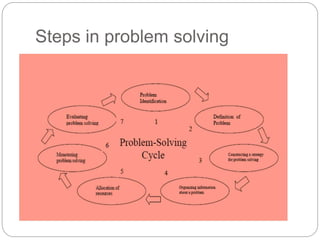
Steps in problem solving
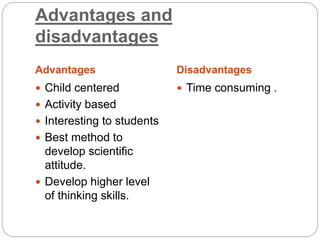
Advantages and
disadvantages
Advantages Disadvantages
 Child centered
 Activity based
 Interesting to students
 Best method to
develop scientific
attitude.
 Develop higher level
of thinking skills.
 Time consuming .
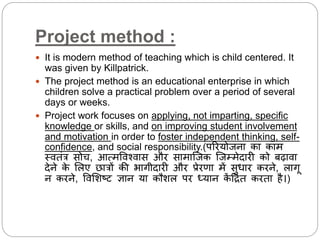
Project method :
 It is modern method of teaching which is child centered. It
was given by Killpatrick.
 The project method is an educational enterprise in which
children solve a practical problem over a period of several
days or weeks.
 Project work focuses on applying, not imparting, specific
knowledge or skills, and on improving student involvement
and motivation in order to foster independent thinking, self-
confidence, and social responsibility.(पररयोजना का काम
थितांत्र सोच, आत्मविश्िास और सामास्जक स्जम्मेदारी को बढ़ािा
देने के लिए छात्रों की भागीदारी और प्रेरणा में सुिार करने, िागू
न करने, विलशष्ट ज्ञान या कौशि पर ध्यान कें द्रित करता है।)
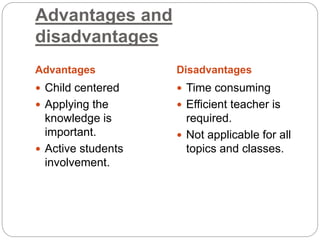
Advantages and
disadvantages
Advantages Disadvantages
 Child centered
 Applying the
knowledge is
important.
 Active students
involvement.
 Time consuming
 Efficient teacher is
required.
 Not applicable for all
topics and classes.
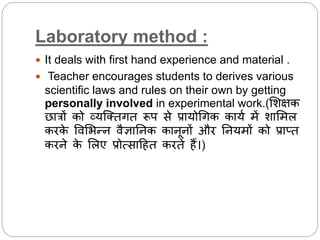
Laboratory method :
 It deals with first hand experience and material .
 Teacher encourages students to derives various
scientific laws and rules on their own by getting
personally involved in experimental work.(लशक्षक
छात्रों को व्यस्ततगत रूप से प्रायोधगक कायथ में शालमि
करके विलभन्न िैज्ञाननक कानूनों और ननयमों को प्राप्त
करने के लिए प्रोत्साद्रहत करते हैं।)
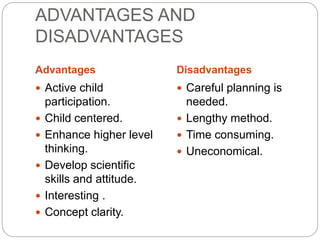
ADVANTAGES AND
DISADVANTAGES
Advantages Disadvantages
 Active child
participation.
 Child centered.
 Enhance higher level
thinking.
 Develop scientific
skills and attitude.
 Interesting .
 Concept clarity.
 Careful planning is
needed.
 Lengthy method.
 Time consuming.
 Uneconomical.
Heuristic Method:
 In Heuristic method the student be put in the place
of an independent discoverer. Thus no help or
guidance is provided by the teacher in this method.
(ह्यूररस्थटक पदिनत में छात्र को एक थितांत्र िोजकताथ के
थिान पर रिा जाता है। इस प्रकार इस पदिनत में लशक्षक
दिारा कोई सहायता या मागथदशथन प्रदान नहीां ककया जाता
है।)
 It is based on the psychological principles of “trial and
error” theory. Logical and imaginative thinking are
perquisites for his type of teaching strategy.(यह
"परीक्षण और त्रुद्रट" लसदिाांत के मनोिैज्ञाननक लसदिाांतों पर
आिाररत है। ताककथ क और कल्पनाशीि सोच उसकी लशक्षण
रणनीनत के लिए अनुिाभ हैं।)
Advantages And
Disadvantages
Advantages Disadvantages.
 Child centered.
 Enhances heigher
mental skills.
 Learning through
independent
approach.
 Applicable for
maximum topics.
 Not suitable for large
group of students.
 Too much
expectations from
children and teachers
also.
 Posibility of erranious
conclusions.
:Techniques And Stratagies
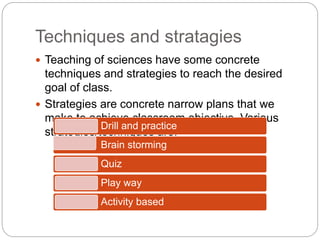
Techniques and stratagies
 Teaching of sciences have some concrete
techniques and strategies to reach the desired
goal of class.
 Strategies are concrete narrow plans that we
make to achieve classroom objective. Various
strategies/techniques are:
Drill and practice
Brain storming
Quiz
Play way
Activity based
Drill and practice (ड्रिल और अभ्यास
)
 The term drill and practice is
defined as a method of
instruction characterized by
systematic repetition of
provided knowlede ,concepts,
examples, and practice
problems. Drill and practice is a
disciplined and
repetitious exercise, used as a
mean of teaching and perfecting
a skill or procedure.(ड्रिि और
अभ्यास शब्द को अििारणाओां,
उदाहरणों और अभ्यास समथयाओां
के व्यिस्थित पुनरािृवि दिारा
विशेषता ननदेश की एक विधि के
रूप में पररभावषत ककया गया है।
ड्रिि और अभ्यास एक अनुशालसत
और दोहराि िािा व्यायाम है,
स्जसका उपयोग लशक्षण या कौशि
या प्रकक्रया को पूरा करने के लिए
ककया जाता है।)
Advantages: useful when
teaching a specific skill.
 Beneficial in memorizing
concept.
 Transfer great amount of
information.
 Accurate learning.
 Build confidence.
 Immediate feedback on
accuracy.
Disadvantages: time consuming.
 not suitable for higher classes.
 focus on memorization only.
 No concept clarity.
Brain storming :
 Done in In controlled
conditions and a free-
thinking environment.
 Brainstorming is defined as
an idea creation method for
generating a large number of
creative ideas in a short
period of time.(कम समय में
बडी सांख्या में रचनात्मक
विचारों को उत्पन्न करने के
लिए विचार मांिन को एक
विचार ननमाथण पदिनत के रूप
में पररभावषत ककया गया है।)
 Advantages:Confidence
booster for students as
everyone's ideas are noted
without any judgment.
 Uses divergent and
convergent thinking ability of
child.
 Children oriented .
 Child become active learner
in class.
 Helps in generating new
ideas.
disadvantages: efficient
teacher is required to
channelize ideas towards
solution.
 Based on subjective
development of child.
 Not suitable for all classes
and levels.
Quiz :
 Various
solutions(options) of a
problem are presented
to students and by
careful observation they
find the possible
solution.(एक समथया के
विलभन्न समािान
(विकल्प) छात्रों को प्रथतुत
ककए जाते हैं और
साििानीपूिथक अििोकन
करके िे सांभावित समािान
ढूांढते हैं।)
Advantages : it enhances
critical thinking.
 Test knowledge easily.
 Suitable for all classes
and all level of students.
 best tool for evaluation.
Disadvantages :
possibility of guess work
is high.
 Time consuming on the
part of teacher.
 Need efficient teacher
to prepare good
questions.
Activity based learning:
 Activity-based learning is the
process of learning by doing.
As opposed to asking kids to
simply listen and take
notes.(गनतविधि-आिाररत लशक्षा,
सीिने की प्रकक्रया है। जैसा कक
बच्चों को के िि सुनने और नोट्स
िेने के लिए कहने के लिए विरोि
ककया जाता है)
 activity-based
learning encourages students
to actively participate in their
own learning experience
through practical activities such
as problem-solving and
independent
investigation.(गनतविधि-आिाररत
लशक्षा छात्रों को समथया-समािान
और थितांत्र जाांच जैसे व्यािहाररक
गनतविधियों के माध्यम से अपने
थियां के सीिने के अनुभि में
सकक्रय रूप से भाग िेने के लिए
प्रोत्साद्रहत करती है।
Advantages : child centered
technique.
 Interesting to students.
 Easy concept learning.
 Concrete knowledge.
 Useful at almost all levels of
education.
Disadvantages :
 Lengthy process.
 Time consuming for teacher.
 Expectations are high on the
part of teacher.
Play way technique:
 In this method of
learning, playing acts as the
driving force as the entire
learning method revolves
around activity-based learning.
It encourages expression and
creative skills among
children.(सीिने की इस पदिनत
में, िाइविांग बि िाइविांग के रूप में
कायथ करता है तयोंकक सांपूणथ लशक्षण
पदिनत गनतविधि-आिाररत सीिने
के चारों ओर घूमती है। यह बच्चों
के बीच अलभव्यस्तत और
रचनात्मक कौशि को प्रोत्साद्रहत
करता है।)
 Teaching method is informal and
suitable to students need.(लशक्षण
विधि अनौपचाररक और छात्रों की
आिश्यकता के लिए उपयुतत है।)
 Advantages: based on
subjective and emotional
development of child.
 Child centered teaching
techniques.
 Active participation of child.
 Easy and effective Concept
formation .
 Psychological principles based.
 Enhances creative skills and
creative expressions.
 Disadvantages: not suitable
for all classes.
 Not suitable for all levels.
 Lengthy process.
Scintific attitude and aptitude
 Attitude is a positive
or negative or
indifferent feeling
towards a person,
object, event or
idea.(दृस्ष्टकोण एक
व्यस्तत, िथतु, घटना या
विचार के प्रनत एक
सकारात्मक या
नकारात्मक या उदासीन
भािना है।)
 Aptitute :
 Aptitude is
associated with skill
enhancement,
learning and
training.(एस्प्टट्यूड
कौशि िृदधि, और
सीिना और प्रलशक्षण
के साि जुडा हुआ है।)
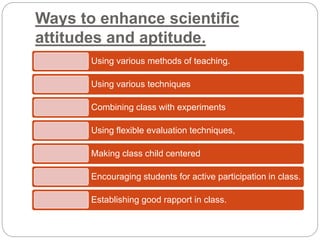
Ways to enhance scientific
attitudes and aptitude.
Using various methods of teaching.
Using various techniques
Combining class with experiments
Using flexible evaluation techniques,
Making class child centered
Encouraging students for active participation in class.
Establishing good rapport in class.
Thank
you

Unit 3 teaching methods and techniques

  • 1.
    •Teaching Methods AndTechniques of teaching Physical Science(meaning, types of methods/techniques) •Techniques and strategies of teaching sciences: drill and practice, brain storming ,quiz, play way and activity based techniques. •Ways of developing scientific attitude and aptitude among children. Unit- 3 Teaching Methods And Techniques
  • 2.
    Teaching Methods And Techniques Teaching methods and techniques are important aspect of every successful class.  Every teacher must use his/her knowledge to combine various teaching methods and techniques in his/her class to achieve goal of teaching learning process.  Method and Techniques: By Merriam Webster dictionary “method is a systematic plan followed in presenting material for instruction” ( एक विधि एक व्यिस्थित योजना है जो अनुदेश के लिए सामग्री प्रथतुत करने में अनुसरण की जाती है)
  • 3.
     Also “a discipline that deals with the principles and techniques of scientific inquiry” is called method as well.(एक विधि एक अनुशासन है जो िैज्ञाननक जाांच के लसदिाांतों और तकनीकों से सांबांधित है) Method (broad plan) Techniques (concrete steps) Easy achievement of Educational goals
  • 4.
    Types of methods/techniques Lecturemethod Project method Laboratory method Demonstration method Heuristic method Problem solving method
  • 5.
  • 6.
     According towikipaedia :A lecture (from the French lecture, meaning reading) is an oral presentation intended to present information or teach people about a particular subject.(एक व्याख्यान (फ्ाांसीसी व्याख्यान से, स्जसका अिथ है पढ़ना) एक मौखिक प्रथतुनत है स्जसका उददेश्य ककसी विशेष विषय के बारे में िोगों को जानकारी देना या लसिाना है)
  • 7.
    Advantages and disadvantages AdvantagesDisadvantages  quick exposure to new material, नई सामग्री के त्िररत सांपकथ ,  greater teacher control in the classroom, कक्षा में अधिक लशक्षक ननयांत्रण,  an engaging format, which may complement and clarify course material, and facilitating large-class communication. एक आकषथक प्रारूप, जो पाठ्यक्रम सामग्री को पूरक और थपष्ट कर सकता है, और बडे िगथ के सांचार को सुवििाजनक बनाता है।  Lecturing also permits the dissemination of unpublished or not readily available material. व्याख्यान अप्रकालशत या आसानी से उपिब्ि सामग्री के प्रसार की अनुमनत देता है  Not interesting  Teacher oriented method  It become monotonous if used alone.
  • 8.
  • 10.
    Problem solving method A problem solving method is a student centered teaching method which requires students to be an active participant in classroom activities.  In this methods students are presented with a problem in order to find a scientific and technological solution.(इस तरीके में छात्रों को एक िैज्ञाननक और तकनीकी समािान िोजने के लिए एक समथया के साि प्रथतुत ककया जाता है।)
  • 11.
  • 12.
    Advantages and disadvantages Advantages Disadvantages Child centered  Activity based  Interesting to students  Best method to develop scientific attitude.  Develop higher level of thinking skills.  Time consuming .
  • 13.
    Project method : It is modern method of teaching which is child centered. It was given by Killpatrick.  The project method is an educational enterprise in which children solve a practical problem over a period of several days or weeks.  Project work focuses on applying, not imparting, specific knowledge or skills, and on improving student involvement and motivation in order to foster independent thinking, self- confidence, and social responsibility.(पररयोजना का काम थितांत्र सोच, आत्मविश्िास और सामास्जक स्जम्मेदारी को बढ़ािा देने के लिए छात्रों की भागीदारी और प्रेरणा में सुिार करने, िागू न करने, विलशष्ट ज्ञान या कौशि पर ध्यान कें द्रित करता है।)
  • 14.
    Advantages and disadvantages Advantages Disadvantages Child centered  Applying the knowledge is important.  Active students involvement.  Time consuming  Efficient teacher is required.  Not applicable for all topics and classes.
  • 15.
    Laboratory method : It deals with first hand experience and material .  Teacher encourages students to derives various scientific laws and rules on their own by getting personally involved in experimental work.(लशक्षक छात्रों को व्यस्ततगत रूप से प्रायोधगक कायथ में शालमि करके विलभन्न िैज्ञाननक कानूनों और ननयमों को प्राप्त करने के लिए प्रोत्साद्रहत करते हैं।)
  • 16.
    ADVANTAGES AND DISADVANTAGES Advantages Disadvantages Active child participation.  Child centered.  Enhance higher level thinking.  Develop scientific skills and attitude.  Interesting .  Concept clarity.  Careful planning is needed.  Lengthy method.  Time consuming.  Uneconomical.
  • 17.
    Heuristic Method:  InHeuristic method the student be put in the place of an independent discoverer. Thus no help or guidance is provided by the teacher in this method. (ह्यूररस्थटक पदिनत में छात्र को एक थितांत्र िोजकताथ के थिान पर रिा जाता है। इस प्रकार इस पदिनत में लशक्षक दिारा कोई सहायता या मागथदशथन प्रदान नहीां ककया जाता है।)  It is based on the psychological principles of “trial and error” theory. Logical and imaginative thinking are perquisites for his type of teaching strategy.(यह "परीक्षण और त्रुद्रट" लसदिाांत के मनोिैज्ञाननक लसदिाांतों पर आिाररत है। ताककथ क और कल्पनाशीि सोच उसकी लशक्षण रणनीनत के लिए अनुिाभ हैं।)
  • 18.
    Advantages And Disadvantages Advantages Disadvantages. Child centered.  Enhances heigher mental skills.  Learning through independent approach.  Applicable for maximum topics.  Not suitable for large group of students.  Too much expectations from children and teachers also.  Posibility of erranious conclusions.
  • 19.
  • 20.
    Techniques and stratagies Teaching of sciences have some concrete techniques and strategies to reach the desired goal of class.  Strategies are concrete narrow plans that we make to achieve classroom objective. Various strategies/techniques are: Drill and practice Brain storming Quiz Play way Activity based
  • 21.
    Drill and practice(ड्रिल और अभ्यास )  The term drill and practice is defined as a method of instruction characterized by systematic repetition of provided knowlede ,concepts, examples, and practice problems. Drill and practice is a disciplined and repetitious exercise, used as a mean of teaching and perfecting a skill or procedure.(ड्रिि और अभ्यास शब्द को अििारणाओां, उदाहरणों और अभ्यास समथयाओां के व्यिस्थित पुनरािृवि दिारा विशेषता ननदेश की एक विधि के रूप में पररभावषत ककया गया है। ड्रिि और अभ्यास एक अनुशालसत और दोहराि िािा व्यायाम है, स्जसका उपयोग लशक्षण या कौशि या प्रकक्रया को पूरा करने के लिए ककया जाता है।) Advantages: useful when teaching a specific skill.  Beneficial in memorizing concept.  Transfer great amount of information.  Accurate learning.  Build confidence.  Immediate feedback on accuracy. Disadvantages: time consuming.  not suitable for higher classes.  focus on memorization only.  No concept clarity.
  • 22.
    Brain storming : Done in In controlled conditions and a free- thinking environment.  Brainstorming is defined as an idea creation method for generating a large number of creative ideas in a short period of time.(कम समय में बडी सांख्या में रचनात्मक विचारों को उत्पन्न करने के लिए विचार मांिन को एक विचार ननमाथण पदिनत के रूप में पररभावषत ककया गया है।)  Advantages:Confidence booster for students as everyone's ideas are noted without any judgment.  Uses divergent and convergent thinking ability of child.  Children oriented .  Child become active learner in class.  Helps in generating new ideas. disadvantages: efficient teacher is required to channelize ideas towards solution.  Based on subjective development of child.  Not suitable for all classes and levels.
  • 23.
    Quiz :  Various solutions(options)of a problem are presented to students and by careful observation they find the possible solution.(एक समथया के विलभन्न समािान (विकल्प) छात्रों को प्रथतुत ककए जाते हैं और साििानीपूिथक अििोकन करके िे सांभावित समािान ढूांढते हैं।) Advantages : it enhances critical thinking.  Test knowledge easily.  Suitable for all classes and all level of students.  best tool for evaluation. Disadvantages : possibility of guess work is high.  Time consuming on the part of teacher.  Need efficient teacher to prepare good questions.
  • 24.
    Activity based learning: Activity-based learning is the process of learning by doing. As opposed to asking kids to simply listen and take notes.(गनतविधि-आिाररत लशक्षा, सीिने की प्रकक्रया है। जैसा कक बच्चों को के िि सुनने और नोट्स िेने के लिए कहने के लिए विरोि ककया जाता है)  activity-based learning encourages students to actively participate in their own learning experience through practical activities such as problem-solving and independent investigation.(गनतविधि-आिाररत लशक्षा छात्रों को समथया-समािान और थितांत्र जाांच जैसे व्यािहाररक गनतविधियों के माध्यम से अपने थियां के सीिने के अनुभि में सकक्रय रूप से भाग िेने के लिए प्रोत्साद्रहत करती है। Advantages : child centered technique.  Interesting to students.  Easy concept learning.  Concrete knowledge.  Useful at almost all levels of education. Disadvantages :  Lengthy process.  Time consuming for teacher.  Expectations are high on the part of teacher.
  • 25.
    Play way technique: In this method of learning, playing acts as the driving force as the entire learning method revolves around activity-based learning. It encourages expression and creative skills among children.(सीिने की इस पदिनत में, िाइविांग बि िाइविांग के रूप में कायथ करता है तयोंकक सांपूणथ लशक्षण पदिनत गनतविधि-आिाररत सीिने के चारों ओर घूमती है। यह बच्चों के बीच अलभव्यस्तत और रचनात्मक कौशि को प्रोत्साद्रहत करता है।)  Teaching method is informal and suitable to students need.(लशक्षण विधि अनौपचाररक और छात्रों की आिश्यकता के लिए उपयुतत है।)  Advantages: based on subjective and emotional development of child.  Child centered teaching techniques.  Active participation of child.  Easy and effective Concept formation .  Psychological principles based.  Enhances creative skills and creative expressions.  Disadvantages: not suitable for all classes.  Not suitable for all levels.  Lengthy process.
  • 26.
    Scintific attitude andaptitude  Attitude is a positive or negative or indifferent feeling towards a person, object, event or idea.(दृस्ष्टकोण एक व्यस्तत, िथतु, घटना या विचार के प्रनत एक सकारात्मक या नकारात्मक या उदासीन भािना है।)  Aptitute :  Aptitude is associated with skill enhancement, learning and training.(एस्प्टट्यूड कौशि िृदधि, और सीिना और प्रलशक्षण के साि जुडा हुआ है।)
  • 27.
    Ways to enhancescientific attitudes and aptitude. Using various methods of teaching. Using various techniques Combining class with experiments Using flexible evaluation techniques, Making class child centered Encouraging students for active participation in class. Establishing good rapport in class.
  • 28.