WPW SYNDROMEWPW SYNDROME
Ravi Kumar,DM(Cardiology)
NIMS,Hyderbad-50082
India
Historical perspectiveHistorical perspective
The earliest description of an accessory
pathway was reported by Stanley Kent in
1893 who suggested that impulses can
travel from the atrium to the ventricle
over a node-like structure other than the
atrioventricular (AV) node.
Cohn and Fraser reported the first case
of pre-excitation syndrome in 1913
In 1930, Louis Wolff,
Sir John Parkinson, and
Paul Dudley White
published a seminal
article describing 11
young patients who
suffered from attacks
of tachycardia
associated with an
electrocardiographic
pattern of bundle
branch block with a
short PR interval
Ohnell was the first to use the term
“pre-excitation,” whereas Seters
described the slurred initial component
of the QRS complex as a “delta” wave.
Curative therapy of WPW syndrome was
demonstrated in 1967 when Cobb et al
successfully ablated an accessory pathway
during open-hear surgery
The first successful catheter ablation of
an accessory pathway by delivering direct
current energy was reported by Morady
and Scheinman in 1984.
In 1987, Borggrefe et al. successfully
ablated a right-sided pathway by
delivering RF current. Radiofrequency
ablation of accessory pathways has
become a first line therapy and is
favoured over the medical treatment in
most of the patients.
INTRODUCTIONINTRODUCTION
Patients with pre-excitation syndromes
have an additional or accessory pathway,
which directly connects the atria and
ventricles.
In the Wolff-Parkinson-White pattern,
AV conduction through the bypass tract
results in earlier activation (preexcitation)
of the ventricles than if the impulse had
travelled through the AV node
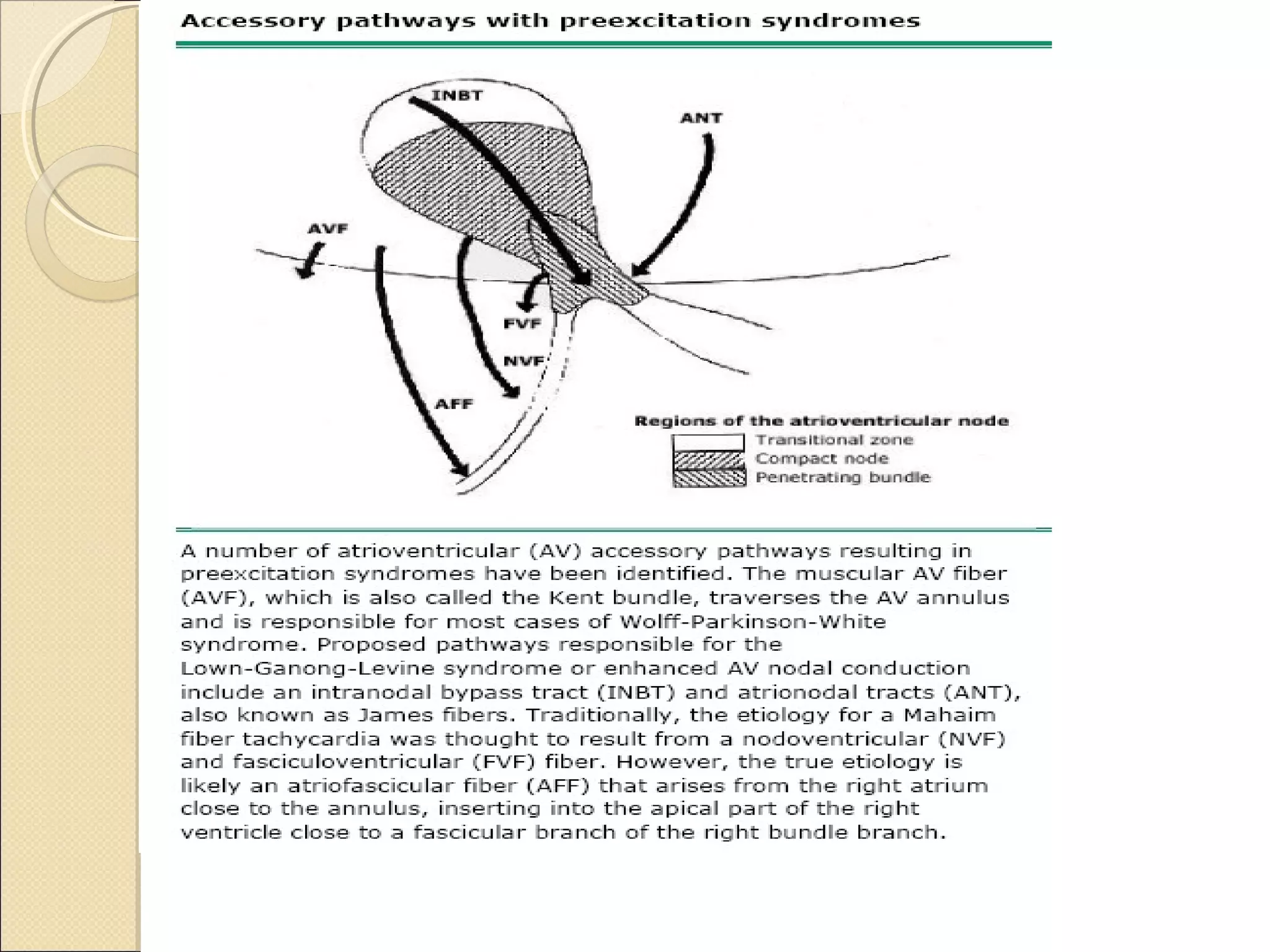
Classic accessory pathway is the AV
bypass tract or bundle of kent in WPW
James fibres, AN tracts connect atrium to
distal AV node
Brechenmacher fibres(atrio- hisian tracts)
connect atrium to HIS bundle
Hisian -fascicular tracts(Mahaim fibres)
CONDUCTIONCONDUCTION
FrequencyFrequency
Delta waves detectable on an ECG have been
reported to be present in 0.15% to 0.25% of the
general population.
 A higher prevalence of 0.55% has been reported in
first-degree relatives of patients with accessory
pathways. Wolff–Parkinson–White syndrome is more
commonly diagnosed in men than in women, although
this sex difference is not observed in children.
Among those with the Wolff–Parkinson–White
syndrome, 3.4 percent have first-degree relatives
with preexcitation.
 The familial form is usually inherited as a mendelian
autosomal dominant trait
Inherited form of WPW syndrome
associated with familial hypertrophic
cardiomyopathy has been recently
described with the locus mapped to
chromosome 7q33.
The term Wolff-Parkinson-White
syndrome is used to describe individuals
with ventricular pre-excitation and
symptomatic tachycardias as originally
described by Wolff, Parkinson and White.
The term Wolff-Parkinson-White pattern
refers to the electrocardiographical
finding of ventricular preexcitation.
VariantsVariants
Concealed Accessory Pathways
 Defined as pathways that are capable of conduction only in
the retrograde (VA) direction at rates similar or greater than
the sinus rate.
 The concealed accessory pathways are noted in between
15% to 42% of patients with accessory pathway.
 Approximately one third of AVRTs are due to concealed
accessory pathways.
 The clinical presentation of patients who have a concealed
accessory pathway is similar to the classic presentation of
WPW syndrome with the exception that no preexcitation,
rapid preexcited responses are not observed during AF.
 Concealed pathways are more frequently localized to the left
free wall (64%), and less frequently in Septal (31%) and right
free wall locations.
Decremental AccessoryDecremental Accessory
pathwayspathways
The electrophysiologic properties of
accessory pathways are similar to
working myocardium.
Few accessory pathways may exhibit
progressive delay in conduction in
response to increased rate of pacing.
Decremental conduction can be seen in
approximately 7% of the patients with
WPW syndrome
Multiple accessory pathways are present
in as many as 13 percent of patients
 Most patients with accessory pathways
do not have any structural cardiac
abnormalities but as many as 10 percent
of patients with Ebstein’s anomaly have
one or more accessory pathways.
PathophysiologyPathophysiology
Accessory AV muscle bridges are normally
presented in human fetal hearts but these
connections are interrupted during growth
of the fibrous annulus
Most accessory pathways consist of small
fibers resembling ordinary myocardium
crossing the AV groove.
The pathways insert directly into the atrial
and basal ventricular myocardium but they
may course through the AV groove at
variable depth ranging from subepicardial to
subendocardial locations.
Accessory pathways may have an oblique
course rather than perpendicular to the
transverse plane of the AV groove,
resulting in an atrial insertion that may be
transverse some distance from the
ventricular insertion site.
The presence of very short AV nodal
conduction times may cause the ventricular
preexcitation to be invisible on the surface
ECG.
Preexcitation can also be minimal when the
accessory pathway is located on the lateral
mitral ring relatively far from the origin of
the sinus impulse.
It was postulated that preexcitation pattern
with a PR interval >120ms typically indicates
a left free wall accessory pathway.
AV reentrant tachycardias (AVRT) occur
when two functionally different
conduction pathways are present.
The effective refractory period of the
accessory tract is usually longer than that
of the normal AV nodal His-Purkinje
tract.
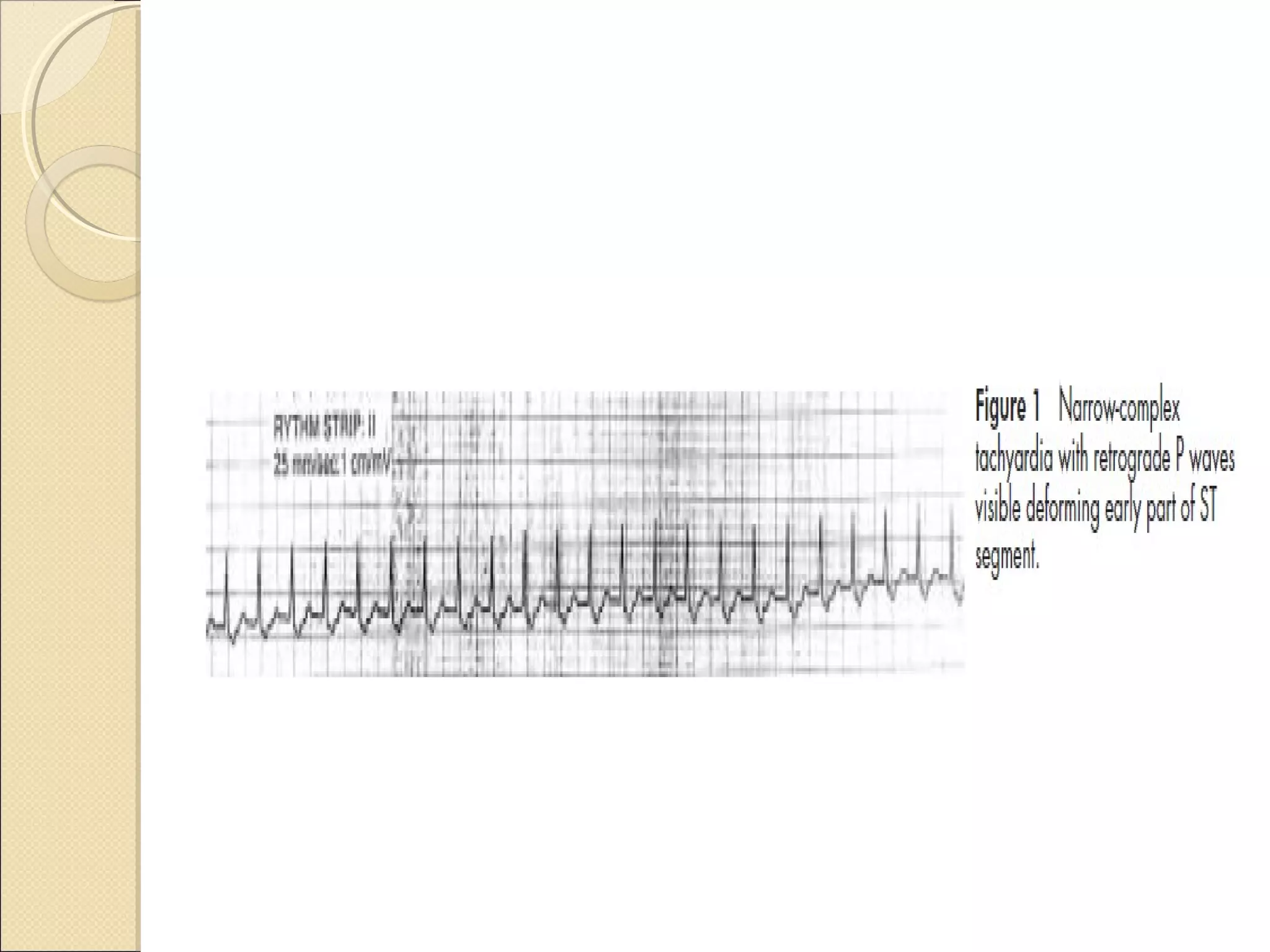
orthodromic atrioventricularorthodromic atrioventricular
reciprocating tachycardia (AVRT)reciprocating tachycardia (AVRT)
Preexcitation pathwaysPreexcitation pathways
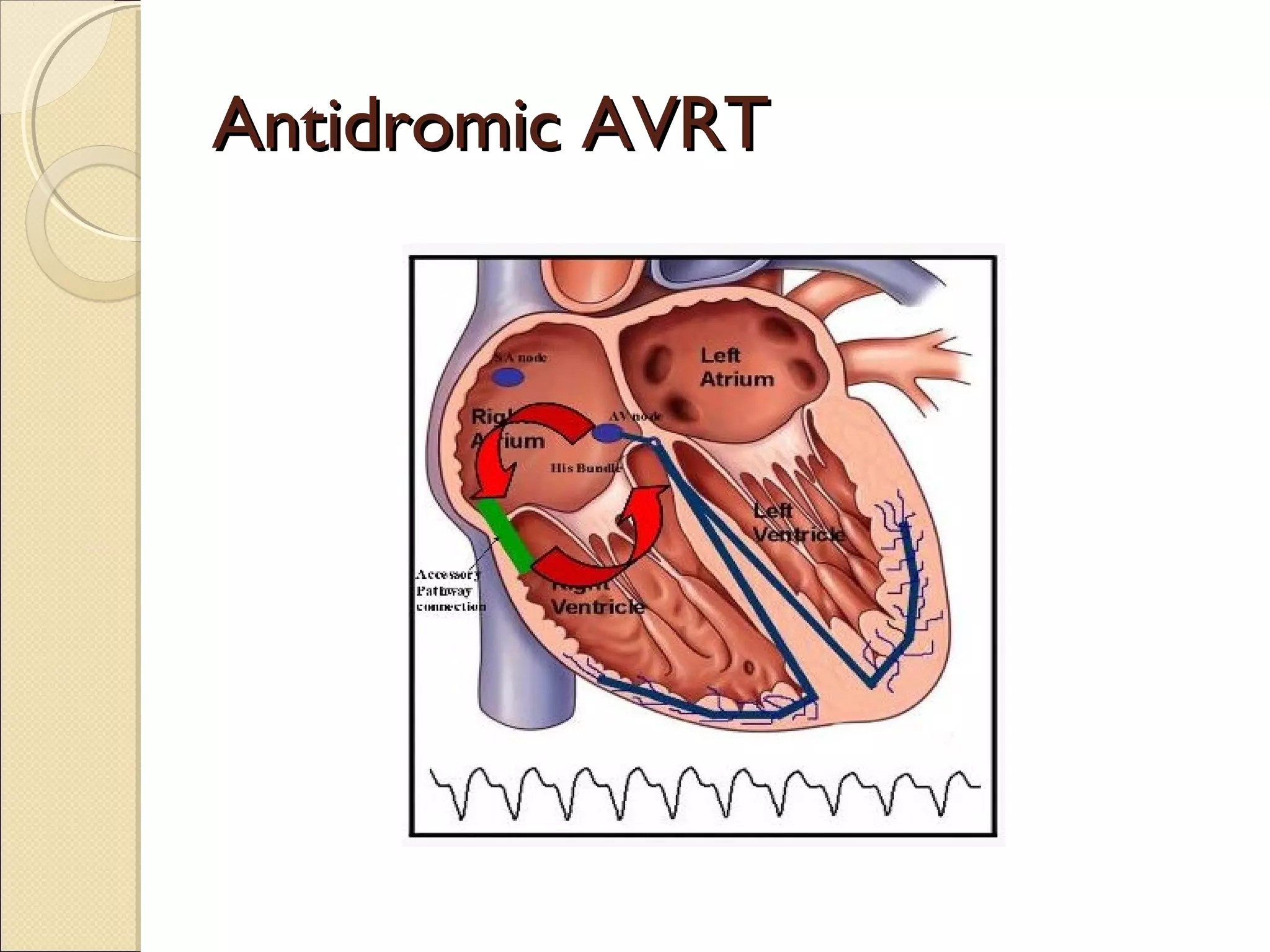
Antidromic AVRTAntidromic AVRT
Patients with antidromic tachycardias have
usually shorter refractoriness in the normal
retrograde VA conduction system and the
maintenance of tachycardia is favored by the
greater distance from the normal AV node.
AVRT using two accessory pathways is a
rare form of tachycardia with broad QRS
complexes in which anterograde conduction
is down one accessory pathway and
retrograde conduction is up another.
The rate of the AVRT depends on the
conduction times of all tissues involved in
the reentrant circuit and on the
autonomic tone modulation.
QRS complex alternans during
supraventricular tachycardia is relatively
specific for AVRT.
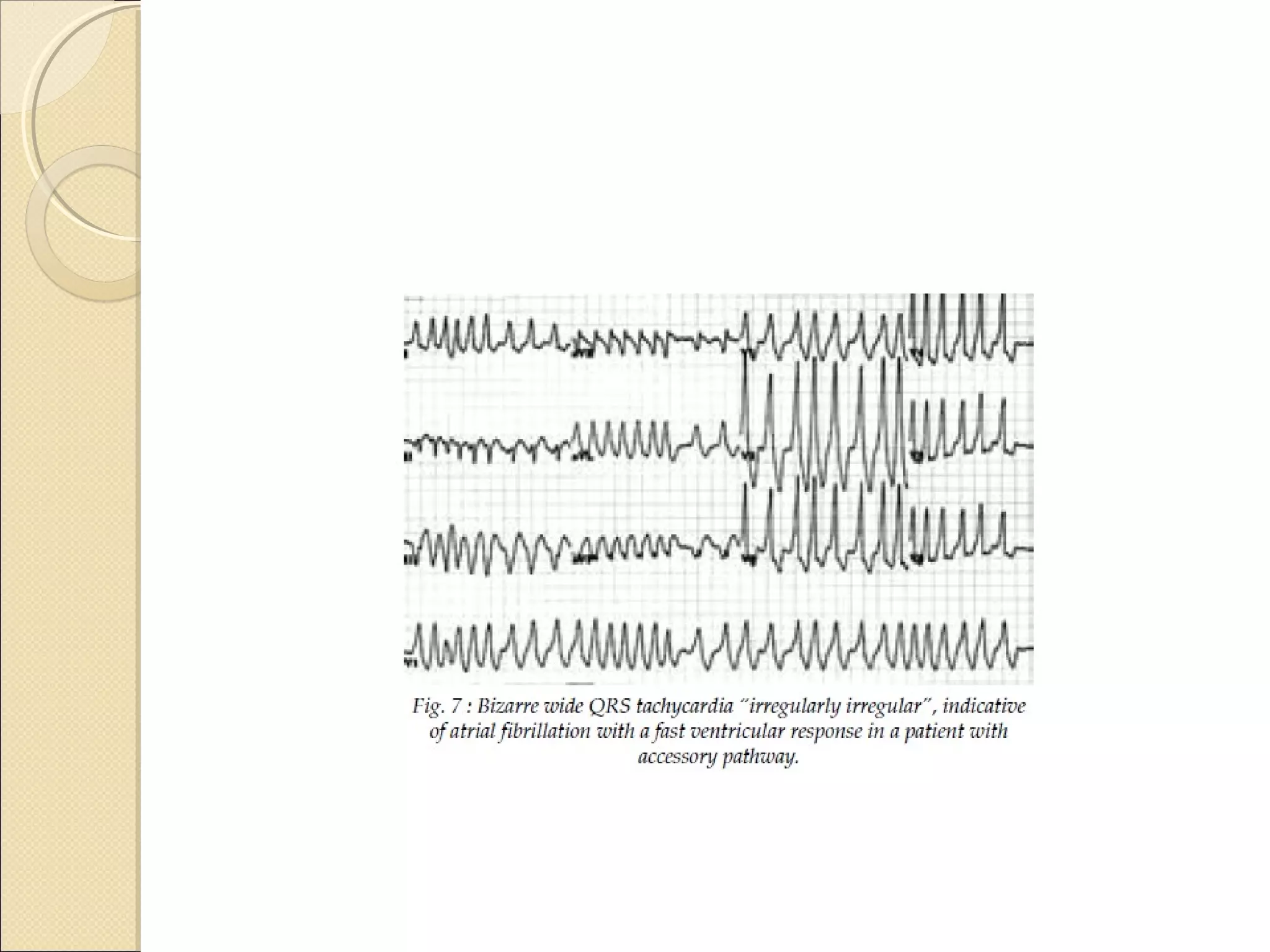
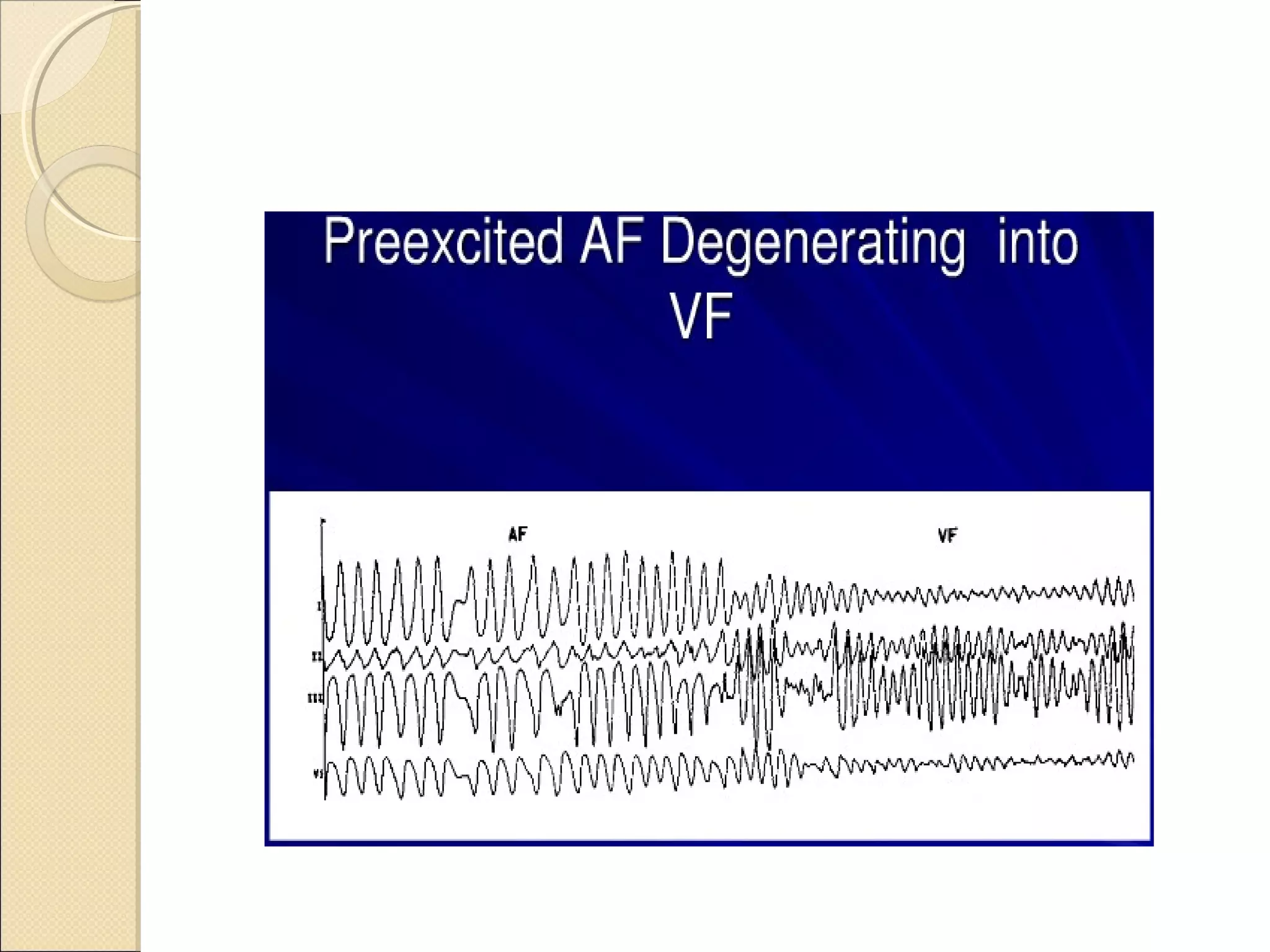
AFAF
Ventricular rates up to 350 bpm are
possible and the QRS morphology
reflects varying degree of preexcitation
due to conduction over the normal AV
node as well as the accessory pathway.
A causal relationship between ventricular
fibrillation and atrial fibrillation with rapid
ventricular response has been
documented
SymptomsSymptoms
The usual complaint of patients with WPW
syndrome and recurrent tachycardia is
usually rapid palpitations associated with
chest discomfort, shortness of breath,
lightheadedness or syncope.
The onset and offset are typically sudden.
Some patients may report precipitating
factors such as coffee, stress, menstrual
periods or pregnancy but most usually the
symptoms are sporadic and unpredictable.
Sudden death is rare but may sporadically
be the initial presentation in previously
asymptomatic individuals.
A history of syncope raises concerns
regarding a very rapid arrhythmia with
haemodynamic compromise.
The WPW pattern in symptomatic or
asymptomatic infants usually disappears,
especially in the first year of life.
However, once symptomatic recurrent
tachycardias appear in adolescence or
adulthood, the course is usually one of
recurring episodes.
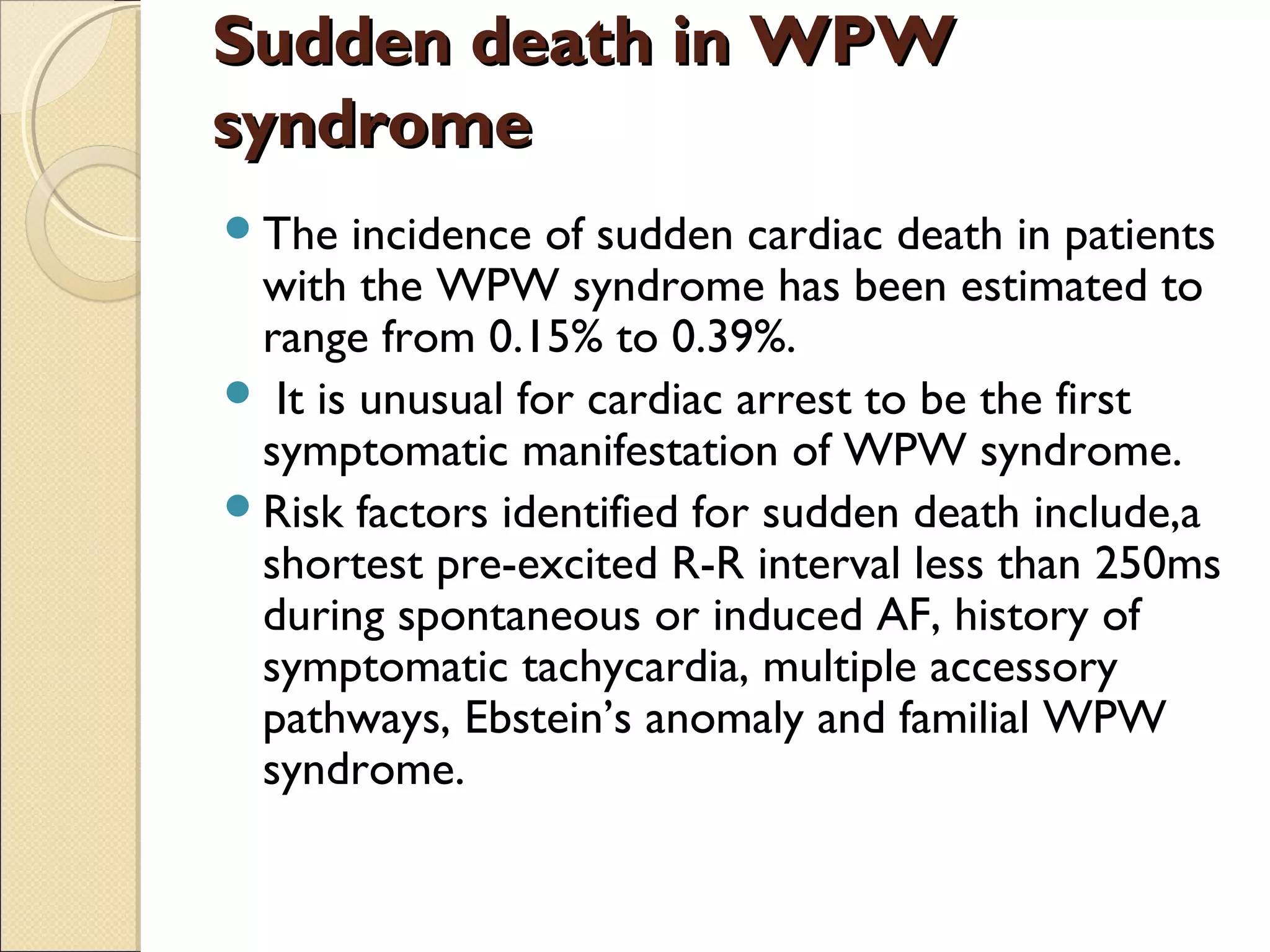
Sudden death in WPWSudden death in WPW
syndromesyndrome
The incidence of sudden cardiac death in patients
with the WPW syndrome has been estimated to
range from 0.15% to 0.39%.
 It is unusual for cardiac arrest to be the first
symptomatic manifestation of WPW syndrome.
Risk factors identified for sudden death include,a
shortest pre-excited R-R interval less than 250ms
during spontaneous or induced AF, history of
symptomatic tachycardia, multiple accessory
pathways, Ebstein’s anomaly and familial WPW
syndrome.
Findings suggestive of a low likelihood of
sudden death include
preexcitation that is intermittent,
the ability to produce anterograde
conduction block with drugs such as
procainamide, and
the disappearance of preexcitation during
exercise
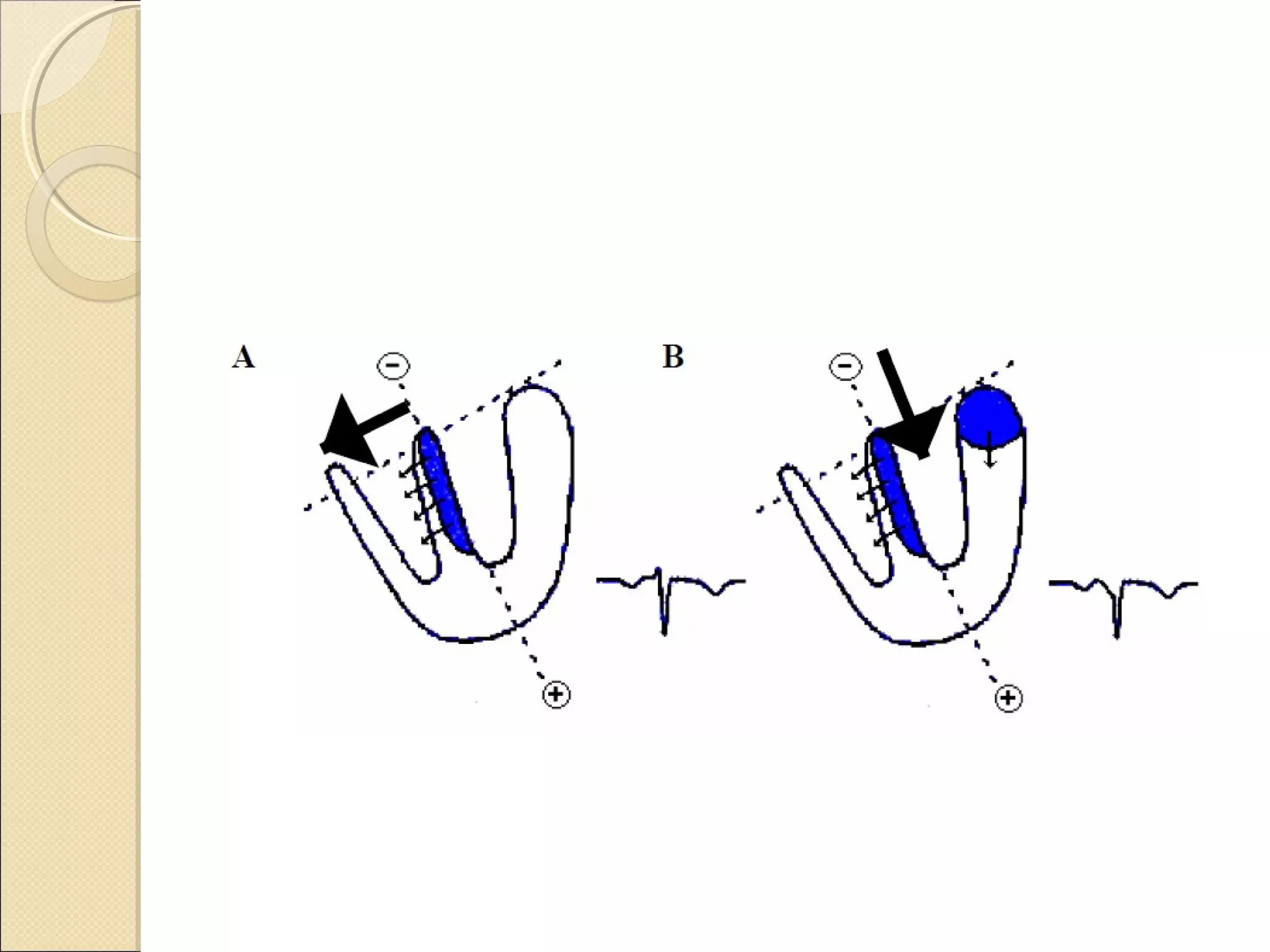
In patients without manifest pre-excitation
the initial activation of the septum is usually
from the left to the right side producing a Q
wave in lateral leads and R wave in lead aVR.
It was claimed that in the presence of a
manifest accessory pathway the usual septal
activation is masked and therefore the
finding of a septal Q wave in lead excludes
ventricular pre-excitation.
 However, several other studies have
reported the presence of the septal Q wave
in lead V6 despite manifest pre-excitation.
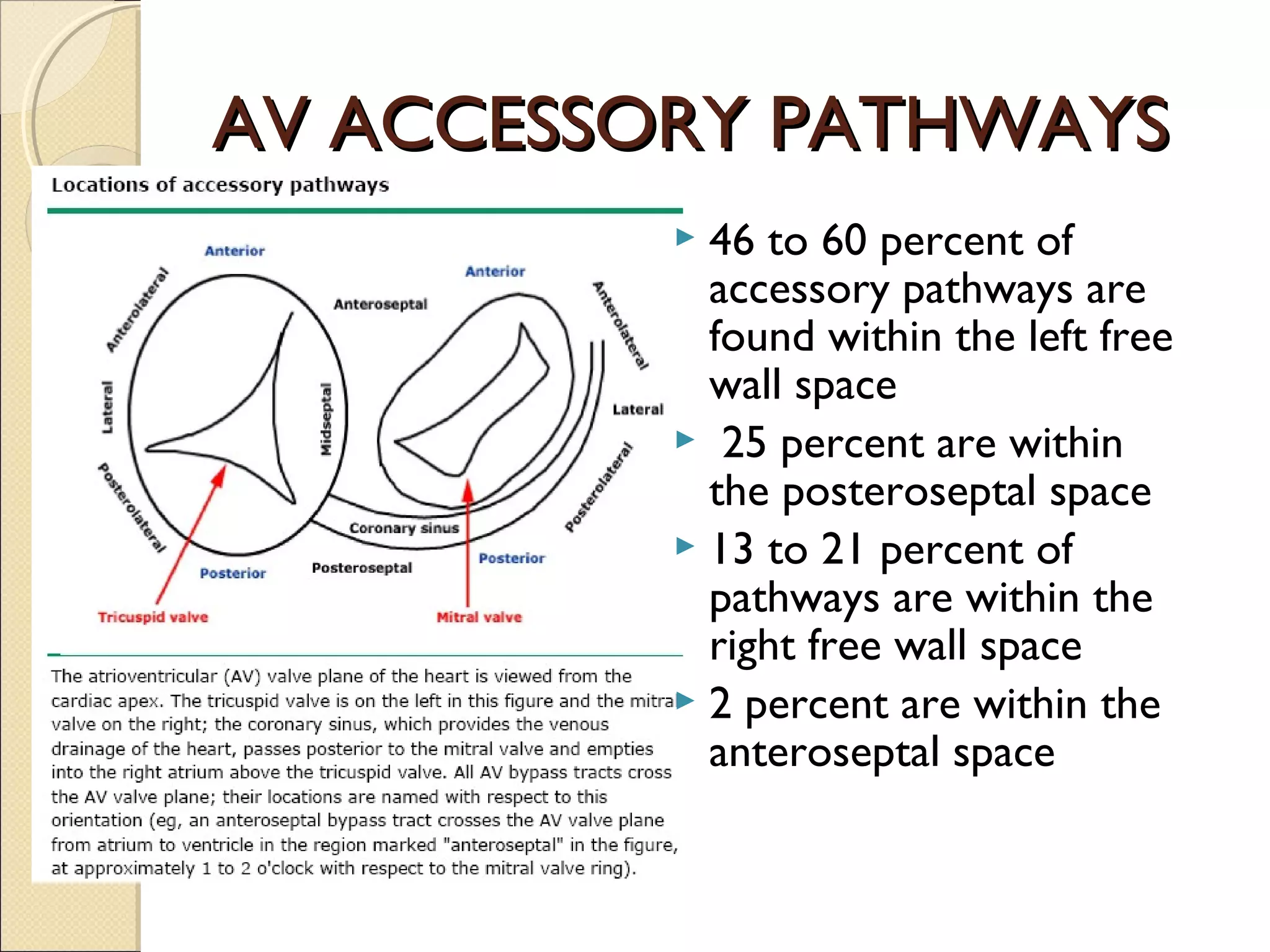
 46 to 60 percent of
accessory pathways are
found within the left free
wall space
 25 percent are within
the posteroseptal space
 13 to 21 percent of
pathways are within the
right free wall space
 2 percent are within the
anteroseptal space
AV ACCESSORY PATHWAYSAV ACCESSORY PATHWAYS
Localization of the accessoryLocalization of the accessory
pathwaypathway
Several algorithms have been proposed
for anatomical localization of the
accessory pathway.
Rosebaum in 1945 divided WPW into
type A, left sided pathways (tall R wave in
lead V1, i.e. a positive delta wave), and
type B, right sided pathways (QS
complex in lead V1, i.e. a negative delta
wave)
Polarity of QRS QRS
AXIS
DELT
A
AXIS
V1 V2 V3
Antero septal
- - - NORMAL NORMAL
Rt lat
- - - LEFT
[ -60]
LEFT
[ -60]
Rt postseptal
- + + LEFT [ -30] LEFT[ -60]
Lt postseptal
+ + + LEFT[ -30] LEFT[ -60]
DELTA IN
V1
QRS IN V1 QRS IN V2
RT POST
SEPTAL
ISO or NEGATIVE DOMINANTLY
NEGATIVE
POSITIVE
LT POST
SEPTAL
POSITVE
[ALWAYS]
DOMINANTLY
POSITIVE or
equiphasic
positive
The predictive accuracy of all these
algorithms is significantly reduced in the
presence of multiple pathways.
Coexistent anomalies such as Acute MI
or LVH may alter the QRS morphology
ElectrophysiologicalElectrophysiological
assessmentassessment
The main indication for electrophysiological
testing is a decision to undergo catheter ablation
or less frequently, diagnostic study for risk
stratification.
Electrophysiological studies utilize the placement
of a decapolar catheter to the coronary sinus and
three quadripolar catheters to the high right
atrium, right ventricular apex and His bundle
region.
The presence of an accessory AV connection is
confirmed by the presence of a delta wave on the
surface ECG and increased preexcitation and
shortening of HV interval during incremental and
programmed atrial pacing.
Indications ofIndications of ElectrophysiologicalElectrophysiological
Studies in WPWStudies in WPW
 1) Sudden deaths have the peculiarity to occur during
exercise, hence all competitive athletes with WPW
syndrome should be studied.
 2) Patient with high responsibility profession such as
professional pilot (plane, truck, bus, train)
 3) The indications in children are more controversial, the
conductionin accessory pathway and normal AV conduction
system are more rapid, probably without a clinical
significance.
 The indications should be liberal in children who are
competitive athletes and in all children above the age of 10
years.
 4) In elderly, the propensity for atrial fibrillation increases
hence the risk of occurrence of a potentially severe
arrhythmia in an asymptomatic WPW patient should not be
underestimated.
Atrial pacing from the sites closer to the
accessory pathway will preferentially
conduct over this pathway with enhanced
preexcitation.
Therefore, in a patient with a left-sided
accessory pathway, the stimulus to delta
wave will be shorter during pacing from the
coronary sinus than during right atrial
pacing. This is especially useful in exposing
left-sided pathways with minimal
preexcitation on the surface ECG.
Multipolar catheters located in the coronary
sinus are useful for accurate localization of
the left sided accessory pathways as the
coronary sinus runs in the epicardial fat in
the posterior groove around the posterior
and lateral aspects of the mitral valve.
The coronary sinus ostium empties into the
junction of the inferior and medial walls of
the right atrium and approximates the
inferoposterior corner of the interatrial
septum.
Mapping on the tricuspid ring is more
difficult and preformed sheaths to facilitate
contact, multipolar “halo” catheters to
record signals along the tricuspid ring or
catheters for mapping within the right
coronary artery are available.
The distal portion of the catheter recording
the His bundle electrogram approximates
the superior limit of the atrial septum where
it joins the tricuspid valve.
Exact localization of an accessory pathway
may be limited by the possible occurrence of
multiple pathways.
It may also be difficult to distinguish
between retrograde atrial activation due to
a midseptal pathway and atypical AV node
reentry.
The use of pharmacologic agent that
selectively slows conduction over the AV
node, such as adenosine, may be useful to
accentuate accessory pathway conduction
during atrial pacing.
Left lat APLeft lat AP
Diag criteriaDiag criteria
Antidromic tachycardiaAntidromic tachycardia
Obligatory 1:1 AV relationship.
QRS morphology in tachycardia consistent
with max preexitation.
Tachycardia QRS morphology reproduced
by atrial pacing near pathway insertion.
Advanced ventricular activation by atrial
extrastimuli near insertion with
advancement of subsequent His activation.
Changes in V –His interval precede changes
in cycle length.
The presence of an accessory pathway
participating in the tachycardia circuit can
be confirmed by prolongation of the cycle
length with ipsilateral bundle branch
block and termination of tachycardia
after a premature ventricular
extrastimulus that does not conduct to
the atria and occurs when the His bundle
is refractory.
Differentiation between atrial tachycardia
and AVRT is best accomplished by
dissociating the ventricles from the
tachycardia.
The demonstration of a VA-AV response
after termination of ventricular pacing
that entrains the atrium excludes an
AVRT and confirms atrial tachycardia
For left free wall accessory pathways, the
diagnosis of AVRT can be mimicked by
antrioventricular nodal reentry with
eccentric atrial activation or by atrial
tachycardias arising from the CS
musculature or the ligament of Marshall.
The differential diagnosis of an antidromic
tachycardia includes ventricular tachycardia that
should be diagnosed by the dissociation of the
atrium from the ventricle or a variable His-to-
atrium timing relationship without alteration of
the tachycardia cycle length.
Antidromic tachycardia is diagnosed by
demonstrating the reproduction of tachycardia
QRS morphology by atrial pacing at the
presumed accessory pathway insertion site and
advancement of the ventricular and subsequent
His activation by a premature atrial stimulus near
the accessory pathway site.
VA conduction indices : Using
ventricular-induced atrial pre-excitation,
Miles et al  devised pre-excitation index
Progressively premature right ventricular
extrastimuli were introduced during
tachycardia and the difference between
the TCL and the longest stimulation
interval at which atrial pre-excitation
occurred 
pre-excitation indexpre-excitation index
Atrial preexcitation at >90% TCL means
the presence of a septal or right sided BT
If PEI is <25 then Anteroseptal or Right
Free Wall
If PEI is > 75 then Left Lateral or AVNRT
More than 75 ms – left free wall
Less than 45 ms- septal tracts
The new index was computed
(AV conduction time during SVT) +
(ventriculoatrial conduction time during
ventricular pacing at the SVT cycle length)
-(SVT cycle length). 
 new index could differentiate AV
reentrant tachycardia (index 60 ms,)
from AV nodal reentrant tachycardia
( 100 ms ).

Wpw syndrome

  • 1.
    WPW SYNDROMEWPW SYNDROME RaviKumar,DM(Cardiology) NIMS,Hyderbad-50082 India
  • 2.
    Historical perspectiveHistorical perspective Theearliest description of an accessory pathway was reported by Stanley Kent in 1893 who suggested that impulses can travel from the atrium to the ventricle over a node-like structure other than the atrioventricular (AV) node. Cohn and Fraser reported the first case of pre-excitation syndrome in 1913
  • 3.
    In 1930, LouisWolff, Sir John Parkinson, and Paul Dudley White published a seminal article describing 11 young patients who suffered from attacks of tachycardia associated with an electrocardiographic pattern of bundle branch block with a short PR interval
  • 4.
    Ohnell was thefirst to use the term “pre-excitation,” whereas Seters described the slurred initial component of the QRS complex as a “delta” wave.
  • 5.
    Curative therapy ofWPW syndrome was demonstrated in 1967 when Cobb et al successfully ablated an accessory pathway during open-hear surgery The first successful catheter ablation of an accessory pathway by delivering direct current energy was reported by Morady and Scheinman in 1984.
  • 6.
    In 1987, Borggrefeet al. successfully ablated a right-sided pathway by delivering RF current. Radiofrequency ablation of accessory pathways has become a first line therapy and is favoured over the medical treatment in most of the patients.
  • 7.
    INTRODUCTIONINTRODUCTION Patients with pre-excitationsyndromes have an additional or accessory pathway, which directly connects the atria and ventricles. In the Wolff-Parkinson-White pattern, AV conduction through the bypass tract results in earlier activation (preexcitation) of the ventricles than if the impulse had travelled through the AV node
  • 8.
    Classic accessory pathwayis the AV bypass tract or bundle of kent in WPW James fibres, AN tracts connect atrium to distal AV node Brechenmacher fibres(atrio- hisian tracts) connect atrium to HIS bundle Hisian -fascicular tracts(Mahaim fibres)
  • 12.
  • 13.
    FrequencyFrequency Delta waves detectableon an ECG have been reported to be present in 0.15% to 0.25% of the general population.  A higher prevalence of 0.55% has been reported in first-degree relatives of patients with accessory pathways. Wolff–Parkinson–White syndrome is more commonly diagnosed in men than in women, although this sex difference is not observed in children. Among those with the Wolff–Parkinson–White syndrome, 3.4 percent have first-degree relatives with preexcitation.  The familial form is usually inherited as a mendelian autosomal dominant trait
  • 14.
    Inherited form ofWPW syndrome associated with familial hypertrophic cardiomyopathy has been recently described with the locus mapped to chromosome 7q33.
  • 15.
    The term Wolff-Parkinson-White syndromeis used to describe individuals with ventricular pre-excitation and symptomatic tachycardias as originally described by Wolff, Parkinson and White. The term Wolff-Parkinson-White pattern refers to the electrocardiographical finding of ventricular preexcitation.
  • 16.
    VariantsVariants Concealed Accessory Pathways Defined as pathways that are capable of conduction only in the retrograde (VA) direction at rates similar or greater than the sinus rate.  The concealed accessory pathways are noted in between 15% to 42% of patients with accessory pathway.  Approximately one third of AVRTs are due to concealed accessory pathways.  The clinical presentation of patients who have a concealed accessory pathway is similar to the classic presentation of WPW syndrome with the exception that no preexcitation, rapid preexcited responses are not observed during AF.  Concealed pathways are more frequently localized to the left free wall (64%), and less frequently in Septal (31%) and right free wall locations.
  • 18.
    Decremental AccessoryDecremental Accessory pathwayspathways Theelectrophysiologic properties of accessory pathways are similar to working myocardium. Few accessory pathways may exhibit progressive delay in conduction in response to increased rate of pacing. Decremental conduction can be seen in approximately 7% of the patients with WPW syndrome
  • 19.
    Multiple accessory pathwaysare present in as many as 13 percent of patients  Most patients with accessory pathways do not have any structural cardiac abnormalities but as many as 10 percent of patients with Ebstein’s anomaly have one or more accessory pathways.
  • 20.
    PathophysiologyPathophysiology Accessory AV musclebridges are normally presented in human fetal hearts but these connections are interrupted during growth of the fibrous annulus Most accessory pathways consist of small fibers resembling ordinary myocardium crossing the AV groove. The pathways insert directly into the atrial and basal ventricular myocardium but they may course through the AV groove at variable depth ranging from subepicardial to subendocardial locations.
  • 21.
    Accessory pathways mayhave an oblique course rather than perpendicular to the transverse plane of the AV groove, resulting in an atrial insertion that may be transverse some distance from the ventricular insertion site.
  • 22.
    The presence ofvery short AV nodal conduction times may cause the ventricular preexcitation to be invisible on the surface ECG. Preexcitation can also be minimal when the accessory pathway is located on the lateral mitral ring relatively far from the origin of the sinus impulse. It was postulated that preexcitation pattern with a PR interval >120ms typically indicates a left free wall accessory pathway.
  • 23.
    AV reentrant tachycardias(AVRT) occur when two functionally different conduction pathways are present. The effective refractory period of the accessory tract is usually longer than that of the normal AV nodal His-Purkinje tract.
  • 24.
    orthodromic atrioventricularorthodromic atrioventricular reciprocatingtachycardia (AVRT)reciprocating tachycardia (AVRT)
  • 25.
  • 27.
  • 29.
    Patients with antidromictachycardias have usually shorter refractoriness in the normal retrograde VA conduction system and the maintenance of tachycardia is favored by the greater distance from the normal AV node. AVRT using two accessory pathways is a rare form of tachycardia with broad QRS complexes in which anterograde conduction is down one accessory pathway and retrograde conduction is up another.
  • 30.
    The rate ofthe AVRT depends on the conduction times of all tissues involved in the reentrant circuit and on the autonomic tone modulation. QRS complex alternans during supraventricular tachycardia is relatively specific for AVRT.
  • 31.
    AFAF Ventricular rates upto 350 bpm are possible and the QRS morphology reflects varying degree of preexcitation due to conduction over the normal AV node as well as the accessory pathway. A causal relationship between ventricular fibrillation and atrial fibrillation with rapid ventricular response has been documented
  • 34.
    SymptomsSymptoms The usual complaintof patients with WPW syndrome and recurrent tachycardia is usually rapid palpitations associated with chest discomfort, shortness of breath, lightheadedness or syncope. The onset and offset are typically sudden. Some patients may report precipitating factors such as coffee, stress, menstrual periods or pregnancy but most usually the symptoms are sporadic and unpredictable.
  • 35.
    Sudden death israre but may sporadically be the initial presentation in previously asymptomatic individuals. A history of syncope raises concerns regarding a very rapid arrhythmia with haemodynamic compromise.
  • 36.
    The WPW patternin symptomatic or asymptomatic infants usually disappears, especially in the first year of life. However, once symptomatic recurrent tachycardias appear in adolescence or adulthood, the course is usually one of recurring episodes.
  • 37.
    Sudden death inWPWSudden death in WPW syndromesyndrome The incidence of sudden cardiac death in patients with the WPW syndrome has been estimated to range from 0.15% to 0.39%.  It is unusual for cardiac arrest to be the first symptomatic manifestation of WPW syndrome. Risk factors identified for sudden death include,a shortest pre-excited R-R interval less than 250ms during spontaneous or induced AF, history of symptomatic tachycardia, multiple accessory pathways, Ebstein’s anomaly and familial WPW syndrome.
  • 38.
    Findings suggestive ofa low likelihood of sudden death include preexcitation that is intermittent, the ability to produce anterograde conduction block with drugs such as procainamide, and the disappearance of preexcitation during exercise
  • 39.
    In patients withoutmanifest pre-excitation the initial activation of the septum is usually from the left to the right side producing a Q wave in lateral leads and R wave in lead aVR. It was claimed that in the presence of a manifest accessory pathway the usual septal activation is masked and therefore the finding of a septal Q wave in lead excludes ventricular pre-excitation.  However, several other studies have reported the presence of the septal Q wave in lead V6 despite manifest pre-excitation.
  • 42.
     46 to60 percent of accessory pathways are found within the left free wall space  25 percent are within the posteroseptal space  13 to 21 percent of pathways are within the right free wall space  2 percent are within the anteroseptal space AV ACCESSORY PATHWAYSAV ACCESSORY PATHWAYS
  • 43.
    Localization of theaccessoryLocalization of the accessory pathwaypathway Several algorithms have been proposed for anatomical localization of the accessory pathway. Rosebaum in 1945 divided WPW into type A, left sided pathways (tall R wave in lead V1, i.e. a positive delta wave), and type B, right sided pathways (QS complex in lead V1, i.e. a negative delta wave)
  • 46.
    Polarity of QRSQRS AXIS DELT A AXIS V1 V2 V3 Antero septal - - - NORMAL NORMAL Rt lat - - - LEFT [ -60] LEFT [ -60] Rt postseptal - + + LEFT [ -30] LEFT[ -60] Lt postseptal + + + LEFT[ -30] LEFT[ -60]
  • 47.
    DELTA IN V1 QRS INV1 QRS IN V2 RT POST SEPTAL ISO or NEGATIVE DOMINANTLY NEGATIVE POSITIVE LT POST SEPTAL POSITVE [ALWAYS] DOMINANTLY POSITIVE or equiphasic positive
  • 49.
    The predictive accuracyof all these algorithms is significantly reduced in the presence of multiple pathways. Coexistent anomalies such as Acute MI or LVH may alter the QRS morphology
  • 50.
    ElectrophysiologicalElectrophysiological assessmentassessment The main indicationfor electrophysiological testing is a decision to undergo catheter ablation or less frequently, diagnostic study for risk stratification. Electrophysiological studies utilize the placement of a decapolar catheter to the coronary sinus and three quadripolar catheters to the high right atrium, right ventricular apex and His bundle region. The presence of an accessory AV connection is confirmed by the presence of a delta wave on the surface ECG and increased preexcitation and shortening of HV interval during incremental and programmed atrial pacing.
  • 51.
    Indications ofIndications ofElectrophysiologicalElectrophysiological Studies in WPWStudies in WPW  1) Sudden deaths have the peculiarity to occur during exercise, hence all competitive athletes with WPW syndrome should be studied.  2) Patient with high responsibility profession such as professional pilot (plane, truck, bus, train)  3) The indications in children are more controversial, the conductionin accessory pathway and normal AV conduction system are more rapid, probably without a clinical significance.  The indications should be liberal in children who are competitive athletes and in all children above the age of 10 years.  4) In elderly, the propensity for atrial fibrillation increases hence the risk of occurrence of a potentially severe arrhythmia in an asymptomatic WPW patient should not be underestimated.
  • 52.
    Atrial pacing fromthe sites closer to the accessory pathway will preferentially conduct over this pathway with enhanced preexcitation. Therefore, in a patient with a left-sided accessory pathway, the stimulus to delta wave will be shorter during pacing from the coronary sinus than during right atrial pacing. This is especially useful in exposing left-sided pathways with minimal preexcitation on the surface ECG.
  • 53.
    Multipolar catheters locatedin the coronary sinus are useful for accurate localization of the left sided accessory pathways as the coronary sinus runs in the epicardial fat in the posterior groove around the posterior and lateral aspects of the mitral valve. The coronary sinus ostium empties into the junction of the inferior and medial walls of the right atrium and approximates the inferoposterior corner of the interatrial septum.
  • 54.
    Mapping on thetricuspid ring is more difficult and preformed sheaths to facilitate contact, multipolar “halo” catheters to record signals along the tricuspid ring or catheters for mapping within the right coronary artery are available. The distal portion of the catheter recording the His bundle electrogram approximates the superior limit of the atrial septum where it joins the tricuspid valve.
  • 55.
    Exact localization ofan accessory pathway may be limited by the possible occurrence of multiple pathways. It may also be difficult to distinguish between retrograde atrial activation due to a midseptal pathway and atypical AV node reentry. The use of pharmacologic agent that selectively slows conduction over the AV node, such as adenosine, may be useful to accentuate accessory pathway conduction during atrial pacing.
  • 58.
  • 60.
  • 61.
    Antidromic tachycardiaAntidromic tachycardia Obligatory1:1 AV relationship. QRS morphology in tachycardia consistent with max preexitation. Tachycardia QRS morphology reproduced by atrial pacing near pathway insertion. Advanced ventricular activation by atrial extrastimuli near insertion with advancement of subsequent His activation. Changes in V –His interval precede changes in cycle length.
  • 62.
    The presence ofan accessory pathway participating in the tachycardia circuit can be confirmed by prolongation of the cycle length with ipsilateral bundle branch block and termination of tachycardia after a premature ventricular extrastimulus that does not conduct to the atria and occurs when the His bundle is refractory.
  • 64.
    Differentiation between atrialtachycardia and AVRT is best accomplished by dissociating the ventricles from the tachycardia. The demonstration of a VA-AV response after termination of ventricular pacing that entrains the atrium excludes an AVRT and confirms atrial tachycardia
  • 65.
    For left freewall accessory pathways, the diagnosis of AVRT can be mimicked by antrioventricular nodal reentry with eccentric atrial activation or by atrial tachycardias arising from the CS musculature or the ligament of Marshall.
  • 66.
    The differential diagnosisof an antidromic tachycardia includes ventricular tachycardia that should be diagnosed by the dissociation of the atrium from the ventricle or a variable His-to- atrium timing relationship without alteration of the tachycardia cycle length. Antidromic tachycardia is diagnosed by demonstrating the reproduction of tachycardia QRS morphology by atrial pacing at the presumed accessory pathway insertion site and advancement of the ventricular and subsequent His activation by a premature atrial stimulus near the accessory pathway site.
  • 67.
    VA conduction indices: Using ventricular-induced atrial pre-excitation, Miles et al  devised pre-excitation index Progressively premature right ventricular extrastimuli were introduced during tachycardia and the difference between the TCL and the longest stimulation interval at which atrial pre-excitation occurred  pre-excitation indexpre-excitation index
  • 69.
    Atrial preexcitation at>90% TCL means the presence of a septal or right sided BT If PEI is <25 then Anteroseptal or Right Free Wall If PEI is > 75 then Left Lateral or AVNRT
  • 70.
    More than 75ms – left free wall Less than 45 ms- septal tracts
  • 71.
    The new indexwas computed (AV conduction time during SVT) + (ventriculoatrial conduction time during ventricular pacing at the SVT cycle length) -(SVT cycle length). 
  • 72.
     new indexcould differentiate AV reentrant tachycardia (index 60 ms,) from AV nodal reentrant tachycardia ( 100 ms ).

Editor's Notes

  • #11 Figure 2.   Image of preexcitation of the EKG with a manifest accessory pathway leading to the EKG findings of WPW pattern. As seen here, electrical conduction from the atria to the ventricles can occur via the normal AV nodal system and the accessory pathway simultaneously. This leads to the creation of the slurred upstroke, or delta wave, seen on the surface EKG lead and denoted by arrows in the tracing seen here. -- Figure 2.   Image of preexcitation of the EKG with a manifest accessory pathway leading to the EKG findings of WPW pattern. As seen here, electrical conduction from the atria to the ventricles can occur via the normal AV nodal system and the accessory pathway simultaneously. This leads to the creation of the slurred upstroke, or delta wave, seen on the surface EKG lead and denoted by arrows in the tracing seen here. --   Image of preexcitation of the EKG with a manifest accessory pathway leading to the EKG findings of WPW pattern. As seen here, electrical conduction from the atria to the ventricles can occur via the normal AV nodal system and the accessory pathway simultaneously. This leads to the creation of the slurred upstroke, or delta wave, seen on the surface EKG lead and denoted by arrows in the tracing seen here.
  • #15 One beat from a rhythm strip demonstrating characteristic ECG features of the Wolff-Parkinson-White syndrome. Note the short PR interval, delta wave and prolonged QRS complex.
  • #29 Illustration of  orthodromic atrioventricular reciprocating tachycardia (AVRT) with a reentrant circuit consisting of 2 limbs.  The forward or antegrade limb involves the normal AV nodal system, and the reverse, or retrograde, limb involves the accessory pathway.  This type of SVT leads to a narrow-complex rhythm on the EKG as seen above.   Illustration of  orthodromic atrioventricular reciprocating tachycardia (AVRT) with a reentrant circuit consisting of 2 limbs.  The forward or antegrade limb involves the normal AV nodal system, and the reverse, or retrograde, limb involves the accessory pathway.  This type of SVT leads to a narrow-complex rhythm on the EKG as seen above.   ortho
  • #32 anti
  • #46 Figure 17. A: Septal depolarisation in patients without manifest pre-excitation producing a septal R wave in lead aVR). B: Depolarisation of the myocardium through the accessory pathway manifested by a negative delta wave in lead aVR.
  • #47 Magnification of surface electrographic lead V6. There is an RSR’ pattern before (A) and QR pattern after (B) successful ablation of a left lateral accessory pathway. It would not be very difficult to miss the first positive deflection on the left hand side picture and misinterpret the S wave as a Q wave.
  • #52 ARUDA
  • #60 Figure 5. Stepwise algorithm for the prediction of accessory pathway localization using a 12 lead ECG. The main criteria considered in the algorithm were horizontal QRS transition, R/S relationship in leads I and aVL, delta wave polarity and frontal axis and R wave amplitude in lead III. Fitzpatrick proposed a stepwise algorithm for the localization of accessory pathway (Figure 5)45.
  • #94 Figure 7. Occurrence of left bundle branch block during AVRT. A. AVRT without functional bundle block. B. The development of left bundle branch block is associated with the prolongation of the VA interval and the tachycardia cycle length indicating utilization of a left lateral accessory pathway as the retrograde limb of this tachycardia circuit. V6 – ECG lead V6, AE – intracardiac electrogram from the high right atrium.
  • #98 Figure 8. Tracings from the 12-lead ECG illustrating the principle of PR dispersion. Lead II has the least pre-excited QRS complex with the longest PR interval (180 ms) whereas lead V5 is the most pre-excited with the PR interval of 100 ms. Thus, the PR dispersion was calculated as 180 – 100 = 80 ms.