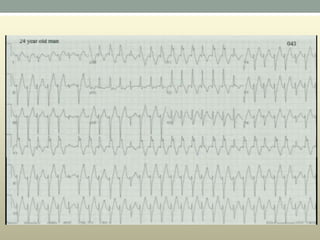
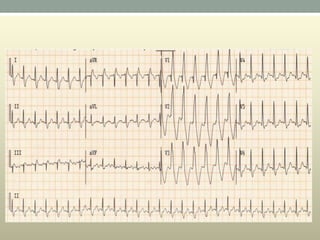
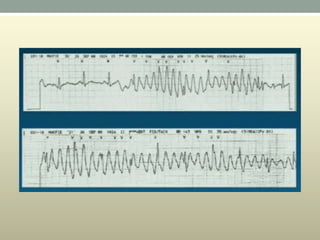
WIDE COMPLEX
TACHYCARDIA
19/01/2012
Omer Abu-Bakr M. El-Amin, MD, FACC
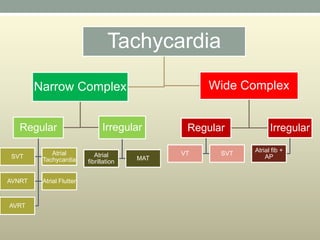
Tachycardia

        Narrow Complex                              Wide Complex


   Regular                      Irregular       Regular           Irregular

            Atrial                                          Atrial fib +
 SVT                         Atrial            VT     SVT
         Tachycardia                     MAT                    AP
                          fibrillation


AVNRT    Atrial Flutter


AVRT
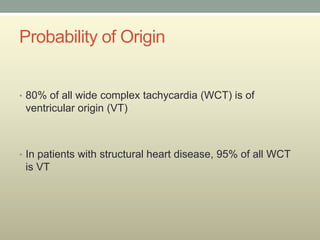
Probability of Origin


• 80% of all wide complex tachycardia (WCT) is of
 ventricular origin (VT)


• In patients with structural heart disease, 95% of all WCT
 is VT
Clinical Significance

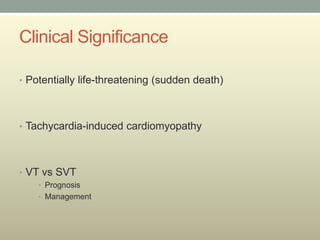
• Potentially life-threatening (sudden death)


• Tachycardia-induced cardiomyopathy


• VT vs SVT
    • Prognosis
    • Management
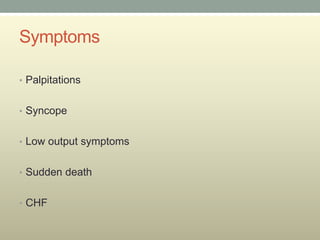
Symptoms

• Palpitations


• Syncope


• Low output symptoms


• Sudden death


• CHF
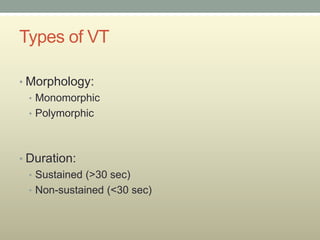
Types of VT

• Morphology:
  • Monomorphic
  • Polymorphic


• Duration:
  • Sustained (>30 sec)
  • Non-sustained (<30 sec)
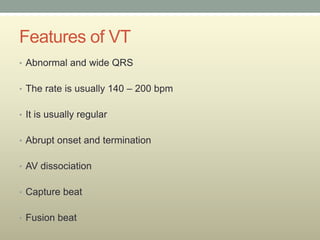
Features of VT
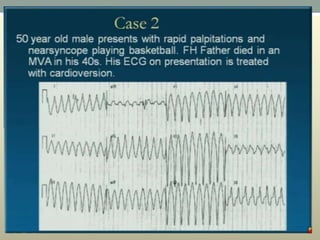
• Abnormal and wide QRS


• The rate is usually 140 – 200 bpm


• It is usually regular


• Abrupt onset and termination


• AV dissociation


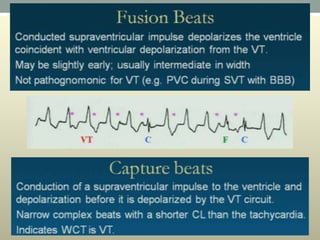
• Capture beat


• Fusion beat
ECG RECOGNITION OF VT
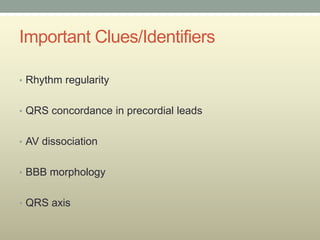
Important Clues/Identifiers

• Rhythm regularity


• QRS concordance in precordial leads


• AV dissociation


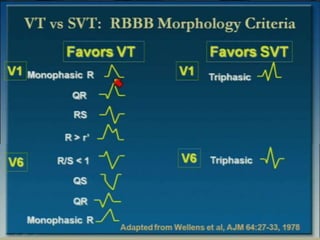
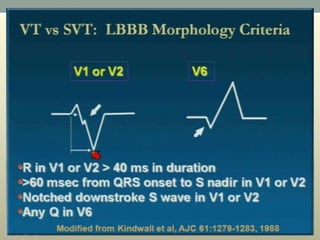
• BBB morphology


• QRS axis
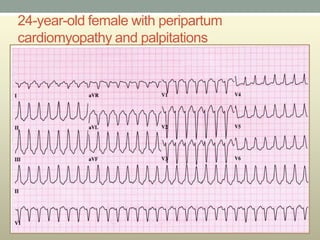
24-year-old female with peripartum
cardiomyopathy and palpitations
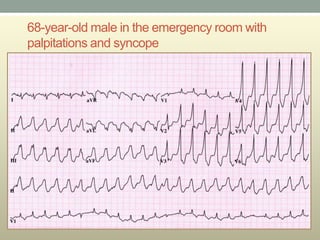
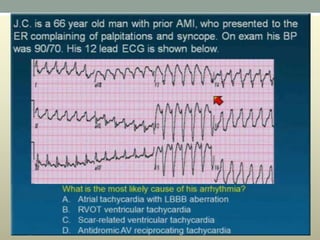
68-year-old male in the emergency room with
palpitations and syncope
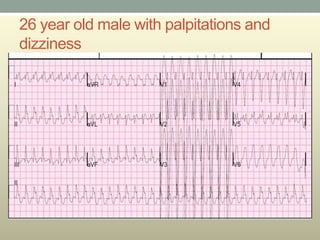
26 year old male with palpitations and
dizziness
Wide complex tachycardia

Wide complex tachycardia

Editor's Notes

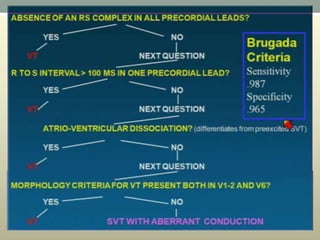
  • #21  Apply the Brugada Criteria: RS is there, so go to next criteria: R to S is 100 or more , so you stop here it is VT, also from Hx, over 95 % chance that it is VT.
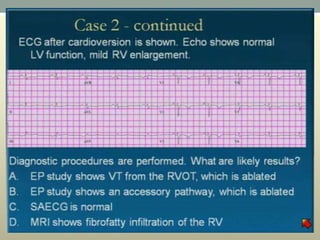
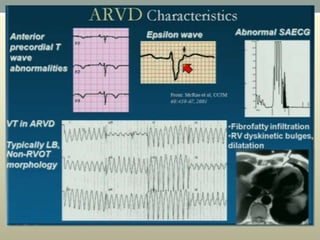
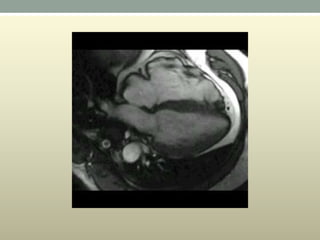
  • #23  ARVD; Look for the epselon wave at the end of QRS in precordial leads , and T wave inversion in precordial leads.
  • #24 Autosomal Domonant with various penetrence
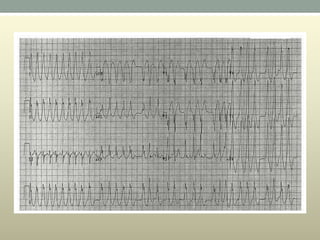
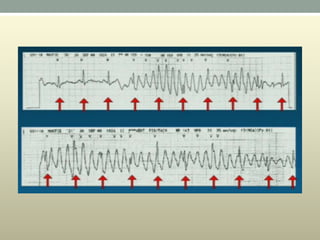
  • #26 80 % of all the Wide complex Tach are VT, and 95 % of all the WC Tach are VT in patients with structural heart disease. If palpitation started after MI, it is VT; but this tracing is an artifact. See the notes on the next slide.
  • #27 Artifact: Look at the last beat ------Sinus without any compensatory pause, look at the intervals…………some are so short that are not possible due to ERP.You can also map the QRS complexes as indicated by the red arrows.