CASE REPORT
Electrocardiographic features of Wolff-Parkinson-White
syndrome
L Keating, F P Morris, W J Brady
. . . . . . . . . . . . . . . . . . . . . . . . . . . . . . . . . . . . . . . . . . . . . . . . . . . . . . . . . . . . . . . . . . . . . . . . . . . . . . . . . . . . . . . . . . . . . . . . . . . . . . . . . . . . . . . . . . . . . . . . . . . . .
Emerg Med J 2003;20:491–493
Wolff-Parkinson-White syndrome is not uncommon in the
emergency department. Its early recognition and initial
treatment allows rapid restoration to sinus rhythm. Prompt
referral to cardiology is essential for risk stratification
through electrophysiological studies.
W
olff-Parkinson-White syndrome (WPW) is the com-
monest form of ventricular pre-excitation. It is char-
acterised by the presence of an accessory pathway
between the atria and the ventricles which provides an alter-
native route for ventricular activation. This bypass tract avoids
the atrioventricular node (AVN) permitting premature ven-
tricular activation hence the term pre-excitation. Historically
Wolff, Parkinson, and White first described the condition in
1930 in a series of 11 healthy young adults with a functional
bundle branch block, an abnormally short PR interval and
paroxysms of tachycardia or atrial fibrillation.
The ECG features are characteristic and important to recog-
nise. Although some patients may remain asymptomatic
throughout their lives, others are prone to tachyarrhythmias
that may be life threatening. It is seen in around 2.4% of
patients presenting with a regular narrow complex tachycar-
dia to the emergency department1
where it can be successfully
treated with the restoration of sinus rhythm. Atrial fibrillation
associated with WPW is less common. In this situation rapid
and irregular ventricular responses are seen,2
which may
degenerate into ventricular fibrillation.
This article consists of two case histories followed by a
review of the literature covering diagnostic and urgent initial
therapeutic issues.
CASE HISTORIES
Case one
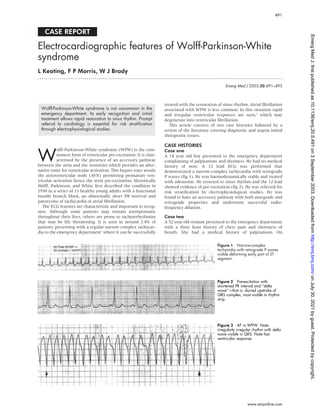
A 14 year old boy presented to the emergency department
complaining of palpitations and dizziness. He had no medical
history of note. A 12 lead ECG was performed that
demonstrated a narrow-complex tachycardia with retrograde
P waves (fig 1). He was haemodynamically stable and treated
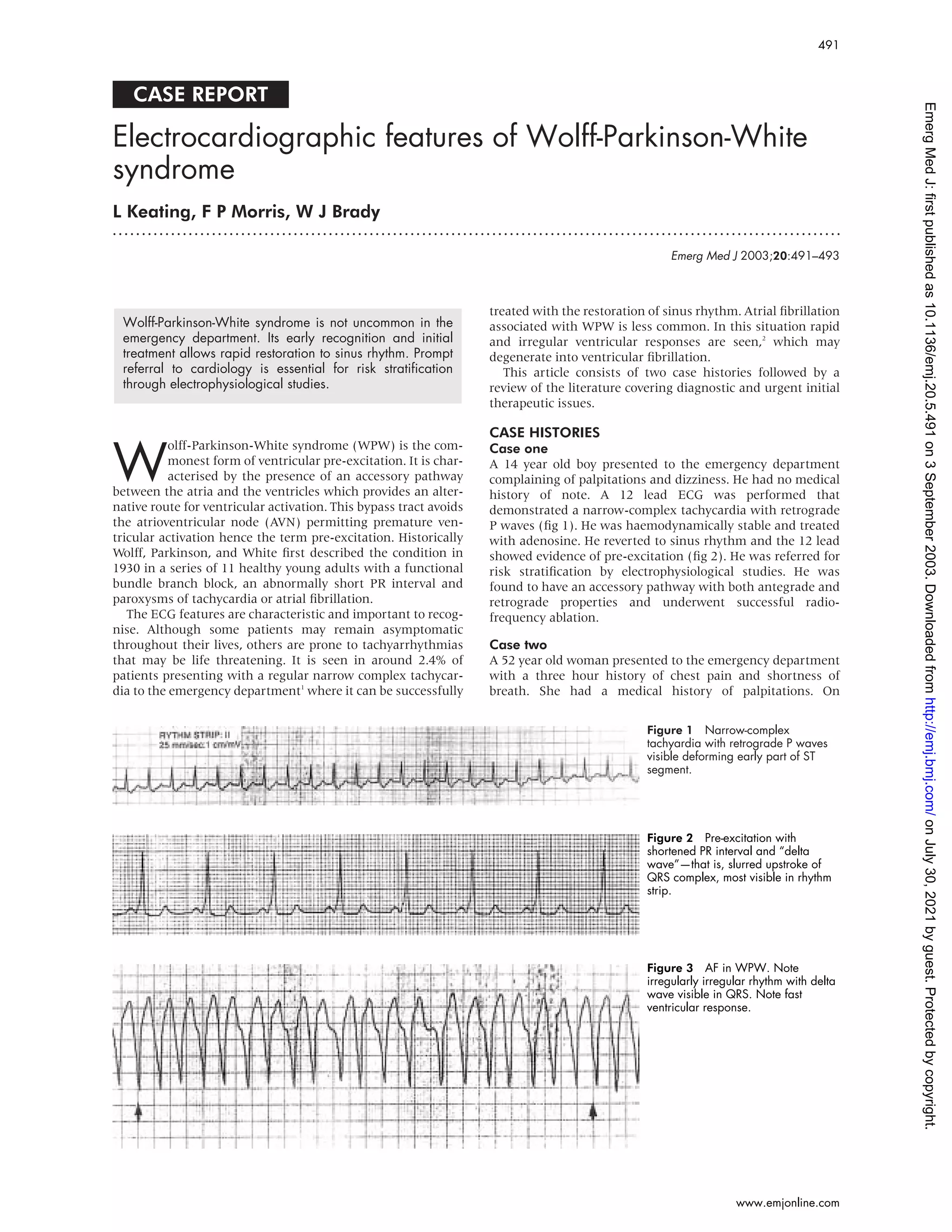
with adenosine. He reverted to sinus rhythm and the 12 lead
showed evidence of pre-excitation (fig 2). He was referred for
risk stratification by electrophysiological studies. He was
found to have an accessory pathway with both antegrade and
retrograde properties and underwent successful radio-
frequency ablation.
Case two
A 52 year old woman presented to the emergency department
with a three hour history of chest pain and shortness of
breath. She had a medical history of palpitations. On
Figure 1 Narrow-complex
tachyardia with retrograde P waves
visible deforming early part of ST
segment.
Figure 2 Pre-excitation with
shortened PR interval and “delta
wave”—that is, slurred upstroke of
QRS complex, most visible in rhythm
strip.
Figure 3 AF in WPW. Note
irregularly irregular rhythm with delta
wave visible in QRS. Note fast
ventricular response.
491
www.emjonline.com
on
July
30,
2021
by
guest.
Protected
by
copyright.
http://emj.bmj.com/
Emerg
Med
J:
first
published
as
10.1136/emj.20.5.491
on
3
September
2003.
Downloaded
from
examination she was unwell, sweating, and clammy. She was
tachycardic and haemodynamically compromised with a
systolic blood pressure of 80 mm Hg. A 12 lead ECG (fig 3)
showed an irregularly irregular rhythm with broad complexes
at a rate of 220. She underwent DC cardioversion and reverted
to sinus rhythm. A 12 lead ECG demonstrated no pre-
excitation. She was referred for electrophysiological studies.
The accessory pathway was identified and found to be capable
of fast antegrade conduction. She was successfully treated
with radiofrequency ablation.
DISCUSSION
In the normal heart electrical impulses generated from the
sino-atrial node in the right atrium pass to the AVN.
Physiological slowing occurs at this point before conduction to
the His-Purkinje system and the ventricular muscle. The PR
interval represents the time taken for the atria to depolarise
and the wave of depolarisation to travel down the AVN and
through the His-Purkinje system. In pre-excitation syndromes
the accessory pathway permits the impulse to bypass the AVN
(thus avoiding the associated delay) and permitting early
depolarisation of the ventricular myocardium (fig 4A). This is
reflected on the ECG as a shortened PR interval. Non-
specialised ventricular myocardium conducts at a slower rate.
Its direct depolarisation in pre-excitation syndrome generates
an initial slurring or “delta wave” at the start of the QRS com-
plex (fig 2). Simultaneous activation of the ventricles occurs as
normal through the AVN and His Purkinje system and hence
the remainder of the QRS complex appears relatively normal.
The mechanism of ventricular depolarisation in sinus rhythm
in patients with WPW is a combination of pre-excitation and
normal conduction giving rise to a short PR interval and a
delta wave followed by a relatively normal QRS complex (fig
2).
The accessory pathway is congenital in origin and results
from a failure of complete separation of the atria and
ventricles. It consists of a thin filamentous structure situated
anywhere along the atrioventricular groove and the left lateral
pathway is the most common.4
In around 10% of cases multi-
ple pathways exist.5
The incidence of associated congenital
abnormalities ranges from 7% to 20%.3 6
Tricuspid valve lesions
are the most common. The prevalence of WPW syndrome in
the population is about 0.3%3
with an associated risk of
sudden death of around 0.5% to 4%.7
The most frequently encountered tachycardia in WPW syn-
drome is an atrioventricular re-entrant tachycardia (AVRT).
The arrhythmia uses the AVN and accessory pathway to form
a re-entry circuit triggered by an appropriately timed ectopic.
This re-entry circuit maybe classified as either orthodromic or
antidromic depending on whether the ventricles are activated
via the normal conduction system or the accessory pathway.
Orthodromic AVRTs account for most tachycardias in WPW
syndrome (70%). Conduction occurs down the AVN and retro-
gradely up the accessory pathway producing a narrow
complex tachycardia (fig 4B). The QRS morphology is normal
(that is, with no delta wave) during the arrhythmia because
ventricular activation has occurred through the normal path-
way. The rate is usually between 140 and 250 beats per minute
(fig 1). Inverted P waves may be visible deforming the ST seg-
ment indicating that atrial depolarisation occurs later than
ventricular depolarisation. In a patient with a narrow complex
tachycardia the presence of such late P waves is frequently the
only ECG evidence that the patient has an accessory pathway
rather than a much more common atrioventricular non-
re-entrant tachycardia (AVNRT) (fig 5).
Antidromic tachycardias occur when the accessory pathway
conducts anterogradely (atrioventricular) and the impulse
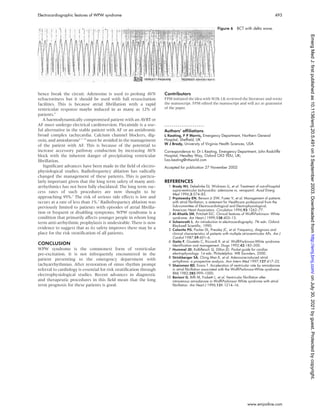
returns to the atria via the AVN (fig 4C). The resulting QRS is
broadened reflecting the abnormal ventricular activation (fig
6). These broad complex tachycardias can be difficult to
distinguish from a ventricular tachycardia and are less
common, occurring in around 10% of patients with WPW
syndrome.
It is important to note that if the accessory pathway only
conducts retrogradely (ventriculo-atrial) the resting ECG will
be normal in sinus rhythm with no evidence of pre-excitation.
This is known as a concealed pathway.
For reasons that are not clear atrial fibrillation is relatively
common (20%) in WPW syndrome compared with the normal
population. In atrial fibrillation with pre-excitation activation
of the ventricles is predominantly via the accessory pathway
(fig 4D). This causes the expected irregular rhythm but the
QRS is widened with a bizarre morphology. Occasional activa-
tion of the ventricles occurs via the AVN resulting in a capture
beat with a normal QRS (fig 3). If the accessory pathway is
capable of conducting rapidly potentially life threatening
arrhythmias may result. The ventricular response may be in
the region of 180–220.
Treatment of AVRTs essentially consists of interrupting the
re-entrant circuit. Stable symptomatic patients can safely
undergo vagal manoeuvres to block the AVN conduction and
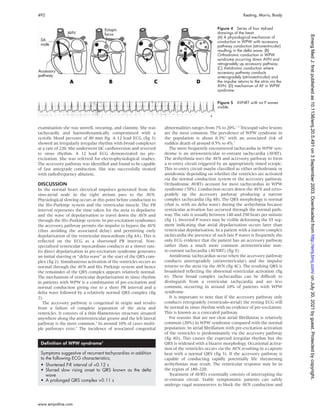
Figure 4 Series of four stylised
drawings of the heart.
(A) A physiological mechanism of
conduction in WPW with accessory
pathway conduction (atrioventricular)
resulting in the delta wave. (B)
Orthodromic conduction in WPW
syndrome occurring down AVN and
retrogradely up accessory pathway.
(C) Antidromic conduction where
accessory pathway conducts
anterogradely (atrioventricular) and
the impulse returns to the atria via the
AVN. (D) mechanism of AF in WPW
syndrome.
Definition of WPW syndrome3
Symptoms suggestive of recurrent tachycardias in addition
to the following ECG characteristics;
• Shortened P-R interval of <0.12 s
• Slurred slow rising onset to QRS known as the delta
wave
• A prolonged QRS complex >0.11 s
Figure 5 AVNRT with no P waves
visible.
492 Keating, Morris, Brady
www.emjonline.com
on
July
30,
2021
by
guest.
Protected
by
copyright.
http://emj.bmj.com/
Emerg
Med
J:
first
published
as
10.1136/emj.20.5.491
on
3
September
2003.
Downloaded
from
hence break the circuit. Adenosine is used to prolong AVN
refractoriness but it should be used with full resuscitation
facilities. This is because atrial fibrillation with a rapid
ventricular response maybe induced in as many as 12% of
patients.8
A haemodynamically compromised patient with an AVRT or
AF must undergo electrical cardioversion. Flecainide is a use-
ful alternative in the stable patient with AF or an antidromic
broad complex tachycardia. Calcium channel blockers, dig-
oxin, and amiodarone6 9 10
must be avoided in the management
of the patient with AF. This is because of the potential to
increase accessory pathway conduction by increasing AVN
block with the inherent danger of precipitating ventricular
fibrillation.
Significant advances have been made in the field of electro-
physiological studies. Radiofrequency ablation has radically
changed the management of these patients. This is particu-
larly important given that the long term safety of many anti-
arrhythmics has not been fully elucidated. The long term suc-
cess rates of such procedures are now thought to be
approaching 95%.3
The risk of serious side effects is low and
occurs at a rate of less than 1%.3
Radiofrequency ablation was
previously limited to patients with episodes of atrial fibrilla-
tion or frequent or disabling symptoms. WPW syndrome is a
condition that primarily affects younger people in whom long
term anti-arrhythmic prophylaxis is undesirable. There is now
evidence to suggest that as its safety improves there may be a
place for the risk stratification of all patients.
CONCLUSION
WPW syndrome is the commonest form of ventricular
pre-excitation. It is not infrequently encountered in the
patient presenting to the emergency department with
tachyarrhythmias. After restoration of sinus rhythm prompt
referral to cardiology is essential for risk stratification through
electrophysiological studies. Recent advances in diagnostic
and therapeutic procedures in this field mean that the long
term prognosis for these patients is good.
Contributors
FPM initiated the idea with WJB. LK reviewed the literature and wrote
the manuscript. FPM edited the manuscript and will act as guarantor
of the paper.
. . . . . . . . . . . . . . . . . . . . .
Authors’ affiliations
L Keating, F P Morris, Emergency Department, Northern General
Hospital, Sheffield, UK
W J Brady, University of Virginia Health Sciences, USA
Correspondence to: Dr L Keating, Emergency Department, John Radcliffe
Hospital, Headley Way, Oxford OX3 9DU, UK;
liza.keating@ntlworld.com
Accepted for publication 27 November 2002
REFERENCES
1 Brady WJ, Debehnke DJ, Wickman LL, et al. Treatment of out-of-hospital
supra-ventricular tachycardia: adenosine vs. verapamil. Acad Emerg
Med 1996;3:574–85.
2 Prystowsky EN, Benson Jr DW, Fuster V, et al. Management of patients
with atrial fibrillation; a statement for Healthcare professional from the
Sub-committee of Electrocardiological and Electrophysiological,
American Heart Association. Circulation 1996;93:1262–77.
3 Al-Khatib SM, Pritchett ELC. Clinical features of Wolff-Parkinson- White
syndrome. Am Heart J 1999;138:403–13.
4 Schamroth L. An introduction to electrocardiography. 7th edn. Oxford:
Blackwell Scientific, 1990.
5 Colovita PG, Packer DL, Pressley JC, et al. Frequency, diagnosis and
clinical characteristics of patients with multiple atrioventricular APs. Am J
Cardiol 1987;59:601–6.
6 Gaita F, Giustetto C, Riccardi R, et al. Wolff-Parkinson-White syndrome.
Identification and management. Drugs 1992;43:185–200.
7 Hummel JD, Kalbfleisch SJ, Dillon JD. Pocket guide for cardiac
electrophysiology. 1st edn. Philadelphia: WB Saunders, 2000.
8 Strickberger SA, Ching Man K, et al. Adenosine-induced atrial
arrhythmia: a prospective analysis. Ann Intern Med 1997;127:417–22.
9 Sheinman BD, Evans T. Acceleration of ventricular rate by amiodarone
in atrial fibrillation associated with the Wolff-Parkinson-White syndrome.
BMJ 1982;285:999–1000.
10 Boriani G, Biffi M, Frabetti L, et al. Ventricular fibrillation after
intravenous amiodarone in Wolff-Parkinson White syndrome with atrial
fibrillation. Am Heart J 1996;131:1214–16.
Figure 6 BCT with delta wave.
Electrocardiographic features of WPW syndrome 493
www.emjonline.com
on
July
30,
2021
by
guest.
Protected
by
copyright.
http://emj.bmj.com/
Emerg
Med
J:
first
published
as
10.1136/emj.20.5.491
on
3
September
2003.
Downloaded
from

491.full.pdf

  • 1.
    CASE REPORT Electrocardiographic featuresof Wolff-Parkinson-White syndrome L Keating, F P Morris, W J Brady . . . . . . . . . . . . . . . . . . . . . . . . . . . . . . . . . . . . . . . . . . . . . . . . . . . . . . . . . . . . . . . . . . . . . . . . . . . . . . . . . . . . . . . . . . . . . . . . . . . . . . . . . . . . . . . . . . . . . . . . . . . . . Emerg Med J 2003;20:491–493 Wolff-Parkinson-White syndrome is not uncommon in the emergency department. Its early recognition and initial treatment allows rapid restoration to sinus rhythm. Prompt referral to cardiology is essential for risk stratification through electrophysiological studies. W olff-Parkinson-White syndrome (WPW) is the com- monest form of ventricular pre-excitation. It is char- acterised by the presence of an accessory pathway between the atria and the ventricles which provides an alter- native route for ventricular activation. This bypass tract avoids the atrioventricular node (AVN) permitting premature ven- tricular activation hence the term pre-excitation. Historically Wolff, Parkinson, and White first described the condition in 1930 in a series of 11 healthy young adults with a functional bundle branch block, an abnormally short PR interval and paroxysms of tachycardia or atrial fibrillation. The ECG features are characteristic and important to recog- nise. Although some patients may remain asymptomatic throughout their lives, others are prone to tachyarrhythmias that may be life threatening. It is seen in around 2.4% of patients presenting with a regular narrow complex tachycar- dia to the emergency department1 where it can be successfully treated with the restoration of sinus rhythm. Atrial fibrillation associated with WPW is less common. In this situation rapid and irregular ventricular responses are seen,2 which may degenerate into ventricular fibrillation. This article consists of two case histories followed by a review of the literature covering diagnostic and urgent initial therapeutic issues. CASE HISTORIES Case one A 14 year old boy presented to the emergency department complaining of palpitations and dizziness. He had no medical history of note. A 12 lead ECG was performed that demonstrated a narrow-complex tachycardia with retrograde P waves (fig 1). He was haemodynamically stable and treated with adenosine. He reverted to sinus rhythm and the 12 lead showed evidence of pre-excitation (fig 2). He was referred for risk stratification by electrophysiological studies. He was found to have an accessory pathway with both antegrade and retrograde properties and underwent successful radio- frequency ablation. Case two A 52 year old woman presented to the emergency department with a three hour history of chest pain and shortness of breath. She had a medical history of palpitations. On Figure 1 Narrow-complex tachyardia with retrograde P waves visible deforming early part of ST segment. Figure 2 Pre-excitation with shortened PR interval and “delta wave”—that is, slurred upstroke of QRS complex, most visible in rhythm strip. Figure 3 AF in WPW. Note irregularly irregular rhythm with delta wave visible in QRS. Note fast ventricular response. 491 www.emjonline.com on July 30, 2021 by guest. Protected by copyright. http://emj.bmj.com/ Emerg Med J: first published as 10.1136/emj.20.5.491 on 3 September 2003. Downloaded from
  • 2.
    examination she wasunwell, sweating, and clammy. She was tachycardic and haemodynamically compromised with a systolic blood pressure of 80 mm Hg. A 12 lead ECG (fig 3) showed an irregularly irregular rhythm with broad complexes at a rate of 220. She underwent DC cardioversion and reverted to sinus rhythm. A 12 lead ECG demonstrated no pre- excitation. She was referred for electrophysiological studies. The accessory pathway was identified and found to be capable of fast antegrade conduction. She was successfully treated with radiofrequency ablation. DISCUSSION In the normal heart electrical impulses generated from the sino-atrial node in the right atrium pass to the AVN. Physiological slowing occurs at this point before conduction to the His-Purkinje system and the ventricular muscle. The PR interval represents the time taken for the atria to depolarise and the wave of depolarisation to travel down the AVN and through the His-Purkinje system. In pre-excitation syndromes the accessory pathway permits the impulse to bypass the AVN (thus avoiding the associated delay) and permitting early depolarisation of the ventricular myocardium (fig 4A). This is reflected on the ECG as a shortened PR interval. Non- specialised ventricular myocardium conducts at a slower rate. Its direct depolarisation in pre-excitation syndrome generates an initial slurring or “delta wave” at the start of the QRS com- plex (fig 2). Simultaneous activation of the ventricles occurs as normal through the AVN and His Purkinje system and hence the remainder of the QRS complex appears relatively normal. The mechanism of ventricular depolarisation in sinus rhythm in patients with WPW is a combination of pre-excitation and normal conduction giving rise to a short PR interval and a delta wave followed by a relatively normal QRS complex (fig 2). The accessory pathway is congenital in origin and results from a failure of complete separation of the atria and ventricles. It consists of a thin filamentous structure situated anywhere along the atrioventricular groove and the left lateral pathway is the most common.4 In around 10% of cases multi- ple pathways exist.5 The incidence of associated congenital abnormalities ranges from 7% to 20%.3 6 Tricuspid valve lesions are the most common. The prevalence of WPW syndrome in the population is about 0.3%3 with an associated risk of sudden death of around 0.5% to 4%.7 The most frequently encountered tachycardia in WPW syn- drome is an atrioventricular re-entrant tachycardia (AVRT). The arrhythmia uses the AVN and accessory pathway to form a re-entry circuit triggered by an appropriately timed ectopic. This re-entry circuit maybe classified as either orthodromic or antidromic depending on whether the ventricles are activated via the normal conduction system or the accessory pathway. Orthodromic AVRTs account for most tachycardias in WPW syndrome (70%). Conduction occurs down the AVN and retro- gradely up the accessory pathway producing a narrow complex tachycardia (fig 4B). The QRS morphology is normal (that is, with no delta wave) during the arrhythmia because ventricular activation has occurred through the normal path- way. The rate is usually between 140 and 250 beats per minute (fig 1). Inverted P waves may be visible deforming the ST seg- ment indicating that atrial depolarisation occurs later than ventricular depolarisation. In a patient with a narrow complex tachycardia the presence of such late P waves is frequently the only ECG evidence that the patient has an accessory pathway rather than a much more common atrioventricular non- re-entrant tachycardia (AVNRT) (fig 5). Antidromic tachycardias occur when the accessory pathway conducts anterogradely (atrioventricular) and the impulse returns to the atria via the AVN (fig 4C). The resulting QRS is broadened reflecting the abnormal ventricular activation (fig 6). These broad complex tachycardias can be difficult to distinguish from a ventricular tachycardia and are less common, occurring in around 10% of patients with WPW syndrome. It is important to note that if the accessory pathway only conducts retrogradely (ventriculo-atrial) the resting ECG will be normal in sinus rhythm with no evidence of pre-excitation. This is known as a concealed pathway. For reasons that are not clear atrial fibrillation is relatively common (20%) in WPW syndrome compared with the normal population. In atrial fibrillation with pre-excitation activation of the ventricles is predominantly via the accessory pathway (fig 4D). This causes the expected irregular rhythm but the QRS is widened with a bizarre morphology. Occasional activa- tion of the ventricles occurs via the AVN resulting in a capture beat with a normal QRS (fig 3). If the accessory pathway is capable of conducting rapidly potentially life threatening arrhythmias may result. The ventricular response may be in the region of 180–220. Treatment of AVRTs essentially consists of interrupting the re-entrant circuit. Stable symptomatic patients can safely undergo vagal manoeuvres to block the AVN conduction and Figure 4 Series of four stylised drawings of the heart. (A) A physiological mechanism of conduction in WPW with accessory pathway conduction (atrioventricular) resulting in the delta wave. (B) Orthodromic conduction in WPW syndrome occurring down AVN and retrogradely up accessory pathway. (C) Antidromic conduction where accessory pathway conducts anterogradely (atrioventricular) and the impulse returns to the atria via the AVN. (D) mechanism of AF in WPW syndrome. Definition of WPW syndrome3 Symptoms suggestive of recurrent tachycardias in addition to the following ECG characteristics; • Shortened P-R interval of <0.12 s • Slurred slow rising onset to QRS known as the delta wave • A prolonged QRS complex >0.11 s Figure 5 AVNRT with no P waves visible. 492 Keating, Morris, Brady www.emjonline.com on July 30, 2021 by guest. Protected by copyright. http://emj.bmj.com/ Emerg Med J: first published as 10.1136/emj.20.5.491 on 3 September 2003. Downloaded from
  • 3.
    hence break thecircuit. Adenosine is used to prolong AVN refractoriness but it should be used with full resuscitation facilities. This is because atrial fibrillation with a rapid ventricular response maybe induced in as many as 12% of patients.8 A haemodynamically compromised patient with an AVRT or AF must undergo electrical cardioversion. Flecainide is a use- ful alternative in the stable patient with AF or an antidromic broad complex tachycardia. Calcium channel blockers, dig- oxin, and amiodarone6 9 10 must be avoided in the management of the patient with AF. This is because of the potential to increase accessory pathway conduction by increasing AVN block with the inherent danger of precipitating ventricular fibrillation. Significant advances have been made in the field of electro- physiological studies. Radiofrequency ablation has radically changed the management of these patients. This is particu- larly important given that the long term safety of many anti- arrhythmics has not been fully elucidated. The long term suc- cess rates of such procedures are now thought to be approaching 95%.3 The risk of serious side effects is low and occurs at a rate of less than 1%.3 Radiofrequency ablation was previously limited to patients with episodes of atrial fibrilla- tion or frequent or disabling symptoms. WPW syndrome is a condition that primarily affects younger people in whom long term anti-arrhythmic prophylaxis is undesirable. There is now evidence to suggest that as its safety improves there may be a place for the risk stratification of all patients. CONCLUSION WPW syndrome is the commonest form of ventricular pre-excitation. It is not infrequently encountered in the patient presenting to the emergency department with tachyarrhythmias. After restoration of sinus rhythm prompt referral to cardiology is essential for risk stratification through electrophysiological studies. Recent advances in diagnostic and therapeutic procedures in this field mean that the long term prognosis for these patients is good. Contributors FPM initiated the idea with WJB. LK reviewed the literature and wrote the manuscript. FPM edited the manuscript and will act as guarantor of the paper. . . . . . . . . . . . . . . . . . . . . . Authors’ affiliations L Keating, F P Morris, Emergency Department, Northern General Hospital, Sheffield, UK W J Brady, University of Virginia Health Sciences, USA Correspondence to: Dr L Keating, Emergency Department, John Radcliffe Hospital, Headley Way, Oxford OX3 9DU, UK; liza.keating@ntlworld.com Accepted for publication 27 November 2002 REFERENCES 1 Brady WJ, Debehnke DJ, Wickman LL, et al. Treatment of out-of-hospital supra-ventricular tachycardia: adenosine vs. verapamil. Acad Emerg Med 1996;3:574–85. 2 Prystowsky EN, Benson Jr DW, Fuster V, et al. Management of patients with atrial fibrillation; a statement for Healthcare professional from the Sub-committee of Electrocardiological and Electrophysiological, American Heart Association. Circulation 1996;93:1262–77. 3 Al-Khatib SM, Pritchett ELC. Clinical features of Wolff-Parkinson- White syndrome. Am Heart J 1999;138:403–13. 4 Schamroth L. An introduction to electrocardiography. 7th edn. Oxford: Blackwell Scientific, 1990. 5 Colovita PG, Packer DL, Pressley JC, et al. Frequency, diagnosis and clinical characteristics of patients with multiple atrioventricular APs. Am J Cardiol 1987;59:601–6. 6 Gaita F, Giustetto C, Riccardi R, et al. Wolff-Parkinson-White syndrome. Identification and management. Drugs 1992;43:185–200. 7 Hummel JD, Kalbfleisch SJ, Dillon JD. Pocket guide for cardiac electrophysiology. 1st edn. Philadelphia: WB Saunders, 2000. 8 Strickberger SA, Ching Man K, et al. Adenosine-induced atrial arrhythmia: a prospective analysis. Ann Intern Med 1997;127:417–22. 9 Sheinman BD, Evans T. Acceleration of ventricular rate by amiodarone in atrial fibrillation associated with the Wolff-Parkinson-White syndrome. BMJ 1982;285:999–1000. 10 Boriani G, Biffi M, Frabetti L, et al. Ventricular fibrillation after intravenous amiodarone in Wolff-Parkinson White syndrome with atrial fibrillation. Am Heart J 1996;131:1214–16. Figure 6 BCT with delta wave. Electrocardiographic features of WPW syndrome 493 www.emjonline.com on July 30, 2021 by guest. Protected by copyright. http://emj.bmj.com/ Emerg Med J: first published as 10.1136/emj.20.5.491 on 3 September 2003. Downloaded from