James Le Fevre
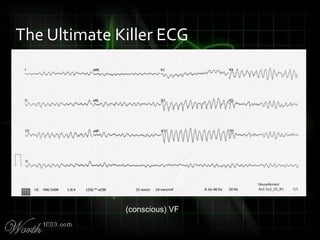
The Ultimate Killer ECG
(conscious) VF
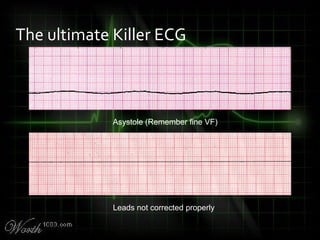
The ultimate Killer ECG
Asystole (Remember fine VF)
Leads not corrected properly
Brugada Syndrome
Long QT syndrome
Short QT syndrome
Arrhythmogenic right ventricular dysplasia (ARVD)
Wolff-ParkinsonWhite Syndrome (WPW)
Repetitive MonomorphicVentricularTachycardia
Catecholaminergic polymorphicVT
Idiopathic FascicularVentricularTachycardia (Verapamil Sensitive
VentricularTachycardia)
Inherited Arrythmia Syndromes
Hypertrophic obstructive cardiomyopathy
Aortic dissection
Submassive PE/Massive PE
Intracerebral bleed/SAH
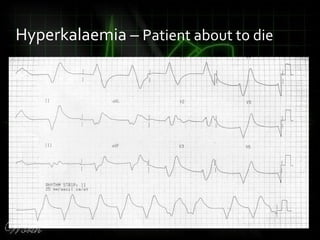
Severe Hyperkalemia
Commotio cordis
Other presentations
Risk Assessment and Disposition
Medical Risk to Our Patient
Medicolegal Risk to Us
Opportunity to Save a Life
Why learn this ?
Lead II
• The QTc (Short QT Syndrome/Long QT Syndrome)
LeadV2 (V1-V3)
• TWave Inversion (Brugada/ARVD)
• ST Elevation (Brugada)
• T wave Notching (LQTS)
• EpsilonWaves (ARVD)
• QRS > 110ms inV1-V3 (ARVD)
The Money Leads
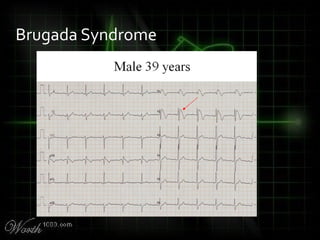
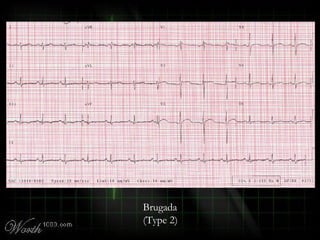
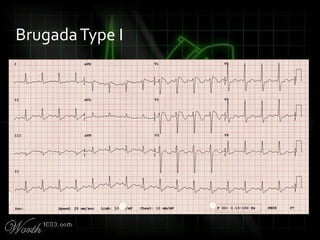
Brugada Syndrome
A ‘Channelopathy’
• Sodium channel mutation
The typical patient
Brugada syndrome is genetically determined
• Now over 60 different mutations identified
• 50% spontaneous
Brugada Syndrome
Unmasked/Augmented by
• Fever
• Ischaemia
• Multiple drugs
• Hypokalaemia
• Hypothermia
• Post DC Cardioversion
Brugada Syndrome
Type I ECGWITH
• DocumentedVF or polymorphicVT
• FHx SCD <45 years of age
• Coved-type ECGs in family members
• InducibleVT (EPS)
• Syncope
• Nocturnal agonal respiration
Brugada Syndrome – Diagnostic
Criteria
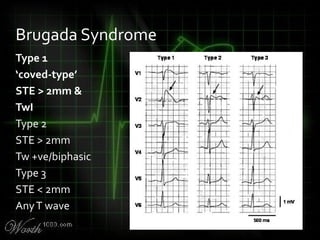
Type 1
‘coved-type’
STE > 2mm &
TwI
Type 2
STE > 2mm
Tw +ve/biphasic
Type 3
STE < 2mm
AnyT wave
Brugada Syndrome
Studies small, evidence level low
SymptomaticType I – Admit
AsymptomaticType I – Debatable (Need EPS)
Type 2/3 ECG Patterns – Outpatient EPS/Sodium blocker challenge
Patients withType 2/3 ECG patterns than convert toType I with Flecainide have
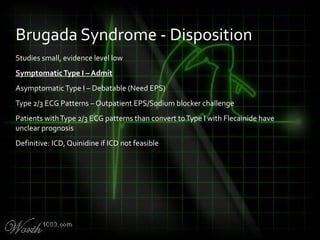
unclear prognosis
Definitive: ICD, Quinidine if ICD not feasible
Brugada Syndrome - Disposition
Take home messages
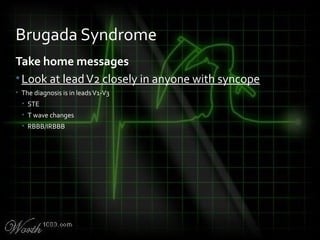
•Look at leadV2 closely in anyone with syncope
• The diagnosis is in leadsV1-V3
• STE
• T wave changes
• RBBB/IRBBB
Brugada Syndrome
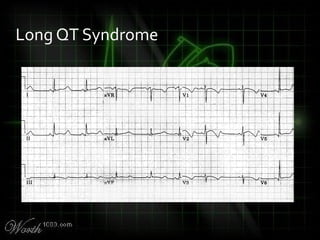
Long QT Syndrome
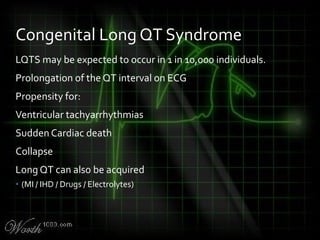
LQTS may be expected to occur in 1 in 10,000 individuals.
Prolongation of the QT interval on ECG
Propensity for:
Ventricular tachyarrhythmias
Sudden Cardiac death
Collapse
Long QT can also be acquired
• (MI / IHD / Drugs / Electrolytes)
Congenital Long QT Syndrome
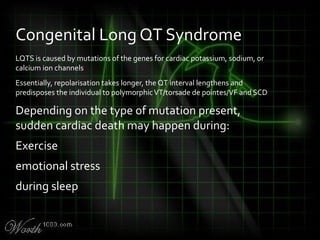
LQTS is caused by mutations of the genes for cardiac potassium, sodium, or
calcium ion channels
Essentially, repolarisation takes longer, the QT interval lengthens and
predisposes the individual to polymorphicVT/torsade de pointes/VF and SCD
Depending on the type of mutation present,
sudden cardiac death may happen during:
Exercise
emotional stress
during sleep
Congenital Long QT Syndrome
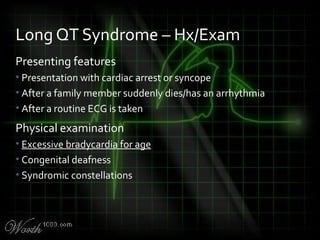
Presenting features
• Presentation with cardiac arrest or syncope
• After a family member suddenly dies/has an arrhythmia
• After a routine ECG is taken
Physical examination
• Excessive bradycardia for age
• Congenital deafness
• Syndromic constellations
Long QT Syndrome – Hx/Exam
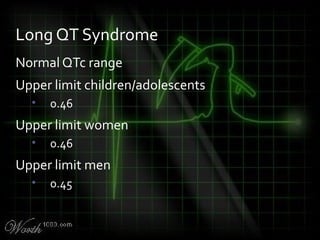
Normal QTc range
Upper limit children/adolescents
• 0.46
Upper limit women
• 0.46
Upper limit men
• 0.45
Long QT Syndrome
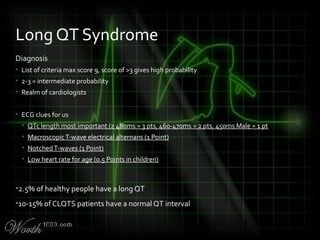
Diagnosis
• List of criteria max score 9, score of >3 gives high probability
• 2-3 = intermediate probability
• Realm of cardiologists
• ECG clues for us
• QTc length most important (≥ 480ms = 3 pts, 460-470ms = 2 pts, 450ms Male = 1 pt
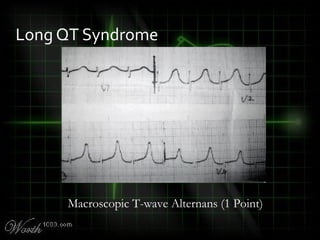
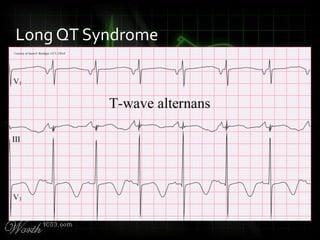
• MacroscopicT-wave electrical alternans (1 Point)
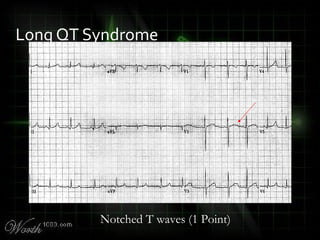
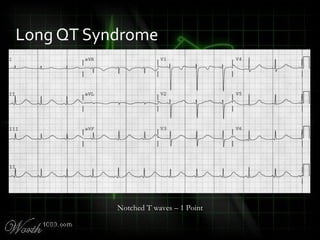
• NotchedT-waves (1 Point)
• Low heart rate for age (0.5 Points in children)
•2.5% of healthy people have a long QT
•10-15% of CLQTS patients have a n0rmal QT interval
Long QT Syndrome
Long QT Syndrome
Macroscopic T-wave Alternans (1 Point)
Long QT Syndrome
Long QT Syndrome
Notched T waves (1 Point)
Long QT Syndrome
Notched T waves – 1 Point
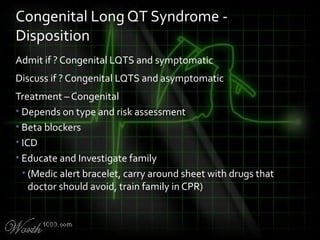
Admit if ? Congenital LQTS and symptomatic
Discuss if ? Congenital LQTS and asymptomatic
Treatment – Congenital
• Depends on type and risk assessment
• Beta blockers
• ICD
• Educate and Investigate family
• (Medic alert bracelet, carry around sheet with drugs that
doctor should avoid, train family in CPR)
Congenital Long QT Syndrome -
Disposition
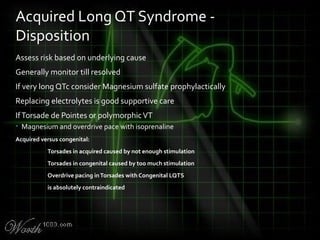
Assess risk based on underlying cause
Generally monitor till resolved
If very long QTc consider Magnesium sulfate prophylactically
Replacing electrolytes is good supportive care
IfTorsade de Pointes or polymorphicVT
• Magnesium and overdrive pace with isoprenaline
Acquired versus congenital:
Torsades in acquired caused by not enough stimulation
Torsades in congenital caused by too much stimulation
Overdrive pacing inTorsades with Congenital LQTS
is absolutely contraindicated
Acquired Long QT Syndrome -
Disposition
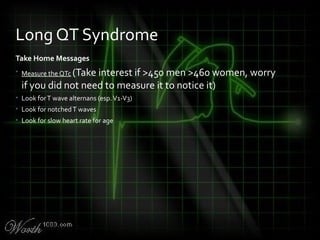
Take Home Messages
• Measure the QTc (Take interest if >450 men >460 women, worry
if you did not need to measure it to notice it)
• Look forT wave alternans (esp.V1-V3)
• Look for notchedT waves
• Look for slow heart rate for age
Long QT Syndrome
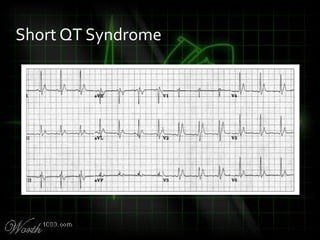
Short QT Syndrome
Short QT interval ≤ 320 ms with no change with HR, tall,
peakedT wave, structurally normal heart
5 mutations found so far
Autosomal dominant inheritance
Think of this in young people with atrial fibrillation and with
syncope/cardiac arrest
Short QT Syndrome
• Genotypes 1-3
• Gain of function in potassium efflux channels
• QTc <320ms
• Genotypes 4-5
• Loss of function in L-type Calcium channels
• Brugada like
• QTc <360ms
• Digoxin toxicity can also cause shortened QT and
arrythmia
Short QT Syndrome
A distinctive electrocardiographic feature of the short QT
syndrome is the appearance of tall peakedT waves, similar
to those encountered with hyperkalemia
Brugada-like in genotypes 4-5
QT interval is fixed independent of heart rate
Short QT Syndrome
QTc < 330 ms in males or <340 ms in female diagnostic
QTc < 360 ms in males or <370 ms in females when
supported by symptoms or FHx
Short QT Syndrome – Diagnostic
Criteria
QT Syndromes – Diagnostic Criteria
Reproduced from Viskin
Viskin S. The QT interval: too long, too short or just right. Heart Rhythm.
2009 May;6(5):711-5. Epub 2009 Mar 3. [PMID: 19389656] [Full text]
Take Home Message
• Be very worried if the QTc is <320ms
• Very rare
Short QT Syndrome
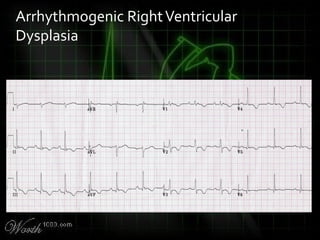
Arrhythmogenic RightVentricular
Dysplasia
ARVD is due to a type of cardiomyopathy, which is possibly familial in some
patients.
Fibrofatty infiltrated Hypokinetic areas
The prevalence of ARVD is estimated to be 1 case per 5,000 population
The death rate associated with arrhythmia is estimated to be 2.5% per year
More common in men than women (3:1)
More common with Italian/Greek descent
Arrhythmogenic RightVentricular
Dysplasia
Major and Minor criteria
• 2 Major OR
• 1 Major 2 minors OR
• 4 minors
Horribly complicated
Arrhythmogenic RightVentricular
Dysplasia – Diagnostic Criteria
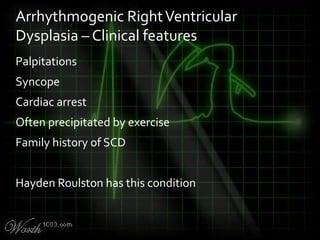
Palpitations
Syncope
Cardiac arrest
Often precipitated by exercise
Family history of SCD
Hayden Roulston has this condition
Arrhythmogenic RightVentricular
Dysplasia – Clinical features
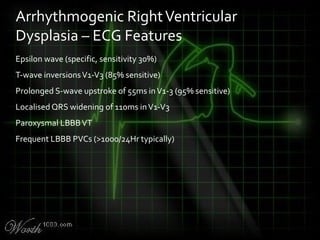
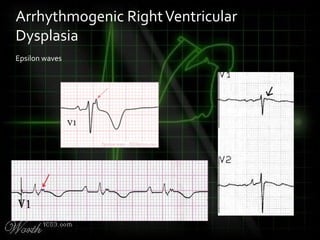
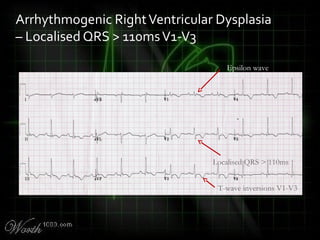
Epsilon wave (specific, sensitivity 30%)
T-wave inversionsV1-V3 (85% sensitive)
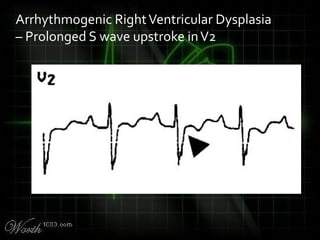
Prolonged S-wave upstroke of 55ms inV1-3 (95% sensitive)
Localised QRS widening of 110ms inV1-V3
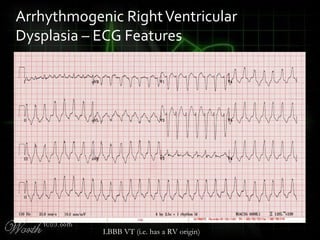
Paroxysmal LBBBVT
Frequent LBBB PVCs (>1000/24Hr typically)
Arrhythmogenic RightVentricular
Dysplasia – ECG Features
Epsilon waves
Arrhythmogenic RightVentricular
Dysplasia
Arrhythmogenic RightVentricular Dysplasia
– Prolonged S wave upstroke inV2
Arrhythmogenic RightVentricular Dysplasia
– Localised QRS > 110msV1-V3
Epsilon wave
Localised QRS > 110ms
T-wave inversions V1-V3
Arrhythmogenic RightVentricular
Dysplasia – ECG Features
LBBB VT (i.e. has a RV origin)
Echo (sensitive, less specific, cheaper)
MRI (Specific and sensitive but expensive)
Combination Echo/MRI ideal
Histology
• Least patient-oriented diagnostic technique
Arrhythmogenic RightVentricular
Dysplasia – Imaging
? ARVD with high risk features (syncope due to cardiac
arrest, recurrent arrhythmia, FHx) : Admit
? ARVD asymptomatic (i.e. ECG suggestive) : Discuss
Treatment:
• High-risk features: Urgent ICD Placement
• No high-risk features: Sotalol
• Persistent arrhythmias: Ablation
• Heart failure: Standard Rx including transplant
Arrhythmogenic RightVentricular
Dysplasia – Disposition
Take home messages
• Look for epsilon waves (Best seenV1-V3)
• Beware the young patient with very frequent LBBB extrasystoles
• Again, examineV1-V3 closely (TWI, QRS >110)
Arrhythmogenic RightVentricular
Dysplasia
Genetic Predisposition
Mostly due to Calcium ryanodine channel mutations
Thought to affect up to 1 in 10,000 people
PolymorphicVT due to emotional upset/physical
activity (and therefore catecholamines)
Estimated to cause up to 15% of SCD in young people
ECG clues
• Sinus bradycardia, prominent U-waves
Not a diagnosis that one can make in the emergency
department
Catecholaminergic polymorphicVT
Due to extra ‘Accessory pathways’ or connections between the atrium and
ventricle
WPW syndrome affects approximately 0.15-0.2% of the general population. Of
these individuals, 60-70% have no other evidence of heart disease.
Kent bundle
Risk of SCD much lower than in the other discussed syndromes (0.6%)
Wolff-Parkinson-White syndrome
Broad spectrum of presentations
• CP/SOB/SCD/Palpitations/Syncope
• Routine ECG diagnosis
Classic:
• Shortened PR interval (<0.12)
• QRS >0.12
• Delta wave
• Secondary ST-T changes in opposite direction to delta wave
Wolff-Parkinson-White syndrome
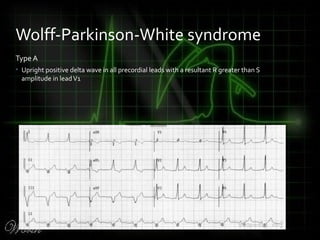
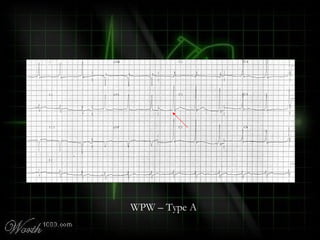
Type A
• Upright positive delta wave in all precordial leads with a resultant R greater than S
amplitude in leadV1
Wolff-Parkinson-White syndrome
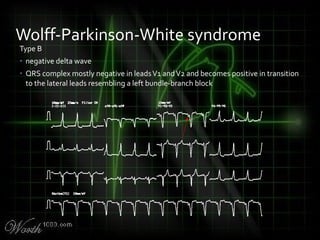
Type B
• negative delta wave
• QRS complex mostly negative in leadsV1 andV2 and becomes positive in transition
to the lateral leads resembling a left bundle-branch block
Wolff-Parkinson-White syndrome
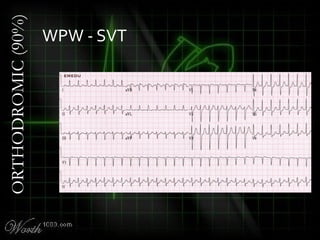
WPW - SVT
ORTHODROMIC(90%)
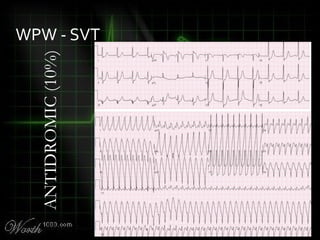
WPW - SVT
ANTIDROMIC(10%)
Circus movement tachycardias
• Vagal maneuvers
• Adenosine is Safe, Diltiazem/verapamil second line
• Give calcium if using verapamil
• Electricity if unstable
• Etomidate +/- fentanyl works well for sedation
• Give 100J initially (2J/kg in children)
WPW - Orthodromic
Atrial fibrillation with antidromicWPW
Adenosine and other AV blockers absolutely Contraindicated
• Sedate and Shock is the safest approach (100J first)
• Must slow the abnormal pathway NOT the node (i.e. fundamentally
different to normal AF treatment)
• If treated like conventional AF,VF can be the outcome
• Procainamide can be used
WPW – Antidromic/AF
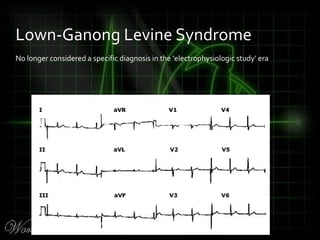
No longer considered a specific diagnosis in the ‘electrophysiologic study’ era
Lown-Ganong Levine Syndrome
Take Home Messages
• If the tachycardia is wide complex, treat it as such
• If in doubt, consult, and/or use electricity
WPW
Hypertrophic cardiomyopathy (HCM) is a genetic disorder that is typically
inherited in an autosomal dominant fashion with variable penetrance and
variable expressivity
Presents with SCD, arrythmia, heart failure, dizziness, angina, syncope,
palpitations
Hypertrophic cardiomyopathy
Some important physical findings
• A fourth heart sound
• Displaced, forceful, enlarged apex beat
• Systolic murmur increased on valsalva
Hypertrophic cardiomyopathy
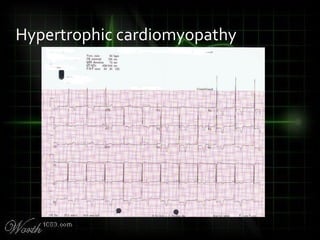
ECG Findings
• ST-T wave abnormalities and LVH
• Axis deviation
• BBB
• Ectopic atrial rhythm
• Q waves anterolaterally
• P wave abnormalities
Hypertrophic cardiomyopathy
Review ECG in General
• Is the QTc >450 (men) or >460 (women) (LQTS) ?
• Is the heart rate too low for age (LQTS) ?
• Is the QTc <320 (Short QT Syndrome) ?
• Are there frequent LBBB PVCs (ARVD) ?
• Think of HOCM (LVH criteria+/-ST-T changes, BBB, Q-waves)
• Is the PR <0.12 ? Are there delta waves (WPW) ?
Review LeadsV1-V3 looking for:
• Is the QRS >110ms inV1-V3 (AVRD) ?
• Are there invertedT-waves (Brugada, ARVD) ?
• Is there ST elevation (Brugada) ?
• Is there macroscopicT-wave alternans (LQTS) ?
• Are there notchedT-waves (LQTS) ?
• Are there epsilon waves (ARVD) ?
Is this a Killer ECG ?
• ? ARVD with high risk features: Admit on monitor,
inpatient Echo (+/- MRI)
• ? ARVD incidentally on ECG : Consult
• ? Long QT Syndrome: Admit on monitor
• ? Short QT Syndrome: Admit on monitor, Publish
• ? HOCM with symptoms: Admit for inpatient Echo
• VT/?VT: Admit on monitor
• WPW, orthodromic SVT, no AF, stable: Discharge with
advice and f/u, EPS can help risk stratify for SCD
• WPW, antidromic SVT, or AF, or both: Use electricity,
discuss with cardiology first if stable, refer cardiology
Disposition ?
Giving an amp of calcium prior to verapamil and diltiazem in SVT can decrease
hypotension without decreasing efficacy of cardioversion
Adenosine in asthma is a relative contraindication, avoid if active wheeze or history
of severe asthma, consider starting with 3mg
? 5% ofVT is adenosine sensitive, Benefit may well outweigh risk. A response to
adenosine does NOT prove SVT with aberrancy
QTc is helpful in differentiating Anterior STEMI from Benign early repolarisation as
the QTc increases in Anterior STEMI
Some patients are terrified of how adenosine makes them feel, give them a bit of
midazolam first (it may increase the chance of cardioversion also)
A gentle carotid massage can differentiate Aflutter with a 2:1 block from a slow SVT
(don’t do if a bruit present, be prepared for a long pause)
Etomidate 2-4mL +/- 25mcg fentanyl iv in an unstable patient for DCCV is a good
option
Ketamine is the next best, as Etomidate appears to be in short supply
HandyTips
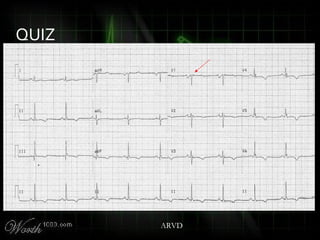
QUIZ
ARVD
WPW – Type A
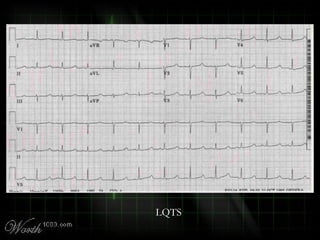
LQTS
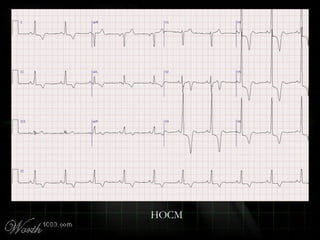
HOCM
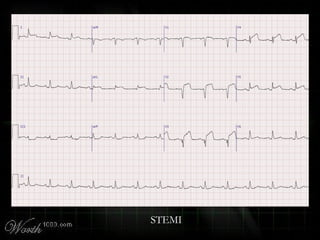
STEMI
Brugada
(Type 2)
Electrical alternans (Tamponade)
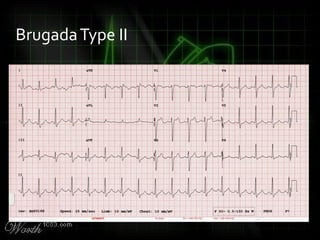
BrugadaType II
Hyperkalaemia – Patient about to die
BrugadaType I

Killer ECGs

  • 1.
  • 2.
    The Ultimate KillerECG (conscious) VF
  • 3.
    The ultimate KillerECG Asystole (Remember fine VF) Leads not corrected properly
  • 4.
    Brugada Syndrome Long QTsyndrome Short QT syndrome Arrhythmogenic right ventricular dysplasia (ARVD) Wolff-ParkinsonWhite Syndrome (WPW) Repetitive MonomorphicVentricularTachycardia Catecholaminergic polymorphicVT Idiopathic FascicularVentricularTachycardia (Verapamil Sensitive VentricularTachycardia) Inherited Arrythmia Syndromes
  • 5.
    Hypertrophic obstructive cardiomyopathy Aorticdissection Submassive PE/Massive PE Intracerebral bleed/SAH Severe Hyperkalemia Commotio cordis Other presentations
  • 6.
    Risk Assessment andDisposition Medical Risk to Our Patient Medicolegal Risk to Us Opportunity to Save a Life Why learn this ?
  • 7.
    Lead II • TheQTc (Short QT Syndrome/Long QT Syndrome) LeadV2 (V1-V3) • TWave Inversion (Brugada/ARVD) • ST Elevation (Brugada) • T wave Notching (LQTS) • EpsilonWaves (ARVD) • QRS > 110ms inV1-V3 (ARVD) The Money Leads
  • 8.
  • 9.
    A ‘Channelopathy’ • Sodiumchannel mutation The typical patient Brugada syndrome is genetically determined • Now over 60 different mutations identified • 50% spontaneous Brugada Syndrome
  • 10.
    Unmasked/Augmented by • Fever •Ischaemia • Multiple drugs • Hypokalaemia • Hypothermia • Post DC Cardioversion Brugada Syndrome
  • 11.
    Type I ECGWITH •DocumentedVF or polymorphicVT • FHx SCD <45 years of age • Coved-type ECGs in family members • InducibleVT (EPS) • Syncope • Nocturnal agonal respiration Brugada Syndrome – Diagnostic Criteria
  • 12.
    Type 1 ‘coved-type’ STE >2mm & TwI Type 2 STE > 2mm Tw +ve/biphasic Type 3 STE < 2mm AnyT wave Brugada Syndrome
  • 13.
    Studies small, evidencelevel low SymptomaticType I – Admit AsymptomaticType I – Debatable (Need EPS) Type 2/3 ECG Patterns – Outpatient EPS/Sodium blocker challenge Patients withType 2/3 ECG patterns than convert toType I with Flecainide have unclear prognosis Definitive: ICD, Quinidine if ICD not feasible Brugada Syndrome - Disposition
  • 14.
    Take home messages •Lookat leadV2 closely in anyone with syncope • The diagnosis is in leadsV1-V3 • STE • T wave changes • RBBB/IRBBB Brugada Syndrome
  • 15.
  • 16.
    LQTS may beexpected to occur in 1 in 10,000 individuals. Prolongation of the QT interval on ECG Propensity for: Ventricular tachyarrhythmias Sudden Cardiac death Collapse Long QT can also be acquired • (MI / IHD / Drugs / Electrolytes) Congenital Long QT Syndrome
  • 17.
    LQTS is causedby mutations of the genes for cardiac potassium, sodium, or calcium ion channels Essentially, repolarisation takes longer, the QT interval lengthens and predisposes the individual to polymorphicVT/torsade de pointes/VF and SCD Depending on the type of mutation present, sudden cardiac death may happen during: Exercise emotional stress during sleep Congenital Long QT Syndrome
  • 18.
    Presenting features • Presentationwith cardiac arrest or syncope • After a family member suddenly dies/has an arrhythmia • After a routine ECG is taken Physical examination • Excessive bradycardia for age • Congenital deafness • Syndromic constellations Long QT Syndrome – Hx/Exam
  • 19.
    Normal QTc range Upperlimit children/adolescents • 0.46 Upper limit women • 0.46 Upper limit men • 0.45 Long QT Syndrome
  • 20.
    Diagnosis • List ofcriteria max score 9, score of >3 gives high probability • 2-3 = intermediate probability • Realm of cardiologists • ECG clues for us • QTc length most important (≥ 480ms = 3 pts, 460-470ms = 2 pts, 450ms Male = 1 pt • MacroscopicT-wave electrical alternans (1 Point) • NotchedT-waves (1 Point) • Low heart rate for age (0.5 Points in children) •2.5% of healthy people have a long QT •10-15% of CLQTS patients have a n0rmal QT interval Long QT Syndrome
  • 21.
    Long QT Syndrome MacroscopicT-wave Alternans (1 Point)
  • 22.
  • 23.
    Long QT Syndrome NotchedT waves (1 Point)
  • 24.
    Long QT Syndrome NotchedT waves – 1 Point
  • 25.
    Admit if ?Congenital LQTS and symptomatic Discuss if ? Congenital LQTS and asymptomatic Treatment – Congenital • Depends on type and risk assessment • Beta blockers • ICD • Educate and Investigate family • (Medic alert bracelet, carry around sheet with drugs that doctor should avoid, train family in CPR) Congenital Long QT Syndrome - Disposition
  • 26.
    Assess risk basedon underlying cause Generally monitor till resolved If very long QTc consider Magnesium sulfate prophylactically Replacing electrolytes is good supportive care IfTorsade de Pointes or polymorphicVT • Magnesium and overdrive pace with isoprenaline Acquired versus congenital: Torsades in acquired caused by not enough stimulation Torsades in congenital caused by too much stimulation Overdrive pacing inTorsades with Congenital LQTS is absolutely contraindicated Acquired Long QT Syndrome - Disposition
  • 27.
    Take Home Messages •Measure the QTc (Take interest if >450 men >460 women, worry if you did not need to measure it to notice it) • Look forT wave alternans (esp.V1-V3) • Look for notchedT waves • Look for slow heart rate for age Long QT Syndrome
  • 28.
  • 29.
    Short QT interval≤ 320 ms with no change with HR, tall, peakedT wave, structurally normal heart 5 mutations found so far Autosomal dominant inheritance Think of this in young people with atrial fibrillation and with syncope/cardiac arrest Short QT Syndrome
  • 30.
    • Genotypes 1-3 •Gain of function in potassium efflux channels • QTc <320ms • Genotypes 4-5 • Loss of function in L-type Calcium channels • Brugada like • QTc <360ms • Digoxin toxicity can also cause shortened QT and arrythmia Short QT Syndrome
  • 31.
    A distinctive electrocardiographicfeature of the short QT syndrome is the appearance of tall peakedT waves, similar to those encountered with hyperkalemia Brugada-like in genotypes 4-5 QT interval is fixed independent of heart rate Short QT Syndrome
  • 32.
    QTc < 330ms in males or <340 ms in female diagnostic QTc < 360 ms in males or <370 ms in females when supported by symptoms or FHx Short QT Syndrome – Diagnostic Criteria
  • 33.
    QT Syndromes –Diagnostic Criteria Reproduced from Viskin Viskin S. The QT interval: too long, too short or just right. Heart Rhythm. 2009 May;6(5):711-5. Epub 2009 Mar 3. [PMID: 19389656] [Full text]
  • 34.
    Take Home Message •Be very worried if the QTc is <320ms • Very rare Short QT Syndrome
  • 35.
  • 36.
    ARVD is dueto a type of cardiomyopathy, which is possibly familial in some patients. Fibrofatty infiltrated Hypokinetic areas The prevalence of ARVD is estimated to be 1 case per 5,000 population The death rate associated with arrhythmia is estimated to be 2.5% per year More common in men than women (3:1) More common with Italian/Greek descent Arrhythmogenic RightVentricular Dysplasia
  • 37.
    Major and Minorcriteria • 2 Major OR • 1 Major 2 minors OR • 4 minors Horribly complicated Arrhythmogenic RightVentricular Dysplasia – Diagnostic Criteria
  • 38.
    Palpitations Syncope Cardiac arrest Often precipitatedby exercise Family history of SCD Hayden Roulston has this condition Arrhythmogenic RightVentricular Dysplasia – Clinical features
  • 39.
    Epsilon wave (specific,sensitivity 30%) T-wave inversionsV1-V3 (85% sensitive) Prolonged S-wave upstroke of 55ms inV1-3 (95% sensitive) Localised QRS widening of 110ms inV1-V3 Paroxysmal LBBBVT Frequent LBBB PVCs (>1000/24Hr typically) Arrhythmogenic RightVentricular Dysplasia – ECG Features
  • 40.
  • 41.
    Arrhythmogenic RightVentricular Dysplasia –Prolonged S wave upstroke inV2
  • 42.
    Arrhythmogenic RightVentricular Dysplasia –Localised QRS > 110msV1-V3 Epsilon wave Localised QRS > 110ms T-wave inversions V1-V3
  • 43.
    Arrhythmogenic RightVentricular Dysplasia –ECG Features LBBB VT (i.e. has a RV origin)
  • 44.
    Echo (sensitive, lessspecific, cheaper) MRI (Specific and sensitive but expensive) Combination Echo/MRI ideal Histology • Least patient-oriented diagnostic technique Arrhythmogenic RightVentricular Dysplasia – Imaging
  • 45.
    ? ARVD withhigh risk features (syncope due to cardiac arrest, recurrent arrhythmia, FHx) : Admit ? ARVD asymptomatic (i.e. ECG suggestive) : Discuss Treatment: • High-risk features: Urgent ICD Placement • No high-risk features: Sotalol • Persistent arrhythmias: Ablation • Heart failure: Standard Rx including transplant Arrhythmogenic RightVentricular Dysplasia – Disposition
  • 46.
    Take home messages •Look for epsilon waves (Best seenV1-V3) • Beware the young patient with very frequent LBBB extrasystoles • Again, examineV1-V3 closely (TWI, QRS >110) Arrhythmogenic RightVentricular Dysplasia
  • 47.
    Genetic Predisposition Mostly dueto Calcium ryanodine channel mutations Thought to affect up to 1 in 10,000 people PolymorphicVT due to emotional upset/physical activity (and therefore catecholamines) Estimated to cause up to 15% of SCD in young people ECG clues • Sinus bradycardia, prominent U-waves Not a diagnosis that one can make in the emergency department Catecholaminergic polymorphicVT
  • 48.
    Due to extra‘Accessory pathways’ or connections between the atrium and ventricle WPW syndrome affects approximately 0.15-0.2% of the general population. Of these individuals, 60-70% have no other evidence of heart disease. Kent bundle Risk of SCD much lower than in the other discussed syndromes (0.6%) Wolff-Parkinson-White syndrome
  • 49.
    Broad spectrum ofpresentations • CP/SOB/SCD/Palpitations/Syncope • Routine ECG diagnosis Classic: • Shortened PR interval (<0.12) • QRS >0.12 • Delta wave • Secondary ST-T changes in opposite direction to delta wave Wolff-Parkinson-White syndrome
  • 50.
    Type A • Uprightpositive delta wave in all precordial leads with a resultant R greater than S amplitude in leadV1 Wolff-Parkinson-White syndrome
  • 51.
    Type B • negativedelta wave • QRS complex mostly negative in leadsV1 andV2 and becomes positive in transition to the lateral leads resembling a left bundle-branch block Wolff-Parkinson-White syndrome
  • 52.
  • 53.
  • 54.
    Circus movement tachycardias •Vagal maneuvers • Adenosine is Safe, Diltiazem/verapamil second line • Give calcium if using verapamil • Electricity if unstable • Etomidate +/- fentanyl works well for sedation • Give 100J initially (2J/kg in children) WPW - Orthodromic
  • 55.
    Atrial fibrillation withantidromicWPW Adenosine and other AV blockers absolutely Contraindicated • Sedate and Shock is the safest approach (100J first) • Must slow the abnormal pathway NOT the node (i.e. fundamentally different to normal AF treatment) • If treated like conventional AF,VF can be the outcome • Procainamide can be used WPW – Antidromic/AF
  • 56.
    No longer considereda specific diagnosis in the ‘electrophysiologic study’ era Lown-Ganong Levine Syndrome
  • 57.
    Take Home Messages •If the tachycardia is wide complex, treat it as such • If in doubt, consult, and/or use electricity WPW
  • 58.
    Hypertrophic cardiomyopathy (HCM)is a genetic disorder that is typically inherited in an autosomal dominant fashion with variable penetrance and variable expressivity Presents with SCD, arrythmia, heart failure, dizziness, angina, syncope, palpitations Hypertrophic cardiomyopathy
  • 59.
    Some important physicalfindings • A fourth heart sound • Displaced, forceful, enlarged apex beat • Systolic murmur increased on valsalva Hypertrophic cardiomyopathy
  • 60.
    ECG Findings • ST-Twave abnormalities and LVH • Axis deviation • BBB • Ectopic atrial rhythm • Q waves anterolaterally • P wave abnormalities Hypertrophic cardiomyopathy
  • 61.
  • 62.
    Review ECG inGeneral • Is the QTc >450 (men) or >460 (women) (LQTS) ? • Is the heart rate too low for age (LQTS) ? • Is the QTc <320 (Short QT Syndrome) ? • Are there frequent LBBB PVCs (ARVD) ? • Think of HOCM (LVH criteria+/-ST-T changes, BBB, Q-waves) • Is the PR <0.12 ? Are there delta waves (WPW) ? Review LeadsV1-V3 looking for: • Is the QRS >110ms inV1-V3 (AVRD) ? • Are there invertedT-waves (Brugada, ARVD) ? • Is there ST elevation (Brugada) ? • Is there macroscopicT-wave alternans (LQTS) ? • Are there notchedT-waves (LQTS) ? • Are there epsilon waves (ARVD) ? Is this a Killer ECG ?
  • 63.
    • ? ARVDwith high risk features: Admit on monitor, inpatient Echo (+/- MRI) • ? ARVD incidentally on ECG : Consult • ? Long QT Syndrome: Admit on monitor • ? Short QT Syndrome: Admit on monitor, Publish • ? HOCM with symptoms: Admit for inpatient Echo • VT/?VT: Admit on monitor • WPW, orthodromic SVT, no AF, stable: Discharge with advice and f/u, EPS can help risk stratify for SCD • WPW, antidromic SVT, or AF, or both: Use electricity, discuss with cardiology first if stable, refer cardiology Disposition ?
  • 64.
    Giving an ampof calcium prior to verapamil and diltiazem in SVT can decrease hypotension without decreasing efficacy of cardioversion Adenosine in asthma is a relative contraindication, avoid if active wheeze or history of severe asthma, consider starting with 3mg ? 5% ofVT is adenosine sensitive, Benefit may well outweigh risk. A response to adenosine does NOT prove SVT with aberrancy QTc is helpful in differentiating Anterior STEMI from Benign early repolarisation as the QTc increases in Anterior STEMI Some patients are terrified of how adenosine makes them feel, give them a bit of midazolam first (it may increase the chance of cardioversion also) A gentle carotid massage can differentiate Aflutter with a 2:1 block from a slow SVT (don’t do if a bruit present, be prepared for a long pause) Etomidate 2-4mL +/- 25mcg fentanyl iv in an unstable patient for DCCV is a good option Ketamine is the next best, as Etomidate appears to be in short supply HandyTips
  • 65.
  • 66.
  • 67.
  • 68.
  • 69.
  • 70.
  • 71.
  • 72.
  • 73.
  • 74.

Editor's Notes

  • #7 Risk assessment of the well-looking patient with a symptom that may be relatively benign but can be deadly A large part of EM practice Medical risk versus medico-legal risk Opportunity to genuinely save a life
  • #10 Brugada syndrome is most common in people from Asia Brugada syndrome is 8-10 times more prevalent in men than in women Second leading cause of death in males &lt;40 after trauma Mean age of sudden death is 41 Previously described as SUNDS (Sudden unexplained nocturnal death syndrome in SEA)
  • #11 frequency of gene mutation is equal, therefore, higher penetrance in men Brugada syndrome most commonly affects otherwise healthy men aged 30-50 years
  • #12 Fever can
  • #38 Major Criteria Right ventricular dysfunction Severe dilatation and reduction of RV ejection fraction with little or no LV impairment Localized RV aneurysms Severe segmental dilatation of the RV Tissue characterization Fibrofatty replacement of myocardium on endomyocardial biopsy Conduction abnormalities Epsilon waves in V1 - V3. Localized prolongation (&gt;110 ms) of QRS in V1 - V3 Family history Familial disease confirmed on autopsy or surgery Minor Criteria Right ventricular dysfunction Mild global RV dilatation and/or reduced ejection fraction with normal LV. Mild segmental dilatation of the RV Regional RV hypokinesis Tissue characterization Conduction abnormalities Inverted T waves in V2 and V3 in an individual over 12 years old, in the absence of a right bundle branch block (RBBB) Late potentials on signal averaged EKG. Ventricular tachycardia with a left bundle branch block (LBBB) morphology Frequent PVCs (&gt; 1000 PVCs / 24 hours) Family history Family history of sudden cardiac death before age 35 Family history of ARVD
  • #39 m
  • #40 m
  • #42 m
  • #43 m
  • #44 m
  • #45 m
  • #46 m