Wernicke’s
Aphasia
By: Hina Khalid
Contents
• Introduction
• Definition
• Location & Function
• Symptoms
• Management
• References
What Is Wernicke’s/Receptive
Aphasia?
• A neurological language disorder that primarily affects a
person's ability to comprehend spoken words. Poor
Comprehension is
▫ Most difficulty is in understanding uncommon words as
well as verb tense (brought, chosen, drawn) and
prepositions (on, in, at, until).
▫ An inability to separate individual sounds and put them in
the correct order to form meaningful words.
• It is also characterized by the use of disordered sentences
that have little or no meaning, including adding extra words,
and using words that don't exist in our vocabulary.
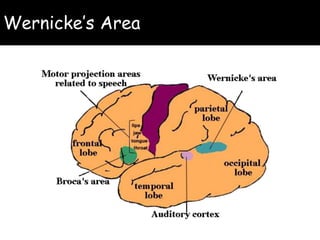
Wernicke’s Area
Discovery
• Wernicke (1874) observed that patients with
damage to the left temporal lobe had difficulty
with speech and understanding sentences
• Hypothesized that an area in the left temporal
lobe was responsible for speech processing
Location & Function
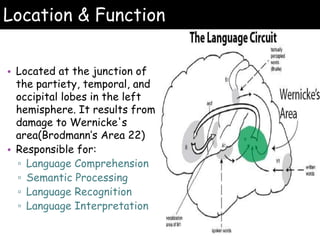
• Located at the junction of
the partiety, temporal, and
occipital lobes in the left
hemisphere. It results from
damage to Wernicke's
area(Brodmann’s Area 22)
• Responsible for:
▫ Language Comprehension
▫ Semantic Processing
▫ Language Recognition
▫ Language Interpretation
Site Of Lesion:-
• Wernicke's aphasia (sensory aphasia)
• Occurs with damage to posterior superior temporal lobe of language
dominant hemisphere.
Occlusion to posterior branch of middle cerebral artery
Speech contains paraphasias and neologisms.
Impaired auditory comprehension is dominant characteristic.
• If Wernicke's aphasia is severe
• -there may be jargon (strings of neologisms)
May produce "empty speech" - strings of real words that don't
contain any real meaning
May have circumlocution
Demonstrate press of speech (logorrhea)
• If Wernicke's aphasia is mild
• may be aware of errors
Rarely occurs with hemiplegia or paresis because Wernicke's is not
close to motor cortex.
May occur with visual deficits due to nearness to optic tract.
Symptoms
• A person with Wernicke’s aphasia will most likely:
• Reading is near impossible
• They do not understand what others say
• Poor comprehension of spoken and written language
• Speech is fluent, but has little or no meaning
• Difficulty repeating sentences accurately
• Speak in long, run-on sentences
• Speech tends to be at a fast rate, Include words that
aren't needed or difficult to understand
• Include words that are made-up
• Unaware of their own language errors and disorganized
speech patterns
• Articulation is normal
• Word finding problems are common
Evaluation
• Wernicke’s aphasia and damage to the Wernicke’s
area have been frequently correlated
• Studies treat Wernicke’s aphasia as a given and
expand upon
▫ Wernicke's aphasia and normal language processing: A
case study in cognitive neuropsychology.
▫ An On-Line Analysis of Syntactic Processing in Broca's
and Wernicke's Aphasia
▫ Recovery from Wernicke's aphasia: A positron emission
tomographic study
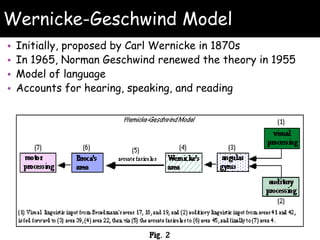
Wernicke-Geschwind Model
• Initially, proposed by Carl Wernicke in 1870s
• In 1965, Norman Geschwind renewed the theory in 1955
• Model of language
• Accounts for hearing, speaking, and reading
Process
Hearing
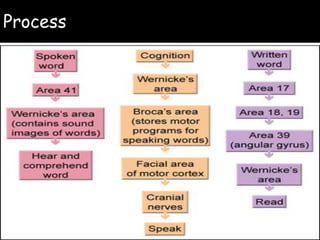
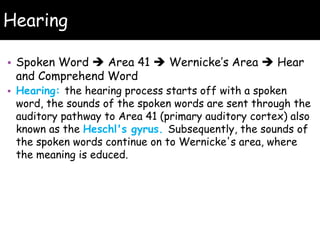
• Spoken Word  Area 41  Wernicke’s Area  Hear
and Comprehend Word
• Hearing: the hearing process starts off with a spoken
word, the sounds of the spoken words are sent through the
auditory pathway to Area 41 (primary auditory cortex) also
known as the Heschl's gyrus. Subsequently, the sounds of
the spoken words continue on to Wernicke's area, where
the meaning is educed.
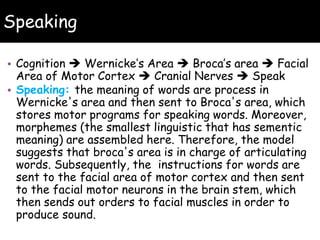
Speaking
• Cognition  Wernicke’s Area  Broca’s area  Facial
Area of Motor Cortex  Cranial Nerves  Speak
• Speaking: the meaning of words are process in
Wernicke's area and then sent to Broca's area, which
stores motor programs for speaking words. Moreover,
morphemes (the smallest linguistic that has sementic
meaning) are assembled here. Therefore, the model
suggests that broca's area is in charge of articulating
words. Subsequently, the instructions for words are
sent to the facial area of motor cortex and then sent
to the facial motor neurons in the brain stem, which
then sends out orders to facial muscles in order to
produce sound.
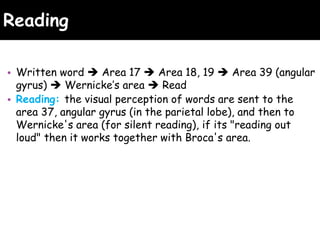
Reading
• Written word  Area 17  Area 18, 19  Area 39 (angular
gyrus)  Wernicke’s area  Read
• Reading: the visual perception of words are sent to the
area 37, angular gyrus (in the parietal lobe), and then to
Wernicke's area (for silent reading), if its "reading out
loud" then it works together with Broca's area.
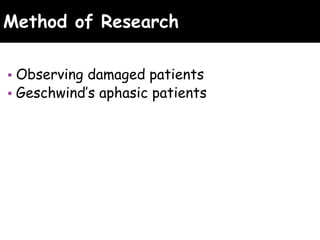
Method of Research
• Observing damaged patients
• Geschwind’s aphasic patients
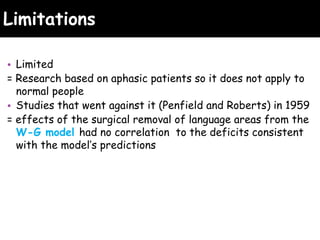
Limitations
• Limited
= Research based on aphasic patients so it does not apply to
normal people
• Studies that went against it (Penfield and Roberts) in 1959
= effects of the surgical removal of language areas from the
W-G model had no correlation to the deficits consistent
with the model’s predictions
Strengths
• Experiments that supported the model
= Hecaen and Angelergues (1964)
-- they came to the same conclusion with 215
patients suffering brain damage in the left-
hemisphere
= Ojemann (1983)
--- electrically stimulated W-G areas
Link to this Video
• This will enhance your understanding of the
model
• http://www.sagepub.com/garrettbb2study/ani
mations/9.23.htm
• http://auditoryneuroscience.com/wernicke_ap
hasia
How to Help Improve Communication at
Home
• Simplify language - use short sentences with basic
words
• Slow down the rate of your speech
• Use pauses between words
• Try to eliminate any distractions (like a television or
radio)
• Speak to the person as an adult
• Include the person in your conversations
• Try not to correct the person's speech
• Be patient - give plenty of time for responses
• Communication comes in many forms: drawing,
pointing, gesturing, and writing. Make use of whatever
might work
Providing Effective Treatment
Providing daily speech and language therapy is
essential for the progress. It require professional
drills and exercises to improve the ability to use
and understand language.
This will include exercises to improve:
• Auditory comprehension
• Word finding skills
• Knowledge of word meanings
• Thinking and reasoning skills
• Verbal expression
Through daily practice significant improvements
can be seen in speech, language, and comprehension
skills.
Auditory processing & Auditory
Comprehension
• This exercise involves presenting questions that
require to listen carefully, comprehend the
information, and respond accurately.
• Therapist will read a passage to the patient.
When finish, ask the patient one or more
questions about the information just read. This
activity challenges memory, understanding,
attention, and processing skills.
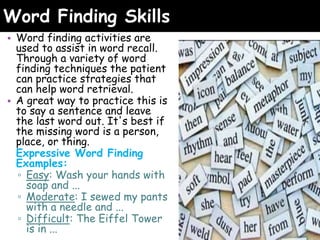
Word Finding Skills
• Word finding activities are
used to assist in word recall.
Through a variety of word
finding techniques the patient
can practice strategies that
can help word retrieval.
• A great way to practice this is
to say a sentence and leave
the last word out. It's best if
the missing word is a person,
place, or thing.
Expressive Word Finding
Examples:
▫ Easy: Wash your hands with
soap and ...
▫ Moderate: I sewed my pants
with a needle and ...
▫ Difficult: The Eiffel Tower
is in ...
Continue:-
Receptive vocabulary exercise:
provide three or four pictures of objects (cut out
pictures from newspapers and magazines) and then ask
patient to point to one of them.
• Word finding difficulty is a common deficit
associated with aphasia. Frequent practice of
expressive and receptive exercises will help improve
an individual's naming abilities.
Knowledge of word meanings:
Synonyms
• Listing words that have similar meanings is also a good
exercise to help increase word knowledge. However,
some expressive and receptive language exercises can
be very challenging. This is one of them.
• When creating a list of synonyms be careful not to
make them too difficult. It is recommended that your
list of synonyms be no more than six words.
• Remember - there are often more than one or two right
answers.
Synonym Examples:
▫ Easy: Another word that means the same as, warm
▫ Moderate: Another word that means the same as, under
▫ Difficult: Another word that means the same as, many
Thinking and reasoning skills:
Inferences
• This is a great activity for higher level thinking. It
requires a patient to "assume" what an answer might be
based on indirect information.
Examples:
• Easy: Ali ordered a burger and French fries.
Did he order breakfast or lunch?
Yes/No Questions
• Presenting questions that require a simple "yes" or
"no" answer is a great activity to stimulate auditory
processing or reasoning skills.
• Create a list of 8-10 questions and present them at
a normal speaking rate. Give patient enough time to
respond.
Yes/No Examples:
• Easy: Does glass break?
• Moderate: Are all cars the same size?
• Difficult: Is Lahore in the Punjab?
Verbal expression: Naming
Opposites
Create a list of ten words and then ask for the opposite of each
one.
• Examples to elicit expressive responses:
• What is the opposite of up?
Receptive exercise (which will include prepositions): present
objects and manipulate them to demonstrate different positions.
For example, to demonstrate the prepositions; in, on, and beside,
you can use a box and two spoons.
• First, place one spoon on the box and the other spoon beside the
box.
• Ask, "Which spoon is on the box?“
• Change the location of the spoons (in, out, on, off, beside,
behind, in front).
• You can also increase the difficulty of each question by
increasing the number of objects used
With a little creativity you can create a variety of expressive and
receptive language exercises using antonyms (opposites).
Functional Naming
In this activity asks the patient for the function of
an item.
Functional Naming Examples:
• A Painting - do you bend it or hang it?
• Categories:-
• This is a great activity to practice expressive and
receptive language exercises.
• You can approach this exercise in two ways:
• a) Give a list of words and provide the patient the
category they belong to.
• b) Provide a category and the patient to list items
that belong to it.
Categories
Expressive Category Examples:
• Easy: Apples, oranges, and pears belong to what
category?
• Moderate: Oak, pine, and maple belong to what
category?
• Difficult: Name three things that are round.
Receptive exercise:
• provide pictures of different foods and ask; "which
one is a fruit?"
• Or, show pictures of several containers and ask;
"which one holds garbage?"
Works Cited
• http://www.speech-therapy-on-
video.com/speechlanguagetherapy.html
• http://www.speech-therapy-on-
video.com/expressiveandreceptivelanguageexercises.ht
ml
• http://pages.slc.edu/~ebj/IM_97/Lecture10/L10.html
• http://everything2.com/title/Wernicke-
Geschwind+model
• Glassman
• Schacter, Gilbert, and Wegner
• Myers
Thank you…

Wernicke’s aphasia

  • 1.
  • 2.
    Contents • Introduction • Definition •Location & Function • Symptoms • Management • References
  • 3.
    What Is Wernicke’s/Receptive Aphasia? •A neurological language disorder that primarily affects a person's ability to comprehend spoken words. Poor Comprehension is ▫ Most difficulty is in understanding uncommon words as well as verb tense (brought, chosen, drawn) and prepositions (on, in, at, until). ▫ An inability to separate individual sounds and put them in the correct order to form meaningful words. • It is also characterized by the use of disordered sentences that have little or no meaning, including adding extra words, and using words that don't exist in our vocabulary.
  • 4.
  • 5.
    Discovery • Wernicke (1874)observed that patients with damage to the left temporal lobe had difficulty with speech and understanding sentences • Hypothesized that an area in the left temporal lobe was responsible for speech processing
  • 6.
    Location & Function •Located at the junction of the partiety, temporal, and occipital lobes in the left hemisphere. It results from damage to Wernicke's area(Brodmann’s Area 22) • Responsible for: ▫ Language Comprehension ▫ Semantic Processing ▫ Language Recognition ▫ Language Interpretation
  • 7.
    Site Of Lesion:- •Wernicke's aphasia (sensory aphasia) • Occurs with damage to posterior superior temporal lobe of language dominant hemisphere. Occlusion to posterior branch of middle cerebral artery Speech contains paraphasias and neologisms. Impaired auditory comprehension is dominant characteristic. • If Wernicke's aphasia is severe • -there may be jargon (strings of neologisms) May produce "empty speech" - strings of real words that don't contain any real meaning May have circumlocution Demonstrate press of speech (logorrhea) • If Wernicke's aphasia is mild • may be aware of errors Rarely occurs with hemiplegia or paresis because Wernicke's is not close to motor cortex. May occur with visual deficits due to nearness to optic tract.
  • 8.
    Symptoms • A personwith Wernicke’s aphasia will most likely: • Reading is near impossible • They do not understand what others say • Poor comprehension of spoken and written language • Speech is fluent, but has little or no meaning • Difficulty repeating sentences accurately • Speak in long, run-on sentences • Speech tends to be at a fast rate, Include words that aren't needed or difficult to understand • Include words that are made-up • Unaware of their own language errors and disorganized speech patterns • Articulation is normal • Word finding problems are common
  • 9.
    Evaluation • Wernicke’s aphasiaand damage to the Wernicke’s area have been frequently correlated • Studies treat Wernicke’s aphasia as a given and expand upon ▫ Wernicke's aphasia and normal language processing: A case study in cognitive neuropsychology. ▫ An On-Line Analysis of Syntactic Processing in Broca's and Wernicke's Aphasia ▫ Recovery from Wernicke's aphasia: A positron emission tomographic study
  • 10.
    Wernicke-Geschwind Model • Initially,proposed by Carl Wernicke in 1870s • In 1965, Norman Geschwind renewed the theory in 1955 • Model of language • Accounts for hearing, speaking, and reading
  • 11.
  • 12.
    Hearing • Spoken Word Area 41  Wernicke’s Area  Hear and Comprehend Word • Hearing: the hearing process starts off with a spoken word, the sounds of the spoken words are sent through the auditory pathway to Area 41 (primary auditory cortex) also known as the Heschl's gyrus. Subsequently, the sounds of the spoken words continue on to Wernicke's area, where the meaning is educed.
  • 13.
    Speaking • Cognition Wernicke’s Area  Broca’s area  Facial Area of Motor Cortex  Cranial Nerves  Speak • Speaking: the meaning of words are process in Wernicke's area and then sent to Broca's area, which stores motor programs for speaking words. Moreover, morphemes (the smallest linguistic that has sementic meaning) are assembled here. Therefore, the model suggests that broca's area is in charge of articulating words. Subsequently, the instructions for words are sent to the facial area of motor cortex and then sent to the facial motor neurons in the brain stem, which then sends out orders to facial muscles in order to produce sound.
  • 14.
    Reading • Written word Area 17  Area 18, 19  Area 39 (angular gyrus)  Wernicke’s area  Read • Reading: the visual perception of words are sent to the area 37, angular gyrus (in the parietal lobe), and then to Wernicke's area (for silent reading), if its "reading out loud" then it works together with Broca's area.
  • 15.
    Method of Research •Observing damaged patients • Geschwind’s aphasic patients
  • 16.
    Limitations • Limited = Researchbased on aphasic patients so it does not apply to normal people • Studies that went against it (Penfield and Roberts) in 1959 = effects of the surgical removal of language areas from the W-G model had no correlation to the deficits consistent with the model’s predictions
  • 17.
    Strengths • Experiments thatsupported the model = Hecaen and Angelergues (1964) -- they came to the same conclusion with 215 patients suffering brain damage in the left- hemisphere = Ojemann (1983) --- electrically stimulated W-G areas
  • 18.
    Link to thisVideo • This will enhance your understanding of the model • http://www.sagepub.com/garrettbb2study/ani mations/9.23.htm • http://auditoryneuroscience.com/wernicke_ap hasia
  • 19.
    How to HelpImprove Communication at Home • Simplify language - use short sentences with basic words • Slow down the rate of your speech • Use pauses between words • Try to eliminate any distractions (like a television or radio) • Speak to the person as an adult • Include the person in your conversations • Try not to correct the person's speech • Be patient - give plenty of time for responses • Communication comes in many forms: drawing, pointing, gesturing, and writing. Make use of whatever might work
  • 20.
    Providing Effective Treatment Providingdaily speech and language therapy is essential for the progress. It require professional drills and exercises to improve the ability to use and understand language. This will include exercises to improve: • Auditory comprehension • Word finding skills • Knowledge of word meanings • Thinking and reasoning skills • Verbal expression Through daily practice significant improvements can be seen in speech, language, and comprehension skills.
  • 21.
    Auditory processing &Auditory Comprehension • This exercise involves presenting questions that require to listen carefully, comprehend the information, and respond accurately. • Therapist will read a passage to the patient. When finish, ask the patient one or more questions about the information just read. This activity challenges memory, understanding, attention, and processing skills.
  • 22.
    Word Finding Skills •Word finding activities are used to assist in word recall. Through a variety of word finding techniques the patient can practice strategies that can help word retrieval. • A great way to practice this is to say a sentence and leave the last word out. It's best if the missing word is a person, place, or thing. Expressive Word Finding Examples: ▫ Easy: Wash your hands with soap and ... ▫ Moderate: I sewed my pants with a needle and ... ▫ Difficult: The Eiffel Tower is in ...
  • 23.
    Continue:- Receptive vocabulary exercise: providethree or four pictures of objects (cut out pictures from newspapers and magazines) and then ask patient to point to one of them. • Word finding difficulty is a common deficit associated with aphasia. Frequent practice of expressive and receptive exercises will help improve an individual's naming abilities.
  • 24.
    Knowledge of wordmeanings: Synonyms • Listing words that have similar meanings is also a good exercise to help increase word knowledge. However, some expressive and receptive language exercises can be very challenging. This is one of them. • When creating a list of synonyms be careful not to make them too difficult. It is recommended that your list of synonyms be no more than six words. • Remember - there are often more than one or two right answers. Synonym Examples: ▫ Easy: Another word that means the same as, warm ▫ Moderate: Another word that means the same as, under ▫ Difficult: Another word that means the same as, many
  • 25.
    Thinking and reasoningskills: Inferences • This is a great activity for higher level thinking. It requires a patient to "assume" what an answer might be based on indirect information. Examples: • Easy: Ali ordered a burger and French fries. Did he order breakfast or lunch?
  • 26.
    Yes/No Questions • Presentingquestions that require a simple "yes" or "no" answer is a great activity to stimulate auditory processing or reasoning skills. • Create a list of 8-10 questions and present them at a normal speaking rate. Give patient enough time to respond. Yes/No Examples: • Easy: Does glass break? • Moderate: Are all cars the same size? • Difficult: Is Lahore in the Punjab?
  • 27.
    Verbal expression: Naming Opposites Createa list of ten words and then ask for the opposite of each one. • Examples to elicit expressive responses: • What is the opposite of up? Receptive exercise (which will include prepositions): present objects and manipulate them to demonstrate different positions. For example, to demonstrate the prepositions; in, on, and beside, you can use a box and two spoons. • First, place one spoon on the box and the other spoon beside the box. • Ask, "Which spoon is on the box?“ • Change the location of the spoons (in, out, on, off, beside, behind, in front). • You can also increase the difficulty of each question by increasing the number of objects used With a little creativity you can create a variety of expressive and receptive language exercises using antonyms (opposites).
  • 28.
    Functional Naming In thisactivity asks the patient for the function of an item. Functional Naming Examples: • A Painting - do you bend it or hang it? • Categories:- • This is a great activity to practice expressive and receptive language exercises. • You can approach this exercise in two ways: • a) Give a list of words and provide the patient the category they belong to. • b) Provide a category and the patient to list items that belong to it.
  • 29.
    Categories Expressive Category Examples: •Easy: Apples, oranges, and pears belong to what category? • Moderate: Oak, pine, and maple belong to what category? • Difficult: Name three things that are round. Receptive exercise: • provide pictures of different foods and ask; "which one is a fruit?" • Or, show pictures of several containers and ask; "which one holds garbage?"
  • 30.
    Works Cited • http://www.speech-therapy-on- video.com/speechlanguagetherapy.html •http://www.speech-therapy-on- video.com/expressiveandreceptivelanguageexercises.ht ml • http://pages.slc.edu/~ebj/IM_97/Lecture10/L10.html • http://everything2.com/title/Wernicke- Geschwind+model • Glassman • Schacter, Gilbert, and Wegner • Myers
  • 31.