
SPEECH LANGUAGE PATHOLOGY & CLASSIFICATION OF APHASIAHelloDr. S. Aswini Kumar. MDProfessor of MedicineMedical College HospitalThiruvananthapuram
Definitions:Speech is a highly evolved function of the cerebral cortexSpeech is the human faculty by which thought processes are symbolically expressedSpeech is the vocalization form of human communicationIt is based upon the syntactic combination of lexicals and names that are drawn from very large vocabularies (usually >10,000 different words)Each spoken word is created out of the phonetic combination of a limited set of vowel and consonant speech sound units
Components of SpeechSpeech is the mechanical function of one’s ability to communicate in oral languageIt includesLanguage productionPhonation and Articulation
LanguageLanguage is the symbolization of ideasIst is the ability to convert thought in to comprehensive wordsIt consists of five parametersSpeakingHearingRepeatingReadingWriting
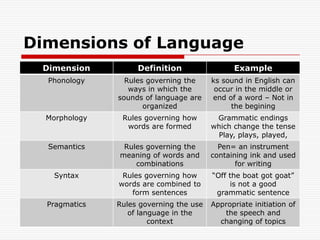
Dimensions of Language
Speech and Hemispherical DominanceSpeech is the function of cerebral hemisphereIt is undertaken by the dominant hemisphere9 out of 10 human have right handedness90% of human also have left hemispherical dominanceRest 10% have left handedness7 out of these 10% have left hemispherical dominance3 out of the 10% have right hemispherical dominanceThus 97% of human have left hemispherical dominanceOnly 3% have right hemispherical dominanceIt also means speech is a function of Left hemisphere in 97 out of 100 and right hemispere in only 3%
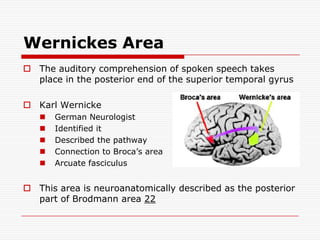
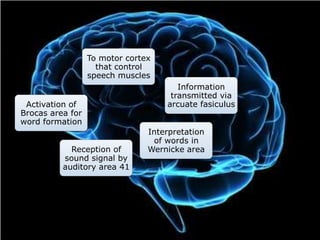
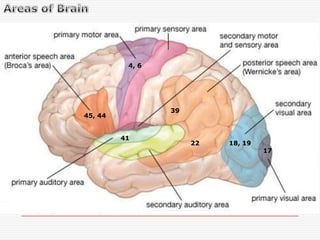
Wernickes AreaThe auditory comprehension of spoken speech takes place in the posterior end of the superior temporal gyrusKarl WernickeGerman NeurologistIdentified it Described the pathwayConnection to Broca’s areaArcuate fasciculusThis area is neuroanatomically described as the posterior part of Brodmann area 22
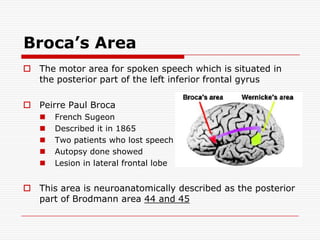
Broca’s AreaThe motor area for spoken speech which is situated in the posterior part of the left inferior frontal gyrusPeirre Paul BrocaFrench SugeonDescribed it in 1865Two patients who lost speechAutopsy done showedLesion in lateral frontal lobeThis area is neuroanatomically described as the posterior part of Brodmann area 44 and 45
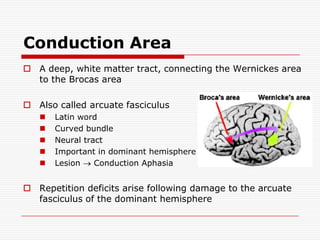
Conduction AreaAdeep, white matter tract, connecting the Wernickes area to the Brocas areaAlso called arcuate fasciculusLatin wordCurved bundleNeural tractImportant in dominant hemisphereLesion  Conduction AphasiaRepetition deficits arise following damage to the arcuate fasciculus of the dominant hemisphere
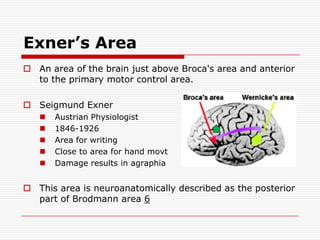
Exner’s AreaAn area of the brain just above Broca's area and anterior to the primary motor control area.Seigmund Exner Austrian Physiologist1846-1926Area for writingClose to area for hand movtDamage results in agraphiaThis area is neuroanatomically described as the posterior part of Brodmann area 6
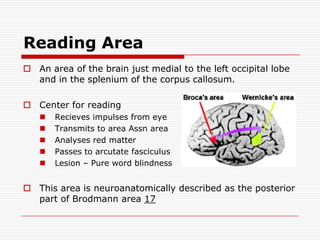
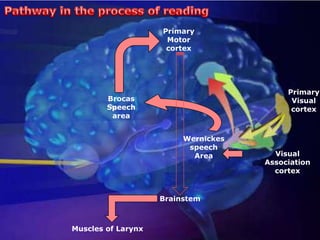
Reading AreaAn area of the brain just medial to the left occipital lobe and in the spleniumof the corpus callosum.Center for reading Recieves impulses from eyeTransmits to area Assn areaAnalyses red matterPasses to arcutate fasciculusLesion – Pure word blindnessThis area is neuroanatomically described as the posterior part of Brodmann area 17
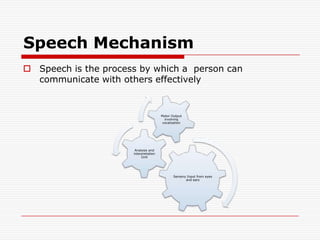
Speech MechanismSpeech is the process by which a  person can communicate with others effectively
Information  transmitted via  arcuate fasiculusActivation of Brocas area for word formationTo motor cortex that control speech muscles
Areas of Brain4, 63945, 44412218, 1917
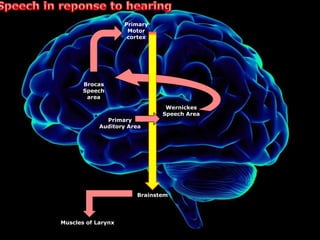
Speech in reponse to hearingPrimary Motor cortexArcuate fasciculusBrocas Speech areaWernickes Speech AreaPrimary Auditory AreaBrainstemMuscles of Larynx
Pathway in the process of readingPrimary Motor cortexPrimary Visual cortexBrocas Speech areaWernickes speech AreaVisualAssociation cortexBrainstemMuscles of Larynx
AphasiaPart II
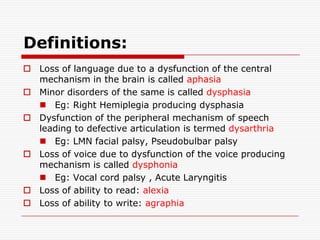
Definitions:Loss of language due to a dysfunction of the central mechanism in the brain is called aphasiaMinor disorders of the same is called dysphasiaEg: Right Hemiplegia producing dysphasiaDysfunction of the peripheral mechanism of speech leading to defective articulation is termed dysarthriaEg: LMN facial palsy, Pseudobulbar palsy Loss of voice due to dysfunction of the voice producing mechanism is called dysphoniaEg: Vocal cord palsy , Acute LaryngitisLoss of ability to read: alexiaLoss of ability to write: agraphia
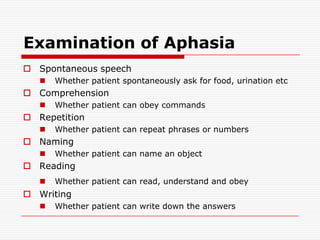
Examination of AphasiaSpontaneous speechWhether patient spontaneously ask for food, urination etcComprehensionWhether patient can obey commandsRepetitionWhether patient can repeat phrases or numbersNamingWhether patient can name an objectReadingWhether patient can read, understand and obeyWritingWhether patient can write down the answers
Testing Spontaneous speechFluencyWhether speech is fluent without hesitationsUninterrupted by searching for a forgotten wordEffort taken for speechSee whether the patient has effortless/effortful speechVocabulary See whether there is any word-finding difficultyWhether patient stammers and stumblesAbility to speak in full sentencesOr patient is able to talk only in phrasesGrammer Whether the grammer is correct or not
Testing ComprehensionWhether patient can hear and understand speech?Tested by asking the patient to obey a commandAsk the patient to show the tongue, close eyes, lift a limbFluency is preserved or notSpeech whetherfluent without hesitations?Is it incessant, rapid and uninterrupted? Use of paraphasiasUse of a descriptive phrase instead of a forgotten wordUse of neologismsInvented word and nonsense wordsJargon aphasiaExtreme example of the above speech devoid of meanings
Testing RepetitionPatient is asked to repeat a simple sentenceIt has to be clearly stated by the examinerEg: Today is Wednesday, the August 17th, 2009See whether the patient is able to repeat what you sayRemember never to shout at a aphasic patientHearing is usually normal in these patientsIn a patient with left frontal lesionThey can repeat simple words and phrasesIn a patient with posterior lesions in the angular gyrusThey cannot repeat what the examiner saysThis is the characteristic feature of conduction aphasiaThis function is preserved in Trans-cortical aphasia
Testing for NamingPatient is shown an object and asked to name itA commonly used object should be shownEg: Pen or match boxSee whether the patient is able to name the objectPatient may be handed over the objectOr asked to demonstrate the use of the objectIn Anomic aphasia or nominal aphasiaPatient is unable to name it, but use it evenAuditory comprehension, repetition, reading and writingThse are usually preserved in such a patientMemory testing other wise will be normalThis function is preserved in Trans-cortical aphasia
Other test doneAsk the patient to read from a commandSee whether he answers a question writtenSee whether he obeys commands, written downNow ask to read aloudAsk the patient to write downThe name and addressDraw a picture of a clock faceAnswer to a question put forwardAsk the patient to calculateSubtract 7 from hundredAsk for 4+4, then more complicated
Aphasia syndromes
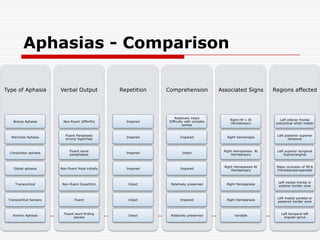
Broca’s AphasiaNon-fluentTelegraphic speechReduced verbal contentPhrase length – generally less then four wordsAgrammatical sentences (or frequent errors)Mostly content words (nouns and verbs)Absence of functional words ( prepositions & conjunctions)The matter is conveyed any wayFunctional comprehension is presentBut trouble following complex grammatical statementsReading loud is not possible; but can read and obeyMCA territory stroke – Left frontal lobe
Wernicke’s AphasiaFluentIncreased verbal contentPara-grammatism – speech runningPhrase length – generally greater than five wordsGrammatical sentences (or close to normal)Paraphasic errors (literal or verbal)Literal – sound substitution with errors (winging ringing)Symantic – word substitution ( sister for mother)Neologisms (made up words) Logorrhea – Inability to stop speakingSeverely impared auditory comprehensionMCA territory stroke – Left superior temporal lobe
Conduction AphasiaRelatively uncommonSpontaneous speech is fluentConsiderable word finding difficultyPreserved auditory comprehensionSignifican difficulty with repetitionLiteral paraphasiaSelf correctionNumerous pauses Filled pauses – Aaaaa AaaaaReading deficit - variableWriting deficit – variableLesion:  Left superior temporal area, supramarginal gyrus
Nominal AphasiaPrimary deficit – word finding and namingSpeech output is fluent with numerous pausesPauses may be filled with circumlocutionsDescribing the function of an objectBut the name cannot be retrievedAuditory comprehension is intactReading and writing are also intactLast localized of all aphasiasFocal damage to left temoral and parietalUsually residual of good recovery from other aphasiasAlso indicates good prognosis if seen in acute stage
Global AphasiaSevere impairment in all modalitiesSpeaking, listening, reading and writingSeverely impaired auditory comprehensionVery limited speech outputOnly few understandable utterancesSome areas of spared speech functionUtilized in communicationBrain damage resulting is massiveFronto-tempero-parietal lesionComplete occlusion of MCARarely without hemiplegia
Trans-cortical Motor AphasiaSimilarities to motor aphasiaBut with intact repetitionLesion in the border zoneSuperior or anterior to Broca’s areaNon-fluentLimited speech outputAuditory comprehension – goodReading comprehension – goodSyntax not as bad as in Broca’s AphasiaOcclusion of Anterior Cerebral Artery
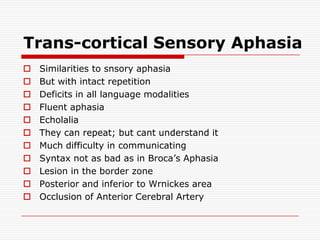
Trans-cortical Sensory AphasiaSimilarities to snsory aphasiaBut with intact repetitionDeficits in all language modalitiesFluent aphasiaEcholaliaThey can repeat; but cant understand itMuch difficulty in communicatingSyntax not as bad as in Broca’s AphasiaLesion in the border zonePosterior and inferior to Wrnickes areaOcclusion of Anterior Cerebral Artery
Aphasias - Comparison
Related disordersPart III
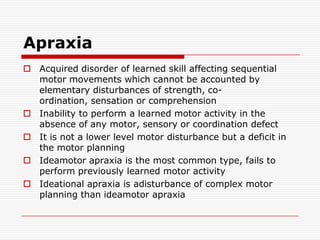
ApraxiaAcquired disorder of learned skill affecting sequential motor movements which cannot be accounted by elementary disturbances of strength, co-ordination, sensation or comprehensionInability to perform a learned motor activity in the absence of any motor, sensory or coordination defectIt is not a lower level motor disturbance but a deficit in the motor planningIdeamotor apraxia is the most common type, fails to perform previously learned motor activityIdeational apraxia is adisturbance of complex motor planning than ideamotor apraxia
AgnosiaAn acquired disorder of recognition in some sensory modality ie visual, auditory or tactileAgnosia can be specific for a particular class within the modality of sensation – ObjectsPicturesFacesColorsIt is to important distinguish agnosia from agnosia, just as in case of apraxiaPatietns with auditory agnosia hear adoor bell ring; but does not recognise it meaning
Thank You

Speech, Language and Aphasia

  • 1.
    SPEECH LANGUAGE PATHOLOGY& CLASSIFICATION OF APHASIAHelloDr. S. Aswini Kumar. MDProfessor of MedicineMedical College HospitalThiruvananthapuram
  • 2.
    Definitions:Speech is ahighly evolved function of the cerebral cortexSpeech is the human faculty by which thought processes are symbolically expressedSpeech is the vocalization form of human communicationIt is based upon the syntactic combination of lexicals and names that are drawn from very large vocabularies (usually >10,000 different words)Each spoken word is created out of the phonetic combination of a limited set of vowel and consonant speech sound units
  • 3.
    Components of SpeechSpeechis the mechanical function of one’s ability to communicate in oral languageIt includesLanguage productionPhonation and Articulation
  • 4.
    LanguageLanguage is thesymbolization of ideasIst is the ability to convert thought in to comprehensive wordsIt consists of five parametersSpeakingHearingRepeatingReadingWriting
  • 5.
  • 6.
    Speech and HemisphericalDominanceSpeech is the function of cerebral hemisphereIt is undertaken by the dominant hemisphere9 out of 10 human have right handedness90% of human also have left hemispherical dominanceRest 10% have left handedness7 out of these 10% have left hemispherical dominance3 out of the 10% have right hemispherical dominanceThus 97% of human have left hemispherical dominanceOnly 3% have right hemispherical dominanceIt also means speech is a function of Left hemisphere in 97 out of 100 and right hemispere in only 3%
  • 7.
    Wernickes AreaThe auditorycomprehension of spoken speech takes place in the posterior end of the superior temporal gyrusKarl WernickeGerman NeurologistIdentified it Described the pathwayConnection to Broca’s areaArcuate fasciculusThis area is neuroanatomically described as the posterior part of Brodmann area 22
  • 8.
    Broca’s AreaThe motorarea for spoken speech which is situated in the posterior part of the left inferior frontal gyrusPeirre Paul BrocaFrench SugeonDescribed it in 1865Two patients who lost speechAutopsy done showedLesion in lateral frontal lobeThis area is neuroanatomically described as the posterior part of Brodmann area 44 and 45
  • 9.
    Conduction AreaAdeep, whitematter tract, connecting the Wernickes area to the Brocas areaAlso called arcuate fasciculusLatin wordCurved bundleNeural tractImportant in dominant hemisphereLesion  Conduction AphasiaRepetition deficits arise following damage to the arcuate fasciculus of the dominant hemisphere
  • 10.
    Exner’s AreaAn areaof the brain just above Broca's area and anterior to the primary motor control area.Seigmund Exner Austrian Physiologist1846-1926Area for writingClose to area for hand movtDamage results in agraphiaThis area is neuroanatomically described as the posterior part of Brodmann area 6
  • 11.
    Reading AreaAn areaof the brain just medial to the left occipital lobe and in the spleniumof the corpus callosum.Center for reading Recieves impulses from eyeTransmits to area Assn areaAnalyses red matterPasses to arcutate fasciculusLesion – Pure word blindnessThis area is neuroanatomically described as the posterior part of Brodmann area 17
  • 12.
    Speech MechanismSpeech isthe process by which a person can communicate with others effectively
  • 13.
    Information transmittedvia arcuate fasiculusActivation of Brocas area for word formationTo motor cortex that control speech muscles
  • 14.
    Areas of Brain4,63945, 44412218, 1917
  • 15.
    Speech in reponseto hearingPrimary Motor cortexArcuate fasciculusBrocas Speech areaWernickes Speech AreaPrimary Auditory AreaBrainstemMuscles of Larynx
  • 16.
    Pathway in theprocess of readingPrimary Motor cortexPrimary Visual cortexBrocas Speech areaWernickes speech AreaVisualAssociation cortexBrainstemMuscles of Larynx
  • 17.
  • 18.
    Definitions:Loss of languagedue to a dysfunction of the central mechanism in the brain is called aphasiaMinor disorders of the same is called dysphasiaEg: Right Hemiplegia producing dysphasiaDysfunction of the peripheral mechanism of speech leading to defective articulation is termed dysarthriaEg: LMN facial palsy, Pseudobulbar palsy Loss of voice due to dysfunction of the voice producing mechanism is called dysphoniaEg: Vocal cord palsy , Acute LaryngitisLoss of ability to read: alexiaLoss of ability to write: agraphia
  • 19.
    Examination of AphasiaSpontaneousspeechWhether patient spontaneously ask for food, urination etcComprehensionWhether patient can obey commandsRepetitionWhether patient can repeat phrases or numbersNamingWhether patient can name an objectReadingWhether patient can read, understand and obeyWritingWhether patient can write down the answers
  • 20.
    Testing Spontaneous speechFluencyWhetherspeech is fluent without hesitationsUninterrupted by searching for a forgotten wordEffort taken for speechSee whether the patient has effortless/effortful speechVocabulary See whether there is any word-finding difficultyWhether patient stammers and stumblesAbility to speak in full sentencesOr patient is able to talk only in phrasesGrammer Whether the grammer is correct or not
  • 21.
    Testing ComprehensionWhether patientcan hear and understand speech?Tested by asking the patient to obey a commandAsk the patient to show the tongue, close eyes, lift a limbFluency is preserved or notSpeech whetherfluent without hesitations?Is it incessant, rapid and uninterrupted? Use of paraphasiasUse of a descriptive phrase instead of a forgotten wordUse of neologismsInvented word and nonsense wordsJargon aphasiaExtreme example of the above speech devoid of meanings
  • 22.
    Testing RepetitionPatient isasked to repeat a simple sentenceIt has to be clearly stated by the examinerEg: Today is Wednesday, the August 17th, 2009See whether the patient is able to repeat what you sayRemember never to shout at a aphasic patientHearing is usually normal in these patientsIn a patient with left frontal lesionThey can repeat simple words and phrasesIn a patient with posterior lesions in the angular gyrusThey cannot repeat what the examiner saysThis is the characteristic feature of conduction aphasiaThis function is preserved in Trans-cortical aphasia
  • 23.
    Testing for NamingPatientis shown an object and asked to name itA commonly used object should be shownEg: Pen or match boxSee whether the patient is able to name the objectPatient may be handed over the objectOr asked to demonstrate the use of the objectIn Anomic aphasia or nominal aphasiaPatient is unable to name it, but use it evenAuditory comprehension, repetition, reading and writingThse are usually preserved in such a patientMemory testing other wise will be normalThis function is preserved in Trans-cortical aphasia
  • 24.
    Other test doneAskthe patient to read from a commandSee whether he answers a question writtenSee whether he obeys commands, written downNow ask to read aloudAsk the patient to write downThe name and addressDraw a picture of a clock faceAnswer to a question put forwardAsk the patient to calculateSubtract 7 from hundredAsk for 4+4, then more complicated
  • 25.
  • 26.
    Broca’s AphasiaNon-fluentTelegraphic speechReducedverbal contentPhrase length – generally less then four wordsAgrammatical sentences (or frequent errors)Mostly content words (nouns and verbs)Absence of functional words ( prepositions & conjunctions)The matter is conveyed any wayFunctional comprehension is presentBut trouble following complex grammatical statementsReading loud is not possible; but can read and obeyMCA territory stroke – Left frontal lobe
  • 27.
    Wernicke’s AphasiaFluentIncreased verbalcontentPara-grammatism – speech runningPhrase length – generally greater than five wordsGrammatical sentences (or close to normal)Paraphasic errors (literal or verbal)Literal – sound substitution with errors (winging ringing)Symantic – word substitution ( sister for mother)Neologisms (made up words) Logorrhea – Inability to stop speakingSeverely impared auditory comprehensionMCA territory stroke – Left superior temporal lobe
  • 28.
    Conduction AphasiaRelatively uncommonSpontaneousspeech is fluentConsiderable word finding difficultyPreserved auditory comprehensionSignifican difficulty with repetitionLiteral paraphasiaSelf correctionNumerous pauses Filled pauses – Aaaaa AaaaaReading deficit - variableWriting deficit – variableLesion: Left superior temporal area, supramarginal gyrus
  • 29.
    Nominal AphasiaPrimary deficit– word finding and namingSpeech output is fluent with numerous pausesPauses may be filled with circumlocutionsDescribing the function of an objectBut the name cannot be retrievedAuditory comprehension is intactReading and writing are also intactLast localized of all aphasiasFocal damage to left temoral and parietalUsually residual of good recovery from other aphasiasAlso indicates good prognosis if seen in acute stage
  • 30.
    Global AphasiaSevere impairmentin all modalitiesSpeaking, listening, reading and writingSeverely impaired auditory comprehensionVery limited speech outputOnly few understandable utterancesSome areas of spared speech functionUtilized in communicationBrain damage resulting is massiveFronto-tempero-parietal lesionComplete occlusion of MCARarely without hemiplegia
  • 31.
    Trans-cortical Motor AphasiaSimilaritiesto motor aphasiaBut with intact repetitionLesion in the border zoneSuperior or anterior to Broca’s areaNon-fluentLimited speech outputAuditory comprehension – goodReading comprehension – goodSyntax not as bad as in Broca’s AphasiaOcclusion of Anterior Cerebral Artery
  • 32.
    Trans-cortical Sensory AphasiaSimilaritiesto snsory aphasiaBut with intact repetitionDeficits in all language modalitiesFluent aphasiaEcholaliaThey can repeat; but cant understand itMuch difficulty in communicatingSyntax not as bad as in Broca’s AphasiaLesion in the border zonePosterior and inferior to Wrnickes areaOcclusion of Anterior Cerebral Artery
  • 33.
  • 34.
  • 35.
    ApraxiaAcquired disorder oflearned skill affecting sequential motor movements which cannot be accounted by elementary disturbances of strength, co-ordination, sensation or comprehensionInability to perform a learned motor activity in the absence of any motor, sensory or coordination defectIt is not a lower level motor disturbance but a deficit in the motor planningIdeamotor apraxia is the most common type, fails to perform previously learned motor activityIdeational apraxia is adisturbance of complex motor planning than ideamotor apraxia
  • 36.
    AgnosiaAn acquired disorderof recognition in some sensory modality ie visual, auditory or tactileAgnosia can be specific for a particular class within the modality of sensation – ObjectsPicturesFacesColorsIt is to important distinguish agnosia from agnosia, just as in case of apraxiaPatietns with auditory agnosia hear adoor bell ring; but does not recognise it meaning
  • 37.